Moderate
Assorted Ram Cichlid (Mikrogeophagus ramirezi)
27–30°C · pH 5.5–7 · 60L
From £5.94Some sizes on sale

Domestic short-bodied Balloon Ram (Mikrogeophagus ramirezi), supplied as one unsexed fish in 2.5-3 cm or supplier-graded XL. Best for a mature, stable warm aquarium; gallery images are representative.
Adult size is the maximum length this species reaches at full maturity (scientific sources). The livestock you receive will be younger and smaller — pick a size above for the actual shipping size. Product-photo provenance and any image-specific limitations are stated on the listing.
Mikrogeophagus ramirezi
Save when buying multiple fish. Each quantity is one fish; sex and pair formation are not guaranteed unless the selected variant explicitly states them.
Domestic short-bodied Balloon Ram (Mikrogeophagus ramirezi), supplied as one unsexed fish in 2.5-3 cm or supplier-graded XL. Best for a mature, stable warm aquarium; gallery images are representative.
Adult size is the maximum length this species reaches at full maturity (scientific sources). The livestock you receive will be younger and smaller — pick a size above for the actual shipping size. Product-photo provenance and any image-specific limitations are stated on the listing.
Cichlids are a family of roughly 1,800 accepted species, not one care type. Before buying, identify the exact species and source, then compare adult measurement, usable tank dimensions, social system, territory, tested water, diet and an exit plan. No family-wide minimum tank, water range or tank-mate list is safe.
Maintain these water conditions for optimal health and vibrant colors
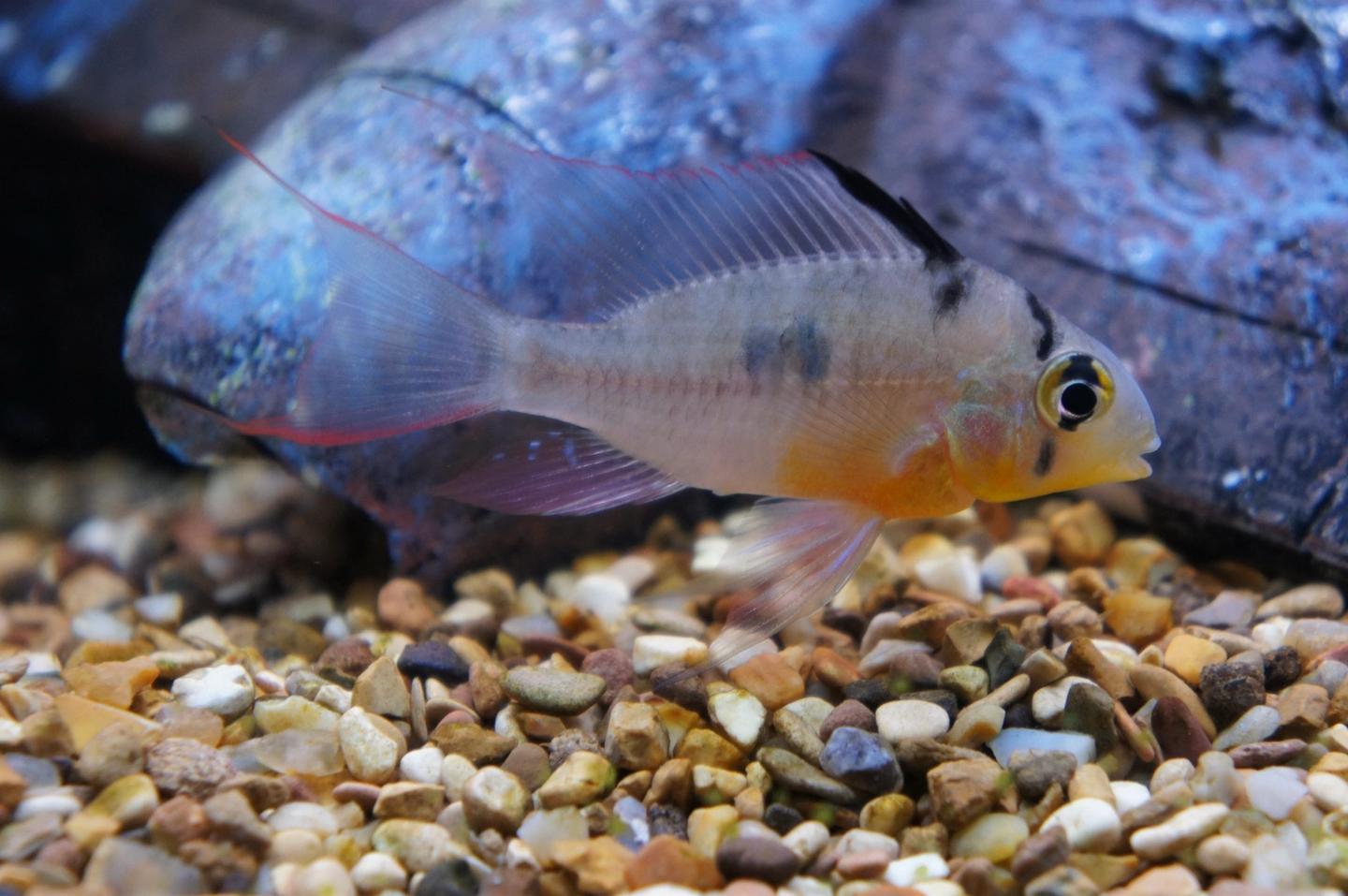
The Balloon Ram is a domestic, short-bodied form of the ram cichlid, Mikrogeophagus ramirezi. This Balloon Ram cichlid has the attentive behaviour and blue, black, gold and red patterning associated with rams, combined with a deeper, more compact outline. It is a small fish, but it is not a casual choice for a new or unstable aquarium: warm, clean water, gentle feeding and carefully matched companions matter far more than its modest adult size suggests.
This listing is for one unsexed fish per selected quantity. The current size choices are 2.5-3 cm and XL. XL is the relative grade; an exact centimetre range has not been supplied for that option. The gallery is representative rather than a photograph of the exact individual that will be dispatched, so colour, markings, body proportions and sex can vary naturally from fish to fish.
For search and scientific clarity, the accepted name used on this page is Mikrogeophagus ramirezi. The older trade name Papiliochromis ramirezi, which appears in some trade catalogues and older aquarium literature, is a synonym rather than a different species. This is the balloon-bodied domestic form, not a separate wild species and not the same sale item as a standard-bodied German Blue Ram or an Electric Blue Ram.
Each quantity added to the basket represents one Balloon Ram. Selecting two means two fish; it does not promise a male-and-female pair, a bonded pair or any particular sex ratio. Young rams can be difficult to sex reliably, and even adults should not be sold as compatible merely because one appears male and another female. If you hope to establish a pair, plan enough space and visual separation to manage rejection or territorial behaviour.
| Listing detail | What it means | What it does not mean |
|---|---|---|
| 2.5-3 cm | The supplier's stated dispatch-size band for the standard option | Not the final adult size |
| XL | A larger supplier grade | No exact centimetre promise is available for this grade |
| Quantity 1 | One fish | Not a pair or sexed fish |
| Representative gallery | A visual guide to the balloon form and possible colour pattern | Not the exact animal, guaranteed sex or guaranteed colour intensity |
| Live-animal order | Eligible orders are covered by our current Live Arrival Guarantee | Not a promise that every postcode or dispatch date is eligible |
Check the selected option, live price and stock status beside the add-to-basket control before ordering. Those Shopify-backed fields are the current commercial record and may change independently of the care guide. For dispatch days, postcode limits and what to do when a livestock parcel arrives, read the live-fish delivery information. Eligible first-time customers can also use WELCOME10 for 10% off, subject to the current checkout terms.
FishBase and GBIF both recognise Mikrogeophagus ramirezi as the accepted name. GBIF lists Papiliochromis ramirezi as a synonym, which explains why both names still appear in the trade. Keeping the accepted name prominent helps aquarists compare reliable care information without mistaking an old genus name for a separate fish.
The parent species is native to the Orinoco basin's llanos in Venezuela and Colombia. FishBase describes it as a freshwater, benthopelagic fish, meaning it is closely associated with the lower part of the water column. Wild rams occur in very warm South American waters, but the rounded balloon body seen in this listing is a selectively maintained aquarium form. It should not be presented as a wild body shape or as evidence that the individual was collected from the Orinoco.
The supplier reports a grown size of about 5 cm. FishBase records 4.2 cm standard length for the species; standard length stops at the base of the tail, so it is not directly interchangeable with a shop's approximate total-length figure. The useful planning conclusion is that this remains a small cichlid, while still needing a meaningful footprint, stable water volume and room to hold a territory.
| Identity point | Evidence-led interpretation |
|---|---|
| Accepted name | Mikrogeophagus ramirezi |
| Older trade synonym | Papiliochromis ramirezi |
| Natural range | Parent species: Orinoco basin llanos of Venezuela and Colombia |
| Body form | Domestic short-bodied balloon form, not a separate wild species |
| Length references | Supplier: about 5 cm grown; FishBase: 4.2 cm standard length for the species |
| Conservation reference | FishBase records the species as Least Concern, based on the cited IUCN assessment |
A Balloon Ram is a good candidate for an aquarist who already runs a fully cycled tropical aquarium and can keep temperature and water chemistry steady. It suits someone prepared to observe feeding closely, test water routinely and choose companions by shared environmental needs rather than appearance alone. Its compact size can be misleading: small aquariums change temperature and chemistry quickly, and the fish cannot simply be treated as a colourful addition to any community.
It is a poor choice for an uncycled tank, a recently reset aquarium, a cool community, or a setup where boisterous fish consume food before slower lower-level feeders can reach it. It is also unsuitable where the owner cannot separate incompatible cichlids. A balloon-bodied individual deserves especially careful observation of swimming, respiration, appetite and body condition; these direct signs are more useful than assuming every fish with the same trade form will behave identically.
Care pages often publish one neat temperature and pH range, but that can hide important context. Our stock records for this stock give 24-27°C, pH 6.0-7.5 and 0-15 dGH. FishBase gives 27-30°C, pH 5.0-6.0 and 5-12 dH for the species in its natural-range summary. OATA's dwarf-cichlid sheet is broader group guidance rather than a Balloon Ram specification. These sources are not describing exactly the same thing: one concerns trade stock, one summarises the wild species, and one covers several dwarf-cichlid genera.
| Source and context | Temperature | pH | Hardness |
|---|---|---|---|
| Our stock records for this trade stock | 24-27°C | 6.0-7.5 | 0-15 dGH |
| FishBase species summary for M. ramirezi | 27-30°C | 5.0-6.0 | 5-12 dH |
| OATA general dwarf-cichlid guidance | 22-27°C | Species dependent | Species dependent |
The safe response is not to chase numbers rapidly. Confirm the aquarium's temperature, pH and hardness before purchase, compare them with the fish's recent holding conditions when that information is available, and make any transition gradually. A stable value within an appropriate warm range is generally safer than repeated chemical correction. Avoid pouring pH-adjusting products into the aquarium to force a target while alkalinity and source-water chemistry remain unknown.
For routine husbandry, ammonia and nitrite should remain at zero. OATA advises keeping nitrate no more than 20 mg/l above the tap-water level for dwarf cichlids and testing regularly. Nitrate cannot be interpreted without knowing the source water, so record the tap baseline as well as the aquarium result. A mature filter, sensible stocking, removal of uneaten food and regular partial water changes all contribute to stability.
Temperature compatibility narrows the choice of companions. A fish that merely survives at the edge of its preferred range is not automatically a good long-term tank mate. Before combining species, compare their sustained temperature, pH, hardness, swimming space, diet and temperament. The water matcher can help organise that comparison, while the water chemistry guide explains why pH, hardness and buffering capacity must be read together.
FishBase gives a minimum aquarium length of 60 cm for the species. That is a length reference, not a universal 60-litre rule. Two tanks can hold the same number of litres while offering very different floor areas, and floor area matters to a lower-level cichlid that establishes a territory. For retail planning, we use 60 litres and a 60 cm length as a cautious starting point for one fish or a carefully observed compatible pair, not as permission to fill every tank of that volume with the same community.
Choose a larger footprint when adding active tank mates, keeping more than one cichlid territory, or allowing for a pair that may spawn. Extra water volume improves stability, but layout also matters. Use wood, plants, smooth stones and sight breaks to create separate visual zones. Leave open areas where food can be seen and reached. A cluttered tank with no clear feeding space can be as impractical as a bare tank with nowhere to withdraw.
| Tank element | Useful approach | Reason |
|---|---|---|
| Footprint | At least 60 cm long as a species reference; increase for a community or multiple territories | Provides horizontal territory and escape routes |
| Substrate | Fine sand or smooth, rounded material | Supports natural lower-level foraging without sharp edges |
| Cover | Plants, wood and shaded retreats | Reduces uninterrupted sight lines and gives a fish choices |
| Open space | Clear feeding and swimming patches | Makes appetite and movement easier to observe |
| Flow | Effective circulation without a forceful jet through the territory | Balances filtration with calm resting and feeding areas |
| Lighting | Moderate light with shaded areas | Allows both plant growth and retreat from bright exposure |
| Cover glass | Secure lid with protected equipment gaps | Reduces accidental escape and temperature fluctuation |
Filtration should be sized for the aquarium and maintained without destroying the entire bacterial population at once. Rinse biological media only as appropriate for the filter and use dechlorinated aquarium water when necessary; do not replace every medium merely because a calendar says so. Ensure oxygen exchange remains adequate at the selected temperature, since warmer water holds less dissolved oxygen than cooler water.
Complete the nitrogen cycle before livestock is added. A bottle of bacteria, a running pump or clear water does not by itself prove that the biofilter can process waste. Record ammonia, nitrite and nitrate over time, and use the cycle tracker or the nitrogen-cycle guide if you need a structured record.
Prepare the aquarium before the parcel is opened. Check temperature, ammonia, nitrite and the intended quarantine setup; dim the aquarium lights; and make sure the fish cannot be harassed immediately by established residents. Read the parcel instructions first because safe handling depends on transit time, bag condition and the difference between transport water and aquarium water.
Do not leave a sealed bag floating for an extended period while repeatedly exposing it to bright light. Once a transport bag is opened, changes in gas balance can alter the toxicity of ammonia in the water. Follow the current arrival instructions supplied with the order and avoid adding shipping water to the aquarium. The site's acclimation timer and fish acclimation guide provide a practical sequence, but direct observation of the fish and water differences still takes priority over a fixed timer.
A separate, cycled observation aquarium is the safest way to watch a new fish's breathing, swimming, faeces and appetite without immediate competition. Quarantine is not a reason to expose every fish to medication automatically. If signs of disease appear, identify the problem as carefully as possible, check water quality first, and obtain qualified aquatic-veterinary or experienced professional advice before treatment. Some medicines and combinations can cause harm when used without a diagnosis.
OATA describes dwarf cichlids as omnivorous and recommends a varied diet using an appropriate complete food alongside suitable live or frozen items. For a Balloon Ram, choose small particles that reach the lower and middle levels and can be swallowed comfortably. A quality micro-granule or small cichlid food can provide the nutritional base; appropriately sourced frozen or live foods can add variety and encourage natural searching behaviour.
Offer only an amount the fish can find and consume while you are watching. Fixed rules such as "two meals for every fish" or "everything in 30 seconds" ignore temperature, age, body condition, competition and the energy density of the food. Observation is better: look for active interest, successful swallowing, a stable body profile and minimal waste. Remove persistent uneaten food before it decomposes.
| Food role | Examples | How to use it |
|---|---|---|
| Complete staple | Quality small granules or micro-pellets formulated for tropical omnivores | Use as the nutritional foundation in a particle size the fish can swallow |
| Texture and behaviour variety | Appropriately sourced frozen or live invertebrate foods | Rotate sensibly; do not let one rich item displace a complete diet |
| Fine or slow-sinking option | Small flakes broken to size or fine soft foods | Useful when the fish is cautious, but watch that surface feeders do not take everything |
| Foods to avoid | Oversized pieces, spoiled frozen food, unidentified wild-collected prey and excessive rich food | These increase choking, contamination or water-quality risk |
In a community tank, watch the Balloon Ram rather than only the water surface. Fast tetras or other active fish may consume the visible meal while the ram receives very little. Place small portions in more than one suitable area when necessary. If appetite falls, check temperature, ammonia, nitrite, recent social changes and respiration before assuming the fish is simply fussy.
A feeding study on M. ramirezi has compared artificial food and bloodworm-based regimes, but one experiment does not establish a universal household feeding ratio. Its useful lesson is that feed form and regime affect growth and colour outcomes; it does not justify feeding bloodworm alone or copying an experimental schedule without regard to the complete diet and aquarium conditions.
Rams are often described as peaceful, but that word is relative. A Balloon Ram is usually less destructive than a large cichlid and can work in a carefully matched community. It still recognises and defends space, especially if reproductive behaviour develops. Chasing, displaying and control of a preferred area can increase quickly even when the fish previously appeared calm.
Normal activity may include deliberate inspection of the substrate, short foraging movements, use of cover and alert responses to the keeper. Concerning changes include persistent hiding combined with poor appetite, clamped fins, loss of balance, repeated surface gasping, unusually rapid gill movement, inability to reach food, or being continually pinned into one corner by another fish. No single sign proves a diagnosis, but a change from that individual's normal pattern deserves prompt water testing and closer observation.
A single Balloon Ram can be kept without claiming that it must have a partner. A compatible pair may display courtship and territorial behaviour, but purchasing two unsexed fish does not create compatibility. If two rams reject one another, the aquarium must provide enough separation and the keeper must be able to move a fish. Do not wait for serious fin damage before acting.
The best companions are calm fish that share the chosen warm-water chemistry, do not dominate food, and do not occupy the same small territory aggressively. The phrase "community fish" is not enough. Check adult size, shoal requirements, temperature, hardness, feeding speed, fin-nipping tendency and the amount of space each species needs.
| Compatibility question | Better sign | Warning sign |
|---|---|---|
| Water | Overlapping long-term temperature, pH and hardness needs | One species is held at the edge of its range |
| Feeding | Food reaches every level and the ram is seen swallowing it | Fast fish take every portion before it sinks |
| Space | Separate retreats and open routes are available | One cave or corner becomes the only secure area |
| Temperament | Brief displays end without persistent pursuit | Repeated chasing, cornering, torn fins or blocked feeding |
| Group needs | Schooling companions are kept in an appropriate group | A token single shoaling fish is added to save space |
Small, calm tetras or rasboras are sometimes used with rams, and some Corydoras are considered, but species-level temperature checks are essential. Many popular Corydoras and small cyprinids prefer cooler water than the upper range cited for M. ramirezi. Bottom-dwelling fish can also enter a ram's defended area even when neither species is generally aggressive.
Avoid large predatory fish, strongly territorial cichlids, persistent fin nippers and any companion whose environmental needs conflict. Mixing South American rams with hard-water African Rift Lake cichlids is normally inappropriate because the water chemistry, social behaviour and aquascape requirements differ. Shrimp and very small invertebrates may be investigated or eaten; do not treat them as guaranteed-safe companions.
Use the tank-mate checker as a first filter, then verify the exact species. Browse the South American dwarf cichlid collection to compare other cichlids, but do not assume two fish belong together merely because they share a category.
The balloon outline is a domestic body form selected for a shorter, deeper appearance. It changes the fish's silhouette compared with a standard-bodied ram. The existence of a trade name does not prove that every individual will have the same proportions, movement or health outcome, so this page does not make a universal lifespan claim or diagnose an anatomical problem from the label alone.
Responsible ownership means judging the actual fish. Look for coordinated swimming, the ability to hold position without obvious struggle, normal respiration at rest, successful feeding, a stable body condition and intact fins. Continue those observations after arrival instead of relying on colour alone. Bright colour can change with age, lighting, hierarchy, stress and reproductive state; it is not a complete welfare assessment.
General fish-welfare research recognises that skeletal or body-shape abnormalities can affect function in some circumstances, but it does not allow a retailer to declare the same internal consequence for every Balloon Ram. That is why this guide uses observable condition and behaviour rather than dramatic unsupported claims. If a fish cannot swim or feed normally, seek expert advice regardless of whether its body shape is standard or short.
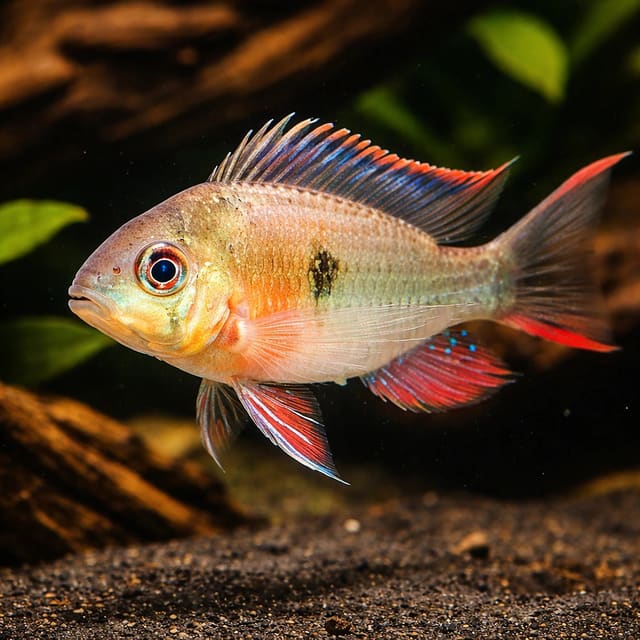
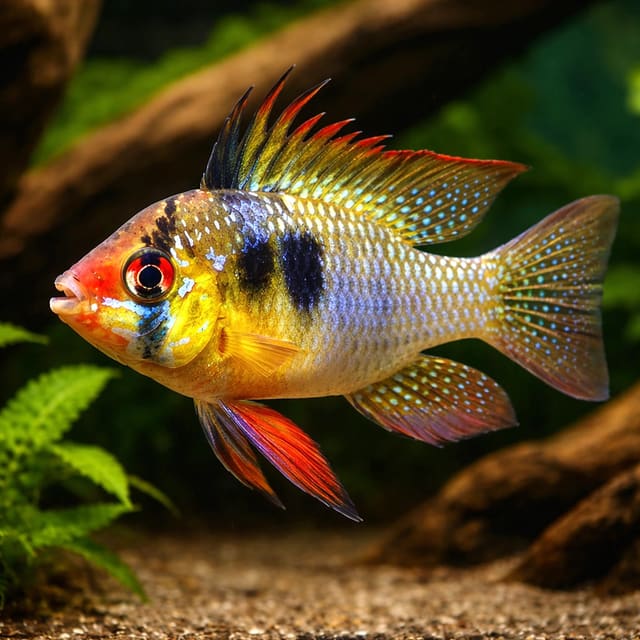
The parent species is known for blue iridescent spotting, dark flank markings, warm yellow or gold areas, red around the eye and patterned fins. The balloon form usually shows these features on a shorter, deeper body. The exact balance varies. Shop lighting, aquarium background, camera processing and stress can all change how saturated a fish appears.
Sex cannot be promised on this listing. Traits sometimes used by experienced keepers, such as dorsal-fin shape, belly colour, body size and the appearance of the dark flank patch, are not perfectly reliable in young, stressed or selectively bred fish. Do not order one fish on the assumption that a particular gallery image proves its sex, and do not order two on the assumption that they will form a breeding pair.
The strongest preventive measures are a mature biofilter, appropriate temperature, low waste, a varied diet, compatible companions and a quarantine plan. Disease names should not be guessed from a single symptom. Rapid breathing, for example, can be associated with poor water quality, low oxygen, gill irritation, infection, transport stress or several other causes. Test the environment before reaching for medication.
| What you observe | Immediate checks | Next step |
|---|---|---|
| Rapid or laboured breathing | Temperature, ammonia, nitrite, oxygenation and recent chemical use | Stabilise the environment and obtain qualified advice if it persists |
| Refusal of food | Competition, temperature, water quality, faeces, mouth and body condition | Observe in a quiet setting; do not keep adding uneaten food |
| Clamped fins or hiding | Aggression, lighting, cover, water change history and other symptoms | Reduce stress and investigate the cause rather than treating blindly |
| Spots, sores or damaged fins | Take clear photos, check tank mates and test water | Isolate safely where appropriate and seek species-aware advice |
| Loss of balance or abnormal buoyancy | Water parameters, injury, feeding history and progression | Seek prompt professional guidance; avoid force-feeding |
Do not combine treatments unless their compatibility is known, and do not increase a dose because the first dose did not produce an immediate visible result. Follow the product label for the actual water volume, remove or protect filtration media only when the instructions require it, and remember that some treatments affect invertebrates or the biofilter. An aquatic veterinarian is the right escalation point for persistent, severe or unclear illness.
Mikrogeophagus ramirezi is a substrate-spawning cichlid. Reproductive behaviour may involve cleaning a surface, displaying, defending a small area and tending eggs or larvae. FishBase's reproduction record specifically reports female care of eggs and larvae. Aquarium accounts sometimes describe shared parental behaviour, but this listing does not promise that every pair will divide care in the same way.
Breeding starts with compatibility, not simply purchasing two fish. A male and female may reject one another, and sex may be uncertain. If spawning is attempted, use a mature setup with excellent water quality, calm surroundings, suitable surfaces and a plan to separate fish if aggression escalates. Eggs can fail because of infertility, disturbance, water conditions, inexperience or fungal growth; repeated spawning attempts should never come at the cost of adult welfare.
Fry require food of an appropriate microscopic or very small size and stable water that is not polluted by excess feeding. This is specialist husbandry, not a feature that should be improvised in a crowded display tank. The active sale item remains one unsexed fish per selected quantity, regardless of any breeding information on this page.
These names describe related aquarium forms of M. ramirezi, not interchangeable sale items. The Balloon Ram is selected primarily for its shortened, deeper body. A standard German Blue Ram retains the more typical body outline and familiar blue-and-black pattern. Electric Blue is a colour form selected for a more extensive blue appearance; some Electric Blue listings may also be balloon-bodied, so read the actual product title rather than assuming colour and body form are the same trait.
| Form | Main distinction | Useful comparison |
|---|---|---|
| Balloon Ram | Shorter, deeper domestic body form | This listing |
| German Blue Ram | Standard body form with familiar ram patterning | Blue Brilliant Ram listing and German Blue Ram guide |
| Electric Blue Ram | Blue colour selection; body form depends on the exact stock | Electric Blue Ram listing and Electric Blue Ram guide |
| Asia-form Ramirezi | Supplier trade designation; check the individual listing | Ramirezi Asia Form listing |
Care requirements overlap because these are forms of the same species, but an individual fish's recent holding water, condition and behaviour still matter. Use comparisons to understand the visible form, not to assume one strain is automatically hardier, more peaceful or longer lived.
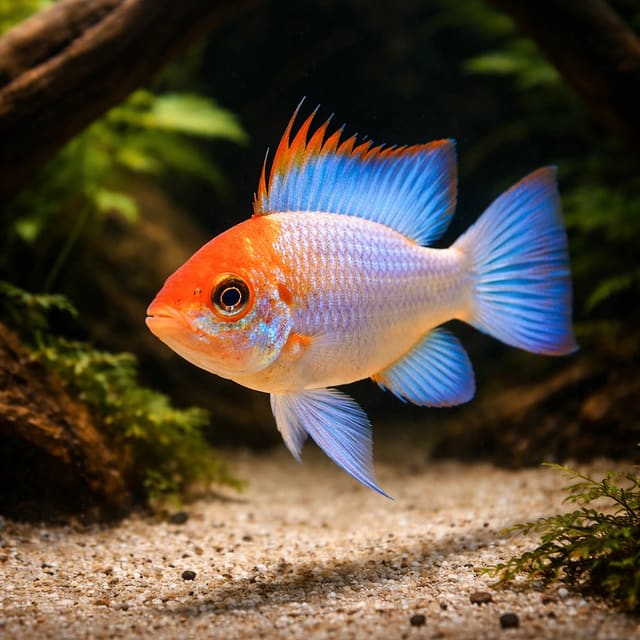
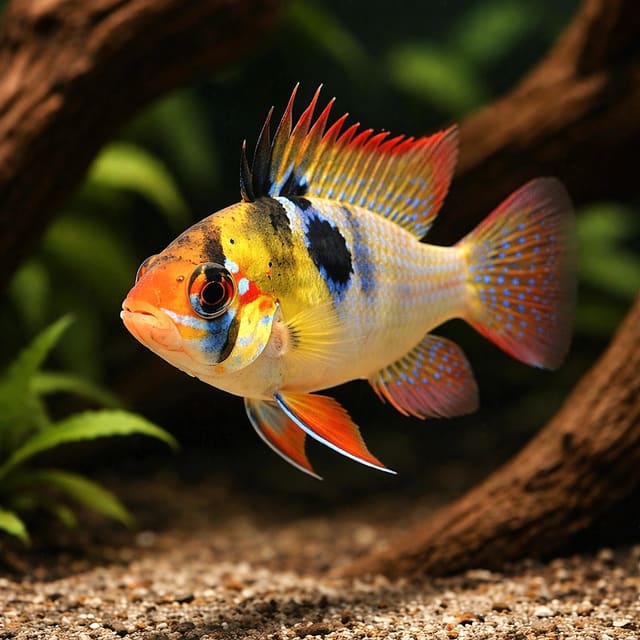
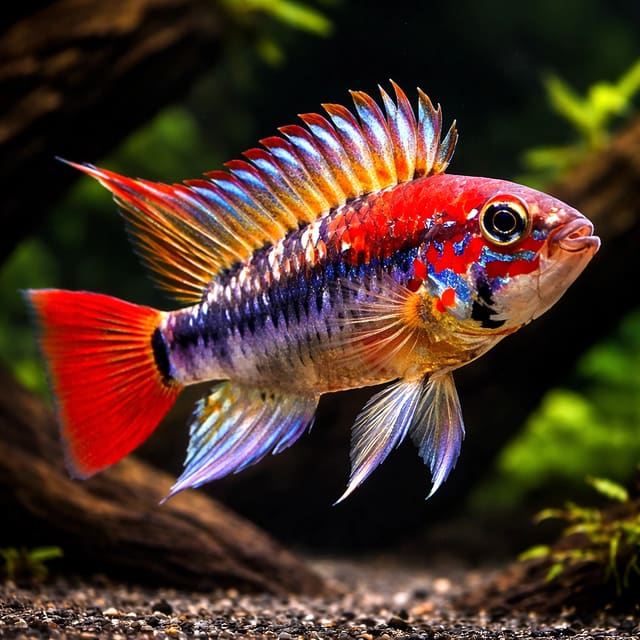
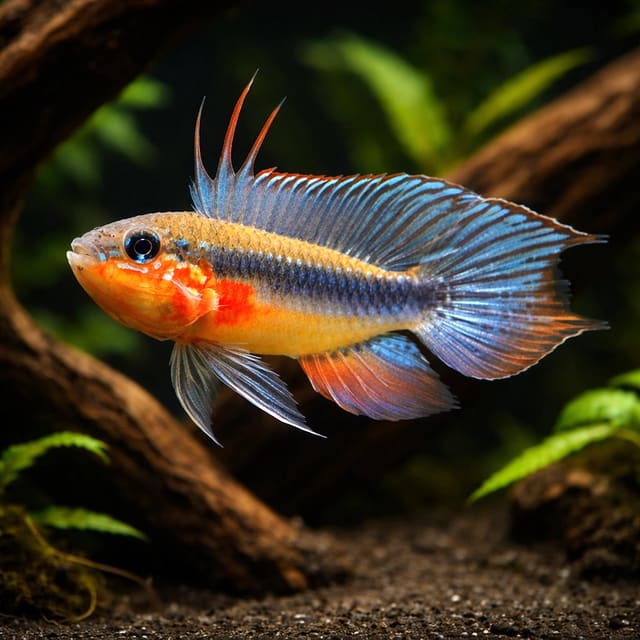
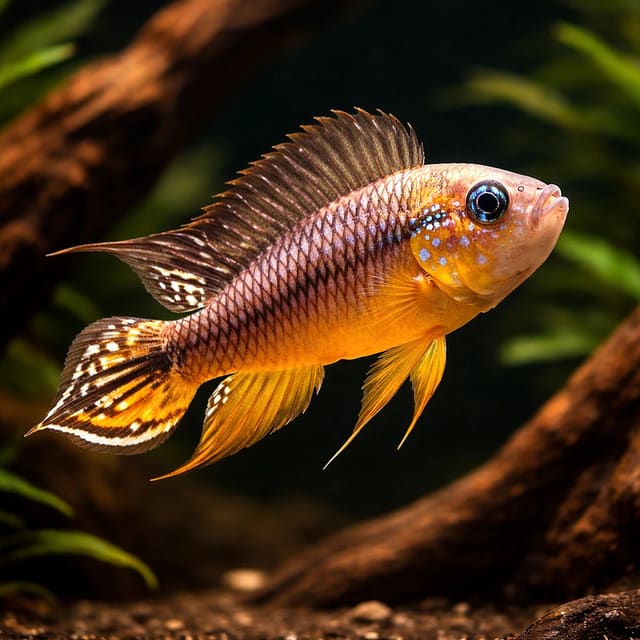
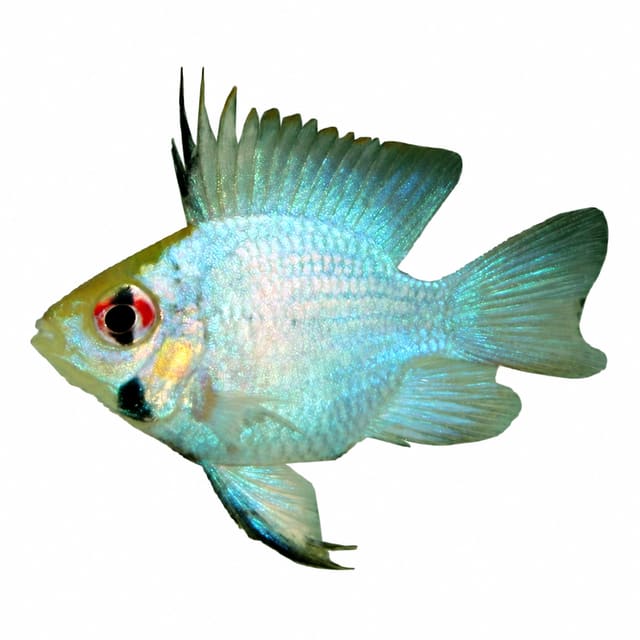
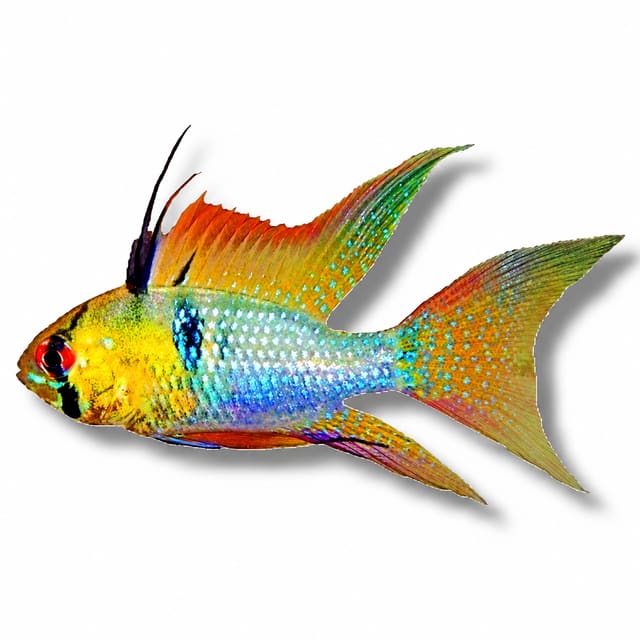
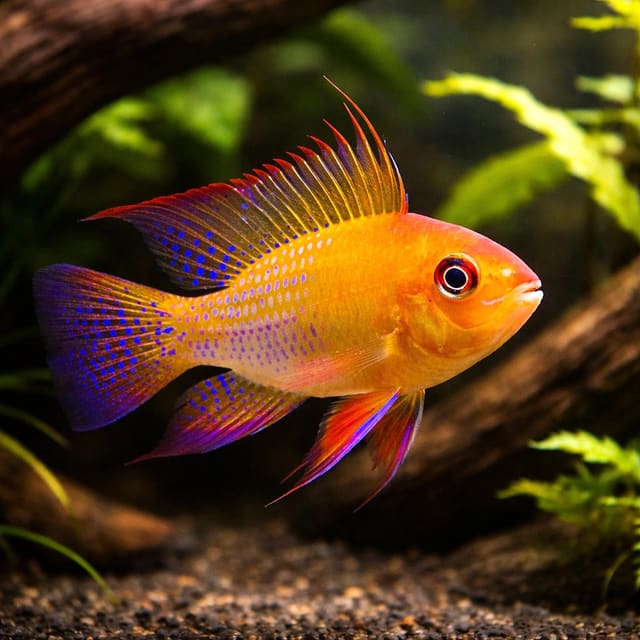
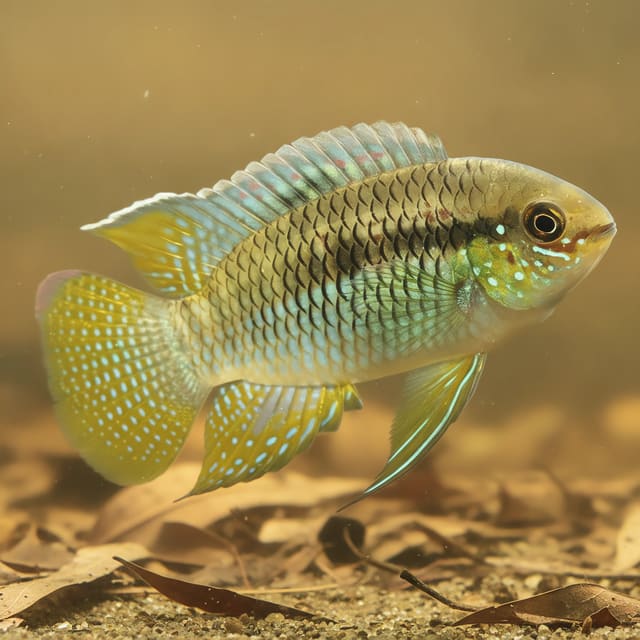
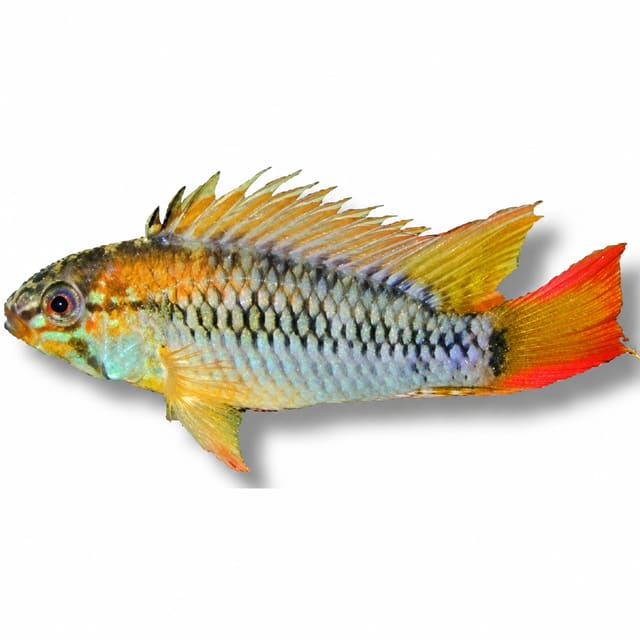
The four current gallery images are representative illustrations based on species-reference material; they are not photographs of the exact fish that will be dispatched. Their role is to show likely body outline, pattern placement and aquarium context. They do not guarantee sex, colour saturation, pair status, exact size or the appearance of an individual at arrival.
The planted image containing two fish is a scene illustration only. It does not change the sale unit: one selected quantity is one unsexed fish. The side and plant-scale views are also illustrative rather than measurements.
This page makes the dispatch size, one-fish sale unit, scientific identity, evidence differences and representative-image status explicit before purchase. That is more useful than promising a sex, pair or exact colour that our stock records do not support. The live option selector shows the current price and availability, while the care guide helps you decide whether the aquarium is suitable before adding the fish to the basket.
Eligible livestock orders are covered by the current Live Arrival Guarantee. Review the delivery page before ordering so you understand dispatch timing, postcode eligibility and the arrival process. First-time customers can use WELCOME10 for 10% off eligible first orders, subject to the checkout terms. If the tank is not yet ready, use the care planner rather than rushing the purchase.
Yes. Both are domestic forms of Mikrogeophagus ramirezi. "Balloon" describes the shorter, deeper body form; German Blue Ram generally refers to a standard-bodied colour form. They are separate sale listings and should not be treated as visually identical.
No. GBIF lists Papiliochromis ramirezi as a synonym of the accepted name Mikrogeophagus ramirezi. The older name remains common in our stock records and aquarium literature.
One selected quantity buys one unsexed Balloon Ram. It is not a guaranteed pair, and an image containing two fish does not alter the sale unit.
No sex choice is stated for the active variants. Sexing young or selectively bred rams can be uncertain, so colour and fin traits should not be treated as a guarantee.
The first option has a supplier-stated dispatch range of 2.5-3 cm. XL is a larger supplier grade, but the supplier has not supplied an exact centimetre range for it.
The supplier reports approximately 5 cm grown size. FishBase gives 4.2 cm standard length for the species; standard length excludes the tail, so the measurements should not be treated as contradictory total-length promises.
FishBase gives a 60 cm minimum aquarium length. We use 60 litres and a 60 cm length as a cautious retail starting point for one fish or a carefully observed compatible pair, with more footprint for communities or multiple territories.
Our stock records give 24-27°C, while FishBase gives 27-30°C for the wild species. Compare the fish's recent holding conditions with your mature aquarium and make any transition gradually; do not make rapid changes merely to reach a published number.
The supplier range is pH 6.0-7.5 and 0-15 dGH; FishBase's wild-species summary is pH 5.0-6.0 and 5-12 dH. Stability, source-water chemistry and gradual acclimation are essential context.
It is better classed as moderate care. A beginner with a fully cycled, stable aquarium and a disciplined testing routine may succeed, but it is not suitable for an uncycled or rapidly changing first setup.
Yes, one fish can be kept without a partner in a suitable aquarium. A compatible pair can display additional social and breeding behaviour, but two purchased fish are not guaranteed to be compatible.
It is usually measured relative to larger cichlids, but it can defend a territory and may become more assertive around spawning. Persistent chasing, blocked feeding or damaged fins require intervention.
Some species can be suitable, but only where their temperature, chemistry, group size and behaviour overlap. Check the exact species because many commonly sold small fish prefer cooler water or may compete strongly for food.
Small shrimp and shrimplets may be investigated or eaten. Plant cover can reduce exposure but cannot create a guarantee, so do not choose a Balloon Ram for a tank where every small invertebrate must remain safe.
Use a varied omnivorous diet built around an appropriate complete small food, with sensibly chosen frozen or live foods for variety. Watch the fish swallow food and remove persistent leftovers.
Quiet hiding can occur after transport, but check temperature, ammonia, nitrite, respiration and aggression. Subdued light and secure cover help; persistent breathing difficulty, loss of balance or worsening condition needs prompt attention.
A compatible pair may spawn on a prepared surface and defend the area, but eggs or fry are vulnerable in a community. This listing does not supply a guaranteed pair, and breeding should not be attempted without a plan for aggression and fry care.
This page does not promise a universal lifespan. Genetics, body form, age at purchase, water quality, temperature, diet and disease history all affect longevity, and the available our stock records do not state a lifespan for this stock.
No. The gallery contains representative illustrations based on species-reference material. The exact fish can differ in colour, markings, body proportions, sex and size within the selected dispatch grade.
Compare this form with the Blue Brilliant Ram, Electric Blue Ram and Ramirezi Asia Form. For a different South American dwarf-cichlid profile, see the Red Mask Dwarf Cichlid, Elizabethae Dwarf Cichlid or Apistogramma agassizii Alenquer Red Tail.
Use the cichlid care guide for broader preparation, then return to the species-specific evidence on this page. The Apistogramma guide explains why visually similar small cichlids should not be assumed to have identical social or water requirements.
This listing separates supplier-specific trade data from species and group references. Sources consulted include the FishBase species summary for Mikrogeophagus ramirezi, the FishBase reproduction record, the GBIF accepted-species record, the OATA dwarf-cichlid care sheet, and a peer-reviewed feeding study on M. ramirezi. Supplier ranges and dispatch grades refer specifically to the current trade record and are identified as such throughout.
No reviews for this item yet. Bought one? Honest reviews only, good or bad.
What customers say about ordering from us
I have a small group of long finned mountain minnows. So was delighted to be able to order ten of this variety to increase the genetics in my tank . The ones I recieved are healthy but it’s to early to give a verdict on wether they are of a long finned type since they are small currently.
Gordon Walker · 23 Sept 2026
100% success travel and "installation". Pleased with quality of purchase. The Siamese fighter a bit "shy" so have not yet seen him at his best yet but looking good. Happy customer. GG
George E Garratt · 21 Sept 2026
Reviews of our shop, collected by Judge.me, an independent third-party review collector. Newest first.