Advanced
Brilliant Turquoise (Symphysodon aequifasciatus) — Domestic Strain
26–30°C · pH 6–7.5
£39.09

Red Turquoise Discus (Symphysodon spp.) is a genus-level discus colour form sold as one animal in the dispatch size selected. Plan a group of at least five in a mature, well-filtered aquarium, allowing 50 litres per adult and up to 20 cm across.
Save when buying multiple fish. Each quantity is one fish; sex and pair formation are not guaranteed unless the selected variant explicitly states them.
Red Turquoise Discus (Symphysodon spp.) is a genus-level discus colour form sold as one animal in the dispatch size selected. Plan a group of at least five in a mature, well-filtered aquarium, allowing 50 litres per adult and up to 20 cm across.
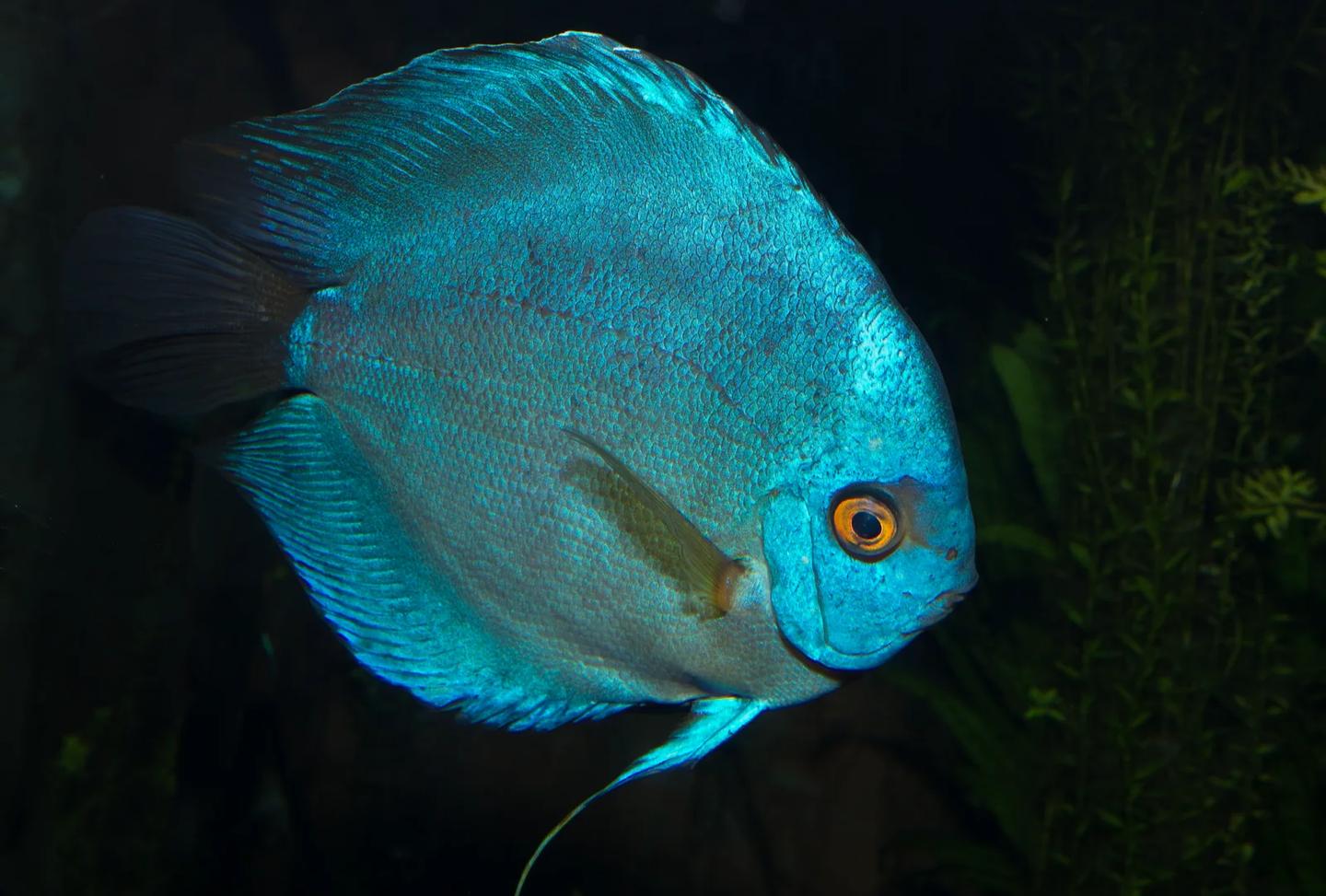
Discus are social Amazonian cichlids with specialised aquarium needs. OATA advises at least five fish, except an established breeding pair, and about 50 litres per adult—roughly 300 litres for six adults. Use that as a planning floor, then check usable dimensions, filtration, source water and the actual fish.
Maintain these water conditions for optimal health and vibrant colors
Red Turquoise Discus is the trade name for this brightly patterned discus form. The scientific label is Symphysodon spp., placing it within the discus genus rather than assigning it to one species. The accepted genus record for Symphysodon places the genus in the cichlid family Cichlidae.
The exact species has not been identified, so the care advice here follows the genus Symphysodon and its care group. This matters when planning the aquarium: use the discus-wide husbandry values below rather than treating the fish as a named wild species with a separate habitat profile.
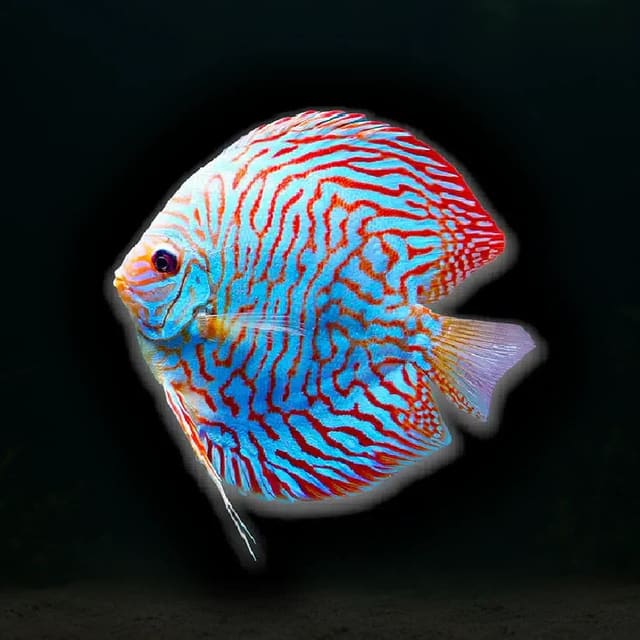
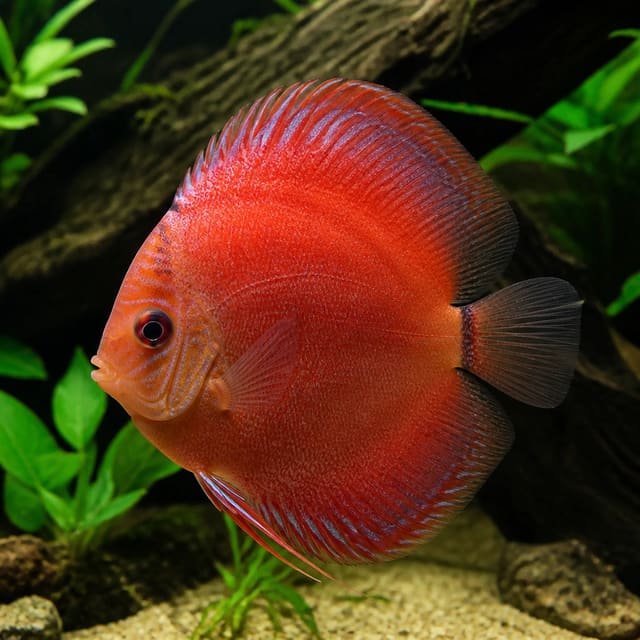
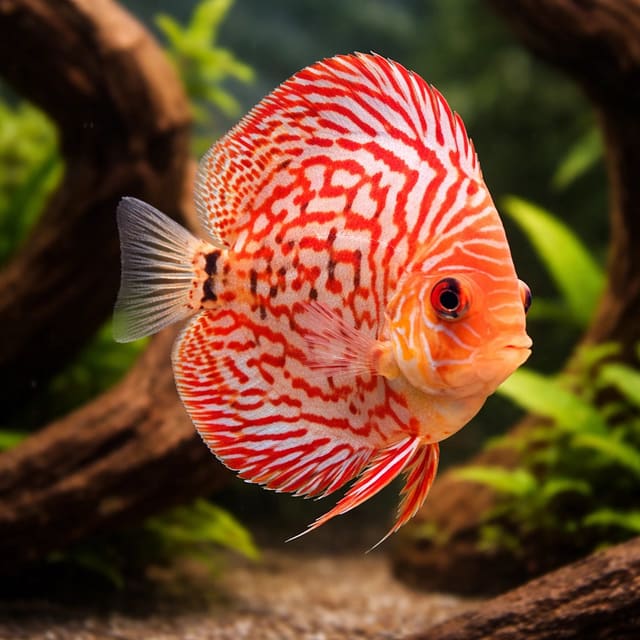
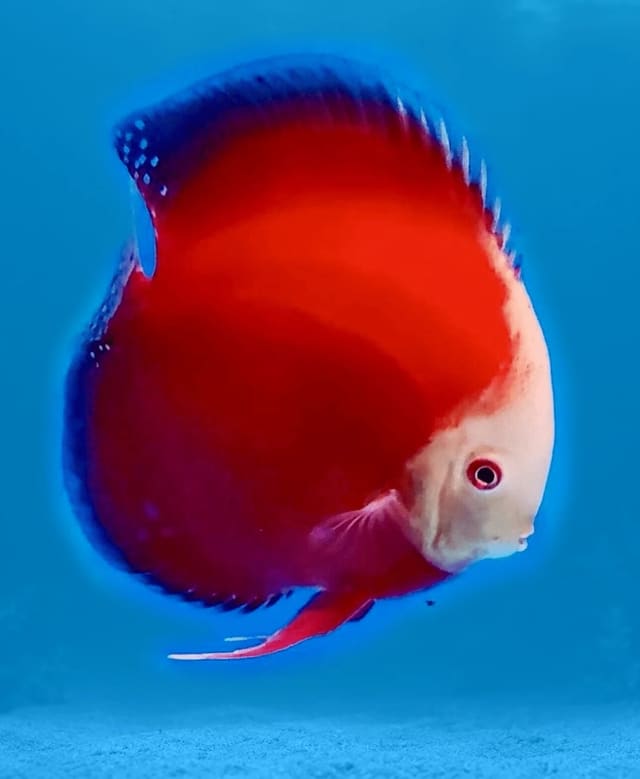
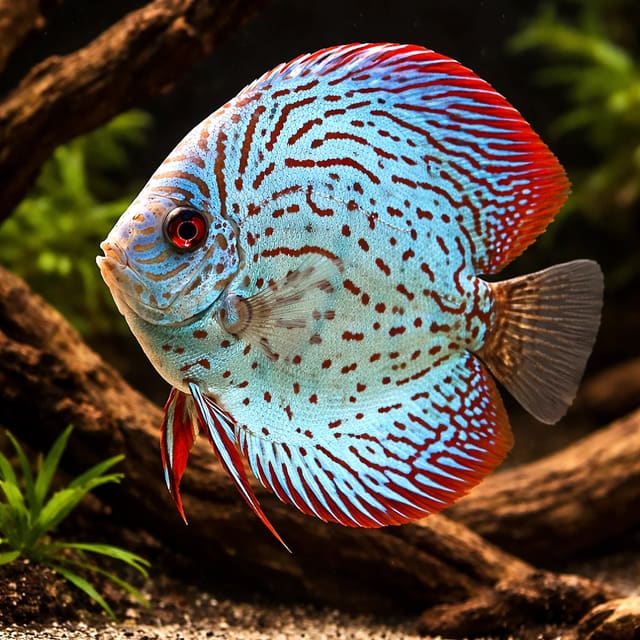
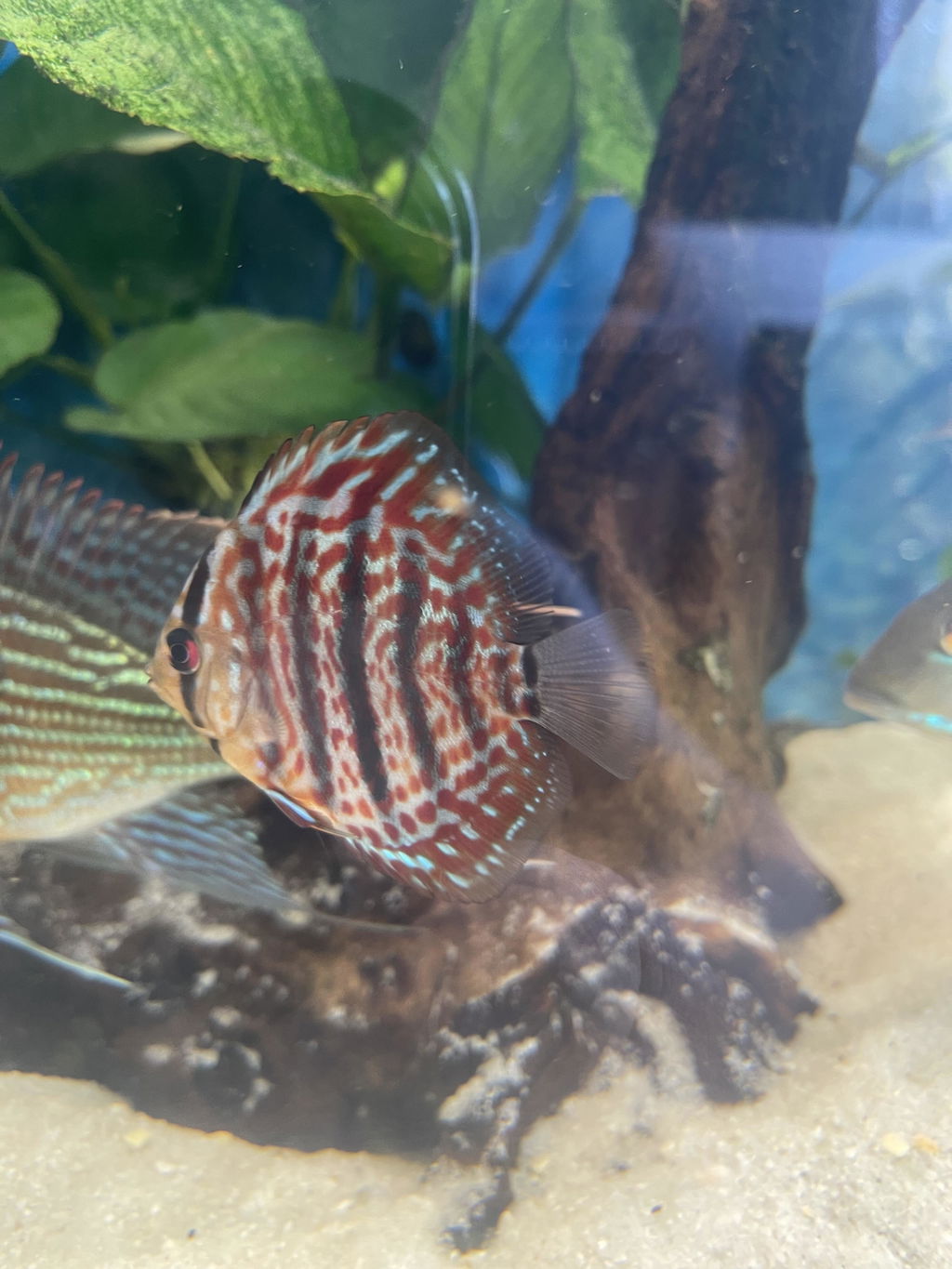
Red Turquoise describes the strong red ground colour and turquoise-blue winding pattern associated with this form. Discus have a rounded, laterally compressed outline that gives them their distinctive disc-like appearance. Individual colour and pattern can differ, so select the animal for the care commitment first and regard its markings as individual variation within the named form.
This fish suits a keeper prepared to maintain precise warm-water conditions, test water every week, complete substantial partial water changes and provide an appropriately sized social group. Those recurring jobs are central to discus husbandry, not optional refinements for showing stronger colour.
| Suits | Not suited to |
|---|---|
| A keeper prepared for weekly testing and a 50% partial water change at least once every week | A plan for one discus or a group of fewer than five |
| A mature, filtered aquarium maintained at 26–30°C | An immature aquarium or one without a working filter |
| An aquarium planned around 50 litres per adult, floor space and open swimming room | A layout that lacks room for the mature group |
A natural-history summary of the genus describes Symphysodon as Amazon-basin cichlids from Brazil, recognised for their distinctive shape, calm behaviour and wide range of colours and patterns. Those facts describe the genus in nature and aquarium culture; they do not assign a wild collection place to this individual colour form.
Discus have become prominent freshwater aquarium fish partly because selective culture has produced many colour variations. Red Turquoise is one such named aquarium form, with the rounded body and red-and-blue pattern providing the visual identity customers expect. Care decisions should still be made around adult dimensions, social behaviour and water quality rather than colour alone.
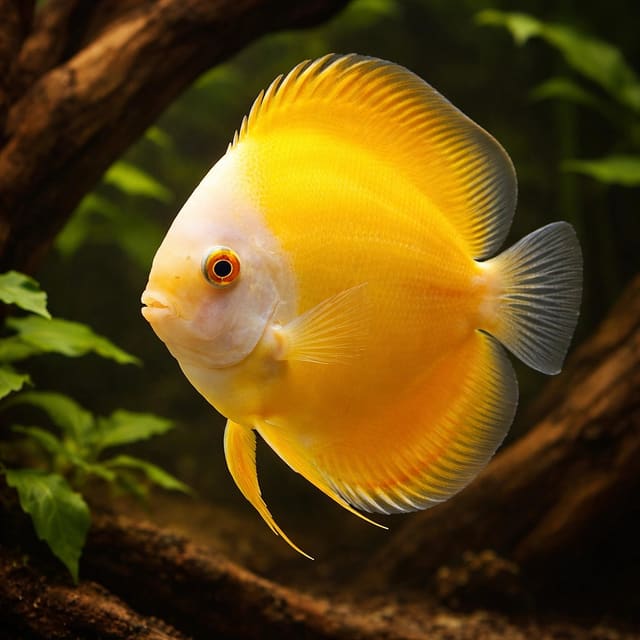
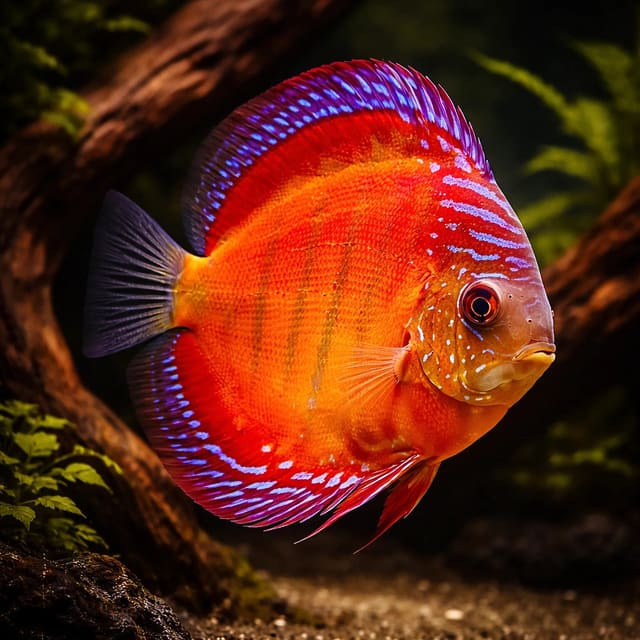
The gallery shows the characteristic circular profile, red fins and turquoise-blue markings in planted and plain-background scenes. The gallery images are representative, based on reference photographs of this kind of animal, so colours can look slightly different from the live animal.
Use the images to understand the general body shape and named colour pattern, not to infer sex, age, origin or the exact markings of the animal received. The flattened body also makes unobstructed swimming room and generous floor space important when arranging the aquarium.
One purchase supplies one animal of the selected option. Use the live size selector to choose the dispatch grade: its labels include single measurements, combined labels such as “4 cm (5 cm)” and named grades such as “XL selection HQ”. Read the complete label rather than interpreting a parenthetical measurement as a guaranteed adult dimension.
The size you select is the size supplied, not the adult size. OATA’s discus guidance records adults reaching up to 20 cm across, although they grow slowly. It recommends at least five discus, with more being better, and an allowance of 50 litres per adult. Approximately 300 litres is its worked recommendation for six adults.
| Planning decision | Figure to use |
|---|---|
| Adult dimension | Up to 20 cm across |
| Social group | At least five; more is better |
| Volume allowance | 50 litres per adult |
| Six-adult example | Approximately 300 litres |
| Routine temperature | 26–30°C |
| Routine pH | 6.0–7.5 |
The water figures are discus guidance rather than a target for one identified species. Alongside 26–30°C and pH 6.0–7.5, plan for general hardness of 4–12°dH, carbonate hardness of 3–10°dKH, zero ammonia, zero nitrite and nitrate not exceeding 20 mg/l.
A five-adult plan begins with 250 litres by the 50-litres-per-adult allowance, while six adults lead directly to the approximately 300-litre example. Floor space, open swimming room, cover and filtration still have to fit inside that calculation. Choose the aquarium around the mature group before selecting a small dispatch grade.
Sex is guaranteed only when the selected option explicitly states male or female. This Red Turquoise Discus listing has no sex-guaranteed option.
For other colour forms with the same planning needs, you can browse the discus collection without treating colour alone as a compatibility difference.
Maintain clean, warm, soft to medium water at 26–30°C and pH 6.0–7.5. General hardness should remain within 4–12°dH and carbonate hardness within 3–10°dKH. Ammonia and nitrite must both read zero, while nitrate must not exceed 20 mg/l.
Each value answers a separate question. Temperature establishes the warm environment discus require. pH describes acidity or alkalinity, while general and carbonate hardness describe different mineral properties. Ammonia, nitrite and nitrate show how effectively the aquarium is processing and removing fish waste. Our aquarium water chemistry guide explains which readings to measure and why they matter.
Record the whole set together instead of judging the aquarium from pH or temperature alone. A tank can fit one part of the range while failing the waste readings that directly affect fish health.
Use the water matcher to compare measured values with the discus range. Repeat measurements at least weekly and whenever swimming, breathing, colour, appetite or hiding behaviour changes. Correct the aquarium conditions before adding to the group rather than expecting the fish to compensate for a marginal reading.
Write down each result with the date and whether it was taken before or after the weekly water change. If nitrate rises towards 20 mg/l between changes, review feeding, waste removal and stocking before adding another animal. If ammonia or nitrite becomes detectable, stop additions immediately, inspect the filter and continue testing until both readings return to zero. A stable pattern within all the stated ranges is a stronger readiness test than one isolated result.
A working filter is essential in every discus aquarium. The RSPCA’s aquarium welfare guidance explains that fish release toxic ammonia, while beneficial bacteria in a biological filter convert ammonia to nitrite and then to the safer end product nitrate. Ammonia and nitrite remain toxic, so both must be held at zero.
Prepare and mature the aquarium before livestock arrives. Our guide to setting up and maturing a first tropical aquarium covers that preparation in a practical sequence. Test the aquarium rather than judging maturity from how clear the water looks: clear water can still contain dissolved ammonia or nitrite.
Rapid stocking can leave too few nitrifying bacteria to process the additional waste, producing the ammonia and nitrite rise commonly called new tank syndrome. The social requirement for at least five discus and the need to increase biological load carefully must be planned together. Prepare the system for the intended group instead of adding fish impulsively to an immature filter.
A larger aquarium helps environmental conditions remain more stable, but volume does not replace filtration or testing. Conversely, a powerful filter does not replace the adult space allowance. The finished plan must provide biological processing, suitable water, floor space, cover and unobstructed swimming room at the same time.
Test again after each livestock addition and after any noticeable increase in feeding. Zero ammonia and zero nitrite show that the biological filter is coping at that point; a detectable result shows that the new load has exceeded its present capacity. Keep the filter running, check it for blockages and avoid adding further livestock while the readings are being brought back under control. Continue to judge the complete aquarium as one system: filtration, adult space and social grouping must all pass together.
Complete a partial water change of 50% at least once every week. This is the central routine for keeping the warm water clean and nitrate at no more than 20 mg/l. Use a siphon to remove solid waste from the substrate while water is withdrawn.
Tap water may contain chlorine or chloramine that can harm the beneficial bacterial population established in filter media. Using removed aquarium water for a light rinse reduces that risk while clearing material that is restricting the filter.
Substrate choice changes one part of the routine. With sand, stir open areas regularly to prevent dead spots where waste can accumulate. Fine gravel can be siphoned to lift solid material. In either case, keep the open feeding and swimming areas clean rather than allowing uneaten food and waste to remain among the grains.
Use the nitrate reading to judge whether the routine is achieving its purpose. A result over 20 mg/l requires action even if the water looks clear. Detectable ammonia or nitrite is more urgent: pause further stocking, check the filter and restore zero readings before increasing the load.
Carry out the weekly test at a similar point before each water change so the results can be compared fairly. Note how much waste is removed, whether the filter flow has changed and whether food has been left after meals. If nitrate reaches more than 20 mg/l before the next scheduled change, bring the maintenance forward and review the causes rather than waiting for the calendar. The goal is a repeatable routine that keeps every reading inside its limit.
Arrange the aquarium around both security and movement. Discus may be shy and benefit from live plant cover, branches, wood and other ornaments that create places to retreat. They also need open space in which the group can swim and explore without repeatedly turning around obstacles.
Use fine gravel or sand as the substrate. Discus can feed naturally by blowing at the substrate, so a fine surface supports that behaviour. Whichever material you choose, leave accessible areas for siphoning and routine cleaning. Sand also needs regular stirring in open areas to prevent waste collecting in dead spots.
| Area | Purpose |
|---|---|
| Plant and wood cover | Gives shy fish somewhere to retreat |
| Open central space | Allows the group to swim and explore |
| Accessible substrate | Supports natural feeding and effective cleaning |
| Generous floor space | Accommodates broad adults reaching up to 20 cm across |
Do not fill the full footprint with ornamentation. A broad adult must be able to turn and remain with the shoal without squeezing between wood or dense planting. The 50-litres-per-adult allowance is a volume calculation; the physical arrangement still determines whether that volume is usable.
Overhead aquarium lighting is recommended, while plants and solid features provide shaded cover within the same layout. Position each item so it cannot prevent access to the substrate during the weekly siphon. A visually dense design that traps waste or removes group swimming room works against the water-quality and social needs the aquarium must meet.
Look across the aquarium from end to end and trace an unobstructed route through the open swimming area. Then check that each sheltered zone can be reached without forcing fish through a narrow gap and that the siphon can reach the exposed substrate. Move wood or ornaments before introduction if they divide the group’s swimming space or trap waste. This simple layout check turns nominal litres into genuinely usable room.
Discus are generally carnivorous and eat aquatic invertebrates in the wild. In the aquarium, use a specialised dried discus granule or pellet at least once each day so the diet includes an appropriate vitamin contribution. Frozen or live choices can include bloodworm, beef heart and specialist discus mixes.
Offer two or three smaller feeds across the day because discus have relatively small stomachs. Each portion should be limited to what the fish can eat within a few minutes. The purpose is to give the group repeated feeding opportunities without leaving excess food to decay.
Watch the whole group during every meal. A portion can be correct for the aquarium overall while a shy or pressured fish receives little. Reduced food intake or complete loss of interest is also one of the changes that can signal a health or water-quality problem.
Overfeeding introduces uneaten material that breaks down and releases toxic waste into the water. If food remains after a few minutes, remove what you can and reduce the next portion. Do not compensate for a missed meal by adding a large amount later.
Judge the routine through appetite, body condition and the weekly water tests. Increasing or decreasing body condition, a sudden change in feeding response or rising nitrate all justify reviewing portions. Keep the dried discus food in the daily pattern rather than feeding only favourite frozen or live items.
If every fish feeds and the food disappears within a few minutes, retain that portion for the next comparable meal. If food reaches the substrate and remains there, remove it and make the following portion smaller. When one fish repeatedly hangs back, spread a small meal across more than one feeding point while watching whether it actually eats. A rising nitrate result alongside leftover food is a direct reason to reduce waste before adding another meal or another fish.
Arrange for someone to receive the parcel because live fish must not be left unattended. Before opening it, have the mature aquarium running within the discus ranges and confirm that ammonia and nitrite are zero. Introduction day is not the time to finish preparing filtration or correct an unsuitable temperature.
Follow our delivery and Live Arrival Guarantee policy: start filming while the parcel is still sealed, then open it in one continuous take and show the fish still inside the sealed bag. Float the bag for 20–30 minutes, acclimatise slowly and never pour the bag water into the aquarium. Release the fish without transferring that transport water.
Keep the video from every delivery. If a Live Arrival Guarantee claim is needed, send the continuous unboxing video with the order number and contact us on the day the fish arrive.
After introduction, keep the established feeding and testing routine rather than attempting to settle the fish with excess food. At each small feed, check whether the newcomer approaches food and whether other discus prevent it from feeding. Test the water if breathing, swimming, colour or appetite changes.
Every added fish increases waste and feeding, so the beneficial bacterial population must adjust to the higher load. Do not make another addition simply because the water remains visually clear. Use zero ammonia, zero nitrite and nitrate no higher than 20 mg/l as the measurable checkpoints.
Note where the fish swims, how quickly its gill covers move, whether its colour becomes darker or paler and whether it approaches a small feed. Compare later observations with that first-day baseline rather than reacting to one moment in isolation. If behaviour or breathing changes, test the full water set immediately and inspect the filter. Keep the aquarium routine stable while the fish settles instead of changing several conditions at once without a measured reason.
Learn the group’s normal appearance and behaviour so a change is easy to recognise. Healthy fish should show clear, bright eyes, undamaged fins, intact scales, appropriate swimming behaviour and no ulcers, bumps or abnormal growths.
When one of these changes appears, test temperature, pH, hardness, ammonia, nitrite and nitrate first. A reading outside the stated range gives you an immediate husbandry problem to address. Check the filter for blockage and review recent feeding and maintenance at the same time.
Do not rely on appearance alone when the aquarium can be measured. Clear water is not a substitute for zero ammonia and zero nitrite, and normal temperature does not rule out excessive nitrate. Keep dated weekly results so a change can be compared with the aquarium’s usual pattern.
If a health change continues or the fish has visible damage, contact us with the test results and a concise description of the swimming, breathing, colour and feeding changes. That combination is more useful than a general statement that the fish looks unwell.
Write down when the change began, whether one fish or the whole group is affected and what happened at the most recent feed or water change. Pair those observations with the measured values rather than guessing from colour or posture alone. If ammonia or nitrite is detectable, treat restoring zero readings as the immediate aquarium priority. Continued visible damage, abnormal breathing or loss of appetite needs prompt attention even when the first test set falls within range.
Discus are shoaling, social fish and should be kept in groups of at least five in the home aquarium; more is better. Individuals kept alone or in a group that is too small will often become stressed or be bullied by larger or more dominant fish.
Two discus are a special exception only when they are an already established breeding pair. Two fish selected at random should not be treated as a substitute for the normal group. Plan the standard social group unless you already have the established-pair situation described by the care guidance.
| Group plan | Volume calculation |
|---|---|
| Five adults | 5 × 50 litres = 250 litres before layout is assessed |
| Six adults | Approximately 300 litres |
| Larger group | Add 50 litres for each adult and retain ample floor space |
These calculations describe water-volume allowance rather than a promise that every tank with that nominal capacity has the right shape or usable space. Check that broad adults can move as a group, turn freely and reach food without the central swimming area being blocked by décor.
Because each purchase supplies one animal, decide how the selected fish fits the complete social plan before ordering. If it is joining an established discus group, count the existing adults, recalculate the volume allowance and assess the biological filter’s capacity for the additional waste and feeding.
Group welfare and gradual biological loading must be considered together. A mature aquarium should be prepared around the intended shoal, with zero ammonia and nitrite before introduction and close testing as the load changes. Do not solve a water-quality problem by leaving a social fish isolated indefinitely.
For an established group of five, adding one animal changes the adult allowance from 250 litres to the approximately 300-litre six-adult plan. Check the aquarium’s dimensions and open swimming area as well as the nominal volume, then confirm that ammonia and nitrite are zero before introduction. After the addition, watch whether every fish reaches food and repeat the waste tests. A group count that meets the social rule still needs enough usable space and biological capacity.
A discus aquarium should be built around discus requirements first. OATA identifies medium-sized tetras, Corydoras, plecos and dwarf cichlids as possible companion groups, but those categories are candidates rather than universal matches. The outcome remains case by case because each proposed fish must fit the same warm water, space and behavioural plan.
| Check | Decision |
|---|---|
| Water | The proposed fish must suit 26–30°C, pH 6.0–7.5 and the stated hardness ranges |
| Space | The completed community must still leave 50 litres per adult discus and open group swimming room |
| Behaviour | The arrangement must allow shy discus to use cover, remain with the shoal and reach food |
| Filtration | The mature biological filter must hold ammonia and nitrite at zero after the load increases |
Some suitable smaller companions may act as dither fish and help discus feel more confident, but that possible benefit does not override a failed water or space check. Assess the exact species, intended number and mature dimensions rather than approving a fish solely because it belongs to one of the candidate groups.
Plan the order of introduction carefully. Every added fish increases waste and feeding, and the filter bacteria must increase with that load. Measure ammonia, nitrite and nitrate after changes instead of assuming a previously mature aquarium can absorb any number of additions immediately.
For a mixed stocking assessment, contact us with the aquarium volume, dimensions, measured water values, filter status, existing livestock and intended numbers. Those details allow a useful decision without turning a companion category into a blanket compatibility promise.
A candidate that suits 28°C but needs water outside pH 6.0–7.5 does not pass the water screen. A fish fitting every water value still fails if the completed community removes the discus group’s open swimming room or prevents shy individuals from feeding. Likewise, compatible behaviour does not compensate for detectable ammonia or nitrite after stocking. Approve the combination only when water, adult space, feeding access and filtration all work together.
It is a named discus colour form within the genus Symphysodon and the cichlid family Cichlidae. Its identity is at genus level rather than one named species.
One purchase supplies one animal of the selected option. Use the live selector to choose the dispatch grade that fits your established group and adult aquarium plan.
The selector labels describe dispatch grades rather than mature measurements. OATA’s discus guidance says discus grow slowly and can reach up to 20 cm across.
For Red Turquoise Discus, OATA’s discus guidance recommends allowing 50 litres per adult, ample floor space, a mature filter and open swimming room; approximately 300 litres is recommended for six adults.
OATA’s discus guidance says to keep at least five, with more being better. Two are suitable only when they are already an established breeding pair, not simply two fish selected together.
Maintain 26–30°C, pH 6.0–7.5, 4–12°dH and 3–10°dKH, with zero ammonia, zero nitrite and nitrate no higher than 20 mg/l. These are OATA’s discus values, not an optimum for one identified species.
OATA’s discus guidance says to give a specialised discus granule or pellet at least daily, with frozen or live bloodworm, beef heart or discus mixes. Offer two or three small feeds eaten within a few minutes.
Start filming while the parcel is still sealed, continue in one take through opening until the fish is shown inside the sealed bag, then float the bag for 20–30 minutes, acclimatise slowly and release the fish without pouring bag water into the aquarium.
OATA identifies medium-sized tetras, Corydoras, plecos and dwarf cichlids as possible candidates when their water, space and behaviour needs fit the discus aquarium. Treat every match as case by case.
Independently collected by Judge.me from customers who bought this item. All reviews are shown.
Most beautiful
Reply from Tropical Fish Co
<p>Thank you, that's good to hear. Red Turquoise Discus are a proper centrepiece fish - keep the water warm and stable and feed them well and the colour will deepen a lot over the next few months, so the best of it is still ahead of you. Enjoy them. - Tropical Fish Co</p>