−15%
Red Turquoise Discus (Symphysodon spp.)
26–30°C · pH 6–7.5
£37.99£53.99

The Red Turquoise High Body Discus (Symphysodon spp.) is an aquarium cichlid colour form from a genus native to the Amazon river basin in Brazil. It suits experienced keepers; OATA’s discus guidance says keep at least five at 26–30°C, pH 6.0–7.5 and 4–12°dH. Sold individually in sizes labelled 8cm (10cm), 10cm, 9 cm (11.5 cm) and XL selection HQ.
Symphysodon spp.
Save when buying multiple fish. Each quantity is one fish; sex and pair formation are not guaranteed unless the selected variant explicitly states them.
The Red Turquoise High Body Discus (Symphysodon spp.) is an aquarium cichlid colour form from a genus native to the Amazon river basin in Brazil. It suits experienced keepers; OATA’s discus guidance says keep at least five at 26–30°C, pH 6.0–7.5 and 4–12°dH. Sold individually in sizes labelled 8cm (10cm), 10cm, 9 cm (11.5 cm) and XL selection HQ.
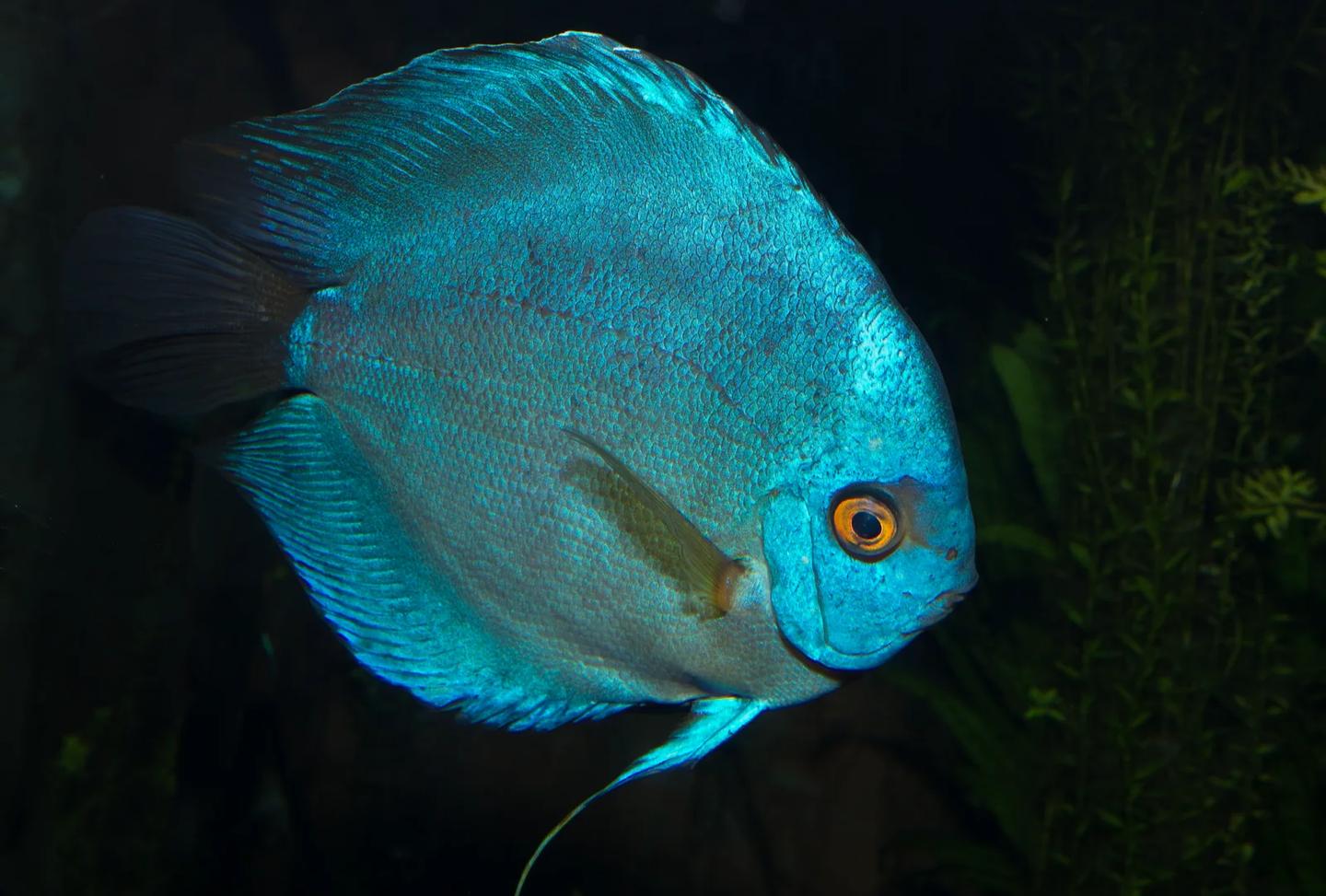
Discus are social Amazonian cichlids with specialised aquarium needs. OATA advises at least five fish, except an established breeding pair, and about 50 litres per adult—roughly 300 litres for six adults. Use that as a planning floor, then check usable dimensions, filtration, source water and the actual fish.
Maintain these water conditions for optimal health and vibrant colors
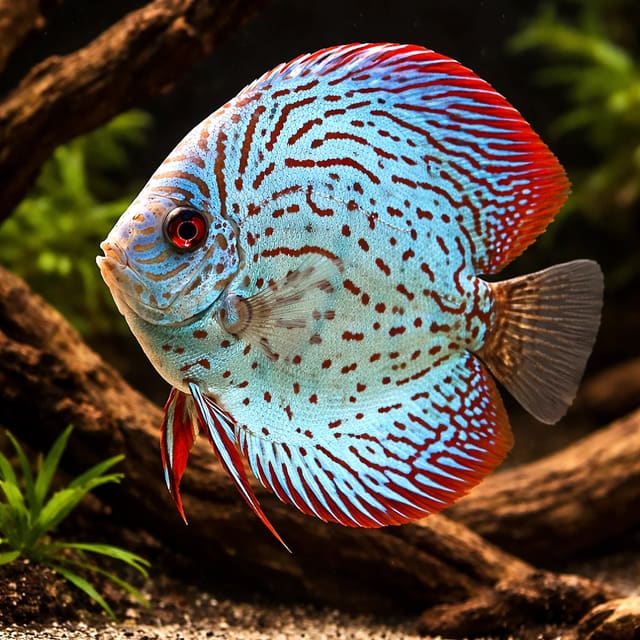
Red Turquoise High Body Discus is an aquarium colour form within Symphysodon, the discus genus. Its name describes the intended high, rounded body and red-turquoise pattern rather than a separate wild species. WoRMS places Symphysodon in the cichlid family Cichlidae.
The exact species has not been identified, so the care advice here follows the genus Symphysodon and its care group. That identity matters when planning care: use the warm-water discus requirements below rather than treating the fish as a named wild species with its own narrower profile.
At genus level, the natural history of Symphysodon places discus in the Amazon river basin in Brazil and describes their distinctive shape, calm behaviour and wide range of bright aquarium patterns. This describes the genus in nature and aquaculture; it does not identify the origin of the individual fish selected through this offer.
We classify this fish as advanced because discus have specialised requirements. It suits a keeper prepared to mature the biological filter before arrival, maintain warm and tightly controlled water, provide the correct social group, feed several small meals and complete substantial weekly maintenance. The decisive question is not simply whether the aquarium looks spacious: it is whether its volume, filtration, water values and maintenance routine can support adult discus over the long term.
| Suits | Not suited to |
|---|---|
| Experienced keepers prepared for specialised discus care | A solitary centrepiece plan |
| A mature, filtered aquarium planned for at least five discus | An immature or unfiltered aquarium |
| Keepers able to maintain warm, stable water and substantial weekly maintenance | A setup that cannot maintain the stated water values and social group |
OATA’s group-level guidance for discus records an adult size of up to 20 cm across and notes that these fish grow slowly. Plan from that adult measurement rather than using the selected dispatch size to judge permanent space.
Discus are shoaling fish. Keep at least five, with more being better, because single fish and undersized groups will often become stressed or be bullied by larger, more dominant individuals. An already established breeding pair may sometimes be kept as two, but two unrelated fish should not be treated as a substitute for a properly planned group.
Allow 50 litres of water volume for each adult and provide plenty of floor space. OATA gives an aquarium of approximately 300 litres for six adults. The arithmetic for five adults reaches 250 litres, but that figure is a planning baseline rather than a reason to compress the layout or filtration:
| Adult group | Volume calculation |
|---|---|
| Five discus | At least 250 litres at 50 litres each |
| Six discus | Approximately 300 litres |
A larger aquarium makes environmental conditions such as temperature and water quality more stable. Retain open group-swimming space after adding substrate, plants, branches, wood and other cover. A filter is essential in every aquarium, and its biological capacity must be mature enough for the waste produced by the planned group and its feeding routine.
The live size selector carries the labels 8cm (10cm), 10cm, 9 cm (11.5 cm) and XL selection HQ. Use the selector to choose the preferred dispatch grade and to see the live position of each choice. The size you select is the size supplied, not the adult size.
One purchase quantity supplies one animal of the selected option. If you are building the recommended group, plan the total number deliberately rather than reading a gallery scene containing two fish as the purchase unit. You can also browse the current discus collection while planning the group, but do not combine fish until their water and social requirements have been screened together.
Sex is guaranteed only when the selected option explicitly states male or female. This Red Turquoise High Body Discus listing has no sex-guaranteed option.
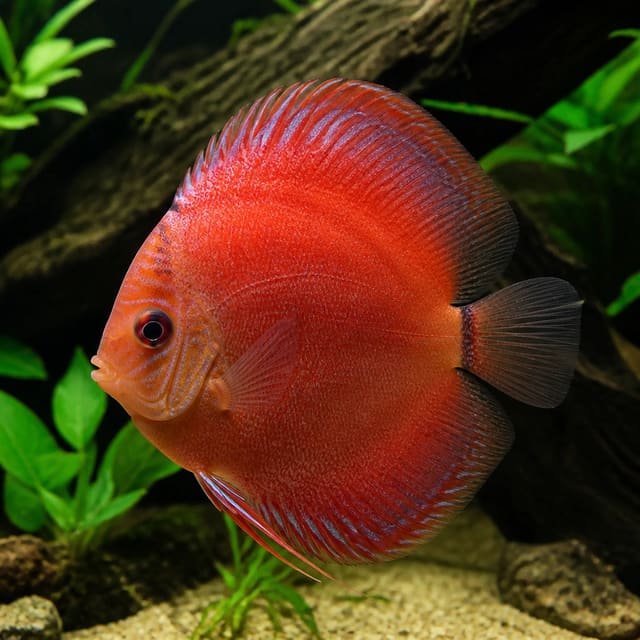
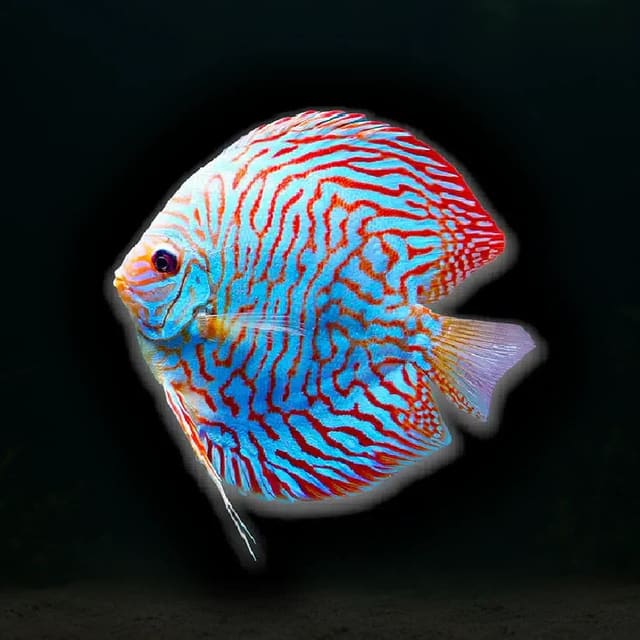
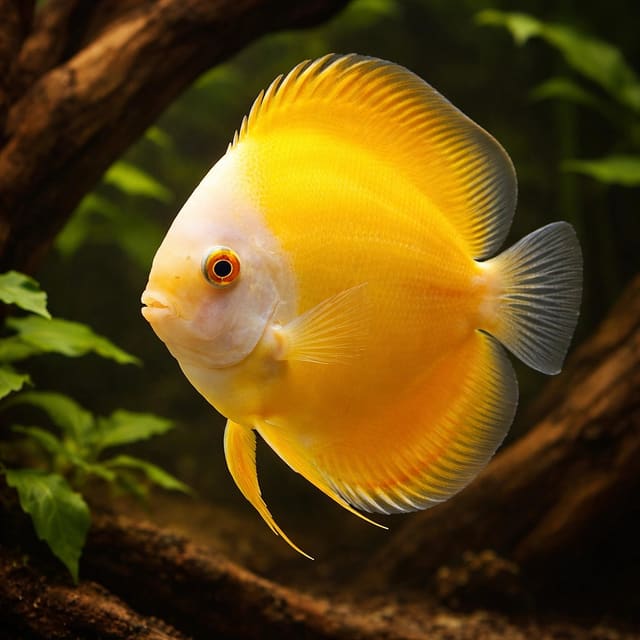
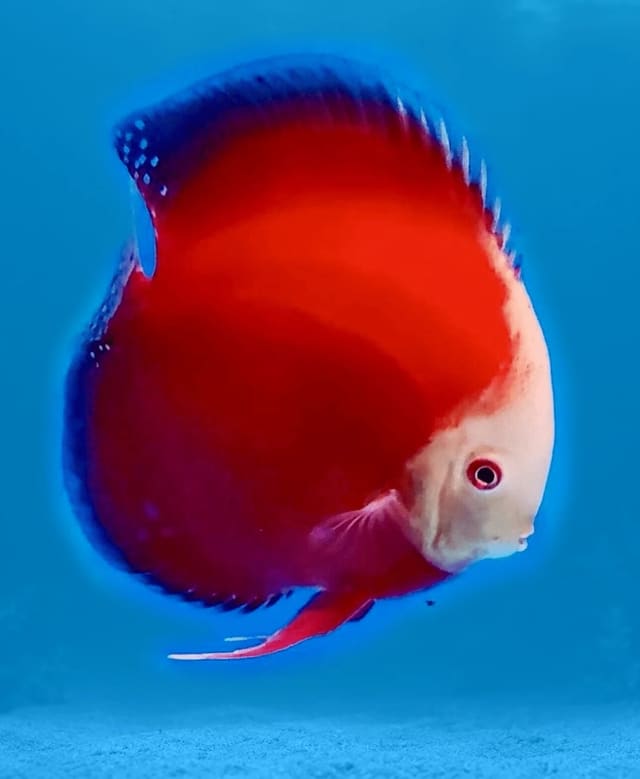
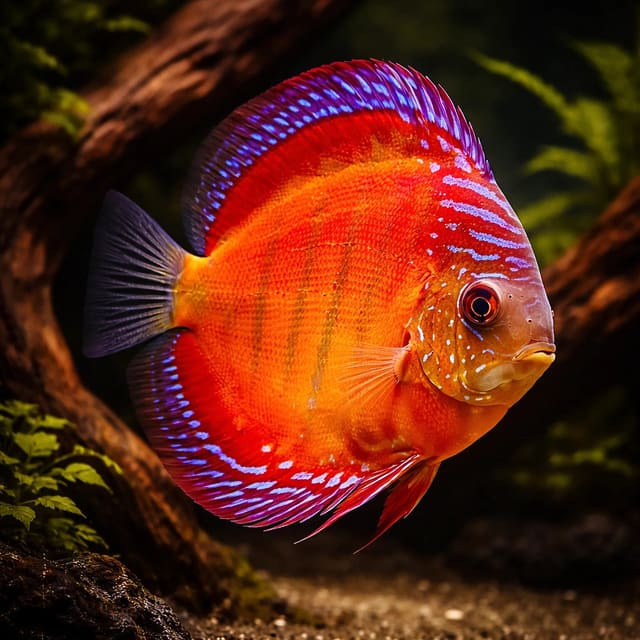
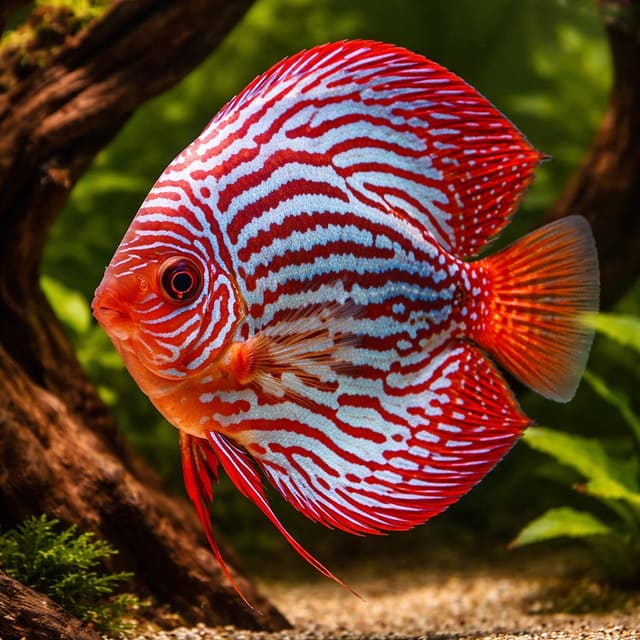
The gallery images are representative, based on reference photographs of this kind of animal, so colours can look slightly different from the live animal. Use the gallery to understand the intended high-bodied red-turquoise appearance, while allowing for natural differences in markings and colour between individual live fish.
Before selecting a grade, complete the adult-space calculation, confirm that the filter is mature and measure the aquarium water. A smaller dispatch fish still belongs in a plan capable of housing a social adult discus group at up to 20 cm across.
Maintain the aquarium between 26–30°C, at pH 6.0–7.5 and with general hardness of 4–12°dH. Carbonate hardness should be 3–10°dKH. Clean, warm, soft and slightly acidic water is the preferred direction within those ranges.
| Measurement | Working range or limit |
|---|---|
| Temperature | 26–30°C |
| pH | 6.0–7.5 |
| General hardness | 4–12°dH |
| Carbonate hardness | 3–10°dKH |
| Ammonia | Zero mg/l |
| Nitrite | Zero mg/l |
| Nitrate | Up to 20 mg/l |
Choose a stable position inside these limits and prepare the aquarium there before introducing the fish. Do not use one acceptable reading to overlook another: temperature, pH, hardness and nitrogen waste values work together as the water conditions experienced by the fish. Our aquarium water chemistry guide explains what the main tests measure, while the water matcher helps compare measured values with this discus range.
Take one set of readings before the weekly water change and another when the replacement water has mixed through the aquarium. The first set shows the conditions reached after a normal week of feeding; the second confirms that maintenance has returned the aquarium to its established working position without an abrupt change.
For example, a nitrate result nearing 20 mg/l before maintenance means the weekly routine must prevent it rising beyond that limit. A satisfactory nitrate result does not cancel an ammonia or nitrite reading above zero: either toxic-waste reading requires immediate attention to stocking, feeding and biological filtration.
Record the results at the same point in the maintenance cycle each week. Consistent records make changes easier to spot than isolated readings. Ammonia or nitrite above zero means the aquarium is outside the stated requirement, while nitrate must not be allowed to exceed 20 mg/l.
Regular partial water changes are the main route to clean discus water. Condition replacement tap water to remove chlorine or chloramine before it enters the aquarium, and make sure its use does not push the aquarium outside the chosen working values.
RSPCA aquarium guidance explains why filtration is vital: fish release toxic ammonia, and a working biological filter supports bacteria that convert ammonia to nitrite and then to the safer nitrate. Ammonia and nitrite are still required to remain at zero in a discus aquarium.
Prepare and mature the filter before the fish arrives. Our guide to maturing a first tropical aquarium provides a practical setup route. Before introducing livestock, test rather than relying on the appearance of clear water. The readiness checkpoint is zero ammonia, zero nitrite and nitrate no higher than 20 mg/l, with temperature, pH and hardness already inside the discus ranges.
Beneficial bacteria must process the waste created by the fish and their food. When fish numbers and feeding increase, the bacterial population also needs time to increase. Add fish only gradually; stocking too quickly can leave too few nitrifying bacteria to cope and may produce unhealthy ammonia or nitrite.
After adding fish or increasing the daily food, keep the next decision tied to water tests. Continue the established feeding and maintenance routine, then confirm that ammonia and nitrite remain at zero and nitrate remains no higher than 20 mg/l before making another increase. If either toxic-waste reading rises, pause the stocking plan and restore the filter-water balance first.
Clear-looking water is not a substitute for that checkpoint. Dissolved ammonia and nitrite can create a serious problem without making the aquarium visibly dirty, while a blocked filter can reduce effective water movement and waste processing. Inspect the equipment and use test results together.
Never keep fish in an aquarium without a well set up and maintained filter. Aquarium volume helps stability, but volume does not replace biological filtration. Likewise, a filter does not replace weekly testing and water changes. Build the group only as quickly as the measured water quality allows while keeping the final social requirement of at least five in view.
Carry out a 50% partial water change at least once every week. Use a siphon to remove solid waste from the substrate as water is withdrawn. Treat all replacement tap water with conditioner to remove chlorine or chloramine before adding it to the aquarium.
Do not rinse biological filter media under the tap. Chlorine or chloramine may kill the beneficial bacteria established on the media. Cleaning it lightly in removed aquarium water reduces that risk while clearing accumulated debris.
If sand is used, stir its open areas regularly to prevent dead spots where waste can build up. Keep this task focused on accessible open substrate rather than allowing waste to remain trapped around the feeding area. Fine gravel can be siphoned during the water change.
| Finding | Required response |
|---|---|
| Ammonia or nitrite above zero | Pause further stocking, check filtration and restore both to zero |
| Nitrate approaching 20 mg/l | Use maintenance to keep it from exceeding the limit |
| Blocked filter | Clear the blockage without washing biological media under tap water |
| Waste collecting in sand | Stir open areas and remove the released waste during the water change |
Use four weekly cycles to judge whether the routine is controlling waste consistently. Compare readings taken at the same stage each week, note how much debris is removed from the feeding area and check whether the filter repeatedly develops a blockage. A repeated rise in nitrate towards 20 mg/l is a practical signal to review food left uneaten, total stocking and the thoroughness of waste removal.
Keep filter cleaning proportionate. Check it for blockages each week, but rinse media lightly in removed aquarium water only when cleaning is needed. This preserves the useful bacterial population while keeping the filter clear enough to operate properly.
Watch the fish alongside the tests. Changes in swimming, breathing, colour, temperament, body condition or feeding can be early signs of a problem. If a concerning change persists, test the water promptly and contact us for further guidance.
Choose fine gravel or sand as the substrate. Discus may feed by blowing at the substrate, so a fine surface supports that natural action. If sand is selected, retain accessible open patches that can be stirred during maintenance to prevent waste dead spots.
Provide live plant cover because discus can be shy and benefit from places to shelter. Branches, wood and other aquarium ornaments can add further cover. At the same time, their tall, rounded body and social behaviour make open swimming space important, so do not fill the entire floor or central water column with decoration.
| Area | Purpose |
|---|---|
| Covered area | Plants, branches or wood give shy fish somewhere to retreat |
| Open substrate | Supports substrate feeding and allows waste removal |
| Open water | Gives the group room to swim and explore together |
| Filter access | Allows routine inspection for blockages and maintenance |
Judge the finished aquarium after every major object is in place. The nominal water volume is not the only space decision: the fish still need plenty of floor area and an open route through the aquarium. A layout that looks heavily furnished but leaves no group-swimming area misses that requirement.
Stand in front of the completed aquarium and trace three clear routes: from open water to cover, across the group-swimming area and from the feeding point to a place where waste can be siphoned. Move a branch, ornament or dense plant if it blocks all three routes or creates an inaccessible pocket where food can settle.
Then check practical access. The filter must remain easy to inspect for blockages, open sand must be reachable for stirring, and the main feeding area must be visible enough to judge whether food is cleared within a few minutes. This test connects the layout directly to the weekly maintenance and feeding decisions.
Overhead aquarium lighting is recommended. Plant cover and solid features give shy fish a choice of sheltered positions beneath that lighting. Watch how the group uses the aquarium: fish should be able to move into cover without being confined there and should also have space to explore as a group.
Keep the feeding zone accessible. Food left among inaccessible ornaments is harder to remove and can break down into toxic waste. A visible open feeding area makes it easier to judge whether each small meal is eaten within a few minutes and to siphon debris during the weekly water change.
Discus are generally carnivorous and eat aquatic invertebrates in the wild. In the aquarium, use a specialised dried discus food in granule or pellet form at least once each day so that the diet supplies adequate vitamins. Frozen or live foods may add variety; OATA specifically includes bloodworm, beef heart and prepared discus mixes among the choices.
Offer two to three smaller feeds through the day. Discus have relatively small stomachs, so several controlled meals suit them better than placing the whole daily ration into the aquarium at once. At every feed, give only what the fish can eat within a few minutes.
| Feed | Decision |
|---|---|
| First small feed | Use specialised discus granules or pellets |
| Second small feed | Choose a suitable frozen, live or prepared discus food |
| Third small feed | Offer another controlled portion only if the daily plan uses three feeds |
This is a pattern for distributing food, not a reason to increase the total amount. Stop adding food when the fish no longer clear it within a few minutes. Remove visible leftovers rather than allowing them to settle into substrate or decoration.
Begin each feed with a controlled amount and watch the group throughout the few-minute window. If food remains on the substrate or among ornaments when interest has stopped, remove it and reduce the next comparable portion. If the food is cleared, keep the portion controlled rather than automatically increasing it.
Check that the feeding point lets you observe the whole group. A dominant fish reaching every portion while another fish consistently hangs back is a social observation as well as a feeding issue. Review group pressure, cover, usable swimming space and water quality rather than solving the difference by adding excess food.
Overfeeding has two connected consequences. Uneaten food breaks down and releases toxic waste into the water, while the extra input increases the demand on the biological filter. Use feeding response and water tests together: a rich feeding routine is only successful when ammonia and nitrite remain at zero and nitrate stays no higher than 20 mg/l.
Reduced intake or a complete loss of interest in food is a health-warning sign, particularly when it appears alongside altered colour, hiding, unusual swimming or changed breathing. Check water quality first. Maintain the normal small-meal structure rather than adding larger portions in an attempt to force a feeding response.
Prepare the aquarium before the delivery window. Confirm that someone can receive the parcel, the filter is operating, temperature is 26–30°C, ammonia and nitrite are zero and nitrate is no higher than 20 mg/l. The aquarium should already be mature and ready; arrival day is not the time to begin stabilising its water.
Follow the current delivery and Live Arrival Guarantee policy. Float the closed bag for 20–30 minutes before releasing the fish. Do not pour the bag water into the aquarium.
Observe once after release, again during the next planned small feed and again before the aquarium lights finish their normal cycle. At each checkpoint, compare swimming, breathing, colour, hiding and feeding response. This gives you a sequence of observations instead of reacting to one brief movement.
If the fish hangs at the surface, sits on the bottom, swims erratically or breathes at a changed rate, test the water promptly. Check ammonia, nitrite and nitrate alongside temperature, pH and hardness, then correct the aquarium condition involved. Remove uneaten food so that a hesitant first feed does not add avoidable waste.
At each small meal, use the few-minute feeding window as an observation point. It shows whether the fish is engaging with food and whether uneaten material needs removing. Keep the established two-to-three-feed routine controlled rather than adding extra food because a newly introduced fish is hesitant.
Increase the aquarium population slowly. Every additional fish and every feeding increase adds waste that the beneficial bacteria must process. Before the next planned addition, repeat the water tests and check that the existing fish show appropriate swimming, feeding and social behaviour.
Plan Red Turquoise High Body Discus as a shoaling fish rather than a solitary centrepiece. Keep at least five, with more being better when aquarium volume and filtration support them. A fish kept singly or in too small a group will often become stressed or be bullied by larger, more dominant discus.
A group of five requires an adult planning calculation of at least 250 litres at 50 litres per fish. Six adults are suited to approximately 300 litres. More space can improve environmental stability, but it must still be paired with a mature filter, zero ammonia, zero nitrite and a maintenance routine capable of keeping nitrate no higher than 20 mg/l.
Two discus may sometimes be kept together when they are an already established breeding pair. Do not select two unrelated fish and assume that they will form that relationship. If the aquarium is not receiving an established pair, plan the normal group of at least five.
| Observation | What to review |
|---|---|
| One fish hides more than normal | Group pressure, cover and water quality |
| A larger fish repeatedly dominates | Group size, usable space and bullying |
| Colour becomes darker or paler | Water readings and social stress |
| Feeding interest falls | Water quality, group behaviour and health |
Use the controlled small meals as a regular social checkpoint. Look for a fish that repeatedly stays behind cover, is displaced from food by a larger individual or changes from normal swimming to persistent isolation. One missed approach to food is less informative than the same pattern across several planned feeds.
When a pattern appears, test the water first and then review the physical and social setup. Confirm that the aquarium still provides open group-swimming space, more than one route into cover and sufficient adult volume for the planned number. Do not treat extra food as the solution to repeated exclusion because leftovers increase the waste burden.
Provide both cover and open swimming room so a shy fish can retreat without the group losing its shared swimming area. Avoid keeping one discus as the permanent social plan, and avoid an undersized group unless the two fish are already an established breeding pair.
Only a limited selection of other fish will suit a discus aquarium. OATA identifies medium-sized tetras, Corydoras, plecos and dwarf cichlids as groups that may be considered. These are screening categories, not universal approvals for every species or every aquarium.
Start with the discus conditions: 26–30°C, pH 6.0–7.5, general hardness 4–12°dH, carbonate hardness 3–10°dKH, zero ammonia, zero nitrite and nitrate up to 20 mg/l. A proposed companion must fit the same aquarium conditions without forcing the discus outside these ranges.
For a six-discus plan, begin with the approximately 300-litre guidance and check that decoration still leaves plenty of floor space and open water. Next, confirm that the proposed companion fits the aquarium’s actual temperature, pH and hardness. Finally, include its feeding and waste in the filtration decision rather than judging capacity from discus numbers alone.
If any step fails, revise the plan before mixing the fish. A companion that needs different water is unsuitable for that setup even when its group appears in the list above. A water-compatible fish may still be a poor choice when the aquarium cannot retain the required discus space or the filter cannot keep ammonia and nitrite at zero under the combined load.
Smaller dither fish may help discus feel more confident because their activity can indicate that no predator is nearby. That possible benefit does not remove the need to screen the exact species and total stocking.
For a stocking and compatibility assessment, contact us with the aquarium volume, measured temperature, pH, hardness, existing livestock and planned discus number. Honest compatibility advice depends on that complete combination; a group name alone cannot decide whether an individual community will work.
It is an aquarium colour form within the cichlid genus Symphysodon. The name describes the intended high body and red-turquoise pattern, while care follows the genus and the wider discus group.
One purchase supplies one animal in the option chosen through the live size selector. Plan the number of purchases around OATA’s discus guidance: keep at least five.
The selector uses the labels 8cm (10cm), 10cm, 9 cm (11.5 cm) and XL selection HQ. These are dispatch grades; OATA’s discus group guidance says adults can reach up to 20 cm across.
Use a mature, filtered aquarium with fine gravel or sand, plant or wood cover and open group-swimming space. OATA’s discus guidance says allow 50 litres per adult; approximately 300 litres houses six adults.
OATA’s discus guidance says keep at least five, with more being better when space and filtration allow. Two may sometimes be kept when they are an already established breeding pair, but a single fish or undersized group will often become stressed or be bullied by larger, more dominant fish.
OATA’s discus group guidance says maintain 26–30°C, pH 6.0–7.5, general hardness 4–12°dH and carbonate hardness 3–10°dKH. Keep ammonia and nitrite at zero mg/l and nitrate no higher than 20 mg/l.
OATA’s discus guidance says give two to three small feeds, with specialised discus granules or pellets at least once daily. Frozen or live foods may add variety, but offer only what is eaten within a few minutes.
Start filming the sealed parcel before opening it, continue in one take and show the fish inside the sealed bag. Float the bag for 20–30 minutes before release, do not pour the bag water into the aquarium, and send the video with the order number if making a Live Arrival Guarantee claim.
OATA’s discus guidance says medium-sized tetras, Corydoras, plecos and dwarf cichlids may be considered after individual screening. Match the exact companion to 26–30°C water, aquarium capacity and the social needs of at least five discus.
No reviews for this item yet. Bought one? Honest reviews only, good or bad.
What customers say about ordering from us
I have a small group of long finned mountain minnows. So was delighted to be able to order ten of this variety to increase the genetics in my tank . The ones I recieved are healthy but it’s to early to give a verdict on wether they are of a long finned type since they are small currently.
Gordon Walker · 23 Sept 2026
100% success travel and "installation". Pleased with quality of purchase. The Siamese fighter a bit "shy" so have not yet seen him at his best yet but looking good. Happy customer. GG
George E Garratt · 21 Sept 2026
Reviews of our shop, collected by Judge.me, an independent third-party review collector. Newest first.