−15%
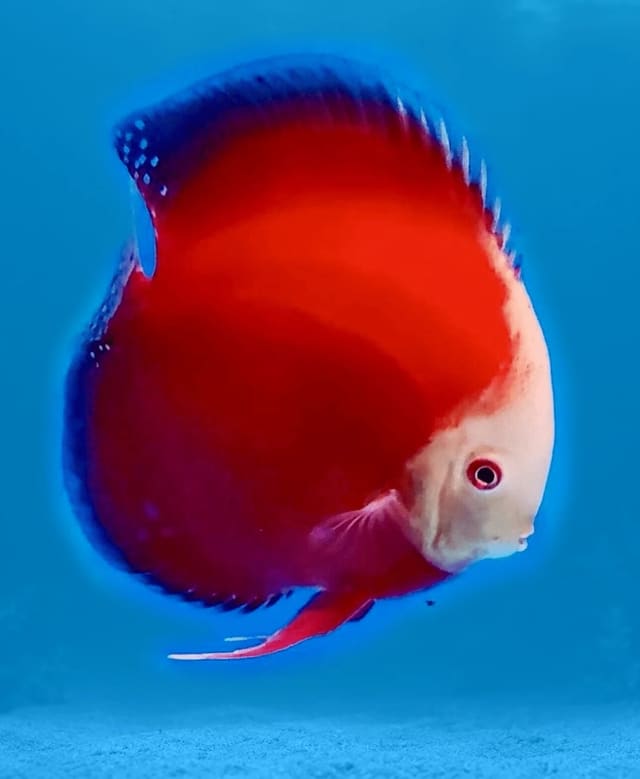
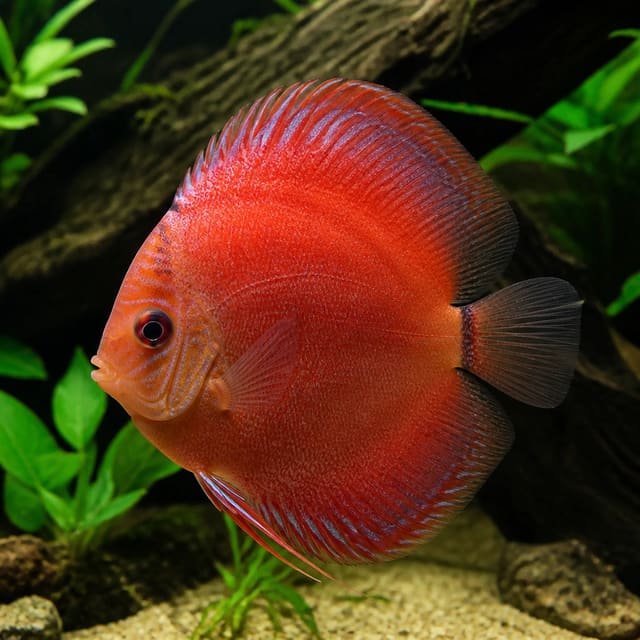
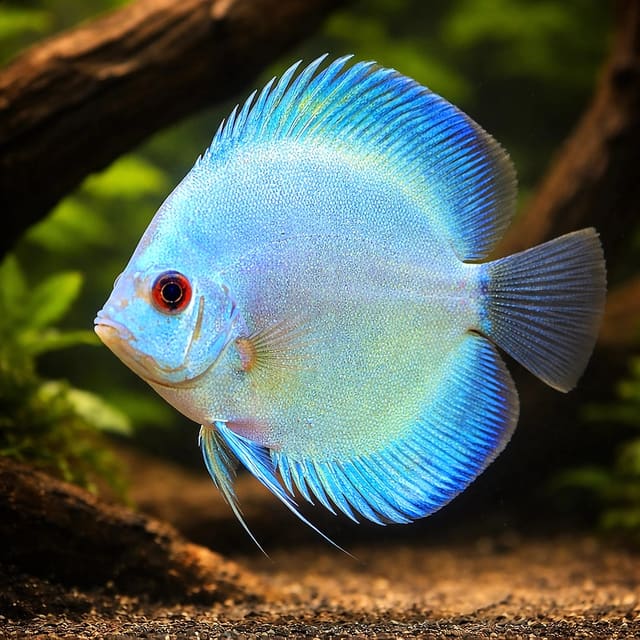
Red Melon Discus (Symphysodon sp.)
26–30°C · pH 6–7.5
£44.19£51.99
Turquoise Checkerboard Discus (Symphysodon sp.) is a domestic discus colour strain, sold as one live fish per purchase. It should live in a group of at least five and needs warm, soft, very clean water in a large, mature aquarium planned for adult fish.
Symphysodon sp.
Save when buying multiple fish. Each quantity is one fish; sex and pair formation are not guaranteed unless the selected variant explicitly states them.
Turquoise Checkerboard Discus (Symphysodon sp.) is a domestic discus colour strain, sold as one live fish per purchase. It should live in a group of at least five and needs warm, soft, very clean water in a large, mature aquarium planned for adult fish.
Discus are social Amazonian cichlids with specialised aquarium needs. OATA advises at least five fish, except an established breeding pair, and about 50 litres per adult—roughly 300 litres for six adults. Use that as a planning floor, then check usable dimensions, filtration, source water and the actual fish.
Maintain these water conditions for optimal health and vibrant colors
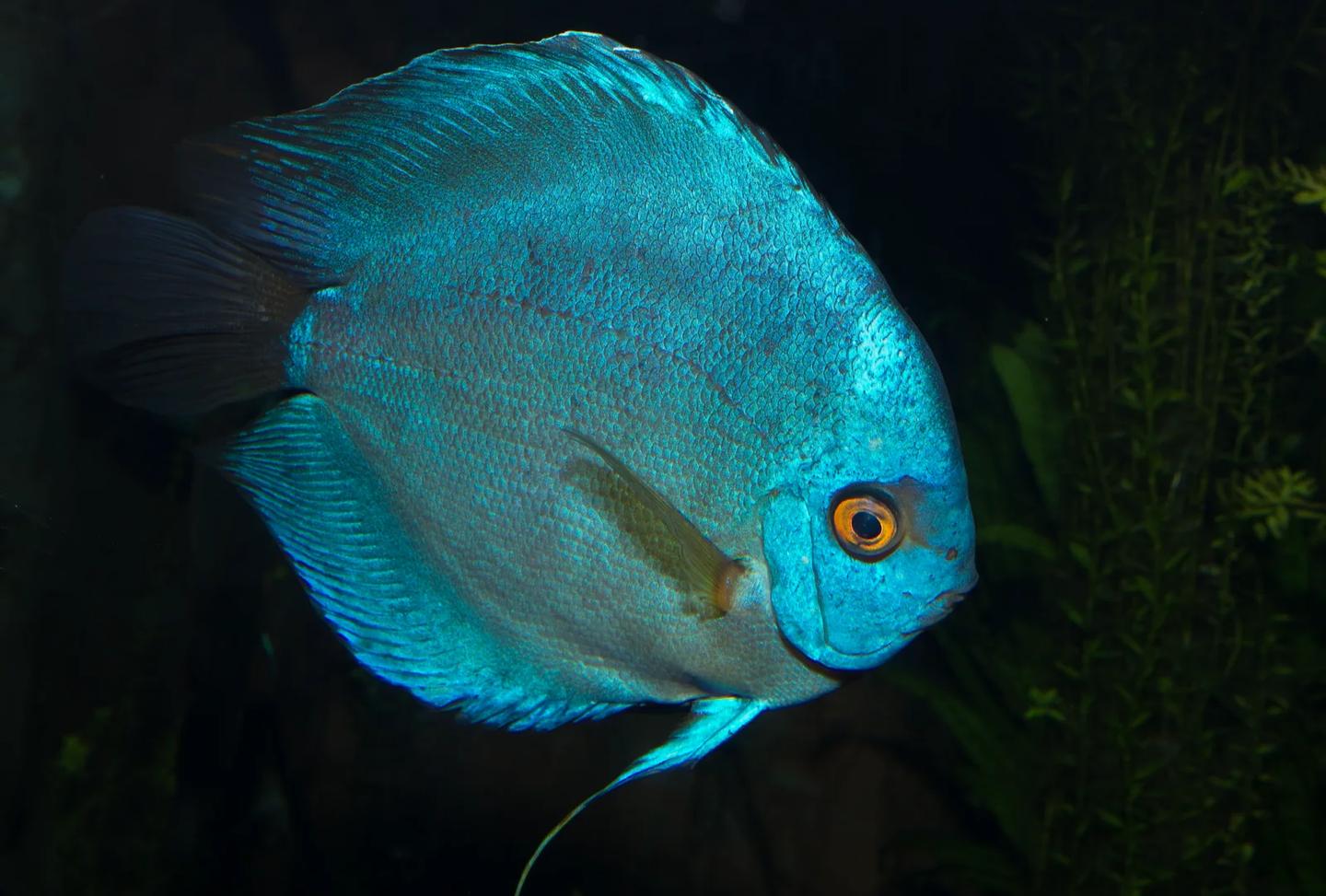
The Turquoise Checkerboard Discus is a domestic colour strain of discus, a fish held in the highest regard by many fishkeepers and described by some as the ultimate freshwater tropical species. In the photograph, fine turquoise-blue lines break into short dashes across a warm orange-brown body, which is where the checkerboard name comes from. Each purchase supplies one live fish at the size you choose.
Discus are cichlids that originate from South America. They are social, they need warm, soft and very clean water, and they grow slowly into large adults. That makes them a fish to plan for rather than buy on impulse: the aquarium has to suit a group of adult discus, not one young fish. Give them the right set-up and a steady routine, and a settled group becomes the centrepiece of the room.
| Suits | Experienced keepers with a large, mature aquarium planned for a group |
|---|---|
| Identity | Domestic discus colour strain, genus Symphysodon |
| You receive | One live fish per purchase, at the size you select |
| Adult size | Discus can reach up to 20 cm across and grow slowly |
| Group | At least five discus, and more is better |
| Aquarium | About 50 litres of water per adult discus, with plenty of floor space |
| Water | OATA guidance for discus: 26–30°C, pH 6.0–7.5, 4–12°dH |
| Diet | Discus granules or pellets plus frozen or live foods |
| Care level | Advanced, in our assessment |
The Turquoise Checkerboard is a good choice if:
It is worth waiting if your aquarium is new, small or already well stocked, or if your tap water is far from soft. None of those rules discus out for good; each one simply needs solving before the fish arrive.
Its care is the same as for any other discus. What sets the Turquoise Checkerboard apart is its pattern, not its needs, so everything on this page applies to the whole group you keep, whichever colour forms it includes.
This discus comes in six sizes: 5 cm (6.5 cm), 6 cm (7.5 cm), 7cm, 8cm, 9cm and 10cm. The size you select is the size supplied, not the adult size. Because discus grow slowly and adults can reach up to 20 cm across, even the largest choice here is a young fish with most of its growing still ahead of it. Every size is the same domestic strain; they differ only in how far each fish has grown so far. Stock moves between sizes, so the product page shows which ones you can order when you visit.
If you are building a group, buying the fish at a similar size means no single discus starts out much bigger than the rest. That matters because discus kept in too small a group will often be bullied by larger or more dominant fish.
It is difficult to sex discus unless they are in breeding condition, when the female’s ovipositor can be seen. Sex is guaranteed only when the selected option explicitly states male or female. This Turquoise Checkerboard Discus listing has no sex-guaranteed option.
FishBase lists three species in the genus Symphysodon. Domestic colour strains such as the Turquoise Checkerboard have been selectively bred for their appearance and are sold under their strain name. The exact species has not been identified, so the care advice here follows the genus Symphysodon and its care group.
The photograph shows one turquoise checkerboard discus beside bogwood and tall green plants over a sandy floor. Gallery images have been digitally enhanced to improve image quality. Natural colour, pattern, size and maturity can vary between live animals.
Start with the aquarium, because it decides almost everything else. OATA advises buying an aquarium as large as possible, within reason, and allowing each adult discus 50 litres of water volume with plenty of floor space. On that basis, an aquarium of approximately 300 litres will house a shoal of six adults. The larger the aquarium, the more stable the temperature and water quality will be, and stability is exactly what discus need.
Work from the number of adult discus you intend to keep, using OATA’s 50 litres per adult:
| Five adult discus | About 250 litres of water |
|---|---|
| Six adult discus | About 300 litres of water |
| Eight adult discus | About 400 litres of water |
These are volumes of water, not the nominal size printed on the tank. Substrate, wood, rock and equipment all take up space, so a tank sold as 300 litres holds less once it is furnished. OATA asks for plenty of floor space as well as volume, because a group of discus needs room to move around together.
A useful way to picture the layout is a planted, wooded background with a clear stage in front of it. The fish retreat into the planting when they feel unsure and come out into the open water as they settle.
Discus should go into an aquarium whose filter is already mature, never a newly filled tank. Our guide to setting up and maturing a first tropical aquarium explains how to build up the filter bacteria before any fish arrive. The same steps apply to a discus aquarium; the difference is scale, and the standard of water quality you need to hold once the fish are in.
OATA’s discus care sheet is clear that discus need more specific water parameters than many other fish. Clean, warm, soft and slightly acidic water is the optimum for all discus, and the best way to keep it that way is regular partial water changes. Tank-bred discus can tolerate harder water than their wild counterparts, but that tolerance does not change the target.
| Temperature | 26–30°C |
|---|---|
| pH | 6.0–7.5 |
| General hardness | Soft to medium, 4–12°dH |
| Carbonate hardness | Soft to medium, 3–10°dKH |
| Ammonia | Zero |
| Nitrite | Zero |
| Nitrate | Not above 20 mg per litre |
These values are OATA’s guidance for discus as a group, not a tailored optimum for this colour strain. The most reliable way to settle new fish is therefore to find out the conditions they have been kept in and replicate them in your aquarium as closely as you can. Ask about the water before you buy, and set your aquarium up to match it before the fish arrive.
Fish release ammonia into the water, and ammonia is toxic. As the RSPCA’s guidance on aquarium filtration explains, a working biological filter grows beneficial bacteria that break waste down naturally: ammonia is converted to nitrite, which is also toxic, and then eventually to nitrate, which is safer. No fish should be kept without a well set up and maintained filter, and for discus that filter has to keep pace with a group of large, well-fed fish.
Nitrate is the end product of that process, and it builds up between water changes. OATA sets the limit for discus at 20 mg per litre, and large, regular water changes are what keep it below that level.
Keep the aquarium steadily within 26–30°C, day and night. In a UK home that means a reliable heater sized for the aquarium and a thermometer you check every day. Check it again after each water change, because a large volume of new water can pull the temperature down if it goes in too cool.
pH describes how acidic or alkaline water is, with 7 as neutral, so OATA’s 6.0–7.5 for discus runs from slightly acidic to just above neutral. General hardness (GH) mainly reflects dissolved calcium and magnesium, while carbonate hardness (KH) is the water’s buffering capacity, which helps hold pH steady. OATA gives soft to medium values for both: 4–12°dH general hardness and 3–10°dKH carbonate hardness. Very soft water with little buffering can let pH move more easily, which is another reason to test regularly rather than occasionally.
Test the water regularly, at least once a week, so that ammonia and nitrite never have the chance to build up unnoticed. If you are not sure which tests matter most or how to read them, our guide to aquarium water parameters explains what to test and why. You can then compare your own results with the discus values using our water parameter matcher.
Test your tap water as well as your aquarium water. If your tap water sits well outside the discus values, plan how you will prepare water for weekly changes before you buy the fish, because a 50% change of unsuitable water undoes everything else you have done.
Discus reward a predictable routine. OATA strongly recommends a partial water change of 50% at least once every week. That is a large change, and it is the heart of discus care: regular partial water changes are how you keep the water clean, warm, soft and slightly acidic.
Keeping the same day and the same order each week makes the routine easy to hold and makes changes in the fish easier to spot. It also gives you a regular moment to look at every discus closely, which is the best early warning you have.
Half the water every week is a real commitment in a large aquarium, so think about the practical side before you buy. A long siphon hose, a way of treating and warming a large volume of replacement water, and a set time in the week all help. If the routine is hard to keep up, the water quality will drift, and discus need it to stay stable.
In the wild, discus are generally carnivores and eat aquatic invertebrates. In the aquarium, OATA recommends a diet built on specialised discus foods with frozen or live foods added:
Overfeeding undoes the work of your water changes. Uneaten food breaks down and releases toxic waste into the water, so if food is still lying on the bottom after a few minutes, feed less next time and siphon out what is left.
One way to put that advice into practice for a group is three small feeds:
| First feed | Dried discus granules or pellets |
|---|---|
| Second feed | Frozen bloodworm, beef heart or a discus mix |
| Third feed | A small portion of granules or pellets |
Adjust the portions so each feed is cleared within a few minutes. If you can only manage two feeds on some days, keep them small rather than making up the difference with one large meal.
In a group, watch every fish at feeding time rather than the food. A discus that stops showing interest in food or starts to lose body condition needs attention: both are on OATA’s list of changes to watch for, and feeding time is when you will see them first.
Discus spend their day as a group. Expect them to explore the open water together, drift back into the planting and wood when something unsettles them, and pick over the floor of the aquarium, feeding naturally by “blowing” at the fine gravel or sand. They are not as aggressive as some of their close cichlid relatives, but they can be shy.
Confidence comes from company. Discus use smaller “dither” fish as a sign that there are no predators nearby, and a group of their own kind is the foundation of a settled tank. A discus that spends most of its time hiding, turns darker or paler than usual, or stops coming forward at feeding time is telling you something has changed, and the first step is always to test the water.
Get the aquarium ready before the delivery date: the water should already be within 26–30°C, ammonia and nitrite should read zero, and you should know the parcel will be met. Having the water tests and a clean bucket to hand saves time when the parcel arrives.
Every order is hand-packed by our team. Fish are hand-bagged in pure oxygen and packed in an insulated poly box, with a heat pack when the weather calls for it, and a licensed live-animal courier delivers the parcel with tracking. We email you the tracking number and your confirmed delivery date so you know when to be in. On the day, follow these steps in order:
Those conditions are part of our Live Arrival Guarantee. Read the full delivery and Live Arrival Guarantee policy before you order so you know exactly what to expect.
Before any fish go in, make sure the aquarium is an appropriate size for the number of discus you want to keep, and check that ammonia and nitrite are both at zero. Then increase the number of fish only slowly. The beneficial bacteria in a matured filter need to grow every time more fish are added and feeding increases.
Stocking too many fish, or stocking too quickly, can cause “new tank syndrome”: there are not enough nitrifying bacteria to cope with the extra waste, ammonia and nitrite rise to unhealthy levels, and fish may become ill or die. With discus the sensible plan is to treat the group as the core of the aquarium, have the filter fully matured before it arrives, and add any companions gradually afterwards, testing ammonia and nitrite as you go.
Healthy fish have clear, bright eyes, undamaged fins, intact scales, no ulcerations or bumps and appropriate swimming behaviour. Every fish varies slightly in behaviour and appearance, so get to know your group and watch for changes in:
If you are concerned about the health of any fish, test your water quality first. Then contact us for further guidance, with your test results to hand.
A notebook or phone note with the date, your test results, the size of each water change and anything unusual you noticed makes gradual changes much easier to see. When a fish starts to eat less or changes colour, a record of the previous few weeks often shows what changed first.
A young discus is a long-term commitment. Discus can live for many years in a well-matured set-up with good water quality, and they are slow growers, so the aquarium you plan now needs to suit the same fish when they are adults up to 20 cm across.
Keep the first weeks after arrival calm and predictable. Feed small portions, watch every fish eat, and test ammonia and nitrite more often than once a week while the filter adjusts to the extra fish and food. Hold off adding anything else until those readings have stayed at zero, because the filter bacteria need time to catch up every time more fish are added and feeding increases.
As the group grows, the demands on the aquarium grow with it: more food goes in, more waste comes out, and the filter and your weekly water change are doing more work. Keep testing weekly, and treat any rise in ammonia or nitrite as a sign the aquarium is at its limit rather than something to tolerate.
Discus are sometimes kept as an established breeding pair. It is difficult to tell males and females apart until they are in breeding condition, and a pair is not something you can reliably put together by picking two young fish.
Discus are shoaling fish. OATA advises keeping them in groups of at least five in the home aquarium, and says that more is better. They are social fish, and those kept singly or in too small groups will often become stressed or bullied by larger or more dominant fish.
The only exception OATA gives is a pair: it is sometimes possible to keep two discus in a set-up provided they are an already established breeding pair. For anyone starting out with young fish, that means a group.
There are many different colour variations of discus, all selectively bred, and OATA’s group advice applies to discus in general rather than to one colour form. You can browse our discus collection if you are planning a group, keeping the same numbers and space in mind whichever colours you choose.
Because a discus aquarium is built around discus needs, only a handful of other species will be suitable companions. OATA names four kinds:
Adding some of these can help discus feel more confident. Discus use smaller “dither” fish as a signal that there are no predators nearby, so a calm group of companions moving about the aquarium can make shy discus more willing to come out into the open.
| Water | The same warm, soft, slightly acidic water the discus need |
|---|---|
| Maintenance | A 50% weekly water change and the feeding routine of a discus aquarium |
| Temperament | A calm aquarium in which shy discus can settle |
| Stocking | Added gradually, after the discus group, with water tests as you go |
Fish that need cooler or harder water than the discus range do not belong in this aquarium, however peaceful they are. Check each companion against the discus water values before buying it, and keep numbers modest so the aquarium stays comfortably within its filtration.
Discus are slow growers, but OATA’s discus care sheet notes that adults can reach up to 20 cm across. Plan the aquarium, the filtration and the group around fish of that size, not around the size they are when they arrive.
OATA advises allowing each adult discus 50 litres of water volume with plenty of floor space, and says an aquarium of approximately 300 litres will house a shoal of six adults. Within reason, buy the largest aquarium you can, because a bigger volume keeps temperature and water quality more stable.
Keep discus in a group of at least five, and more is better. They are social fish, and those kept singly or in too small groups will often become stressed or bullied by larger or more dominant fish. Two can sometimes share an aquarium if they are already an established breeding pair.
We rate it as a fish for advanced keepers. Discus have specialised care requirements, need more specific water parameters than many other fish and do best with a 50% partial water change at least once every week, so they suit keepers who already run a stable, well-maintained aquarium.
In the wild, discus are generally carnivores that eat aquatic invertebrates. Feed a specialised dried discus granule or pellet at least once a day for vitamins, and add frozen or live foods such as beef heart, bloodworm and discus mixes. Give only what they eat within a few minutes, split into two to three smaller feeds through the day.
OATA’s discus care sheet gives 26–30°C, pH 6.0–7.5, soft to medium general hardness of 4–12°dH and carbonate hardness of 3–10°dKH, with ammonia and nitrite at zero and nitrate no higher than 20 mg per litre. These figures cover discus as a group, so aim to match the water the fish have been kept in.
Discus, including this Symphysodon sp. colour strain, are not as aggressive as some of their close cichlid relatives, and they can be shy. Keep enough of them: a discus kept alone or in too small a group will often become stressed or bullied by larger or more dominant fish.
Only a handful of species suit a discus aquarium. OATA names medium-sized tetras, Corydoras, plecos and dwarf cichlids, and notes that smaller dither fish can help discus feel more confident. Any companion must suit the same warm, soft, slightly acidic water.
Each fish is hand-bagged in pure oxygen and packed in an insulated poly box, with a heat pack when the weather calls for it, then carried by a licensed live-animal courier with tracking. Someone must be at the address to receive the parcel. Start one continuous unboxing video while the parcel is still sealed and keep filming until the fish are shown still in the bag, because our Live Arrival Guarantee needs that video and a same-day inspection. Then float the bag for 20–30 minutes before releasing the fish, and never pour the bag water into your tank.
The care guidance on this page draws on these public sources:
No reviews for this item yet. Bought one? Honest reviews only, good or bad.
What customers say about ordering from us
Easy website plenty of info on fish your buying great to pick a time slot
TRACEY DURRANT · 7 Oct 2026
Got some lovely fish thank you
Kevin Mackie · 7 Oct 2026
Reviews of our shop, collected by Judge.me, an independent third-party review collector. Newest first.