Moderate
Blue Angelfish (Pterophyllum scalare)
24–27°C · pH 6.5–8 · 200L
£9.99

The Marble Angelfish (Pterophyllum scalare) is a tall freshwater cichlid from the Amazon basin in South America that reaches 15 cm. It suits prepared intermediate keepers; plan a compatible pair or a managed group of five or more in routine water of 24–27°C, pH 6.5–8.0 and 5–12 dGH, the overlap of FishBase species values and OATA group guidance. Sold individually in dispatch sizes from 1 cm to XXL (>7 cm).
Adult size is the maximum length this species reaches at full maturity (scientific sources). The livestock you receive will be younger and smaller — pick a size above for the actual shipping size. Product-photo provenance and any image-specific limitations are stated on the listing.
Minimum of 2 per order.
The Marble Angelfish (Pterophyllum scalare) is a tall freshwater cichlid from the Amazon basin in South America that reaches 15 cm. It suits prepared intermediate keepers; plan a compatible pair or a managed group of five or more in routine water of 24–27°C, pH 6.5–8.0 and 5–12 dGH, the overlap of FishBase species values and OATA group guidance. Sold individually in dispatch sizes from 1 cm to XXL (>7 cm).
Adult size is the maximum length this species reaches at full maturity (scientific sources). The livestock you receive will be younger and smaller — pick a size above for the actual shipping size. Product-photo provenance and any image-specific limitations are stated on the listing.
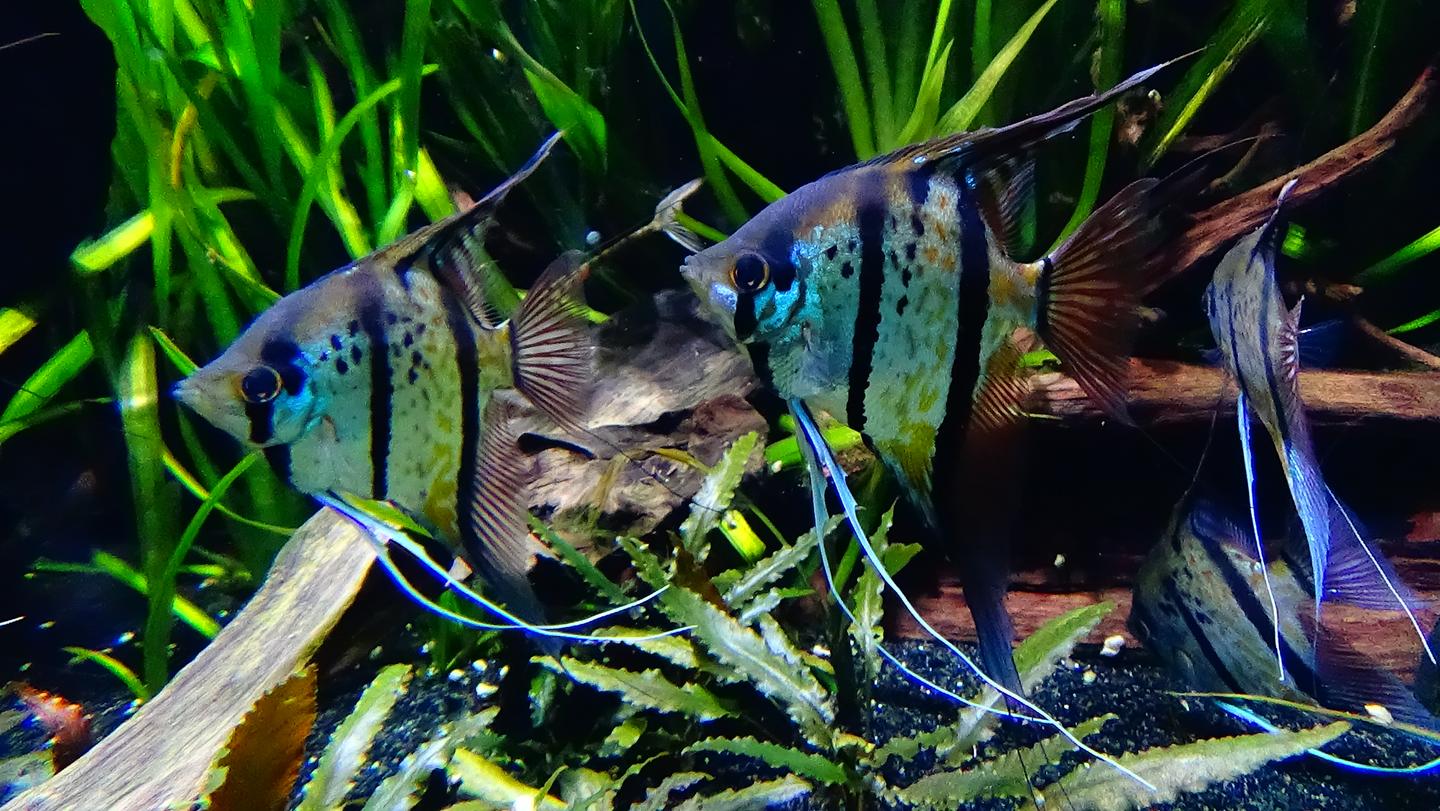
Freshwater angelfish are tall South American cichlids, not small community fish. OATA gives 120 litres as an industry floor for a compatible pair and says the aquarium must be sufficiently tall. We prefer planning around roughly 200 litres, a 100 × 40 cm footprint and about 50 cm height for an adult pair, with more space and an exit plan for a group.
Maintain these water conditions for optimal health and vibrant colors
Marble Angelfish is a domestic colour form of Pterophyllum scalare, a tall freshwater cichlid from the Amazon basin in South America that reaches 15 cm. It suits an intermediate keeper prepared to provide a mature, spacious aquarium and manage changing social behaviour. The accepted species name remains Pterophyllum scalare, in the family Cichlidae.
The native range covers parts of Brazil, Colombia, French Guiana, Guyana and Peru. FishBase records adults in densely vegetated swamps and flooded ground with clear or silty water, giving useful inspiration for tall plants, roots and sheltered areas. Aquarium care should still be planned around measured water, adult dimensions and the behaviour of the fish in front of you.
| Suits | Not suited to |
|---|---|
| A prepared intermediate keeper | A beginner seeking a shortcut around cycling, testing and social planning |
| A mature aquarium planned around roughly 200 litres for a compatible adult pair | A shallow aquarium sized only for a juvenile |
| A compatible pair or deliberately managed group with a separation plan | Default isolation or two random fish assumed to be compatible |
| Stable routine water of 24–27°C, pH 6.5–8.0 and 5–12 dGH | Cold-water conditions or abrupt chemistry changes |
Plan around a recorded maximum of 15 cm total length. Extended fins can make an adult roughly 20–25 cm tall, so upward growth is the decisive feature. A shallow aquarium can hold a respectable nominal volume while still restricting the dorsal and anal fins or leaving too little vertical turning room.
For a compatible adult pair, plan roughly 200 litres, about a 100 × 40 cm footprint and 50 cm usable height. Use routine water of 24–27°C, pH 6.5–8.0 and about 5–12 dGH. Our complete freshwater angelfish care guide explains the adult planning policy in greater depth.
One purchase supplies one Marble Angelfish in the size chosen on the live selector. The size you select is the size supplied, not the adult size. Use the selector itself when choosing between the named grades, then keep the 15 cm adult-length and 20–25 cm overall-height plan separate from that choice.
| Selector label | Meaning |
|---|---|
| 1 cm | Approximate dispatch grade |
| 1.5-2 cm | Approximate dispatch range |
| 2.5-3 cm | Approximate dispatch range |
| 3 - 3,5 cm | Approximate dispatch range |
| 4-5 cm | Approximate dispatch range |
| 5-5.5 cm | Approximate dispatch range |
| L (5.5-6 cm) | Named dispatch grade with its size range |
| XL (6-7 cm) | Named dispatch grade with its size range |
| XXL (>7 cm) | Named dispatch grade above 7 cm |
Smaller grades still need a complete adult aquarium plan. Do not build a temporary setup around the fish’s first measurement unless a larger, cycled aquarium is already prepared for the next stage. The filter, social group and tank mates must also be chosen for the eventual biomass and territorial behaviour rather than the dispatch grade alone.
Sex is guaranteed only when the selected option explicitly states male or female. This Marble Angelfish listing has no sex-guaranteed option.
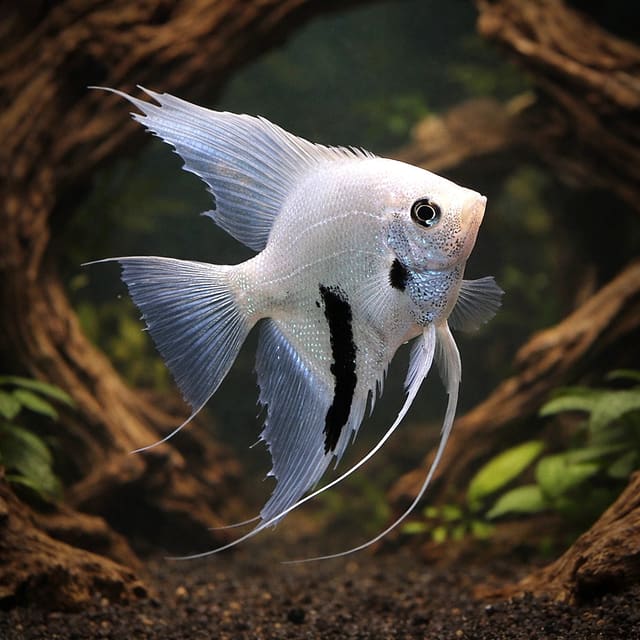
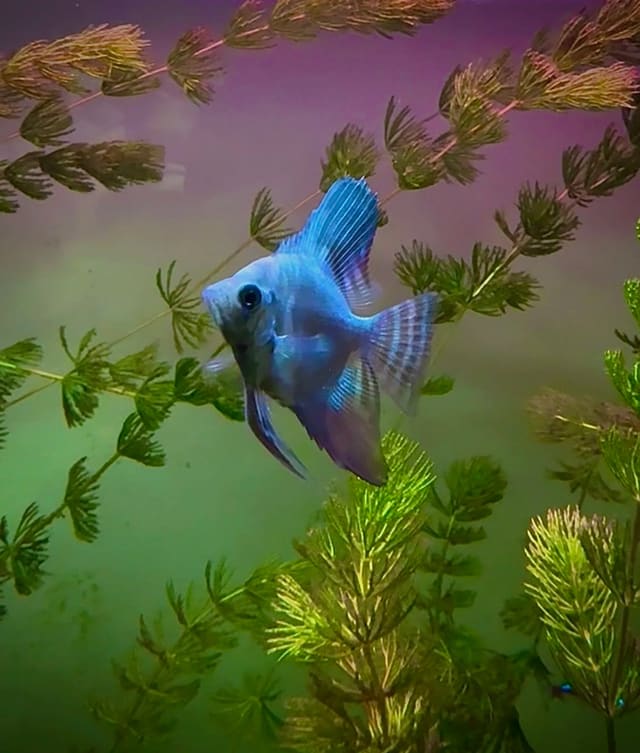
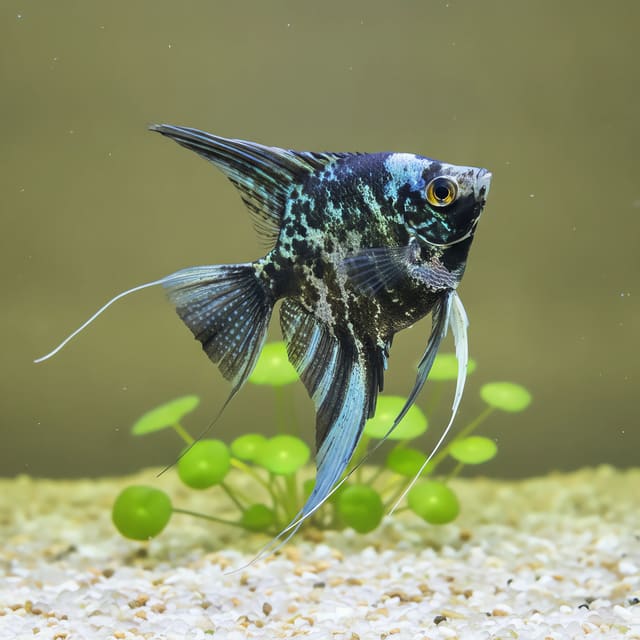
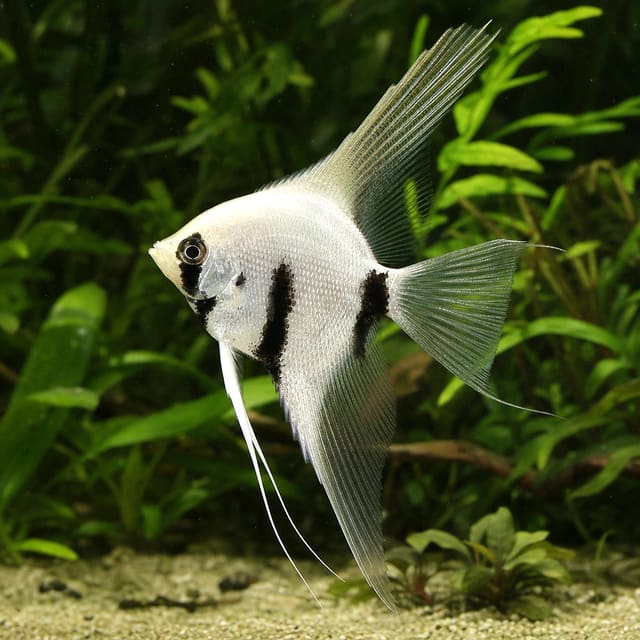
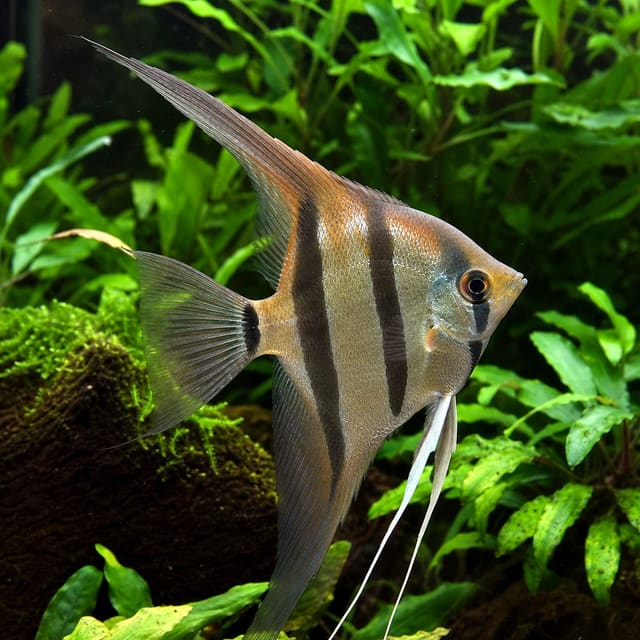
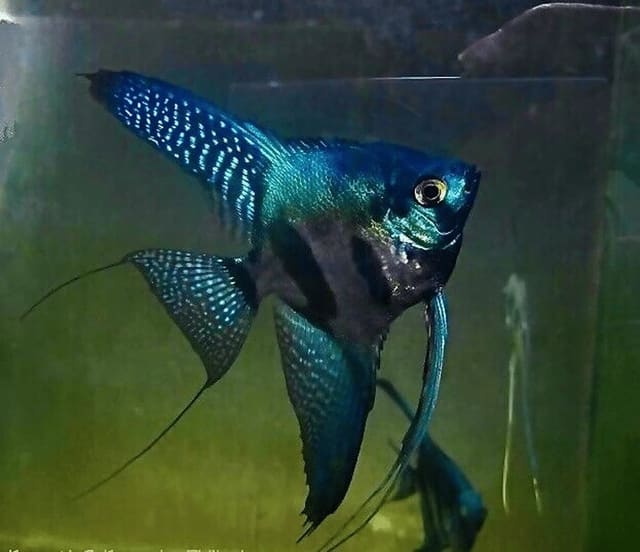
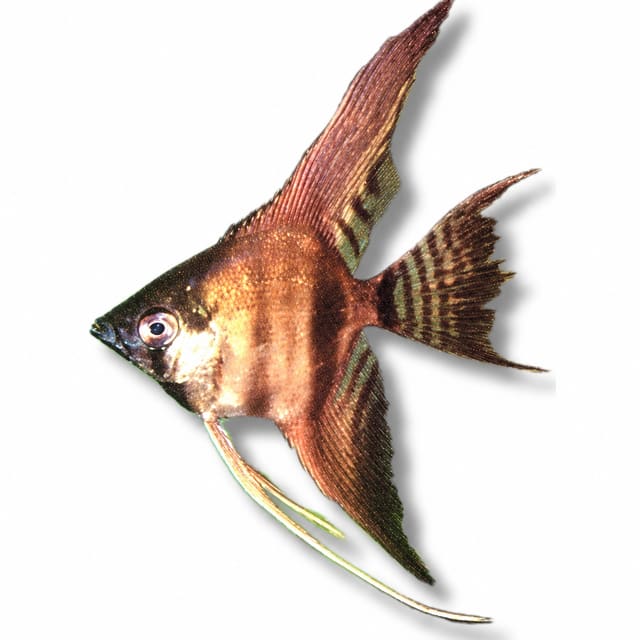
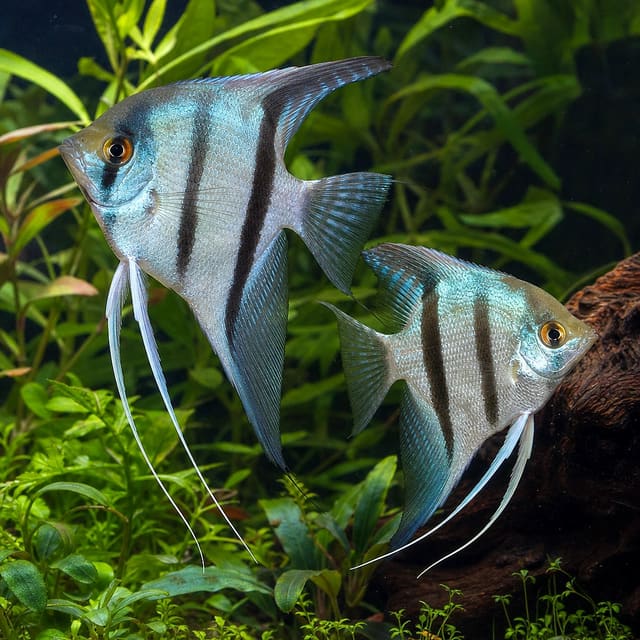
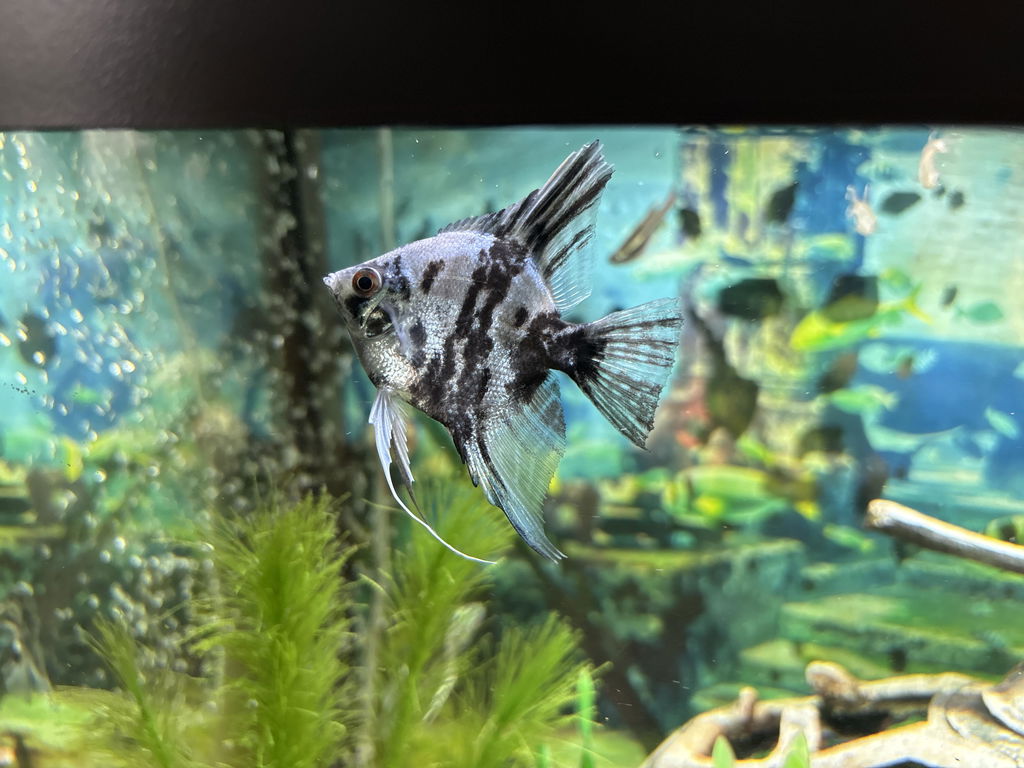
The gallery images are representative of this type of animal rather than photographs of the exact animal supplied, so colours can look slightly different from the live animal.
The gallery scene shows two gold and silver angelfish with pale blue patches, fine reddish speckles and long trailing fins. Its pair of visible fish does not alter the one-animal purchase unit. Treat the image as a guide to angelfish body shape and finnage rather than an exact marble-pattern promise.
Seriously Fish recommends an aquarium measuring 100 × 40 × 50 cm, approximately 200 litres, as the smallest species-focused plan. That gives an adult pair useful horizontal territory as well as the vertical room needed by the extended dorsal and anal fins. Measure usable water height after allowing for substrate, the waterline and any equipment that occupies the swimming area.
OATA’s American-cichlid guidance is broad group guidance: it gives at least 120 litres for a pair of smaller American cichlids, says adult angelfish need a sufficiently tall aquarium and suggests allowing 40 litres per adult when stocking them. We use the more conservative 200-litre, 100 × 40 cm and 50 cm usable-height plan for a compatible adult pair.
Aquarium shape can defeat a litre figure. A long but shallow tank may offer swimming distance without safe fin clearance, while a tall but narrow tank may prevent an adult from turning comfortably. Keep open routes through the middle of the aquarium and avoid filling every vertical plane with wood or plants.
A tank sold as 50 cm tall may offer less usable water height after adding substrate and leaving space below the rim. Measure from the top of the substrate to the normal waterline, then check whether wood, filter pipes or dense planting narrow the routes an adult would use. For example, a 5 cm substrate bed in a tank holding water to 3 cm below the rim removes 8 cm from the stated height before decor is considered. Rework the layout if long fins would have to brush the substrate, surface or ornaments during a normal turn.
Angelfish are social cichlids, but social does not mean that any two individuals will form a peaceful pair. The species entry advises groups of five or more, while UK group guidance treats a pair or group as the minimum social plan and warns that a fish kept alone may become stressed. A compatible pair and two fish selected at random are different arrangements.
A juvenile group can allow pair formation and normal social choice. As the fish mature, hierarchy, feeding access and preferred territories may change. A forming pair can claim a broad leaf, piece of wood, aquarium wall or another vertical surface, then drive lower-ranking fish away from food or shelter. More fish therefore requires more space, not simply more hiding places inside the same pair-sized tank.
| What you see | What to do |
|---|---|
| All fish feed and move through several areas | Continue observing body condition, fins and access to shelter |
| One fish hangs back at every meal | Spread food across more than one point and check whether territory blocks access |
| Repeated cornering, torn fins or persistent hiding | Use the prepared mature separation aquarium before injury or weight loss develops |
| A pair starts cleaning a vertical surface | Expect stronger territorial defence and reassess every companion’s escape space |
Do not rely on a single quiet day as proof of long-term compatibility. Observe during feeding, after maintenance and when the lights follow their normal cycle, because competition may appear only around a valued area or meal. A workable group plan includes a second suitable aquarium or a realistic rehoming route before conflict begins.
During the first week, record which fish reaches each feeding point and which areas each one uses. Repeat the check after decor is moved, after a water change and whenever two fish begin spending time together near a vertical surface. At the end of the first month, compare fin condition, body profile and feeding access with the first-week observations. A fish that is consistently excluded needs action even if no dramatic fight occurs, because repeated missed meals and restricted movement can develop gradually.
Use 24–27°C, pH 6.5–8.0 and approximately 5–12 dGH as the routine aquarium target. This deliberately overlaps the species range of 24–30°C, pH 6.0–8.0 and 5–13 dGH with the American-cichlid range of 22–27°C, pH 6.5–8.0 and 4–12 dGH. Stability inside the routine range matters more than repeatedly chasing a single ideal reading.
Measure temperature with a thermometer instead of relying only on the heater dial. Test pH and hardness before altering the source water, particularly when moving a fish between aquariums or introducing it after transport. Our water chemistry guide explains GH, KH and pH, while the water matcher helps compare measured aquarium values with the stated range.
| Measured result | Response |
|---|---|
| 25°C, pH 7.4 and 8 dGH | Keep the routine stable rather than changing water to reach a central value |
| Temperature just outside the routine target | Confirm the thermometer reading and adjust gradually while watching the fish |
| Unexpected pH or hardness change | Check source water, recent water changes and additives before making another adjustment |
| Detectable ammonia or nitrite | Treat it as an urgent water-quality problem rather than making a slow elective adjustment |
Avoid copying fixed tap-water and reverse-osmosis recipes. Different water supplies begin with different GH, KH and pH, so the same mixing ratio can produce a different result. Define the measured starting point, the target and the reason for changing it, then make any elective adjustment gradually.
If the aquarium reads 26°C, pH 7.2 and 9 dGH on repeated tests, those values already sit inside the routine range; changing them to 25°C, pH 7.0 and 8 dGH adds disturbance without solving a care problem. When two tests disagree, repeat them with clean equipment before altering the aquarium. Record readings alongside water changes, feeding changes and filter maintenance so an unexpected movement can be connected to a practical cause rather than answered with several additives at once.
A working biological filter is essential. The RSPCA explains that fish release toxic ammonia, which filter bacteria convert first to nitrite and then to the safer nitrate. An elapsed number of weeks cannot show that this process is functioning; measured ammonia and nitrite must both be zero before adding the angelfish.
Prepare and mature the aquarium before choosing livestock. The first tropical aquarium guide sets out the practical sequence for installing equipment, establishing the filter and checking water. Add fish gradually because every increase in feeding and waste requires the bacterial population to support a larger load.
| Checkpoint | Required action |
|---|---|
| Before introduction | Confirm zero ammonia and zero nitrite with suitable tests |
| Normal operation | Provide filtration and oxygen exchange without forcing the fish against a harsh current |
| Filter intake | Cover hazardous openings and check that long fins cannot be drawn against them |
| Reduced flow | Inspect the filter for blockages before water quality deteriorates |
| Media cleaning | Do not run it under the tap; rinse it lightly in removed aquarium water |
Keep nitrate from rising unchecked through measured feeding, regular testing and partial water changes. The American-cichlid target is no more than 20 mg per litre above the normal tap-water level. Record the tap and aquarium readings separately so a change in the incoming water is not mistaken for a filtration failure.
Test after adding fish and after any clear increase in feeding rather than assuming yesterday’s result covers the new load. If ammonia or nitrite becomes detectable, respond as a water-quality emergency and reduce further pressure on the system while the cause is addressed. Do not add more livestock during that period. Once readings return to zero, continue checking until repeated results show that the biological filter is handling the revised load. A filter that worked for a small juvenile setup still needs enough capacity and maintenance access for the adult aquarium.
Use tall plants, broad leaves or smooth wood to create vertical structure, then preserve open water where an adult can turn without dragging its fins. Broken sight lines allow a lower-ranking fish to move out of direct view, while several routes through the aquarium reduce the chance that one territory blocks every feeding or resting area.
Choose smooth, stable decor. Sharp edges can damage extended fins, and digging or substrate sifting can loosen unsecured pieces. Fine aquarium gravel or sand suits the group guidance. Live plants may be disturbed, so secure roots well and use the layout for cover rather than depending on one delicate planting scheme.
Provide gentle distributed flow without allowing stagnant areas. Watch how the fish holds position: steady swimming through open water is preferable to continual effort against one powerful outlet. Keep a secure lid, protect filter intakes and leave enough access to remove waste and inspect equipment.
A separate quarantine aquarium must itself be mature, heated, filtered and suitably sized; separate equipment prevents water transfer between systems. Keep quarantine planning ready before the fish arrives rather than improvising an uncycled container after a problem appears. Read the delivery and Live Arrival Guarantee policy for the shop’s dispatch days and claim process.
Freshwater angelfish are omnivorous. In nature they feed predominantly on zoobenthos, including small crustaceans and other aquatic invertebrates. In the aquarium, use a nutritionally complete cichlid pellet, granule or suitable flake as the staple, choosing a particle size the selected fish can swallow.
Add appropriate frozen or freeze-dried variety such as daphnia, brine shrimp or bloodworm. Live or frozen foods may also be accepted, but one attractive treat should not replace the complete staple. A controlled angelfish feeding study reinforces that feed composition affects growth and reproductive performance without creating one universal household menu.
| Decision | Instruction |
|---|---|
| Frequency | Feed once a day |
| Portion | Offer only what the fish can eat within a few minutes |
| Distribution | Use more than one feeding point when hierarchy limits access |
| Variety | Keep frozen or freeze-dried invertebrate foods as measured supplements |
| Leftovers | Remove persistent uneaten food and reduce the next portion |
Observe swallowing rather than judging the meal by how quickly the dominant fish reaches it. A subordinate animal can lose condition while food still disappears rapidly. Check body profile over time and make portion changes gradually, using feeding response and water-test results together.
Overfeeding increases faeces and leaves food to break down, adding toxic waste to the aquarium. Reduced appetite is also a health warning rather than a reason to scatter extra treats. If a fish suddenly stops eating, test the water and assess breathing, swimming, injuries and social pressure before changing the diet.
If food remains after a few minutes, remove it and offer less at the next daily feed rather than skipping observation or changing several foods together. When one fish takes every pellet, divide the same measured portion between separated feeding points and confirm that the lower-ranking fish swallows its share. If the complete staple is refused but an attractive supplement is taken, do not let treats become the whole menu; first check water quality, particle size, social pressure and the fish’s condition.
Use a 25% partial water change at least once a week as the starting routine. Siphon accumulated solid waste, treat replacement tap water with conditioner to remove chlorine or chloramine and avoid abrupt temperature or chemistry changes. Adjust the routine from measured nitrate, stocking, feeding and filter performance rather than waiting for cloudy water.
Healthy fish usually show steady swimming, regular breathing, clear eyes, open undamaged fins, an appropriate body profile and consistent feeding. The RSPCA fish-health guidance supports using visible changes and water checks to identify a developing welfare problem early.
If you see gasping, erratic swimming, unusual balance, clamped fins, white spots, wounds, rapid breathing or a sudden appetite change, test ammonia, nitrite, nitrate and temperature immediately. Check pH where a chemistry shift is possible. Isolate an affected fish only when the separate aquarium is mature and suitable; an improvised container can add water-quality stress.
Seek prompt help from a specialist aquatic retailer or fish vet when signs persist or injury is present. Use only lawful treatments labelled for the animal and aquarium system, following the product instructions or veterinary direction. Avoid preventive medication and fixed heat recipes because similar visible signs can have different causes.
Compare four weekly sets of readings rather than treating each result in isolation. If nitrate rises faster each week while ammonia and nitrite remain zero, review feeding, waste removal, stocking and the timing of water changes. If reduced filter output follows media maintenance, inspect for displaced media or a blockage before altering water chemistry. A repeated log also shows whether appetite, aggression or fin damage changed at the same time as a maintenance event, making the next response more focused.
Marble Angelfish can live in a robust community, but compatibility remains conditional. They are cichlids that may defend territory, swallow very small fish or lose feeding access beside much faster species. No companion is universally safe because adult size, aquarium dimensions, hierarchy and individual behaviour can change the result.
| Compatibility check | Why it matters |
|---|---|
| Adult body size | A fish small enough to swallow may become prey even if both animals look similar in size when young |
| Fin behaviour | Persistent fin-nippers can damage long dorsal, anal and ventral fins |
| Temperament | Highly aggressive or territorial fish may compete for the same space |
| Water overlap | Both species must share a workable temperature, pH and hardness range |
| Feeding speed | Fast feeders can leave angelfish or subordinate animals underfed |
Assess the exact adult species rather than relying on a broad common name. Floor-dwelling and mid-water fish may still compete during feeding or occupy the same defended area. Likewise, a peaceful label cannot resolve incompatible temperature or social-group needs.
If you are comparing colour forms in the angelfish collection, apply the same adult-space and behaviour screen to each fish. A different colour does not turn Pterophyllum scalare into a different compatibility category.
A proposed companion may pass the size and water checks yet still fail when its full social group is added. Count the territory, swimming room and feeding access required by all inhabitants at adult size. Then consider the angelfish pair’s potential breeding area. If either species depends on the same central space or one group cannot feed without entering defended territory, change the stocking plan before combining them.
Angelfish may swim calmly for long periods and still become territorial around a preferred area. Brief displays and short pursuits can occur within a hierarchy. Repeated cornering, blocked access to food, torn fins, persistent hiding or declining body condition show that the arrangement needs intervention.
A compatible pair may clean and lay eggs on a broad leaf, slate, wood, filter housing or aquarium glass. Both parents may guard the eggs and young, expanding the defended area into space previously used by community fish. Breeding behaviour therefore changes the compatibility calculation even when the aquarium was settled beforehand.
| Behaviour | Response |
|---|---|
| Short display with normal feeding afterwards | Continue close observation and check that every fish retains access to shelter |
| One fish repeatedly driven behind equipment | Break the sight line and use the mature separation plan if exclusion continues |
| Damaged fins or missed meals | Separate the aggressor or affected fish into a suitable mature aquarium |
| Pair cleaning a vertical surface | Reassess the whole community before spawning defence intensifies |
| New fish rejected by an established pair | Do not force repeated introductions into the defended territory |
Two randomly selected fish are not automatically compatible, and adding another angelfish does not reliably redirect aggression. More individuals may create additional competition unless the aquarium has substantially more territory and several visual breaks.
Keep the alternative aquarium heated, filtered and biologically mature. Moving a bullied fish into poor water replaces one welfare problem with another. When separation is required, maintain stable temperature and chemistry and minimise chasing or handling.
It reaches 15 cm, and its extended fins can make it roughly 20–25 cm tall, so plan the aquarium around adult length and vertical clearance.
Plan roughly 200 litres, a 100 × 40 cm footprint and about 50 cm usable height for a compatible adult pair, with substantially more room for a group or community.
FishBase recommends groups of five or more, while OATA advises a pair or group at minimum and warns that an isolated fish may become stressed; a group needs substantially more space, visual barriers and a separation plan.
It has an intermediate store care rating and suits a prepared keeper with a mature, sufficiently large and tall aquarium, measured water values and a plan for territorial behaviour.
Feed a complete cichlid pellet, granule or suitable flake once daily, offering only what it can eat within a few minutes and adding measured frozen or freeze-dried daphnia, brine shrimp or bloodworm for variety.
Use 24–27°C, pH 6.5–8.0 and about 5–12 dGH, the routine overlap of FishBase species values and OATA American-cichlid group guidance, with zero ammonia and zero nitrite.
Expect occasional squabbling, territorial chasing and stronger defence around breeding sites; persistent fin-nippers should be avoided because they can damage its extended fins.
Consider calm, robust, larger shoaling fish with overlapping water needs and fair feeding access; avoid very small fish, persistent fin-nippers, highly aggressive species, much faster-feeding species and incompatible cold-water fish.
Have someone present to receive the parcel. Start filming every delivery continuously from the sealed parcel, show it being opened with the fish still inside the sealed bag, float the bag for 20–30 minutes, and never pour the bag water into the aquarium.
Independently collected by Judge.me from customers who bought this item. All reviews are shown.
I received two very healthy and beautiful Angel fish. Once they acclimatised to their new home they have become the star attraction.
Reply from Tropical Fish Co
<p>That's lovely to hear, thank you David. Marble Angels are one of those fish that repay a bit of patience - they look ordinary for the first week or two, then the pattern really comes into its own once they're settled and confident. Sounds like yours have done exactly that. Enjoy them. - Tropical Fish Co</p>
Good looking fish but unfortunately died and out of all the fish I wanted so disappointed
Reply from Tropical Fish Co
<p>Tracey, I'm sorry - losing the one fish you'd actually set your heart on is the worst version of this, and five stars is generous in the circumstances. Angels are more sensitive to a hard journey than the rest of your order, which is why we back them the same as everything else: email <a target="_blank" rel="nofollow noopener" href="mailto:hello@tropicalfishco.co.uk">hello@tropicalfishco.co.uk</a> with your order number and we'll sort a replacement or a refund on it. Thank you for still being fair about the others. - Reza, Tropical Fish Co</p>