−15%
Red Turquoise Discus (Symphysodon spp.)
26–30°C · pH 6–7.5
£37.99£53.99

Golden Melon Discus is a domestic Symphysodon sp. colour strain for experienced keepers. One purchase supplies one unsexed fish in the chosen size; plan a mature, warm aquarium for a compatible group and use the current product page for current availability.
Symphysodon sp.
Save when buying multiple fish. Each quantity is one fish; sex and pair formation are not guaranteed unless the selected variant explicitly states them.
Golden Melon Discus is a domestic Symphysodon sp. colour strain for experienced keepers. One purchase supplies one unsexed fish in the chosen size; plan a mature, warm aquarium for a compatible group and use the current product page for current availability.
Discus are social Amazonian cichlids with specialised aquarium needs. OATA advises at least five fish, except an established breeding pair, and about 50 litres per adult—roughly 300 litres for six adults. Use that as a planning floor, then check usable dimensions, filtration, source water and the actual fish.
Maintain these water conditions for optimal health and vibrant colors
Golden Melon Discus is a domestic yellow-gold colour strain of Symphysodon. Its tall, rounded body and warm colour can make it the visual centre of a large aquarium, but it is not a decorative impulse buy. Discus need mature filtration, clean warm water, a considered social group and a keeper who notices whether every fish is eating. This listing suits an experienced aquarist preparing a discus-led aquarium, not someone looking for a single feature fish for an ordinary community tank.
One purchase supplies one live fish in the size chosen at checkout. Sex is guaranteed only when the selected option explicitly states male or female. This Golden Melon Discus listing has no sex-guaranteed option. No size label promises a breeding pair, mature fish, guaranteed position in the group or exact final shade. The size you select is the size supplied, not the adult size. A smaller fish still needs a permanent plan for an adult discus group; a larger grade does not prove sex or readiness to breed.
Golden Melon is a trade name for a domestic colour strain. The supplier identifies the stock as yellow or golden-melon Symphysodon, while the available taxonomic record confirms the genus only. The exact species has not been identified, so the care advice here follows the genus Symphysodon and its care group. That honest genus-level identity avoids claiming wild ancestry, collection locality, breeder, pedigree or genetic line. It also keeps the useful trade identity shoppers recognise.
Because this is domestic stock without a documented wild locality, terms such as Amazon-style aquarium describe a husbandry look, not the provenance of the fish. Colour can move between lemon yellow, gold and warmer orange tones as a fish grows and responds to lighting, background, health and stress. The strain name does not guarantee a particular face colour, eye shade, fin edging or absence of faint bars.
| Suits | Practical starting point |
|---|---|
| Keeper experience | Advanced store assessment: suited to a keeper comfortable with mature filtration, testing, matched water changes and group management. |
| Social plan | OATA recommends at least five discus; about 300 litres is its example for six adults. Treat this as broad discus-group guidance and allow more room when companions or heavy decor are added. |
| Water | OATA group guidance: 26–30°C, pH 6.0–7.5, 4–12°dH and 3–10°dKH, with ammonia and nitrite at zero and nitrate no higher than 20 mg/l. |
| Adult planning | OATA says discus can reach up to about 20 cm across. This is a group-level planning figure, not a measured maximum for the exact domestic line offered here. |
| Food | A complete discus granule or pellet as the staple, supported by suitable frozen or live foods in small measured feeds. |
| Sale unit | One unsexed fish per purchase in the chosen dispatch grade. |
The recurring catalogue includes numeric grades from 4 to 13 cm as well as an XL trade grade, although not every grade will be available at the same time. Use the live size menu for the current choice, price and availability. A centimetre grade is a commercial dispatch band rather than a promise of exact age or maturity, and the XL wording is not a scientific measurement.
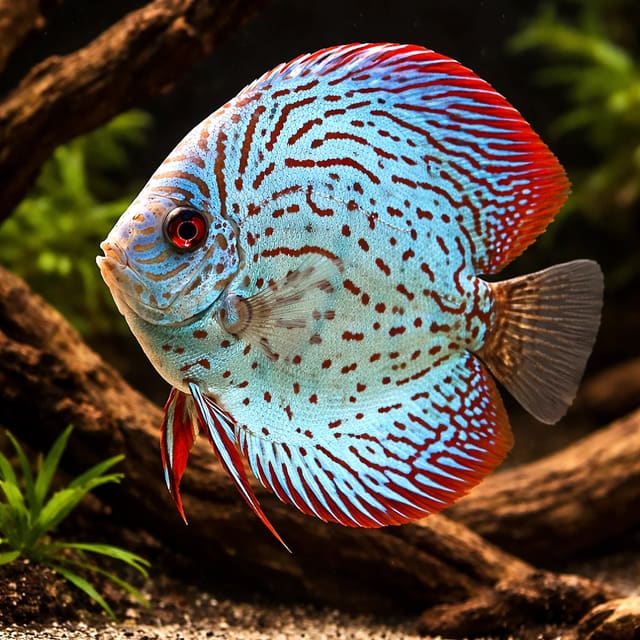
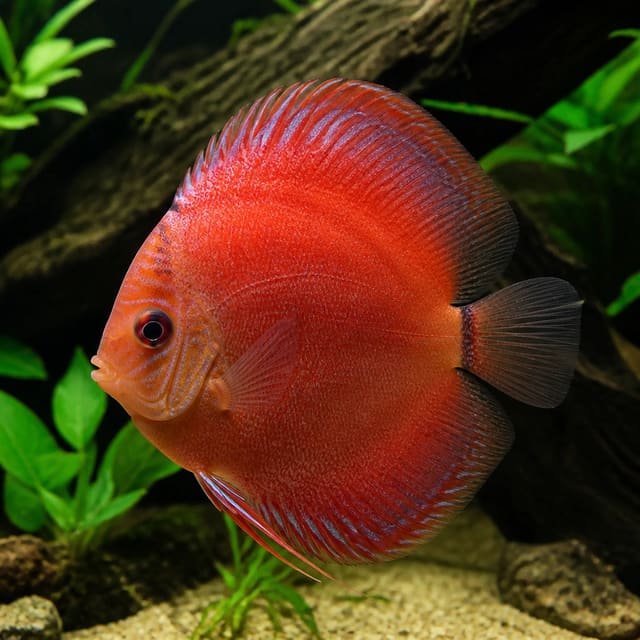
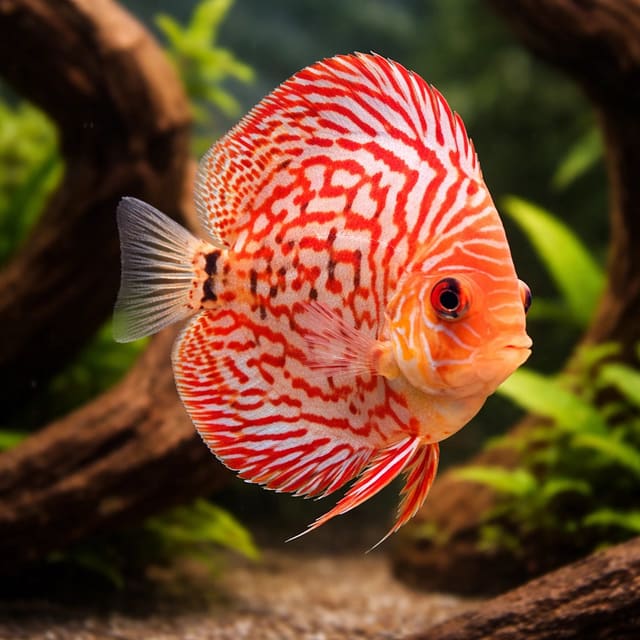
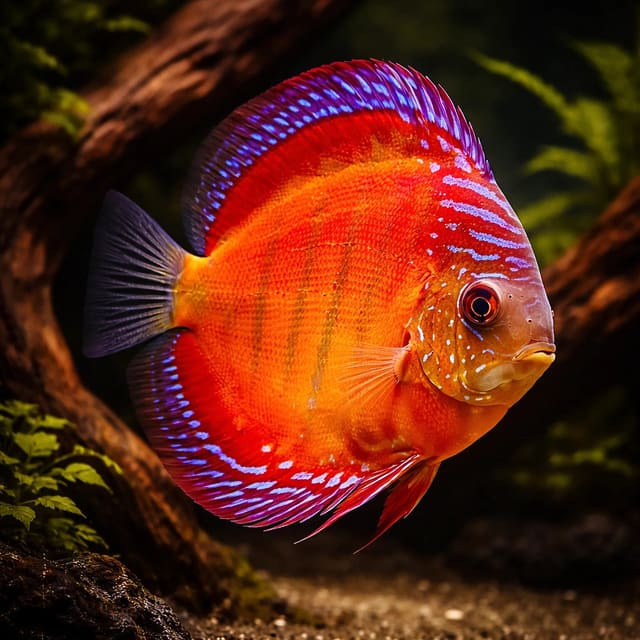
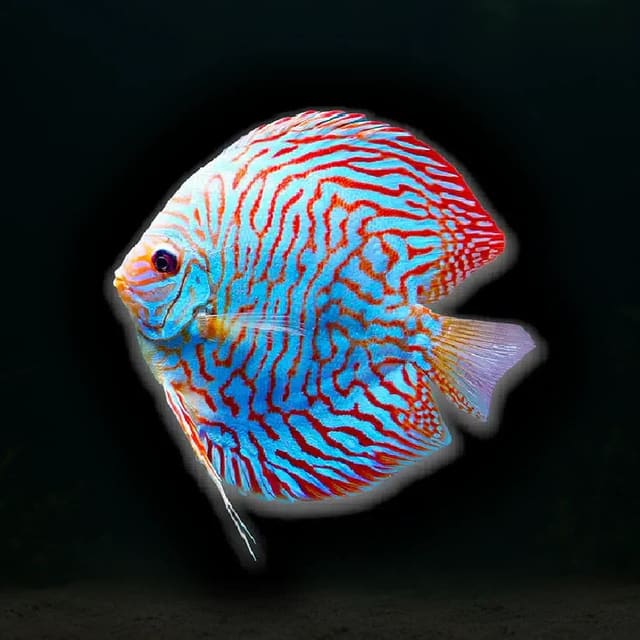
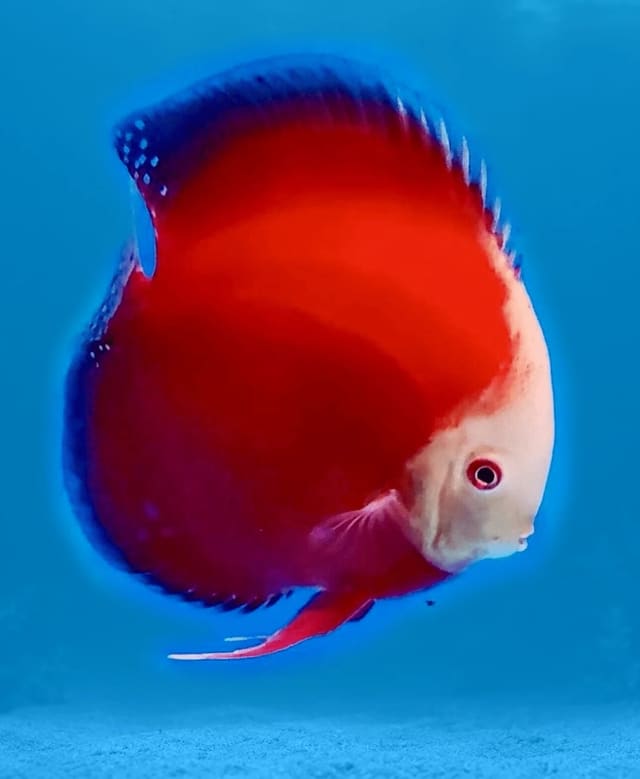
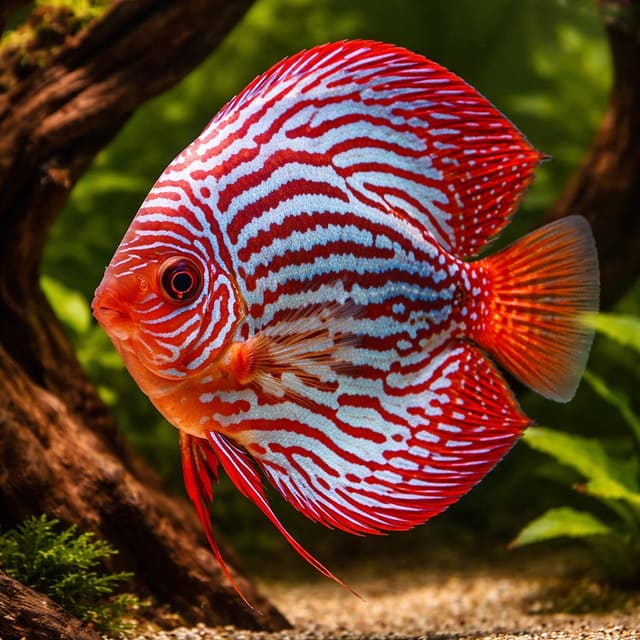
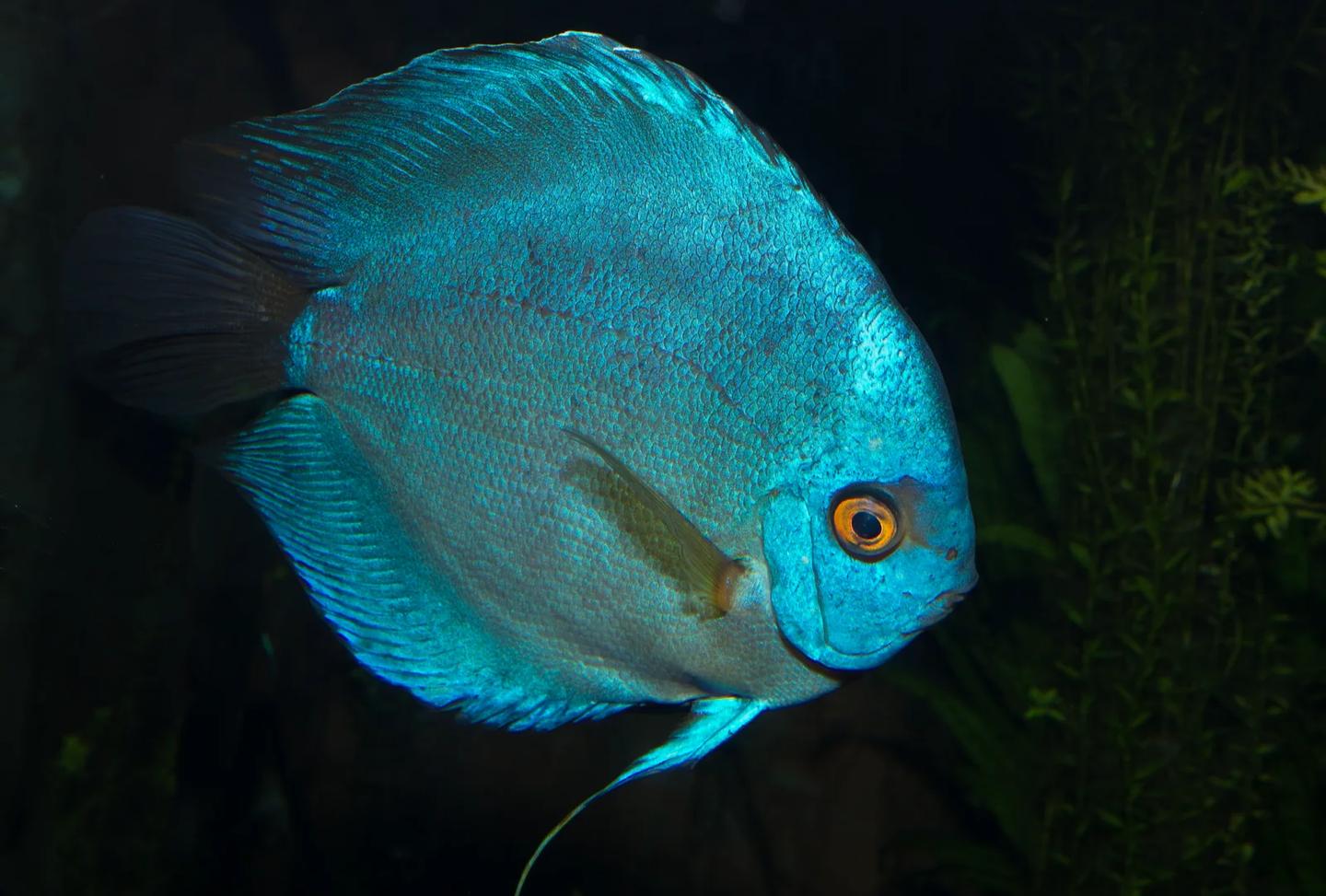
The gallery shows yellow-gold discus in four scenes: one beside dark driftwood, two fish in a planted aquarium, one clean side view against blue and one fish beside a broad green leaf. The two-fish scene does not mean a pair or bundle is supplied. Gallery images have been digitally enhanced to improve image quality. Natural colour, pattern, size and maturity can vary between live animals. The pictures cannot establish sex, breeder, exact lineage or the appearance of the individual dispatched.
If this care profile fits your aquarium, compare the current discus collection by identity, body size and husbandry rather than colour alone. Different domestic strains can share broad care needs, but a related listing is not automatically the right social or size match for an established group.
Discus should enter a stable, mature system rather than wait in a small temporary aquarium while an upgrade is planned. OATA recommends about 50 litres for each adult and gives approximately 300 litres for a shoal of six adults. It also recommends a group of at least five, with more often preferable when the aquarium and maintenance routine can support them. These are broad discus-care figures rather than species-specific measurements for this domestic strain, but they are a sensible welfare starting point.
Volume is only one part of the plan. A useful discus aquarium needs horizontal swimming room, open midwater space and enough distance for a subordinate fish to move away from social pressure. Plants and smooth wood can break sight lines and create shade, yet the layout should still let you see every fish during feeding. Equipment, substrate and decor reduce usable water volume, so allow margin instead of treating the nominal tank size as a precise capacity.
A group plus other fish needs more space than the discus-only example. So does a heavily decorated aquarium, a group containing several large adults or a system whose maintenance schedule sometimes slips. More water provides dilution and thermal stability, but it does not compensate for an immature filter or unsuitable companions. If this is your first warm freshwater setup, work through the first tropical tank guide before choosing livestock.
OATA's current UK discus sheet gives routine group guidance of 26–30°C, pH 6.0–7.5, general hardness of 4–12°dH and carbonate hardness of 3–10°dKH. It specifies ammonia at 0 mg/l, nitrite at 0 mg/l and nitrate no higher than 20 mg/l. Those values are appropriate planning guidance for discus generally; they are not proof of a unique species-level optimum for this Golden Melon stock.
| Parameter | Discus-group guidance |
|---|---|
| Temperature | 26–30°C, kept steady with a reliable heater and thermometer. |
| pH | 6.0–7.5; stability and gradual change matter more than chasing one decimal point. |
| General hardness | 4–12°dH. |
| Carbonate hardness | 3–10°dKH. |
| Ammonia and nitrite | 0 mg/l; any detectable result needs prompt investigation. |
| Nitrate | No higher than 20 mg/l under the OATA group guidance. |
Test the aquarium before purchase and keep a written record after stocking. A single reading can miss a developing trend; weekly results show whether nitrate is climbing, pH is drifting or the filter has been disturbed. The water chemistry guide explains what the common readings mean, while the water matcher helps compare measured values with the stated range. Neither replaces a reliable test kit or patient adjustment.
Tank-bred discus may tolerate harder water than wild fish, but tolerance is not permission for sudden change. Ask what water the fish has been held in, compare it with the receiving aquarium and plan any adjustment gradually. Improvised pH chemicals can make conditions less stable. If reverse-osmosis water is used, it needs an understood remineralisation method; untreated RO water is not automatically safe.
Use a fully cycled biological filter with enough media for the adult group and the chosen feeding routine. RSPCA guidance explains why this matters: fish release toxic ammonia, and an established bacterial community converts it first to nitrite and then to the less harmful nitrate that regular maintenance controls. Never introduce discus to a newly filled aquarium simply because the water looks clear.
Discus are often described as preferring gentle water movement. That means avoiding a hard jet that forces their broad bodies to work constantly; it does not mean stagnant corners or a still surface. Warm water holds less dissolved oxygen than cooler water, so maintain even circulation, visible surface movement and dependable heating. Diffuse a powerful return with a spray bar or layout rather than reducing filtration until debris accumulates.
Choose fine sand, fine gravel or another base that can be cleaned thoroughly. Rich food trapped in deep substrate quickly becomes a water-quality problem. Smooth wood and stable decor are preferable to sharp edges or narrow gaps. A predictable day-and-night cycle, floating shade and planted retreats can reduce startle responses, but always preserve open swimming space and a clear view of each fish.
Use an appropriately sized complete discus granule or pellet as the nutritional foundation. Suitable frozen or live foods can add variety and encourage a natural feeding response, but they should support rather than displace a balanced staple. Use trusted sources, thaw and portion frozen food hygienically, and never rely on a rich homemade mix unless its nutrition and hygiene are properly understood.
OATA recommends two or three smaller feeds through the day. Juveniles may benefit from carefully managed extra feeding, yet every meal increases waste and the risk of uneaten food. Feed where all group members can reach the food, watch each fish swallow and remove leftovers promptly. Multiple feeding points can help a quieter individual without turning feeding into an uncontrolled cloud.
Judge condition over time rather than trying to create a very rounded fish with heavy meals. A healthy fish should show steady interest in food, clear eyes, intact fins, controlled breathing and a body that is neither hollow nor excessively swollen. Colour-enhancing foods may support existing pigments, but cannot guarantee the final shade or repair poor water quality.
OATA strongly recommends a partial water change of about 50% at least weekly for discus. The actual frequency may need to rise when juveniles are fed heavily, the group is large or nitrate approaches the advised limit. A large change is only helpful when replacement water is conditioned and closely matched for temperature and chemistry. Fast, poorly matched changes can cause the instability the routine is meant to prevent.
Filter cleaning should preserve the bacterial community rather than make every component look sterile. Never wash all mature media at once. If flow falls, find the blockage and restore circulation while keeping useful biological media wet. If ammonia or nitrite becomes detectable, reduce feeding, test again, check equipment and seek competent advice rather than adding more fish or a random treatment.
Read the current delivery and Live Arrival Guarantee policy before dispatch. Be present to receive the parcel, inspect it immediately and keep the fish in its sealed bag while making any required continuous unboxing video. Claim evidence and animal introduction are separate tasks: record the sealed arrival first if there is a problem, then prioritise safe acclimation.
Prepare the receiving aquarium in advance. Confirm heater operation, zero ammonia and nitrite, and the actual pH and hardness. Dim bright lights and keep the room calm. OATA advises a gentler introduction for discus than for many fish: after temperature equalisation, keep the fish in the supplied container or move the fish with its transport water into a suitable bucket, then use an airline siphon to add aquarium water slowly. Prevent chilling while the water chemistry changes.
Once the conditions match, net the fish into the aquarium and discard the transport water rather than pouring it into the system. Do not leave a fish indefinitely in deteriorating bag water while pursuing perfect numbers. Keep lights subdued, watch breathing and balance, and offer only a small familiar meal after the fish has settled. Monitor water quality particularly closely through the first week.
Quarantine is strongly recommended when fish from different systems are mixed. The quarantine aquarium must itself be mature, heated and appropriately sized; an unstable spare tank is not safer simply because it is separate. Use dedicated nets and siphons where practical, keep written notes and observe feeding, waste, skin, fins, eyes, respiration and posture.
A settled discus normally swims calmly in midwater, holds its fins open and joins feeding without frantic competition. Short caution after travel is common, but the direction should be towards normal posture and appetite. Persistent darkening, clamped fins, rapid breathing, isolation, loss of condition or refusal to eat deserves prompt attention. If several fish change together, test water and equipment immediately.
Do not medicate a display aquarium by guesswork. Similar signs can arise from poor water, temperature stress, parasites, bacterial disease, injury or bullying, and an unsuitable treatment can harm fish or the filter. Isolate when appropriate and seek an aquatic veterinary professional or suitably qualified fish-health specialist for serious or persistent problems.
A planted aquarium can work when the plants tolerate the chosen 26–30°C range. Combine rooted plants, epiphytes or floating shade while leaving open group-swimming space and access for cleaning. Carbon-dioxide systems and fertilisers add another layer of management: preserve oxygen, understand pH movement and put fish stability ahead of maximum plant growth.
Discus are a long-term commitment. Budget for reliable heating, mature filtration, test reagents, water conditioner, quality food, quarantine space and enough prepared water for substantial changes. Keep spare aeration and a plan for heater or power failure. The aquarium should be ready for the adult group before the fish is bought, not promised as a future improvement.
Commercial size labels are useful for ordering, but they are only one part of social planning. Compare the newcomer with the body size of resident discus, not merely the length of the aquarium. A much smaller fish can struggle to reach food when confident larger fish feed first. A larger newcomer can change established interactions. Neither outcome is certain, so prepare observation time and feeding space instead of relying on the grade alone.
Think through the first week before purchase. Decide where the fish will be quarantined, which food it will receive, how the receiving water will be matched and which measurements you will record. If the main aquarium already holds discus, note the residents' approximate size, feeding behaviour and any individual that guards a preferred area. This makes later changes easier to recognise.
Do not use colour to judge readiness for a group. A bright golden fish can still be stressed, and a temporarily darker fish can simply be responding to transport or the room. Body condition, steady breathing, open fins, controlled swimming and a reliable feeding response are more useful observations. Give the newcomer calm time to settle while still checking it closely.
A small notebook or spreadsheet can turn vague impressions into useful trends. Record temperature, pH, ammonia, nitrite, nitrate, hardness, water-change volume and any equipment service. Add short notes on appetite, breathing and which fish receives food at each feeding point. If a problem develops, those notes show whether it followed a water change, heater fluctuation, filter clean, new arrival or altered diet.
Use the record to adjust one thing at a time. If nitrate rises, examine food, stocking and water-change frequency before changing several chemical values together. If one fish hangs back, compare its behaviour at different feeding points and check for repeated pressure from the same neighbour. If the whole group breathes faster, test water and equipment immediately rather than assuming a social cause.
Preparation also includes contingency planning. Keep enough conditioner for an extra water change, know how to aerate during a filter or power interruption and have a safe spare heater available. Check replacement equipment before an emergency; a heater still in its box is not proven to work. Calm, planned responses protect a warm-water group better than a cupboard full of treatments chosen after symptoms appear.
A discus aquarium can be attractive without becoming difficult to maintain. Start by reserving a broad open area where the group can move and feed together. Place smooth wood and planting so they create shade and visual separation around the edges, not narrow pockets where a quieter fish disappears from view. The aim is to offer choice while keeping appetite, breathing and body condition easy to see.
Fine sand or fine gravel allows straightforward siphoning and suits the feeding behaviour OATA describes. Keep the substrate shallow enough to clean where rich food settles. Check behind wood, around plant bases and beneath the filter return; these are common places for debris to remain even when the front glass looks clean. A clean-looking display can still carry a high dissolved-waste load, which is why tests and recorded maintenance matter.
Overhead lighting should follow a predictable day-and-night rhythm and need not be intense. Floating plants or branches can create shaded areas, while a gradual room-light transition reduces sudden startle. Avoid placing the aquarium next to a draught, radiator, direct sun, loud speaker or frequently slammed door. Stable temperature and a calm setting make it easier to interpret the fish's behaviour.
Warm-tolerant plants can soften the display and give cautious fish a retreat, but they should not take all of the open water. Select plants for the intended temperature rather than lowering the temperature to suit a favourite species. If leaves deteriorate in warm water, remove decaying material before it adds to the filter load.
Carbon-dioxide injection and heavy fertilisation demand extra care in a warm aquarium. Any system that changes gas exchange or pH should be understood and monitored before livestock is introduced. Surface movement remains important. The best planted-discuss display is not the one with the fastest plant growth; it is the one where fish breathe steadily, water stays predictable and maintenance remains practical every week.
Feeding and cleaning should be planned together. A group receiving several small meals will produce more waste than a lightly fed community, even when each portion is sensible. Choose feeding points that let you watch every fish and that are reachable with a siphon. If food repeatedly settles behind one piece of decor, change the flow or layout rather than accepting a permanent waste trap.
OATA advises adding fish gradually because the bacterial population in a filter must respond to increased waste and feeding. A mature aquarium is not infinitely mature: a large, sudden increase in livestock can still overwhelm it. Quarantine each addition, check the main system's readings and avoid making several major changes—new fish, a deep filter clean and a large decor move—on the same day.
After an addition, compare the whole group before and after feeding. Note who approaches first, who waits, who changes colour and who stays near the surface or bottom. A fish that looks calm may simply be excluded. Multiple feeding points can help, but persistent loss of access calls for action rather than ever more food, which would only worsen water quality.
Increase monitoring after any change. Test ammonia and nitrite even when they were previously zero, watch nitrate and confirm that heaters and flow are unchanged. If readings move in the wrong direction, pause further stocking. The aquarium should demonstrate that it can carry the current group before another fish is added.
Long-term care includes holidays, illness, power cuts and equipment failure. Write a short routine that another responsible person can follow: how much to feed, where the thermometer is read, which behaviour needs a call and what must never be poured into the aquarium. Pre-measured food prevents a well-meaning helper from doubling portions.
Keep a tested backup for aeration and a safe way to hold temperature during an interruption. Know where spare hoses, conditioner and buckets are kept. If the main heater fails, replace it with equipment of appropriate capacity and continue watching the temperature rather than making a rapid correction. Sudden over-heating can be as dangerous as cooling.
Before committing to discus, be realistic about weekly time and water use. A 50% change on a large aquarium requires preparation, temperature matching and safe disposal. This recurring work is part of the animal's cost. Choosing the fish after the routine is practical is kinder than discovering later that the display cannot receive the maintenance it needs.
Discus are social cichlids. OATA recommends keeping at least five, with more often preferable where the aquarium can support them, because a small group can concentrate pressure on one individual. Calm appearance does not mean the hierarchy is harmless. A subordinate fish may hang back, darken, clamp its fins or lose condition while the rest of the group appears settled.
Match body size and feeding confidence when adding a newcomer. Provide open swimming room, more than one feeding point and visual breaks that do not turn the aquarium into a maze. Watch access to food rather than counting only visible chases. A group member that repeatedly misses meals needs an investigation of water, health and social pressure.
OATA names medium-sized tetras, Corydoras, plecos and dwarf cichlids as possible companion groups for discus. That is a starting list, not an automatic stocking recipe. The exact species still has to tolerate 26–30°C for its full life, fit the aquarium at adult size, eat without overwhelming the discus and remain safe around broad fins and slow feeding.
| Candidate group | Decision test |
|---|---|
| Other discus | Best social match when healthy, of compatible body size and supported by the full aquarium volume. |
| Medium tetras | Consider only species with genuine long-term heat tolerance and calm feeding behaviour. |
| Corydoras | Check the exact species for temperature, group size, substrate and feeding needs. |
| Plecos | Check adult size, waste, diet, temperature and any tendency to attach to slow-bodied fish. |
| Dwarf cichlids | A specialist choice because spawning territory and feeding competition can change behaviour. |
Avoid fish that require cooler water, nip fins, dominate every feed or are aggressively territorial. Also avoid assuming that a South American label makes two species compatible. Shared geography does not prove matching temperature, chemistry, space or temperament.
Two retail fish are not a proven pair. Discus can form pairs and become territorial around a spawning surface, but size, forehead shape, fin shape and colour are not reliable retail sex guarantees. This listing supplies one unsexed fish per purchase. A picture containing two fish is not proof of pair status.
Different domestic colour strains can often share a well-run discus aquarium when their health, size and care needs match. Quarantine matters more than colour contrast. Do not buy a second strain as a treatment for a lone or stressed fish until the original problem—group size, bullying, disease, food access or unstable water—has been resolved.
OATA says discus can reach up to about 20 cm across. Use that as broad discus-group planning guidance, not an exact measured maximum for this undocumented domestic line.
OATA gives about 50 litres per adult and approximately 300 litres for six adult discus. Treat 300 litres as a group-level starting point and choose more room for companions, heavy decor or a larger group.
OATA recommends at least five discus, with more preferable when space and maintenance allow. Two randomly selected fish are not automatically a compatible pair.
Our store assessment is advanced. This fish suits a keeper able to manage a mature warm aquarium, frequent testing, closely matched water changes, quarantine and a social group.
Use a complete discus pellet or granule as the staple, with suitable frozen or live foods for variety. Offer small measured feeds and confirm that every fish eats.
OATA's broad discus guidance is 26–30°C and pH 6.0–7.5, with 4–12°dH general hardness. Keep conditions stable and adjust chemistry gradually.
Discus are generally calmer than many cichlids, but they form a hierarchy and may pressure weaker group members. They are not normally chosen as fin nippers; observe feeding access and persistent chasing.
OATA names medium tetras, Corydoras, plecos and dwarf cichlids as possible groups. Check the exact species for heat tolerance, adult size, feeding pace and behaviour before combining it with discus.
Tropical Fish Co packs each fish individually in an oxygenated bag inside an insulated box and uses a tracked courier licensed to carry live animals. Be present, inspect the sealed parcel on arrival and follow the current guarantee instructions.
These references support taxonomy and broad husbandry only. They do not identify the individual fish, establish breeder lineage or guarantee sex and adult colour. Group-level figures remain explicitly scoped so they are useful without becoming false species-level claims.
No reviews for this item yet. Bought one? Honest reviews only, good or bad.
What customers say about ordering from us
I have a small group of long finned mountain minnows. So was delighted to be able to order ten of this variety to increase the genetics in my tank . The ones I recieved are healthy but it’s to early to give a verdict on wether they are of a long finned type since they are small currently.
Gordon Walker · 23 Sept 2026
100% success travel and "installation". Pleased with quality of purchase. The Siamese fighter a bit "shy" so have not yet seen him at his best yet but looking good. Happy customer. GG
George E Garratt · 21 Sept 2026
Reviews of our shop, collected by Judge.me, an independent third-party review collector. Newest first.