−15%
Red Turquoise Discus (Symphysodon spp.)
26–30°C · pH 6–7.5
£37.99£53.99

Brilliant Turquoise is a domestic discus form catalogued here under Symphysodon aequifasciatus, supplied as one unsexed fish in the chosen size grade. It suits an experienced keeper planning a mature, warm aquarium for a compatible group of at least five, with dependable filtration, stable water and measured feeding.
Symphysodon aequifasciatus
Save when buying multiple fish. Each quantity is one fish; sex and pair formation are not guaranteed unless the selected variant explicitly states them.
Brilliant Turquoise is a domestic discus form catalogued here under Symphysodon aequifasciatus, supplied as one unsexed fish in the chosen size grade. It suits an experienced keeper planning a mature, warm aquarium for a compatible group of at least five, with dependable filtration, stable water and measured feeding.
Discus are social Amazonian cichlids with specialised aquarium needs. OATA advises at least five fish, except an established breeding pair, and about 50 litres per adult—roughly 300 litres for six adults. Use that as a planning floor, then check usable dimensions, filtration, source water and the actual fish.
Maintain these water conditions for optimal health and vibrant colors
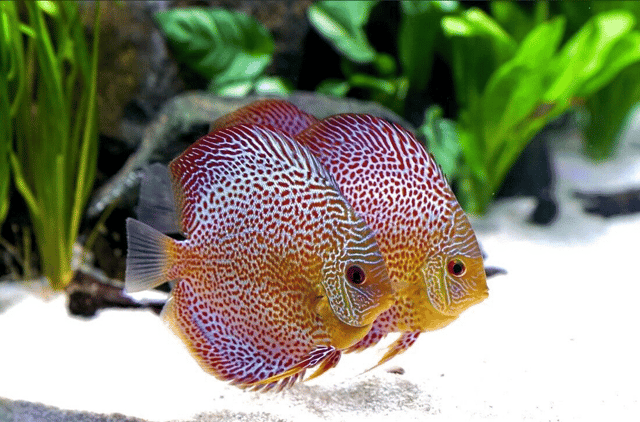
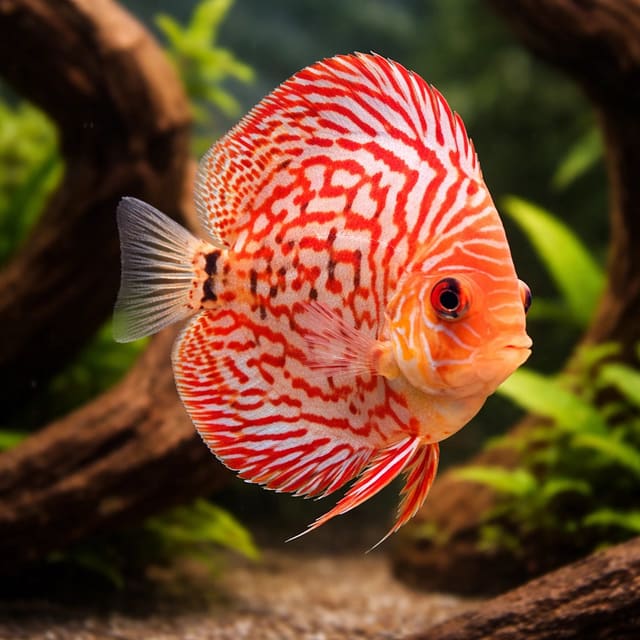
Brilliant Turquoise is the catalogue name for a domestic discus colour form with a blue to turquoise ground colour and red or rust-coloured markings. We catalogue this domestic form under Symphysodon aequifasciatus; its strain name does not certify a wild locality, pedigree or pure species lineage. The trade-form name describes the intended appearance, while individual pattern, colour balance and maturity will still vary.
One purchase supplies one live fish in the size grade you choose. The size you select is the size supplied, not the adult size. This matters when you are adding to a discus group: a small juvenile and a large established fish can have very different feeding confidence, social standing and ability to compete. Compare the new arrival with the fish already in the aquarium rather than choosing on colour alone.
Sex is guaranteed only when the selected option explicitly states male or female. This Brilliant Turquoise Discus listing has no sex-guaranteed option. Ordering two therefore does not create a promised male-and-female pair, and a larger grade does not prove breeding maturity. The sensible way to choose is by suitable size, the space available and the structure of the group you intend to keep.
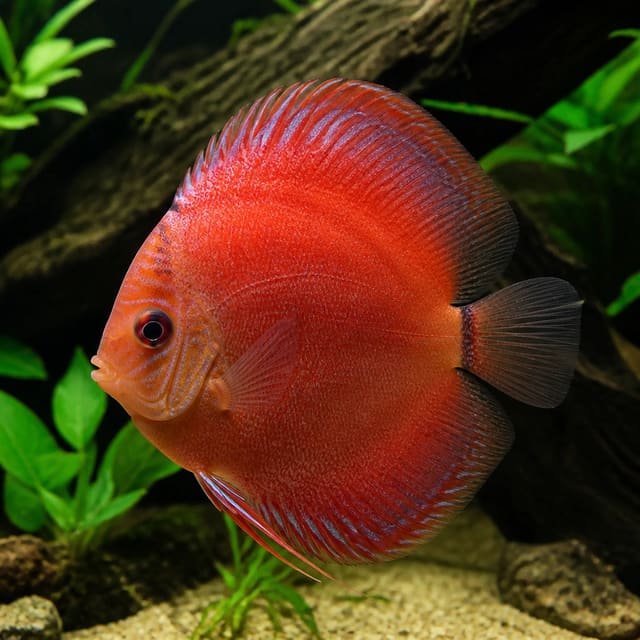
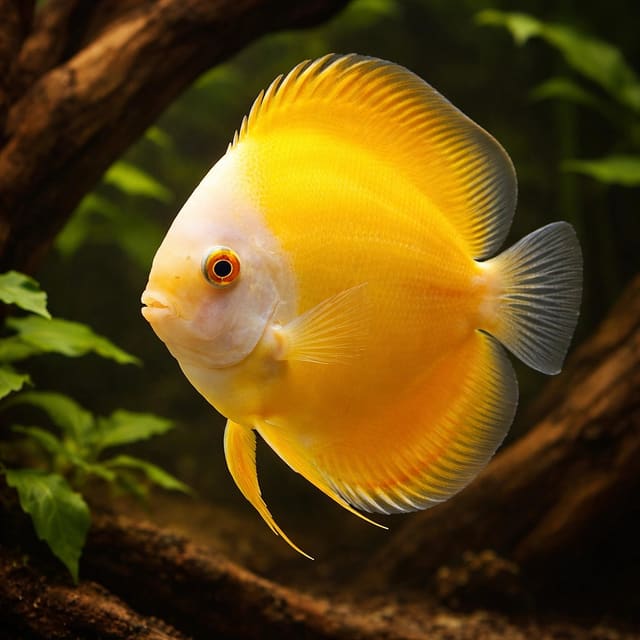
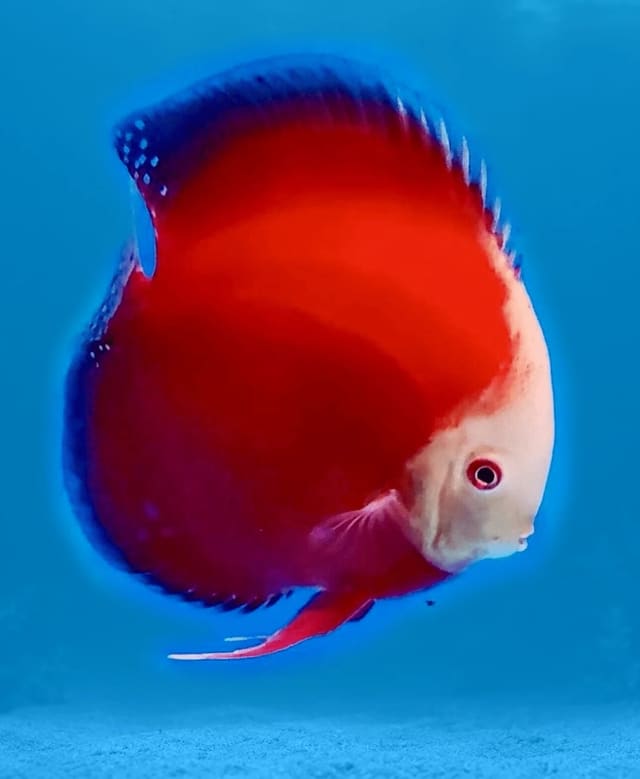
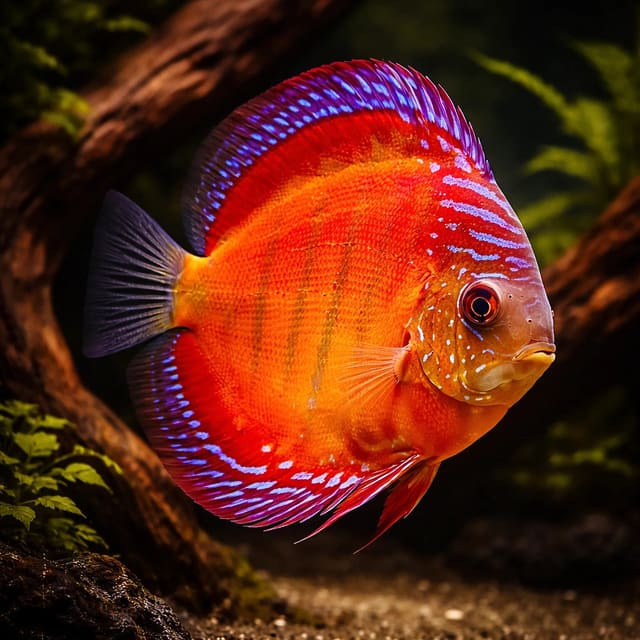
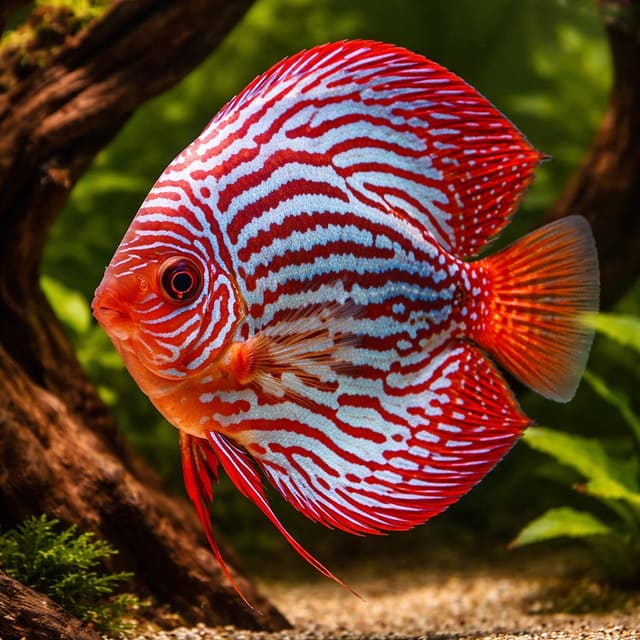
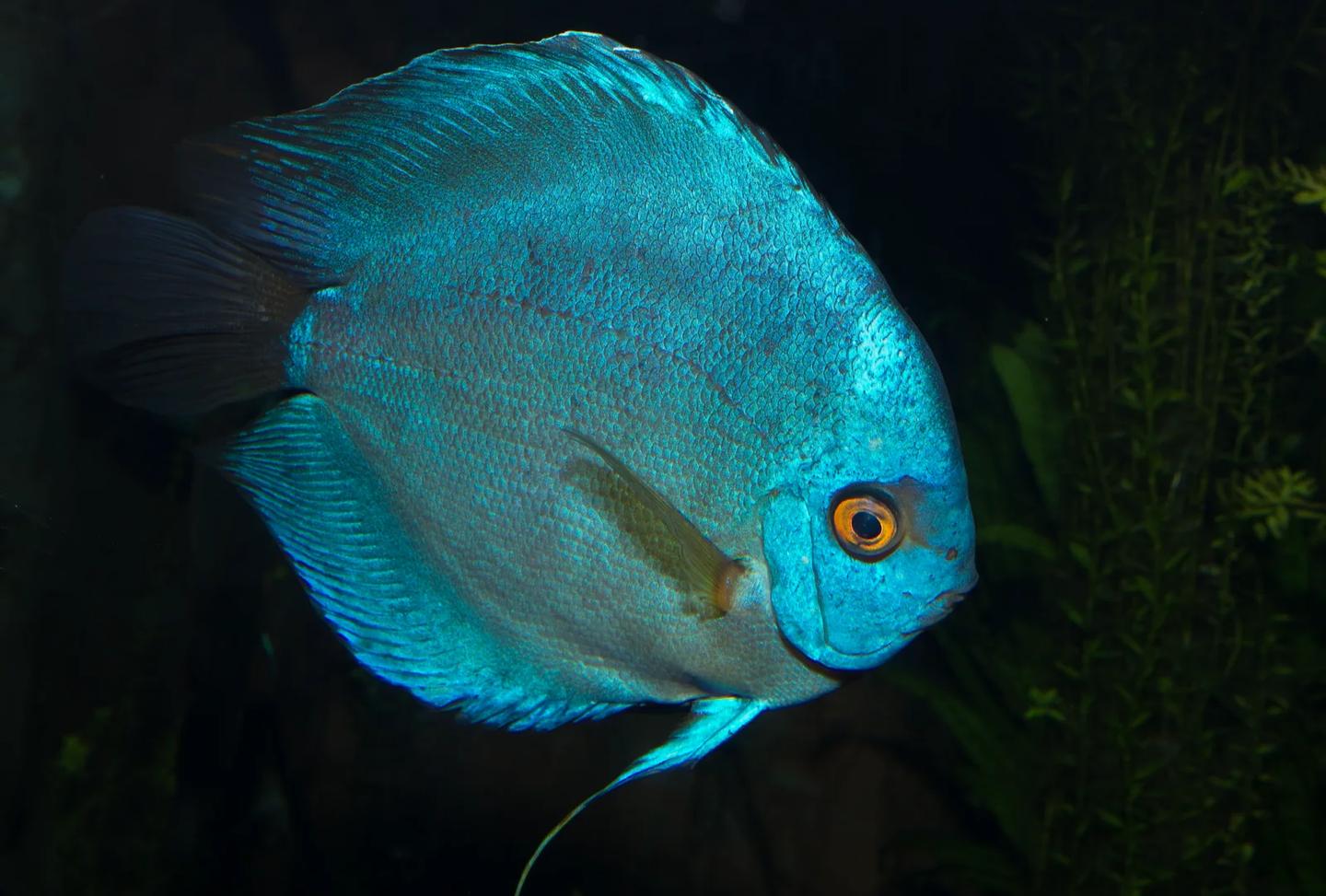
Gallery images have been digitally enhanced to improve image quality. Natural colour, pattern, size and maturity can vary between live animals. The four views show the round discus outline and the sort of turquoise-and-red pattern associated with the strain, but the gallery views cannot promise the markings or sex of the fish that arrives.
The catalogue classification used here is Symphysodon aequifasciatus, linked to the FishBase species record for taxonomic and natural-history context. FishBase did not identify the supplied domestic animals or certify their breeding lineage. Brilliant Turquoise remains the trade strain label for the cultivated appearance offered.
This scope prevents the colour form from being treated as a certified wild locality. FishBase places the referenced species in the eastern Amazon system, while this shop offer is domestic. A fish with a stronger red network, a paler turquoise ground or a less developed juvenile pattern can still fit the Brilliant Turquoise trade presentation; decorative lighting and background colour can also alter how those markings appear.
The listing carries a broad run of supplier size grades, from small juveniles to much larger fish and an XL supplier label. Some labels contain a second measurement in brackets. Treat each paired label as a supplier dispatch grade rather than a measurement taken immediately before packing. If two figures make a practical difference to your existing group, ask before ordering.
Make the choice in three steps. First, compare the grade with the body size of the discus already present. Second, check that the new fish can take the same food without being crowded away. Third, confirm that the aquarium has room for the adult group, not merely for the animal on delivery day. This approach is more dependable than choosing the brightest-looking photograph or the largest label within budget.
A smaller juvenile gives you more of the growth journey, but it also needs feeding opportunities that larger companions cannot monopolise. A larger fish may show more mature colour at once, yet it still needs a careful introduction and an appropriate place in the hierarchy. None of the size labels promises a show grade, pedigree, particular sex or breeding status.
| Buyer question | Practical answer |
|---|---|
| What is supplied? | One unsexed live fish in the chosen size grade. |
| What should already be ready? | A mature, heated, filtered aquarium planned around a compatible discus group. |
| Who is this best for? | An experienced keeper comfortable with warm water, regular testing, measured feeding and close observation. |
| Can colour be chosen exactly? | No. Domestic strain pattern and colour develop and vary between individuals. |
If you are comparing strains rather than looking for a particular companion, browse the current discus collection. Different colours share the same need for deliberate group, space and water planning; appearance alone does not make two fish a good match.
FishBase recommends an aquarium at least 120 cm long and keeping this species in groups of five or more, outside the different context of an established breeding pair. Length gives the fish room to move and allows a keeper to spread cover and feeding points. Height also matters because an adult discus is deep-bodied rather than long and slender.
Species references provide natural-history context rather than a verified maximum for this domestic form. FishBase records 13.7 cm standard length for Symphysodon aequifasciatus, and Seriously Fish gives 14 cm standard length. OATA's broader discus guidance separately says adults can reach about 20 cm across. Its word “across” is kept as written: it is not interpreted here as height or as an equivalent standard-length measurement. Together, the records reinforce the need for generous horizontal room and vertical clearance without turning a species figure into a domestic-line maximum.
There is no single volume that describes every valid discus arrangement. A Seriously Fish profile uses about 255 litres for a breeding pair or a few juveniles in a 120 × 45 × 45 cm aquarium. OATA gives a broader example of about 300 litres for six adults. The purpose and stocking differ, so apply the example that matches the fish you actually intend to keep and increase space for more discus or companion species.
A long, mature aquarium with open swimming room is a better starting point than a cramped decorative display. Arrange smooth wood, suitable warm-water plants or other structures so a quieter fish can move out of direct view without being trapped. Cover should not consume every open route or make waste removal difficult. Discus can be shy, so a bare bright aquarium may leave them exposed; an overcrowded hardscape can create a different problem by reducing usable room.
The aquarium must be biologically established before the fish arrives. If this is your first substantial tropical set-up, the first tropical aquarium guide explains maturation and the relationship between stocking and filtration. A new fish increases waste production, so adding several animals at once changes the load on the filter as well as the social group.
Use a dependable heater and a thermometer that is easy to read. Position filtration so it circulates the whole aquarium without producing a current that stops the discus feeding or resting comfortably. Provide access for a siphon and keep a clear routine for checking equipment. A beautiful aquascape is only successful when it can also be maintained.
Substrate choice is partly practical. OATA describes fine gravel or sand as suitable for discus and notes that the fish can blow at the surface while feeding. Whatever you use, prevent food and waste from accumulating in inaccessible pockets. Smooth, stable decor is preferable to sharp or precarious pieces around a deep-bodied fish.
For routine aquarium care, use the broad OATA discus guidance of 26–30°C, pH 6.0–7.5 and 4–12 dGH. These are group-level captive values rather than a claim that every Symphysodon aequifasciatus strain has one exact optimum. Ask what conditions the fish has been held in and make changes gradually; stability around an appropriate target is more useful than repeatedly chasing a number.
FishBase records a wider wild environmental range of pH 5.0–8.0 and 0–12 dH for the species. Those field values describe where records occur, not the full range a keeper should deliberately swing through. The domestic strain should receive consistent, clean, warm aquarium water, with the broad OATA captive range providing the more practical home target.
The OATA discus care sheet sets ammonia and nitrite at zero and advises nitrate below 20 mg/l. Test before adding the fish, after meaningful stocking changes and whenever behaviour or appetite changes. Our water-chemistry guide explains what the main readings mean, while the water matcher helps compare measured conditions with the stated guidance.
The RSPCA aquarium guidance explains why biological filtration matters: fish produce ammonia, bacteria convert it to nitrite and then to the safer nitrate end product. Clear water is not proof that this cycle is working. A mature filter, current test results and normal fish behaviour together give a more useful picture.
Check the filter for reduced flow or blockages, but preserve its bacterial population. OATA advises rinsing filter media lightly in removed aquarium water rather than under chlorinated tap water. Replace only what is genuinely exhausted and avoid stripping the whole filter during a large clean. Match conditioned replacement water closely for temperature and chemistry.
OATA recommends a partial water change of 50% at least weekly for discus. Treat that as a strong broad-care baseline, then adjust the exact routine to measured nitrate, stocking, feeding and the capacity of the system. A heavily fed group of growing juveniles may create a different maintenance load from a settled adult group. The tests should guide whether the chosen routine is sufficient; they should not become an excuse for leaving visible waste in place.
Siphon uneaten food and debris, including material trapped around wood or plants. If sand is used, keep accessible areas from compacting into dirty pockets. Condition new water before it enters the aquarium. Large, sudden differences in temperature, pH or mineral content make an otherwise beneficial water change stressful.
A test result is useful when it changes what you do. Detectable ammonia or nitrite calls for prompt action: check the filter and stocking event, protect water quality with appropriate conditioned changes, reduce avoidable waste and continue testing until the system is stable. A rising nitrate trend tells you that the present balance of feeding, stocking and water changes needs adjustment even before the fish look unwell.
Compare results taken at similar points in the maintenance cycle. A reading immediately after a large change and one taken just before the next change answer different questions. Consistent timing makes a trend easier to understand, while extra tests after a new arrival, equipment fault or feeding problem provide the closer watch that event deserves.
Keep the routine practical enough to repeat. Prepare conditioner, clean buckets and a siphon before starting; check the heater and filter while the water level is lower; and make sure every fish is accounted for before moving decor. Predictable work reduces hurried corrections and gives the discus a more stable environment.
Record a simple pattern of temperature, pH, ammonia, nitrite, nitrate and maintenance dates. You are looking for consistency and early movement, not a decorative logbook. A falling appetite, darker colour, faster breathing, hiding or a change in swimming position should prompt an immediate water check and equipment inspection.
| Routine check | What good practice looks like |
|---|---|
| Temperature | Stable within the chosen 26–30°C broad discus range. |
| Ammonia and nitrite | Zero mg/l. |
| Nitrate | Below 20 mg/l under OATA's broad guidance. |
| Replacement water | Conditioned and closely matched before use. |
| Filter | Reliable flow, media cleaned gently in removed aquarium water when needed. |
In nature, FishBase records insect larvae, insects and planktonic invertebrates in the diet of Symphysodon aequifasciatus. Aquarium feeding has a different practical aim: deliver balanced nutrition consistently without allowing rich leftovers to damage warm water. OATA recommends a complete specialist discus granule or pellet at least once a day, with suitable frozen or live foods for variety.
Offer portions that the fish can finish within a few minutes. OATA's broad guidance suggests two or three smaller feeds over the day because discus have relatively small stomachs. That schedule is useful only when portions remain controlled; dividing an excessive daily amount into several meals does not solve overfeeding.
Choose a food size the smallest fish can take easily. Spread the food so a bold individual cannot intercept everything at one point. Stand back and observe: a fish that approaches but repeatedly misses out needs attention even if the group appears energetic. Growth, body fullness, waste production and water tests together show whether the routine is working.
Remove leftovers promptly. Warm water accelerates the consequences of uneaten food, and a diet that looks generous can undermine the filtration system. Frozen or live items should be appropriate, clean and offered as variety rather than as the only source of nutrition. Avoid treating one food as a guaranteed colour shortcut; the strain's appearance also reflects genetics, age, condition, lighting and individual variation.
Size grades influence how food should be presented. A small fish may need finer particles and a quieter feeding position; a larger fish can take bigger pellets and may dominate an obvious drop point. Choose a staple that all residents can swallow, or use two appropriate sizes while keeping the daily quantity controlled.
Observe the entire feeding sequence rather than the first rush. Note which fish approaches late, spits out food or waits below the others. Distribute portions across the usable swimming area so the most confident individual cannot guard every mouthful. Where a newcomer is consistently excluded, address the group match and layout rather than repeatedly adding extra food.
Body condition changes gradually. View the fish from the front and side, compare it with its own recent appearance and keep the glass clear enough for useful observation. Feeding records are especially helpful for juveniles, because growth increases demand while overfeeding still increases waste. The aim is steady condition and clean water, not the fastest possible size gain.
Healthy fish should be assessed against their normal pattern. Clear eyes, intact fins and scales, steady swimming and a reliable feeding response are reassuring. A temporary pause after transport is different from persistent refusal, laboured breathing or loss of condition. Test the water first when something changes because environmental problems can affect several fish at once.
Colour can darken or pale with stress, background and social pressure. A quieter discus may spend more time under cover when a dominant fish controls the best feeding area. Revisit layout, group space and feeding distribution rather than assuming the colour strain itself predicts temperament.
Do not add medication simply because a fish looks subdued. Diagnosis matters, and the aquarium environment should be checked before treatment. If professional advice is needed, provide the water readings, recent additions, feeding observations and a clear timeline rather than relying on colour alone.
The aquarium should be heated, filtered, tested and ready before dispatch. Plan where the new fish will settle and, where practical, use a mature heated quarantine aquarium so you can observe feeding, breathing and body condition before joining the main group. Quarantine needs the same care over temperature and water quality as the display; an uncycled spare tank is not a safe substitute.
Read the current delivery and Live Arrival Guarantee policy before the delivery day and make sure somebody is present to receive the parcel. Record every delivery in one continuous unboxing video showing the parcel sealed, the outer box, the opening and the fish still in the unopened bag. If a Live Arrival Guarantee claim is needed, contact the shop the same day with the order number and that evidence.
Follow the policy's arrival guidance: float the bag for 20–30 minutes before releasing, acclimatise slowly and keep transport water out of the aquarium. Work calmly and keep the fish supported. Observe breathing, posture and balance as it settles, then continue watching appetite and interactions rather than judging success only by immediate colour.
Match the new fish sensibly to the resident group. A much smaller arrival may need protection from feeding competition; a large confident fish can alter an existing hierarchy. Introductions go more smoothly when the aquarium already has adequate space, cover and more than one feeding area.
FishBase describes Symphysodon aequifasciatus as normally schooling and territorial during breeding. OATA similarly advises groups of at least five because single fish or very small groups will often become stressed or bullied. A group spreads social attention, but it still needs space and management.
Five is a minimum social starting point rather than a guarantee. Fish differ in confidence, health, size and position in the hierarchy. More discus require more aquarium capacity, and a new arrival can disturb relationships that looked settled. Watch for one fish being pushed from food, kept in a corner or repeatedly chased.
An already established breeding pair in a suitable specialist arrangement is a different case from two randomly selected fish. Two unsexed fish bought together may compete, ignore one another or form a relationship later; the sale does not decide that outcome. Avoid designing the aquarium around a breeding assumption that the offer does not make.
Choose additions of compatible size and feeding confidence. A very small juvenile may struggle in a group of large, fast-feeding adults even when the water parameters match. Conversely, a large newcomer can become the focus of attention. Use open swimming room, calm retreats and distributed feeding points so observation and intervention are possible.
Breeding territoriality can change the mood of the aquarium. A pair defending an area may displace other fish, so the available footprint and escape routes matter. The right response is not simply to add more decoration; assess whether the group has enough usable space and whether a separate breeding arrangement is appropriate.
Discus are often described as comparatively calm cichlids, but calm does not mean socially passive. Their hierarchy can be subtle: a fish may lose access to food without obvious fin damage. Regular observation at feeding time is one of the best compatibility checks available.
Any companion must share the actual warm-water range, water chemistry and maintenance pattern chosen for the discus. It should also be calm, non-nipping and able to feed without either intimidating the discus or being starved by them. A generic tropical label is not enough.
OATA names medium tetras, Corydoras, plecos and dwarf cichlids as possible groups. Treat that as a list for further species-level checking, not a universal shopping list. Some Corydoras prefer cooler conditions; plecos differ greatly in size and waste production; dwarf cichlids can become territorial; and tetras vary in fin-nipping behaviour and temperature tolerance.
Before adding any named species, compare its full temperature range, preferred chemistry, adult size, diet, activity level and social needs. Check whether it is comfortable at the upper end of tropical temperatures for the long term, not merely able to survive a short overlap. Also consider whether it will take food before slower discus.
Avoid aggressive or highly territorial cichlids, habitual fin nippers, cool-water animals and companions that create excessive feeding competition. Very small livestock may be vulnerable, while large active fish can leave a shy discus constantly on edge. Space calculated for the discus alone may not be enough once another group is added.
Write down the intended adult numbers for every species, not just the animals already present. Then compare the warmest and coolest acceptable temperatures, the pH and hardness ranges, adult dimensions, preferred swimming areas and feeding methods. A compatible overlap must work every day and leave enough capacity for waste, maintenance and normal social behaviour.
Consider the pace of the aquarium at feeding time. Discus often benefit from a calm routine in which they can approach food deliberately. A companion that is peaceful in the sense of not attacking may still be unsuitable if it races through every feed. The same applies to a bottom-dweller whose temperature fits but whose adult size or waste production overwhelms the available floor area and filtration.
Review the plan again after choosing an exact species. Broad labels such as tetra, pleco or dwarf cichlid hide important differences. Use the adult animal, not the juvenile sold at the shop, for space and behaviour decisions. Where the evidence for a particular match is weak, a discus-focused aquarium is the safer and simpler choice.
Behavioural compatibility is only one part of a safe introduction. New fish can bring a different health history, so a mature quarantine aquarium allows observation before the animals share water. Use separate equipment where practical and keep notes on appetite and condition.
When the quarantine period is complete, reconsider the match using the fish you actually observed. If the newcomer is smaller, slower or less confident than expected, delay the introduction or choose a different arrangement. A visually attractive combination is not a reason to ignore a poor behavioural or environmental fit.
| Potential companion | Decision gate |
|---|---|
| Other discus | Compatible size, health and feeding confidence; enough room for the whole managed group. |
| Medium tetras | Exact species tolerates the chosen warmth and is not a fin nipper. |
| Corydoras or plecos | Exact species suits the temperature, floor area, diet and waste capacity. |
| Dwarf cichlids | Enough space to manage territorial behaviour, especially during breeding. |
For natural-history context, FishBase records 13.7 cm standard length and Seriously Fish records 14 cm standard length for Symphysodon aequifasciatus. OATA's broad discus guide separately says adults can reach about 20 cm across. These records do not certify a maximum for this domestic form, so allow generous adult discus space and keep dispatch grade separate from adult planning.
FishBase gives a minimum aquarium length of 120 cm. OATA's broad planning example uses about 300 litres for six adults, while a specialist breeding pair or a few juveniles has a different context. Increase capacity for more fish or companions and preserve open swimming space.
Keep five or more compatible discus under the species and OATA guidance. An already established breeding pair in a specialist set-up is a different arrangement; two unsexed fish from this listing are not automatically a pair.
We classify it as advanced care because it needs a mature warm aquarium, stable water, group planning, regular testing, measured feeding and close observation. A prepared keeper can manage those needs, but this is not a good fish for an uncycled first aquarium.
Use a complete discus granule or pellet as the staple and add suitable frozen or live foods for variety. Offer small measured portions, make sure every fish feeds and remove leftovers promptly so warm water remains clean.
Use the broad OATA discus guidance of 26–30°C, pH 6.0–7.5 and 4–12 dGH for routine aquarium planning. These are group-level captive values rather than a unique optimum for this domestic strain; keep conditions stable and ask about the holding water before arrival.
Discus are social cichlids that form hierarchies and can become territorial during breeding. They are not selected as fin-nipping companions, but chasing and feeding pressure can occur within a group. Provide room, cover and several feeding points, and watch quieter fish.
OATA names medium tetras, Corydoras, plecos and dwarf cichlids as possible groups, but each exact species must suit the chosen warmth, chemistry, space and feeding pace. Avoid aggressive fish, fin nippers, cool-water species and animals that outcompete the discus.
The shop uses a licensed live-animal courier, oxygenated bags, an insulated box and a heat pack when weather calls for it. Be present to receive the parcel. For a Live Arrival Guarantee claim, record one continuous video from the sealed parcel through opening to the fish still in its unopened bag, then contact the shop the same day.
FishBase: taxonomic and natural-history context for Symphysodon aequifasciatus, including eastern Amazon distribution, environmental records, standard length, natural diet and social notes; it does not certify the lineage of the domestic Brilliant Turquoise form.
Seriously Fish: aquarium layout and contextual space guidance for the species, including the distinct breeding-pair or juvenile example.
Ornamental Aquatic Trade Association: broad UK discus care guidance for warm water, chemistry, group planning, feeding, maintenance, observation and possible companion groups.
RSPCA: general aquarium-welfare explanation of biological filtration and the ammonia-to-nitrite-to-nitrate cycle.
Tropical Fish Co delivery policy: current packing, attended delivery, fish arrival and Live Arrival Guarantee evidence requirements.
No reviews for this item yet. Bought one? Honest reviews only, good or bad.
What customers say about ordering from us
I have a small group of long finned mountain minnows. So was delighted to be able to order ten of this variety to increase the genetics in my tank . The ones I recieved are healthy but it’s to early to give a verdict on wether they are of a long finned type since they are small currently.
Gordon Walker · 23 Sept 2026
100% success travel and "installation". Pleased with quality of purchase. The Siamese fighter a bit "shy" so have not yet seen him at his best yet but looking good. Happy customer. GG
George E Garratt · 21 Sept 2026
Reviews of our shop, collected by Judge.me, an independent third-party review collector. Newest first.