−15%
Red Melon Discus (Symphysodon sp.)
26–30°C · pH 6–7.5
£44.19£51.99
Symphysodon discus blue heckel is the Blue Heckel Discus (Symphysodon discus), a cichlid endemic to Brazil’s Amazon Basin that reaches 20 cm. It suits advanced keepers planning at least five fish at the FishBase–OATA overlap of 26–30°C and pH 6.0–6.2, with hardness at FishBase’s 0–1°dH. Sold individually as one live fish.
Adult size is the maximum length this species reaches at full maturity (scientific sources). The livestock you receive will be younger and smaller. Product-photo provenance and any image-specific limitations are stated on the listing.
Symphysodon discus
Save when buying multiple fish. Each quantity is one fish; sex and pair formation are not guaranteed unless the selected variant explicitly states them.
Symphysodon discus blue heckel is the Blue Heckel Discus (Symphysodon discus), a cichlid endemic to Brazil’s Amazon Basin that reaches 20 cm. It suits advanced keepers planning at least five fish at the FishBase–OATA overlap of 26–30°C and pH 6.0–6.2, with hardness at FishBase’s 0–1°dH. Sold individually as one live fish.
Adult size is the maximum length this species reaches at full maturity (scientific sources). The livestock you receive will be younger and smaller. Product-photo provenance and any image-specific limitations are stated on the listing.
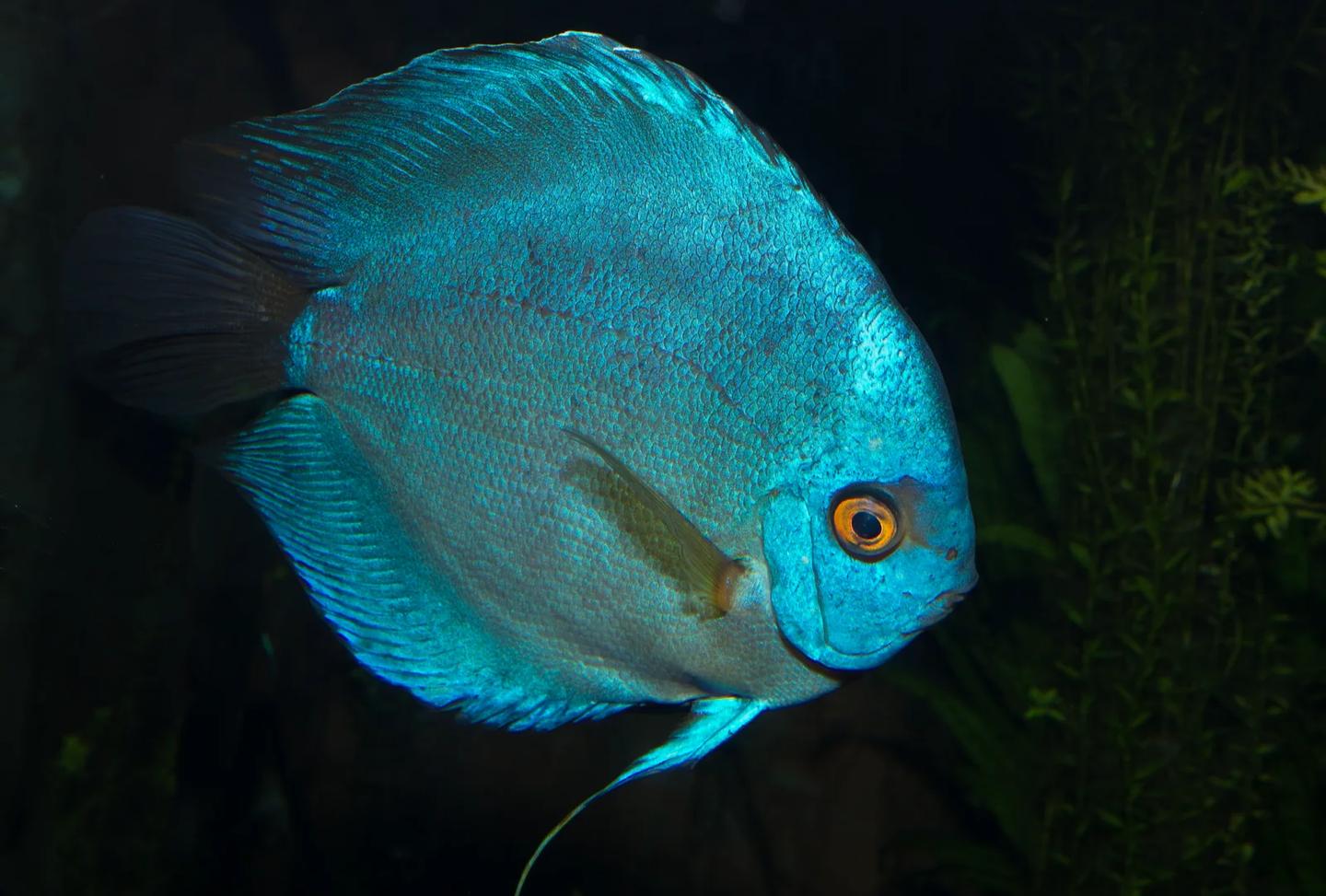
Discus are social Amazonian cichlids with specialised aquarium needs. OATA advises at least five fish, except an established breeding pair, and about 50 litres per adult—roughly 300 litres for six adults. Use that as a planning floor, then check usable dimensions, filtration, source water and the actual fish.
Maintain these water conditions for optimal health and vibrant colors
The Blue Heckel Discus (Symphysodon discus) is a freshwater cichlid endemic to Brazil’s Amazon Basin that reaches 20 cm total length. It suits advanced keepers who can prepare a large, mature aquarium for a social group and maintain warm, very soft, acidic water. FishBase records the species from the Amazon River basin in Brazil, near the mouth of the Negro River and in the lower Abacaxis and Trombetas rivers, while Wikipedia’s species account also places Heckel discus in the lower Rio Negro, upper Uatumã and Nhamundá.
FishBase gives red discus as the species' common name, Wikipedia also calls it the Heckel discus, and it belongs to the cichlid family, Cichlidae. Its recorded wild diet includes worms, crustaceans, insects and plant matter. A varied diet reflects that record, while aquarium portions and frequency follow the discus feeding routine below.
Keep this fish at 26–30°C, pH 6.0–6.2 and 0–1°dGH, and plan a group of at least five. Temperature and pH are the FishBase–OATA overlap, while hardness follows FishBase’s species record. OATA’s discus sheet gives group planning figures of at least five fish, 50 litres per adult and approximately 300 litres for six adults. More than five is better when the aquarium has the necessary volume and floor space.
| Suits | Not suited to |
|---|---|
| Keepers able to maintain 26–30°C and very soft, acidic water | An aquarium that cannot hold the stated water range steadily |
| A mature, filtered aquarium planned for at least five discus | Single-fish keeping or an undersized social group |
| A layout with plants, wood, cover and open group swimming space | An unfiltered or newly prepared aquarium |
| A weekly routine that includes testing and a 50% partial water change at least once every week | A low-maintenance community assembled without compatibility checks |
We rate this fish advanced because several requirements must work together: a social group, substantial water volume, mature biological filtration, a narrow working pH range and frequent maintenance. Success comes from preparing those conditions before the fish arrives rather than trying to correct them after introduction.
Each purchase supplies one live fish. Treat 20 cm as the adult planning figure rather than the size the animal will be when sent; the aquarium must be chosen for the mature fish and its eventual social group.
Sex is guaranteed only when the selected option explicitly states male or female. This Symphysodon discus blue heckel listing has no sex-guaranteed option.
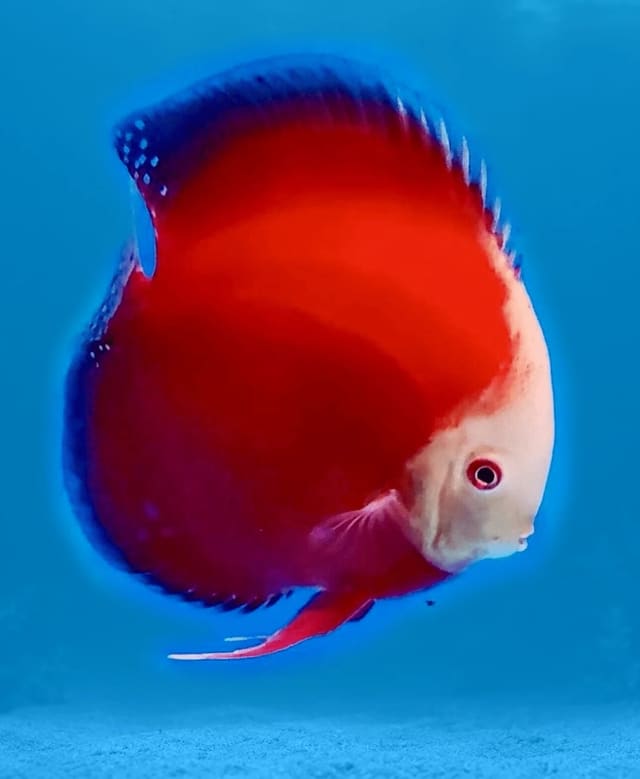
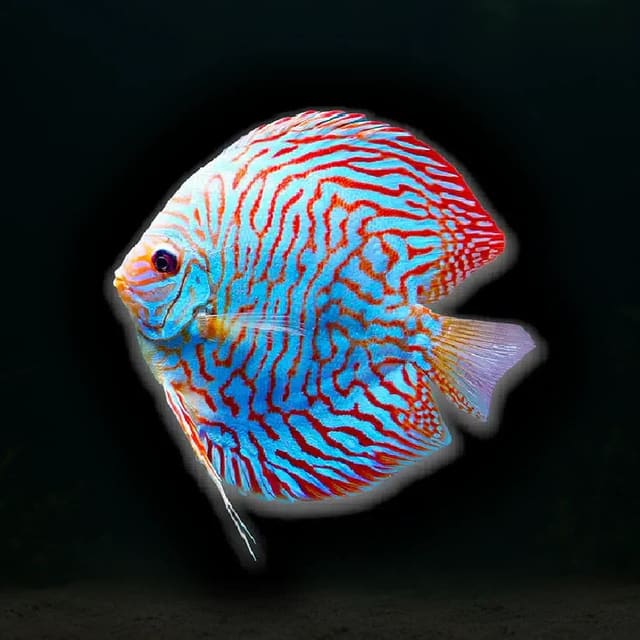
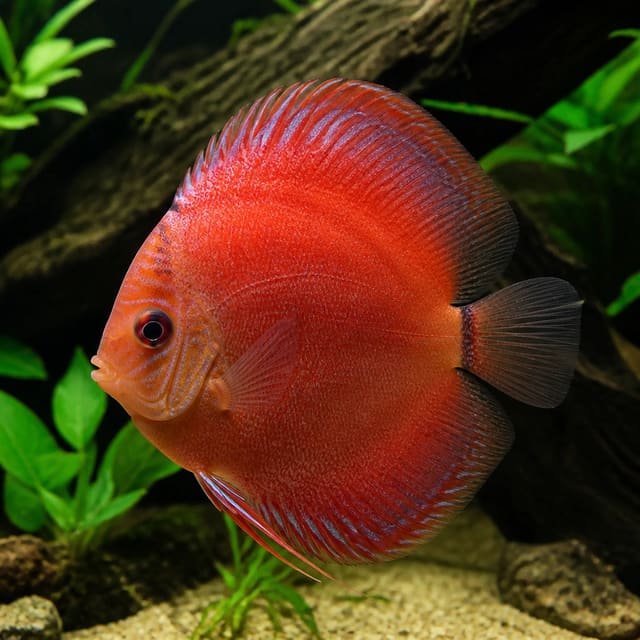
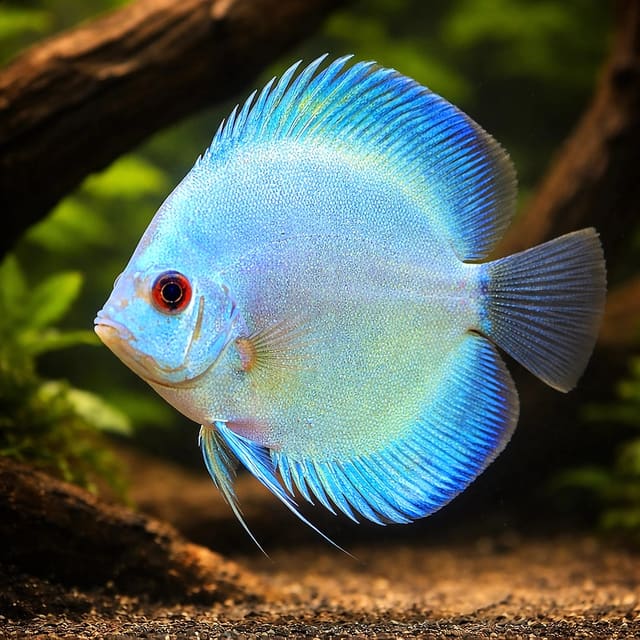
The gallery images are representative of this type of animal rather than photographs of the exact animal supplied, so colours can look slightly different from the live animal.
Blue Heckel Discus is the trade description for this Symphysodon discus. Individual markings and colour intensity should not be used to infer sex, age or the exact appearance of the fish that will arrive. Base the aquarium plan on the species identity, the 20 cm adult figure and the needs of a group.
This is a specialist discus rather than a routine addition to an established mixed aquarium. Check the aquarium’s measured temperature, pH and hardness, calculate the adult discus allowance, and assess every proposed companion before committing space. If you are comparing colour forms or related offers, browse the current discus collection without treating another colour name as evidence of identical care or temperament.
These decisions are linked. A tank may match the water values yet still be too small for the social group, while a large aquarium is not ready until its filter is mature and its water falls within the working range.
Plan for at least five discus and allow 50 litres for each adult. OATA recommends approximately 300 litres for a shoal of six adults, with plenty of floor space. For five adults, the same allowance gives 250 litres before accounting for the layout and any companion fish; it is a volume calculation, not permission to use a poorly proportioned aquarium.
A young or smaller dispatch fish does not reduce the mature space requirement. This species reaches 20 cm, and discus have a deep, rounded body as well as length. The aquarium therefore needs useful floor space, clear group swimming room and enough total water to make environmental conditions more stable.
| Planning question | Decision |
|---|---|
| How many discus? | At least five; more is better when the aquarium can support them |
| Five adults | Begin with a 250-litre volume allowance |
| Six adults | Plan approximately 300 litres |
| Adding companions | Calculate their space after reserving the discus allowance |
Do not count decorative height or nominal capacity as the whole answer. Wood, plants, substrate and ornaments occupy room, while the fish still need open space in which to explore the aquarium as a group. Choose the aquarium around usable floor area and the completed layout.
Discus kept singly or in a group that is too small will often become stressed or be bullied by larger, more dominant fish. Keeping just two is only sometimes possible, and only when they are already an established breeding pair; buying two unrelated fish is not a substitute for the normal shoal plan, and this offer carries no sex guarantee.
Before adding other species, reserve the adult volume and swimming room for the discus group. A 300-litre aquarium calculated for six adult discus is not automatically a 300-litre community allowance as well. The more livestock and food added, the more waste the biological filter must process, so stocking decisions must also match the filter’s mature capacity.
Keep the aquarium at 26–30°C, pH 6.0–6.2 and 0–1°dGH. FishBase records 26–30°C, pH 4.2–6.2 and 0–1°dH for the species’ environment. OATA’s aquarium guidance for discus gives the same temperature, pH 6.0–7.5 and general hardness of 4–12°dGH.
The full 26–30°C temperature range falls within both references. For pH, 6.0–6.2 is the shared range and gives a practical target without moving beyond FishBase’s upper boundary. Use those two values as the routine temperature and pH instructions.
The hardness ranges do not intersect. Keep this identified species within FishBase’s 0–1°dH record rather than extending the target to OATA’s harder general discus range. Test the intended source water before choosing the fish, because the aquarium must begin within the target rather than relying on later correction.
| Value | Routine instruction |
|---|---|
| Temperature | 26–30°C |
| pH | 6.0–6.2 |
| General hardness | 0–1°dGH |
| Ammonia | 0 mg/l |
| Nitrite | 0 mg/l |
| Nitrate | Do not exceed 20 mg/l |
Use the aquarium water chemistry guide to understand what each test measures, then compare your results with the target through the water matcher. Record the aquarium’s readings over time instead of relying on one test, because weekly checks reveal whether the system continues to hold the intended conditions.
Prepare replacement water with tap-water conditioner to remove chlorine or chloramine, and preserve the selected temperature and chemistry during maintenance. Clean, warm, soft and slightly acidic water is central to discus care; a large aquarium helps stability, but volume does not replace testing or water changes.
Use a well-established biological filter and confirm ammonia and nitrite are both 0 mg/l before adding the fish. The RSPCA explains that aquarium filters are vital because fish release toxic ammonia; beneficial bacteria convert it first to nitrite, which is also toxic, and then to the safer nitrate.
A filter is not ready merely because water is circulating. Its biological population must be able to process the waste produced by the intended livestock and feeding routine. Prepare and mature the aquarium in advance by following the first tropical aquarium guide, then use measured ammonia and nitrite results to judge readiness.
The plan is a group of at least five discus, so choose filtration for that adult group and add fish slowly so the biological filter can keep pace. OATA advises increasing aquarium populations slowly because beneficial bacteria must increase as fish numbers and feeding rise. Stocking too quickly can cause new tank syndrome, with ammonia or nitrite reaching unhealthy levels.
Before adding fish, ask us whether your aquarium is an appropriate size for the number of discus you plan to keep, with the tank volume, current occupants and recent test results to hand.
Clear water alone is not a biological-filter test. Continue measuring ammonia, nitrite and nitrate at least weekly even when the aquarium looks clean and the fish appear settled.
Use fine gravel or sand, live plant cover, branches and wood, while retaining open space for the discus to swim together. OATA recommends fine gravel or sand because discus can feed naturally by blowing at the substrate, and it notes that plant cover and other shelters help shy fish.
| Area | Purpose |
|---|---|
| Planted cover | Gives shy fish somewhere to shelter |
| Branches and wood | Adds additional cover without replacing swimming room |
| Open floor and water space | Lets the group explore and swim together |
| Fine gravel or sand | Supports natural substrate-feeding behaviour |
Build the hardscape around the adult group rather than filling every part of the aquarium. A striking piece of wood may create cover, but it should not divide the remaining open area so severely that five or six deep-bodied fish cannot move together. Check the layout from end to end and leave a continuous route through the open portion.
Live plants can form sheltered margins while the central or front area remains clear. Branches, wood and ornaments can be grouped to create cover efficiently instead of being scattered through every swimming lane. OATA also recommends overhead aquarium lighting; plan the planted layout around it.
Fine gravel can be siphoned during water changes to remove solid waste. If using sand, stir its open areas regularly so waste does not collect in dead spots. Place wood and plants so the accessible substrate can still be inspected and maintained during the weekly routine.
A suitable layout therefore combines three needs rather than copying a decorative scene: cover for shy behaviour, open room for social movement and accessible surfaces for cleaning. Recheck those needs whenever plants grow or ornaments are moved.
Feed two or three small meals each day, with only as much food as the fish can finish within a few minutes. Include a specialist dried discus food at least once daily so the routine supplies the vitamins covered by a formulated feed, then add suitable frozen or live foods for variety.
FishBase records worms, crustaceans, insects and plant matter in the wild diet of Symphysodon discus. OATA describes discus generally as carnivorous and recommends specialist granules or pellets, alongside frozen or live foods such as bloodworm, beef heart and specialist discus mixes. For this identified species, use a varied feeding plan that reflects the recorded mixed diet rather than relying on one ingredient.
| Meal | Practical choice |
|---|---|
| At least one daily meal | Specialist dried discus granules or pellets |
| Other small meals | A suitable frozen or live food named for discus |
| Portion limit | Only what is eaten within a few minutes |
| Daily frequency | Two or three small feeds |
Watch the whole group while it eats. The useful question is not whether food disappears somewhere in the tank, but whether each fish approaches food and maintains its normal feeding behaviour. A dominant individual or a fish that is hiding may not receive the same share even when the total amount looks sufficient.
Uneaten food breaks down and adds toxic waste to the water. If food remains after a few minutes, reduce the next portion rather than extending the feeding period. Remove accumulated solid waste during maintenance and check ammonia, nitrite and nitrate if feeding has changed.
Keep variety within the named food types and introduce routine changes carefully enough to observe intake. Do not substitute repeated large meals for the recommended two or three smaller feeds; discus have relatively small stomachs, and the small-meal schedule limits waste while giving them several opportunities to feed.
Change 50% of the water at least once every week and test ammonia, nitrite and nitrate at least weekly. OATA strongly recommends that maintenance schedule for discus and sets the targets at 0 mg/l ammonia, 0 mg/l nitrite and no more than 20 mg/l nitrate.
Prepare replacement water so the aquarium remains within 26–30°C, pH 6.0–6.2 and 0–1°dGH. A large replacement volume makes preparation important: the goal is a clean, repeatable water-change routine that preserves the chosen conditions.
If filter media needs cleaning, rinse it lightly in water removed from the aquarium during the partial water change. Do not rinse it under the tap, because chlorine or chloramine may kill the beneficial bacteria established in the media. Cleaning should clear obstructing waste without treating the biological media as disposable.
| Finding | Action |
|---|---|
| Ammonia or nitrite detected | Pause new livestock additions and inspect filtration and waste control |
| Nitrate nearing 20 mg/l | Complete the partial change and review feeding and substrate waste |
| Filter flow reduced | Check for blockages and rinse media in removed aquarium water if necessary |
| Waste collecting on sand | Stir accessible open areas and remove the released debris |
Do not postpone testing because the fish are feeding normally. Water tests detect a developing waste problem before appearance alone can guide a reliable decision, while the recorded results show whether the aquarium returns to its usual values after maintenance.
Arrange for someone to be home to receive the fish. Tropical Fish Co hand-bags live fish in pure oxygen, uses an insulated poly box and adds a heat pack when the weather calls for it. A licensed live-animal courier carries the parcel.
Open and inspect the parcel the same day it arrives; if anything has gone wrong, contact us the same day, WhatsApp is fastest, with your order number and the unboxing video.
The current claim terms and unpacking information are set out in the delivery and Live Arrival Guarantee policy. Keep those policy steps separate from the aquarium’s longer-term care routine.
OATA advises watching for changes in swimming, colour, temperament, breathing, appearance, body condition and feeding. Healthy signs include clear, bright eyes, intact scales, undamaged fins and appropriate swimming behaviour. During the first week, use each small feed as an opportunity to check whether the fish approaches food and whether its behaviour differs from earlier observations.
Keep testing weekly and changing 50% of the water at least once every week from the first week onwards. If behaviour, breathing, appearance or appetite changes, test water quality first, then contact us for further guidance. The test results help separate an environmental problem from a change that needs further assessment.
Consider medium-sized tetras, Corydoras, plecos and dwarf cichlids only after checking the exact species against the discus aquarium. OATA names those kinds as possible discus companions and notes that smaller dither fish may help discus feel more confident.
Those names are starting points, not universal pairings. Every candidate must be able to live at 26–30°C, pH 6.0–6.2 and 0–1°dGH, while leaving enough floor space and water volume for at least five adult discus. Use the candidate species’ own adult size and social needs when calculating the remaining capacity.
| Candidate kind | Checks before introduction |
|---|---|
| Medium-sized tetras | Exact temperature and chemistry requirements, group needs and adult size |
| Corydoras | Exact water range, floor-space use and social requirement |
| Plecos | Adult size, waste load, floor-space use and water requirements |
| Dwarf cichlids | Exact water range, space needs and behaviour in the planned layout |
Begin the calculation with 50 litres per adult discus and the open swimming room required by the shoal. Companion fish come after that allowance, not inside it. A 300-litre plan for six adult discus does not automatically include capacity for an additional tetra group, bottom-dwelling fish or another cichlid.
Check the biological load as well as physical space. Adding companions increases feeding and waste, so the established filter must continue to hold ammonia and nitrite at 0 mg/l and nitrate at no more than 20 mg/l. Increase the population slowly enough for biological filtration to respond, then use test results to decide whether the system remains stable.
Treat Blue Heckel Discus as social cichlids that are less aggressive than some close relatives, not as fish with no hierarchy. OATA warns that discus kept singly or in groups that are too small will often become stressed or be bullied by larger, more dominant fish.
Keep at least five and provide cover as well as open group swimming room. A fish that hides more, changes colour, loses condition or stops approaching food may be experiencing social pressure, poor water conditions or another health change. Check the whole picture rather than assuming every withdrawn fish needs another companion.
Fin damage should trigger observation of group interactions, swimming, feeding and water quality. The practical aggression risk described for discus is dominance and bullying when social conditions are wrong. Keep enough fish, preserve usable space and watch whether one individual repeatedly excludes another from food or open areas.
If any requirement falls outside the aquarium plan, do not add that candidate. Beyond the kinds named by OATA, the outcome depends on the exact species, available space and individual behaviour, so no universal pairing promise applies.
FishBase records a maximum total length of 20 cm. Plan the aquarium around that adult size, not the animal’s size on arrival.
OATA’s discus guidance recommends 50 litres per adult and approximately 300 litres for six adults, with ample floor space; five adults therefore require a 250-litre volume allowance before layout and other fish are considered.
OATA’s discus guidance says keep at least five, with more better. Single fish and undersized groups will often become stressed or bullied by larger, more dominant fish; keeping just two is only sometimes possible, and only when they are already an established breeding pair.
We rate it advanced because the aquarium must hold the FishBase–OATA overlap of 26–30°C and pH 6.0–6.2, maintain hardness at FishBase’s 0–1°dH, support at least five discus and receive a 50% partial water change at least once every week.
Feed a specialist dried discus food at least once daily, plus suitable frozen or live foods such as bloodworm or a discus mix. Offer two or three small feeds daily, each eaten within a few minutes.
Keep it at 26–30°C, pH 6.0–6.2 and 0–1°dGH. Temperature and pH use the overlap between FishBase’s species record and OATA’s discus guidance; hardness follows FishBase’s 0–1°dH record.
It is less aggressive than some close cichlid relatives, but a dominant discus can bully others when the group is too small. Keep at least five and judge damaged fins alongside group behaviour and water quality.
OATA names medium-sized tetras, Corydoras, plecos and dwarf cichlids as possible companions. Check the exact species against 26–30°C, pH 6.0–6.2, 0–1°dGH, adult space and social needs before introduction.
Tropical Fish Co hand-bags the fish in pure oxygen, uses an insulated poly box and adds a heat pack when weather calls for it. A licensed live-animal courier carries the parcel, and someone must be home to receive it.
No reviews for this item yet. Bought one? Honest reviews only, good or bad.
What customers say about ordering from us
Easy website plenty of info on fish your buying great to pick a time slot
TRACEY DURRANT · 7 Oct 2026
Got some lovely fish thank you
Kevin Mackie · 7 Oct 2026
Reviews of our shop, collected by Judge.me, an independent third-party review collector. Newest first.