−15%
Red Melon Discus (Symphysodon sp.)
26–30°C · pH 6–7.5
£44.19£51.99

Captive-bred Super Red Melon Discus for experienced keepers. Plan a stable 26-30°C aquarium around 300 litres for a social group; one quantity is one unsexed fish.
Adult size is the maximum length this species reaches at full maturity (scientific sources). The livestock you receive will be younger and smaller — pick a size above for the actual shipping size. Product-photo provenance and any image-specific limitations are stated on the listing.
Symphysodon spp. (domestic Super Red Melon strain)
Each quantity is one pack containing 2 fish. Discounts count packs.
Captive-bred Super Red Melon Discus for experienced keepers. Plan a stable 26-30°C aquarium around 300 litres for a social group; one quantity is one unsexed fish.
Adult size is the maximum length this species reaches at full maturity (scientific sources). The livestock you receive will be younger and smaller — pick a size above for the actual shipping size. Product-photo provenance and any image-specific limitations are stated on the listing.
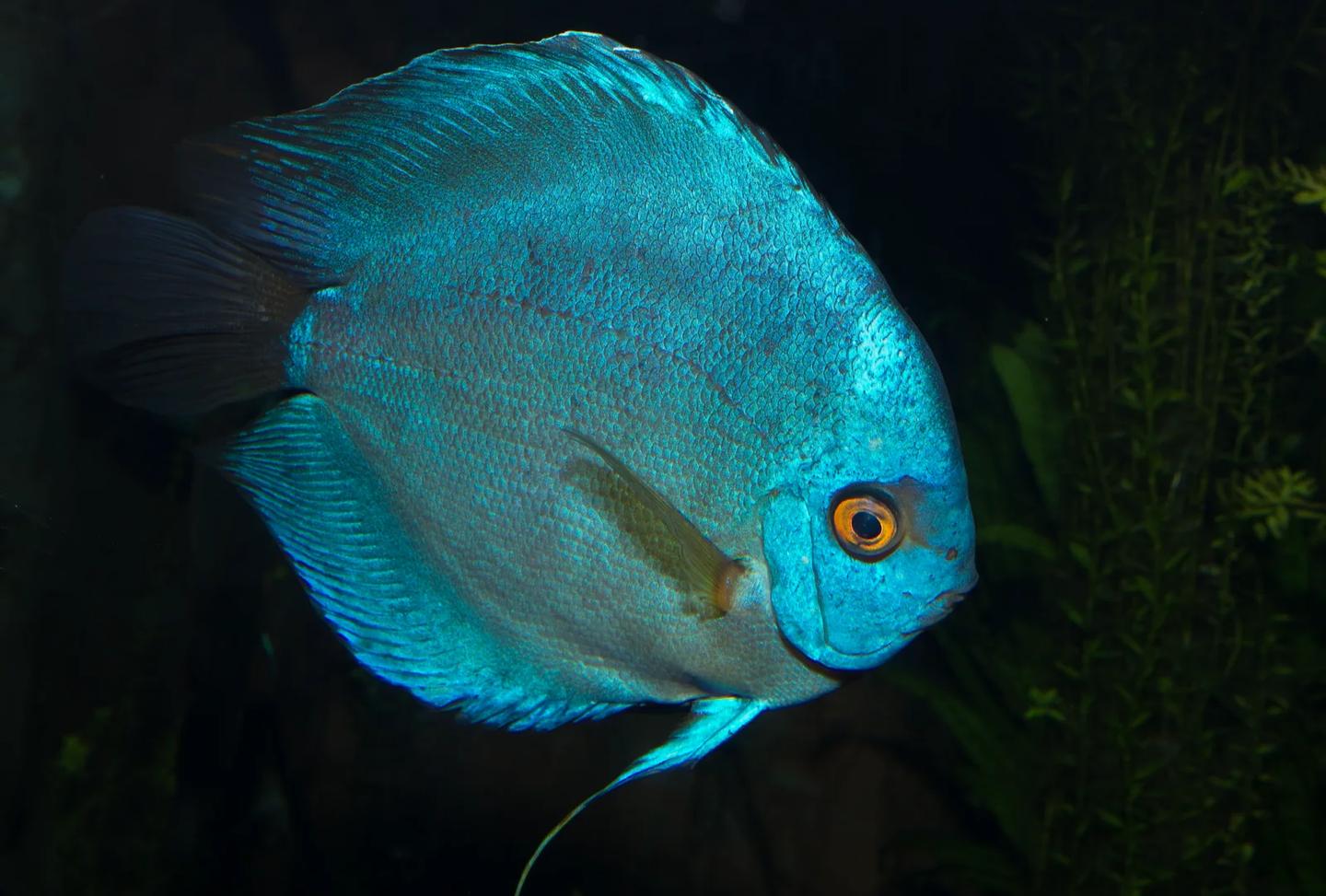
Discus are social Amazonian cichlids with specialised aquarium needs. OATA advises at least five fish, except an established breeding pair, and about 50 litres per adult—roughly 300 litres for six adults. Use that as a planning floor, then check usable dimensions, filtration, source water and the actual fish.
Maintain these water conditions for optimal health and vibrant colors
Super Red Melon Discus is a captive-bred Symphysodon colour strain selected for a broad red to red-orange body and the tall, rounded profile associated with discus fish. It is an impressive centrepiece for an experienced keeper, but colour is only one part of the decision. A mature filter, consistently warm water, a properly sized social group and enough time to observe every fish at feeding are essential.
This product combines several live size options. Select the size shown in the live menu, then choose the quantity required. Each quantity is one unsexed fish. A two- or four-fish quantity choice is not a sexed pair, an established breeding pair or a guarantee that the fish will pair later. The images show the intended strain and colour direction; they do not show the exact individual that will be packed.
| Care point | Practical guidance |
|---|---|
| Trade identity | Super Red Melon, a captive-bred domestic Symphysodon colour strain |
| Scientific identity | Symphysodon spp.; the trade record does not establish a single wild species or breeder lineage |
| Care level | Expert; best for a keeper already confident with mature filtration, testing and stable warm water |
| Adult size allowance | Plan for a fish reaching up to about 20 cm across, even when buying a smaller juvenile |
| Social requirement | A compatible group of at least five discus; more can be better when aquarium capacity allows |
| Adult aquarium plan | Approximately 300 litres or larger for a group of six adults, with open swimming room and suitable floor area |
| Temperature | 26-30°C, held steady |
| pH | 6.0-7.0 as a conservative routine range for this stock |
| General hardness | About 4-10 dGH, with gradual adjustment and stability more important than chasing one exact number |
| Water quality | Ammonia 0 mg/l, nitrite 0 mg/l and nitrate below 20 mg/l |
| Diet | Complete discus granules or pellets, supported by suitable frozen or live foods in measured portions |
| Sale unit | One unsexed fish per selected quantity; no pair or sex guarantee |
The size selector is the current source for availability and price. Discus are living animals, so each commercial band is approximate and normal variation can occur. Parenthesised measurements in a supplier band are part of that trade label; they are not a promise of an exact millimetre measurement, age, sex, maturity or final body shape.
A smaller juvenile has more growing to do and may need more frequent, carefully distributed meals. A larger juvenile or subadult has greater immediate presence, but size alone does not prove sex, social rank or breeding readiness. Whichever band is selected, the permanent aquarium must be planned around the adult group rather than the shipping size.
| Choice | Useful planning point | Not guaranteed |
|---|---|---|
| Smaller juvenile | More growth ahead; make sure it can feed confidently within the intended group | Sex, a smaller permanent tank or exact adult colour |
| Larger juvenile | More developed body size; introduce carefully where a hierarchy already exists | Pair status, maturity or dominant rank |
| Large or selection band | A supplier size category shown in the live menu | Show grade, named breeder, pedigree or a particular individual |
| Quantity of two or four | Two or four unsexed fish bought together | A male/female pair, two pairs or established breeding compatibility |
Use the tank volume calculator to estimate usable capacity from internal dimensions. If you are adding to an established group, compare body size, feeding confidence, quarantine history and the behaviour of the resident fish, not just the number printed beside the option.
The most defensible scientific label for this listing is Symphysodon spp. (domestic Super Red Melon strain). The current supplier group identifies all ten connected size variants as Super Red Melon, but it does not provide a wild locality, pedigree, breeder name or genetic record. Assigning the stock confidently to one wild species would therefore claim more than the evidence supports.
Discus taxonomy has a long history of competing classifications. University of Florida IFAS explains that species-level classification remains disputed and uses Symphysodon spp. for practical aquaculture. Molecular research likewise describes a genus undergoing diversification with complicated relationships among named forms. A domestic colour name describes a selected appearance; it is not a separate Latin species.
Super Red Melon and Red Valentine are treated as separate trade strains in our stock records. This product is the Super Red Melon group. Shoppers specifically looking for the other strain can compare the separate Red Valentine Discus listing. Keeping those identities distinct prevents a legacy stock name from becoming an unsupported synonym.
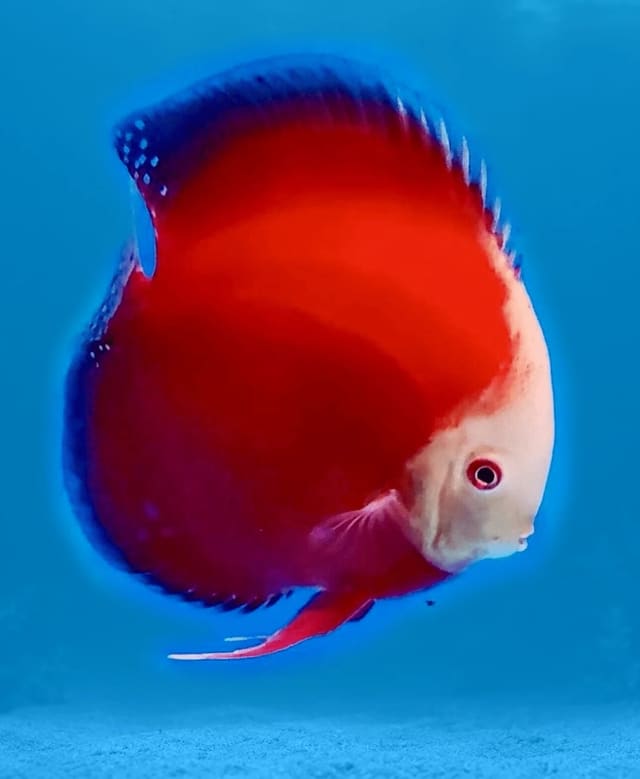
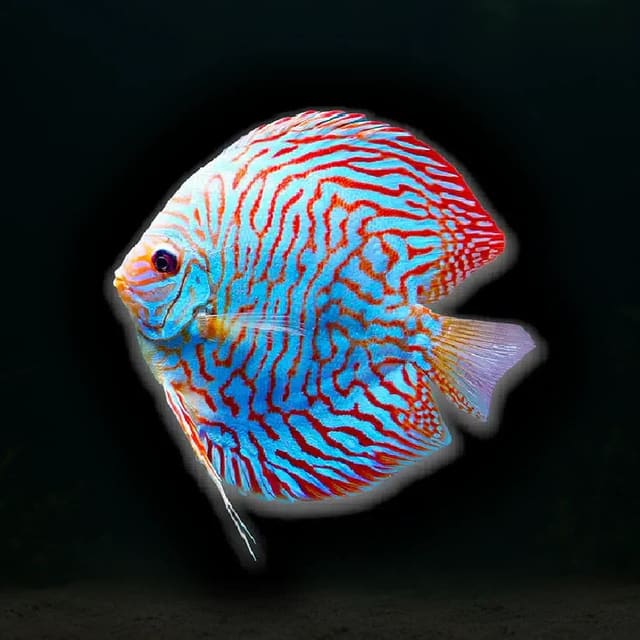
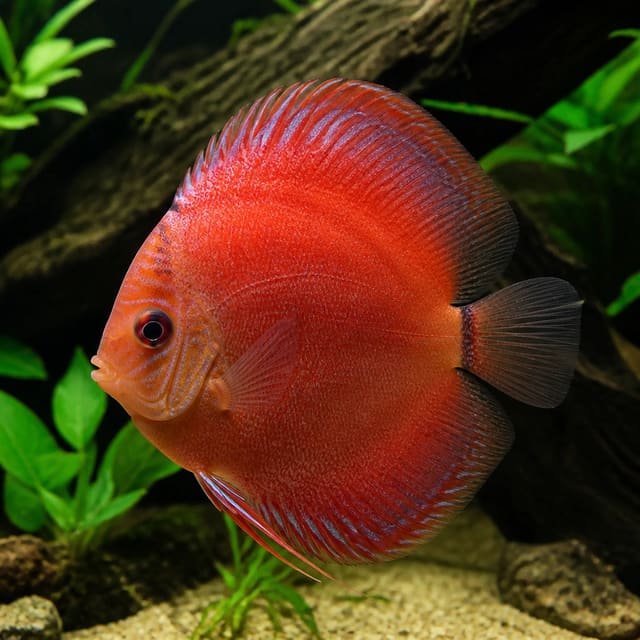
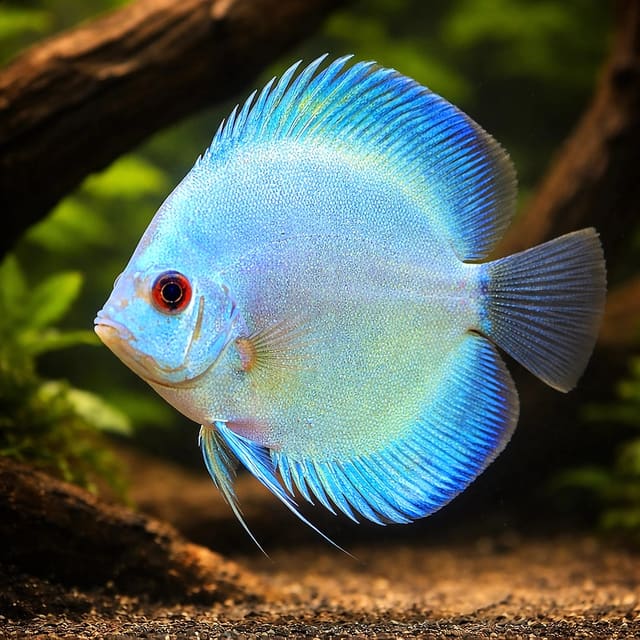
The four retained gallery images are representative illustrations. They show a vivid red to red-orange discus with a pale face, rounded body and blue accents along parts of the dorsal and anal fins. The first is a single-fish planted aquarium scene, the second shows two fish, the third is a clean side profile on blue and the fourth shows one fish beside a broad leaf.
They are useful for understanding the intended strain direction and general discus profile, but they are not photographs of the exact fish supplied. Real juveniles can differ in red coverage, facial tone, eye colour, fin edging, body depth and the visibility of stress bars. Colour can continue to develop with age and is affected by genetics, diet, health, water quality, background, lighting and momentary stress.
A juvenile discus should not be matched to a temporary juvenile tank. OATA advises that adults can reach about 20 cm across, should be kept in groups of at least five and need roughly 50 litres per adult as a general planning rule. Its example is an aquarium of approximately 300 litres for six adults. More water volume usually improves temperature and water-quality stability, but litres alone do not guarantee enough swimming space or social separation.
Provide open midwater room, sheltered areas and enough distance for a lower-ranking fish to move away from pressure. A very tall aquarium can hold many litres while offering limited horizontal space. Substrate, wood, plants and equipment also reduce usable water volume, so calculate the real capacity and leave a margin for companions.
| Situation | Recommendation |
|---|---|
| New discus group | Plan for at least five compatible fish and an adult aquarium around 300 litres or larger |
| Six adults | Approximately 300 litres is OATA's example; more room gives additional stability and flexibility |
| Group with tank mates | Increase capacity beyond the discus-only baseline and assess every companion individually |
| One newcomer | The mature aquarium must have room within the full social group, not merely spare litres today |
| Established breeding pair | A specialist exception for fish already known to be paired; two random unsexed fish are not an established pair |
Discus are relatively peaceful cichlids, but they form a hierarchy. A stronger individual can repeatedly displace another from food or a preferred area without dramatic fighting. OATA warns that fish kept singly or in undersized groups may become stressed or bullied. A compatible group spreads interaction more effectively than keeping one fish alone or placing two unrelated fish together and hoping that they pair.
Watch access to food as closely as chasing. A subordinate fish may hang back, darken, clamp its fins or slowly lose condition while the rest of the aquarium appears calm. Multiple feeding points, open swimming room, broken sight lines and reasonably matched body sizes can help. If one fish is repeatedly excluded, investigate water quality, health, aquarium capacity and group structure.
Sex is difficult to determine reliably outside breeding condition. This listing supplies unsexed fish and makes no male, female or pair promise. A true established pair is identified through sustained compatible behaviour and breeding evidence, not simply because two fish were bought together.
Our stock records show 26-30°C, pH 5.0-7.0 and 0-10 dGH. OATA's domestic discus guidance gives 26-30°C, pH 6.0-7.5 and 4-12 dGH. This page uses the conservative routine overlap: 26-30°C, pH 6.0-7.0 and about 4-10 dGH. The aim is a stable, mature aquarium, not abrupt chemical correction to an exact target.
| Parameter | Routine target | Practical boundary |
|---|---|---|
| Temperature | 26-30°C | Use a reliable heater and thermometer; avoid rapid heating or cooling |
| pH | 6.0-7.0 | Keep stable and change only through a controlled, understood method |
| General hardness | 4-10 dGH | Measure source and aquarium water before altering mineral content |
| Ammonia | 0 mg/l | Any detectable reading requires immediate investigation and protective action |
| Nitrite | 0 mg/l | Any detectable reading is unsafe |
| Nitrate | Below 20 mg/l | Review feeding, stocking and maintenance if it rises |
Test the proposed aquarium before ordering and continue at least weekly. OATA strongly recommends a weekly partial water change of about 50% for discus, adjusted sensibly to measured load and replacement-water chemistry. Match temperature and treat chlorine or chloramine before new water enters the aquarium. If reverse-osmosis water is used, learn the complete remineralisation process first; untreated RO water and improvised pH chemicals can create dangerous instability. The water parameter matcher can help compare readings, but it cannot replace calibrated tests and gradual changes.
The aquarium should be biologically mature before these fish arrive. Use generous biological filtration for the adult group and distribute the return so the fish are not forced to fight a concentrated jet. Warm water holds less dissolved oxygen than cooler water, so maintain surface movement and even circulation without turning the display into a high-flow river tank.
| Element | Useful approach | Avoid |
|---|---|---|
| Biological filter | Mature, generously sized media with a repeatable cleaning routine | Adding discus to a new or incompletely cycled aquarium |
| Water movement | Even circulation, good gas exchange and a softened outlet | A hard jet or warm stagnant areas |
| Substrate | Fine sand, fine gravel or another surface that can be cleaned thoroughly | Deep waste-trapping pockets beneath feeding areas |
| Decor | Smooth wood, stable cover, broken sight lines and open swimming space | Sharp edges, unstable stone and narrow traps |
| Lighting | A predictable day/night cycle with shaded retreats | Sudden intense light without cover |
| Observation | Clear sight of every fish during feeding and routine checks | A layout so dense that bullying or illness remains hidden |
A planted display can work when the plants are selected for the fish's temperature. Leave a broad open area for group movement and use planting or smooth wood to provide shade and visual separation. Dense growth must not prevent cleaning or hide a fish that is losing condition.
This is a domestic strain without a documented collection locality, so an Amazon-style layout is a husbandry choice rather than a claim that the fish came from one exact habitat. Choose warm-tolerant plants, keep gas exchange adequate and prioritise fish stability over maximum plant growth. Carbon-dioxide systems, fertilisers and medications add complexity and should be monitored carefully.
Use a complete, appropriately sized discus granule or pellet as the nutritional base. OATA describes discus as generally carnivorous and recommends specialised dry food for vitamin coverage, supported by suitable frozen or live foods. University of Florida IFAS also describes a protein-rich diet. Frozen bloodworm, brine shrimp, mysis and clean discus mixes can add variety, but no single treat should become the whole diet.
Offer small measured portions and confirm that every fish eats. Juveniles may benefit from several smaller feeds, while adults still need portion control. Remove leftovers before they decay. Rich food combined with warm water can quickly increase waste, so feeding and water maintenance must be planned together.
| Check | What to look for |
|---|---|
| Staple food | A complete discus pellet or granule accepted by every fish |
| Variety | Suitable frozen or live foods rotated in clean, controlled portions |
| Distribution | More than one feeding point where hierarchy prevents equal access |
| Body condition | A full but not swollen belly, steady growth and no individual becoming pinched |
| After feeding | Remove uneaten food and investigate repeated refusal immediately |
Choose companions only after meeting the discus requirements. OATA lists medium-sized tetras, Corydoras, plecos and dwarf cichlids as possible groups, but every candidate still needs individual checking for temperature, temperament, adult size, feeding speed and disease risk. Warm-tolerant Cardinal Tetras or Rummy-nose Tetras can work in suitable systems; the species and stock must be comfortable at the chosen temperature.
| Usually worth considering | Use caution | Avoid |
|---|---|---|
| Compatible discus of similar size, suitable medium tetras, warm-tolerant Corydoras, appropriate Otocinclus or a carefully chosen small pleco | Fast feeders, territorial dwarf cichlids, very small newcomers and large suckermouth catfish | Fin nippers, aggressive cichlids, predators, boisterous feeders, coldwater fish and hard-water specialists |
Compatibility is not a guarantee. Quarantine new fish and observe breathing, appetite, body condition and social access. Use the tank mate checker as a screening aid, then verify the full care needs of every species.
Prepare a mature quarantine aquarium wherever possible. It should be heated, filtered and large enough for observation without creating another source of instability. Do not share wet nets, hoses or buckets between systems unless they have been cleaned and managed for biosecurity.
On delivery, follow the instructions supplied with the order and use the acclimation timer as a prompt rather than improvising. OATA recommends a gentler acclimation process for discus because rapid changes in temperature and chemistry are stressful. Keep lights low, prevent the container from cooling and never pour transport water into the aquarium.
| Time | Priority |
|---|---|
| Before arrival | Confirm temperature, pH, ammonia, nitrite, nitrate, heater operation and filter flow |
| Arrival day | Receive the parcel promptly, document opening, acclimate carefully and keep lighting subdued |
| First 24 hours | Observe breathing, balance and social pressure; avoid repeated disturbance |
| Days 2-7 | Confirm that each fish feeds and holds condition; test water more often after the added bioload |
| Before mixing groups | Complete the planned quarantine and assess compatibility rather than rushing introduction |
Healthy discus should have clear eyes, intact fins, steady breathing, balanced swimming and enough confidence to feed. Warning signs include darkening, clamped fins, rapid breathing, isolation, erratic swimming, a pinched body or repeated refusal of food. These signs are not a diagnosis. Test water and equipment first, isolate when appropriate and seek qualified aquatic-veterinary advice when a health problem is suspected.
| Frequency | Tasks |
|---|---|
| Daily | Check temperature, equipment, breathing, appetite, fins, body condition and social access |
| At feeding | Watch every fish eat and remove leftovers |
| Weekly or more often | Test ammonia, nitrite, nitrate, pH and hardness; record results and trends |
| Water change | OATA recommends about 50% weekly for discus; match and condition replacement water carefully |
| Filter service | Preserve beneficial bacteria, clear blockages and avoid rinsing biological media under chlorinated tap water |
Live fish are dispatched by a licensed live-animal courier when conditions are suitable. The delivery page explains current delivery days, packing and the requirement for someone to receive the parcel. The Live Arrival Guarantee terms explain same-day reporting and the evidence that helps a claim move quickly.
Browse the Discus collection or read the full Discus care guide before choosing a strain. The Red Melon Discus is the closest colour-family comparison. The separate Red Valentine Discus should be used when that specific trade strain is wanted. Other live comparisons include Turquoise Checkerboard Discus, White Diamant Discus and Blue Heckel Discus.
Choose by verified identity, current size, care compatibility and the aquarium you can maintain, not by colour alone. Contact us before ordering if the proposed group, water chemistry or size match is uncertain.
No reviews for this item yet. Bought one? Honest reviews only, good or bad.
What customers say about ordering from us
I have a small group of long finned mountain minnows. So was delighted to be able to order ten of this variety to increase the genetics in my tank . The ones I recieved are healthy but it’s to early to give a verdict on wether they are of a long finned type since they are small currently.
Gordon Walker · 23 Sept 2026
100% success travel and "installation". Pleased with quality of purchase. The Siamese fighter a bit "shy" so have not yet seen him at his best yet but looking good. Happy customer. GG
George E Garratt · 21 Sept 2026
Reviews of our shop, collected by Judge.me, an independent third-party review collector. Newest first.