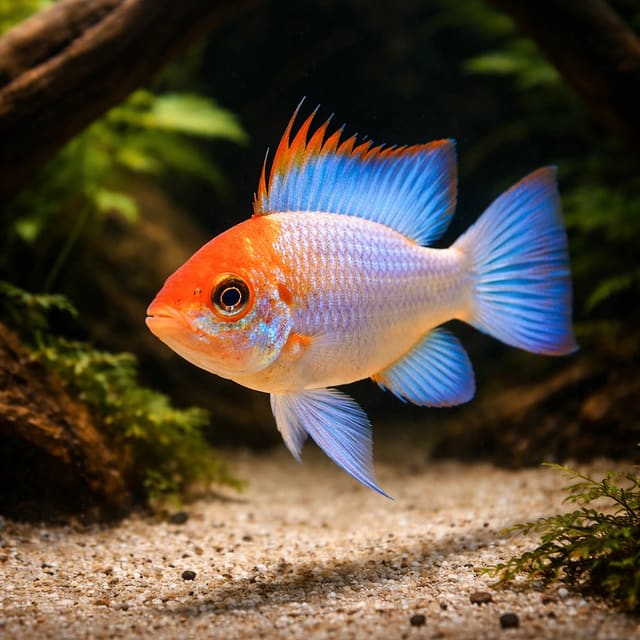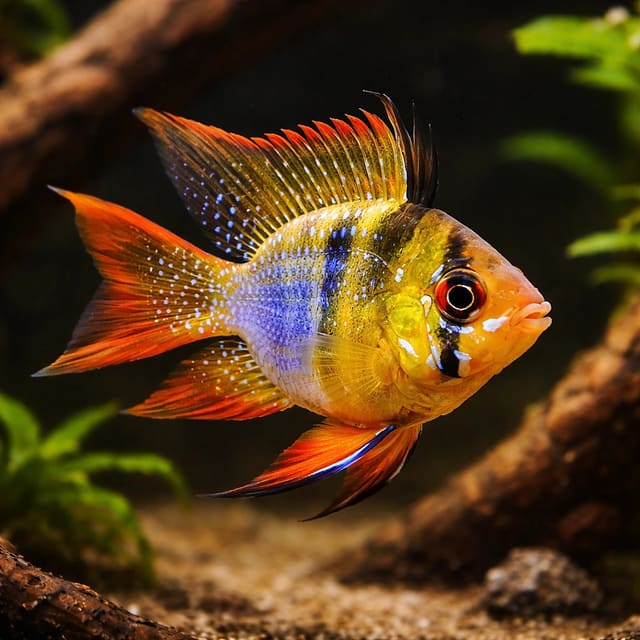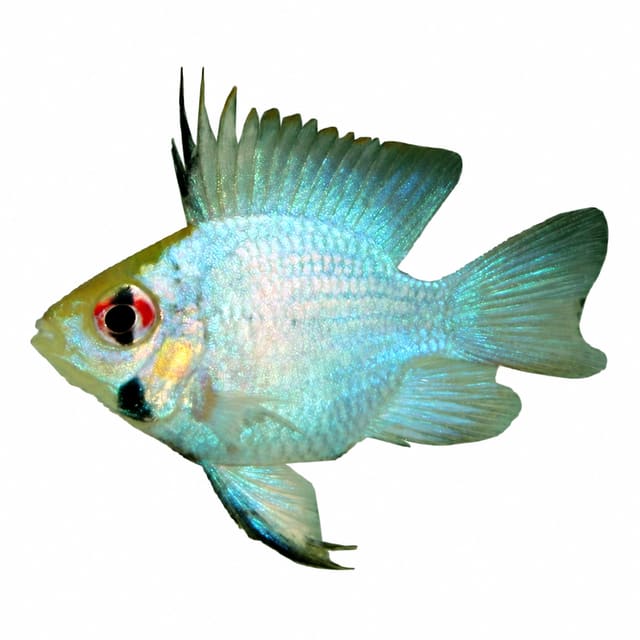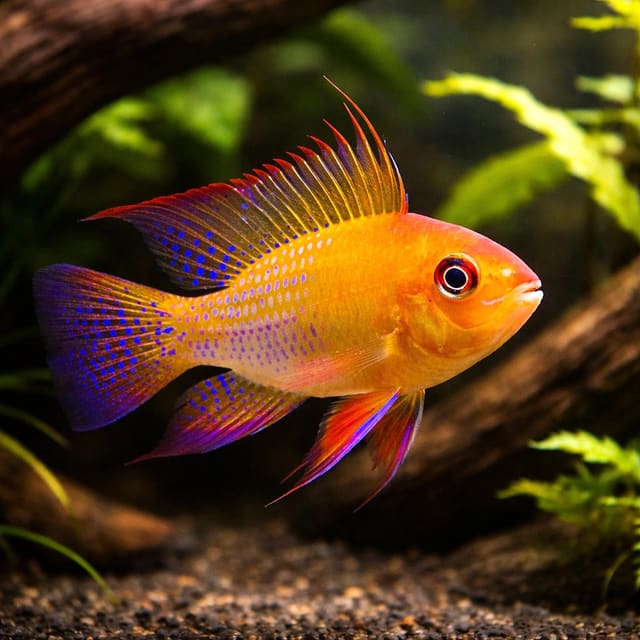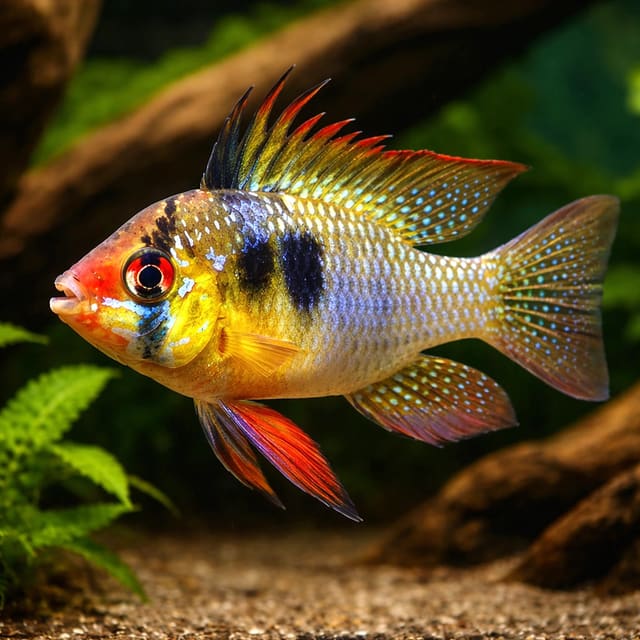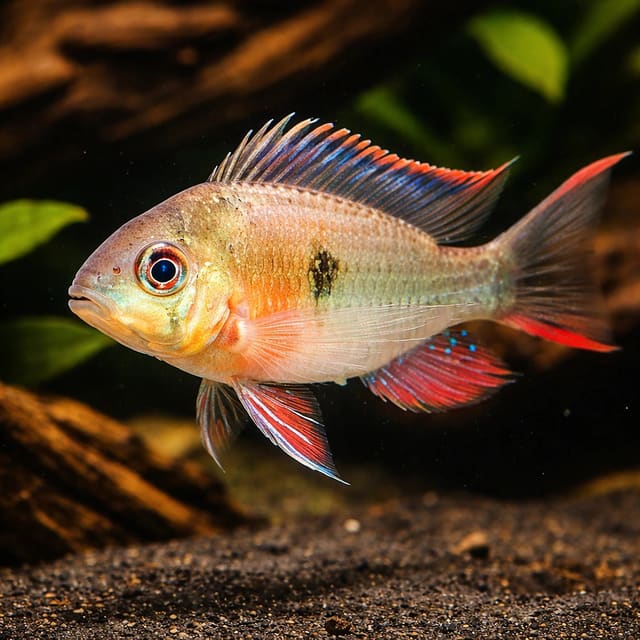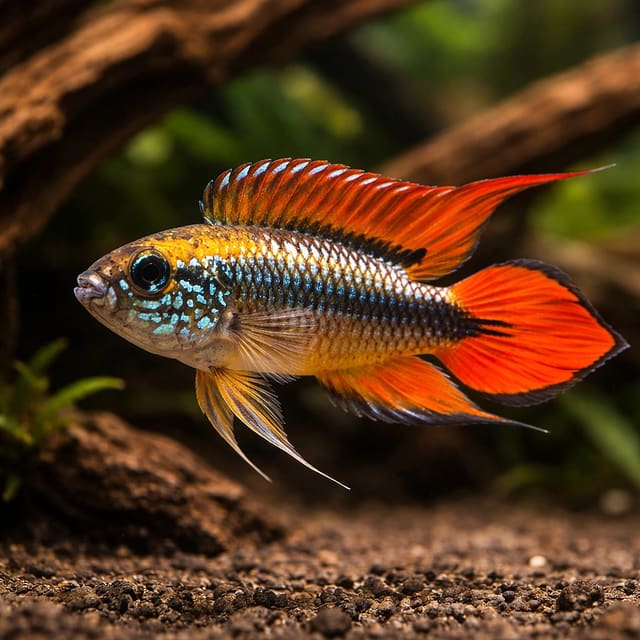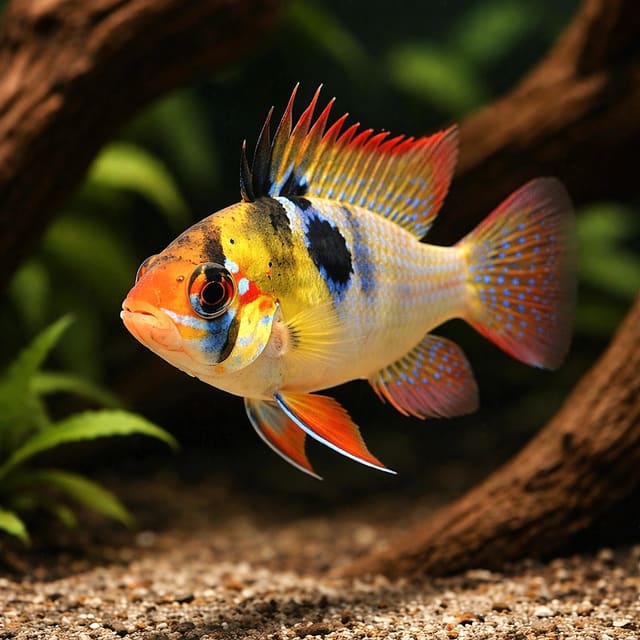
Asia Form Ram Cichlid (Mikrogeophagus ramirezi)
27–30°C · pH 4–7 · 54L
£5.99

The Longfin Ram Cichlid (Mikrogeophagus ramirezi) is a freshwater dwarf cichlid from the Orinoco basin of Venezuela and Colombia that reaches 4.2 cm standard length. It suits keepers prepared to maintain 27–30°C, pH 4.0–7.0 and 1–10 dGH; plan a 60 × 30 cm base or equivalent for a single pair. Sold individually in sizes from 2.5–3 cm to XXL (4.5–5 cm).
Adult size is the maximum length this species reaches at full maturity (scientific sources). The livestock you receive will be younger and smaller — pick a size above for the actual shipping size. Product-photo provenance and any image-specific limitations are stated on the listing.
Mikrogeophagus ramirezi
Save when buying multiple fish. Each quantity is one fish; sex and pair formation are not guaranteed unless the selected variant explicitly states them.
The Longfin Ram Cichlid (Mikrogeophagus ramirezi) is a freshwater dwarf cichlid from the Orinoco basin of Venezuela and Colombia that reaches 4.2 cm standard length. It suits keepers prepared to maintain 27–30°C, pH 4.0–7.0 and 1–10 dGH; plan a 60 × 30 cm base or equivalent for a single pair. Sold individually in sizes from 2.5–3 cm to XXL (4.5–5 cm).
Adult size is the maximum length this species reaches at full maturity (scientific sources). The livestock you receive will be younger and smaller — pick a size above for the actual shipping size. Product-photo provenance and any image-specific limitations are stated on the listing.
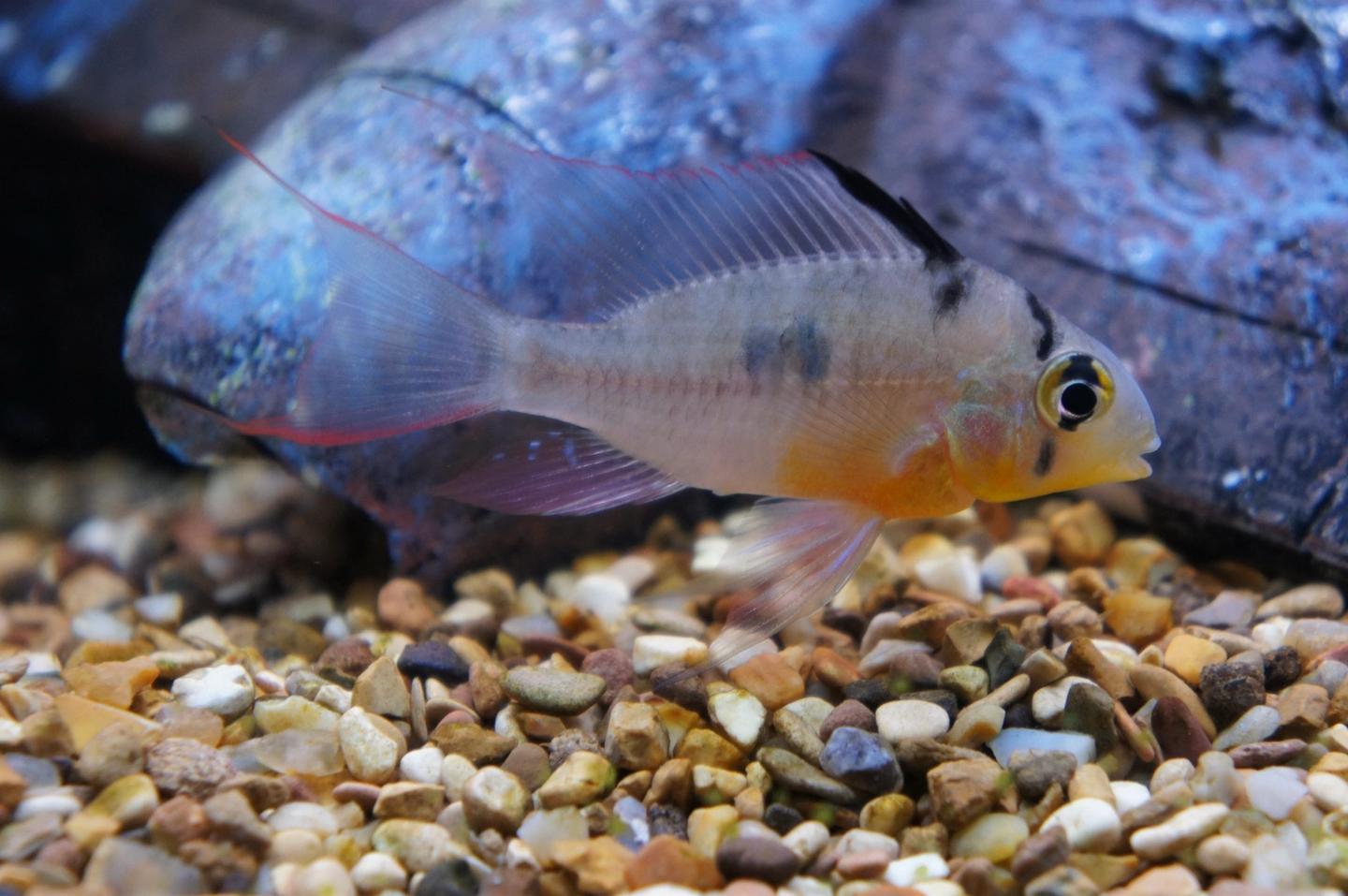
Cichlids are a family of roughly 1,800 accepted species, not one care type. Before buying, identify the exact species and source, then compare adult measurement, usable tank dimensions, social system, territory, tested water, diet and an exit plan. No family-wide minimum tank, water range or tank-mate list is safe.
Maintain these water conditions for optimal health and vibrant colors
The Longfin Ram Cichlid is an ornamental long-finned form of Mikrogeophagus ramirezi, a freshwater member of the cichlid family. It is also known in the hobby as Ramirez’ dwarf cichlid or butterfly cichlid, while long-finned forms may be called veil-tail, lyre-tail or hi-fin rams.
FishBase records Mikrogeophagus ramirezi from the Orinoco River basin in the llanos of Venezuela and Colombia and records a maximum of 4.2 cm standard length.
This compact body does not make the fish a casual addition to every community. It needs warm water, consistently low waste, gentle movement and tank mates that will not outcompete or intimidate it. It suits a keeper prepared to test regularly, feed deliberately and plan the aquarium around its warm, soft-water requirements. Explore the wider South American cichlid collection when comparing fish with different space, water and temperament requirements.
One purchase supplies one animal in the selected size. Use the live size selector to choose 2.5–3 cm, 3–3.5 cm, 3.5–4 cm, XL (4–4.5 cm) or XXL (4.5–5 cm). The selector is the place to check which size can be chosen when ordering.
The size you select is the size supplied, not the adult size. A dispatch measurement describes the animal when it leaves us; it is not a promise that the fish has completed its growth. Plan the aquarium around the recorded adult body size, the required floor area and the intended social arrangement rather than using a dispatch size as the tank-planning figure.
Sex is guaranteed only when the selected option explicitly states male or female. This Longfin Ram Cichlid listing has no sex-guaranteed option.
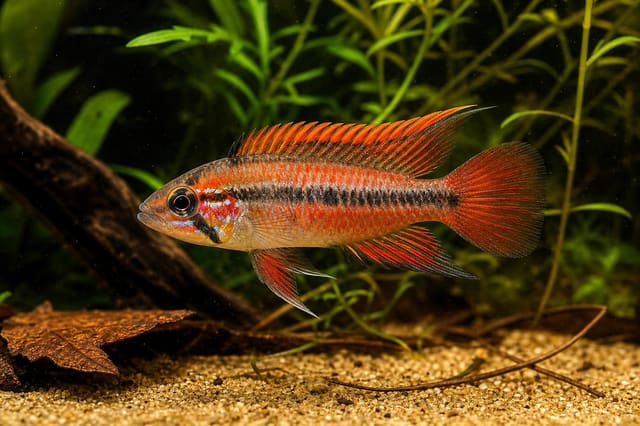
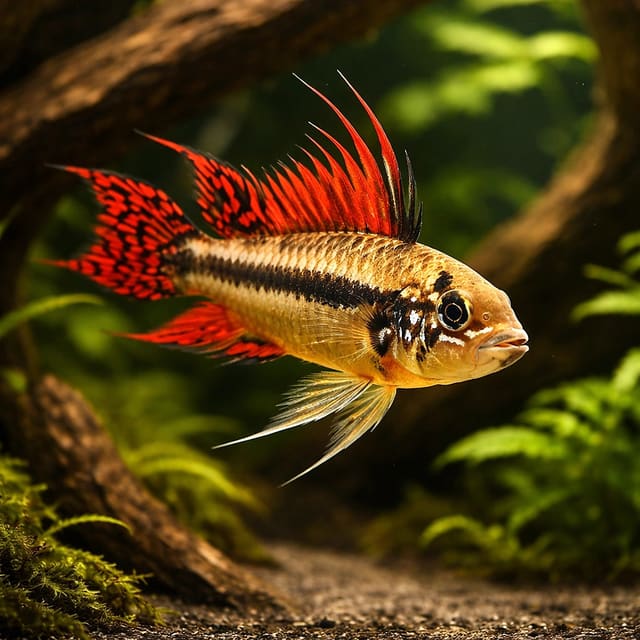
The gallery images are representative, based on reference photographs of this species, so colours can look slightly different from the live animal.
One animal should not be treated as an established pair. If your plan is to keep a pair, allow for two separate purchases and remember that selecting two animals does not promise a compatible or bonded pairing. The 60 × 30 cm base recommendation discussed below applies to a single pair and is an aquarium-planning benchmark, not a statement about the relationship between two selected fish.
For dispatch days, packing-policy details and guarantee terms, read our delivery and Live Arrival Guarantee policy before choosing a delivery date.
Seriously Fish gives the routine aquarium range for Mikrogeophagus ramirezi as 27–30°C, pH 4.0–7.0 and 1–10 dGH. It gives a 60 × 30 cm aquarium base, or an equivalent footprint of about 54 litres, as sufficient for a single pair. These figures should be considered together: warm water and soft chemistry do not compensate for inadequate floor area, and a suitable footprint does not compensate for poor water quality.
| Decision | Planning value |
|---|---|
| Temperature | 27–30°C |
| pH | 4.0–7.0 |
| General hardness | 1–10 dGH |
| Single-pair base | 60 × 30 cm or equivalent |
| Approximate volume | 54 litres |
| Recorded body length | Up to 4.2 cm standard length |
| Suits | Not suited to |
|---|---|
| Keepers prepared to maintain 27–30°C and pristine water | An unscreened general community aquarium |
| A single-pair plan with a 60 × 30 cm base or equivalent | Fish requiring harder water |
| Peaceful open-water companions that share its water range | Territorial or aggressive fish, including most other cichlids |
A larger aquarium can give you more room for cover, visual barriers and carefully screened companions, but litres alone do not settle the stocking decision. Compare the base dimensions, usable territory, décor, filter maturity and the requirements of every other fish.
This ram is not recommended as a general-purpose community fish. It requires very clean water and can be a poor competitor, so it suits a keeper prepared to test regularly, feed deliberately and build the surrounding stock around its warm, soft-water requirements.
Start with a soft, sandy substrate that allows natural bottom-focused feeding. Rams take mouthfuls of substrate, sift edible particles and expel the remaining material through the mouth and gill openings. Coarse décor that prevents this behaviour misses an important reason for providing sand.
Arrange wood roots and branches so they produce shaded areas, caves and broken sight lines. Ceramic flowerpots, suitable lengths of aquarium-safe piping and other artificial shelters can also provide structure. A fish entering a new aquarium should be able to leave an exposed area without crossing the whole tank in open view.
Plants from genera such as Microsorum, Taxiphyllum, Cryptocoryne and Anubias are among the examples used for this species. Choose and position plants according to their own light and substrate needs while preserving the ram’s open feeding areas.
Dried leaf litter can add cover and encourage beneficial microbial growth as it decomposes. Those microbes may become a secondary food source for fry, while tannins and other compounds released by the leaves help create a more natural-style environment. Add only aquarium-suitable material and keep it within a maintenance routine that prevents trapped food and waste from accumulating unnoticed.
Prepare and mature the aquarium before livestock arrives. Our first tropical aquarium guide explains the sequence for establishing the tank and biological filter.
View the finished aquarium from the front and both ends before adding fish. At floor level, there should be more than one route between open sand and shelter. If every route passes through a single cave entrance or narrow gap, one fish could control access to the remaining lower area. Move wood, plants or artificial shelters until the layout offers alternative paths and several places to leave direct view.
Place food on the intended feeding patch while the filter is running. A suitable patch keeps small sinking food accessible instead of carrying it behind wood or into dense planting. This simple dry run links décor, flow and feeding before an animal has to negotiate them.
Set the aquarium within 27–30°C, pH 4.0–7.0 and 1–10 dGH, then confirm that it stays there through the normal heating and maintenance cycle. A single reading is only a snapshot. Stability matters because this fish requires pristine water quality and is less forgiving of neglected conditions than a general community species.
Use a reliable thermometer and suitable water tests rather than judging warmth or chemistry by touch or appearance. Our water chemistry guide explains what the principal aquarium readings mean, while the water matcher helps compare measured values with the stated range.
| Reading | Action |
|---|---|
| Below 27°C | Correct the heating plan before introduction. |
| Above 30°C | Bring the aquarium back within range without a sudden swing. |
| Outside pH 4.0–7.0 | Resolve the mismatch before selecting this fish. |
| Above 10 dGH | Choose a safe softening plan or a fish suited to harder water. |
| Ammonia or nitrite detected | Pause livestock additions and restore biological control. |
OATA’s broad dwarf-cichlid guidance sets ammonia and nitrite at zero mg per litre and nitrate at no more than 20 mg per litre above the normal tap-water level. Apply those waste limits alongside the narrower 27–30°C, pH 4.0–7.0 and 1–10 dGH aquarium range for this ram.
Test the replacement water as well as the aquarium when your tap water varies. Treat tap water with a suitable conditioner before it enters the tank so chlorine or chloramine does not damage fish or the filter’s bacterial population.
Take readings while the aquarium is operating normally rather than immediately after adjusting the heater or changing water. Check again after the system has settled. If the first reading is 27°C and a later reading falls below 27°C, the heating plan has not yet demonstrated that it can hold the required range. If pH or hardness moves outside the target after a routine water change, resolve the replacement-water mismatch before introducing the ram.
Write down the aquarium result and the replacement-water result separately. This shows whether a change begins in the source water or develops inside the tank. It also prevents a single acceptable test from masking a repeated shift associated with normal maintenance.
A filter is essential even when the aquarium looks clean. General RSPCA aquarium welfare guidance explains that fish release toxic ammonia; a working biological filter supports bacteria that convert ammonia to nitrite and then to the safer nitrate. The filter must therefore be established, maintained and able to process the waste created by the aquarium’s full population.
For an aquarium of about 54 litres, the species profile suggests looking for a filter rated at 110–160 litres per hour because the fish prefers gentle movement. Treat this as a practical reference for that volume, then account for the actual tank shape, media, pipework and the manufacturer’s stated performance.
Check the fish’s usable areas after installation. If the lower aquarium is dominated by current, redirect or diffuse the outlet while preserving filtration. If food races away before the ram can take it from the floor or water column, adjust the feeding position and flow rather than adding excessive food.
Holding 27–30°C in an aquarium of about 54 litres requires roughly 125–175 W when the surrounding room is around 20°C. That is an assumption-based planning range, not a universal heater size. Cooler rooms, larger aquariums and different heater designs change the calculation, so use the manufacturer’s guidance and confirm the result with a thermometer.
Equipment is working properly when it holds the target conditions without turning the ram’s sheltered lower zones into fast-flowing channels.
Observe how the equipment behaves after décor, plants and substrate are in place. These features can redirect current and create sheltered pockets that were not apparent in an empty aquarium. Confirm that water still moves through the filter while the open sandy feeding area remains usable.
Recheck the thermometer after routine room-temperature changes. The 125–175 W example assumes a room around 20°C, so a different room condition changes the heater’s task. The decision is complete only when measured aquarium temperature remains within 27–30°C during ordinary operation.
Mikrogeophagus species feed from the bottom by sifting substrate, but they also browse solid surfaces and take food directly from the water column. Use that behaviour to shape both the menu and its placement. Food should reach an open sandy area without disappearing into inaccessible gaps or being taken immediately by faster companions.
Offer appropriately small live and frozen foods such as bloodworm, Artemia, Daphnia and grindal worm. Supplement them with good-quality sinking dried food in a size the fish can handle. A varied diet gives the ram more than one food texture and feeding opportunity without relying on a single item.
Gelatine-bound recipes can also work when made from a mixture such as dried fish food, puréed shellfish, fruit and vegetables. Cut the finished food into bite-sized discs. Any prepared food must be small enough for the fish and managed so uneaten fragments do not remain in the aquarium.
Feed only what can be eaten within a few minutes, once a day. Watch the fish take the food rather than adding a guessed amount and leaving. If pieces remain after the feeding period, remove them and reduce the next portion. This protects water quality because uneaten food breaks down and adds waste.
| What you see | What to do |
|---|---|
| Food remains on the floor | Remove it and reduce the next portion. |
| Other fish take everything | Feed in a controlled location or reconsider the companions. |
| Large pieces are ignored | Change to a suitably small food. |
| Dried food is refused | Use suitable live or frozen fare and introduce sinking dried food gradually. |
| Interest in food declines | Test the water and compare behaviour with the fish’s normal pattern. |
Do not compensate for competition by scattering more food throughout the tank. This ram is a poor competitor, so the safer decision is to control access or change the stocking plan.
Begin with a deliberately small portion and observe whether the ram can take it within a few minutes. The correct amount is defined by consumption, not by a fixed number of pieces, because food size and the number of fish sharing the meal can differ. Remove leftovers before they break down.
When changing food type, keep the same controlled feeding window. A smaller sinking food may reach the sand differently from frozen fare, so watch where it lands and whether the ram can retrieve it. If a companion repeatedly intercepts both types, the problem is competition rather than menu variety.
Complete the setup before the fish arrives. The heater should already hold 27–30°C, the pH and hardness should sit within range, and the biological filter should be processing waste. Test ammonia and nitrite and proceed only when both read zero mg per litre.
Increase aquarium stocking slowly. Every added fish increases waste and feeding, so the beneficial bacteria in a mature filter must adjust to the greater load. Adding too many animals too quickly can leave the biological filter unable to process ammonia and nitrite.
Observe swimming, breathing, colour, appetite, body condition and use of cover at the same times each day. A consistent routine helps you notice a change. Record the water readings beside those observations so a behaviour change can be compared with measurable conditions.
| Checkpoint | Decision |
|---|---|
| Fish uses cover but emerges to feed | Keep the routine steady and continue observing. |
| Fish cannot reach food | Change feeding placement or reassess competing fish. |
| Breathing rate changes | Test water immediately and check temperature. |
| Ammonia or nitrite appears | Stop further additions and act to restore safe water. |
| A companion repeatedly displaces it | Separate the conflict and revise the stocking plan. |
A calm introduction is achieved by preparing the environment and limiting simultaneous changes, not by relying on the fish to adapt to unsuitable conditions.
Cover use on its own is not a reason to rearrange the aquarium immediately. If the fish also emerges to feed, breathes normally and occupies more than one sheltered area, keep the surroundings steady and continue the daily comparison. Repeated décor changes remove the stable reference needed to judge whether behaviour is improving.
Intervene when an observation identifies a concrete problem. A changed breathing rate leads to immediate water and temperature tests. Missed meals lead to a feeding-access check. Persistent displacement leads to separation and a revised stocking plan. This sequence avoids changing several variables at once and makes the result of each action easier to assess.
Do not add more animals while the ram’s feeding, breathing and use of cover are still being assessed. Additional fish increase waste and may alter competition or territory. Continue only after ammonia and nitrite remain at zero mg per litre and the existing population can feed without repeated displacement.
At least once a week, carry out a partial water change of 25%. Use a siphon to remove solid waste from the substrate, concentrating on places where food and debris collect without stripping every sheltered area at once. Treat replacement tap water with conditioner before adding it to the aquarium.
Test at least weekly for ammonia and nitrite and track nitrate against the limit of no more than 20 mg per litre above the normal tap-water level. Check temperature at the same time. Periodic pH and hardness checks help reveal whether the aquarium is drifting away from 4.0–7.0 pH or 1–10 dGH.
Do not run biological filter media under the tap. Chlorine or chloramine may kill part of the beneficial bacterial population. Avoid replacing all established media together unless the equipment instructions require a specific safety action.
Watch for surface hanging, prolonged bottom sitting, erratic swimming, unusual hiding, a change in aggression, faster or slower gill movement, white spots, fluffy growths, damaged fins or scales, changes in body condition and reduced interest in food. These signs have several possible causes, so begin with water tests and a temperature check rather than guessing at a treatment.
If a health change persists, test the water, separate immediate aggression where necessary and contact us for further guidance. Record the measured values and the change you observed so the next decision is based on concrete conditions.
Keep the weekly test results together for the first month. Four sets of temperature, ammonia, nitrite and nitrate readings show more than one isolated result. Add pH and hardness checks when evaluating whether the tank remains inside 4.0–7.0 and 1–10 dGH through ordinary water changes.
Compare each maintenance session with the previous one. If debris repeatedly gathers behind the same shelter, siphon that point carefully during the next water change. If filter flow falls again soon after cleaning, check for recurring blockage rather than simply increasing the output and creating stronger current across the lower aquarium.
A useful baseline also includes normal feeding and shelter use. Note where the fish usually feeds, which areas it occupies and how it breathes when settled. Later changes can then be compared with a concrete normal pattern alongside measured water values.
This ram does not have to live alone, but it is not recommended for an unscreened general community. It needs pristine water, is a poor competitor and must share the aquarium only with animals that can thrive at 27–30°C in soft water.
| Check | Pass condition |
|---|---|
| Temperature | The candidate thrives throughout 27–30°C. |
| Chemistry | Its pH and hardness needs overlap 4.0–7.0 and 1–10 dGH. |
| Temperament | It is peaceful and will not defend the same area aggressively. |
| Feeding | The ram can reach food without being displaced. |
| Space | The layout provides cover and room if territorial behaviour develops. |
Peaceful open-water characids or similar fishes are the type most strongly recommended because small schooling or shoaling fish may help reduce shyness. Cardinal tetra, Paracheirodon axelrodi, and green neon tetra, P. simulans, are named examples that share the required warmth, but every aquarium still needs an individual stocking assessment.
Avoid territorial or otherwise aggressive fishes, including most other cichlids. Also avoid fish requiring harder water. These are direct conflicts with the ram’s behaviour or water requirements rather than assumptions based only on a broad community label.
A combination can fail even when no obvious aggression occurs. If companions repeatedly take all food before it reaches the lower aquarium, the ram is being outcompeted. Feed in a controlled location, observe the result and change the stocking arrangement if the fish still cannot eat normally.
Compatibility remains conditional because temperament, aquarium dimensions, cover, population and breeding behaviour all alter the result. Leave out any candidate whose adult water, space or behaviour requirements do not clearly pass every check.
Begin with water requirements because no layout can resolve a temperature or chemistry conflict. A candidate that cannot thrive throughout 27–30°C, pH 4.0–7.0 and 1–10 dGH fails before temperament is considered. This prevents a peaceful label from overriding incompatible environmental needs.
Next compare where and how each fish feeds. An open-water companion may pass the space check but still fail if it takes every portion before sinking food reaches the ram. Observe an actual meal in the completed aquarium. If controlled placement still leaves the ram without reliable access, revise the combination.
Finally assess behaviour and usable space together. A peaceful candidate still needs enough room to withdraw if the ram becomes territorial. Pass the plan only when cover, feeding access and adult space remain workable at the same time; a single successful meeting or meal is not enough to settle long-term compatibility.
A 60 × 30 cm base, or an equivalent aquarium of about 54 litres, is sufficient for a single pair. Use that as the starting footprint for two fish, then increase space when the aquarium includes other animals. OATA says an aquarium of at least 80 litres will be needed when dwarf cichlids are mixed with other fish, with the larger volume helping provide more stable conditions and more room if breeding behaviour creates a territory.
Selecting two unsexed animals does not establish that they are male and female, compatible or bonded. Do not build a breeding plan around dispatch size, colour or gallery appearance. Instead, provide each fish with access to shelter and monitor whether both can feed and occupy the aquarium without persistent displacement.
Dwarf cichlids may become territorial, especially when breeding. Even well-settled pairs will often chase each other, which makes cover and visual barriers essential. Wood, caves, plants and broken sight lines let a pursued fish leave view instead of remaining exposed across the whole floor.
| What happens | Required response |
|---|---|
| Brief display followed by separation | Continue observing access to food and shelter. |
| One fish controls every shelter | Add effective visual separation or move a fish. |
| Repeated chasing prevents feeding | Separate the fish rather than waiting for injury. |
| Territory disrupts other occupants | Revise the community or use a dedicated setup. |
| Several rams are planned | Use more space and territories than a single-pair setup. |
Breeding is best attempted in a dedicated aquarium without other fish. The species is a biparental substrate spawner, and good diet, stringent maintenance, very clean water and low hardness are important. A community arrangement introduces competition around the spawning site and the possibility that other fish disturb eggs or fry.
For ordinary display keeping, the safest rule is simple: plan the floor around the ram first, then add only peaceful animals whose warm-water needs and feeding behaviour fit the completed aquarium.
When two animals share the aquarium, observe each one separately during feeding and shelter use. Both should be able to reach food and leave direct view. If one animal can use the whole floor while the other remains confined to one corner or misses meals, the usable territory is not balanced even when the nominal aquarium volume meets the starting figure.
Rearranging cover may help when one direct sight line divides the tank poorly, but persistent chasing that prevents feeding requires separation. Do not wait for visible damage before acting. The practical threshold is loss of access to food, shelter or a usable lower area.
FishBase records a maximum of 4.2 cm standard length for Mikrogeophagus ramirezi. Plan the aquarium around that adult body length rather than the selected dispatch size.
Seriously Fish gives a 60 × 30 cm base, or an equivalent aquarium of about 54 litres, as sufficient for a single pair. Use more space when adding other fish; OATA says an aquarium of at least 80 litres will be needed when dwarf cichlids are mixed with other fish.
FishBase describes aquarium keeping in pairs, and Seriously Fish gives a 60 × 30 cm base for a single pair. Two unsexed animals are not necessarily compatible or bonded, so provide separate shelter and monitor feeding and territory.
It suits a keeper prepared to maintain pristine water at 27–30°C, test regularly and manage feeding competition. It is a poor competitor and is not recommended as an unscreened general community fish.
Offer suitably small live or frozen bloodworm, Artemia, Daphnia or grindal worm, supplemented with good-quality sinking dried food. Feed only what it can eat within a few minutes, once a day.
Keep it at 27–30°C, pH 4.0–7.0 and 1–10 dGH. Maintain ammonia and nitrite at zero mg per litre and nitrate at no more than 20 mg per litre above the normal tap-water level.
It may become territorial, especially when breeding. Provide cover and broken sight lines, monitor access to food and shelter, and separate fish if repeated chasing prevents feeding or confines an animal to one area.
Peaceful open-water characids or similar fishes may suit if they thrive at 27–30°C in soft water and do not outcompete the ram. Avoid territorial or aggressive fishes, including most other cichlids, and fish requiring harder water.
Someone must be present to receive the parcel. Start filming every delivery before opening the sealed parcel, then record continuously as it is opened with the fish still inside the sealed bag. Float the bag for 20–30 minutes before releasing the fish, and never pour the bag water into the aquarium.
No reviews for this item yet. Bought one? Honest reviews only, good or bad.
What customers say about ordering from us
I have a small group of long finned mountain minnows. So was delighted to be able to order ten of this variety to increase the genetics in my tank . The ones I recieved are healthy but it’s to early to give a verdict on wether they are of a long finned type since they are small currently.
Gordon Walker · 23 Sept 2026
100% success travel and "installation". Pleased with quality of purchase. The Siamese fighter a bit "shy" so have not yet seen him at his best yet but looking good. Happy customer. GG
George E Garratt · 21 Sept 2026
Reviews of our shop, collected by Judge.me, an independent third-party review collector. Newest first.