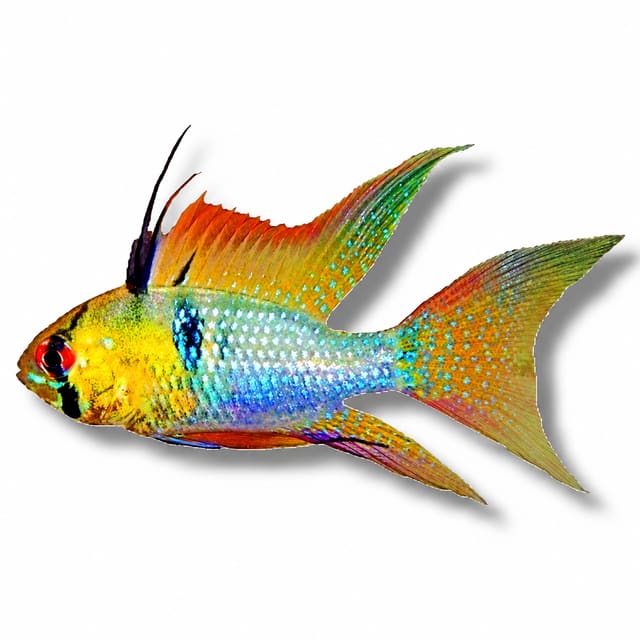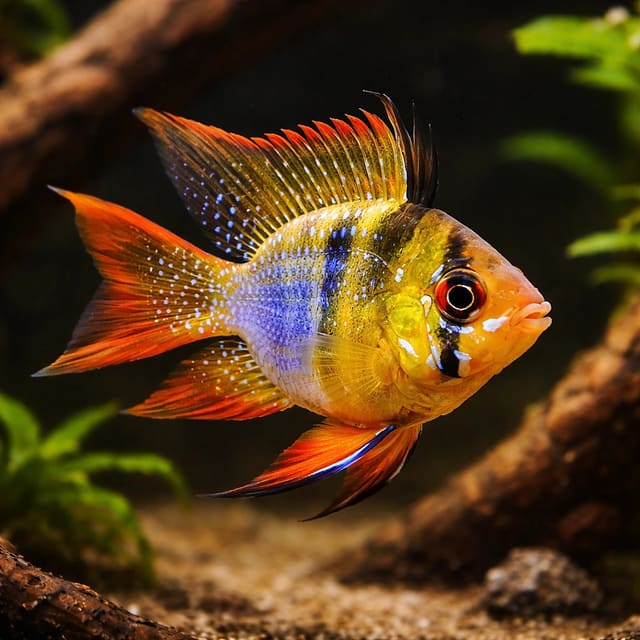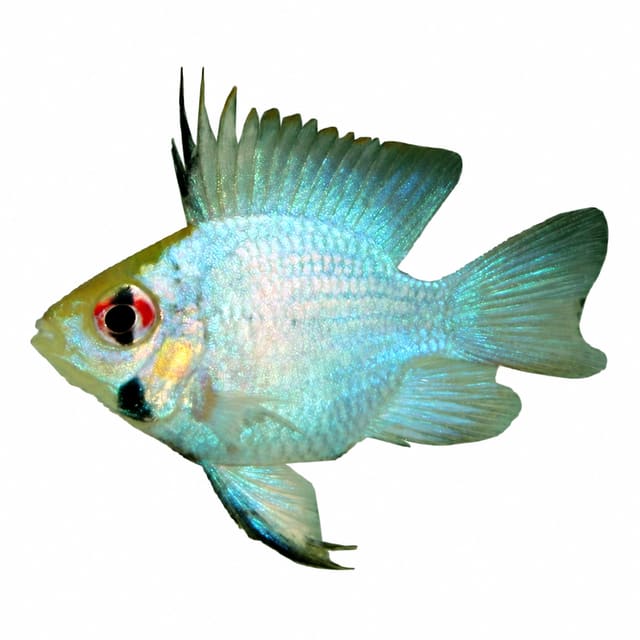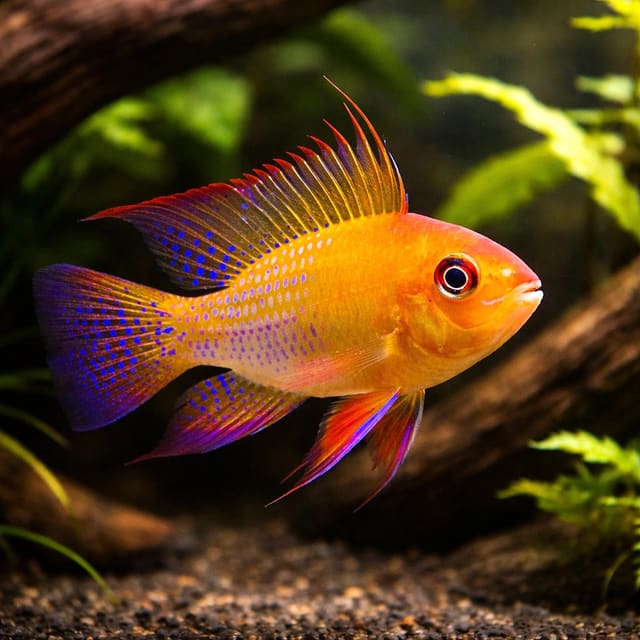
Asia Form Ram Cichlid (Mikrogeophagus ramirezi)
27–30°C · pH 4–7 · 54L
£5.99

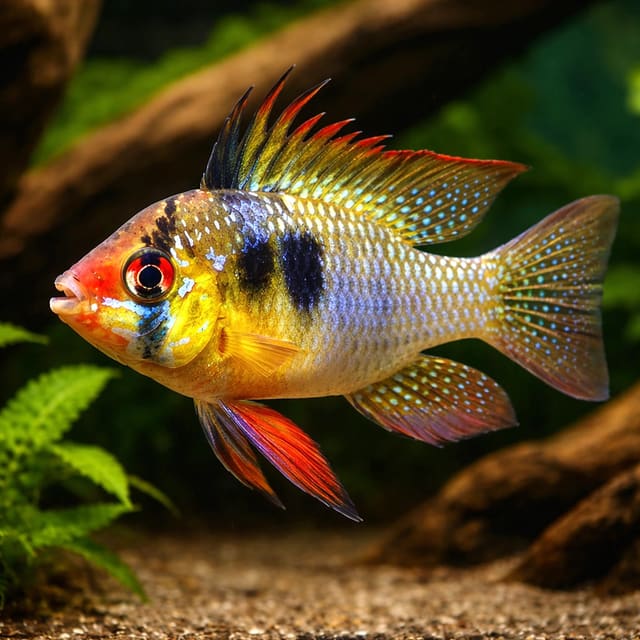
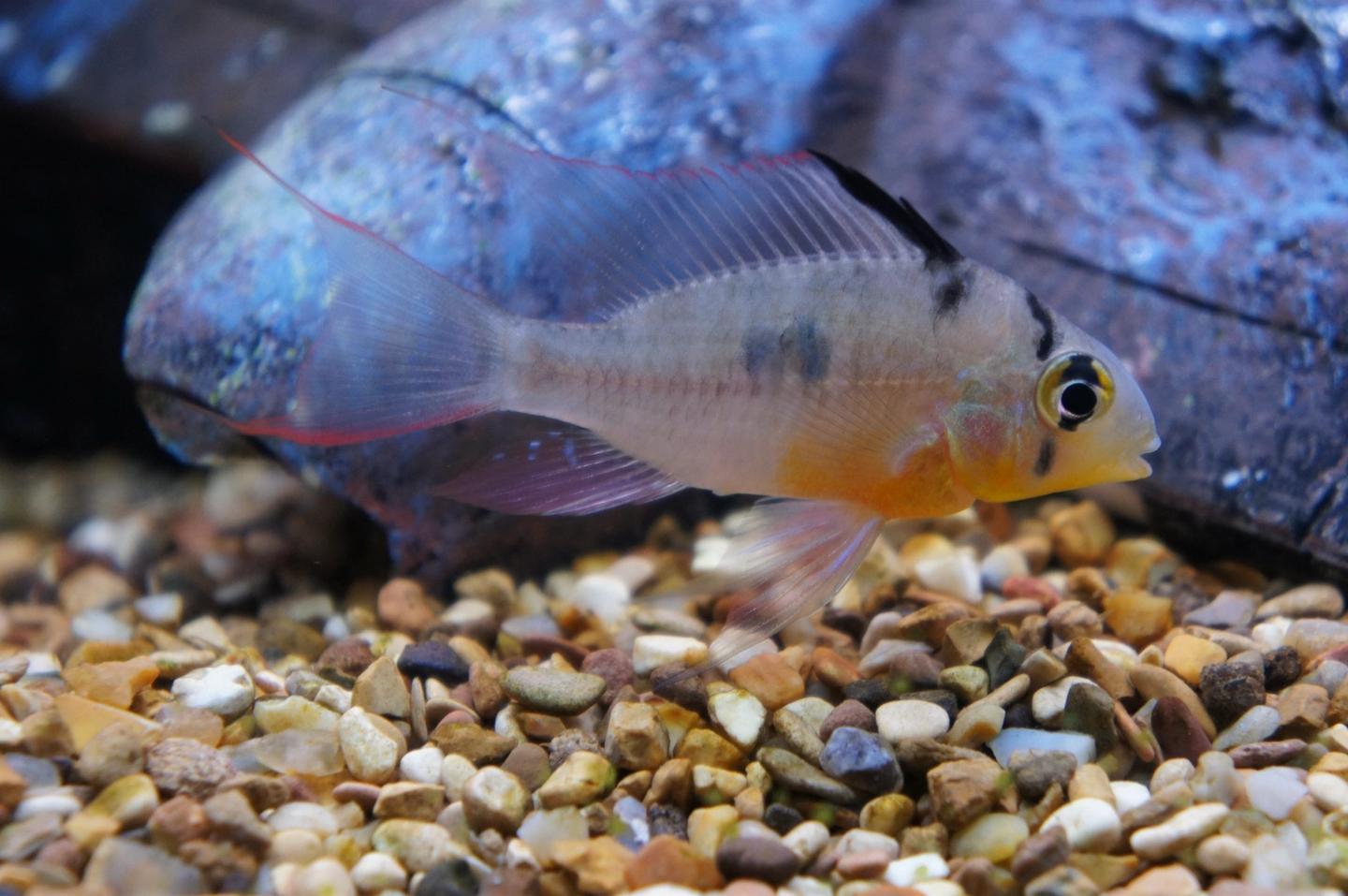
Electric Blue Ram (Mikrogeophagus ramirezi) is an electric-blue ornamental dwarf cichlid for a warm, mature aquarium. One purchase supplies one animal from the selected 2–5 cm dispatch band. For a compatible pair, plan a 60 × 30 cm base or equivalent, around 54 litres, at 27–30°C.
Adult size is the maximum length this species reaches at full maturity (scientific sources). The livestock you receive will be younger and smaller — pick a size above for the actual shipping size. Product-photo provenance and any image-specific limitations are stated on the listing.
Mikrogeophagus ramirezi
Save when buying multiple fish. Each quantity is one fish; sex and pair formation are not guaranteed unless the selected variant explicitly states them.
Electric Blue Ram (Mikrogeophagus ramirezi) is an electric-blue ornamental dwarf cichlid for a warm, mature aquarium. One purchase supplies one animal from the selected 2–5 cm dispatch band. For a compatible pair, plan a 60 × 30 cm base or equivalent, around 54 litres, at 27–30°C.
Adult size is the maximum length this species reaches at full maturity (scientific sources). The livestock you receive will be younger and smaller — pick a size above for the actual shipping size. Product-photo provenance and any image-specific limitations are stated on the listing.
Cichlids are a family of roughly 1,800 accepted species, not one care type. Before buying, identify the exact species and source, then compare adult measurement, usable tank dimensions, social system, territory, tested water, diet and an exit plan. No family-wide minimum tank, water range or tank-mate list is safe.
Maintain these water conditions for optimal health and vibrant colors
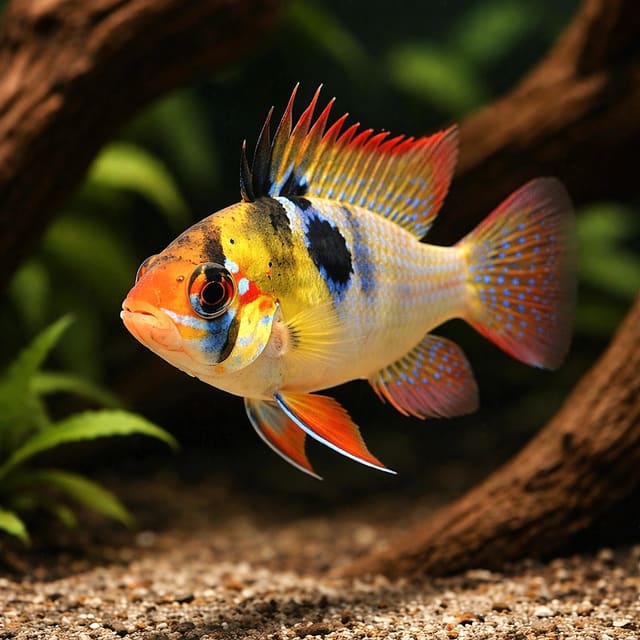
The Electric Blue Ram is an ornamental electric-blue form of Mikrogeophagus ramirezi, a freshwater dwarf cichlid in the family Cichlidae. Its compact proportions do not make it a casual addition to every small community: this fish needs warm water, excellent water quality, calm feeding conditions and a carefully structured lower area.
FishBase records a maximum of 4.2 cm standard length in its male/unsexed category. Treat that figure as an adult-size planning reference rather than a promised final measurement for every animal. Standard length is also the stated scientific measurement, while the shop selector presents dispatch grades.
This ram suits a keeper who can hold 27–30°C, maintain a mature biological filter and test the water routinely. It forages around the substrate, competes poorly against forceful feeders and may become territorial around breeding activity. Those traits make water quality, floor layout and tank-mate behaviour more important than colour or nominal community labels.
The species originates from the Orinoco River basin in the llanos of Venezuela and Colombia and is described as freshwater and benthopelagic. In the aquarium, provide a soft sandy substrate, shaded cover, wood and caves so the fish can forage and withdraw from view. Browse our South American cichlid collection when comparing related aquarium fish, but assess every candidate against this ram’s warmer water and calm-feeding requirements.
One purchase quantity supplies one animal from the option selected on the page. The size selector may show 2–2.5 cm, 2.5–3 cm, 3–3.5 cm, 3.5–4 cm, 4–4.5 cm and 4.5–5 cm grades. Use that live selector to choose the dispatch grade and see its associated price.
The size you select is the size supplied, not the adult size. Do not subtract a dispatch grade from the 4.2 cm standard-length reference to predict future growth. The selector and FishBase figure serve different purposes: one describes the retail dispatch grade, while the other is a recorded maximum standard length for biological planning.
Sex is guaranteed only when the selected option explicitly states male or female. This Electric Blue Ram listing has no sex-guaranteed option.
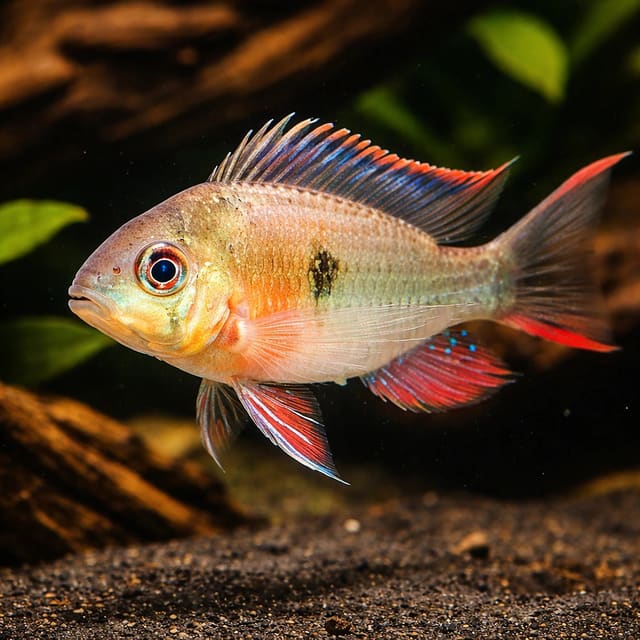
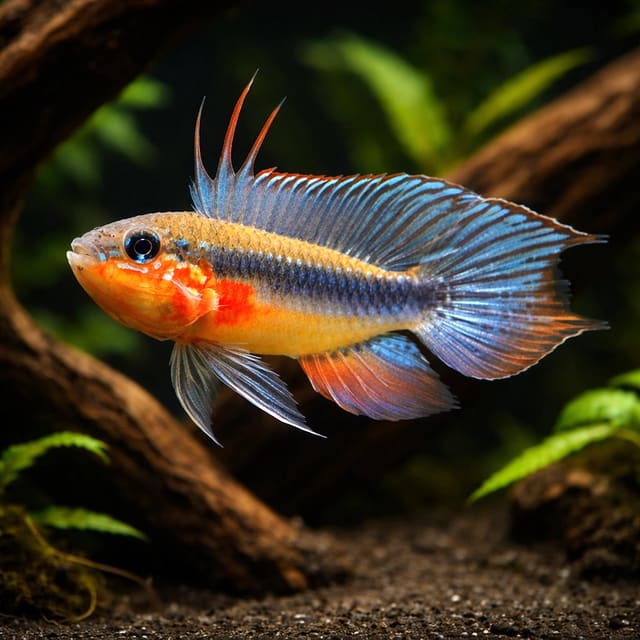
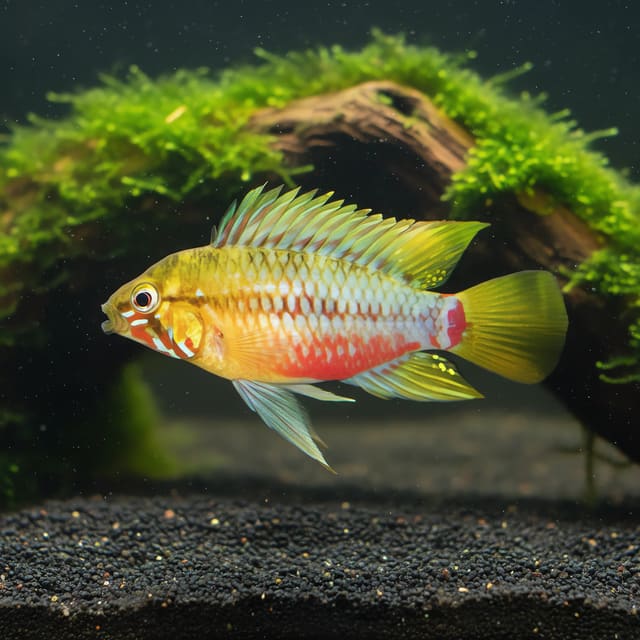
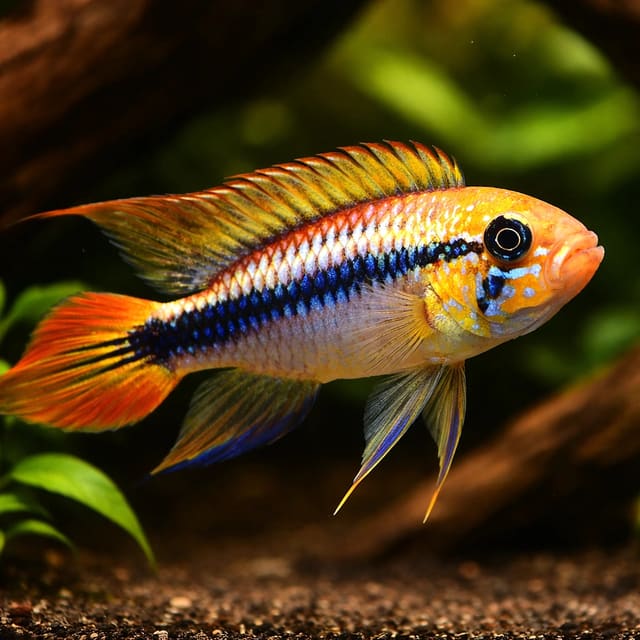
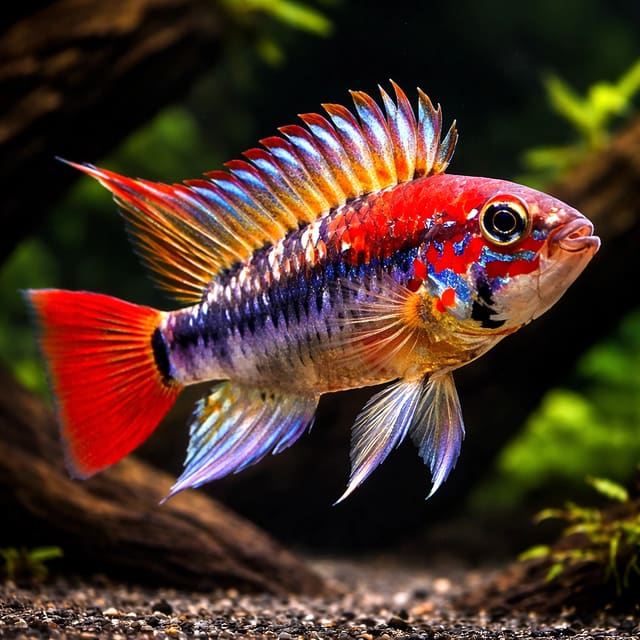
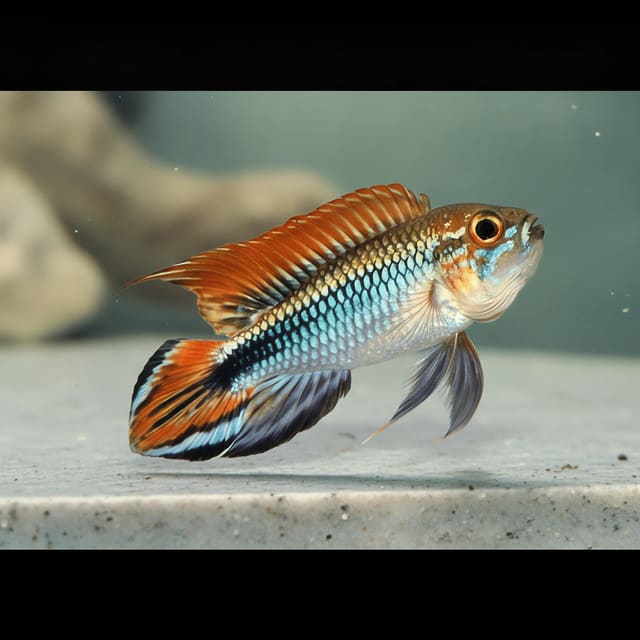
Some gallery images have been digitally enhanced to improve image quality. They show the listed type of animal rather than guaranteeing the exact markings of the individual supplied, so natural colour and pattern can vary.
Review our delivery and Live Arrival Guarantee policy for the shop’s dispatch days, delivery information and claim process.
The Seriously Fish species account gives a 60 × 30 cm aquarium base or equivalent, around 54 litres, as sufficient for a single pair. It also gives an aquarium range of 27–30°C, pH 4.0–7.0 and hardness of 1–10 dGH. These are the species-specific values to use when deciding whether this ram fits your aquarium.
| Decision | Planning value |
|---|---|
| Recorded maximum | 4.2 cm standard length |
| Base for one pair | 60 × 30 cm or equivalent |
| Approximate pair volume | 54 litres |
| Temperature | 27–30°C |
| pH | 4.0–7.0 |
| General hardness | 1–10 dGH |
Use the base dimensions and volume together. A nominal 54-litre aquarium with a markedly different shape may not offer the same lower-area layout as a 60 × 30 cm base. The floor must hold sand, cover, shaded retreats and separate routes through the décor without leaving the fish exposed.
Temperature is an early compatibility filter. Every tank mate, plant choice and item of equipment must work at 27–30°C. Water chemistry is equally decisive: measure pH and hardness before choosing the fish, then compare those readings with the full range rather than considering temperature alone.
The pair figure is not a universal community allowance. Other fish add waste, occupy space and compete for food, while breeding behaviour may create a defended area. Community planning therefore needs more room, restrained stocking and a stronger compatibility screen.
| Suits | Not suited to |
|---|---|
| Stable aquarium water maintained at 27–30°C and pH 4.0–7.0 | Water outside 27–30°C and pH 4.0–7.0 |
| Peaceful open-water characids or similar fishes sharing 27–30°C, pH 4.0–7.0 and 1–10 dGH | Territorial or aggressive fishes, including most other cichlids |
Start with a soft sandy substrate because this ram naturally takes mouthfuls from the bottom, sifts them for edible material and expels the remainder through its mouth and gill openings. Sand supports that behaviour and works with the species’ preference for feeding close to the substrate.
Arrange wood roots and branches to form shady spots, then add caves and one or two flat rocks. Ceramic flowerpots, suitable lengths of plastic piping and other aquarium-safe artificial structures can also provide cover. The goal is not decorative density for its own sake; it is to give each fish a way to leave another fish’s direct line of sight.
Plants from genera such as Microsorum, Taxiphyllum, Cryptocoryne and Anubias are among the stated options. Position plants around retreats without filling every patch of sand. Artificial plants remain useful where live planting is unsuitable, provided they contribute real cover.
Dried leaf litter can strengthen the natural appearance. As leaves decompose, they support beneficial microbe colonies that may become a secondary food source for fry, while tannins and other released compounds help simulate natural conditions. Use leaf litter as one element of the layout rather than a substitute for filtration and maintenance.
For an aquarium of about 54 litres, the species account suggests gentle movement and a filter rated around 110–160 litres per hour. It also gives roughly 125–175 W of heating for that tank when the room is around 20°C. Those equipment figures belong to that stated aquarium and room assumption.
Set the aquarium to 27–30°C and confirm the temperature with a reliable aquarium reading. This range is warmer than many conventional community combinations, so screen every proposed tank mate against it before adding either fish. A species that requires cooler water is not made suitable by choosing the bottom of this ram’s range.
Keep pH within 4.0–7.0 and general hardness within 1–10 dGH. These are ranges rather than a command to alter water to a single point. Measure the aquarium and source water, then use our water chemistry guide to understand what each reading means.
Do not treat pH and hardness as interchangeable. A pH reading describes acidity or alkalinity, while dGH is the hardness value used in the stated range. Record both values alongside temperature so a seemingly suitable pH does not conceal hardness outside 1–10 dGH.
At the edge of any range, the remaining requirements still apply. Water at 27°C must still be clean, properly filtered and suitable in pH and hardness. Water at pH 7.0 must still remain at 27–30°C. Passing one number never compensates for missing another.
Check the intended aquarium rather than a separate container, because that aquarium contains the substrate, décor, filter and stocking load the fish will experience. Use measured values to make the decision before introduction, then preserve consistency through the maintenance routine.
A biologically mature filter is essential. The RSPCA explains that biological filtration supports bacteria that convert toxic ammonia to toxic nitrite and then to safer nitrate. Prepare and mature the aquarium before livestock arrives; our first tropical tank guide sets out that preparation sequence.
OATA’s dwarf-cichlid sheet gives broad group targets of zero mg per litre ammonia, zero mg per litre nitrite and nitrate no more than 20 mg per litre above the normal tap-water level. The warmer 27–30°C aquarium range for this ram remains the temperature instruction.
When filter media needs cleaning, rinse it lightly in aquarium water removed during the partial water change. Do not rinse it under the tap because chlorine or chloramine may kill part of the beneficial bacterial population. Keep the filter running effectively rather than replacing established media simply because it looks discoloured.
Add fish to the aquarium gradually. Every added animal and every increase in feeding raises the workload on the biological filter. Rapid stocking can leave too few nitrifying bacteria to process the increased waste, producing unhealthy ammonia or nitrite.
A larger aquarium can make temperature and water quality more stable, but volume does not remove the need for filtration, testing and water changes. Use the weekly routine to find developing changes before the ram’s behaviour or appetite is affected.
This ram is benthophagous by nature. It takes food while sifting substrate, browses solid surfaces and can snatch suitable items from the water column. Choose foods and placement that let the fish feed without racing forceful tank mates at the surface.
Offer a varied menu of live and frozen foods such as bloodworm, Artemia, Daphnia and grindal worm. Supplement these with good-quality sinking dried foods in a suitably small size. The food must be small enough for the animal selected and able to reach the lower feeding area.
Use the dwarf-cichlid group schedule of one feed per day, offering only the quantity eaten within a few minutes. This limit reduces uneaten material that would otherwise break down and add toxic waste to the water.
| What you see | What to do |
|---|---|
| Food remains after a few minutes | Remove the excess and reduce the next portion. |
| Food stays at the surface | Use a suitably small sinking product. |
| Faster fish take every item | Change placement and review the tank-mate mix. |
| The ram ignores dried food | Offer the stated live or frozen choices while continuing a varied menu. |
Wild fish may initially refuse dried foods but normally learn to accept them over time. Do not respond to refusal by scattering a larger quantity. Uneaten food burdens the filter, while the cause may be food type, placement, competition or a developing health or water-quality issue.
Watch the individual rather than judging feeding by how quickly the aquarium appears to clear. A busy group of open-water fish can consume a meal while the ram receives very little. Confirm that food reaches the lower area and that the fish actively takes it.
Variety means rotating suitable food types, not increasing the total daily quantity. Keep the few-minute limit consistent and use body condition, appetite and waste accumulation as practical checks on the portion.
Before introduction, confirm that the aquarium is mature, filtered and within 27–30°C, pH 4.0–7.0 and 1–10 dGH. Test ammonia and nitrite and proceed only when both read zero mg per litre. The fish should enter the aquarium you assessed, not a newly assembled substitute.
Increase the aquarium population slowly. Beneficial bacteria must respond whenever fish numbers and feeding rise; adding too much livestock too quickly can result in ammonia and nitrite accumulation. A mature filter is a living system with a workload, not permission to make a large stocking change at once.
Check whether the ram uses cover, swims appropriately, breathes at its usual rate and takes food within the controlled feeding period. Confirm that other fish do not monopolise every food item or repeatedly drive it away from the lower area.
If the fish hides, first distinguish ordinary use of shelter from a change accompanied by poor appetite, altered breathing, erratic swimming or persistent aggression. Test water quality when behaviour or feeding changes. Avoid making several major changes simultaneously, because a clear sequence of observations and test results makes the next decision easier.
The dispatch grade does not change the aquarium’s required temperature, chemistry or filtration. Prepare the full setup before choosing a size rather than treating a smaller grade as a reason to postpone essential cover or water-quality work.
Learn the fish’s normal swimming, breathing, appetite, colour and use of cover. Individual behaviour varies, so a change from its own usual pattern is more useful than comparing every movement with another ram.
| Change observed | First action |
|---|---|
| Hanging at the surface, sitting unusually on the bottom or erratic swimming | Test water quality and check filter operation. |
| Gill covers moving faster or slower than usual | Check temperature, ammonia and nitrite promptly. |
| Darker or paler colour than normal | Review water readings, aggression and access to cover. |
| More aggression or hiding | Check territory layout and tank-mate pressure. |
| White spots, fluffy growths, damaged fins, lost scales, ulcers or bumps | Record the signs, test the water and contact us for health guidance. |
| Reduced food intake or loss of interest | Confirm that food reaches the fish, then test the water. |
| Body condition increasing or decreasing | Review the portion, feeding access and other health signs. |
Testing comes before guessing. Ammonia and nitrite are toxic, and a filter blockage or increased waste load can create a problem even when the water looks clear. Record the actual readings alongside the temperature instead of relying on appearance.
Do not add extra food to compensate for persistent refusal. Excess breaks down and increases the load on the filter. Check whether the fish can reach the meal, whether another animal is excluding it and whether any listed warning sign accompanies the poor appetite.
During the first month, compare observations from week to week. Consistent feeding, intact fins and scales, normal breathing and ordinary use of the aquarium are useful checkpoints. A developing change deserves action before it becomes severe.
Keep the normal maintenance schedule while observing the fish. A single partial water change does not replace the need to identify blocked filtration, unsuitable chemistry, excessive stocking or continuing aggression.
This ram is not recommended as a routine general-community fish. It requires pristine water quality and can be a poor competitor, although it does not have to live without other fish. Compatibility remains conditional because individual behaviour, territory, aquarium dimensions and feeding pressure can change the outcome.
| Question | Required answer |
|---|---|
| Can the candidate live at 27–30°C, pH 4.0–7.0 and 1–10 dGH? | Yes, across the intended shared values. |
| Is it peaceful and unlikely to defend the ram’s lower territory? | Yes, with enough space and cover. |
| Will the ram still receive food? | Yes, without being overwhelmed by faster or boisterous feeders. |
Peaceful open-water characids or similar fishes are particularly recommended when they share the required conditions. Their presence may act as an indicator that no immediate threat is nearby and can reduce shyness. Paracheirodon axelrodi and Paracheirodon simulans are named examples that meet the warm-water requirement.
Avoid territorial or otherwise aggressive fishes, including most other cichlids. Also avoid species requiring harder water and any fish unable to manage 27–30°C. These exclusions are based on direct conflicts in aggression, chemistry or temperature rather than a general label such as “community fish”.
Open-water placement alone does not settle the decision. A peaceful-looking fish can still be unsuitable if it needs cooler or harder water, while a warm-water species can still fail the screen through aggression or feeding pressure.
For a stocking assessment, share the aquarium’s dimensions, volume, temperature, pH, dGH and complete resident list. Those details allow each proposed combination to be checked against the same conditions instead of relying on a universal tank-mate list.
A 60 × 30 cm base or equivalent, around 54 litres, is stated as sufficient for a single pair. The word “pair” describes two compatible fish; buying two animals does not guarantee that relationship. Build the aquarium so either fish can withdraw from direct view, and have a safe separation plan before introducing both.
Even well settled pairs will often chase each other. Cover remains necessary after the fish appear calm. Territorial behaviour can increase around breeding. In a community, other fish need enough space to stay clear of a defended site, and the rams still need access to food.
If one fish repeatedly pursues the other, do not assume that more time will automatically create a pair. Check whether the pursued fish can eat, rest and leave the aggressor’s line of sight. Use the prepared separation plan when it cannot do those things safely.
Breeding is not required for successful routine keeping. Flat rocks, caves and structured cover are useful parts of the aquarium whether spawning occurs or not. Their immediate purpose is to create shelter, visual barriers and choices within the lower area.
Do not infer sex or maturity from the selected dispatch grade, colour or gallery. Adult males may grow larger, have slightly more extended fins and show stronger colour, while many females have a pinkish belly patch; ornamental strains may not show the latter feature. Those traits do not create a sex guarantee for this offer.
Use the aquarium that will actually house the fish when working through these examples. Record its base dimensions, volume, temperature, pH, dGH, filter maturity and residents. A missing value means the stocking decision needs another measurement, not a guess.
Check that every resident manages 27–30°C and falls within the shared pH and hardness plan. Confirm that the ram can feed at the bottom without every item being taken first. Add shaded cover and caves before introduction, then watch for territorial pressure from existing lower-area fish.
Start from a 60 × 30 cm base or equivalent, around 54 litres. Provide several retreats, sand, wood and visual barriers. Feed where both fish can reach the meal and keep the separation plan ready because even settled pairs will often chase one another.
OATA says an aquarium of at least 80 litres will be needed when dwarf cichlids are mixed with other fish. Treat that as a group planning minimum rather than an automatic approval: this ram still needs its 27–30°C range, pristine water, calm feeding conditions and enough lower-area structure. More litres do not make aggressive, hard-water or cool-water companions suitable.
Choose a different stocking direction. The ram’s aquarium guidance is 1–10 dGH, and the species account says to avoid fish requiring harder water as well as territorial or aggressive fishes, including most other cichlids. Trying to split the difference can leave one side outside its intended conditions.
Complete filter maturation first. Ammonia and nitrite must both read zero mg per litre, and the filter must be ready for the waste created by the planned stocking and feeding. Décor and warm water do not replace biological maturity.
It is the electric-blue ornamental strain of a South American dwarf cichlid in the family Cichlidae; its scientific name is abbreviated M. ramirezi.
One purchase supplies one animal from the selected option. Buying two requires a quantity of two and does not guarantee that the animals will form a compatible pair.
The live selector may show 2–2.5 cm, 2.5–3 cm, 3–3.5 cm, 3.5–4 cm, 4–4.5 cm and 4.5–5 cm dispatch grades.
For a compatible pair, use a 60 × 30 cm base or equivalent, around 54 litres, with sand, wood, shaded cover, caves and mature biological filtration.
A 60 × 30 cm base or equivalent is stated as sufficient for one compatible pair, but two animals must not be assumed to pair; keep a separation plan ready.
Keep it at 27–30°C, pH 4.0–7.0 and 1–10 dGH, with zero mg per litre ammonia and zero mg per litre nitrite.
Feed suitably small sinking dried food plus varied live or frozen bloodworm, Artemia, Daphnia or grindal worm once daily, limiting the portion to what it eats within a few minutes.
Before introduction, confirm 27–30°C and zero mg per litre ammonia and nitrite, use a mature filtered aquarium and increase stocking slowly so biological filtration can adjust.
Choose peaceful open-water fish that share 27–30°C and the same pH and hardness plan; avoid territorial or aggressive fish, most other cichlids and harder-water species.
No reviews for this item yet. Bought one? Honest reviews only, good or bad.
What customers say about ordering from us
I have a small group of long finned mountain minnows. So was delighted to be able to order ten of this variety to increase the genetics in my tank . The ones I recieved are healthy but it’s to early to give a verdict on wether they are of a long finned type since they are small currently.
Gordon Walker · 23 Sept 2026
100% success travel and "installation". Pleased with quality of purchase. The Siamese fighter a bit "shy" so have not yet seen him at his best yet but looking good. Happy customer. GG
George E Garratt · 21 Sept 2026
Reviews of our shop, collected by Judge.me, an independent third-party review collector. Newest first.