Moderate
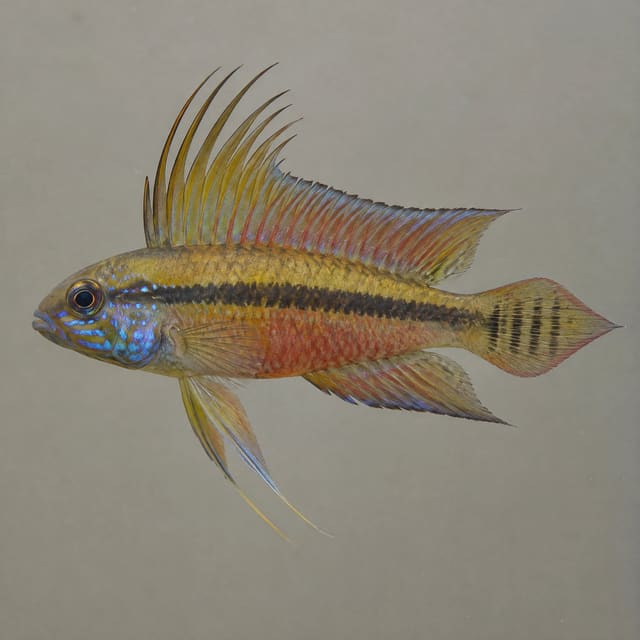
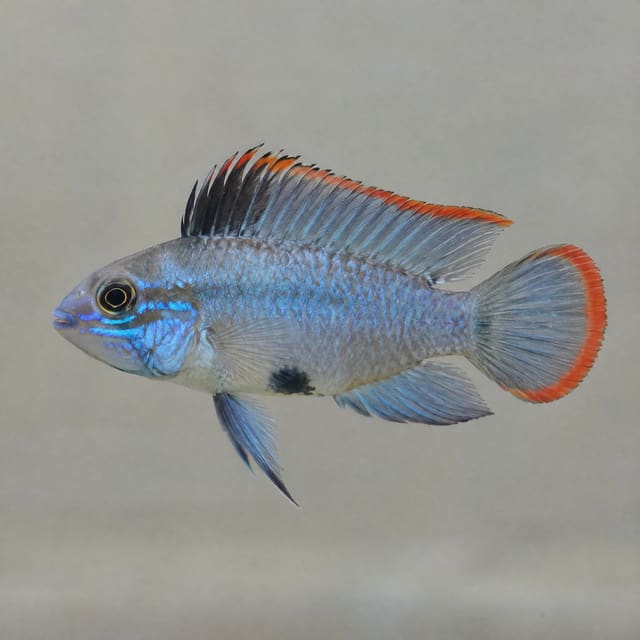
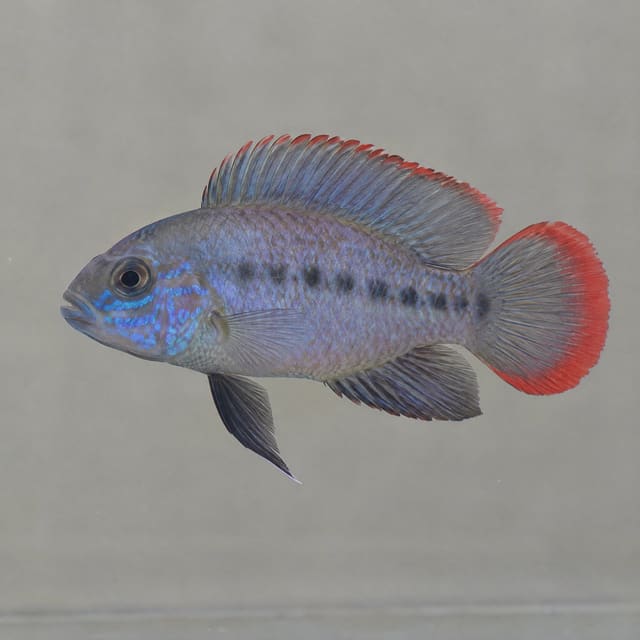
Macmaster's Dwarf Cichlid (Apistogramma macmasteri 'Red Mask')
24–28°C · pH 5.5–7 · 41L
£25.99
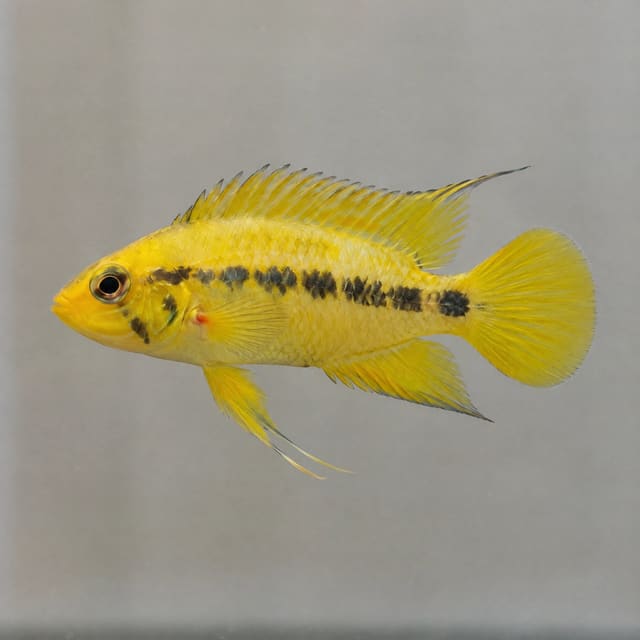
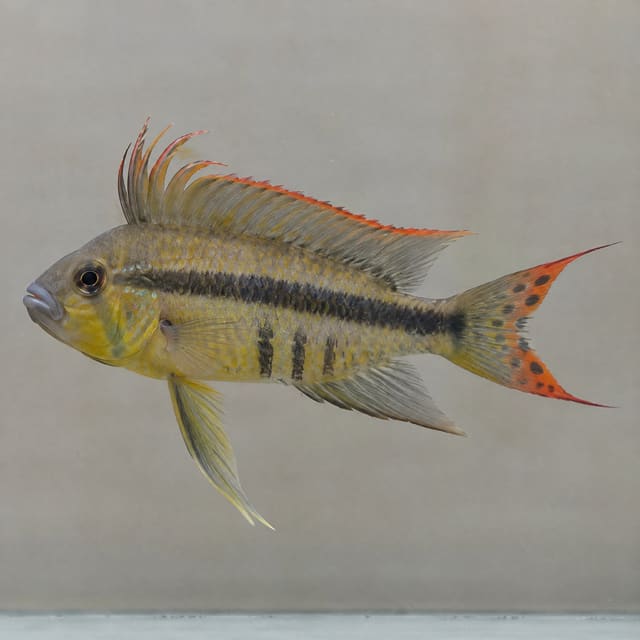
The Gold Cacatuoides is a line-bred gold form of the cockatoo dwarf cichlid, Apistogramma cacatuoides: a golden-yellow fish with a broken dark side stripe and, in males, orange-red spotted fins and a crest of long dorsal spines. Males reach about 7.5 cm, females 5 cm. It suits a mature, planted aquarium of 60 litres or more with caves, wood and calm dither fish. Sold individually as one live fish.
Apistogramma cacatuoides
Save when buying multiple fish. Each quantity is one fish; sex and pair formation are not guaranteed unless the selected variant explicitly states them.
The Gold Cacatuoides is a line-bred gold form of the cockatoo dwarf cichlid, Apistogramma cacatuoides: a golden-yellow fish with a broken dark side stripe and, in males, orange-red spotted fins and a crest of long dorsal spines. Males reach about 7.5 cm, females 5 cm. It suits a mature, planted aquarium of 60 litres or more with caves, wood and calm dither fish. Sold individually as one live fish.
Cichlids are a family of roughly 1,800 accepted species, not one care type. Before buying, identify the exact species and source, then compare adult measurement, usable tank dimensions, social system, territory, tested water, diet and an exit plan. No family-wide minimum tank, water range or tank-mate list is safe.
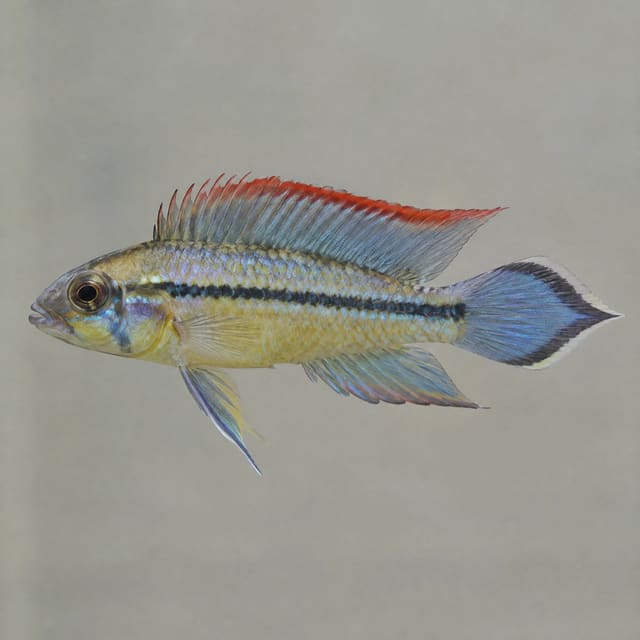
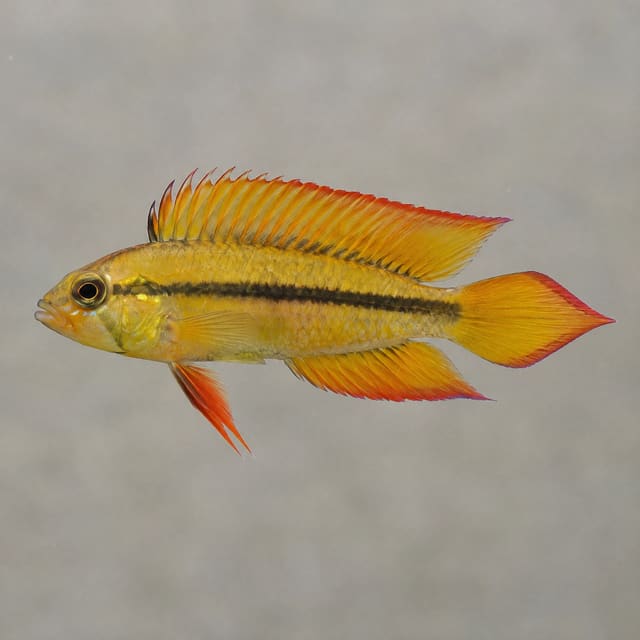
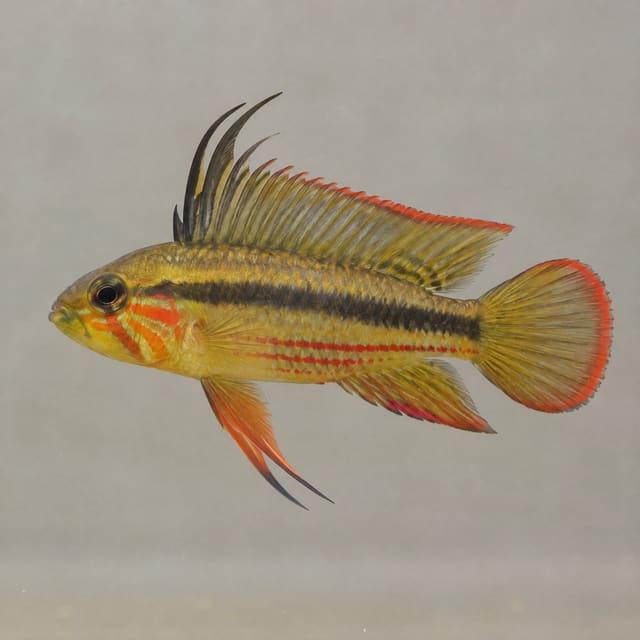
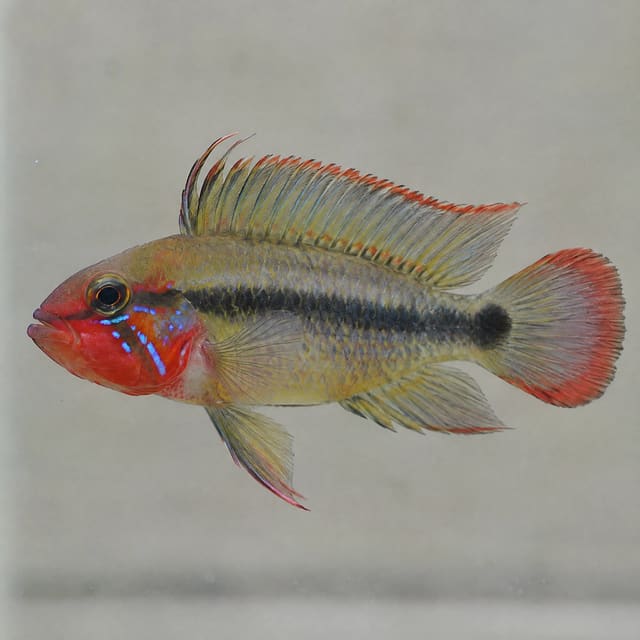
The Gold Cacatuoides is a line-bred gold form of Apistogramma cacatuoides, the cockatoo dwarf cichlid. An adult male is golden yellow, with a broken black stripe running from behind the head to the tail and a dark bar through the eye and cheek. The fins are orange-red with rows of dark spots, the tail is broad with extended upper and lower tips, the pelvic fins trail long, pale-tipped threads, and the front spines of the dorsal fin stand up as a tall crest, which gives the species its cockatoo name. In a planted aquarium with caves and wood, the Gold Cacatuoides brings real character to the lower levels.
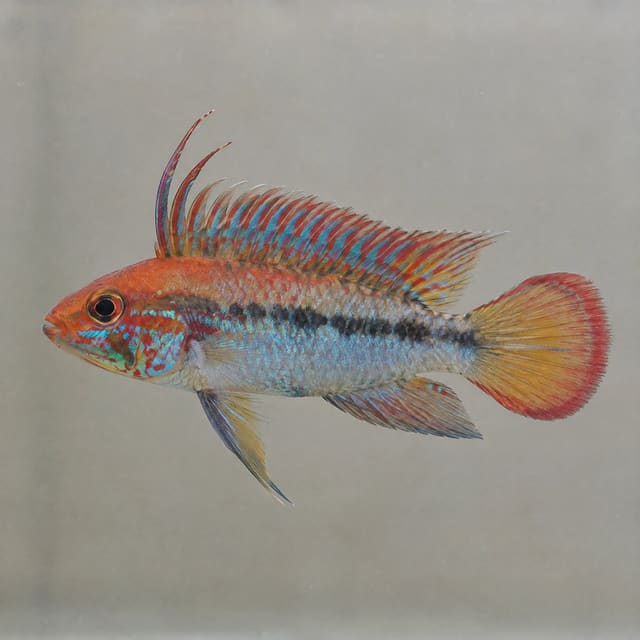
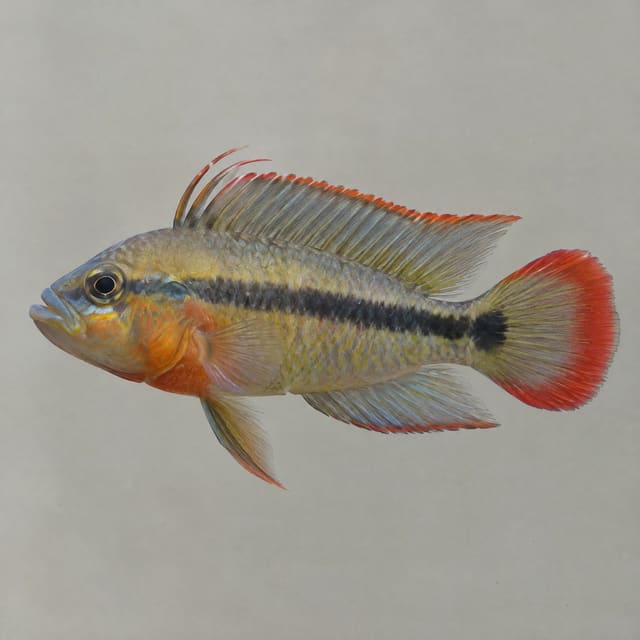
Seriously Fish notes that many ornamental forms of this species have been line-bred for the aquarium trade, naming 'sunset', 'sunburst', 'double red', 'triple red', 'gold', 'white gold', 'orange flash' and 'albino', and its photo gallery includes adult male and brooding female fish of the gold strain.
| Listing | What it is |
|---|---|
| Gold Cacatuoides (this fish) | Line-bred gold form of A. cacatuoides |
| Cockatoo Dwarf Cichlid | A. cacatuoides sold under its species name |
| Cockatoo Dwarf Cichlid Orange | An orange line-bred form of the same species |
| Cockatoo Dwarf Cichlid Double Red | The 'double red' line-bred form of the same species |
| Gold Viejita-Type Dwarf Cichlid | A different Apistogramma species in a gold form, without the cockatoo crest |
Seriously Fish describes A. cacatuoides as widespread in the upper Amazon basin, from the Ucayali and Amazonas in Peru to the Solimões in western Brazil, and notes that some populations differ noticeably in colour. FishBase places it in tributaries of the Ucayali, Amazon and Solimões from the Pachitea River to Tabatinga, and lists it as Least Concern on the IUCN Red List. The type locality was first given wrongly as Paramaribo in Suriname before being corrected to the Amazon basin.
In the wild it lives in slow tributaries, backwaters and creeks where fallen leaves collect, in black, white or clear water depending on the place and season. Seriously Fish notes that it carries the A-number A200 in the German DATZ system, and that Apistogramma holds around 70 valid species with many more awaiting description. FishBase translates the genus name from Greek as "uncertain" plus "graphic signal".
A gold fish is a product of selective breeding, not a wild population. Seriously Fish says commercially produced cockatoos are relatively unfussy about water chemistry and recommends captive-raised fish for the general community aquarium, which suits a line-bred form like this one.
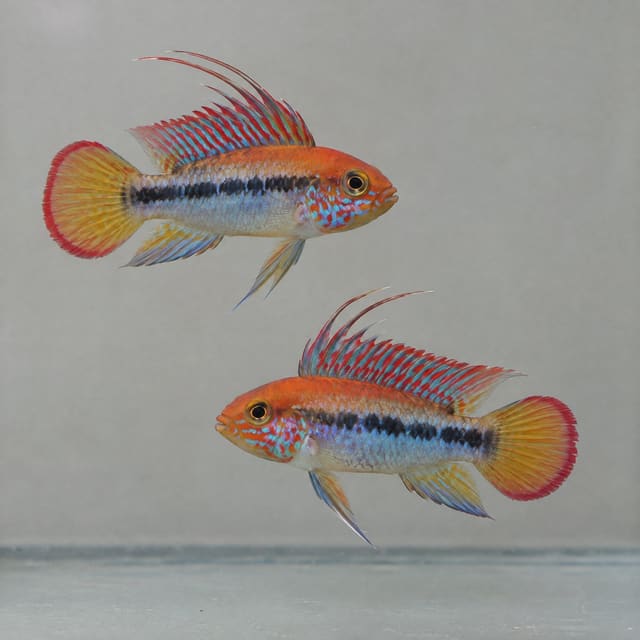
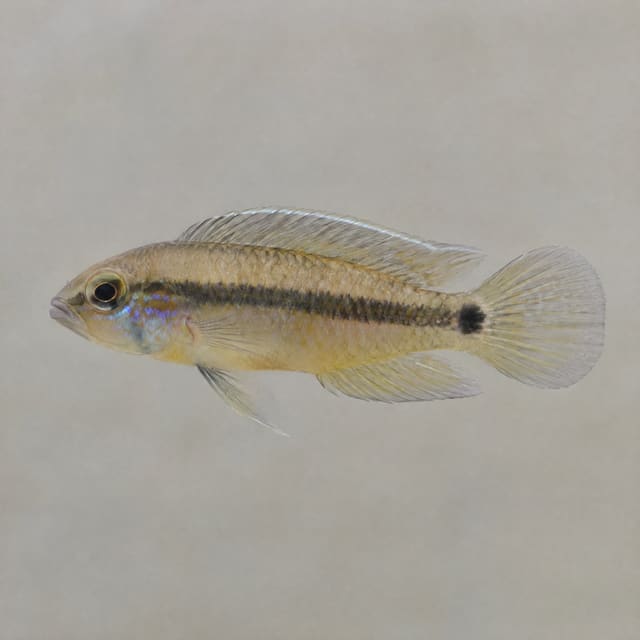
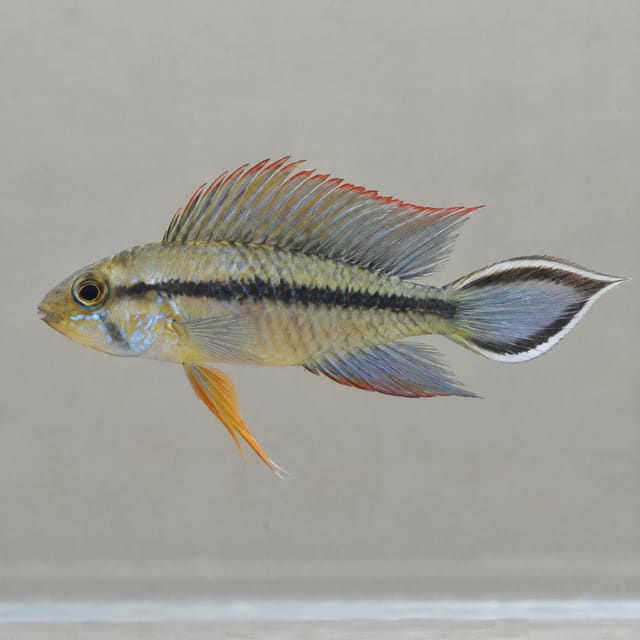
One purchase supplies one live Gold Cacatuoides at the standard size currently available. Sex is not chosen or guaranteed. Seriously Fish notes that males are larger and more colourful and develop more extended fins than females, so a young fish may not yet show the crest and tail tips in the photographs, which show an adult male. Females are smaller and plainer, with short fins.
Colour and finnage vary between individuals and develop with age.
Our delivery information explains dispatch days, packing and the Live Arrival Guarantee before you order.
Seriously Fish gives a maximum of 75 mm standard length for males and 50 mm for females, measured without the tail. FishBase records a maximum of 5.0 cm standard length. OATA says even the larger dwarf cichlids do not exceed about 10 cm. Plan for a male of up to about 7.5 cm.
Seriously Fish considers a base of 60 × 30 cm, about 54 litres, acceptable for a single pair, with larger quarters for a group. OATA recommends at least 60 litres for a pair and at least 80 litres if you want to mix dwarf cichlids with other fish.
Seriously Fish says this species is unfussy about decor as long as there is plenty of cover: ceramic flowerpots and lengths of pipe work as well as natural materials. For a natural look it suggests a soft, sandy substrate with wood roots and branches arranged to create shady spots and caves, plus dried leaf litter such as beech, oak or Indian almond (Ketapang) leaves. As the leaves decay, they grow microbes that feed fry and release tannins that most populations appreciate. It recommends fairly dim lighting, shade-tolerant plants such as Microsorum, Taxiphyllum, Cryptocoryne and Anubias, and a few floating plants to diffuse the light.
OATA adds that dwarf cichlids usually form a territory around a good spawning site such as a cave, stone or piece of wood, so offer a choice of sites. Browse our fish for planted tanks for companions that suit the same set-up.
| Zone | Job |
|---|---|
| Caves and coconut shells or pots | Spawning sites and refuges, at least one per female |
| Wood roots and branches | Shade and visual barriers between territories |
| Fine sand with leaf litter | Foraging ground and a source of microbial food for fry |
| Floating plants | Dim, broken light that makes the fish more confident |
The published ranges differ, mainly on pH. Seriously Fish gives pH 5.0–6.0 but explains that commercially produced fish are relatively unfussy and that some wild populations need these acidic values to breed. FishBase and OATA give the wider pH 6.0–8.0. The table shows each range and a target that sits inside the others.
| Reading | Seriously Fish | FishBase | OATA (dwarf cichlids) | Our target |
|---|---|---|---|---|
| Temperature | 22–29°C | 24–25°C | 22–27°C | 24–25°C |
| pH | 5.0–6.0 (wild fish) | 6.0–8.0 | 6.0–8.0 | 6.0–7.0 |
| General hardness | 0–15 dGH | 5–19 dH | 4–12 dGH | 5–12 dGH |
| Carbonate hardness | — | — | 3–10 dKH | 3–10 dKH |
| Ammonia, nitrite, nitrate | — | — | 0, 0, and no more than 20 mg/l above tap water | As OATA |
Tap water in the UK ranges from very soft to very hard, so check your water company's postcode report and test pH, GH and KH before you buy. Stability matters more than chasing an exact number. Our water matcher shows how your water compares, and our guide to pH for tropical fish explains how to read and adjust it safely. Always treat new water with a tap water conditioner.
Seriously Fish advises that filtration, or at least water flow, should not be very strong, and that very large water changes are best avoided, suggesting 10–15% a week in a lightly stocked tank. OATA recommends a partial change of 25% each week and weekly testing, and warns that dwarf cichlids can be stressed by even small amounts of ammonia and nitrite. The difference comes down to stocking: the more fish, the more you need to change. Mature the filter fully before the fish arrive; our nitrogen cycle guide explains how.
Seriously Fish describes the cockatoo cichlid as primarily carnivorous, feeding mostly on small bottom-living invertebrates in nature. It recommends offering live and frozen foods such as Artemia, Daphnia and bloodworm regularly, and notes that most fish learn to accept dried foods, preferring pellets to flake. OATA describes dwarf cichlids more broadly as omnivorous and suggests a good flake or granule with small live or frozen foods such as daphnia, brine shrimp or tubifex, fed once a day in amounts eaten within a few minutes.
| Part of the meal | How to use it |
|---|---|
| Small sinking pellets or granules | The everyday base, sized for a small mouth |
| Frozen or live Artemia and Daphnia | Several times a week, thawed first if frozen |
| Frozen bloodworm | Once or twice a week |
| Leftovers | Remove anything not eaten within a few minutes |
Check that ammonia and nitrite read zero before the fish arrives. OATA describes the floating-bag method: switch off the aquarium lights, float the sealed bag for 10 minutes, add small amounts of aquarium water over up to 20 minutes, then release the fish with as little bag water as possible. OATA also warns against adding many fish at once, which can cause "new tank syndrome" as the filter bacteria struggle to keep up. Our acclimatisation guide walks through each step.
Seriously Fish recommends captive-raised cockatoos for the general community aquarium, and suggests small "dither" fishes such as pencilfish (Nannostomus) for wild fish, which are best kept alone or with dithers and not mixed with other Apistogramma. OATA says dwarf cichlids do best with shoals of dither fish, which give them confidence and are quick enough to move away if a cichlid turns territorial. It adds that Apistogramma can be shy and will not do well with very active or boisterous tank mates, and that if you plan to breed, you should avoid fish that disturb spawning sites or eat fry.
| Suits | Avoid |
|---|---|
| Pencilfish, such as the Dwarf Pencilfish or the Beckfordi Pencilfish | Other Apistogramma and other cockatoo colour forms, if you want pure young |
| Small, calm tetras, such as the Ember Tetra | Very active or boisterous fish that crowd it out at feeding time |
| Peaceful catfish, such as the Panda Cory, in a tank with enough floor space | Bottom dwellers that dig into caves, if you plan to raise fry |
Check any mix with our tank mates checker, read our cockatoo cichlid guide and the broader Apistogramma guide, and browse the South American cichlids, the South American dwarf cichlids category and our Apistogramma category.
OATA describes a healthy dwarf cichlid as having clear, bright eyes, undamaged fins, intact scales, normal swimming and steady breathing. Its warning signs include hanging at the surface, sitting on the bottom or swimming erratically, turning darker or paler than normal, hiding more than usual, gill covers moving faster or slower, white spots or fluffy growths, weight loss and reduced feeding. Remember that a female guarding eggs or fry changes colour and behaviour as part of normal brood care, which Seriously Fish's photos of gold-strain females show.
| Sign | Action |
|---|---|
| Pale colour and constant hiding | Look for a bullying tank mate; add cover and dither fish |
| Fast breathing or hanging at the surface | Test ammonia and nitrite at once and do a partial water change |
| White spots, fluffy patches or flicking | Confirm water quality first, then seek treatment advice |
| A female guarding a cave and chasing everything | Normal brood care; in a small tank, Seriously Fish says the male may need moving |
The cockatoo cichlid spawns in caves. FishBase records up to 80 eggs attached to the ceiling of a cave and cared for by the female, and Seriously Fish describes eggs laid in crevices or cavities, with the female responsible for eggs and fry. In smaller aquaria she may become very aggressive, and the male may need to be removed. OATA says dwarf cichlid eggs typically hatch in three to four days and the fry are free-swimming a couple of days later, and that parents gather straying fry back into the group by mouth. The microbes growing on decaying leaf litter give the fry an early source of food.
Colour matters to these fish. In a peer-reviewed mate-choice study, Engelking, Römer and Beisenherz (2010) found that female cockatoo cichlids choose mates by colour, and that females of an aquarium strain preferred their own brightly coloured males in about 90% of trials. Different cockatoo forms will still interbreed, so keep gold fish with gold fish if you want the line to stay gold.
It is a line-bred gold colour form of Apistogramma cacatuoides, the cockatoo dwarf cichlid from the upper Amazon basin. Seriously Fish lists 'gold' among the ornamental forms bred for the aquarium trade, alongside 'double red', 'triple red', 'orange flash' and others. Adult males have a golden-yellow body, a broken dark stripe along the side and orange-red, dark-spotted fins with a crest of long front dorsal spines.
Males grow larger than females. Seriously Fish gives 75 mm standard length for males and 50 mm for females, while FishBase records 5.0 cm standard length. Plan for a male of up to about 7.5 cm without the tail.
Seriously Fish gives a base of 60 × 30 cm, about 54 litres, for a single pair, with more space for a group. OATA recommends at least 60 litres for a pair of dwarf cichlids and at least 80 litres if you mix them with other fish.
Soft to medium, slightly acidic to neutral water that stays stable. Farm-raised fish are relatively unfussy, according to Seriously Fish. We suggest 24–25°C, pH 6.0–7.0 and 5–12 dGH, which sits inside the OATA and FishBase ranges; Seriously Fish notes that some wild populations need pH 5.0–6.0 to breed.
Mostly, but it is a cichlid. Seriously Fish recommends captive-raised fish for a general community aquarium. Males hold territories, and a female guarding eggs or fry can become very aggressive in a small tank. Give it caves, cover and calm dither fish.
Small meaty foods. Seriously Fish describes it as mainly carnivorous and recommends regular live or frozen Artemia, Daphnia and bloodworm; most fish also learn to take dried food, preferring pellets to flake. Feed only what is eaten within a few minutes.
It is safer not to. Seriously Fish advises against mixing wild cockatoos with other Apistogramma, and hobbyists keep forms separate to avoid hybrids. For a gold line that breeds true, keep it apart from double red and other cockatoo forms.
Often, if you have a male and a female. It spawns in caves, laying up to 80 eggs on the ceiling, according to FishBase, and the female guards them. OATA says eggs typically hatch in 3–4 days and the fry swim freely a couple of days later.
One live Gold Cacatuoides at the standard size currently available. Sex is not chosen or guaranteed; the photographs show an adult male.
No reviews for this item yet. Bought one? Honest reviews only, good or bad.
What customers say about ordering from us
Easy website plenty of info on fish your buying great to pick a time slot
TRACEY DURRANT · 7 Oct 2026
Got some lovely fish thank you
Kevin Mackie · 7 Oct 2026
Reviews of our shop, collected by Judge.me, an independent third-party review collector. Newest first.
Moved by UK carriers licensed to handle live animals
Hand-packed with oxygen bags, poly box, heat pack
Email photos the same day; an optional unboxing video helps us review problems faster — claim terms apply
Klarna & PayPal Pay in 3 at checkout