Moderate
Neon Tetra (Paracheirodon innesi)
21–25°C · pH 5–7
£2.99

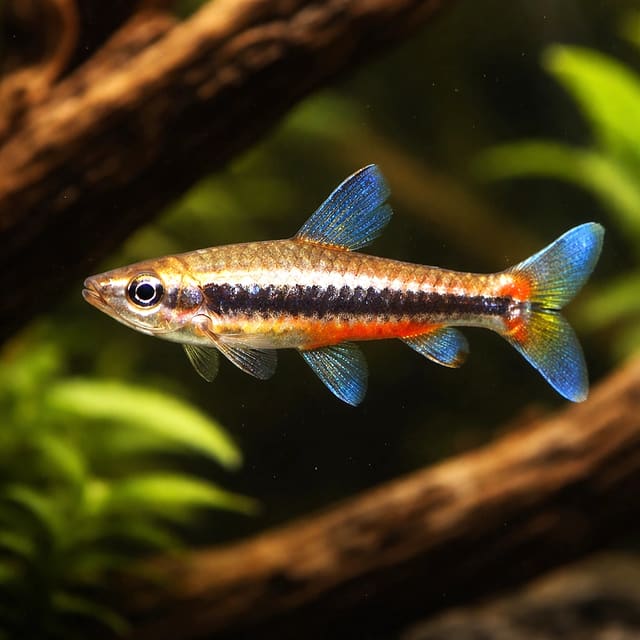
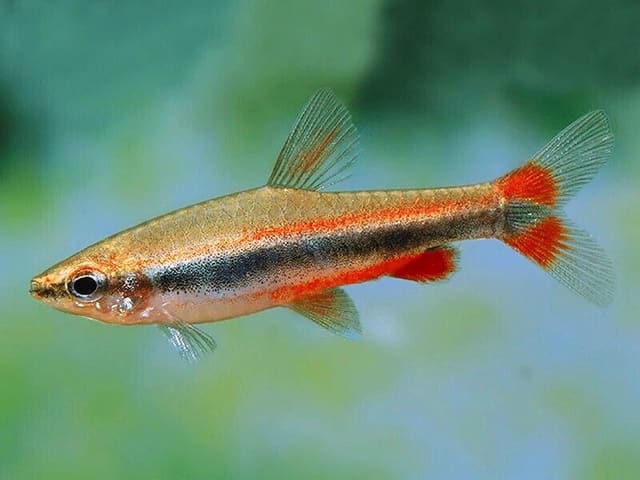
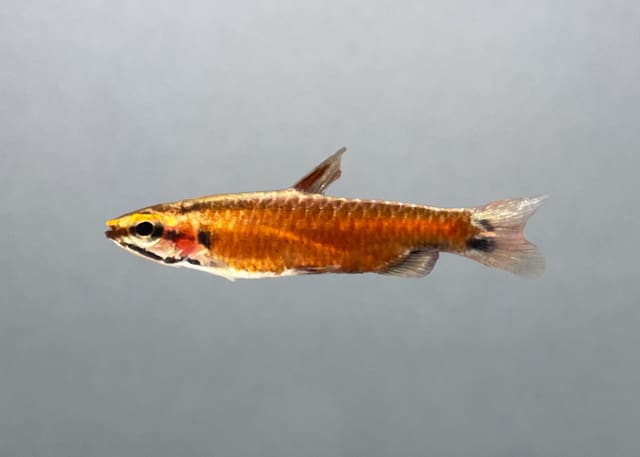
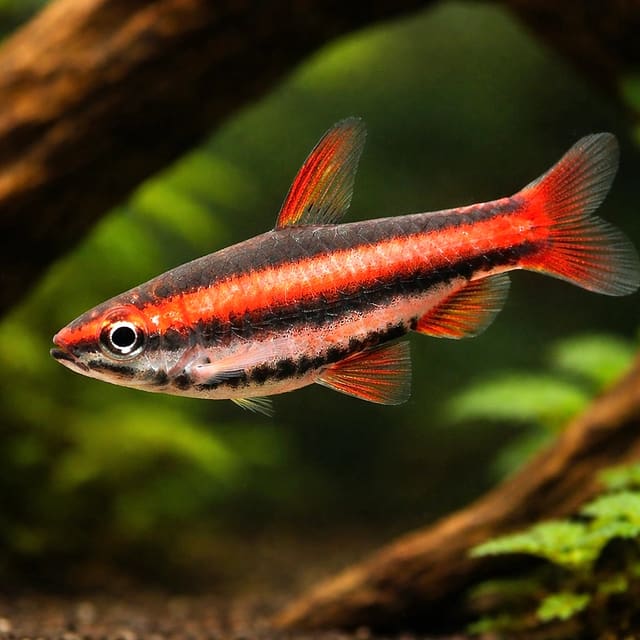
The Dwarf Pencilfish (Nannostomus marginatus) is a peaceful freshwater pencilfish from South America that reaches 3.5 cm. It suits a mature, planted aquarium; plan ideally 10 or more and keep 24–26°C, pH 6.5–7.0 and 4–10 dGH, the overlap of FishBase, Seriously Fish and OATA guidance. Sold individually in dispatch sizes from 1–2 cm to over 3 cm.
Adult size is the maximum length this species reaches at full maturity (scientific sources). The livestock you receive will be younger and smaller — pick a size above for the actual shipping size. Product-photo provenance and any image-specific limitations are stated on the listing.
Nannostomus marginatus
Shoaling fish: kept in a group they feel safer, stay calmer and show their best colour.
Minimum of 2 per order.
The Dwarf Pencilfish (Nannostomus marginatus) is a peaceful freshwater pencilfish from South America that reaches 3.5 cm. It suits a mature, planted aquarium; plan ideally 10 or more and keep 24–26°C, pH 6.5–7.0 and 4–10 dGH, the overlap of FishBase, Seriously Fish and OATA guidance. Sold individually in dispatch sizes from 1–2 cm to over 3 cm.
Adult size is the maximum length this species reaches at full maturity (scientific sources). The livestock you receive will be younger and smaller — pick a size above for the actual shipping size. Product-photo provenance and any image-specific limitations are stated on the listing.
Maintain these water conditions for optimal health and vibrant colors
The Dwarf Pencilfish (Nannostomus marginatus) is a small South American freshwater fish from the pencilfish family, Lebiasinidae. FishBase records it from the lower to middle Amazon River and parts of Colombia, Guyana, Peru, Suriname and Venezuela, with a maximum length of 3.5 cm total length. Its peaceful temperament and timid nature suit a keeper prepared to provide a mature planted aquarium, gentle filtration, very small food and carefully screened companions.
Use the recorded 3.5 cm maximum when calculating adult stocking, even when the fish selected for dispatch is smaller. Small adult length should not be confused with low care needs: the group requires horizontal room, planted shelter that breaks lines of sight and a biological filter that can keep waste under control.
| Suits | Not suited to |
|---|---|
| A mature, stable planted aquarium | An immature aquarium |
| A group planned around ideally 10 or more | A permanent solitary display |
| Gentle filtration and sheltered areas | Strong current throughout the aquarium |
| Similarly sized, peaceful companions | Fish large enough to eat it |
| A keeper able to provide tiny dried, live and frozen foods | A community dominated by larger or boisterous feeders |
A compact but properly planned aquarium is more suitable than an unfiltered bowl or an immature desktop container. The fish should be able to move through middle-to-upper water, retreat among plants and reach appropriately sized food without continual competition.
Its peaceful character does not make it robust around large, predatory or boisterous fish. Screen every proposed companion for adult size, temperament, water requirements, group needs and feeding behaviour before combining them.
Reference: FishBase species account.
One purchase supplies one animal in the size selected. The dispatch sizes shown on the live selector are 1 - 2 cm, >3cm, 2.5-3 cm and 2-2.5 cm.
The size you select is the size supplied, not the adult size. A smaller dispatch size does not reduce the mature group, aquarium or water requirements, while a larger size is not a promise that growth has finished. Plan every fish against the maximum recorded length of 3.5 cm total length.
Sex is guaranteed only when the selected option explicitly states male or female. This Dwarf Pencilfish listing has no sex-guaranteed option.
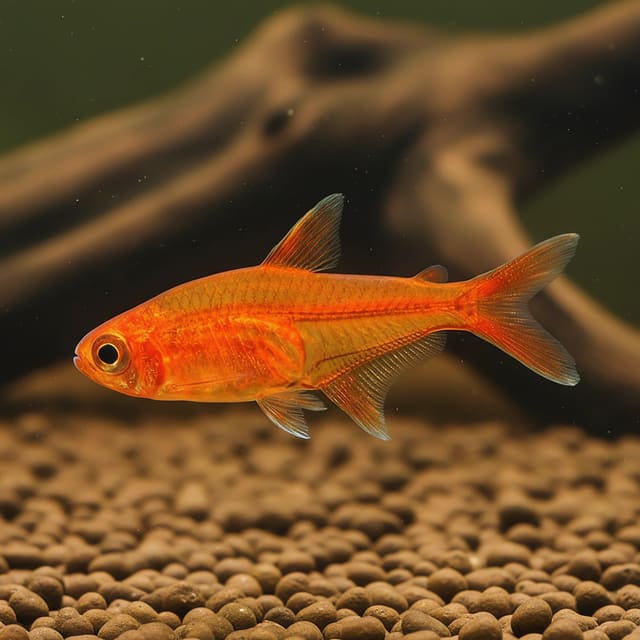
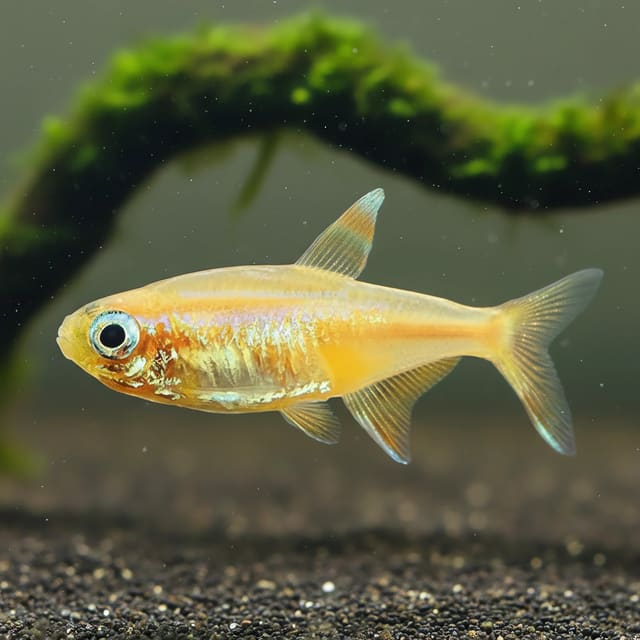
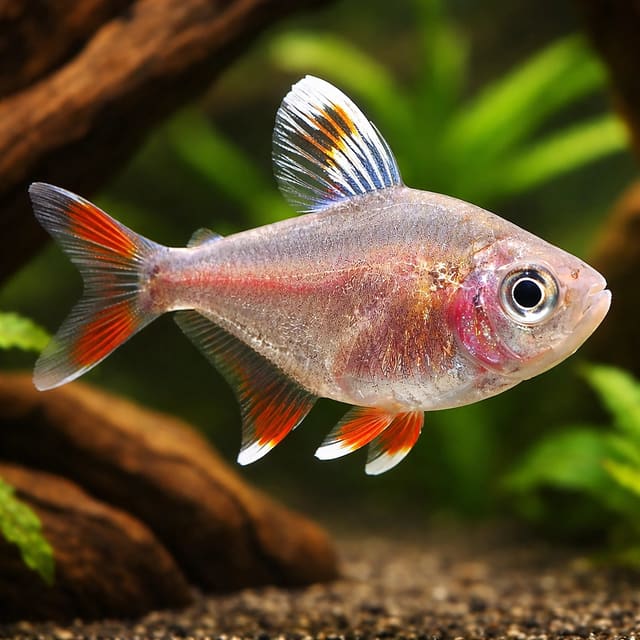
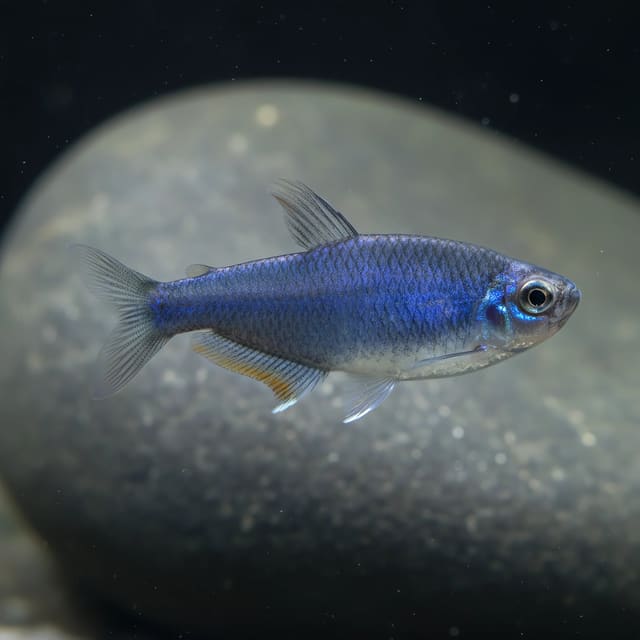
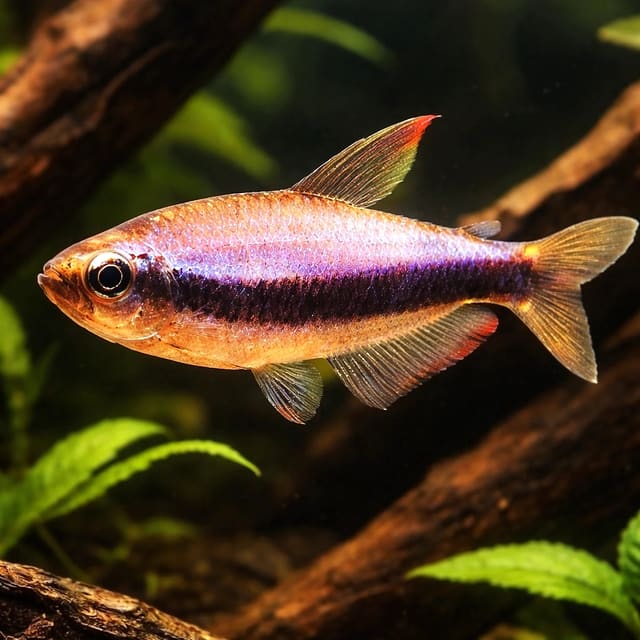
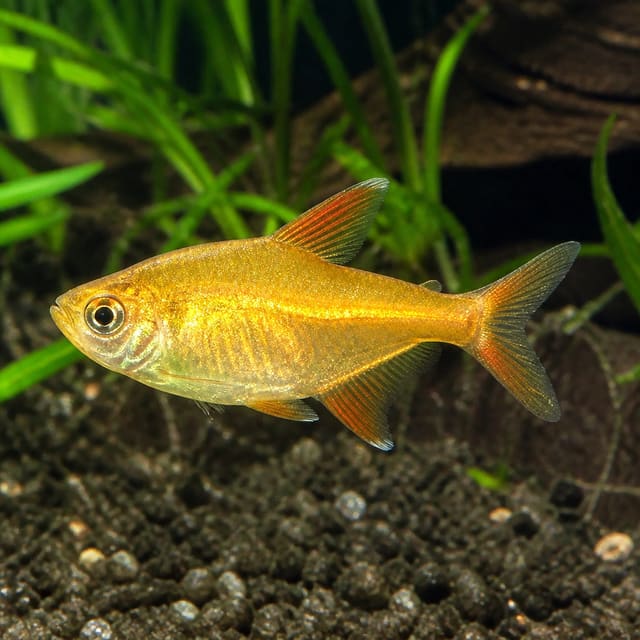
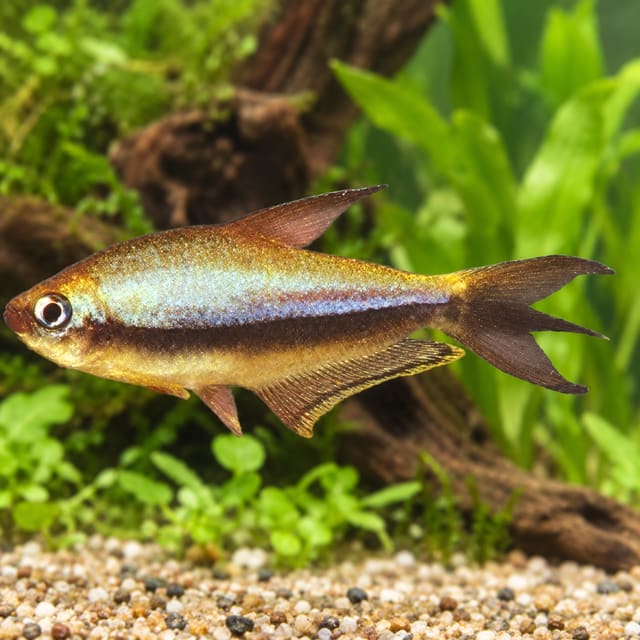
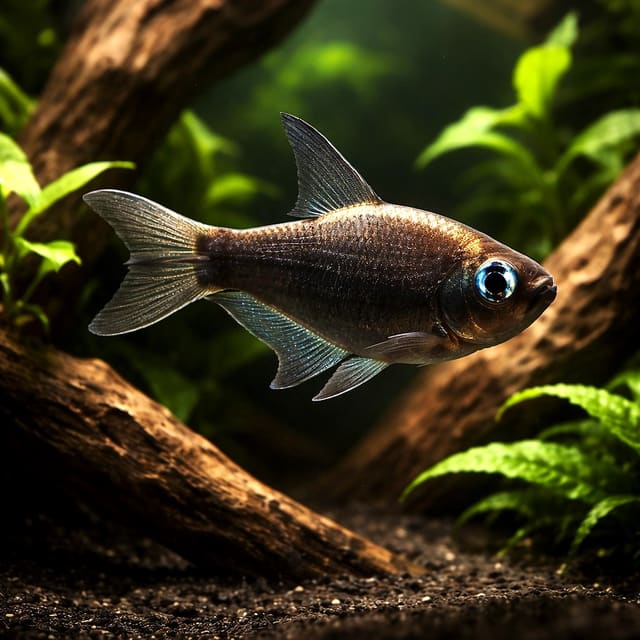
Some gallery images have been digitally enhanced to improve image quality. They show the listed type of animal rather than guaranteeing the exact markings of the individual supplied, so natural colour and pattern can vary.
The Seriously Fish species profile describes this fish as strongly gregarious and recommends buying as many as practical, ideally 10 or more. Larger groups spread social attention between more individuals, make the fish bolder and allow more natural behaviour. One animal is therefore the purchase unit, not the recommended long-term social arrangement.
That same guidance sets a base of at least 45 × 30 cm or equivalent, corresponding to approximately 41 litres. These dimensions apply to a species setup rather than every possible community. More inhabitants increase the demand for usable space, food access and biological capacity, so assess a mixed aquarium as a whole rather than treating 41 litres as a universal community allowance.
| Size decision | What remains unchanged |
|---|---|
| Select a smaller fish | Adult stocking is still calculated at up to 3.5 cm per fish |
| Select a larger fish | The fish still needs a mature planted aquarium and a social group |
| Purchase several animals | Each purchase adds one animal and its full adult stocking demand |
| Build towards a group | Increase livestock only at a pace the mature filter can support |
Before making the selection, decide whether the aquarium can support the intended number at adult size. Check its internal base dimensions, existing inhabitants and planting space rather than relying only on the nominal capacity printed on the tank.
Arrange the aquarium as a heavily planted display with a dark substrate. Dense growth along selected areas creates broken lines of sight, helping this timid fish behave more naturally and reducing skittishness. Keep some middle-to-upper water open so the group can move and see appropriately sized food.
Seriously Fish notes that microorganisms associated with decomposing leaves can become a valuable secondary food source for fry. Tannins and other compounds released by the leaves are also thought beneficial. Leaf litter supports the habitat design, but it does not replace regular feeding, filtration or maintenance.
A dark substrate is preferable because it complements the sheltered arrangement. The behavioural benefit comes from the complete layout—plant cover, interrupted sight lines and gentle conditions—not from substrate colour alone. Position every item securely and preserve enough open water for the group to use the middle-to-upper part of the aquarium.
This fish requires stable conditions and should never be added to an immature aquarium. Follow the first tropical aquarium guide while establishing the filter and learning how the water responds to routine maintenance. Readiness depends on a working biological filter and water tests, not merely on how long the aquarium has contained water.
| If the layout has… | Make this adjustment |
|---|---|
| Dense plants everywhere | Open a clear feeding and observation area |
| Long exposed sight lines | Add grouped plants, floating cover or branches |
| Strong movement throughout | Reduce the flow and restore calm areas |
| Little shelter | Complete the planted structure before introduction |
Finish planting and equipment placement before the group is introduced. Large changes made after arrival can remove shelter and disturb stable conditions at the same time.
Keep the aquarium at 24–26°C, pH 6.5–7.0 and 4–10 dGH. This is the overlap of FishBase’s recorded environmental values, the species-level aquarium range from Seriously Fish and OATA’s group guidance for tetras and pencilfish.
| Measurement | Routine aquarium guidance |
|---|---|
| Temperature | 24–26°C |
| pH | 6.5–7.0 |
| General hardness | 4–10 dGH |
| Ammonia | 0 mg/L |
| Nitrite | 0 mg/L |
OATA’s tetras and pencilfish sheet gives 22–27°C, pH 6.5–8.0, 4–12 dGH and 3–10 dKH as group guidance. Its water-quality targets are ammonia and nitrite at zero, with nitrate not exceeding the normal tap-water level by more than 20 mg/L.
Use the water chemistry guide to understand each result, then compare your measurements with the routine range using the water matcher. Record temperature, pH, hardness, ammonia, nitrite and nitrate so gradual movement becomes visible.
If ammonia or nitrite rises above zero, treat that result as a filtration and stocking problem requiring prompt attention. Pause further additions and review the mature filter, feeding load and maintenance routine. If pH, hardness or temperature is drifting, identify what changed before making another adjustment.
Measure replacement water as part of the same routine. OATA’s nitrate ceiling is relative to the tap-water baseline, so compare the aquarium result with the water used for changes rather than considering the aquarium value in isolation.
Stable values within the stated range are preferable to repeated swings made in pursuit of one exact figure. Test again after livestock additions or any substantial change to filter operation because both events can alter the demand on the aquarium.
A biological filter is essential. The RSPCA explains aquarium filtration as the process by which beneficial bacteria convert toxic ammonia into nitrite and then into the safer nitrate. That bacterial population must be established and maintained before this fish is introduced.
Use gentle filtration rather than a strong current. Seriously Fish recommends an air-powered sponge-style filter as adequate in most cases and gives a turnover of four to five times the aquarium volume per hour. For the approximately 41-litre setup in its example, that corresponds to a filter rating of about 165–205 litres per hour.
| Calculation | Example for 41 litres |
|---|---|
| Four turnovers per hour | 41 × 4 = 164 litres per hour |
| Five turnovers per hour | 41 × 5 = 205 litres per hour |
| Practical rating range | Approximately 165–205 litres per hour |
The rating is a planning reference rather than a guarantee of gentle flow. Check the actual aquarium after installation. The fish should be able to occupy its preferred middle-to-upper area without being forced continually into one sheltered corner. An air-powered sponge unit is especially useful where low force and biological filtration are both priorities.
For the same 41-litre example, Seriously Fish suggests approximately 50–75 W of heating to hold 22–28°C when the room is around 20°C. The room-temperature assumption matters: choose and operate heating equipment according to the actual aquarium, and confirm that the routine temperature remains 24–26°C with a thermometer.
OATA strongly recommends a 25% water change at least once each week. Treat replacement tap water with conditioner before it enters the aquarium. Check the filter for blockages, and rinse media lightly in removed aquarium water when cleaning is necessary. Do not run it under the tap because chlorine or chloramine may kill the beneficial bacterial population established in the media.
Avoid changing every mature filter component at once. Preserve the established biological media, keep the filter operating reliably and use weekly test results to judge how well the system is processing the group’s waste. Filtration, maintenance and measured feeding work together; increasing one cannot safely compensate for neglecting the others.
In nature, this species is a micropredator that feeds on tiny invertebrates and other zooplankton. In an aquarium it accepts dried food of a suitable size, but it should also receive daily meals of small live and frozen foods. Particle size and feeding access are decisive because the fish is both small and timid.
| Food choice | How to use it |
|---|---|
| Quality dried food | Select a product whose particles can be taken easily |
| Artemia nauplii | Offer as appropriately small live or frozen variety |
| Moina | Use as another tiny live or frozen option |
| Grindal worm | Offer in a size and quantity the group can finish |
| Freeze-dried Artemia | Use as suitable variety alongside the main routine |
Watch the fish rather than judging suitability from the food label alone. If pieces repeatedly pass by untouched or remain too large to swallow, change to a finer product. If only the boldest animals obtain food, distribute a measured portion across more than one accessible point without increasing the total amount.
OATA’s pencilfish guidance recommends feeding once a day and supplying only what the fish consume within a few minutes. Seriously Fish adds the species requirement for daily small live and frozen fare. Build the daily ration around both points: provide suitable variety while keeping the amount low enough to avoid persistent leftovers.
Uneaten food breaks down and adds waste to the aquarium. If fragments remain after the feeding period, remove what is practical and reduce the next ration. Test the water if repeated leftovers coincide with a rise in ammonia, nitrite or nitrate.
A varied routine is useful only when every item is small enough to eat. Large foods that must be ignored or broken apart in the aquarium add waste without meeting the needs of this micropredator.
Prepare the aquarium before delivery. Confirm that the filter is mature, the temperature remains at 24–26°C, pH remains at 6.5–7.0 and hardness remains at 4–10 dGH. Ammonia and nitrite must both read 0 mg/L before fish are introduced.
Read the current delivery and Live Arrival Guarantee policy, and arrange for someone to receive the parcel because live fish cannot be left unattended.
OATA advises increasing fish numbers slowly because every addition increases feeding and waste. The beneficial bacterial population in the mature filter must process that extra load. Adding too many animals too quickly can produce unhealthy ammonia or nitrite levels associated with new tank syndrome.
Healthy fish should have clear, bright eyes, intact scales and undamaged fins. Record how the group normally occupies the aquarium, how quickly it approaches food and whether every animal gets a share. That baseline makes later changes easier to recognise.
| First-week checkpoint | Action |
|---|---|
| Breathing becomes faster or slower | Test water and check temperature promptly |
| Fish remain at the surface or bottom | Compare the whole group and test water |
| One fish cannot reach food | Review competition and distribution of the ration |
| Ammonia or nitrite rises above zero | Pause further stocking and address the filter load |
The first month is successful when water values remain stable, the group eats consistently and no individual is persistently excluded. Continue the weekly maintenance and observation routine after that point; maturity does not remove the need to monitor the aquarium.
This is a gregarious fish rather than a solitary display animal. Seriously Fish recommends keeping as many as practical, ideally 10 or more. In a larger group, social attention is spread between more individuals, the fish become bolder and their natural behaviour is easier to observe.
OATA gives at least five as group guidance for shoaling tetras and pencilfish and notes that more is better. For this animal, use the stronger species recommendation of ideally 10 or more when planning the long-term group. Do not reduce the number simply because each fish reaches only a few centimetres.
| Question | Decision |
|---|---|
| How many animals are in the group? | Aim for ideally 10 or more |
| How much space does each need? | Calculate every fish at up to 3.5 cm total length |
| What base is required? | Use at least 45 × 30 cm or equivalent |
| Can the filter accept more waste? | Increase numbers only while tests remain stable |
A group should not be expanded automatically when the aquarium is already crowded. First account for the adult size and social requirements of every inhabitant. A mixed display may need more room than the approximately 41-litre species setup because other fish occupy space, consume food and add waste.
Within the group, rival males rarely spar or harm one another. That peaceful social pattern does not remove the benefit of larger numbers: the main reasons for the group are confidence, natural behaviour and distribution of social attention.
If the fish remain unusually timid, check group number, cover, current strength and companion behaviour. If one animal stays apart, confirm that it can eat and look for changes in breathing, condition or appearance. Do not use body shape, colour or a dispatch size to assign sex.
When building the group over more than one introduction, retain the same adult-capacity plan from the start. Each additional purchase adds one animal, while the biological filter should be given time to adjust to increased waste and feeding.
Observe the group before feeding and during routine maintenance. Small changes in swimming, breathing, appetite, colour or body condition can be easier to recognise when you know how the fish normally behave in their own aquarium.
| Change | First action |
|---|---|
| Hanging at the surface | Test water and check filter operation |
| Sitting on the bottom | Compare the group and check temperature |
| Erratic swimming | Test ammonia and nitrite promptly |
| Faster or slower gill movement | Check water quality and temperature |
| Darker or paler colour | Review recent environmental and social changes |
| More hiding than normal | Check companions, group number and cover |
| Reduced food intake | Confirm access to food and test the water |
| White spots or fluffy growth | Record the signs and seek qualified guidance |
OATA also highlights damaged fins, missing scales, ulcerations, bumps and changes in body weight or condition. Compare affected individuals with the rest of the group and write down when the change began. A clear timeline and current water results make the next decision more informed.
Start with water testing because ammonia and nitrite are toxic even at low levels, and poor water can affect several fish at the same time. Confirm that the filter is running, inspect it for blockages and review whether feeding or stocking has recently increased.
If abnormal swimming, breathing, appetite or appearance continues, contact us for further guidance and seek an aquatic veterinarian where appropriate. Do not turn a visible sign into a diagnosis without qualified assessment.
Weekly observation is most useful when it is consistent. Count the fish, note whether every animal feeds, compare breathing and posture, and record the test results beside the maintenance performed. This turns gradual deterioration into a visible trend rather than a surprise.
Good prevention remains practical: keep the filter mature, water stable, food appropriately sized, the social group adequate and companions calm. These actions support welfare without relying on speculative treatment.
This fish is very peaceful, but its small size and timid nature mean it is not an automatic fit for every community. Seriously Fish recommends similarly sized peaceful characids and smaller callichthyid or loricariid catfishes. It also describes the fish as suitable alongside Apistogramma and other dwarf cichlids in properly matched setups because it occupies middle-to-upper water and does not actively predate fry.
Match temperature, pH, hardness, adult size, group requirements, feeding access and total aquarium capacity before combining animals. Behaviour in the actual aquarium is the final check.
| Companion screen | Decision |
|---|---|
| Similarly sized and peaceful | Potentially suitable when water and space also match |
| Smaller callichthyid or loricariid catfish | Potentially suitable after checking its own adult requirements |
| Dwarf cichlid | Assess the exact species, territory, water and aquarium layout |
| Large enough to eat a 3.5 cm fish | Avoid |
| Larger or boisterous around timid fish | Avoid |
| Unknown adult size or temperament | Research the exact animal before mixing |
A companion may match the water yet still make the community unsuitable if the Dwarf Pencilfish cannot obtain its tiny food. Watch whether every individual can approach the feeding area without being displaced. Persistent hiding or repeated missed meals means the combination needs reassessment.
OATA advises that smaller tetras and pencilfish should not be kept with fish large enough to eat them. It also warns against mixing larger or more boisterous species with timid fish. Those screening rules are more reliable than assuming that every animal described as peaceful will coexist safely.
Browse the tetras collection only as a starting point for comparison. Check each candidate’s adult size, required group, water range and behaviour separately before treating it as a potential companion.
Compatibility remains conditional because aquarium dimensions, stocking history and individual behaviour differ. Make the decision from the complete setup, then continue observing after introduction.
Begin with the adult group rather than with one attractive individual. The strongest plan is a mature, heavily planted aquarium with a base of at least 45 × 30 cm, approximately 41 litres, gentle filtration and room for ideally 10 or more. Every additional species changes that calculation.
| Your aquarium | Decision before selection |
|---|---|
| Mature planted species display | Confirm room for the full social group and stable 24–26°C water |
| Peaceful mixed community | Add the adult size and group needs of every inhabitant |
| Immature aquarium | Complete filter maturation before introducing livestock |
| Strong current throughout | Create the gentle conditions required by this timid fish |
| Large or boisterous inhabitants | Choose a separate suitable aquarium rather than risking predation or stress |
| Water outside pH 6.5–7.0 or 4–10 dGH | Plan for values that can be maintained consistently |
A tank with a 45 × 30 cm base and about 41 litres reaches the stated minimum species setup. Before planning 10 fish, confirm that planting still leaves usable middle-to-upper water, the filter can provide gentle turnover and the mature system maintains zero ammonia and nitrite. The adult calculation uses up to 3.5 cm total length for each animal, not the selected dispatch size.
The same nominal volume cannot automatically take the group plus another shoal and bottom-dwelling fish. Each companion adds its own social minimum, territory, feeding needs and waste. Increase aquarium dimensions and biological capacity where the complete plan demands it rather than reducing the Dwarf Pencilfish group below its preferred number.
Check water overlap as a range, not a single matching temperature. A proposed companion should fit 24–26°C, pH 6.5–7.0 and 4–10 dGH at values both animals can experience consistently. Then screen adult size and temperament.
Finally, consider how food reaches the fish. Tiny live, frozen and dried particles must remain accessible to a timid middle-to-upper-water group. If another species dominates every feeding opportunity, matching chemistry alone does not make the combination suitable.
A sound decision balances social number, adult size, base dimensions, water stability and behaviour. Passing only one of those checks is not enough for a responsible mixed aquarium.
FishBase records the Dwarf Pencilfish at a maximum of 3.5 cm total length. Plan its aquarium and stocking around that adult figure rather than the dispatch size.
Use a mature aquarium with a base of at least 45 × 30 cm or equivalent. Seriously Fish associates that base with approximately 41 litres, while a mixed community may require more space.
Plan for ideally 10 or more Dwarf Pencilfish. Seriously Fish says larger groups spread social attention, make the fish bolder and support more natural behaviour; OATA gives at least five as group guidance.
The Dwarf Pencilfish suits a careful keeper who can provide a mature, stable planted aquarium, gentle filtration, tiny foods and peaceful companions. It should never be added to an immature aquarium.
A Dwarf Pencilfish eats suitably small dried food plus daily small live or frozen fare such as Artemia nauplii, Moina or grindal worm. Feed once a day and limit the total amount to what the group finishes within a few minutes.
Keep it at 24–26°C, pH 6.5–7.0 and 4–10 dGH. These routine values are the overlap of FishBase, Seriously Fish and OATA guidance; ammonia and nitrite should remain at 0 mg/L.
This fish is very peaceful, and Seriously Fish says rival males rarely spar or harm one another. Its timid nature means larger or boisterous species should be avoided because they can overwhelm it.
Consider similarly sized peaceful characids and smaller callichthyid or loricariid catfishes when water, space and feeding access match. Seriously Fish also permits carefully assessed combinations with Apistogramma and other dwarf cichlids. Avoid fish large enough to eat it.
Someone must be present to receive it. Film every delivery continuously from the sealed parcel as it is opened, keeping the fish inside the sealed bag in view; then float the bag for 20–30 minutes before release and never pour the bag water into the aquarium.
No reviews for this item yet. Bought one? Honest reviews only, good or bad.
What customers say about ordering from us
I have a small group of long finned mountain minnows. So was delighted to be able to order ten of this variety to increase the genetics in my tank . The ones I recieved are healthy but it’s to early to give a verdict on wether they are of a long finned type since they are small currently.
Gordon Walker · 23 Sept 2026
100% success travel and "installation". Pleased with quality of purchase. The Siamese fighter a bit "shy" so have not yet seen him at his best yet but looking good. Happy customer. GG
George E Garratt · 21 Sept 2026
Reviews of our shop, collected by Judge.me, an independent third-party review collector. Newest first.