−12%
Moderate
Leporinus affinis
23–27°C · pH 6.5–7.8
£15.83£17.99

A bold South American headstander supplied around 6-9 cm. Plan for a spacious mature aquarium, robust tank mates, vegetable-rich feeding and secure adult-size care. Covered by our Live Arrival Guarantee when eligible.
Leporinus octofasciatus
Save when buying multiple fish. Each quantity is one fish; sex and pair formation are not guaranteed unless the selected variant explicitly states them.
Confirm your email, then we’ll send an availability message for this exact item if it returns within 180 days.
This request is only for this product—no newsletter or other promotions. A mail-provider retry may very rarely duplicate the same availability message. Unconfirmed addresses are removed after 48 hours. See our privacy policy.
A bold South American headstander supplied around 6-9 cm. Plan for a spacious mature aquarium, robust tank mates, vegetable-rich feeding and secure adult-size care. Covered by our Live Arrival Guarantee when eligible.
Maintain these water conditions for optimal health and vibrant colors
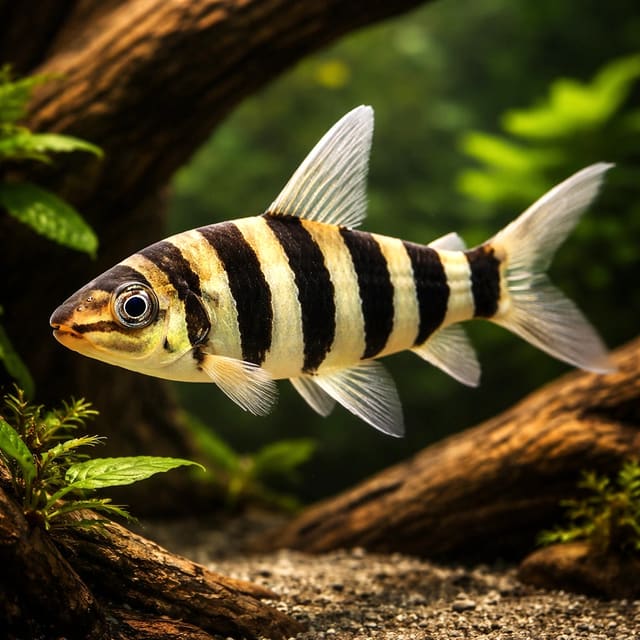
The Eight-Banded Leporinus (Leporinus octofasciatus) is a bold South American anostomid, or headstander, with strong vertical banding and a restless, purposeful swimming style. It is not a tiny community tetra, even though it sits in a wider characin-related group. This is a character fish for aquarists who enjoy active, intelligent fish and can give them enough room to mature properly.
This listing is for young specimens supplied at around 6-9 cm. That size is the trade size, not the adult size. FishBase records Leporinus octofasciatus at a much larger adult size, with a common length around 25.3 cm standard length and a recorded maximum of 31.2 cm standard length. The page has therefore been corrected to separate the supplied size from realistic adult planning.
The appeal is easy to see. The fish carries clean dark bars over a pale gold to beige body, giving a crisp striped pattern that stands out even in a busy planted display. Young fish are already striking, and the body becomes more powerful and elongated as they mature. The headstander family is also famous for unusual browsing behaviour, with fish tilting down to inspect wood, leaves, algae films and plant growth.
Expect an alert, active fish. Eight-Banded Leporinus move around the aquarium, investigate surfaces and compete confidently at feeding time. They are best described as semi-aggressive or assertive rather than delicate. Kept singly or cramped, they can become nervous, pushy or nippy. In the right layout, with enough space and visual breaks, their behaviour is much more settled and natural.
FishBase places Leporinus octofasciatus in South America, especially the northern Cubatao River in Santa Catarina and the upper Parana River basin in Brazil, with reports from Argentina. It is a freshwater, benthopelagic species from tropical waters. That combination helps explain the aquarium approach: warm water, strong biological filtration, stable conditions and a layout that gives both open swimming space and cover.
In nature, these fish are part of complex river systems rather than bare display tanks. Use driftwood, smooth stones, tough planting, shaded corners and open lanes. A dark substrate and tannin-stained water can make the fish feel more secure, but the most important foundation is maturity and stability. Do not add them to a brand-new aquarium that is still biologically settling.
Because adults can mature well beyond the 6-9 cm supplied size, plan a large aquarium from the start. A tank around 150 cm long and roughly 450 litres or more is a sensible adult target for a small group or for keeping one with robust companions. A smaller aquarium may work only as a temporary grow-on setup for juveniles.
Keep the lid secure. Leporinus are strong, fast fish and can jump when startled. Inside the aquarium, leave open water through the middle and front, then build structure along the back and sides. Driftwood roots, broad-leaved plants, hardy rhizome plants and smooth rockwork all help create territories without blocking swimming space. Soft plants may be grazed, so choose tougher species such as Anubias, Java fern and robust swords, or accept that fine plants may be sampled.
Filtration should be generous. Aim for clean, oxygenated water with steady movement rather than a blasting current. These fish produce more waste than small tetras, especially once they grow, so under-filtering is a common mistake. Weekly water changes, good mechanical filtration and stable biological media matter more than decorative complexity.
For aquarium care, keep the temperature around 24-28 C. FishBase lists a pH range of 5.6-7.0 and hardness up to 15 dH for the species, so a practical home range is soft to moderately hard water, ideally around pH 6.0-7.2. Stability matters more than chasing a perfect number. Avoid sudden swings, especially after water changes.
Ammonia and nitrite must stay at zero, and nitrate should be kept low through routine maintenance. If your tap water is very hard or alkaline, acclimate carefully and avoid sharp corrections. If your aquarium already runs as a mature South American community with driftwood, leaf litter, warm water and consistent water changes, the species will usually settle far better than in a sterile, high-light tank with little cover.
FishBase notes that adults feed on plants, so this is not a fish to feed only meaty foods. Offer a vegetable-rich omnivore diet: quality omnivore pellets, algae wafers, spirulina foods, blanched courgette, cucumber, spinach or peas, plus occasional frozen foods such as bloodworm, brine shrimp, mysis or daphnia. The plant side of the diet helps condition, digestion and long-term behaviour.
Feed controlled portions once or twice daily. Leporinus are quick at feeding time and may outcompete slower tank mates. Sinking foods, vegetable clips and feeding in more than one area can reduce chasing. Remove uneaten vegetables before they soften and pollute the water. A varied diet will also help maintain the bold banding and strong body shape that make this fish so appealing.
Watch the body line as well as appetite. A well-fed Leporinus should look strong and clean, not hollow behind the head and not heavy with a swollen belly. If it begins shredding soft plants or chasing companions at meals, increase vegetable feeding, spread food across the tank and check that the aquarium is large enough for the fish's activity level.
Choose tank mates with care. The safest options are robust fish that are too large to be bullied or eaten, but not so aggressive that they start fights. Larger peaceful catfish, medium South American characins, silver-dollar-type fish, peaceful cichlids with enough space, and other confident mid-sized species can all work when the aquarium is large enough.
Avoid very small fish, tiny shrimp, long-finned slow fish, nervous nano species and delicate surface dwellers. Also avoid mixing them into cramped tanks with territorial cichlids unless the layout is generous and the keeper is experienced. The goal is a stable community where every fish can feed, move and retreat without constant pressure.
If you keep more than one Eight-Banded Leporinus, provide room for a group and monitor hierarchy. Groups can spread attention and show more natural behaviour, but only when space, filtration and feeding are strong enough. A crowded group in a small aquarium is not kinder than a single fish in a suitable large setup.
Home-aquarium breeding is rarely reported. FishBase notes that distinct pairs breed in densely grown weedy places, which supports the idea that mature, planted or vegetated environments matter. In practice, this should be regarded as a display and care species rather than a realistic breeding project for most home aquaria.
If breeding behaviour appears, expect increased territorial behaviour and give the fish extra cover. Do not rely on breeding claims when buying this species. Success is more likely to come from excellent long-term husbandry, mature water, space and seasonal conditioning than from quick tricks.
Set the aquarium up before the fish arrives. Check temperature, pH, ammonia, nitrite and nitrate, and make sure the lid is secure. On arrival, dim the lights, float the sealed bag to equalise temperature, then acclimate gradually with small amounts of tank water. Move the fish with a net where practical rather than adding transport water to the aquarium.
For the first week, keep lighting gentle and feeding modest. Watch posture, breathing, fin condition and feeding response. A newly arrived Leporinus may be cautious at first, but it should become alert and interested once settled. If you see persistent chasing, hiding or refusal to feed, review tank size, tank mates, cover and water quality before assuming the fish itself is the problem.
This is the right choice if you want a larger South American fish with visible pattern, movement and presence, and if your aquarium is built around adult care rather than impulse size. It is the wrong choice for a small beginner community, a delicate aquascape full of soft plants, or a peaceful nano display. That distinction protects the fish, your existing livestock and the quality of your aquarium long after delivery day.
If you are unsure, compare the adult plan with your actual tank length, filtration and tank mates. A good home for this species has spare swimming room, sturdy decor, a mature filter, a secure cover and companions that will not panic every time the Leporinus moves quickly. Getting those basics right matters more than adding one more decorative feature.
We treat the Eight-Banded Leporinus as a specialist South American fish, not a generic small tetra. The listing now reflects the care it actually needs: supplied around 6-9 cm, capable of growing much larger, active, assertive and best suited to prepared aquarists. That honesty helps you choose the right livestock for the aquarium you already have, or plan the aquarium this fish deserves.
Eligible livestock is covered by our Live Arrival Guarantee, and our team can advise on tank size, compatibility, feeding and acclimation before you order. If your aquarium is mature, spacious and built for active mid-sized fish, Leporinus octofasciatus can become a standout centrepiece with genuine personality.
Semi-aggressive and active. Choose robust tank mates, provide open swimming room and monitor feeding competition.
Always research specific species before adding them to your tank. Consider:
No reviews for this item yet. Bought one? Honest reviews only, good or bad.
What customers say about ordering from us
I have a small group of long finned mountain minnows. So was delighted to be able to order ten of this variety to increase the genetics in my tank . The ones I recieved are healthy but it’s to early to give a verdict on wether they are of a long finned type since they are small currently.
Gordon Walker · 23 Sept 2026
100% success travel and "installation". Pleased with quality of purchase. The Siamese fighter a bit "shy" so have not yet seen him at his best yet but looking good. Happy customer. GG
George E Garratt · 21 Sept 2026
Reviews of our shop, collected by Judge.me, an independent third-party review collector. Newest first.