Moderate
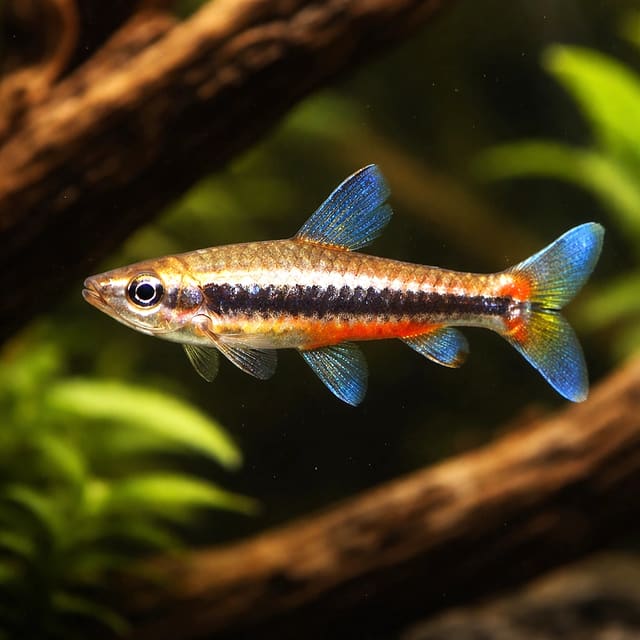
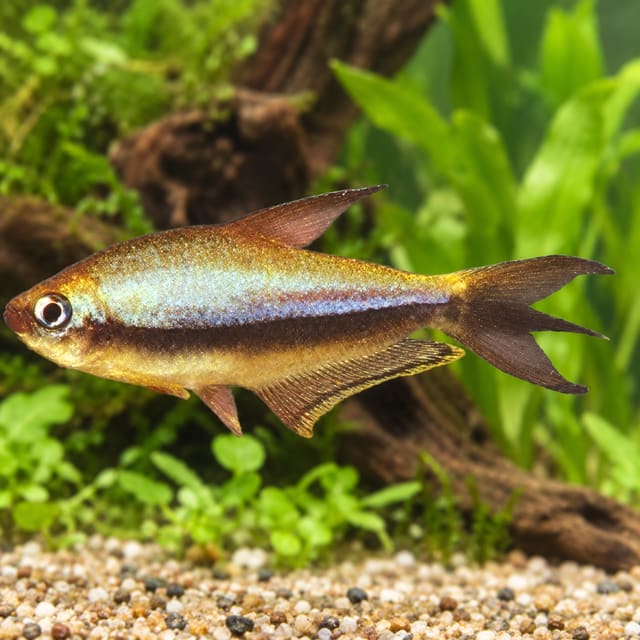
Neon Tetra (Paracheirodon innesi)
21–25°C · pH 5–7
£2.99

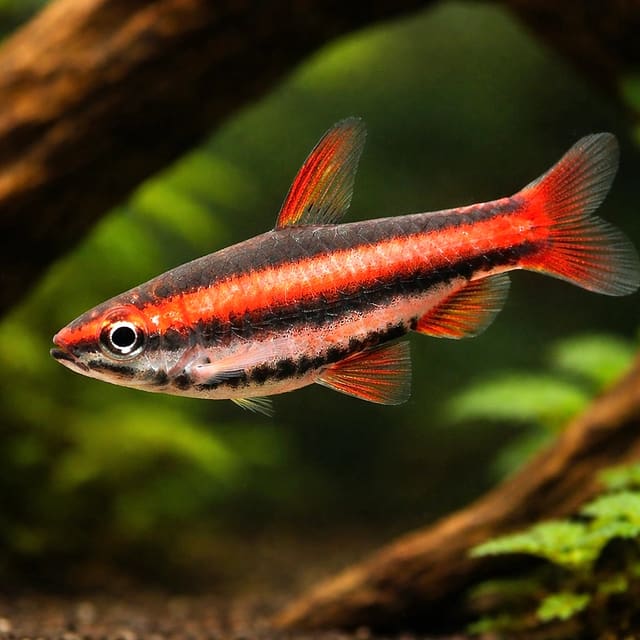
Red Golden Pencilfish (Nannostomus beckfordi) is a peaceful South American shoaling fish for mature, planted aquariums with gentle flow. Keep a settled group, offer suitably small foods and choose calm companions that will not dominate the upper levels or feeding time. One purchase supplies one live fish in the chosen dispatch size.
Adult size is the maximum length this species reaches at full maturity (scientific sources). The livestock you receive will be younger and smaller — pick a size above for the actual shipping size. Product-photo provenance and any image-specific limitations are stated on the listing.
Nannostomus beckfordi
Shoaling fish: kept in a group they feel safer, stay calmer and show their best colour.
Minimum of 2 per order.
Red Golden Pencilfish (Nannostomus beckfordi) is a peaceful South American shoaling fish for mature, planted aquariums with gentle flow. Keep a settled group, offer suitably small foods and choose calm companions that will not dominate the upper levels or feeding time. One purchase supplies one live fish in the chosen dispatch size.
Adult size is the maximum length this species reaches at full maturity (scientific sources). The livestock you receive will be younger and smaller — pick a size above for the actual shipping size. Product-photo provenance and any image-specific limitations are stated on the listing.
Maintain these water conditions for optimal health and vibrant colors
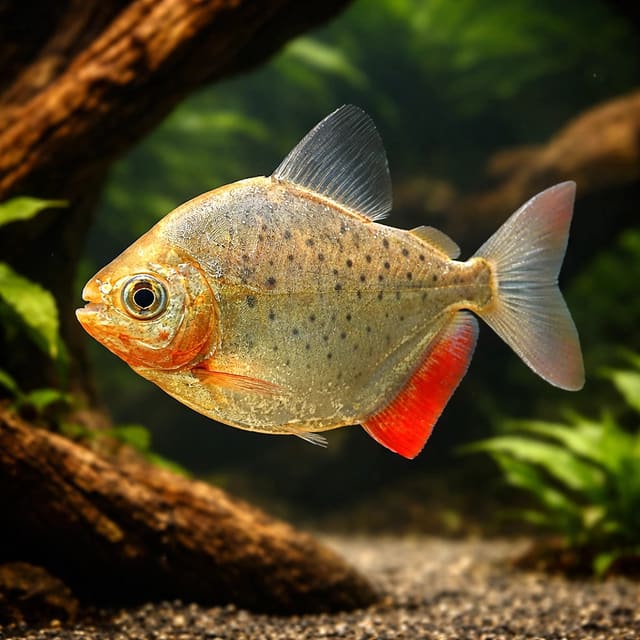
Red Golden Pencilfish is a red-toned aquarium form of Nannostomus beckfordi, the Golden pencilfish. It is a slender South American freshwater fish that spends much of its time in the middle and upper parts of the aquarium. Its appeal is not just a flash of red: a well-settled group brings gentle movement, fine detail and interesting interaction to a planted display without the heavy presence of a large fish.
This is a relatively peaceful species, but peaceful does not mean passive in every situation. Males can defend small spaces within the group, and a cramped or sparse aquarium can make those interactions more conspicuous. A larger group spreads attention and lets the fish show a fuller range of natural behaviour. The species profile recommends buying as many as possible and ideally keeping ten or more. That is a better planning target than treating one or two fish as ornaments.
One purchase supplies one live fish. The listing offers fish at 2.2–2.5 cm and 2.6–3 cm dispatch grades. The size you select is the size supplied, not the adult size. FishBase records Nannostomus beckfordi at a maximum of 6.5 cm standard length, so the aquarium must be planned for the adult fish and the whole group rather than the dimensions of a newly arrived youngster.
| Suits | Keepers with a mature planted aquarium, gentle filtration and calm community fish |
|---|---|
| Adult record | Up to 6.5 cm standard length |
| Social plan | Ideally ten or more, with enough room for several males to spread out |
| Species aquarium range | 21–27 °C, pH 5.0–8.0 and 1–15 dGH |
| Swimming area | Mostly middle to upper water |
| Main caution | Avoid large predators and very boisterous competitors |
For a wider view of similar livestock, browse the tetras collection. Treat that collection as a comparison tool rather than a ready-made compatibility list: the temperament, adult size, water needs and feeding style of every proposed companion still matter.
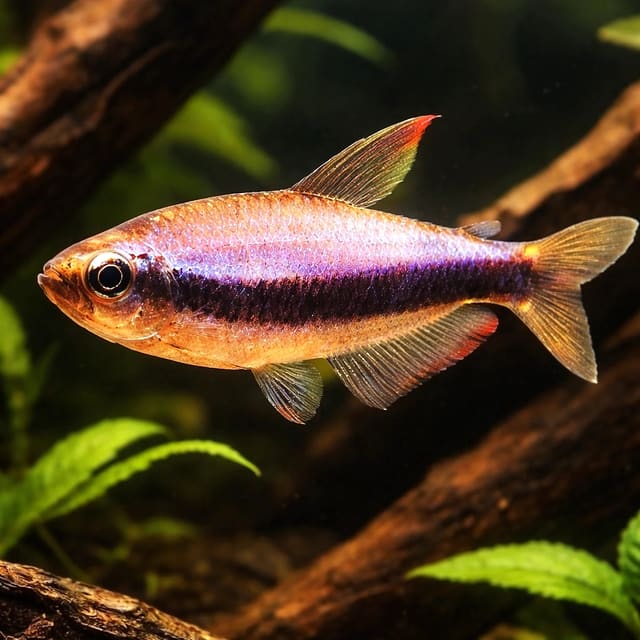
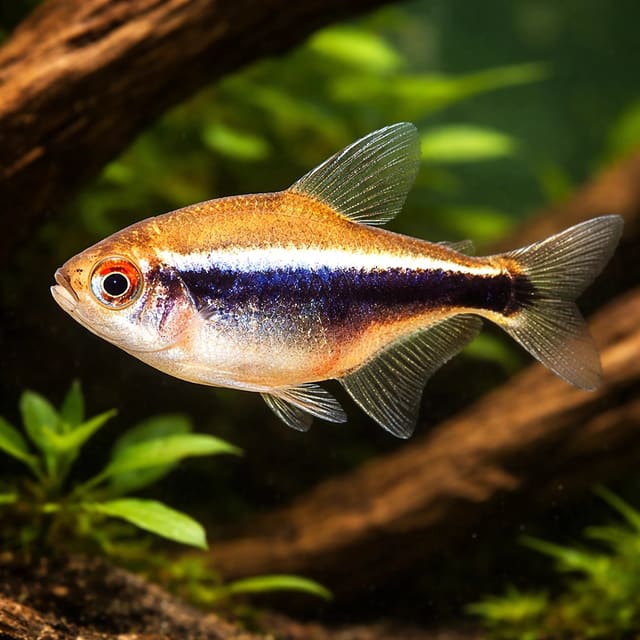
The common name points to the warm red and gold impression of this form, while the scientific identity remains Nannostomus beckfordi. The species has a slim pencil-like body and a dark lateral marking, with the red form selected for stronger warm tones. Colour is influenced by age, maturity, social setting, diet, lighting and how secure the fish feels. A newly transported fish can look subdued before it settles, so the sensible goal is a stable environment rather than trying to force colour through heavy feeding or intense lighting.
Adult males are described as more intensely coloured, particularly in breeding condition, while females tend to be rounder-bodied. These differences are biological observations, not a retail sex promise. Sex is guaranteed only when the selected option explicitly states male or female. This Red Golden Pencilfish listing has no sex-guaranteed option. A customer should therefore build a group around welfare and behaviour rather than expecting a chosen male-to-female ratio.
Nannostomus beckfordi is regarded as less demanding than many other pencilfish and can be a good introduction to the genus. Success still depends on the basics being in place: a biologically mature filter, consistent water, appropriately small food and companions that leave it room to feed. It is a poor match for an unsettled new aquarium or a busy community where larger fish charge through the upper levels.
The fish is especially effective in a planted layout with shaded areas, floating cover, driftwood and open routes between planting. Those features are not decoration alone. They break up exposed space, reduce skittishness and allow group members to move away from minor territorial encounters. The result is usually a bolder group that can be watched without needing to crowd the front glass.
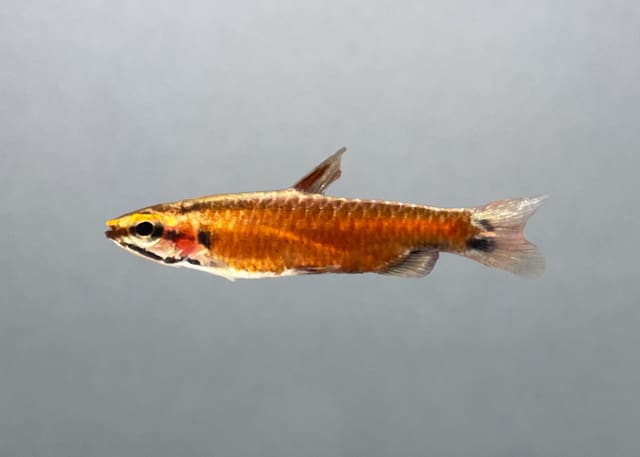
Gallery images have been digitally enhanced to improve image quality. Natural colour, pattern, size and maturity can vary between live animals.
The species profile gives a base of at least 45 × 30 cm, roughly 41 litres, for Nannostomus beckfordi. That is a useful lower planning reference, not an invitation to crowd a large group into the smallest possible tank. More length and planted structure are valuable when several males are present because they provide more separate positions and reduce constant face-to-face contact. The adult record of 6.5 cm standard length also makes this a larger pencilfish than its dispatch grade may suggest.
A mature aquarium matters more than a nominal litre figure. Fish continually add ammonia through respiration and waste. A functioning biological filter converts ammonia to nitrite and then nitrate, while regular maintenance removes accumulated waste. The RSPCA aquarium environment guidance explains why a well-established filter is fundamental. Set up and cycle the aquarium before the group arrives; the first tropical tank guide is a practical starting point for that preparation.
Use live plants generously around the back and sides, with finer stems or broad clumps creating separate sheltered zones. Floating plants help soften overhead light and make the upper water feel less exposed. Driftwood branches can extend that shelter while retaining open lanes across the front and centre. Dried leaves are another suitable natural element: as they decompose they encourage microbial growth and release tannins, although they should be used as part of a managed aquarium rather than allowed to create heavy organic debris.
A dark substrate tends to show the fish well and can make the display feel more secure. Sand or fine gravel can both work because this is not a bottom-sifting species. What matters is that the substrate supports the chosen plants and can be cleaned without uprooting the entire layout. Keep the top swimming zone open enough for the group to feed and move, while maintaining cover near it.
The species occurs in small rivers with little current and in swamp habitats. Aquarium filtration should therefore provide biological stability and oxygen exchange without turning the upper water into a fast raceway. A sponge filter or a suitably baffled outlet can work well. Watch the group: fish that are continually pushed away from feeding positions or forced to shelter behind equipment are experiencing more flow than the layout allows them to escape.
The Seriously Fish species profile gives an aquarium range of 21–27 °C, pH 5.0–8.0 and 1–15 dGH for Nannostomus beckfordi. FishBase records the species in 24–26 °C water with pH 6.0–8.0 and 5–19 dH. These figures describe a broad capacity, not a reason to move the aquarium around the limits. Select a suitable point that also works for the intended companions, then keep it consistent.
Wild fish may benefit from conditions nearer the softer, more acidic end of the aquarium range. Provenance is not promised here, so do not assume a particular origin. Instead, measure the aquarium you actually have. If your tap water is moderately hard and alkaline but remains within the species range, stability is generally preferable to chasing softness through abrupt chemical adjustments. If you deliberately run a soft, acidic system, monitor buffering carefully so pH cannot fall unpredictably.
The water chemistry guide explains the meaning of ammonia, nitrite, nitrate, pH and hardness. Use the water matcher to compare measured values with the care range, but base final stocking on all animals in the aquarium rather than a single number.
Ammonia and nitrite should remain at zero. Nitrate should be managed through stocking, feeding, plant growth and water changes. The OATA group sheet for tetras and pencilfish advises keeping nitrate no more than 20 mg/l above the level in the incoming tap water. That comparison is useful because tap water itself may contain nitrate. Record the tap and tank values separately so a rising aquarium trend is visible.
Temperature consistency is just as important. Place the heater where filtered water distributes warmth, and verify it with a separate thermometer. During warm weather, check the upper-water zone because pencilfish spend much of their time there. Higher temperatures reduce the amount of dissolved oxygen water can carry, so surface exchange and sensible stocking deserve extra attention.
A water reading is information, not a command to make a dramatic correction. If pH or hardness is outside the intended plan, identify the cause and change the system in measured stages. Large sudden shifts can be more stressful than a slightly imperfect but stable reading. Match replacement water closely for temperature and condition it before use.
In nature, Nannostomus beckfordi feeds on worms, crustaceans and insects, while the species profile describes it as a micropredator taking tiny invertebrates and zooplankton. In the aquarium it accepts suitably small dried foods, but it benefits from small live or frozen fare such as Artemia nauplii, Moina and grindal worms. A varied menu supports condition and gives the fish more opportunities to feed naturally.
Food size is crucial. A pellet that is technically nutritious is no use if the fish cannot take it comfortably. Choose fine granules, crushed flake or micro-pellets that remain accessible in the upper and middle water, then rotate in small frozen or live foods. Thaw frozen food in a clean container and add only the food rather than a large quantity of thaw water.
Scatter modest portions across more than one area instead of dropping everything into a single point. That approach gives quieter fish access while confident individuals are occupied elsewhere. Observe the first minute: food should be small enough to swallow, and every group member should have a fair chance to take it. A fish that repeatedly misses food may be intimidated, unwell or struggling with particle size.
The OATA group sheet advises feeding only what tetras and pencilfish eat within a few minutes, once a day, and warns that overfeeding leaves waste that breaks down in the aquarium. The species profile also discusses daily small live and frozen meals. Use these together sensibly: portion control and variety matter more than repeatedly adding food because the fish still appear interested.
The OATA care sheet for tetras and pencilfish strongly recommends a partial water change of 25% at least once every week. Use that as a regular checkpoint while adjusting the exact routine to measured nitrate, stocking and feeding. A lightly stocked planted aquarium and a busy community can accumulate waste at different rates, so testing should confirm whether the schedule is sufficient.
Siphon loose debris from accessible areas without stripping the aquarium of every leaf and surface at once. Treat replacement water with a suitable conditioner and bring it close to the aquarium temperature before adding it. If the filter needs cleaning, rinse the media lightly in water removed from the aquarium. Do not run it under the tap, because chlorine or chloramine can damage the beneficial bacterial population.
Learn the fish's normal swimming, feeding and spacing. Changes become more meaningful when compared with that baseline. Warning signs include hanging at the surface, sitting unusually low, erratic swimming, rapid or slow gill movement, fading or darkening colour, damaged fins, spots, fluffy growths, loss of scales, reduced body condition or reluctance to feed.
Begin with water tests whenever several fish change behaviour at the same time. Ammonia, nitrite, temperature and oxygen problems can affect an entire aquarium. A single fish being excluded or losing weight may point instead to competition, injury or individual illness. Separate observation from diagnosis: gather clear information, correct environmental faults and seek appropriate aquatic veterinary or experienced retailer help when the problem persists.
Have the aquarium fully mature, tested and at a suitable stable temperature before delivery day. Make sure someone is present to receive the fish; live animals must not be left unattended. Keep your order number available and read the current delivery and Live Arrival Guarantee policy before arrival so the claim steps are clear.
The video protects the evidence needed for a Live Arrival Guarantee claim; it is separate from the fish's care. Slow temperature equalisation and careful transfer reduce avoidable stress. Do not add a large number of fish to an immature filter at once, because the bacterial population must be able to process the increased waste.
Red Golden Pencilfish are relatively peaceful towards other suitable species, yet group members are not motionless. Males defend small territories and display to one another. In a good setup those interactions add interest; in a sparse, undersized aquarium they can become concentrated on the same individuals.
A group of ten or more is the most useful target from the species profile. Larger groups tend to be bolder and spread aggression, while planting and driftwood allow fish to step out of view. If the aquarium can only accommodate the bare minimum, rethink the stocking plan before purchase rather than squeezing a social species around other priorities.
Group size cannot compensate for insufficient swimming room. Ten fish in a cramped cube do not receive the same usable space as ten fish in a longer planted aquarium. Consider footprint, open upper-water routes and the number of territorial males as well as litres. The 45 × 30 cm base is a starting reference; larger housing is specifically encouraged when keeping multiple males.
Minor displays are expected, but one fish should not be driven into a corner, kept away from food or left with repeated fin damage. Rearranging dense plant clumps can redistribute preferred positions if one area has become a permanent bottleneck. Check water quality too, because stress from poor conditions can make normal social tension harder for the group to absorb.
The safest companions are similarly sized, peaceful fish that thrive in overlapping water conditions and do not overwhelm feeding time. Seriously Fish names small peaceful characids and smaller callichthyid or loricariid catfishes, and also notes smaller rasboras, barbs and anabantoids as possibilities. These are categories to assess, not universal approvals for every species within them.
Bottom-dwelling fish can reduce direct competition for the same swimming layer, but their adult size and behaviour still require checking. Small peaceful cory-type catfish are often easier to plan than a large armoured catfish that eventually dominates the floor and adds heavy waste. The same principle applies to rasboras and barbs: choose calm small species rather than assuming the family name alone guarantees compatibility.
Avoid fish large enough to eat a pencilfish. Very boisterous or substantially larger companions can keep the group hidden and win every meal even without deliberate aggression. Fin-nipping species and highly territorial fish also deserve caution. Sedate surface dwellers, including hatchetfish, are best omitted in smaller aquariums because both groups rely on the upper layers and may compete for calm space and food.
A mature planted aquarium with a substantial group of Red Golden Pencilfish, a modest group of small peaceful bottom catfish and no large upper-water competitor is a sensible pattern. The fish use different levels, their feeding can be distributed and the planting supports security. It still requires enough base area for the bottom fish and sufficient filtration for the combined load.
An aquarium already filled with fast barbs, large tetras and assertive surface fish is a weak match even when its water values overlap. The pencilfish may receive no physical attack yet still remain hidden and underfed. Compatibility includes access to space and food, not merely the absence of predation.
The species profile describes Nannostomus beckfordi as a useful dither fish for Apistogramma and other dwarf cichlids because it occupies the middle and upper water and does not often predate fry. That combination needs adequate footprint, cover and a calm cichlid species. Breeding cichlids can become territorial, so monitor boundaries rather than assuming the pairing is automatically trouble-free.
Related-product links on this page are comparisons, not tank-mate endorsements. Make the decision from the actual animals, aquarium dimensions, water values and behaviour.
FishBase records Nannostomus beckfordi at up to 6.5 cm standard length. The fish supplied here are smaller dispatch grades, so plan the aquarium around the adult record and the whole group.
A base of at least 45 × 30 cm, about 41 litres, is the species reference, with larger housing advised for several males. Choose more length and planted structure for a substantial group or a community.
Keep a group, ideally ten or more. A larger group tends to be bolder and spreads male interactions, provided the aquarium has enough swimming room and several planted areas.
It can suit a careful newer keeper because Nannostomus beckfordi is considered less demanding than many congeners. The aquarium must already be mature, stable and gently filtered, and the keeper must provide small food and a proper group.
Offer suitably small dried food plus tiny live or frozen foods such as Artemia nauplii, Moina and grindal worms. Spread modest portions so every fish can feed, and avoid leaving uneaten food to decay.
The species aquarium range is 21–27 °C, pH 5.0–8.0 and 1–15 dGH. Choose a stable point within that range that also suits the intended companions rather than moving between the limits.
It is relatively peaceful, although males defend small territories within the group. Keep enough fish and provide planted structure; avoid combining it with aggressive fin-nippers or much larger, boisterous fish.
Consider similarly sized peaceful characids, smaller callichthyid or loricariid catfishes, and carefully chosen small rasboras, barbs or anabantoids with overlapping water needs. Avoid predators and assess every species rather than relying on a broad family label.
Tropical Fish Co hand-packs live fish in oxygenated bags inside an insulated box, using a heat pack when weather calls for it, and sends them with a licensed live-animal courier. Be present to receive the parcel. Before opening it, record a continuous unboxing video showing the sealed parcel, outer box and fish still in the sealed bag; contact the store the same day with the order number if there is a problem.
Use the species aquarium profile for practical care values and use the group sheet for wider maintenance context. Wild environmental records describe where the species occurs; they are not automatic targets for every aquarium.
No reviews for this item yet. Bought one? Honest reviews only, good or bad.
What customers say about ordering from us
I have a small group of long finned mountain minnows. So was delighted to be able to order ten of this variety to increase the genetics in my tank . The ones I recieved are healthy but it’s to early to give a verdict on wether they are of a long finned type since they are small currently.
Gordon Walker · 23 Sept 2026
100% success travel and "installation". Pleased with quality of purchase. The Siamese fighter a bit "shy" so have not yet seen him at his best yet but looking good. Happy customer. GG
George E Garratt · 21 Sept 2026
Reviews of our shop, collected by Judge.me, an independent third-party review collector. Newest first.