Easy
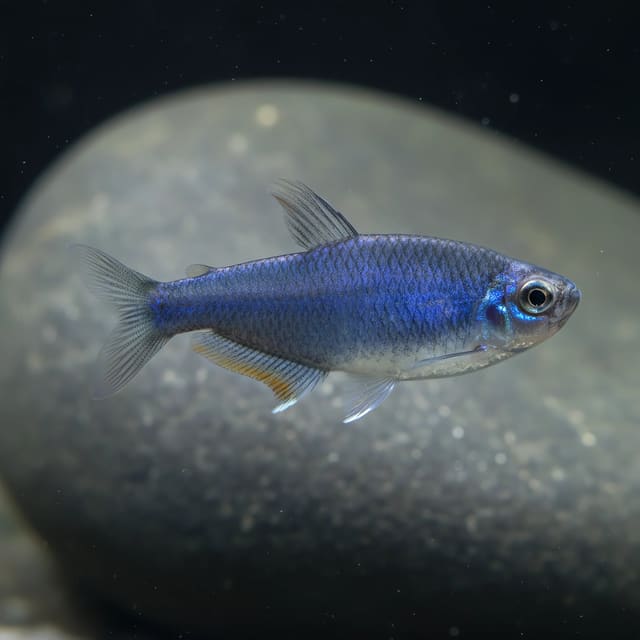
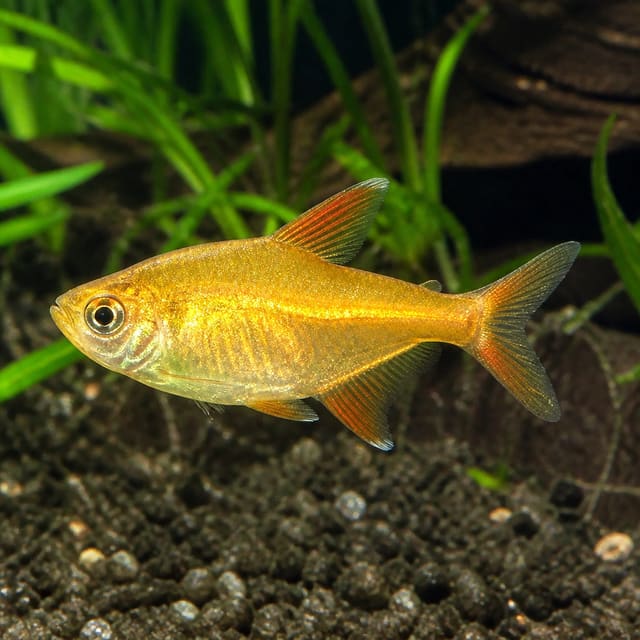
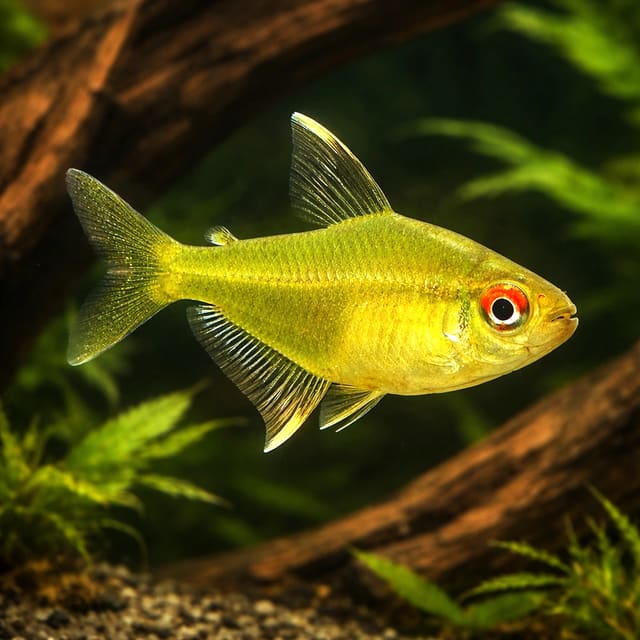
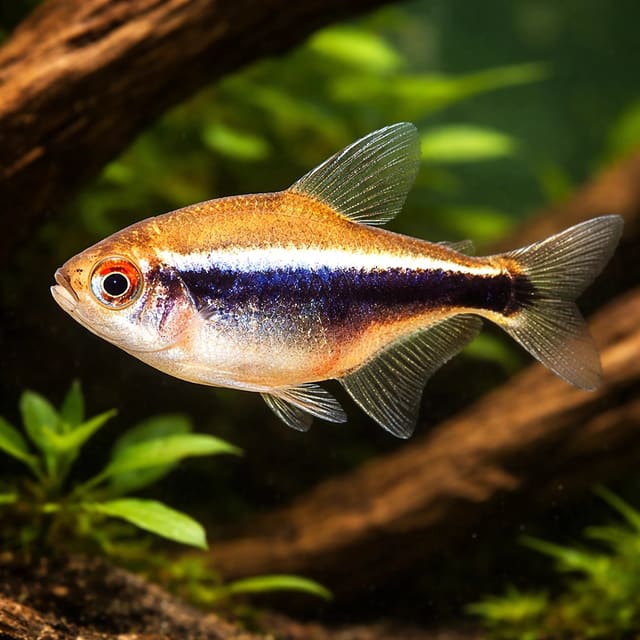
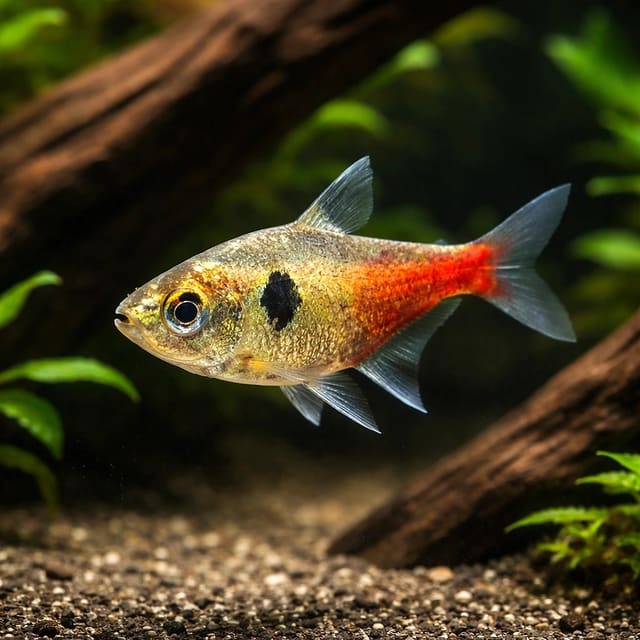
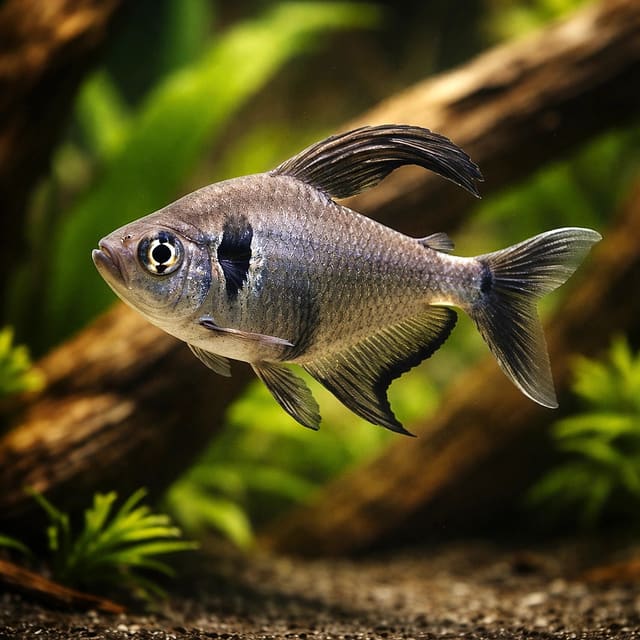
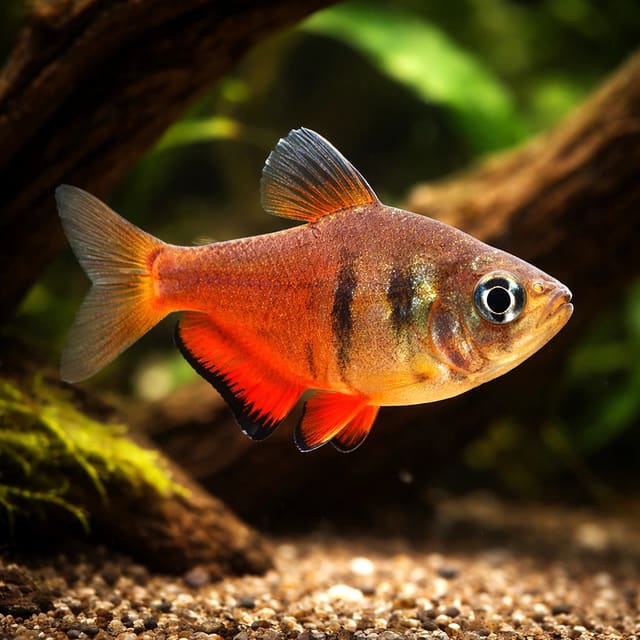
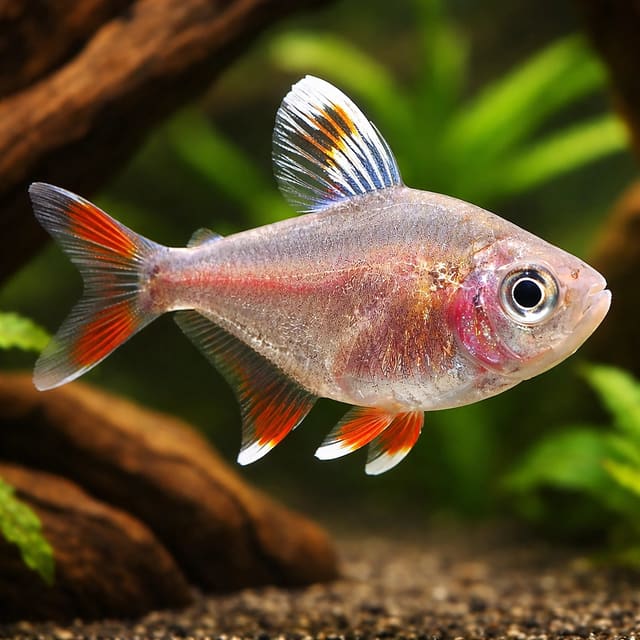
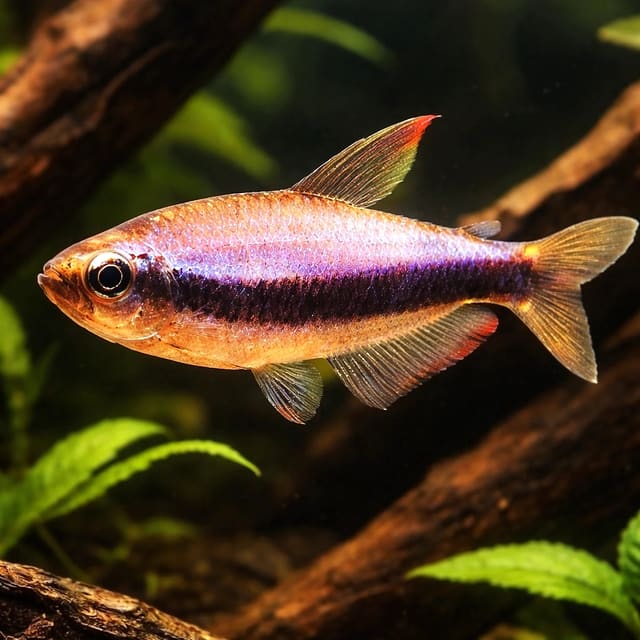
Emperor Tetra Black (Nematobrycon palmeri black)
23–27°C · pH 6.5–7.5 · 81L
£5.99

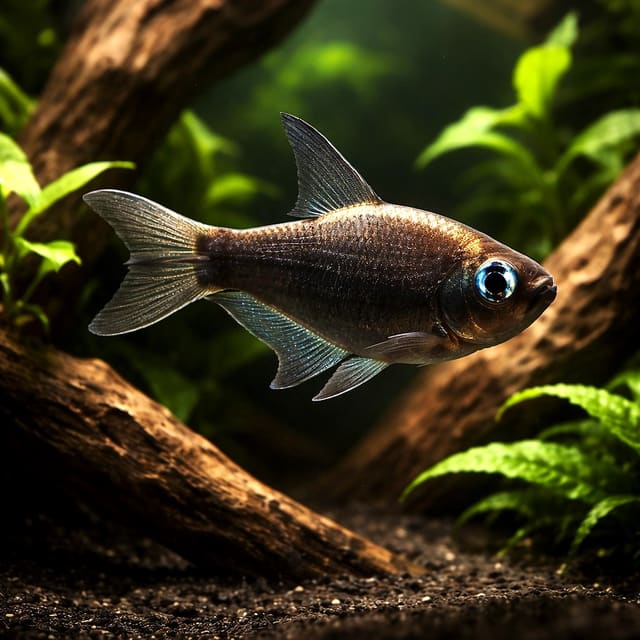
The Emperor Tetra (Nematobrycon palmeri) is a peaceful Colombian shoaling tetra reaching 4.2 cm standard length, with a dark body band, bronze back and the three-pronged tail of mature males. Keep six or more in at least 81 litres at 23–27°C, pH 6.5–7.5 and 5–12 dGH. Sold as one live fish per quantity in four dispatch sizes; sex is not selected.
Adult size is the maximum length this species reaches at full maturity (scientific sources). The livestock you receive will be younger and smaller. Product-photo provenance and any image-specific limitations are stated on the listing.
Nematobrycon palmeri
Shoaling fish: kept in a group they feel safer, stay calmer and show their best colour.
Minimum of 2 per order.
The Emperor Tetra (Nematobrycon palmeri) is a peaceful Colombian shoaling tetra reaching 4.2 cm standard length, with a dark body band, bronze back and the three-pronged tail of mature males. Keep six or more in at least 81 litres at 23–27°C, pH 6.5–7.5 and 5–12 dGH. Sold as one live fish per quantity in four dispatch sizes; sex is not selected.
Adult size is the maximum length this species reaches at full maturity (scientific sources). The livestock you receive will be younger and smaller. Product-photo provenance and any image-specific limitations are stated on the listing.
Maintain these water conditions for optimal health and vibrant colors
The Emperor Tetra (Nematobrycon palmeri) is a small Colombian fish with a big reputation among people who have kept aquariums for years. It does not rely on neon colour to catch your eye. What you notice in a settled group is contrast: a warm bronze back, a cool blue sheen along the upper flank, a dark band running from nose to tail and, in mature males, a tail that ends in three distinct points. Wikipedia dates its arrival in the aquarium trade to 1960, and it has stayed a regular in good fish shops ever since because it is calm, hardy and easy to feed.
| Scientific name | Nematobrycon palmeri Eigenmann, 1911 |
|---|---|
| Family | Acestrorhamphidae, the American tetras (older books: Characidae) |
| Native range | Atrato and San Juan river basins, western Colombia |
| Maximum size | 4.2 cm standard length (FishBase) |
| Temperature | 23–27°C |
| pH we recommend | 6.5–7.5 (published ranges run from 5.0 to 8.0) |
| Hardness we recommend | 5–12 dGH |
| Aquarium | Base of at least 90 × 30 cm, about 81 litres |
| Group | Six as a minimum, ten or more preferred |
| Care level | Easy |
| IUCN Red List | Data Deficient (assessed 2014) |
C. H. Eigenmann described the species in 1911. The name palmeri honours Mervyn George Palmer (1882–1954), an English collector who gathered specimens for the British Museum and obtained the fish that became the type specimen. According to Wikipedia the genus Nematobrycon holds only two valid species: this one and the Rainbow Tetra, Nematobrycon lacortei. Both live only in the Atrato and San Juan basins of western Colombia.
Classification has shifted in recent years. FishBase and Wikipedia now place the genus in the family Acestrorhamphidae, the American tetras, while Seriously Fish still files it under Characidae. Nothing about the fish has changed; you will simply meet both family names in books and on websites.
Colour shifts with the setting. Wikipedia notes that the fish shows purple tones under subdued lighting among plants, while yellow becomes dominant in bright conditions. The same fish can therefore look golden under a strong white light and noticeably bluer in a shaded, planted tank. It also helps to know how the adult size is measured. FishBase gives a maximum of 4.2 cm standard length, taken from the tip of the snout to the end of the body and leaving out the tail fin. A grown male with his extended tail therefore looks longer than 4.2 cm when he swims past the glass.
This listing sells Emperor Tetras individually. Each unit of quantity is one live fish, so a quantity of ten brings ten fish. You choose a size grade first: 1.5–2 cm, 2.5–3 cm, 3–4 cm or over 4 cm. Those figures describe the fish when it is packed, not the size it will reach, so plan the aquarium for adults of up to 4.2 cm standard length, the maximum FishBase records for the species.
Sex is not guaranteed in any grade, and we do not pick fish by sex. Seriously Fish describes males as developing extended dorsal, anal and tail fins, which tells you those features belong to mature fish; in the smaller grades they may not have appeared yet. If sex ratio matters to you, for example because you want to try breeding, order a larger group and sort out pairs once the fish have grown and shown their colours.
Keep a new group within one grade where you can. Fish of a similar size compete for food on equal terms and the shoal looks even from the first day. If you are topping up an existing group, choose the grade closest to the size of the fish you already have.
Seriously Fish advises buying a group of at least half a dozen and preferably ten or more, describing the Emperor as a shoaling species that fares much better in the company of its own kind. FishBase suggests keeping groups of five or more, and the Ornamental Aquatic Trade Association (OATA) says the same for tetras in general, adding that more is better and that tetras kept singly or in small groups often become stressed.
Wikipedia strikes a different note. It describes the Emperor as placid and says it prefers pairs to schooling groups, although larger groups sometimes school after water changes. That observation is worth knowing, because a group of Emperors in a large tank does not always move as one tight shoal. It does not change the welfare advice: the species-specific sources and OATA all recommend a group, and so do we. Six is our minimum; ten or more is better if your tank has room.
Seriously Fish and Wikipedia give a consistent set of differences:
Every Emperor Tetra in the hobby traces back to a small corner of South America. FishBase and Seriously Fish both give its range as the Atrato and San Juan river basins of western Colombia, and Seriously Fish records the type locality as Condoto on the Río Condoto and Novita on the Río Tamaná, in the south-west of the country. The whole genus is endemic to those two basins.
Within that range the species is common rather than fussy about where it lives. Seriously Fish calls it ubiquitous in the slower-moving sections of rivers, minor tributaries and backwaters. FishBase classes it as a tropical freshwater fish of open water (pelagic) and lists worms and crustaceans in its natural diet. Put those details together and you get a mid-water fish that patrols calm water rather than fighting a current, taking small animal food from the water column.
That picture is useful when you plan the aquarium. It argues for gentle water movement rather than a powerful stream, open swimming space at mid-level, and enough cover around the edges for the males to stake out display spots. It also explains why a varied diet of small invertebrate foods brings the fish into its best condition, which the feeding section covers in detail.
Seriously Fish notes that wild-caught Emperors are not as common in the trade as they once were and that most fish in the hobby are captive bred. On the IUCN Red List the species is assessed as Data Deficient, with the assessment dated 9 October 2014 on FishBase. Data Deficient means there was not enough information to judge its status; it does not mean the species is known to be safe, nor that it is known to be threatened.
FishBase rates the Emperor's resilience as high, with a minimum population doubling time of less than 15 months, and gives it a low vulnerability to fishing. Those are figures about wild populations rather than aquarium care, but they sit comfortably with Seriously Fish's picture of a fish that is widespread within its range.
For the home aquarist the practical lesson is straightforward. The broad water ranges published by FishBase and Seriously Fish show an adaptable species, so you do not need to recreate a Colombian river to keep it well. What it does need is clean, stable water, a proper group, gentle flow and calm companions, and those are the things the rest of this guide sets out.
Seriously Fish recommends an aquarium with a base of at least 90 × 30 cm, about 81 litres, and that is the figure we use in the care specifications for this listing. FishBase gives a minimum aquarium length of 80 cm. Either way, this is not a fish for a small desktop tank. A 4.2 cm fish might seem to need less, but Emperors are active mid-water swimmers, they live in groups and the males claim small display areas that they defend against one another. Seriously Fish says that rivalry does no serious damage provided the tank is sufficiently large and well decorated. Length and furnishings are what keep it that way.
Plant the back and sides and leave an open swimming area in the front and middle. Because Wikipedia notes that the fish shows purple tones under subdued lighting with plants and turns more yellow in bright conditions, moderate lighting softened by tall stem plants or a few floating plants tends to show the blue and violet at their best. If you prefer the golden look, brighter light will bring that forward instead; neither is wrong.
Seriously Fish ties peaceful sparring to a well-decorated tank, so build in some structure. Pieces of wood and dense plant thickets give each male an area to hold and give any fish that loses a display somewhere to drop out of sight. Keep the middle and upper water open, because this is where the shoal spends most of its time: the care specification lists the Emperor as a middle-water fish, in line with FishBase's description of it as pelagic.
If you might want fry one day, include some fine-leaved plants such as Java moss from the start. Seriously Fish recommends clumps of fine-leaved plants or spawning mops in a breeding set-up, and Wikipedia reports that pairs breed spontaneously in large, well-planted aquariums. Substrate choice is up to you; nothing in the published care information makes it critical for this mid-water species.
OATA is clear that ammonia and nitrite must read zero before fish go in, and that numbers should rise gradually so the filter bacteria can keep pace. Adding too many fish to an immature aquarium is what causes the problems known as new tank syndrome. If you are starting from scratch, mature the filter fully first. If you are buying a large shoal for a newly matured tank, consider adding it in two batches a few weeks apart rather than all at once.
Emperor Tetras tolerate a fairly wide spread of water conditions, which is part of the reason they have done so well in home aquariums. The published sources agree closely on temperature and differ a little on chemistry:
| Source | Temperature | pH | Hardness |
|---|---|---|---|
| FishBase | 23–27°C | 5.0–8.0 | 5–19 dH |
| Seriously Fish | 23–27°C | 5.0–7.5 | 1–12 dGH |
| Wikipedia | 23–27°C | about 6.5 | 3–6 dKH (carbonate hardness) |
| OATA, tetras and pencilfish in general | 22–27°C | 6.5–8.0 | not given |
| Our recommendation | 23–27°C | 6.5–7.5 | 5–12 dGH |
Our recommended range sits inside every species-specific figure in the table. The hardness band of 5–12 dGH is exactly where FishBase and Seriously Fish overlap, and pH 6.5–7.5 keeps you clear of both extremes of the published ranges. Note that Wikipedia's figure is carbonate hardness (KH), which measures buffering, while dGH measures the total of calcium and magnesium; the two are not interchangeable, so check which one your test kit reports.
Aim for steady water inside the range rather than a particular number. If your tap water sits well outside it, very hard or very alkaline, ask us before ordering. Floating the bag on arrival matches temperature but not pH or hardness, so a big difference between our water and yours is worth discussing in advance.
All three species sources give 23–27°C. A setting near the middle of that band leaves a margin on either side for a hot summer spell or a heater that drifts. For breeding, Seriously Fish suggests 24–26.5°C together with softer, slightly acidic water of pH 6.0–7.0 and 1–10 dGH; there is no need to keep a community tank that soft.
Never start a siphon by mouth. OATA warns that bacteria in aquarium water may be harmful if swallowed, and a hand pump or a siphon you prime under water does the job just as well.
Keep a simple log of your weekly readings. A slow upward creep in nitrate or a pH that drifts downward between water changes is easy to spot on paper and easy to correct early, long before the fish show any sign of it.
In the wild the Emperor is a micropredator. Seriously Fish describes it feeding on small insects, worms, crustaceans and other zooplankton, and FishBase lists worms and crustaceans in its diet. Wikipedia calls it omnivorous. In the aquarium that means a fish that will take almost anything small enough to swallow but only looks its best on a varied menu with plenty of meaty food.
Seriously Fish is explicit that the species accepts dried foods but should not be fed them exclusively. A diet of flake alone will keep Emperors alive, but the colour you bought them for depends on the regular small meals of live and frozen food that Seriously Fish recommends.
OATA's advice for tetras is to feed what the fish can eat within a few minutes once a day and to avoid overfeeding, because uneaten food breaks down and pollutes the water. Watch the whole group at feeding time rather than tipping food in and walking away. In a well-planted tank some fish hang back in the plants, and it is worth checking that every fish is getting a share before deciding the group is fed.
Thaw frozen food in a little tank water first and add it with a pipette or spoon so it spreads through the middle water where the shoal feeds. Remove anything still lying on the bottom after a few minutes. If you keep bottom-dwelling companions such as Corydoras, give them their own sinking food so they are not relying on scraps.
If you order the 1.5–2 cm grade, crush flake finely between finger and thumb or use a micro-granule, and choose the smallest frozen foods such as Daphnia and baby brine shrimp. Larger items such as bloodworm can wait until the fish have grown into them.
Well-fed Emperors come forward at feeding time, hold a steady body shape without a pinched or hollow belly, and show strong colour. OATA lists weight loss and reduced feeding among the signs of ill health, so a fish that hangs back from food or thins out over a week or two needs a closer look, starting with your water test results.
Seriously Fish rates the Emperor as one of the best tetras for a general community aquarium, describing it as lively and peaceful, with colours that contrast well with many other species. It is happy sharing the middle water with other calm fish of a similar size, and a well-chosen community shows off its bronze and blue to great effect.
Seriously Fish lists the following groups as good tank mates. Water requirements still have to overlap, so check each companion's own temperature, pH and hardness range before you buy:
For a South American theme, Seriously Fish suggests combining it with other peaceful tetras, pencilfish, Apistogramma and other dwarf cichlids. A fish only counts as a good tank mate if it is comfortable at 23–27°C and within the Emperor's pH and hardness band, and if its adult size suits an aquarium of around 81 litres alongside a group of Emperors.
In a group of mature fish you are likely to see the males squaring up to one another. Seriously Fish describes rival males as territorial to an extent but says no serious damage is done during these contests provided the tank is sufficiently large and well decorated. In practice each male needs enough space and enough visual barriers to claim a spot of his own. Regularly torn fins, or one male being chased without a break, suggest that the tank is too small or too open for the group and that the layout needs more cover.
Because it spends its time in the middle water, the Emperor sits well above a group of bottom dwellers and below any surface fish, so a planted community can use all three levels without crowding. Plan the stocking so the Emperors are a proper group rather than a token few, keep the total within what your filter and weekly water changes can handle, and build up gradually, as OATA advises, rather than stocking everything in one week.
Three fish are regularly confused with the Emperor Tetra, and the Super Blue Emperor Tetra is the one people ask about most. Knowing them helps you check what you have and choose alternatives with your eyes open.
The only other recognised member of the genus, from the same two Colombian river basins. Seriously Fish gives a simple check: the male Emperor has a blue iris, while the male Rainbow Tetra has a bright red one. The check relies on the males, so look at the males in a group.
A dark form sometimes labelled Nematobrycon 'amphiloxus' and once put forward as a third species. Seriously Fish reports that it is currently considered a colour morph of N. palmeri rather than a separate species. If you like the shape and finnage of the Emperor but want a darker fish, have a look at our Black Emperor Tetra (Nematobrycon palmeri black).
Despite the shared trade name, this fish belongs to a different genus. Seriously Fish says it is frequently misidentified as an Emperor, but it is significantly smaller, lacks the fin extensions and has an adipose fin, which Nematobrycon does not. We list it separately as the Super Blue Emperor Tetra (Inpaichthys kerri), with its own care notes.
The adipose-fin test is the one to remember. Look along the back between the dorsal fin and the tail. If there is a small, fleshy fin there, the fish is not a Nematobrycon. If there is none, check the male's eye: blue for the Emperor, red for the Rainbow Tetra.
Seriously Fish describes the Emperor as not difficult to breed, and Wikipedia notes that pairs breed spontaneously in large, well-planted aquariums. Wikipedia adds that young can survive without intervention when the tank holds no other fish and the parents are well fed. Those conditions explain why a busy community tank is the wrong place to count on fry; if you want to raise a reasonable number, set up a dedicated spawning tank.
Seriously Fish recommends conditioning males and females in separate tanks on plenty of live food. The fish are ready when the females look noticeably full of eggs and the males are showing their best colours. Daily small meals of live and frozen food, as described in the feeding section, are what bring them into that condition.
Seriously Fish's method is to move the chosen male and female into the spawning tank in the evening, with spawning following the next morning. The eggs hatch in 24–36 hours, and the fry become free-swimming four to five days after that.
Seriously Fish also describes a group spawning approach, using around six fish of each sex together, but notes that it needs more space than spawning a single male with a single female.
Newly free-swimming fry are tiny. Seriously Fish recommends infusoria-type food for the first week or so, until they are large enough for microworm or brine shrimp nauplii. Wikipedia describes the fry living on natural microorganisms at first, then moving on to screened Daphnia and specialised fry foods.
Fry tanks are small and food goes in often, so water quality needs close attention. Test regularly, remove uneaten food and make small, careful water changes with water at the same temperature. Move the young into a larger grow-on tank as they get bigger, and sort them by size if some outpace the rest.
Live fish need a ready home before they leave us. Please read our delivery and live-arrival information before ordering, and have the aquarium fully prepared: filter running and matured, water tested, heater set and the temperature matched to the range on this page.
Your Emperors are packed in oxygen-filled bags inside insulated packaging, with heat packs when conditions call for them, and sent with a tracked courier licensed to carry live animals. We email you the confirmed delivery date and tracking details. Someone must be at the delivery address to receive the parcel.
Claims are resolved with a replacement on your next order or a refund for the affected fish, subject to the guarantee terms.
Keep the lights low and watch breathing, appetite and behaviour closely over the first week, and test the water during that time as well. Offer small amounts of food and take out anything left uneaten. OATA lists the signs of a healthy fish as clear, bright eyes, undamaged fins, intact scales, no ulcers or bumps, normal swimming and steady breathing.
OATA's list of warning signs is a good checklist for Emperors: clamped fins, flicking against gravel or decor, shimmying on the spot, a change in colour or breathing rate, white spots, fluffy growths, loss of fins or scales, weight loss and reduced feeding. If you see any of these, test the water first, because it is quick to check and easy to put right, then contact us if you need advice.
OATA also notes that diseases can be carried by fish that show no clinical signs. If you already have an established community, a separate quarantine tank for the first few weeks gives you a chance to watch the new group before it joins your other fish.
If the males' fins look torn once the group has settled, consider display contests as well as disease. Seriously Fish links harmless sparring to a large, well-decorated tank, so more cover and more room are the first things to try.
These are the sources we used for this guide. Each is worth reading in full if you want more detail.
No reviews for this item yet. Bought one? Honest reviews only, good or bad.
What customers say about ordering from us
I have a small group of long finned mountain minnows. So was delighted to be able to order ten of this variety to increase the genetics in my tank . The ones I recieved are healthy but it’s to early to give a verdict on wether they are of a long finned type since they are small currently.
Gordon Walker · 23 Sept 2026
100% success travel and "installation". Pleased with quality of purchase. The Siamese fighter a bit "shy" so have not yet seen him at his best yet but looking good. Happy customer. GG
George E Garratt · 21 Sept 2026
Reviews of our shop, collected by Judge.me, an independent third-party review collector. Newest first.