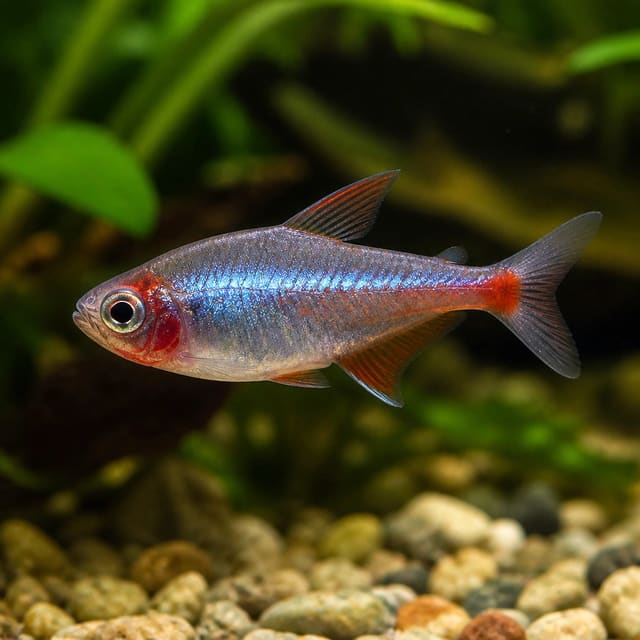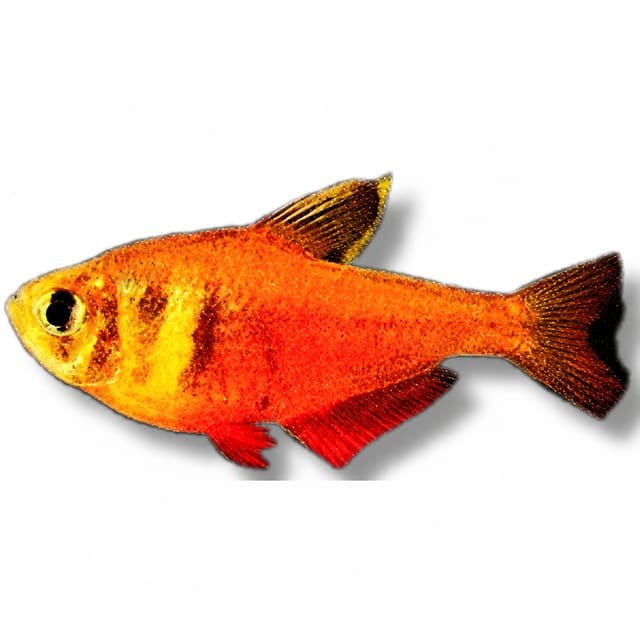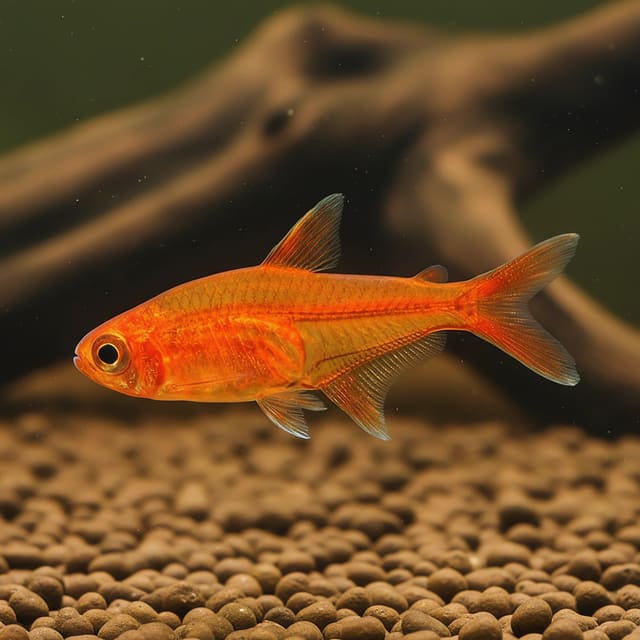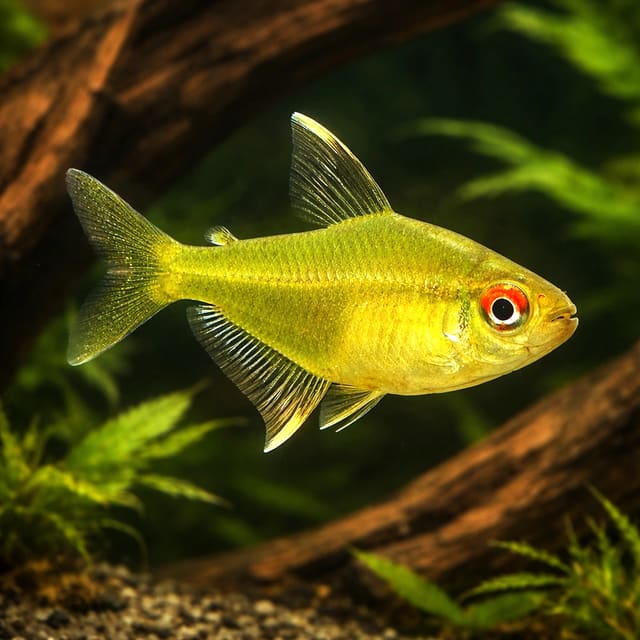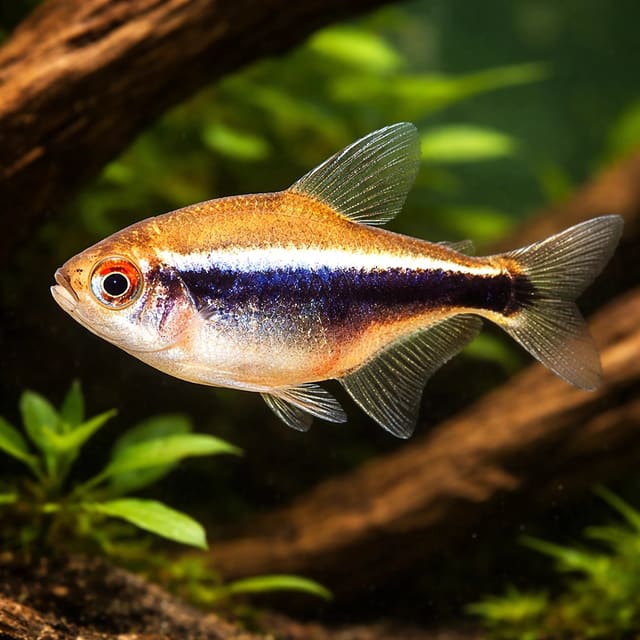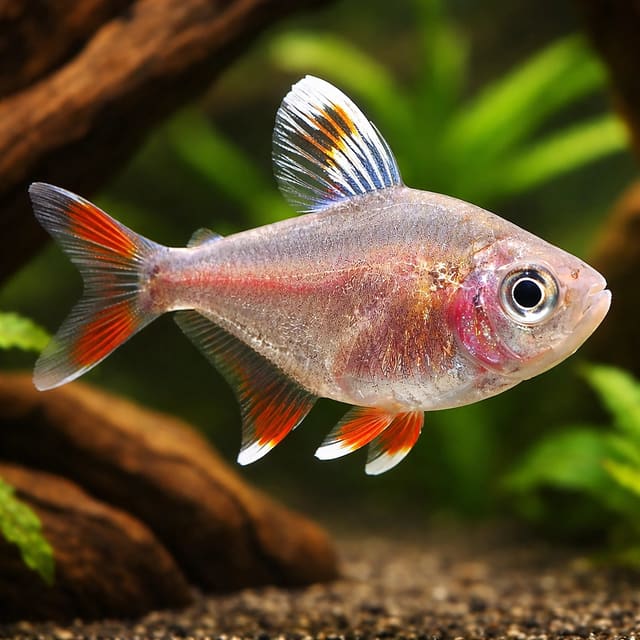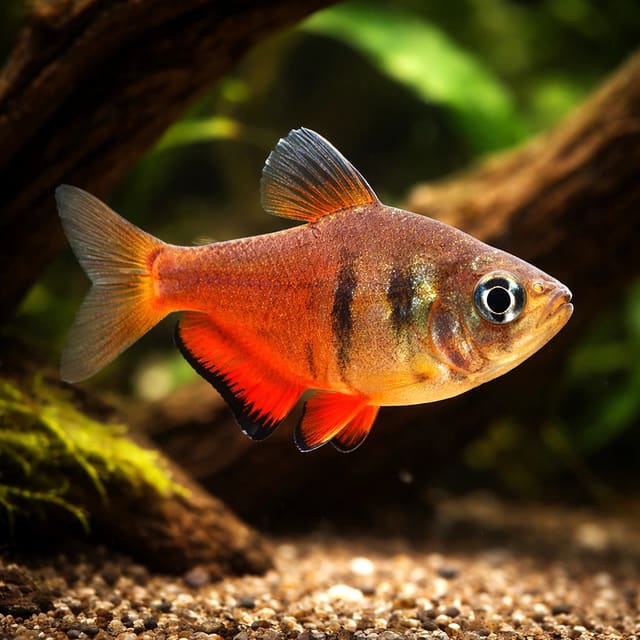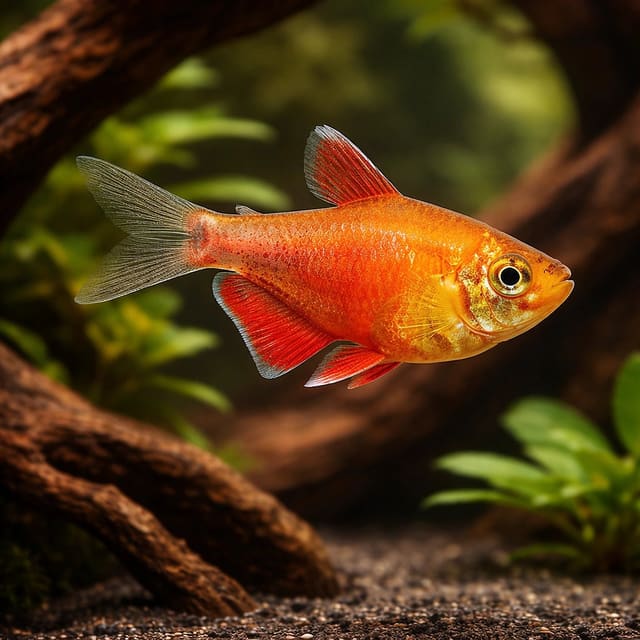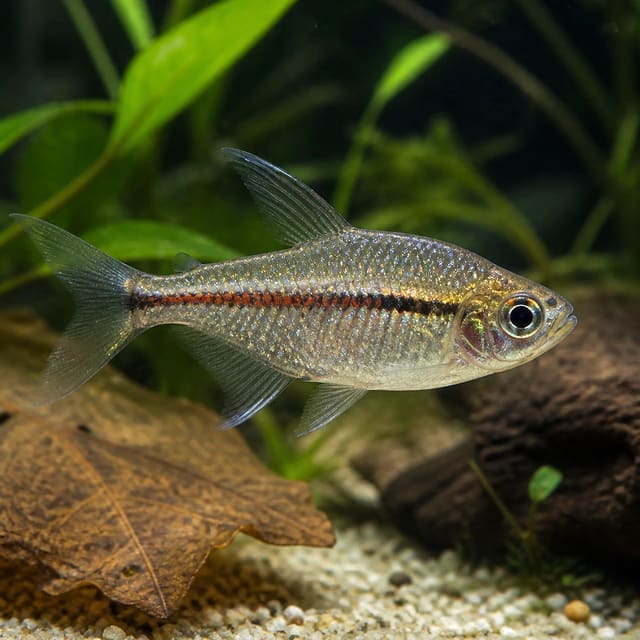
Serpae Tetra (Megalamphodus eques)
20–28°C · pH 5–7.5 · 72L
£2.99

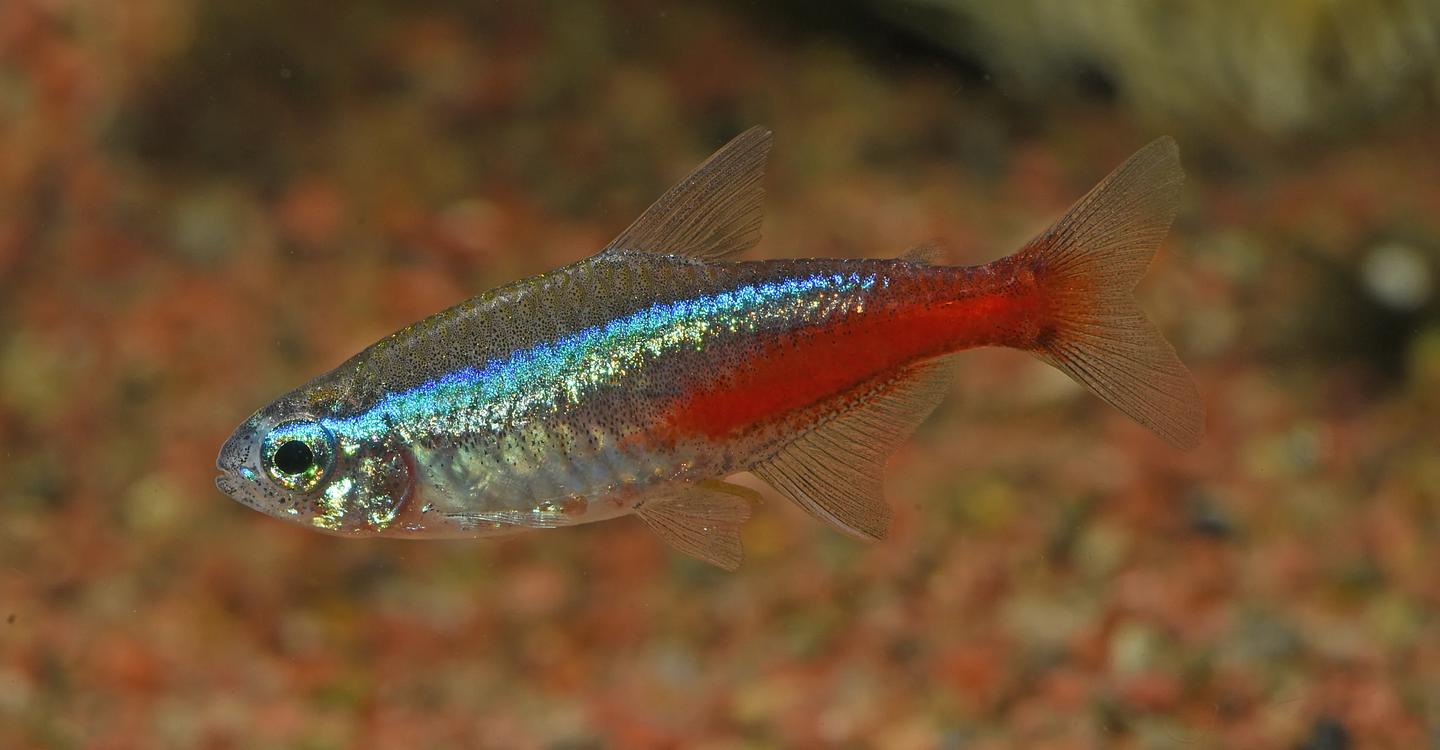
The Serpae Tetra (Megalamphodus eques), widely traded as Hyphessobrycon eques, is a gregarious South American tetra that reaches 4 cm. Keep at least 12 together in a planted tank with an 80 × 30 cm base or larger, and leave out long-finned or timid companions, because the species has a reputation for nipping fins. Each purchase is one live fish, at 2–3 cm or 3–4 cm.
Adult size is the maximum length this species reaches at full maturity (scientific sources). The livestock you receive will be younger and smaller — pick a size above for the actual shipping size. Product-photo provenance and any image-specific limitations are stated on the listing.
Megalamphodus eques
Shoaling fish: kept in a group they feel safer, stay calmer and show their best colour.
The Serpae Tetra (Megalamphodus eques), widely traded as Hyphessobrycon eques, is a gregarious South American tetra that reaches 4 cm. Keep at least 12 together in a planted tank with an 80 × 30 cm base or larger, and leave out long-finned or timid companions, because the species has a reputation for nipping fins. Each purchase is one live fish, at 2–3 cm or 3–4 cm.
Adult size is the maximum length this species reaches at full maturity (scientific sources). The livestock you receive will be younger and smaller — pick a size above for the actual shipping size. Product-photo provenance and any image-specific limitations are stated on the listing.
Start here: use a mature, filtered aquarium at least 60 cm long. FishBase and OATA compile groups of five or more; our conservative planning screen starts at eight, then checks usable volume, water, filtration and every adult tank mate.
Maintain these water conditions for optimal health and vibrant colors
The Serpae Tetra is a small, gregarious fish from South America and a very common tetra in the aquarium trade. Each purchase is one live fish, so the real decision is how many to order: this species belongs in a group of at least 12, in a tank with at least an 80 × 30 cm base, and it is not a safe companion for long-finned or timid fish because of its reputation for nipping fins. Get those three things right and it is an adaptable fish for a planted tank.
In the wild it comes from the Amazon, Guaporé and Paraguay River basins, where FishBase records it holding position near the surface among the stems of emerging plants, often in still water. That picture explains much of the advice below: planting that reaches up towards the surface, gentle water movement and plenty of company of its own kind.
You will see this tetra under a handful of names. Seriously Fish lists jewel, red minor, blood and callistus tetra, and jewel tetra is the common name on the FishBase species summary. It is widely traded as Hyphessobrycon eques, the name many suppliers and references still use. FishBase now treats Hyphessobrycon eques as a synonym and lists the species as Megalamphodus eques in the family Acestrorhamphidae, the American tetras, which is why the scientific name in our title reads Megalamphodus eques. FishBase also notes that the species belongs to a complex of ‘blood’ tetras, and that hybrids within that complex are commonly offered in the aquarium trade.
FishBase lists the species as Least Concern on the IUCN Red List. Seriously Fish notes that several selectively bred ornamental strains have been developed, including metallic, long-finned, balloon and fairy-fin forms. This listing is sold under the species name alone rather than as one of those named strains, and the care on this page is written for the species.
| Suits | Not the best choice for |
|---|---|
| Keepers ready to buy a group of 12 or more | Anyone planning to keep only a few |
| A planted tank with an 80 × 30 cm base or larger and open swimming water | Nano tanks and small bowls |
| A species tank, or robust companions of a similar size and temperament | Tanks holding long-finned or timid fish |
| A keeper who tests and changes water every week | An aquarium that is still maturing |
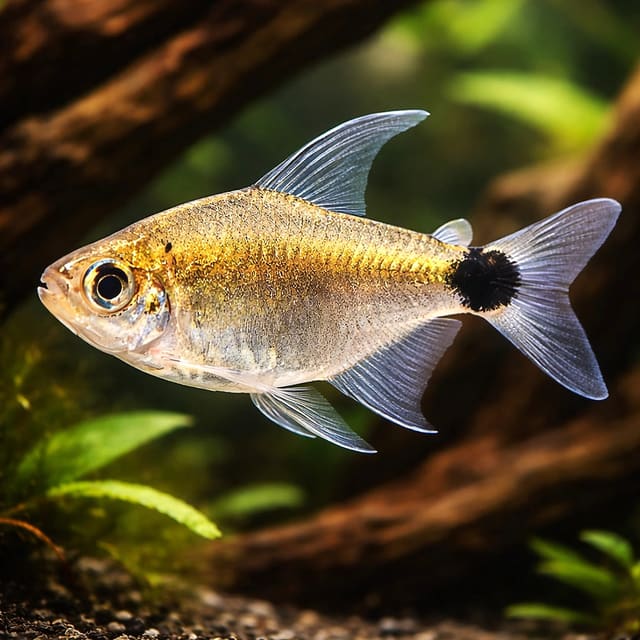
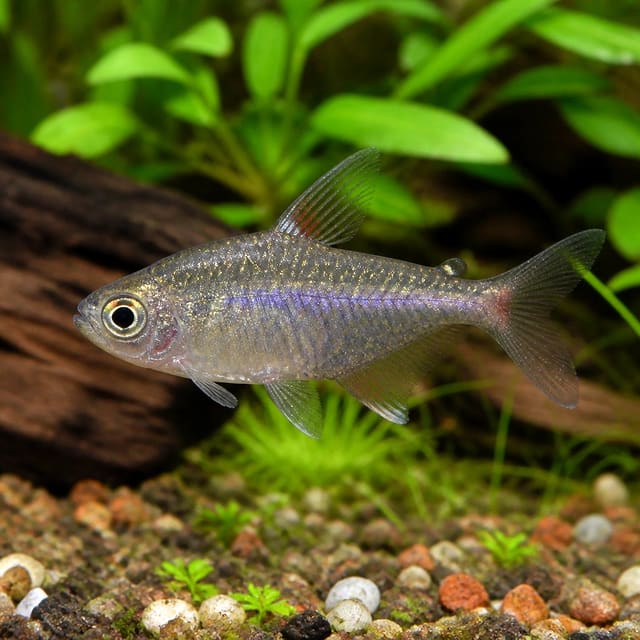
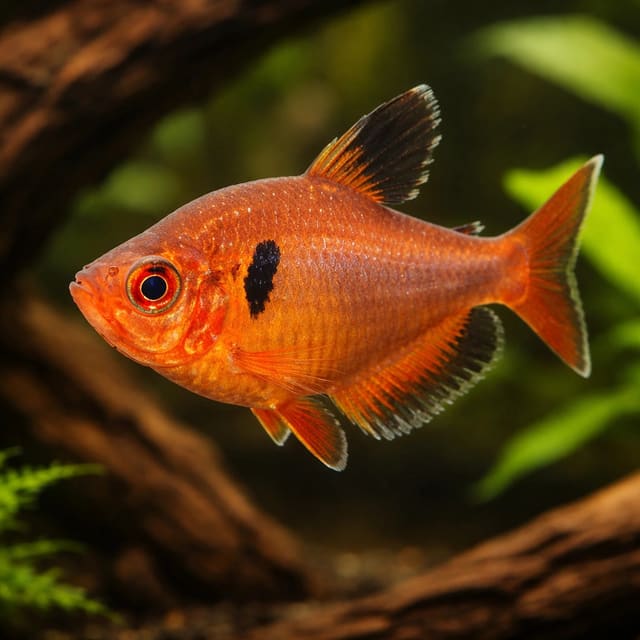
A note on the photograph: Gallery images have been digitally enhanced to improve image quality. Natural colour, pattern, size and maturity can vary between live animals. Seriously Fish adds that this tetra shows better colouration in a well-furnished tank with live plants and a dark substrate, so the setting you give it affects how it looks.
This is a fish to buy by the dozen. FishBase describes a gregarious species, and the Seriously Fish species profile sets a clear bar: a group of at least 12 specimens should be considered the minimum requirement. Its reasoning is practical. In a larger group the fish are more likely to be distracted by each other than by their tankmates, the display looks more natural, and males show better colouration when rivals of their own kind are present.
The OATA care sheet for tetras and pencilfish advises groups of at least five in the home aquarium, adding that more is better, and FishBase’s aquarium note also gives groups of five or more. Both set a floor rather than a target. The Seriously Fish figure is set with this species’ fin nipping in mind, which it notes is most pronounced when too few are bought or space is limited. OATA also warns that tetras kept singly or in too small groups will often become stressed, so trimming the group is a false economy.
Seriously Fish describes Serpae Tetras forming loose hierarchies, with rival males continually battling each other for female attention and for position within the group. That sparring is ordinary behaviour for the species rather than a sign that something has gone wrong, and it is one more reason to give the group room and enough numbers to spread the attention around.
Seriously Fish gives an 80 × 30 cm base, or equivalent, as the absolute minimum for this species, which works out at about 72 litres. FishBase’s aquarium note gives a minimum aquarium length of 60 cm, so the Seriously Fish figure is the larger of the two species-level minimums and the one to plan around. OATA’s general advice points the same way: buy as large an aquarium as you reasonably can, because more water keeps temperature and water quality steadier.
Seriously Fish notes that décor is not especially critical, but that this tetra shows better colouration in a well-furnished set-up with live plants and a dark substrate. A natural-looking arrangement might use:
OATA stresses that tetras need space to swim and a gentle current for the smaller species. Taller stem plants rising towards the surface at the sides and back, with an open lane through the middle, echo the plant-stem habitat FishBase describes while leaving the group room to move together.
Filtration is not optional. The RSPCA’s aquarium environment guidance says no fish should be kept without a well set up and maintained filter: fish release ammonia, which is toxic, and a working biological filter grows the beneficial bacteria that turn it into nitrite, also toxic, and then into the safer nitrate. OATA makes the same point for tetras: whatever the size of the aquarium, a filter is always essential.
Seriously Fish sizes equipment for its minimum tank of about 72 litres. With a turnover of four to five times the tank volume an hour, it suggests a filter rated at 290–360 litres per hour. For a larger aquarium, multiply the volume by four and by five to find the equivalent range; a 100 litre tank, for example, points to roughly 400–500 litres per hour. Keep the outlet flow gentle, in line with OATA’s advice for smaller tetras.
To hold 20–28°C in a tank of about 72 litres, Seriously Fish estimates roughly 50–75 W of heating, assuming a room around 20°C. A colder room or a bigger tank needs more. Pair the heater with a thermometer you check daily, so a stuck thermostat is caught early.
Three sources describe Serpae Tetra water, and they are written for different purposes. Reading them together gives you both the safe range and a sensible target.
| Source and what it describes | Values |
|---|---|
| FishBase: the natural environment | 22–26°C, pH 5.0–7.8, 10–25 dH |
| Seriously Fish: this species in aquariums | 20–28°C, pH 5.0–7.5, 1–15 dGH |
| OATA: tetras and pencilfish as a group | 22–27°C, pH 6.5–8.0, GH 4–12°dH, KH 3–10°dKH |
Keep the tank inside the Seriously Fish aquarium range, because that is written for this species in captivity. Within it, the ground where all three sources agree is 22–26°C and pH 6.5–7.5, and that is where we would set up a new tank. Seriously Fish notes that the vast majority of fish in the trade are bred commercially and are more adaptable than wild specimens, describing the fish sold in stores as fairly adaptable where water chemistry is concerned and happy within pH 5.0–7.5. Stability matters more than chasing an exact number.
Because every water change brings in tap water, test its pH and hardness before the fish arrive. Our water parameter matcher compares your readings with this fish’s ranges, and the guide to what to test in aquarium water, and why explains each value. Seriously Fish’s 1–15 dGH covers soft to moderately hard water. FishBase’s higher 10–25 dH is its record of the natural environment, so it is no reason to harden soft tap water. If your tap sits well above 15 dGH or 7.5 pH, talk to us before ordering so we can help you judge whether it will suit.
In the wild, FishBase records the Serpae Tetra feeding on worms, crustaceans, insects and plants, and Seriously Fish describes it as likely omnivorous. OATA’s tetra sheet agrees that tetras are omnivorous and will take most food types. It may survive on dried food alone, Seriously Fish says, but like most fishes it does best on a varied menu.
OATA’s rule for tetras is to feed only what they can eat within a few minutes once a day. Uneaten food breaks down and releases toxic waste, and that matters more with a group of 12 or more than with a handful of fish.
FishBase notes something every Serpae keeper should know: the species is generally peaceful, but when there are too many of them crowding at feeding, they bite each other’s fins. Scatter food across the surface rather than dropping it in one spot, so the whole group can eat without jostling at a single point. If companions share the tank, make sure slower eaters get their share too.
Pulling the figures together, here is one way to set up a species tank for a first group. It uses the Seriously Fish minimum footprint, so treat it as the smallest sensible version rather than the ideal.
| Element | Plan |
|---|---|
| Tank | 80 × 30 cm base, about 72 litres |
| Fish | 12–15 Serpae Tetras, with no other upper-water species |
| Filter | Rated 290–360 litres per hour, with a gentle outlet |
| Heater | Roughly 50–75 W, set within 22–26°C |
| Floor | Soft, dark sand with a scattering of dried leaves |
| Décor | Wood roots and branches for shade, stem plants at the back and sides, open water through the middle |
| Weekly change | 25%, about 18 litres in a 72 litre tank |
| Feeding | Once a day, only what the group clears within a few minutes, scattered across the surface |
To add other species, start from a bigger tank rather than the 80 × 30 cm minimum, since Seriously Fish says adding compatible species requires more room. The same ratios carry over: filter flow of four to five times the volume an hour, a heater sized for the room temperature, and a weekly change of a quarter of the water.
Tetras can be stressed by even the smallest amounts of ammonia, OATA warns, so the tank has to be ready before a group this size goes in. A new aquarium needs time for nitrifying bacteria to build up in the filter. When fish arrive before that, or too many arrive at once, the bacteria cannot cope with the extra waste; ammonia and nitrite rise to unhealthy levels, which may cause fish to become ill or die. OATA calls this ‘new tank syndrome’.
If this is your first aquarium, our guide to setting up a tropical tank in ten safe steps covers the maturing stage from the beginning.
A group of 12 tetras produces a steady stream of waste, and OATA’s routine for tetras is designed to keep it under control. Build it into the same day each week.
| Task | How |
|---|---|
| Water change | At least once every week, a partial water change of 25%, which OATA strongly recommends; a siphon clears solid waste from the gravel |
| New water | Treat it with tap water conditioner to remove chlorine or chloramine before it goes in |
| Testing | At least once per week, so ammonia and nitrite cannot build up |
| Filter | Check for blockages; if cleaning is needed, rinse it lightly in tank water removed during the water change |
| Leaf litter | Leave it to break down or replace it every few weeks |
Never run filter media under the tap. Any chlorine or chloramine in tap water may kill the beneficial bacteria established in the media, and losing them sends the tank back towards the conditions of a new aquarium. A light rinse in the tank water removed during the change keeps most of that population in place.
We hand-bag your fish in pure oxygen and pack them in an insulated poly box, adding a heat pack when the weather calls for it. A licensed live-animal courier carries the parcel, and we email the tracking number and your confirmed delivery date so you know when to be in. Live fish cannot be left unattended, so someone must be at the delivery address to receive the parcel, and it should be opened and inspected on the day it arrives. Our delivery and Live Arrival Guarantee policy sets out the full terms.
The continuous video matters because our licensed live-animal courier may ask us for that evidence when we raise a claim.
Healthy fish have clear, bright eyes, undamaged fins, intact scales and no ulcerations or bumps. Watch the group settle over the following days, and test the water more often than usual, since a dozen new fish is a real increase in load for the filter.
Every fish varies a little, so the useful habit is noticing change. OATA suggests keeping an eye on these signs:
Because fin nipping is part of this species’ reputation, damaged fins can point to stocking as much as to water. If fins look torn, check that the group is at least 12 strong, that the tank is not crowded, that food is spread out at feeding time and that no long-finned or timid fish are being singled out, as well as testing the water.
If you are concerned, test the water first, then contact us with the readings and what you have seen, and we will help you work out the next step.
The Serpae Tetra is an egg-scattering free spawner that shows no parental care. According to Seriously Fish, adults in good condition spawn often, and in a mature aquarium a few fry may appear without any intervention; leaf litter helps here, because the microbes that grow on decaying leaves can be a valuable secondary food for fry.
To increase the number of young, Seriously Fish describes conditioning the adult group together, then using a smaller aquarium filled with mature water. The base is covered with a mesh coarse enough for eggs to fall through but fine enough to keep adults out; plastic ‘grass’ matting or a layer of glass marbles work too, as does filling much of the tank with a fine-leaved plant such as Taxiphyllum or with spawning mops.
Sexually mature females are noticeably rounder-bodied and a little larger than males, Seriously Fish notes. Sex cannot be chosen when you order, so a group of 12 or more gives the best chance of both sexes being present.
This is the section to read twice. Seriously Fish calls the Serpae Tetra notorious as an aggressive community inhabitant with a reputation for nipping the fins of tankmates, and FishBase’s aquarium note also labels it aggressive. The same sources explain when the problem is worst: Seriously Fish says it is most pronounced when too few are bought or space is limited, and FishBase notes fin biting among the fish themselves when too many crowd in at feeding. Group size, tank size and the choice of companions therefore decide whether a Serpae community works.
OATA’s tetra guidance is that larger or more boisterous tetras should not be kept with any timid or long-finned fish, as they may nip their fins. That rule fits the Serpae Tetra. Leave out long-finned fish of any kind and shy, timid species, however peaceful they are themselves. OATA also advises that small tetras should not be kept with any fish large enough to eat them, which rules out big predatory tankmates for this 4 cm fish.
Tetras mix best with species of a similar size and temperament to themselves, OATA says. For a Serpae group, that means robust, active fish of similar size with short fins, able to hold their own around a busy shoal, and comfortable in the same water.
Before adding any companion, run through these questions:
A companion that fails any one of these is better left out.
Seriously Fish’s advice is a group of 12–15 in its minimum 80 × 30 cm tank with no other upper-water species; adding other compatible species requires larger tanks. If you want a mixed display, size the aquarium up rather than squeezing companions into the minimum footprint.
OATA describes tetras as generally small, colourful and peaceful fish, with some exceptions, and the Serpae Tetra is one of those exceptions. If your aquarium already holds long-finned or timid fish, or you cannot give a group of 12 the room it needs, a gentler species will suit your tank better. Our full range of tetras lets you compare other shoaling fish before you decide.
A single-species tank of 12–15 Serpae Tetras is the most straightforward way to enjoy them, and it gives you the natural display and male colour that Seriously Fish links to a proper group. A community is possible in a larger tank, provided every companion passes the size, temperament and fin tests above.
FishBase and Seriously Fish both record a maximum of 4 cm standard length. The fish are supplied at 2–3 cm or 3–4 cm, which is the size at dispatch rather than the adult size.
Seriously Fish gives an 80 × 30 cm base, about 72 litres, as the absolute minimum for a group of 12–15 with no other upper-water species. A community with other species needs a larger tank.
Keep at least 12. Seriously Fish treats 12 as the minimum because a larger group is more likely to be distracted by each other than by tankmates, and OATA warns that tetras kept singly or in too small groups will often become stressed.
It is adaptable about water, and commercially bred fish are fairly tolerant of chemistry, but it asks for planning: a mature tank, a group of at least 12 and no long-finned or timid companions.
It is omnivorous. Offer a good quality flake or granule, with live or frozen foods such as bloodworm, Daphnia, Moina or mosquito larvae, and feed only what the group eats within a few minutes once a day.
For the Serpae Tetra in aquariums, Seriously Fish gives 20–28°C, pH 5.0–7.5 and 1–15 dGH. A comfortable target inside that range is 22–26°C and pH 6.5–7.5, with ammonia and nitrite at zero.
It has a reputation for nipping the fins of tankmates, and Seriously Fish calls it notorious for this. The behaviour is most pronounced in small groups or cramped tanks, so a group of 12 or more and enough space make a clear difference.
Choose robust fish of a similar size and temperament, as OATA advises for tetras. Avoid any timid or long-finned fish, and any fish large enough to eat a small tetra.
It travels hand-bagged in pure oxygen inside an insulated poly box, with a heat pack when needed, carried by a licensed live-animal courier. Someone must be in to receive it. Record a continuous unboxing video from the sealed parcel onwards, then float the bag for 20–30 minutes before releasing; that video is needed for any Live Arrival Guarantee claim.
No reviews for this item yet. Bought one? Honest reviews only, good or bad.
What customers say about ordering from us
I have a small group of long finned mountain minnows. So was delighted to be able to order ten of this variety to increase the genetics in my tank . The ones I recieved are healthy but it’s to early to give a verdict on wether they are of a long finned type since they are small currently.
Gordon Walker · 23 Sept 2026
100% success travel and "installation". Pleased with quality of purchase. The Siamese fighter a bit "shy" so have not yet seen him at his best yet but looking good. Happy customer. GG
George E Garratt · 21 Sept 2026
Reviews of our shop, collected by Judge.me, an independent third-party review collector. Newest first.