
−14%
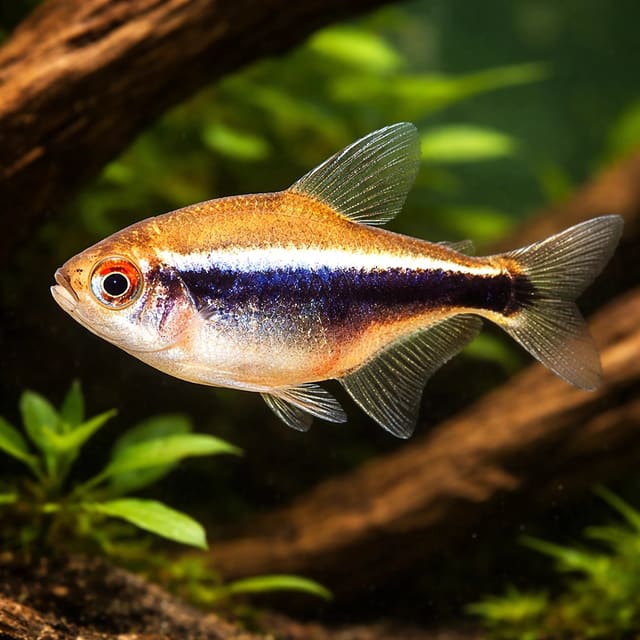
Black Neon Tetra (Hyphessobrycon herbertaxelrodi)
20–28°C · pH 5–7.5 · 72L
£2.57£2.99

Ember Tetra (Hyphessobrycon amandae), sold as one fish in a choice of 1.5–2 cm or 2–2.5 cm dispatch sizes. Keep as a properly planned shoal in a mature, peaceful freshwater aquarium.
Hyphessobrycon amandae
Shoaling fish: kept in a group they feel safer, stay calmer and show their best colour.
Minimum of 2 per order.
Ember Tetra (Hyphessobrycon amandae), sold as one fish in a choice of 1.5–2 cm or 2–2.5 cm dispatch sizes. Keep as a properly planned shoal in a mature, peaceful freshwater aquarium.
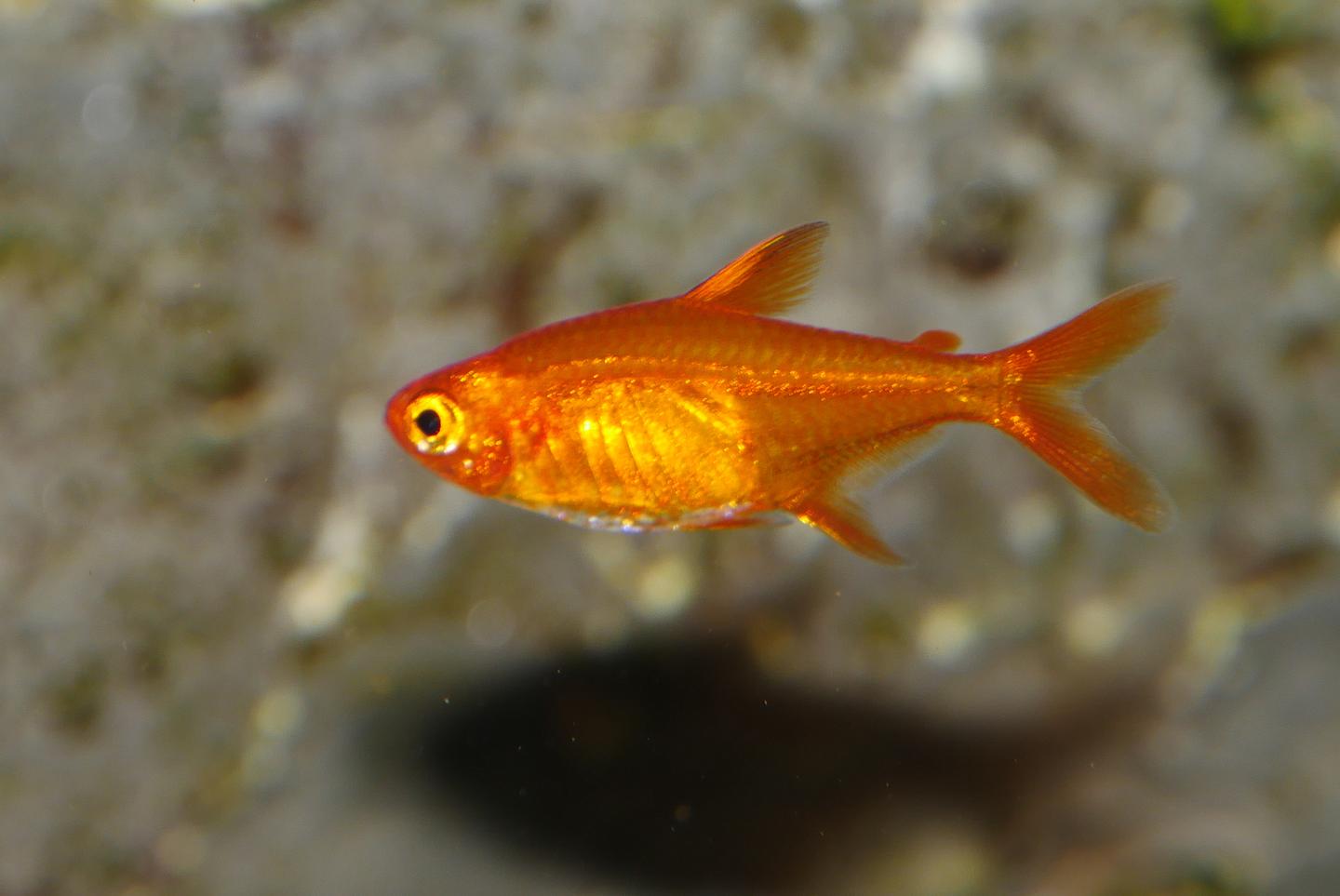
Ember tetras are very small Brazilian social fish, with a maximum recorded length of 2.0 cm excluding the tail. Keep them only in a fully cycled, stable aquarium. We recommend a group of at least 10 and about 45 litres with a 45 × 30 cm footprint rather than using a litres-per-fish formula.
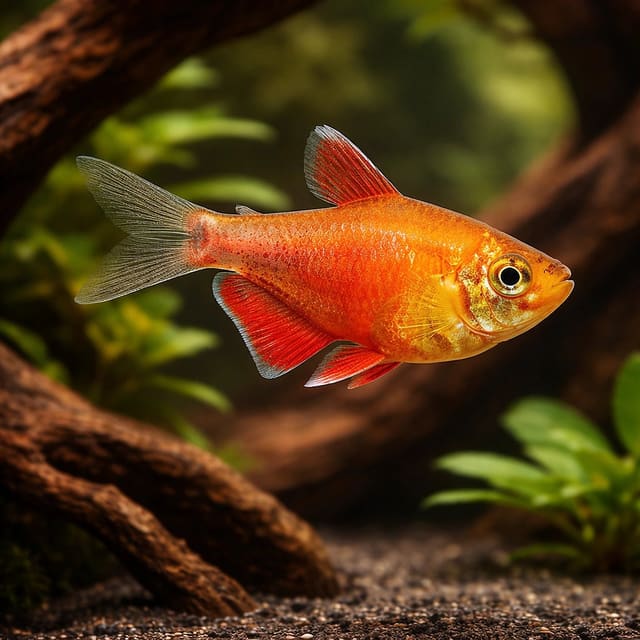
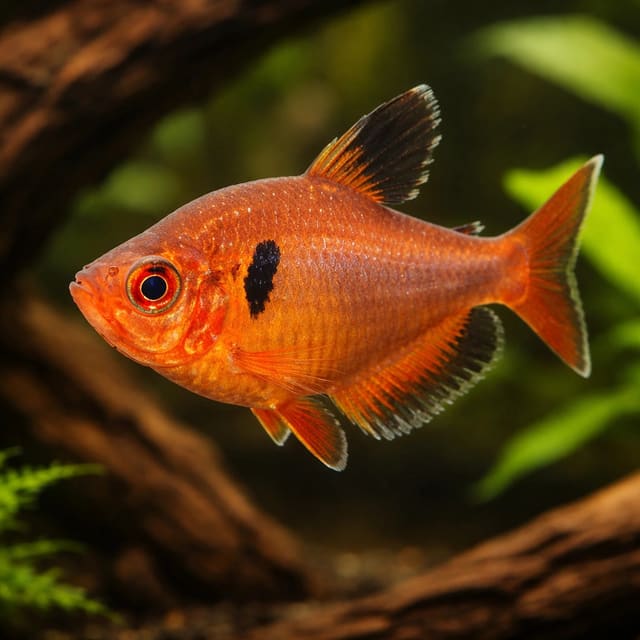
Ember Tetra (Hyphessobrycon amandae) is a very small, peaceful shoaling fish with translucent orange-gold colouring. It is a freshwater species from South America’s Araguaia River basin and is well suited to a carefully planned planted aquarium or calm community display. The accepted identity, distribution and recorded size are supported by the current FishBase species record.
This listing has two recurring dispatch grades. Select the preferred size from the product options and enter the number of individual fish required. Each quantity represents one Ember Tetra; it is not a pair or a concealed group pack. The group should be planned before ordering because this is a social tetra rather than a solitary feature fish.
Best suited to: a mature, heated and filtered freshwater aquarium with room for a proper shoal, a gentle current, shelter or planting and unobstructed swimming space. Existing residents should be similarly small and peaceful, and every Ember Tetra must be able to reach appropriately sized food.
| Accepted name | Hyphessobrycon amandae |
|---|---|
| Common name | Ember Tetra |
| Natural distribution | Araguaia River basin, Brazil |
| Dispatch sizes | 1.5–2 cm or 2–2.5 cm |
| Sale unit | One fish per selected quantity |
| Recorded maximum | 2 cm standard length |
| Aquarium volume | At least 45 litres for a small shoal |
| Social group | At least five; more is better, with ten recommended where capacity allows |
| Retailer temperature routine | 24–27°C |
| Broad tetra water guidance | pH 6.5–8.0 and 4–12 dGH |
| Water quality | Zero ammonia and zero nitrite |
| Feeding | Suitably small flake or granule, with small live or frozen foods; once daily |
| Care level | Intermediate |
The water figures need to be read in context. FishBase reports 24–28°C for this species from cited aquarium literature. The current OATA tetra and pencilfish care sheet gives 22–27°C, pH 6.5–8.0 and 4–12 dGH as broad guidance for captive-bred members of that wider group. The 24–27°C routine used here is the cautious overlap between the two published temperature ranges. It is a practical routine rather than a claim of a proven species optimum, and the stated pH and hardness values remain general tetra-group guidance.
If this is your first aquarium, establish it before ordering livestock. The first tropical tank guide covers preparation and cycling in a practical order.
UK livestock delivery depends on service availability, postcode coverage and the current terms. Check the delivery and Live Arrival Guarantee policy before arranging to receive an order.
Hyphessobrycon amandae is the accepted scientific name of the Ember Tetra. The Catalog of Fishes record treats it as a valid freshwater species in Acestrorhamphidae and places it in the Araguaia basin of Brazil, with Rio das Mortes recorded as the type locality. Those details establish identity and distribution; they do not supply an aquarium formula or a species-specific feeding and breeding method.
FishBase records a maximum of 2 cm standard length. Standard length is a scientific measurement that excludes the tail fin, so it should not be compared mechanically with a commercial dispatch grade whose measuring convention is not stated. It is most useful here as confirmation that the Ember Tetra is a genuinely small species and that adult size must be considered when selecting tank mates, food and equipment.
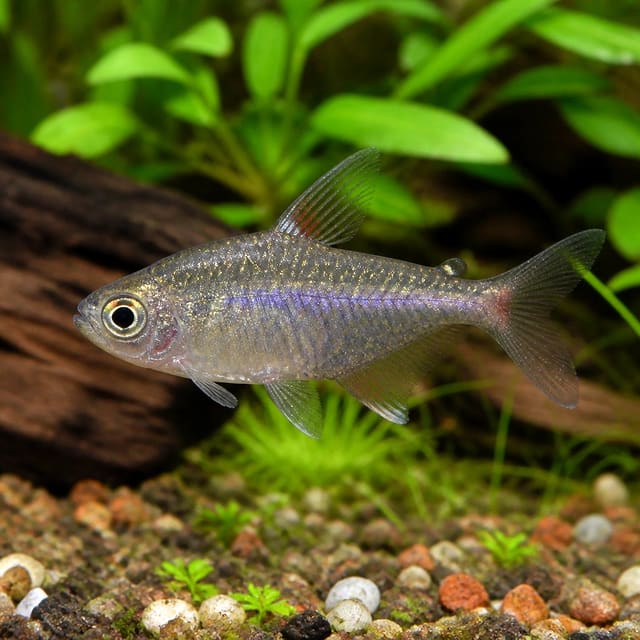
The fish represented in the gallery has a translucent orange-gold body. Its small size means a group forms the visual focus of the aquarium through repeated colour and coordinated movement rather than through the scale of one individual. Planting or other shelter can frame that display, while an open area allows the keeper to inspect the group and see whether all fish are feeding.
Live animals vary naturally. Colour shade, pattern intensity, proportions, size within the selected range and maturity can differ between individuals. A dispatch grade is therefore a bounded selection range rather than a promise that every fish will have precisely the same measurement or appearance.
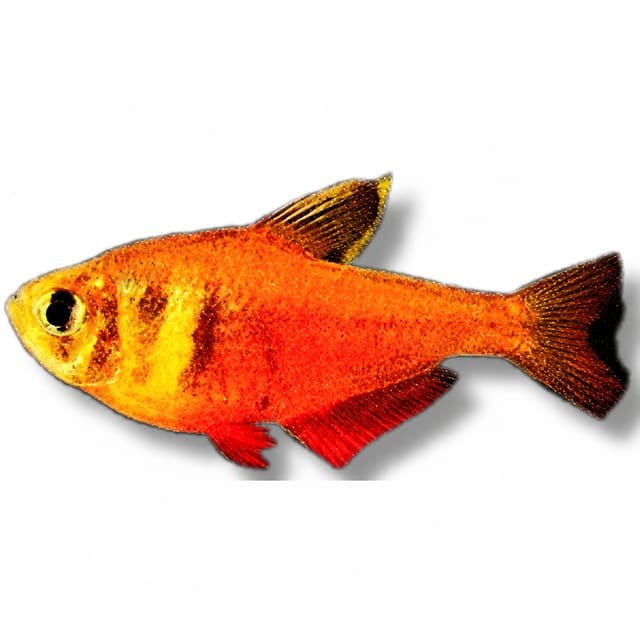
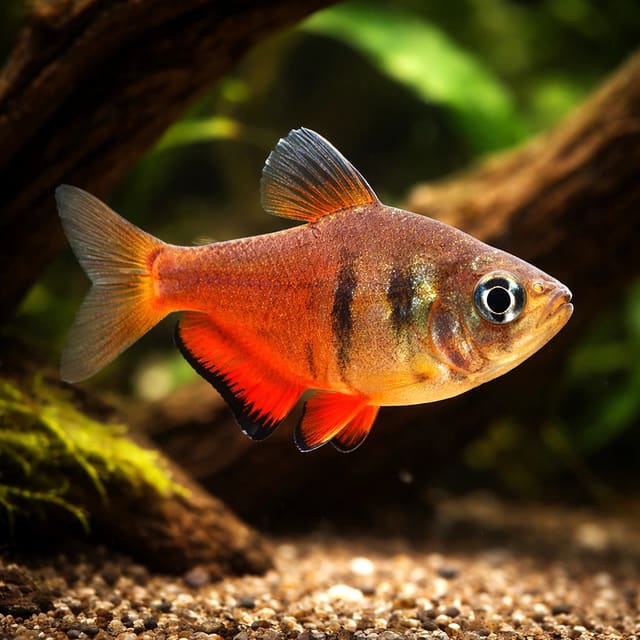
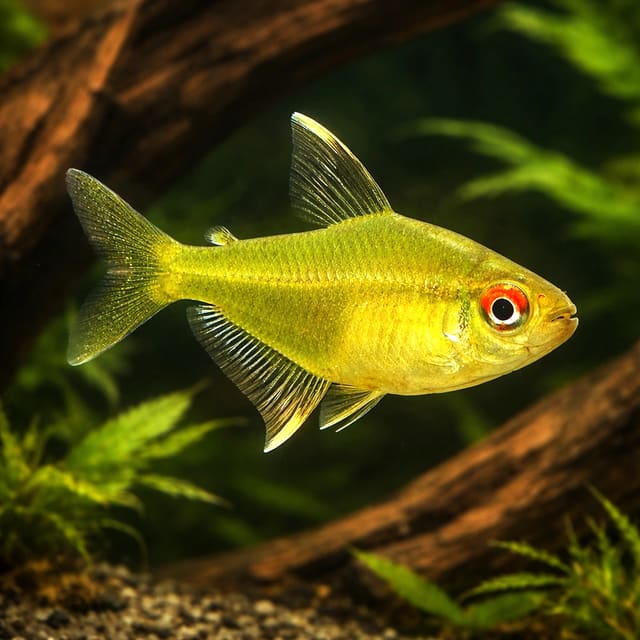
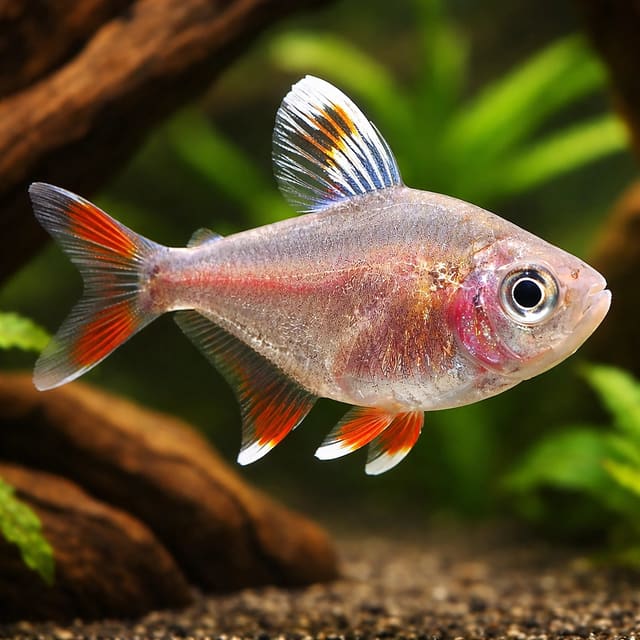
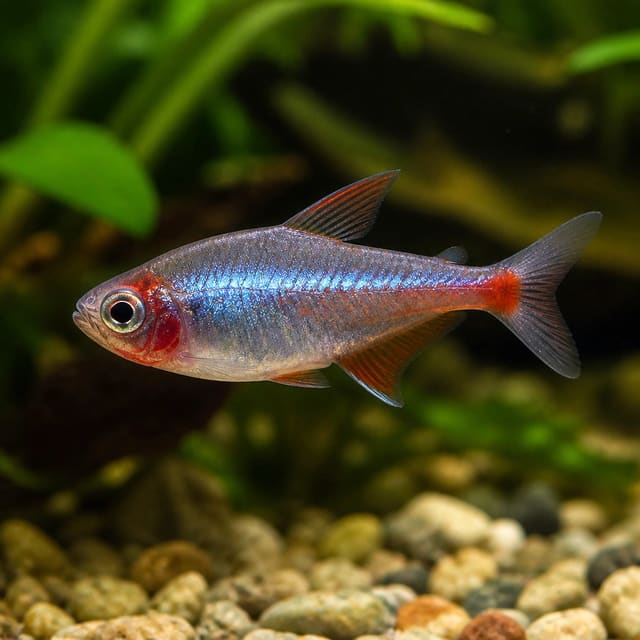
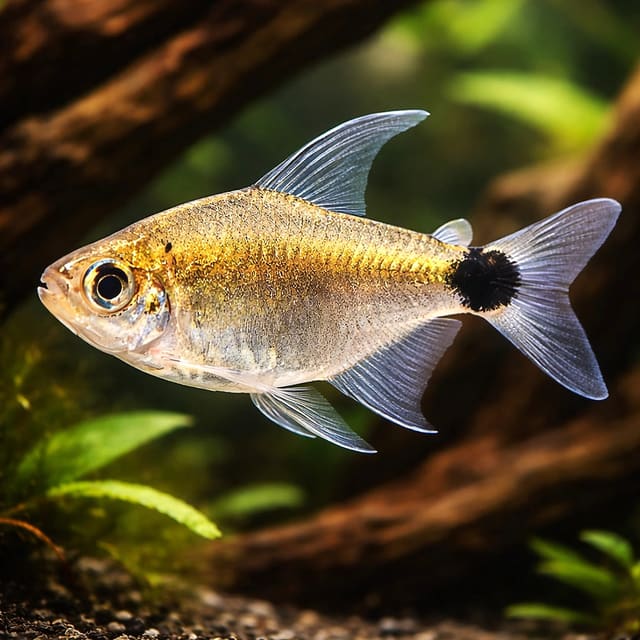
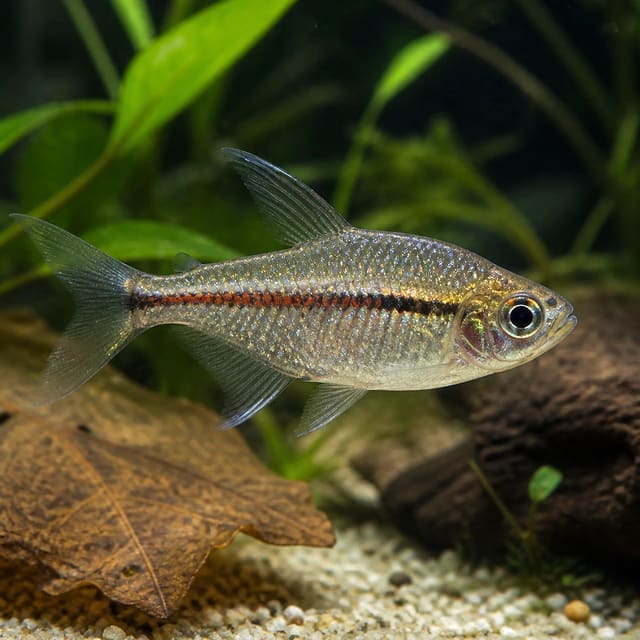
Gallery images have been digitally enhanced to improve image quality from source photographs. They show the listed fish type; natural colour, pattern, size and maturity can vary between live animals.
The 1.5–2 cm and 2–2.5 cm options are the recurring supplier grades available through this parent listing. Select according to the size you want dispatched, allowing for normal variation inside the chosen interval. Neither grade establishes a particular age, reproductive status or future development, and the larger option should not be interpreted as a different care type.
Think about the practical aquarium context rather than choosing from measurement alone. Check that filter inlets and other equipment are appropriate for small fish, that food particles are accessible, and that existing residents will not treat the new fish as prey. Both grades require the same considered approach to social grouping, water quality and feeding.
The quantity selector on this page counts individual Ember Tetras. A customer adding one receives one selected fish in the chosen grade. That format is useful when increasing a suitable established group by a specific number, but it also means anyone starting a new shoal must set the basket quantity deliberately. Separate six-fish and ten-fish offers may appear in the related-products area; they remain different products and do not change the sale unit here.
Before increasing an established group, review the whole aquarium rather than simply counting available litres. Include all current inhabitants, the space used by the layout, the filter’s established capacity and the feeding needs of small fish. A group that fits comfortably into an otherwise lightly stocked aquarium may not fit into another tank of the same nominal volume if that tank is already busy.
Measure the aquarium’s current water values and watch the existing fish at feeding time. This helps identify two common barriers before the order is placed: incompatible water requirements and residents that dominate every feeding opportunity. It is much easier to revise a stocking plan before livestock arrives than to discover afterwards that a very small tetra cannot use the available space or obtain food.
For a fuller species-focused preparation checklist, read the Ember Tetra care guide. Use it alongside the exact size and sale-unit information on this page rather than assuming that a care recommendation changes what one quantity supplies.
Plan at least 45 litres for a small shoal of smaller tetras, following current OATA guidance. Treat that as a starting floor rather than an automatic approval for every aquarium with the same figure on its box. The complete stocking level, usable swimming room, filtration and maintenance all affect whether the available capacity is suitable.
The RSPCA’s general aquarium guidance favours more than about 40 litres, highlights the greater stability of larger water volumes and advises planning around adult size, oxygen exchange and total stocking. This is broad welfare guidance rather than an Ember-specific calculation, but it is useful when comparing a well-proportioned aquarium with a very small container.
Install a filter suitable for the aquarium and allow biological filtration to become established before adding fish. Smaller tetras are advised a gentle current, so arrange the outlet to circulate the water without making the shoal work continually against a forceful stream. Preserve adequate water movement and oxygen exchange when adjusting the flow.
Use a heater and verify its result with an aquarium thermometer. The purpose is to provide stable tropical conditions rather than relying only on a control-dial setting. Equipment should be checked as part of ordinary aquarium care, particularly before livestock is due to arrive.
Provide a fitted cover, substrate, aquarium-safe shelter or planting and a clear area for swimming. A useful layout lets the group move between cover and open water without forcing it through narrow gaps or exposing it to unsuitable residents. It should also allow the keeper to see the fish clearly enough to check breathing, swimming and feeding.
A planted display is an attractive setting for the Ember Tetra’s warm colour, but dense decoration should remain manageable. Leave access for routine cleaning and avoid creating hidden areas where it becomes impossible to account for the group. The aim is a practical habitat with both structure and visibility, not the greatest possible quantity of décor.
The husbandry is accessible to an aquarist who tests water and plans stocking, but the fish’s small scale deserves attention. Food that suits a larger community fish may be too coarse, a seemingly modest tank mate may be capable of swallowing it, and abrupt changes affect the whole shoal. Those considerations are why this listing uses an intermediate care level despite the straightforward equipment required.
Maintain a practical routine of 24–27°C. This sits inside both published ranges: the species-level FishBase report and OATA’s broader captive-bred tetra and pencilfish guidance. It should be treated as a cautious day-to-day overlap, not as proof that one exact point within the range is uniquely ideal.
Check the actual water temperature with a thermometer and aim for consistency. If the reading differs unexpectedly from the normal routine, verify the equipment and restore stable conditions carefully rather than making repeated large adjustments.
For screening captive aquarium water, use OATA’s broad tetra-group figures of pH 6.5–8.0 and general hardness of 4–12 dGH. They are not a demonstrated species-specific optimum for H. amandae. A stable measured result within that broad guidance is more useful than repeatedly altering suitable water to pursue an arbitrary central number.
pH and hardness describe different properties and should not be treated as substitutes for water-quality tests. The aquarium water chemistry guide explains ammonia, nitrite, nitrate, pH and hardness, while the water matcher can help compare measured values with the guidance used for this listing. A numerical match remains only one part of a complete stocking decision.
Ammonia and nitrite should both be zero. Test weekly and test again after adding fish because the biological load has changed. Keep a simple record if possible; dated results make trends easier to recognise than occasional tests remembered only approximately.
If either compound is detected, postpone further livestock additions and review the aquarium’s biological filtration, stocking, feeding and maintenance. Water quality should be corrected using appropriate aquarium practice. Avoid assuming that unusual colour or behaviour establishes a disease when the measured environment has not yet been checked.
OATA recommends a weekly 25% partial water change using conditioned replacement water. Prepare the new water sensibly and avoid abrupt changes in temperature or chemistry. Observe the aquarium and test regularly, as a more heavily stocked system may require closer attention than a lightly stocked one.
When filter media needs cleaning, rinse it lightly in water removed from the aquarium. Avoid replacing all established biological media or carrying out an unnecessarily disruptive clean at once. Routine maintenance should remove accumulated waste while preserving the functioning filtration on which the fish depend.
Watch the group before feeding or disturbing the tank. Changes in breathing, swimming, position in the aquarium, colour or feeding access are reasons to check conditions, but no single visual sign identifies a cause by itself. Combining observation with measured water values gives a much more useful basis for deciding what needs attention.
The sound general match is a similarly small, peaceful fish whose temperature and water requirements overlap with the Ember Tetra’s. Compatibility should be assessed across the full aquarium, including the number required by each social species, the available swimming space and whether all inhabitants can feed without persistent competition.
Compare adult dimensions rather than relying on the size of a juvenile offered in a shop. Do not house Ember Tetras with fish large enough to eat them. A tank mate does not need to be marketed as a dedicated predator to swallow a very small tetra, so body size and mouth size are practical parts of the assessment.
A broadly peaceful species can still be unsuitable if an individual is persistently territorial, dominates the usable space or prevents the shoal from reaching food. Observe actual behaviour after introduction. Repeated pursuit, damaged fish, exclusion from feeding or continual displacement from normal swimming areas means the combination needs attention.
The reverse is also important: brief movement within a social group should not be interpreted without context. Consider whether the fish can settle, swim, shelter and feed normally across the day. Use the pattern of behaviour, water tests and physical condition together rather than drawing a conclusion from one short observation.
Collections and recommendation panels are browsing tools, not compatibility approvals. The tetra collection can help you compare current listings, but each animal’s adult size, temperament, social needs and water guidance must be checked independently before it is added to an Ember Tetra aquarium.
Offer a quality flake or granule in particles small enough for the fish to take easily. Flake can be reduced before feeding when necessary. OATA’s general tetra guidance also includes suitably small live or frozen foods such as daphnia, small bloodworm or tubifex. Use foods that are appropriately sourced, stored and prepared for aquarium use.
Feed once daily, offering only what the fish consume within a few minutes. This gives enough time to see whether each part of the group is feeding without leaving unnecessary food in the aquarium. Portions should be judged by observation rather than by a large fixed measure that ignores group size and the other fish present.
A product labelled for tropical fish can still be too coarse for an Ember Tetra. Watch whether the fish can take and swallow the particles. Repeated unsuccessful attempts or untouched large pieces indicate that the food should be reduced or replaced with a finer option, not that more of the same food should be added.
Community residents may reach food at different speeds. Distribute the controlled portion so that the Ember Tetras have access and observe smaller or quieter individuals. If another fish consumes everything first, adjust placement rather than increasing the total until leftovers accumulate.
A change in feeding should be considered alongside water tests, breathing, swimming and tank-mate behaviour. Check whether the food is physically suitable and whether the fish can reach it before making assumptions about preference or illness. This measured approach helps separate a simple feeding-access problem from a wider aquarium issue.
Have the aquarium ready before delivery. Heating and filtration should already be operating, the water should have been tested and the planned group and tank mates should be settled in the stocking plan. Avoid leaving essential preparation until the transport bag is in front of the aquarium.
This sequence follows current OATA guidance. Keep movements calm and deliberate, and avoid unnecessary chasing or repeated handling. Once the fish have been released, leave them enough time to orient themselves without immediately rearranging the aquarium around them.
Transport is a change of surroundings, so assess the fish across several indicators rather than expecting an exact colour or swimming pattern immediately. Watch breathing, use of the aquarium, access to shelter, interactions with residents and ability to reach suitably small food.
Continue checking the aquarium during the first week because adding livestock changes its load. Keep normal conditions steady unless a measured problem calls for action. Changing temperature, chemistry, décor, lighting and food all at once makes it harder to understand what the fish are responding to.
Offer a restrained portion of fine food and watch the Ember Tetras themselves, not only the aquarium as a whole. If established residents take the food first, use more suitable placement while retaining the normal total portion. Remove obvious leftovers and avoid compensating for competition by overfeeding the system.
Review the complete setup in a sensible order. Confirm that the social plan is appropriate, then consider shelter, usable swimming room, current and interactions with other fish. Test the water rather than assuming hiding has one simple cause. If another resident repeatedly pursues the group or is capable of eating it, compatibility takes priority over cosmetic changes to the layout.
Adding more fish is not an automatic response. First decide whether the aquarium has genuine capacity for them. Where the tank is already fully stocked, correct the underlying space or compatibility problem rather than increasing the biological load.
Natural colour differs between individuals, and appearance can vary with maturity and recent transport. Consider colour alongside breathing, swimming, feeding and measured water quality. The representative gallery helps identify the listed fish type but does not set one identical shade that every live animal must display.
Check particle size and feeding access. Watch whether the Ember Tetras attempt to take the food, whether larger residents reach it first and whether uneaten particles are too coarse. Then check the aquarium’s measured conditions and observe breathing and swimming. Adding more food without finding the cause can create an additional water-quality problem.
Provide calmer usable areas by redirecting or diffusing an overly forceful filter outlet while retaining effective filtration and adequate water movement. Watch the fish across the aquarium rather than judging the outlet in isolation. The goal is a gentle current the group can use comfortably, not stagnant water or filtration that has been switched off.
Identify the animal responsible and consider its adult size, temperament, territory and role in feeding competition. Check whether the affected fish can still use the aquarium and obtain food. A resident that can swallow an Ember Tetra or continually prevents normal access to space and food is not made suitable simply by adding another ornament.
Observe that individual from more than one angle if possible and compare its breathing and swimming with the group. Confirm that it can reach correctly sized food and is not being displaced. Test the aquarium water before reaching for a diagnosis. Where signs suggest illness rather than an environmental or access problem, seek appropriately qualified aquatic-health advice instead of applying an unsupported species-specific treatment.
Pause plans to add more livestock and review feeding, maintenance and the established filter’s capacity for the new load. Repeat testing so that the response is based on a measured pattern rather than one assumption. Address the aquarium-wide cause and continue monitoring the fish while safe conditions are restored.
Care ranges are useful screening tools, not a complete welfare assessment. A tank may match the stated temperature and chemistry yet still be too heavily stocked, poorly arranged for a shoal or occupied by an unsuitable fish. Conversely, an attractive planted display is not ready if its filtration is immature. Judge the numbers, equipment, livestock and actual behaviour together.
OATA’s broad tetra guidance describes tetras as egg scatterers and discusses a dedicated breeding setup and specialist food for fry. That is useful group-level background, but it is not an Ember Tetra breeding study. It does not establish a species-specific egg count, spawning time, hatch time, sexing method, fry-growth schedule or probability of success.
The two size options on this listing are ordinary dispatch grades. They do not identify a breeding pair or provide any reproductive promise. Keepers intending to breed the species should research a dedicated method before beginning rather than relying on the ordinary display aquarium for predictable results.
Our stock records control the animal, dispatch grades and sale unit offered here. Public scientific records support accepted identity, distribution, recorded standard length and the reported species temperature range. Current OATA material supplies broad tetra husbandry on aquarium setup, social grouping, water values, feeding, compatibility, maintenance and acclimation; RSPCA material supplies general aquarium-welfare context.
Where guidance applies to tetras as a wider group rather than specifically to Hyphessobrycon amandae, that boundary is kept explicit. This avoids turning practical group care into a claimed species optimum while still giving the aquarist a clear basis for preparing and assessing an aquarium.
No reviews for this item yet. Bought one? Honest reviews only, good or bad.
What customers say about ordering from us
I have a small group of long finned mountain minnows. So was delighted to be able to order ten of this variety to increase the genetics in my tank . The ones I recieved are healthy but it’s to early to give a verdict on wether they are of a long finned type since they are small currently.
Gordon Walker · 23 Sept 2026
100% success travel and "installation". Pleased with quality of purchase. The Siamese fighter a bit "shy" so have not yet seen him at his best yet but looking good. Happy customer. GG
George E Garratt · 21 Sept 2026
Reviews of our shop, collected by Judge.me, an independent third-party review collector. Newest first.













Social needs and group planning
OATA advises keeping shoaling tetras in groups of at least five and notes that smaller groups may be stressed; more is better. For Ember Tetras, we recommend aiming for ten where the aquarium’s volume, filtration and overall stocking can support that number. Ten is a retailer recommendation, not OATA’s stated minimum and not permission to overstock a small or already crowded tank.
Count compatible Ember Tetras already present when planning an addition. An individual bought from this page may join an established group, whereas a new aquarium needs the intended social number planned from the beginning. The aquarium and filter should be prepared for the complete stocking change rather than for the first fish alone.
Social numbers and physical capacity must be considered together. Extra companions cannot correct unsuitable water, inadequate swimming room or a predatory tank mate. Equally, spare aquarium volume does not turn a solitary Ember Tetra into an appropriate long-term plan. A sound setup provides both the social group and the environmental capacity it needs.
Build the group responsibly: begin with the supported welfare floor, prefer more where practical, and stop before the complete aquarium becomes overstocked. If the desired group does not fit, revise the stocking plan rather than squeezing the fish into the available space.