By Tropical Fish Co Editorial Team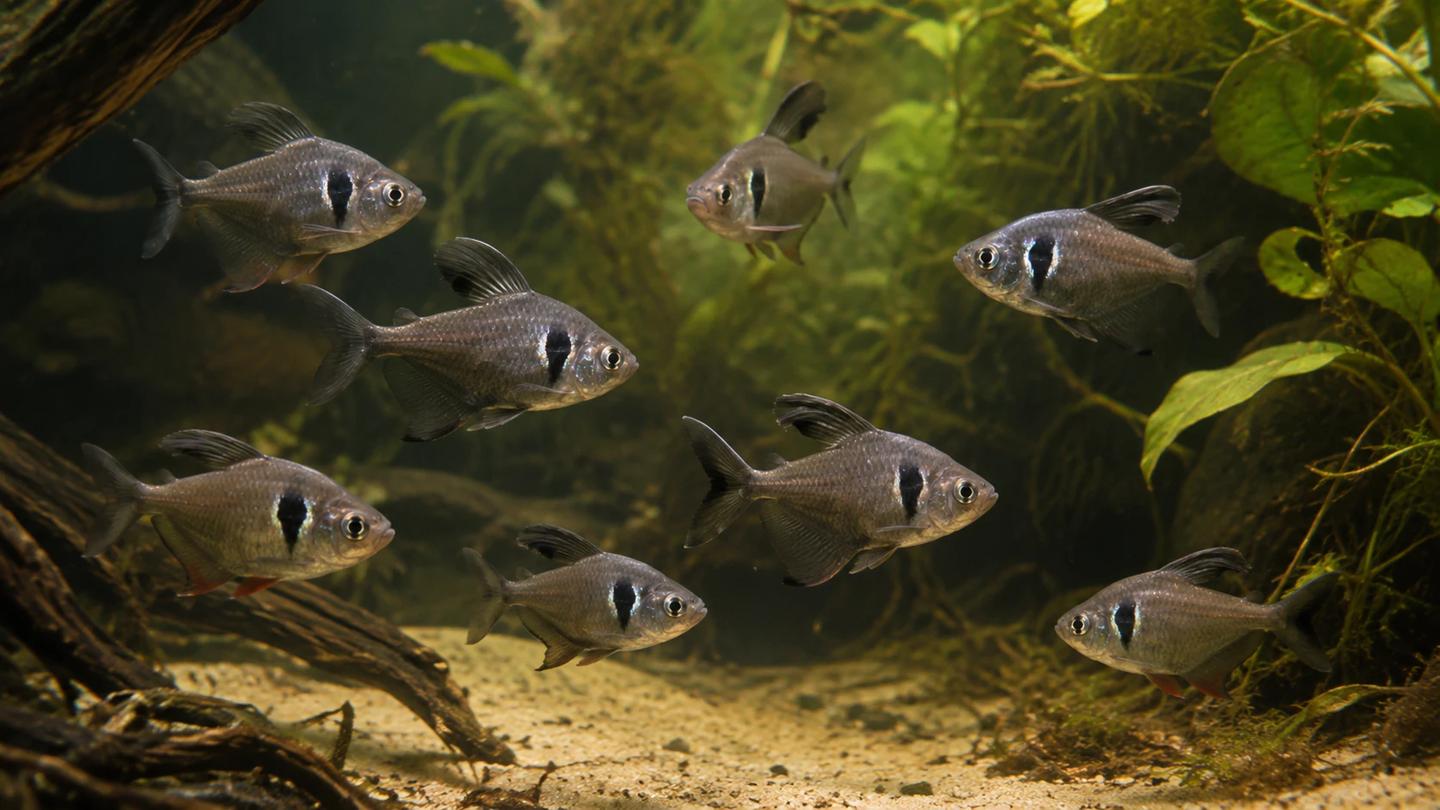
The direct answer
The black phantom tetra is Megalamphodus megalopterus, a small social fish from the upper Paraguay and Guaporé basins of Bolivia and Brazil. FishBase records 3.6 cm maximum standard length, which excludes the tail fin, while specialist aquarium guidance recommends an 80 × 30 cm base and a group of 8–10 where the full stocking plan can support it [1] [3] [4] [7].
For a UK home aquarium, the useful purchase screen is not “easy tetra” or “hard-water safe.” It is a mature filtered tank with horizontal swimming room, cover around an open lane, a supported social group, measured water and a separation plan if male displays become persistent pursuit.
Aquarium books have long used Hyphessobrycon megalopterus. A 2024 phylogenomic study supported revalidating Megalamphodus, and the current Catalog of Fishes now accepts Megalamphodus megalopterus in Acestrorhamphidae. The older name remains a useful search synonym, but it should not be presented as the current accepted combination. [2] [1]
Is it really a black phantom tetra?
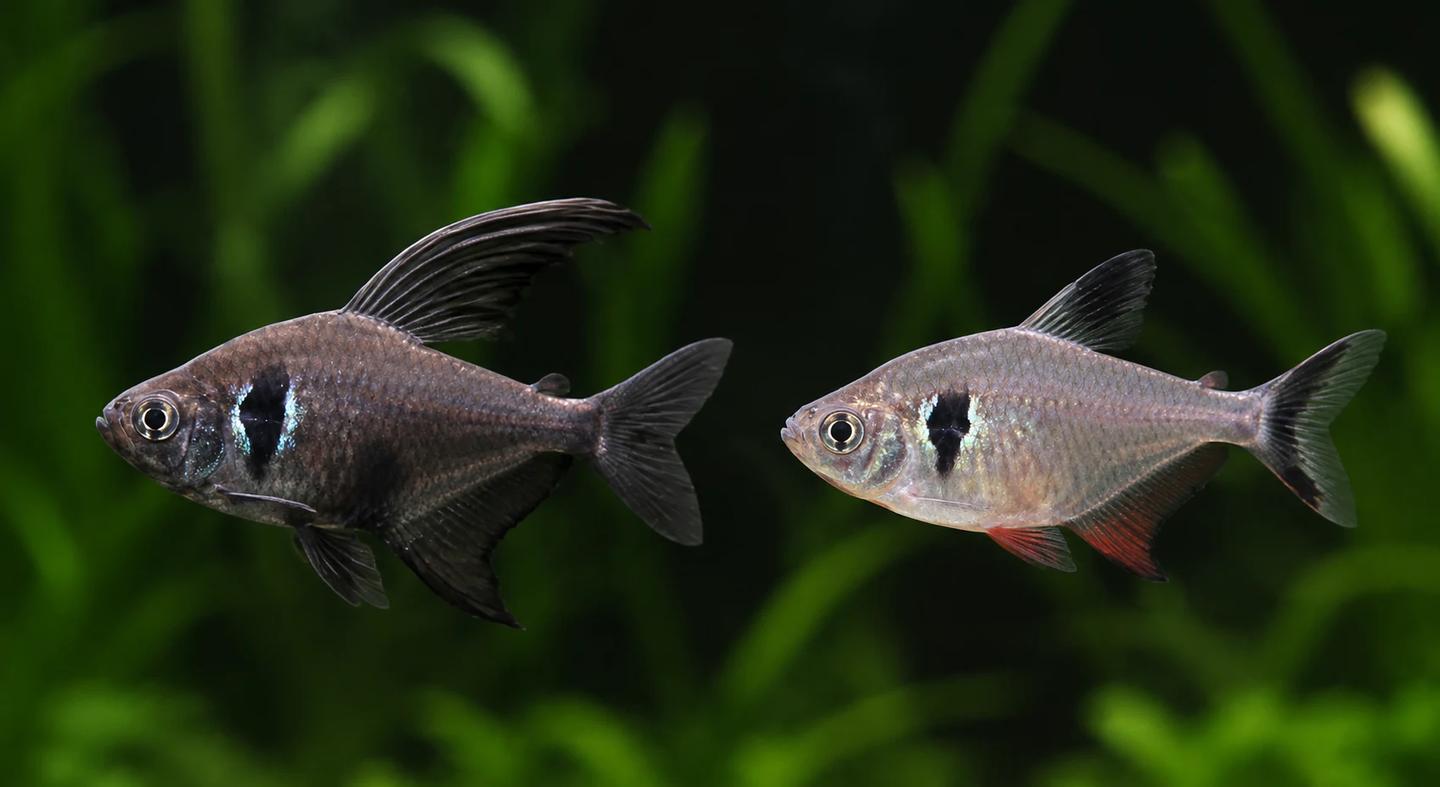
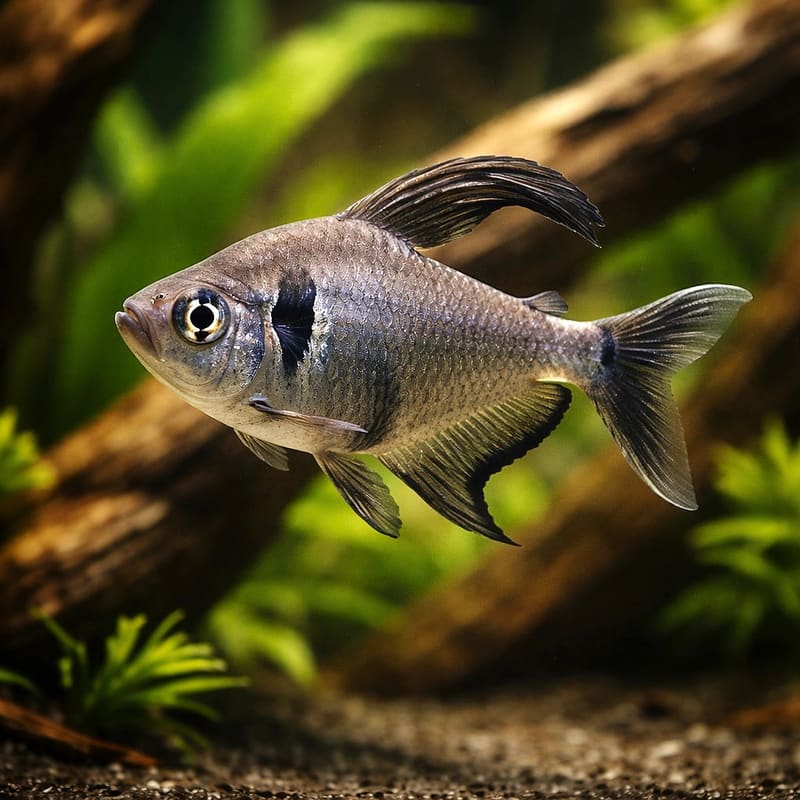
Useful visual clues include a deep, laterally compressed silvery-grey body; a large dark vertical shoulder patch just behind the gill cover; and dark dorsal and anal fins that become especially conspicuous in mature males. Females are usually paler and deeper-bodied with redder tones in the pelvic, anal and adipose fins [7].
Use several clues together:
| Look at | Useful black-phantom clue | What it cannot prove |
|---|---|---|
| Shoulder | Large dark vertical patch with a pale or iridescent edge | Exact origin, age or health |
| Body | Deep, compressed and smoky silver-grey rather than a bright stripe | Sex from colour alone |
| Adult male fins | Enlarged, dark dorsal, pelvic and anal fins | That every long-finned fish is mature or unstressed |
| Adult female fins | Shorter fins, often with reddish pelvic, anal and adipose tones | Reliable sexing of every juvenile |
| Social posture | Males may spread fins and present side-on | That repeated chasing is automatically harmless |
The red phantom tetra is a separate species, and “black skirt tetra” and “black neon tetra” are different trade identities. Do not substitute one because the common name contains “black” or “phantom.” Supplier identity, the scientific name and the fish's combined features should agree.
Black phantom tetra size: what 3.6 cm means
FishBase records 3.6 cm standard length for male or unsexed fish [3]. Standard length is measured to the end of the caudal peduncle, excluding the tail fin, so the whole fish can look slightly longer nose to tail tip [4].
That figure corrects two common mistakes. It is not the same as the fish's shipping size, and it is not evidence that every specimen will reach exactly 3.6 cm. Plan for adult dimensions before purchase, while checking the live product listing for the size and sale unit currently offered.
Tank Volume Calculator
Enter length, width, and height to get your real water volume in litres.
Open tool →Tank size and layout
FishBase carries a broad aquarium note of a 60 cm minimum tank length, while Seriously Fish recommends an 80 × 30 cm base for this species [3] [7]. This guide uses the more cautious 80 × 30 cm footprint as the starting screen for a proper group.
Footprint matters because litres do not reveal the length of the swimming lane, the space occupied by wood and plants or the territories and feeding zones created by other fish. The RSPCA also advises choosing as large an aquarium as practical and notes that wider tanks generally provide more gas-exchange surface than tall tanks of the same nominal volume [9].
A practical layout provides:
- cover from plants, roots or suitable décor around the rear and sides;
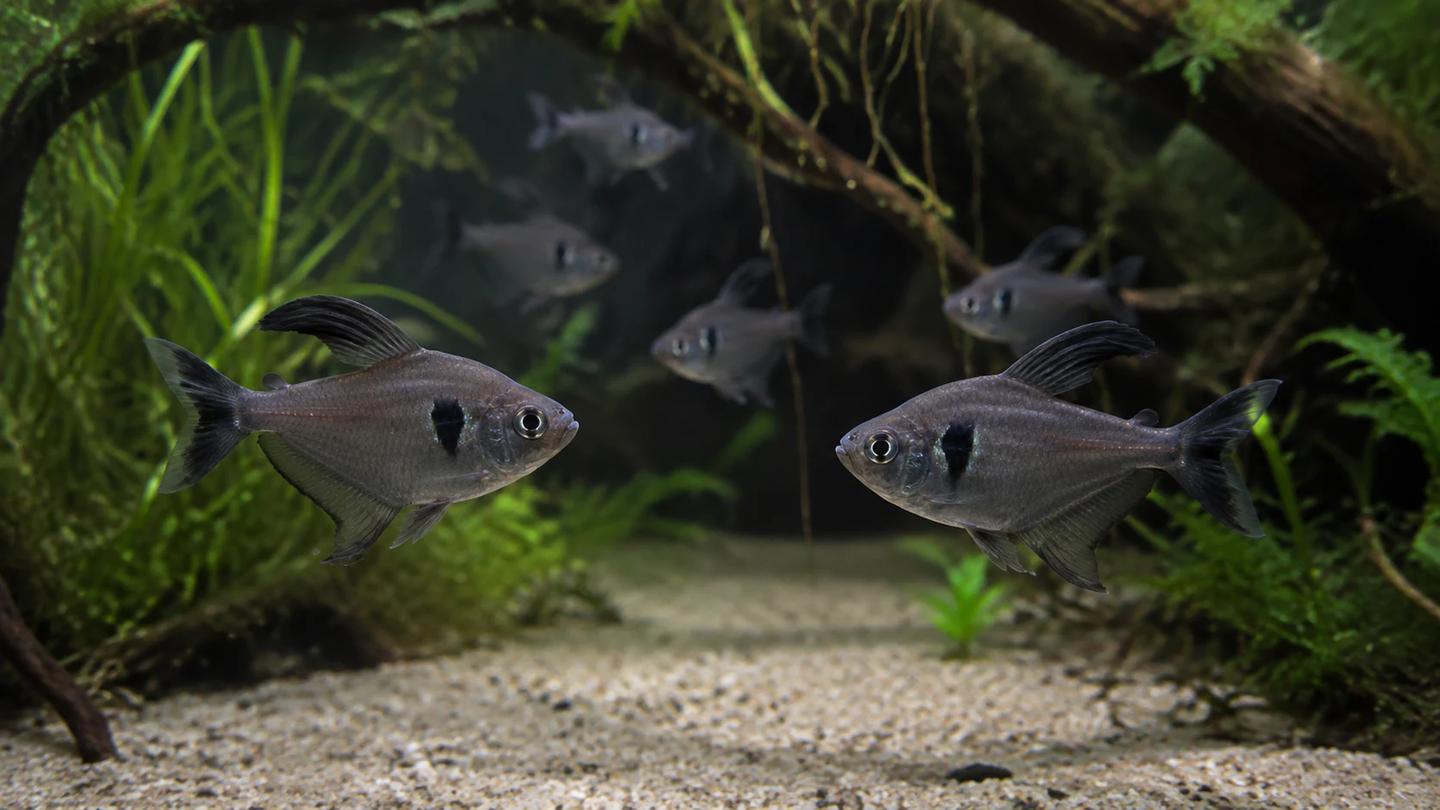
- an open middle lane for group swimming and display;
- a mature filter sized for the real stock and feeding load;
- a thermostatic heater plus a separate thermometer;
- circulation without turning the entire aquarium into a fast-current channel;
- a secure top and a cycled backup space for separation when needed.
The gallery's behaviour visual demonstrates cover around an open lane. It is not a stocking calculator, a guarantee of compatibility or evidence that one décor recipe suits every aquarium.
Group size: five, eight or ten?
FishBase's compiled aquarium note and OATA's UK tetra guidance both use a broad minimum of five [3] [8]. Specialist species guidance recommends 8–10, which is our more cautious planning target where the tank and total stock can genuinely support it [7].
The numbers answer different questions:
- Five is a broad floor recorded in group-level sources.
- Eight to ten is a stronger species-specific starting target.
- More is not automatically better if it creates crowding, unstable water or feeding competition.
The old advice to force a fixed 1:2 male-to-female ratio was not supported strongly enough to keep. A mixed group may spread social attention, but retailers cannot always sex juveniles reliably and no ratio guarantees peace. Use behaviour and welfare outcomes, not a formula, to decide whether the arrangement is working.
Male vs female and display behaviour
Mature males tend to be darker and carry enlarged black pelvic, dorsal and anal fins. Mature females are deeper-bodied and often show redder pelvic, anal and adipose fins [7]. Those are comparative clues, not a promise that every young fish can be accurately sexed.
Males may establish temporary positions and present their fins side-on. This is one of the species' most recognisable behaviours, but “ritual display” must not be translated into “never causes injury.” Watch what happens after the display:
| Observation | Usually lower concern | Act when |
|---|---|---|
| Fin spreading | Brief, fish separate and resume normal activity | One fish cannot disengage |
| Chasing | Short and intermittent | Pursuit is repeated or tank-wide |
| Feeding | Every fish reaches suitable food | A fish is blocked or losing condition |
| Fins and scales | Intact after interactions | Tearing, wounds or repeated contact appears |
| Space use | Fish use open water and cover by choice | One fish hides continuously or is excluded |
Check water quality, recent changes, layout, group structure, tank mates and feeding access together. If injury or persistent exclusion continues, separate the fish into suitable cycled accommodation rather than waiting for a “peaceful species” label to become true.
Water parameters in a UK aquarium
Published sources describe different scopes:
| Source and scope | Temperature | pH | General hardness |
|---|---|---|---|
| FishBase species compilation | 22–28°C | 6.0–7.5 | lower limit not recorded; upper value 18 dH |
| OATA captive-bred tetra group | 22–27°C | 6.5–8.0 | 4–12 dGH |
| Seriously Fish species guidance | 20–28°C | 5.0–7.0 | 1–12 dGH |
These are evidence boundaries, not instructions to swing between extremes. Use a stable setting in the overlap that suits the exact fish and tank mates, keep ammonia and nitrite at zero, and control nitrate through mature filtration and maintenance. OATA explicitly says its figures are general group guidance and that species-specific needs and the retailer's holding conditions should also be checked [8].
The old page promised that black phantoms tolerate the “full UK range.” That was unsafe. The Drinking Water Inspectorate says supply hardness varies with local geology and that accurate local information should come from the water company [10]. Test the source and aquarium water yourself, ask what water the seller uses, and avoid abrupt attempts to chase an internet number.
Water Parameter Matcher
Enter your tap water readings to see if this species will thrive.
Open tool →Tank mates: use a screen, not a safe list
Black phantom tetras are generally considered peaceful, but no named pairing is automatically safe. Screen the complete adult plan:
| Check | Better sign | Stop or rethink when |
|---|---|---|
| Adult size | Companions cannot swallow or overpower the tetra | A predator can fit it in its mouth |
| Water overlap | One stable setting suits every species | A fish sits at the edge of its evidence range |
| Space | Swimming, cover and feeding zones remain usable | The tank is full before behaviour is considered |
| Feeding | Every fish reaches appropriate food | Shy or lower fish repeatedly miss meals |
| Behaviour | Displays end without injury or exclusion | Pursuit, torn fins, hiding or blocked access persists |
| Contingency | A cycled separation option is ready | There is nowhere safe for a targeted fish |
Calm, similarly sized community fish may pass that screen in a sufficiently large aquarium. A betta pairing remains individual and risky: the betta may react to movement or fins, while tetra displays may disturb the betta. Small shrimp and shrimplets are potential prey for an omnivorous fish; a fish-free shrimp tank is safer when breeding or maximum survival is the priority.
Use our Lemon Tetra guide, Cardinal Tetra guide and Ember Tetra guide to compare evidence for each candidate rather than treating those names as approvals.
Feeding without miracle claims
FishBase records worms, small insects and crustaceans in the natural diet [3]. In an aquarium, use appropriately sized complete dry food as a dependable base and rotate suitable frozen or live foods for variety. Offer portions the group can consume while you watch, remove leftovers and make sure less assertive fish eat.
No food guarantees darker colour, successful breeding or a fixed lifespan. Colour changes with genetics, age, sex, condition, background, light, social setting and stress. A sudden change is a reason to check the whole aquarium, not a diagnosis by itself.
Lifespan: answer the search without inventing a number
This should be treated as a multi-year commitment, but the selected authoritative sources did not establish one dependable exact captive lifespan for every black phantom tetra. Repeating “five years” as a certainty would turn a weak aquarium estimate into a promise.
Age at purchase, genetic background, transport history, disease, social stress, water quality and long-term husbandry all affect outcome. Plan the cost and care for years, and do not use a lifespan number to compare species as if it were guaranteed.
Breeding: what the evidence supports
FishBase records separate sexes, external fertilisation, open-water or substrate egg scattering and no parental care [5]. Specialist guidance similarly describes an egg-scattering free spawner [7].
The safe conclusions are modest:
- spawning behaviour does not mean eggs or fry will survive;
- adults and tank mates may consume eggs or tiny fry;
- a separate mature setup is more controllable than a community aquarium;
- juveniles should not be sold as a guaranteed pair from uncertain visual sexing;
- no clutch size, hatch time or saleable result should be promised from a generic recipe.
If breeding is the goal, research the current source stock and seek experienced specialist guidance before adjusting water. Do not make sudden chemistry changes merely to copy a published limit.
When something looks wrong
Pale colour, hiding, clamped fins, surface breathing, damaged fins and refusal to feed are signs to investigate, not diagnoses. Start with measured temperature, ammonia, nitrite, nitrate, pH, oxygenation, recent maintenance, new animals and feeding access. Observe whether one fish, one species or the whole aquarium is affected.
The MSD Veterinary Manual emphasises a complete history, water-quality assessment, quarantine and diagnostic testing; it discourages treatment without a diagnosis [11]. This page therefore does not prescribe salt, heat or medication from a symptom table. Separate when necessary using suitable equipment, and seek a fish-experienced veterinary professional for severe, persistent or spreading signs.
Use our nitrogen-cycle guide before adding livestock and our new-fish acclimation guide for the underlying arrival decisions. Follow the current seller's instructions when they are more specific to the shipment; do not combine incompatible acclimation routines.
Buying black phantom tetras without freezing stock claims
Before purchase, confirm the scientific and trade names, current sale size, sale unit, seller's water, group availability and arrival instructions. Look for fish that swim normally, hold their fins naturally, breathe without obvious distress and can reach food. One attractive image cannot prove the condition of another fish.
Check the current Black Phantom Tetra listing
The product page owns today's size, price, sale unit and checkout availability. This guide owns long-term identity and care, so it never promises that stock is available before the live listing confirms it.
If the product is unavailable, do not reduce the group below the welfare plan merely to buy immediately. Wait for enough correctly identified fish or choose a different species that fits the aquarium you actually have.
Conservation and provenance
The IUCN assessment lists the species as Least Concern under the then-used name Hyphessobrycon megalopterus; the fish was assessed in 2021 and the record was published in 2023 [6]. “Least Concern” does not prove that an individual shop fish is captive bred, responsibly sourced or healthy. Ask the retailer about the actual stock rather than inferring provenance from conservation category.
Never release aquarium animals or water into the wild. OATA notes that release is illegal and may harm native wildlife as well as the released animal [8].
How this guide was checked
Current identity and distribution were checked against the Catalog of Fishes and the 2024 phylogenomic revision. FishBase supplies the compiled size, environmental, diet and reproductive records, with its standard-length definition kept explicit. OATA, the RSPCA and the Drinking Water Inspectorate provide UK care, welfare and source-water context. Seriously Fish is used as specialist secondary husbandry guidance, not as a substitute for the current taxonomy.
Search Console showed that this page was indexed and already receiving UK-mobile impressions for the species, size, lifespan, sex, aggression, care and tank-size questions, but it recorded no clicks in the latest equal window. The repair therefore gives those questions accurate direct answers, removes unsupported guarantees and adds three distinct identity-led images. It is not an indexing fix, and no ranking or click improvement is claimed before deployment, recrawl and an equal-window comparison.
Corrections, feedback forms and email are never counted as leads or ecommerce conversions. Add-to-cart and begin-checkout are diagnostic ecommerce steps; purchase and revenue are the final commercial outcomes.
Continue planning
- Browse the current tetra range only after checking the evidence for each candidate.
- Use the planted-tank fish hub for layout-compatible ideas, not as an automatic compatibility list.
- Compare the Lemon Tetra guide, Cardinal Tetra guide and Ember Tetra guide before choosing by colour alone.
- Check the live Black Phantom Tetra product listing for today's size, sale unit and availability; this guide intentionally does not freeze those commercial facts.