Moderate
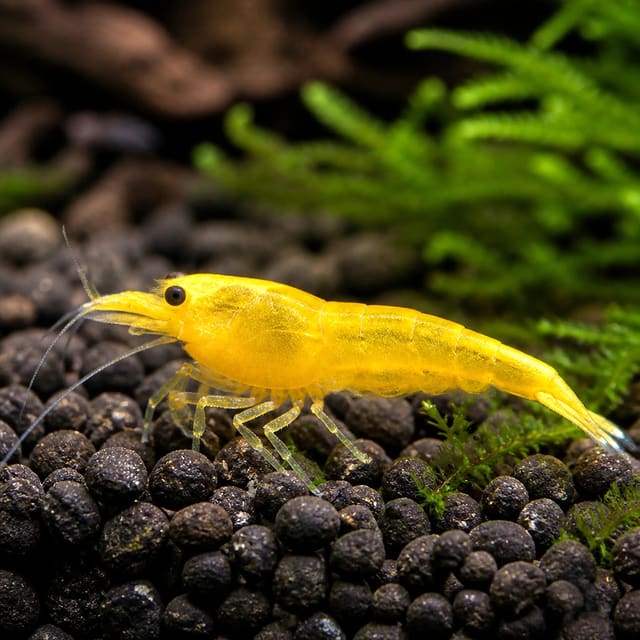
Yellow Cherry Shrimp (Neocaridina davidi)
17–27°C · pH 6.5–8
£11.99

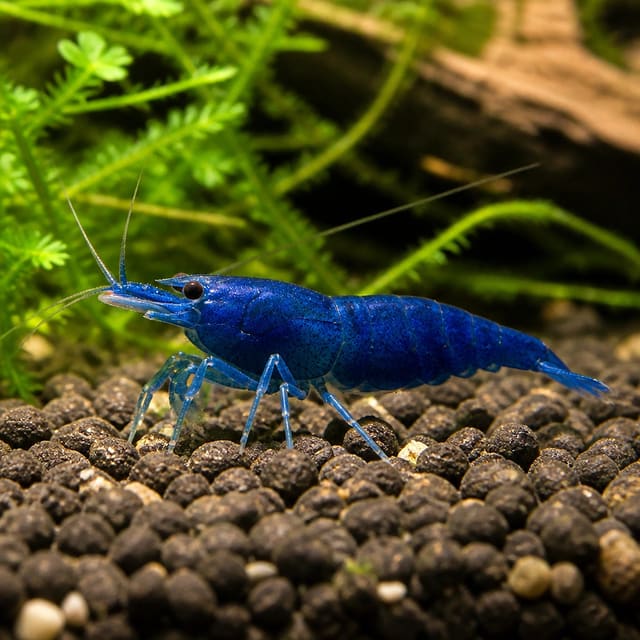
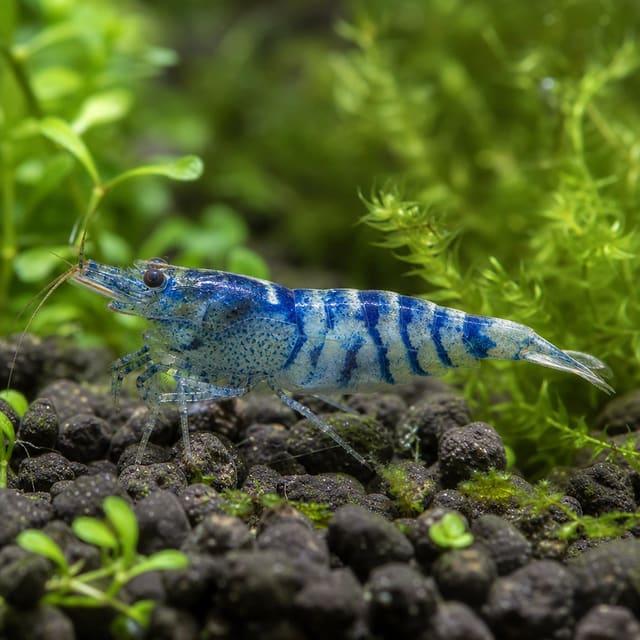
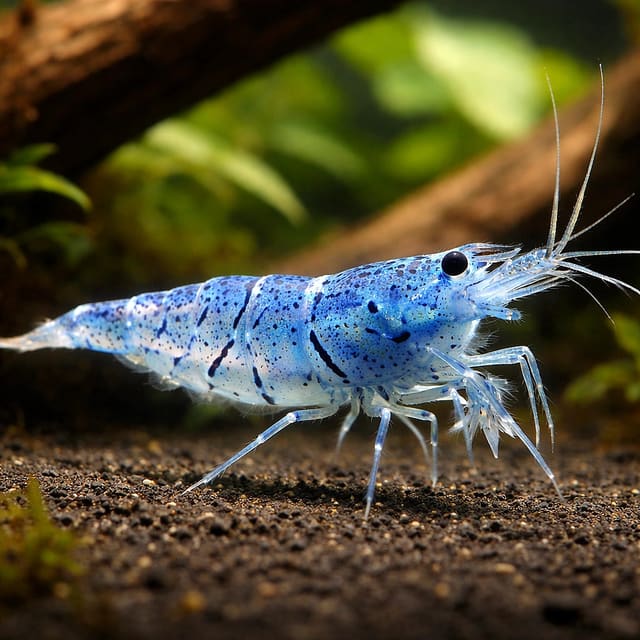
Blue Cherry Shrimp are a blue colour line of Neocaridina davidi: peaceful, easy-to-keep grazers about 3 cm long that breed readily in a mature, planted tank. Sold as individual shrimp, sexes not chosen; keep five or more, one colour line per tank, with stable water and no copper.
Adult size is the maximum length this species reaches at full maturity (scientific sources). The livestock you receive will be younger and smaller. Product-photo provenance and any image-specific limitations are stated on the listing.
Neocaridina davidi
Lives in groups: kept together they stay settled, active and show their best colour.
Blue Cherry Shrimp are a blue colour line of Neocaridina davidi: peaceful, easy-to-keep grazers about 3 cm long that breed readily in a mature, planted tank. Sold as individual shrimp, sexes not chosen; keep five or more, one colour line per tank, with stable water and no copper.
Adult size is the maximum length this species reaches at full maturity (scientific sources). The livestock you receive will be younger and smaller. Product-photo provenance and any image-specific limitations are stated on the listing.
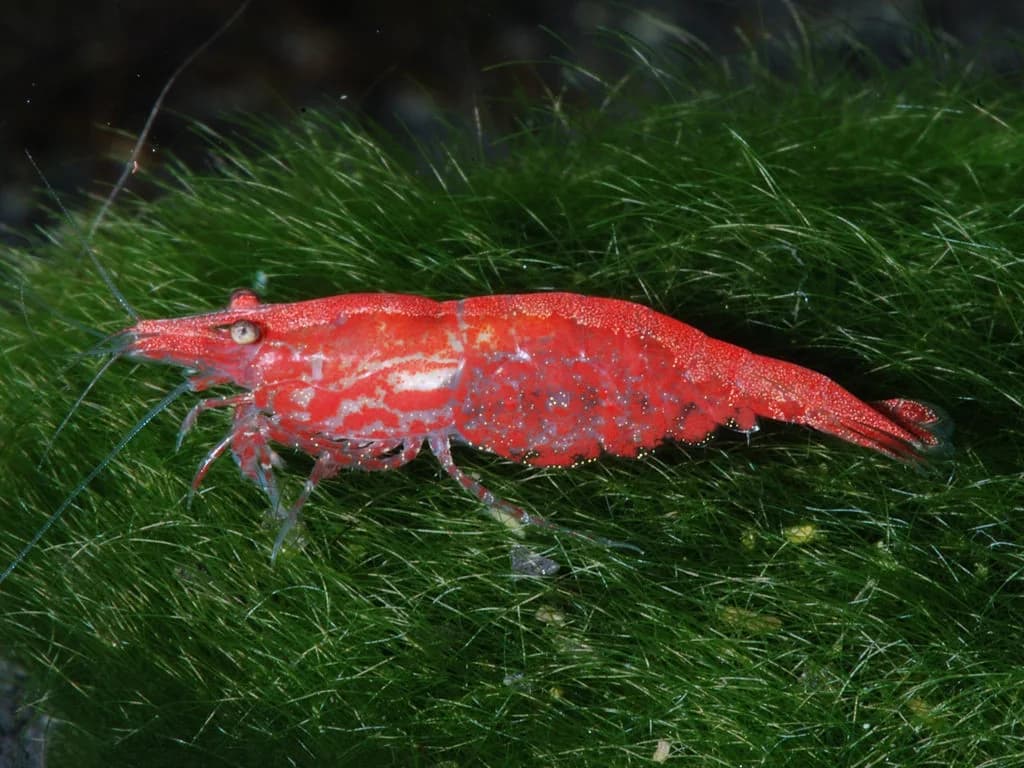
Use a mature, filtered aquarium and measured water—not a shrimp-per-litre rule. Tropical Fish Co uses 20 litres as a cautious starting policy for a small Cherry Shrimp group, above OATA's general 10-litre screen for small shrimp. Provide established grazing surfaces, cover and a protected filter inlet. No fish is guaranteed shrimplet-safe, and breeding should never be promised.
Maintain these water conditions for optimal health and vibrant colors
The Blue Cherry Shrimp is a blue colour line of Neocaridina davidi, the small freshwater shrimp that most keepers simply call the cherry shrimp. That name comes from the red form, which became so popular that "cherry" stuck to the whole species whatever its colour. Take away the selective breeding and you are left with a mottled, greenish-brown animal from the fresh waters of East Asia. The blue you see in this line is there because keepers have chosen blue parents, generation after generation.
The offer itself is straightforward. This listing sells individual shrimp: every one you add to the basket is one live Blue Cherry Shrimp. There is no size option and no choice of sex. We cannot promise a set number of males or females in any order, so if you hope to breed them, a bigger starting group simply makes a mix of both more likely. OATA, the UK trade association for ornamental fish, recommends keeping these colour forms in groups of at least five, and our own care notes suggest six or more.
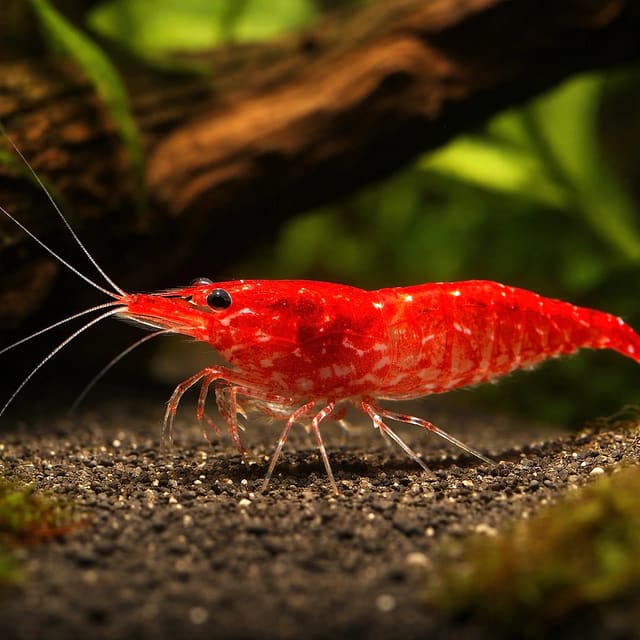
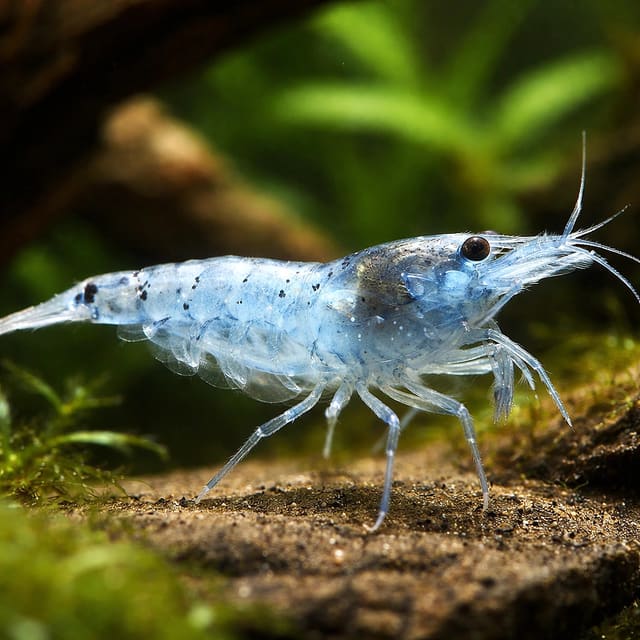
An adult is a compact little shrimp of about 3 cm. Published figures vary slightly: Wikipedia gives 3 to 4 cm at maturity, while OATA's care sheet puts the smaller freshwater shrimps at around 3 cm, and that is the realistic figure we use for an aquarium. Long, fine antennae sweep forward from the head, thin walking legs carry it over plants and stones, and a fan-shaped tail closes off the curved body. Under the tail sit the swimmerets, the small paddle-like legs that females use to hold their eggs.
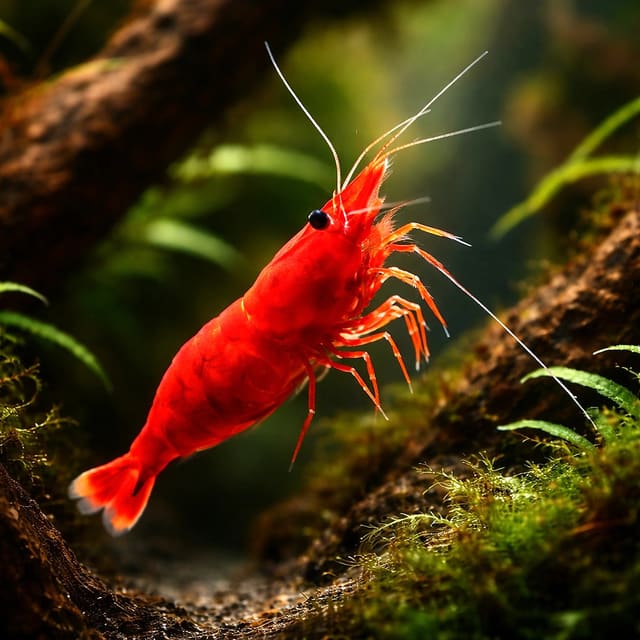
In this line the shell carries a strong blue, often broken by lighter flecks, while the legs, tail fan and antennae tend to be paler and a little see-through. Females are usually the easier ones to pick out once they mature. Wikipedia describes them as larger, with wider tails for carrying eggs and a richer, more opaque colour, while males are smaller and less colourful. In a blue group that tends to mean the deepest, most solid shrimp are the females and the slimmer, glassier ones are the males.
A mature female may also carry what shrimp keepers call a saddle: eggs developing in the ovaries, visible through the shell just behind the head as a green or yellow patch. Wikipedia notes that a saddle shows a female that is likely to be ready to mate.
In this shrimp, blue is made differently from the red of the classic cherry. Wikipedia, drawing on a 2022 study of pigment genes in different colour strains, explains that shrimp colour comes from several kinds of pigment cell, called chromatophores. Xanthophores give yellow and orange, erythrophores red and orange, iridophores blue, leucophores white and melanophores black and brown. Blue shrimp owe their colour either to iridophores, which reflect blue light, or to a lack of melanophores combined with bluish flesh. The animal is semi-translucent, so what you see is a blend of the colour in the shell and the colour of the tissue underneath.
That is why shrimp colour is not fixed. A 2021 study in the journal Animals, which tested colour forms of Neocaridina davidi on different backgrounds, describes two ways the colour shifts. The quick one is physiological: pigment moves within the chromatophores, and it happens within minutes. The slow one is morphological: the amount of pigment itself changes, which takes days or weeks. The same study found that shrimp of every colour form tested chose dark backgrounds over light ones, whatever their own colour.
For a keeper, that adds up to a simple habit. Do not judge a new group on its first evening, when the shrimp have just come out of a bag into unfamiliar surroundings. Judge it after a couple of weeks on a dark substrate with some cover and steady water, which is the kind of setting the research shows they prefer and the timescale over which the slower colour change works.
Every colour form of this shrimp, from red through yellow to blue and black, belongs to one species, so they can all breed with one another. Wikipedia notes that there is limited public information about how colour traits are inherited in the selective breeding of N. davidi, and the wild colour is a mottled, greenish brown. In plain terms, you cannot count on blue young from a tank where blues share space with reds or yellows. If you want a colony that stays blue, keep blue with blue.
If you would rather have a tank of mixed colours and are relaxed about what later generations look like, our 10 × Assorted Cherry Shrimp mix is the listing to look at instead.
Neocaridina davidi was described by the French zoologist E.-L. Bouvier in 1904, originally in the genus Caridina. The name has moved around since, and older labels still turn up in books, forums and research papers: Neocaridina heteropoda and Neocaridina denticulata sinensis are both former names for this same shrimp. It belongs to the family Atyidae, the freshwater shrimp family that also contains the genus Caridina.
Wikipedia gives its native range as Taiwan, eastern China, the Korean Peninsula and Vietnam, where it lives in inland waters such as lakes, ponds, rivers and streams. A 2015 paper in PLOS ONE also lists Japan, but Wikipedia treats the Japanese shrimp as introduced. A 2018 study by Mitsugi and Suzuki followed one of those populations, in the Tomoe River on the Boso Peninsula, and called it invasive. In that river the shrimp spawned from April to September, and the authors estimated a life span of roughly 10 to 15 months in the wild.
That invasive status deserves a moment. This shrimp tolerates a wide range of conditions, and Wikipedia records it becoming established in thermally polluted waterways in Japan, the United States, Poland and Germany, with releases from home aquariums the likely cause. A colony that outgrows its tank is a pleasant problem to have, but the surplus should go to another keeper or a local shop. It should never go into a garden pond, a ditch or a stream.
The 2021 background study used a brown form that the authors describe as corresponding to the wild type found in native habitats: translucent, with a faint bluish tint and black-brown spots. It is a useful reminder that the strong blue of this line exists only because people have selected for it. Wikipedia notes that the variable wild colouring is thought to work as camouflage against predators, which is the opposite of what a display line is bred for.
Blue Cherry Shrimp are small, but they do best in a tank that has been running long enough to grow a thin film of algae and microscopic life over every surface. That film, usually called biofilm, is where much of their grazing happens, and a brand-new tank simply does not have it. Set the aquarium up, cycle it fully so that ammonia and nitrite read zero, and wait until you can see a light growth on the glass, wood and stones before the shrimp go in.
OATA's care sheet for freshwater shrimps and snails gives at least 10 litres for small shrimp species. Our own minimum for this listing is 20 litres, and there is a good reason for the extra margin. A larger volume of water changes temperature and chemistry more slowly, and stability is the main thing this shrimp asks of you. A planted tank of 20 to 30 litres makes a comfortable home for a starter group, and a colony that breeds well will happily fill something larger.
OATA is clear that a filter is always essential. Newly hatched young are only about a millimetre long, so fit a fine sponge over the intake of a power filter, or use an air-driven sponge filter, which also gives the shrimp another surface to pick over.
OATA recommends aquarium gravel or sand with, ideally, live plants to provide cover, and notes that the colour forms will reproduce on their own provided there is enough protective cover. The 2021 background study adds a useful detail: the shrimp preferred dark substrates, and the brown and red forms also chose coarse patterns over fine ones. A dark gravel or aquarium soil therefore suits the animal and shows off the blue at the same time.
Plants with a lot of surface area earn their place: fine-leaved stem plants, bushy carpeting plants, and floating plants whose roots trail into the water. Wikipedia notes that these shrimp do not eat vascular plants, so your stems, rosettes and floaters are not on the menu. Leave some open ground as well. Wikipedia describes the species as timid, so a mix of dense cover and open floor lets nervous shrimp retreat while still giving you a clear view of the group at feeding time.
Because temperature swings are what you are trying to avoid, place the aquarium away from radiators, draughty doors and windows that take direct sun. A lid helps to limit evaporation, which in turn keeps hardness from creeping upwards between water changes.
If you can tick every line, the shrimp will have an easy start, and almost all of the hard work in shrimp keeping is already done.
The figures below are the ones to aim for. Our care range comes from the care notes on this listing; the OATA column is the trade association's general guide for freshwater shrimps and snails, which it asks keepers to treat as a starting point rather than a species-specific rule.
| Measure | Our care range | OATA general guide |
|---|---|---|
| Temperature | 18 to 28 °C | 17 to 27 °C |
| pH | 6.5 to 8.0 | 6.5 to 8.0 |
| General hardness (GH) | 4 to 15 °dH | 4 to 18 °dH |
| Carbonate hardness (KH) | follow the OATA guide | 3 to 15 °dKH |
| Ammonia and nitrite | zero | zero |
| Nitrate | keep it low | no more than 20 mg per litre above your tap water |
With these shrimp the bigger risk is rarely the exact number; it is how quickly the number moves. A large water change with water at a different temperature or hardness is harder on a shrimp than a tank that sits a little off the middle of the range but stays put.
The most useful study for home keepers is a 2015 PLOS ONE paper by Tropea, Stumpf and López Greco, who raised red cherry shrimp at 24, 28 and 32 °C in water of pH 7.5. Eggs took about 21 days to hatch at 24 °C and about 12 days at 32 °C. The number of young per female barely changed with temperature, averaging about 24. But every female that matured and mated at 32 °C lost her eggs, and the authors recommended 28 °C as the best temperature for culture in their system.
The lesson for an aquarium is not that hotter is better. It is that 32 °C is too warm for breeding, and that the top of our range, 28 °C, is a ceiling rather than a target. In the same study, young shrimp at 24 °C started more slowly but had caught up in weight by day 90, so a steady temperature in the low to mid twenties sits comfortably inside both our range and the conditions the researchers tested.
Winter is the easy half. A heater with a built-in thermostat, set somewhere in the low twenties, holds a small tank steady through cold nights. Check the thermometer after any power cut, because a nano tank loses heat quickly once the heater stops.
Summer needs more thought. A small tank in a warm room or a conservatory can climb past 28 °C during a heatwave, and the Tropea study shows what that does: at 32 °C every mated female lost her eggs. When hot weather is forecast, keep the tank out of direct sun, keep the room shaded through the day, and check the thermometer morning and evening. Lifting the lid to let air move across the surface helps the water lose heat through evaporation. What you want to avoid is the opposite mistake of a big, cold water change on a hot afternoon, which swaps one sudden change for another.
OATA warns that freshwater shrimps are very sensitive to copper and will die if exposed even to low levels. Read the label of every treatment, conditioner and plant product before it goes into a shrimp tank, and never use a fish medicine on a shrimp tank unless it is clearly marked as safe for invertebrates.
OATA suggests testing at least once a week and changing about 25 percent of the water weekly. Treat new water with a dechlorinator, bring it to the tank's temperature first, and add it slowly. A drip of fresh water poured in over a few minutes is far gentler than a bucket tipped in all at once.
In a mature tank these shrimp spend most of their day feeding themselves. Wikipedia describes them as omnivores that graze on biofilm, algae and detritus, and that is exactly what you will see: a steady picking motion with the front legs, working over leaves, wood, glass and gravel. They also eat their own moulted shells, which Wikipedia notes helps them recover nutrients, so there is no need to take a cast skin out of the tank.
OATA's guidance is to feed two or three times a week, using algae wafers and commercial pellets. That light schedule is the right instinct. Leftover food breaks down into ammonia, and in a small tank a heavy hand with the food tin causes more trouble than hunger ever will. Give an amount the group clears within a couple of hours, and lift out anything still lying there afterwards.
Prepared foods suit them well. In the Tropea temperature study the shrimp were raised on an ordinary commercial tropical fish food with at least 47.5 percent crude protein, and they bred and grew on it. Sinking foods suit an animal that spends its life on surfaces rather than in open water, and dropping food in the same spot each time makes it easy to count the group as they gather.
Wikipedia notes that carotenoids in a shrimp's food are thought to supply pigment for its chromatophores. Those carotenoid pigments are the reds, oranges and yellows, though, while blue comes mainly from light-reflecting iridophores or from a lack of dark pigment. So a varied diet supports a healthy shrimp, but we would not promise that any particular food will make a blue shrimp bluer. A dark substrate and stable water, as described above, are the better route to good colour.
Baby shrimp are tougher than they look. A 2015 study in the Journal of Crustacean Biology by Pantaleão and colleagues measured how long early juveniles of this species could go without food before half of them could no longer recover. It was about 16 days for the first juvenile stage and about 9 days for the third. That is a laboratory figure, not a feeding plan, but it explains why young shrimp survive between your feeds in a well-grown tank, as long as there is biofilm and fine detritus for them to graze.
Wikipedia describes Neocaridina davidi as non-aggressive and timid, spending most of its time scavenging for food. They do not fight among themselves and they do not eat vascular plants. Their one real weakness is that they are small enough to be food for many fish.
OATA recommends groups of at least five, and our care notes say six or more. A larger starting group has two advantages: there are more shrimp on view at any one time, and because sexes are not chosen, more animals give you a better chance of both males and females.
OATA's rule is short and clear: freshwater shrimp should not be mixed with any fish that can fit them in its mouth, or with any species known to be predatory. In practice that rules out large fish, puffers, crayfish and any cichlid big enough to take a shrimp. Remember too that young shrimp hatch at roughly a millimetre long, which fits into the mouth of practically any fish, so even a peaceful community tank will thin out the babies.
That leaves you two sensible approaches. If the colony is the point, give it a tank of its own and let it grow. If you want fish as well, choose small, peaceful species whose mouths cannot take an adult shrimp, plant densely so that the young have somewhere to hide, and accept that fewer of them will reach adulthood. OATA covers freshwater shrimps and snails on a single care sheet with shared water guidance, so the two fit the same set-up.
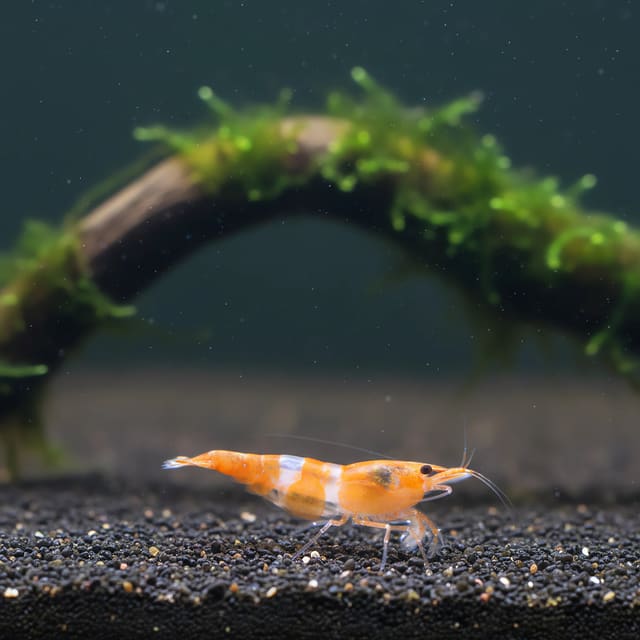
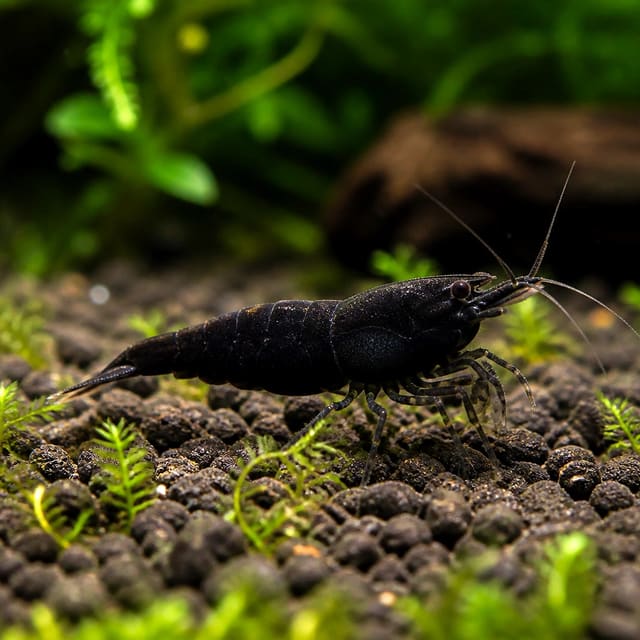
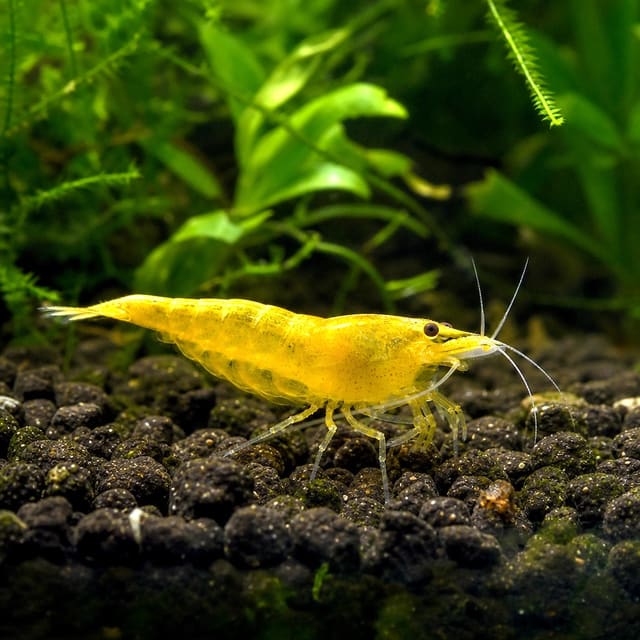
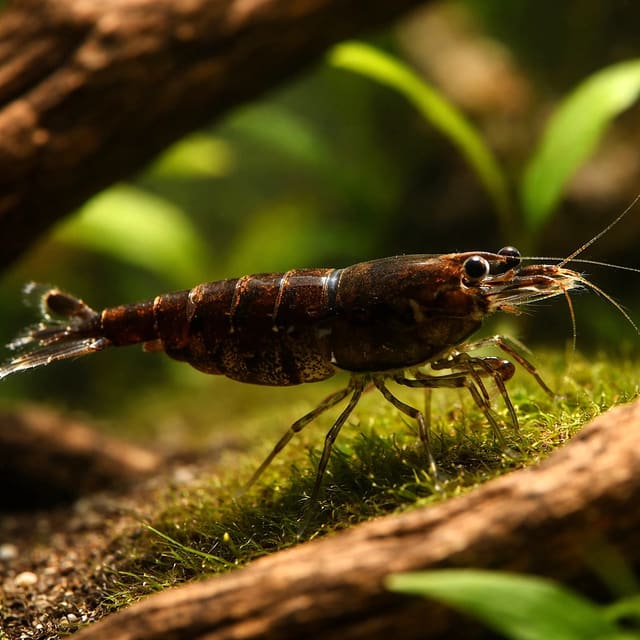
Other colour lines of Neocaridina davidi are the same species, so they live together peacefully but will crossbreed. If you like the idea of several colours, give each one its own tank: a second small aquarium could hold a contrasting line such as our Yellow Cherry Shrimp or Super Red Sakura Shrimp, and anyone torn between shades of blue might compare this line with our Blue Velvet Shrimp before deciding which blue to build a colony around.
Like all crustaceans, this shrimp grows by shedding its shell, and OATA warns keepers not to be surprised by the cast skins they find. Wikipedia adds that young shrimp moult more often than adults. A fresh moult is an empty, see-through copy of the shrimp, complete with legs and antennae, and it is easy to mistake for a dead animal. Look closely: a moult is hollow and light, while a dead shrimp has a body inside the shell. Leave moults where they fall, because the shrimp eat them.
It is worth repeating. OATA is blunt that freshwater shrimps are very sensitive to copper and will die if exposed even to low levels. If something goes wrong in a shrimp tank, start by asking what has been added to the water recently: a new treatment, a plant product, a decoration, or water from a different source.
A healthy colony is busy. Shrimp should be out and picking over surfaces through the day, gathering quickly when food goes in, and females in a settled group will start to show saddles and, later, carry eggs. Wikipedia notes that egg-carrying females may drop their eggs if they are stressed, and that a female carrying eggs for the first time may also lose them. One dropped clutch is no cause for alarm, but repeated losses are a reason to look hard at temperature and water quality.
Working through those points usually narrows the problem down, and fixing the cause gently, with small water changes rather than one large one, is usually the safest course.
For many keepers, breeding is the best part of shrimp keeping, and this species makes it easy. Wikipedia sums up what is needed as a sexed pair, stable water and a source of food. Because this listing does not sell sexed shrimp, the practical way to get a pair is to buy a group large enough that both sexes are likely to be among them.
Sources differ a little on when young shrimp mature. Wikipedia's introduction says maturity can come at around 30 days, while its breeding section, citing a 2015 study by Tropea and López Greco, gives sexual maturity at approximately two months of age. In the PLOS ONE temperature trial, egg-carrying females were seen from about day 50. Two months is the realistic figure to plan around.
The saddle is the first clue. When a female is ready to lay, which happens after she moults, Wikipedia explains that she releases pheromones into the water. The males then become agitated and swim busily around the tank looking for her. It can look like panic the first time you see it, but it is simply the colony breeding. The eggs are fertilised as they pass out of the female's body, so any shrimp you see carrying eggs has already mated.
The female fixes her eggs to the swimmerets under her tail and carries them there, fanning water over them with those small legs. Wikipedia gives a clutch of 20 to 30 eggs, and in the PLOS ONE trial an average of about 24 young hatched per female. The eggs are green or yellow, matching the colour of the saddle, and they darken as they develop until tiny dark eye spots can be seen inside them. Wikipedia gives two to three weeks to hatching; in the temperature study it was about 21 days at 24 °C and about 12 days at 32 °C, although 32 °C also caused females to lose their eggs.
There is no larval stage in this shrimp. The young hatch as tiny copies of the adults, roughly a millimetre long, and start grazing straight away. That direct development is what makes the species so easy to breed at home: there is nothing to raise separately, no special food at the start, and no need to move the female. Put that together with maturity at about two months and a brood of around two dozen young, and you can see how a small starter group becomes a busy colony within a few months in a tank that suits it. What the young do need is cover and a mature tank, which is why a fish-free aquarium with fine plants and plenty of surface growth gives the young their best chance.
Have the aquarium ready before you order: the filter running, the water tested and the temperature matched to the range above. Someone must be at the delivery address to receive live animals. Please read our delivery and live-arrival information before ordering; your confirmed delivery date and tracking details are sent by email.
Shrimp travel in oxygen-filled bags inside insulated packaging, with heat packs when the weather calls for them, and are carried by a tracked courier licensed to carry live animals.
Start a continuous unboxing video while the parcel is still sealed, and open it in the same take so that the shrimp can be seen in the still-sealed bag. If any arrive dead, dying or clearly in poor condition, email hello@tropicalfishco.co.uk on the day of delivery with your order number and that video. Photos alone do not meet the policy. The resolution is a replacement with your next order or a refund for the affected animals, subject to the guarantee terms.
Keep the lights low for the first day and watch how the shrimp breathe, feed and behave over the next week. They may hide at first and look paler than they will once settled; as the colour research above shows, the slower colour changes take days or weeks. Offer a small amount of food after a day or so, remove what is not eaten, and keep up the weekly testing. Once settled, the group should spend much of the day grazing where you can see it.
These are the sources behind the care and biology on this page, if you would like to read further:
No reviews for this item yet. Bought one? Honest reviews only, good or bad.
What customers say about ordering from us
I have a small group of long finned mountain minnows. So was delighted to be able to order ten of this variety to increase the genetics in my tank . The ones I recieved are healthy but it’s to early to give a verdict on wether they are of a long finned type since they are small currently.
Gordon Walker · 23 Sept 2026
100% success travel and "installation". Pleased with quality of purchase. The Siamese fighter a bit "shy" so have not yet seen him at his best yet but looking good. Happy customer. GG
George E Garratt · 21 Sept 2026
Reviews of our shop, collected by Judge.me, an independent third-party review collector. Newest first.