Moderate
Neon Tetra (Paracheirodon innesi)
21–25°C · pH 5–7
£2.99

A small Red Phantom Tetra for a mature, peaceful aquarium. Choose the size that suits your plan; each purchase supplies one unsexed fish. Keep this social species in a group of five or more, with cover, swimming room and a working filter.
Megalamphodus sweglesi
Shoaling fish: kept in a group they feel safer, stay calmer and show their best colour.
A small Red Phantom Tetra for a mature, peaceful aquarium. Choose the size that suits your plan; each purchase supplies one unsexed fish. Keep this social species in a group of five or more, with cover, swimming room and a working filter.
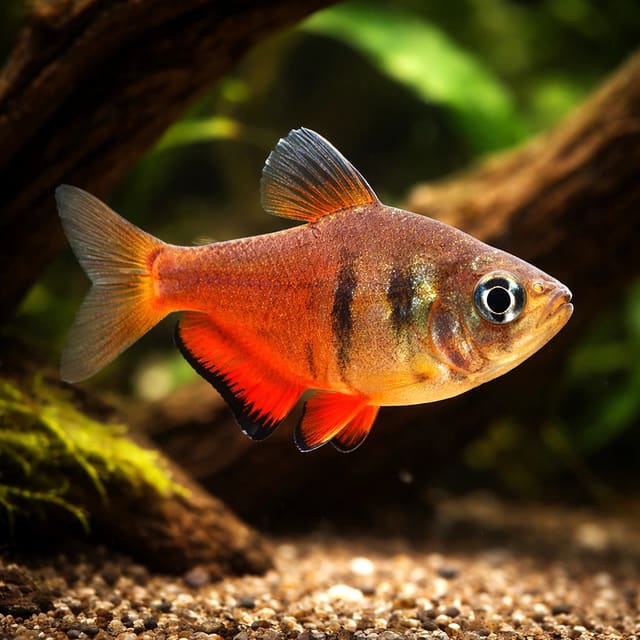
The Red Phantom Tetra, Megalamphodus sweglesi, is a small freshwater fish for a calm, established aquarium. Each purchase of this listing supplies one unsexed fish in the Size you choose. The size you select is the size supplied, not the adult size. The photograph shows two fish; the offer remains one fish per purchase. If you are starting a group, choose a suitable number of individual fish at checkout and check the live size selector for current choices.
This is a social species. FishBase advises five or more Red Phantom Tetras together, and OATA also advises at least five tetras as general group care. Five is a documented starting point; check available space and filtration for the whole group. More may be practical in a suitably spacious aquarium, but assess the whole stock, filter and swimming room first. Plan for a group from the outset.
This listing identifies the fish as Red Phantom Tetra, Megalamphodus sweglesi. FishBase currently uses the same scientific name and places the species in Acestrorhamphidae. The fish is recorded from the Orinoco River basin in South America. That natural distribution describes the species. Sex is guaranteed only when the selected option explicitly states male or female. This Red Phantom Tetra listing has no sex-guaranteed option.
The measured 2,5 - 3 cm option is a dispatch grade. The selector also has s and XL grades; neither label establishes an exact centimetre range. Select by the offered grade and ask us if you need help assessing an individual size before ordering. FishBase records a maximum length of 3.2 cm standard length for male or unsexed fish. Standard length excludes the tail fin, so it should not be read as a guaranteed full nose-to-tail adult measurement. A dispatch grade and a species record answer different questions: one describes the fish selected for an order, the other a recorded biological length. Neither guarantees the eventual size or sex of an individual fish.
A useful first decision is whether your aquarium can support a group while still offering cover and a clear swimming area. A second is whether its water can be kept stable with an established filter. A third is whether existing residents are similarly small and peaceful. If any answer is uncertain, work through the practical checks below before buying. The first tropical tank guide explains why a running, mature aquarium matters before livestock arrives.
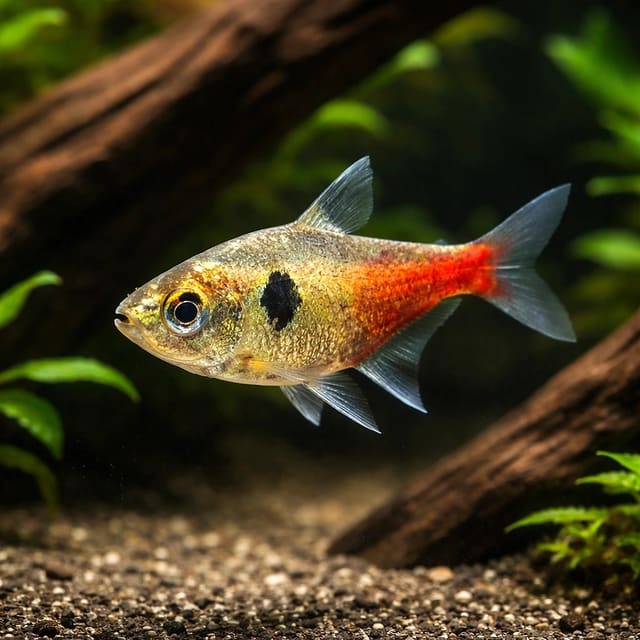
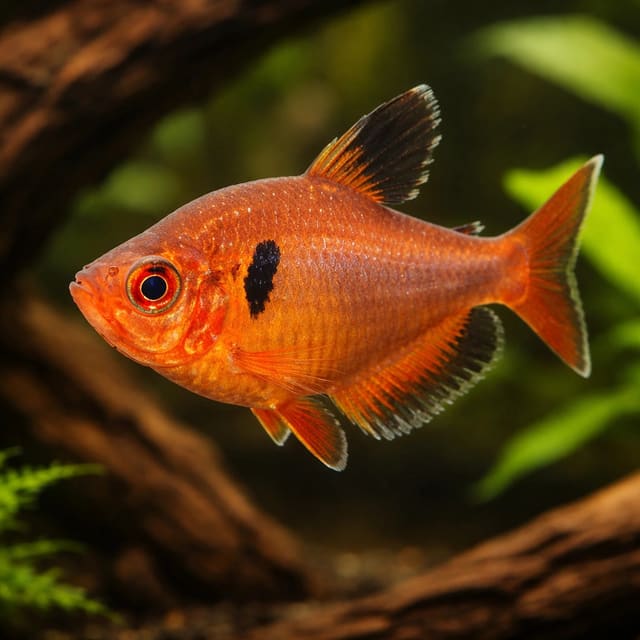
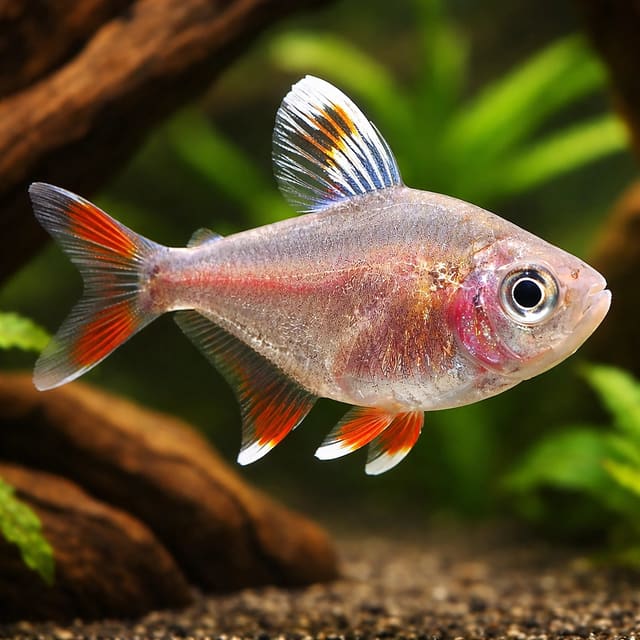
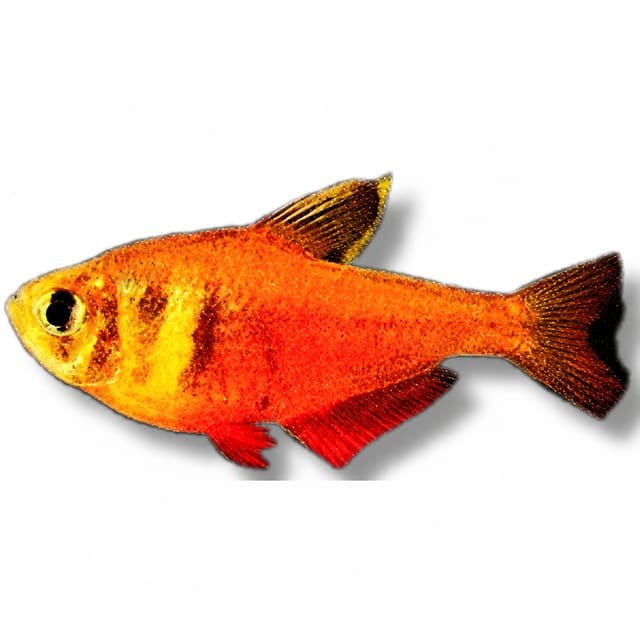
The gallery image shows two orange-red fish with dark shoulder spots above leaf litter. It helps show the appearance associated with this listing, while the offer remains one fish per purchase. Colour and pattern naturally vary between live animals; your delivered fish may differ in appearance. FishBase currently uses Megalamphodus sweglesi, the scientific name used throughout this page.
The Red Phantom's modest recorded length can make it tempting to judge the aquarium by volume alone. Think in terms of usable space. A group needs an uninterrupted area to move through, places to withdraw from activity, and water quality that remains sound after feeding. FishBase gives a 60 cm minimum aquarium length for the species. Apply that minimum alongside the group size, footprint, filter and other residents. Check the actual footprint, filtration and other inhabitants before deciding how many fish the tank can support. If you are comparing several small tetras, the tetras collection can help you see the available species, but each candidate still needs its own care check.
Red Phantoms suit a keeper who likes to watch a group in a planted or otherwise sheltered community, and who is willing to establish the aquarium before ordering. They are a poor shortcut for a newly filled tank or an excuse to add a lone bright fish to a busy community. A properly considered group, patient introduction and consistent maintenance matter more than trying to match the exact appearance in a photograph.
Prepare the aquarium before choosing a delivery day. A filter needs time to develop the bacteria that convert fish waste. RSPCA aquarium guidance explains that ammonia becomes nitrite and then nitrate through biological filtration; ammonia and nitrite are harmful to fish. Clear water alone says little about filter maturity. Test the water, confirm that the filter is working, and check that ammonia and nitrite are at zero before adding Red Phantom Tetras. Continue testing as the group and the feeding load are introduced. If a reading rises, investigate the cause instead of treating the fish as a way to finish cycling the tank.
FishBase lists a minimum aquarium length of 60 cm for this species. For a real group, length is only the start of the assessment. Allow swimming room after planting and décor, consider the footprint rather than a volume figure in isolation, and count all the other fish already living there. OATA's general tetra guidance suggests a 45 litre aquarium for a small shoal of smaller species. Use that group-level example alongside FishBase's 60 cm species length and your full stocking plan. A larger aquarium often gives a keeper more room to arrange cover and more water volume against day-to-day swings. If your tank is near any published minimum, discuss the complete stock and layout before ordering.
Keep the filter running continuously. Place its outlet so there is water movement without forcing small fish to hold position in a strong jet. OATA recommends a gentle current for smaller tetras and pencilfish as a group. Watch how food and fish move: a vigorous surface ripple may coexist with calmer swimming areas. Check quiet corners for trapped waste. A safe intake, stable heater, lid and accessible areas for maintenance are practical parts of the setup. None replaces a measured water-quality check.
Keep some clear swimming space, then use planting or other shelter around it. OATA recommends substrate and, ideally, live plants for tetras; suitable artificial plants and ornaments can also provide cover. A useful layout keeps planting at the back and sides while leaving a more open centre. That can be adapted to your aquarium rather than copied as a fixed aquascape. The fish should be able to move away from a busy neighbour and return to open water without being exposed across the entire tank.
Fine sand or rounded gravel can work if maintained properly. Choose substrate for all residents, especially any bottom-dwelling fish, and avoid sharp or dirty areas under décor. Wood, plant clumps and leaf litter can add structure, but keep space around the filter intake and remove decaying material before it compromises water quality. Floating plants may soften bright light; leave access for gas exchange and for observing the fish. A dark background can make a planted aquarium visually calmer; water quality and shelter still need their own attention. Red Phantom Tetras need sound husbandry even in a beautifully arranged tank.
A covered aquarium is sensible for small active fish, particularly during maintenance and introduction. Close cable gaps where practical and keep water level appropriate for the lid and equipment. Resolve persistent problems such as a predatory or aggressive tank mate directly. If the fish repeatedly crowd one corner, hide continuously or struggle in the current, check water, temperature and social conditions before adding more décor or changing the light. Use behaviour as a prompt to investigate the whole aquarium.
Different sources give different kinds of numbers. FishBase records 20–23°C, pH 5.5–7.5 and a hardness range with an unknown lower bound for the species' environment. Those environmental records have a different scope from routine aquarium guidance. OATA's broad guidance for captive-bred tetras and pencilfish is 22–27°C, pH 6.5–8.0 and soft to medium general hardness of 4–12°dH. OATA expressly says this is general group guidance and to check species-specific requirements with a retailer. Keep the environmental record and broad group guidance in their own contexts when planning aquarium water.
Use those figures to measure and discuss your aquarium water, making any necessary adjustment gradually. Check temperature with a separate thermometer, and test pH and hardness when evaluating a species for your tap water. A stable tank that is appropriate for its full community is preferable to a rapid chemical change intended to hit a single number. If you have very hard water, a fluctuating heater or uncertain readings, ask for advice with the actual measurements. The water chemistry guide explains what the common readings mean; the water matcher can help compare measured values with care guidance. Neither tool can verify the provenance or needs of an individual fish.
OATA advises zero ammonia and zero nitrite in its general care sheet. It also advises that nitrate should not exceed 20 mg per litre above normal tap water levels. Compare a tank reading with your source water rather than treating that difference as an absolute zero-nitrate target. Test more often during setup, after a change in stock or feeding, and whenever fish behave unusually. In an established, steady aquarium, record readings so a change stands out. Use species and trade-body figures with their stated scope.
FishBase describes Red Phantom Tetras feeding on worms, small insects and crustaceans. That natural-history note helps explain interest in appropriately sized animal foods; OATA provides broad captive feeding guidance. OATA advises a good quality flake or granule for tetras and pencilfish, supplemented with small live or frozen foods such as daphnia or small bloodworm. Choose pieces the fish can take readily. A fine flake or small granule can be easier to distribute through a group than a large pellet that only the quickest fish can seize.
Feed an amount the fish finish within a few minutes and remove or reduce any repeat leftovers. OATA's general advice is once a day and warns that excess food decays, adding harmful waste to the water. Observe all levels of the aquarium at feeding time: quick surface feeders can take food before a quieter mid-water group reaches it, while food sinking into the substrate can add waste for a bottom group. Alter how you present food to fit the actual community. A varied diet is useful; no particular food should be advertised as a guaranteed way to change colour, growth or breeding behaviour.
Store frozen food correctly, thaw and portion it according to its instructions, and keep feeding tools clean. Choose live food from a reliable source. If a fish stops feeding, look at water quality, social pressure and visible health changes. A single missed meal after a move calls for observation; prolonged refusal or multiple affected fish warrant prompt attention. Avoid adding food repeatedly in the hope that one variety will solve a water-quality problem.
OATA recommends a partial water change of around 25% at least weekly for tetras and pencilfish, with regular testing. Treat that as a useful general routine to adapt to measured waste levels and the needs of all inhabitants. Condition replacement tap water to remove chlorine or chloramine and avoid a sudden temperature difference. A siphon can lift settled waste from open substrate without dismantling every planted refuge. It is easier to protect a group's health by keeping a simple routine than by repeatedly making large emergency corrections.
Check the filter for blocked flow. When filter media needs cleaning, OATA advises a light rinse in removed tank water rather than under the tap, which may harm beneficial bacteria. Clean filter media in stages to preserve the established bacteria. Watch for a changed outlet flow, an unusual heater reading, damaged fins, abnormal breathing, loss of appetite or prolonged hiding. These signs can have several causes. Test the water and seek appropriate aquarium or veterinary advice instead of assuming a named disease or using a speculative treatment recipe.
Plan for an aquarium you can maintain consistently. A group of small fish still produces waste, and other residents do too. Leave room for growth and for normal feeding rather than stocking to a theoretical maximum. New livestock increases the load on a biological filter; OATA warns against adding fish too rapidly because the beneficial bacterial population needs to adjust. This advice matters when building a Red Phantom group in a community. Arrange a sound social group while pacing overall additions according to the tank's measured condition and expert advice.
Have the aquarium running and tested before dispatch. Have someone ready to receive the parcel. On arrival, inspect the parcel the same day. For any Live Arrival Guarantee claim, the current delivery terms require a continuous video beginning with the parcel still sealed, showing it opened and the fish still inside the sealed bag, plus the order number in a same-day email. Follow those terms before disturbing the bag. The claim evidence is separate from how you introduce healthy fish to the aquarium.
After inspection, keep the room calm and avoid a sudden burst of bright aquarium light. The delivery guidance says to float the closed bag for 20–30 minutes to reduce a temperature difference, then acclimatise the fish slowly before release. Keep transport water out of the aquarium. Check the delivered fish against the selected size grade. Observe colour and condition calmly, avoiding repeated netting. Give the group cover, monitor breathing and swimming, and check the aquarium's readings if behaviour is concerning.
A newly arrived fish can look different from one settled under familiar lighting. Be patient and observant as appearance changes after transport. Maintain good conditions, offer appropriate food and watch the group without assigning a timetable to its appearance. If a fish is injured or unwell, act on what you see and the measured water rather than waiting for a supposed settling period to expire.
Plan the number of Red Phantom Tetras before considering a second species. FishBase's species account recommends a group of five or more, matching OATA's general advice that tetras should be kept in groups of at least five. More fish may suit a larger, well-filtered aquarium; five remains the documented minimum. This listing sells one fish per selected Size, so order the individual quantity you need for the planned group. The presence of two fish in the picture has no bearing on that quantity.
Allow the group room to move together and apart. OATA warns that tetras kept alone or in too-small groups will often become stressed. Group size works together with a mature aquarium, suitable water and peaceful tank mates. When making a stocking plan, count the fish already present and the size they may reach. A 60 cm minimum still leaves the stocking plan to assess for each aquarium.
OATA's broad compatibility advice is to avoid fish large enough to eat smaller tetras and pencilfish; smaller peaceful species mix best with fish of similar size and temperament. Use that as the starting rule for Red Phantoms. A calm community may work when all residents can share the same stable conditions and feeding arrangements. It is still necessary to assess the specific species, individual temperament and available space. Check the particular residents behind a community label.
Avoid a fish that can swallow a small tetra, persistently chases it or dominates every feed. OATA also warns that larger or more boisterous tetras can nip timid or long-finned companions. That is a reason to scrutinise a proposed mix, including other tetra species, rather than assuming all tetras make a safe combination. For a bottom-dweller, check its social needs, substrate, temperature and water chemistry as carefully as the Red Phantom's.
Consider competition at feeding time. Small food can be taken quickly by fast fish before every member of a more cautious group has eaten. Observe the whole tank, distribute food in a way that reaches the intended fish, and avoid compensating with an excessive overall ration. If a resident must be kept in markedly different water, choose a different stocking plan rather than trying to split the difference. Use OATA's broad figures to start a species-by-species comparison.
Retain open water for the group, but provide cover that breaks lines of sight. In a planted aquarium, shelter at the edges can give fish a route away from activity without forcing them into a single crowded corner. In an aquarium with artificial décor, leave the same balance of swimming room and secure retreats. Keep an eye on the filter flow at the levels used by all residents. A tank can have an attractive centrepiece and still be awkward for a group if the only calm area is behind the heater or if feeding happens in one crowded spot.
Before adding a second species, compare its adult size and group needs with the aquarium footprint and current stock. Check that its temperature, pH and hardness needs overlap with the water you actually maintain. Leave room for both groups to feed without crowding. If existing residents already use most of the swimming space or filtration capacity, establish the Red Phantom group first and reassess later additions after the tank remains stable.
Small fish may interact with very small invertebrates even where there is planted cover. If a breeding shrimp colony is the main aim, check the precise shrimp and fish combination before ordering. Observe any shrimp already in the tank and maintain water conditions that suit both.
If the Red Phantom does not suit your tank, evaluate a different tetra as an alternative purchase. Read each species' own care and offer details before deciding. Compare water needs and social behaviour even when two fish look similar.
Compare each named tetra through its own current identity and care information before choosing. Here, the reliable identity is the Red Phantom Megalamphodus sweglesi identity matched to FishBase. If you are replacing an existing fish or trying to complete an established group, check the scientific name and visible characteristics of the fish you already have rather than buying solely by a common colour word.
A good stocking plan leaves room to change course. If the established community has a resident that chases new fish, if the filter is close to its practical load or if the measured water differs from the planned species' needs, resolve that issue first. Red Phantoms are easier to appreciate when the tank's routine already supports a peaceful group; no amount of copy on a product page can substitute for observing the actual aquarium.
FishBase records 3.2 cm standard length as a maximum for male or unsexed Megalamphodus sweglesi. Standard length excludes the tail fin. The selected dispatch Size is a separate offer detail, not a promise of an individual's eventual adult length.
FishBase gives a 60 cm minimum aquarium length for Red Phantom Tetras. Plan beyond that single dimension: a group needs swimming room, cover, suitable water, a mature filter and space for every other resident. OATA's 45 litre example is broad guidance for a small shoal of smaller tetras, not a species-specific stocking guarantee.
Keep five or more Red Phantom Tetras together: FishBase recommends that number for this species, and OATA gives the same minimum for tetras generally. Check the tank's space and filtration before deciding whether a larger group is appropriate.
A prepared beginner can keep Red Phantom Tetras when the aquarium is mature, water is tested and a proper group fits with peaceful residents. The important first task is learning to maintain the biological filter, rather than using the fish to cycle a new tank.
Offer appropriately sized quality flake or granules, with small live or frozen foods such as daphnia or small bloodworm for variety. OATA advises feeding tetras only what they finish within a few minutes, generally once a day, so leftovers do not spoil the water.
FishBase records 20–23°C and pH 5.5–7.5 as environmental context for this species, not a complete aquarium target. OATA's broad guidance for captive-bred tetras and pencilfish is 22–27°C, pH 6.5–8.0 and 4–12°dH general hardness. Measure your tank, keep conditions stable and ask for species-specific advice before changing the water.
Do not assume a Red Phantom Tetra will behave identically in every community. Provide a group and space, then watch interactions. OATA notes that some larger or boisterous tetra species can nip timid or long-finned fish; assess the actual residents instead of relying on a blanket label.
OATA advises mixing smaller peaceful tetras with fish of similar size and temperament, and avoiding fish large enough to eat them. Any proposed companion must also suit the same water, space and feeding plan. Another tetra on the site is an alternative to consider, not an automatic safe tank mate.
Tropical Fish Co's current delivery policy says live fish are hand-packed and carried by a licensed live-animal courier. Someone must receive the parcel and inspect it the same day. For a Live Arrival Guarantee claim, email the order number and a continuous video showing the sealed parcel being opened and the fish still in its sealed bag; read the full delivery terms before arrival.
The species identity, natural distribution, maximum recorded standard length, 60 cm aquarium length and five-fish group note come from FishBase's Red Phantom Tetra account. Its environmental temperature and pH entries describe source context rather than a universal home-aquarium target. The general care, feeding, water-quality, introduction and compatibility guidance comes from OATA's tetra and pencilfish care sheet; that sheet explicitly covers a wider group, so its figures should be checked against the particular aquarium and fish. RSPCA fish environment advice explains why a working biological filter matters. For dispatch, attendance and claims, use Tropical Fish Co's current delivery policy.
No reviews for this item yet. Bought one? Honest reviews only, good or bad.
What customers say about ordering from us
I have a small group of long finned mountain minnows. So was delighted to be able to order ten of this variety to increase the genetics in my tank . The ones I recieved are healthy but it’s to early to give a verdict on wether they are of a long finned type since they are small currently.
Gordon Walker · 23 Sept 2026
100% success travel and "installation". Pleased with quality of purchase. The Siamese fighter a bit "shy" so have not yet seen him at his best yet but looking good. Happy customer. GG
George E Garratt · 21 Sept 2026
Reviews of our shop, collected by Judge.me, an independent third-party review collector. Newest first.