−14%
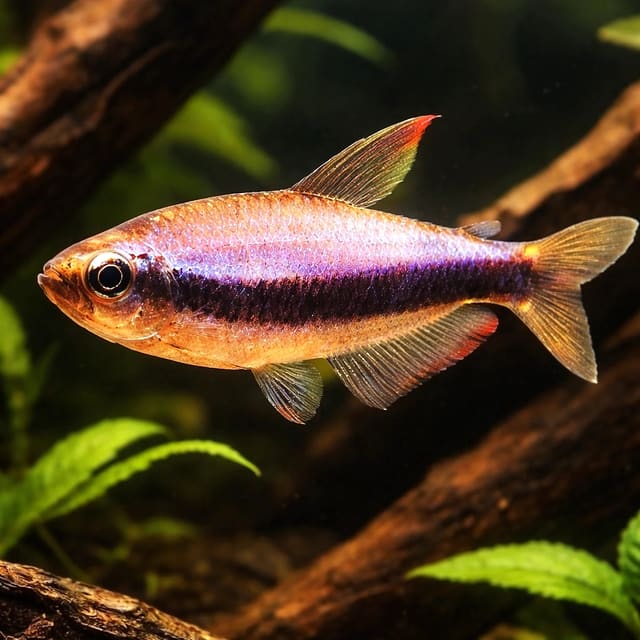
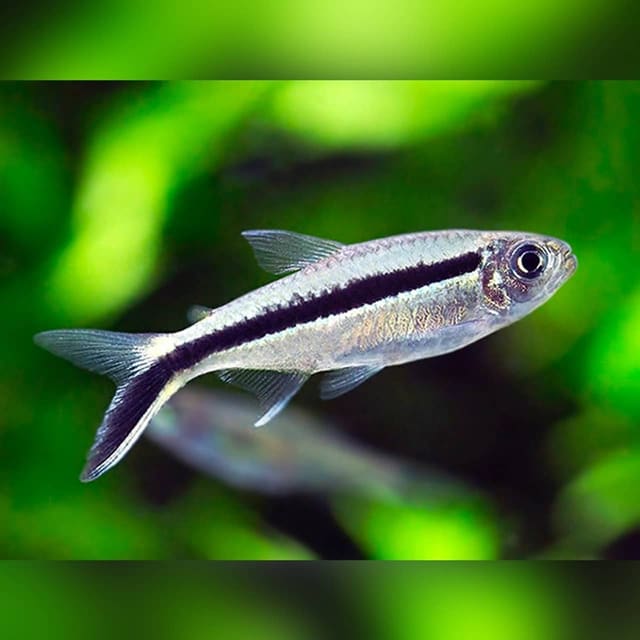
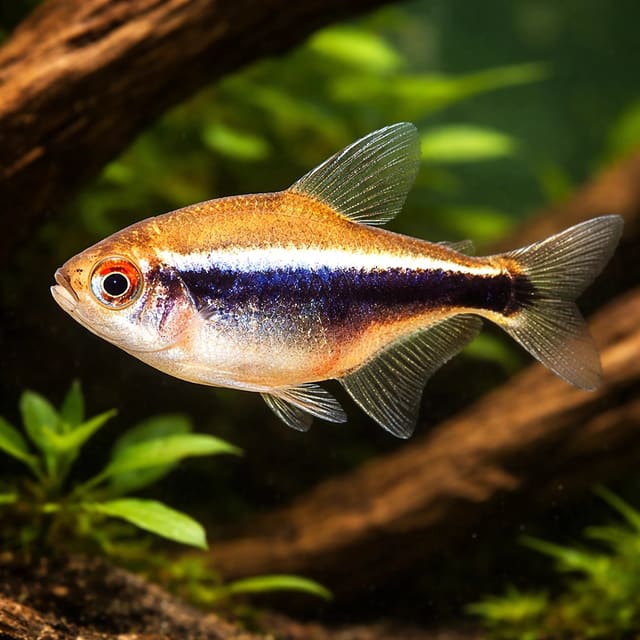
Black Neon Tetra (Hyphessobrycon herbertaxelrodi)
20–28°C · pH 5–7.5 · 72L
£2.57£2.99

The Black Phantom Tetra (Megalamphodus megalopterus) is a peaceful South American tetra reaching about 3.6 cm standard length. Keep at least 8–10 in a mature aquarium with an 80 × 30 cm base, around 72 litres, at 22–27°C, pH 6.5–7.0 and 4–12 dGH; one purchase supplies one selected live fish.
Adult size is the maximum length this species reaches at full maturity (scientific sources). The livestock you receive will be younger and smaller — pick a size above for the actual shipping size. Product-photo provenance and any image-specific limitations are stated on the listing.
Megalamphodus megalopterus
Shoaling fish: kept in a group they feel safer, stay calmer and show their best colour.
Minimum of 2 per order.
The Black Phantom Tetra (Megalamphodus megalopterus) is a peaceful South American tetra reaching about 3.6 cm standard length. Keep at least 8–10 in a mature aquarium with an 80 × 30 cm base, around 72 litres, at 22–27°C, pH 6.5–7.0 and 4–12 dGH; one purchase supplies one selected live fish.
Adult size is the maximum length this species reaches at full maturity (scientific sources). The livestock you receive will be younger and smaller — pick a size above for the actual shipping size. Product-photo provenance and any image-specific limitations are stated on the listing.
Maintain these water conditions for optimal health and vibrant colors
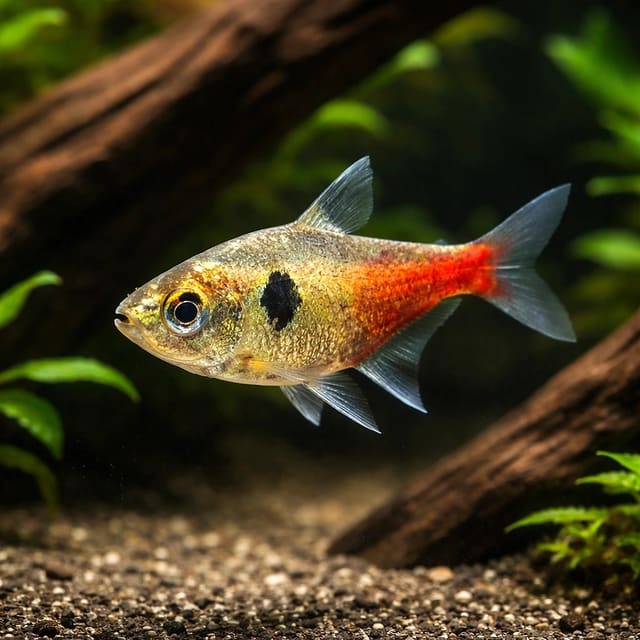
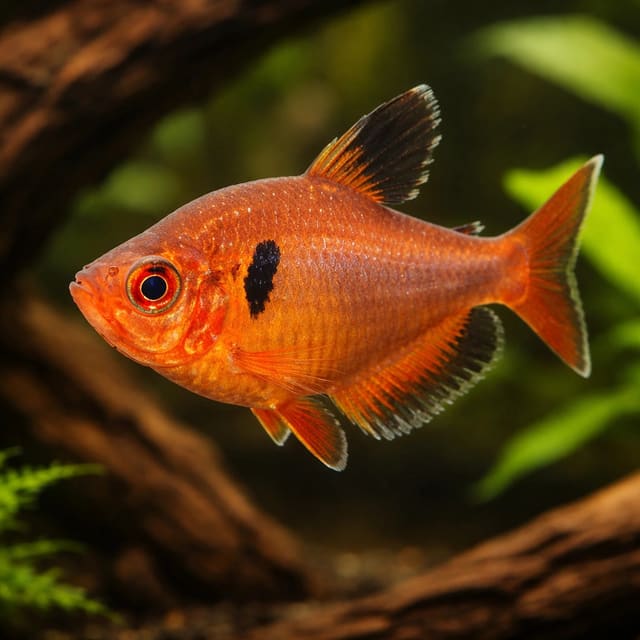
The Black Phantom Tetra, Megalamphodus megalopterus, is a small South American freshwater tetra associated with the upper Paraguay and Guaporé river basins. It is recognised by a dark shoulder patch, a silvery to dusky body and tall dark fins. One purchase supplies one live fish in the selected dispatch grade; the grade is not a promise that the fish has reached its adult length.
FishBase records 3.6 cm standard length and the species' environmental data. Seriously Fish gives 3.6 cm standard length, an 80 × 30 cm minimum base and a group of at least 8–10. The XL option has no exact centimetre promise and is kept distinct from the adult biological record. The Seriously Fish page uses the historical combination Hyphessobrycon megalopterus and explains that the fish was originally described as the type species of Megalamphodus; the current name used here is Megalamphodus megalopterus.
Black Phantom Tetras make sense when you want a full shoal as a focal point among roots and plants. Start the purchase plan with the space for that shoal, rather than choosing one fish for an empty corner. The relevant question is whether the aquarium can support at least 8–10 of this species alongside the residents it already holds.
The appeal of a Black Phantom Tetra aquarium is the group moving through a structured display. Plants and branching wood give the fish places to pause, while an open lane lets them move between those places together. That combination is more useful than adding decorations until every centimetre is occupied. Think about how the fish will travel through the tank, how each can reach food and how you will reach the substrate during maintenance.
Its modest adult length can make it tempting to choose this species for any small aquarium. However, the number needed for social keeping changes the space calculation. A tank intended for a shoal must support the whole group, with enough usable room after wood, plants and equipment are installed. A mature aquarium with the right base dimensions is a stronger starting point than a taller vessel chosen only because its litre figure looks sufficient.
For a first community, start by making this shoal the main midwater group and assess other residents around it. This gives the aquarium a clear stocking plan and makes feeding and behaviour easier to observe. In an existing community, ask whether the present fish already occupy the same swimming route or dominate the food. Adding a peaceful species still changes the daily demands on the filter and the available space.
One purchase supplies one live fish in the selected dispatch grade. The size you select is the size supplied, not the adult size. Size options include 1–1.5 cm, 1.5–2 cm, 2–2.5 cm, 2.5–3 cm and XL, with current availability shown by the live selector. XL has no exact centimetre promise.
Sex is guaranteed only when the selected option explicitly states male or female. This Black Phantom Tetra listing has no sex-guaranteed option. Do not use colour, body depth, fin shape or the gallery to infer the sex of the animal dispatched. Those features can vary with condition, maturity, lighting and individual appearance.
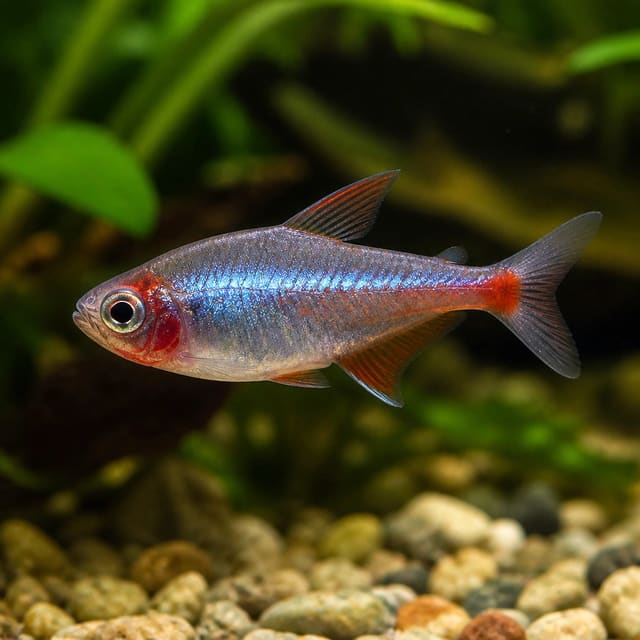
If you are comparing this fish with other small characins, browse the current tetra collection. The Neon Tetra (Paracheirodon innesi) is another small tetra to compare with a different appearance and care profile; this does not make the two automatic tank mates. Compare adult size, behaviour, water range, shoal requirements and footprint before combining species.
For an existing Black Phantom group, check both its number and the space it actually uses. Decide whether the proposed addition completes the shoal or adds more mouths to an already crowded community. Then choose a grade appropriate to safe equipment and companion sizes. Juveniles still grow towards the species' adult length: their smaller dispatch measurement does not reduce the long-term aquarium requirement.
| Suits | Needs reconsidering |
|---|---|
| A mature, filtered aquarium planned for 8–10 Black Phantom Tetras | A new aquarium or a plan for one fish |
| A keeper who tests water and provides open midwater room | A crowded community without room for completed groups |
Choose the dispatch grade for the aquarium you have prepared. The smallest fish need particular attention to safe equipment intakes, food particle size and companions large enough to swallow them. Larger grades still need the same social group and adult swimming provision. The live selector shows which choice can be ordered; a list of size choices is not a statement that every grade is available at the same time.
For the Black Phantom shoal, draw an 80 × 30 cm rectangle before planning the hardscape. That is the minimum base recommended in the Seriously Fish species profile, associated with about 72 litres. Roots and planted margins should fit around useful swimming space within it. A larger community or a more heavily furnished layout needs additional room rather than treating the published minimum as a stocking allowance.
Use the habitat account as a layout brief: the fish gather near marginal vegetation and submerged roots in slow waters. Put the sheltered areas beside an open route, so the shoal can move from one patch to another without squeezing between obstacles. Check the view from the front and above. A dramatic piece of wood should support the fish's route rather than divide it into cramped compartments.
Start with a properly matured system. The first tropical aquarium guide explains the preparation sequence before livestock is introduced. Maturation is about establishing the biological filter that processes waste, not merely letting tap water stand. The RSPCA aquarium guidance explains that fish release toxic ammonia, which a working biological filter converts first to nitrite and then to the safer nitrate.
Compare aquariums by the base left available after furnishing. A taller tank can hold more water without offering a longer route past the planted margins, while a broader base offers more ways to arrange those margins. Choose dimensions that let you maintain both cover and a full Black Phantom shoal; additional volume is useful only as part of that workable plan.
Before settling on the layout, imagine carrying out the weekly water change with the fish in place. Leave a route for the siphon, access to the filter intake and space to remove dead plant material. Wood arranged directly against the glass can trap waste where it is difficult to reach. A little accessible space around planted margins lets you keep the habitat clean without repeatedly uprooting the shelter the fish use.
A planted aquarium also needs a clear boundary between cover and swimming room. As plants grow, check whether the original lane is still open and whether the group can move around the ends of the hardscape. Pruning should preserve useful shelter while restoring the route through the aquarium. The aim is a stable arrangement that continues to work after several weeks of growth, rather than a display that only fits the fish on the day it is planted.
Keep routine aquarium water at 22–27°C, pH 6.5–7.0 and 4–12 dGH. These values are a conservative routine overlap of the cited species records and broad OATA tetra guidance. They are not the species' complete tolerance, and a fish already thriving within a wider cited range should not be moved solely because it sits outside this narrower recommendation.
Before choosing Black Phantoms, put your measured pH and hardness beside the routine guidance rather than relying on a supplier's general description of your tap water. Our water chemistry guide explains the measurements. Enter those readings into the water matcher to help compare the aquarium you can maintain with the fish you are considering.
| Reading | Action |
|---|---|
| Ammonia above zero | Stop adding fish, check filtration and take corrective water-quality action. |
| Nitrite above zero | Treat it as a toxic-water warning and correct the cause. |
| Nitrate rising unusually | Review stocking, feeding, maintenance and source-water readings. |
| Temperature drifting | Check heater operation and measure away from the heater. |
Alongside pH and hardness, maintain a record of the waste readings that matter for a completed shoal. OATA's tetra care sheet requires zero ammonia and nitrite and recommends nitrate no more than 20 mg per litre above normal tap-water levels. Measure the replacement source as well: this is a comparison with its baseline, not an instruction to assume tap water contains no nitrate.
Plan replacement water before the maintenance session begins. Its conditioner, temperature and chemistry should be ready while the fish remain in their familiar planted layout. Follow the readings across several sessions to judge whether your routine handles the shoal's waste. A gradual rise deserves attention before you notice a change in appetite or swimming.
Use the measurements from your own aquarium to decide whether this species fits your maintenance routine. Source water establishes what each water change adds, while aquarium readings show what the occupants and equipment are doing between changes. If the two differ substantially, investigate the cause before buying fish. A plan that requires frequent corrections to pH or hardness is harder to maintain consistently than one based on suitable, predictable replacement water.
The routine figures above deliberately sit inside a wider set of published guidance. Seriously Fish gives species aquarium guidance of 20–28°C, pH 5.0–7.0 and 1–12 dGH; OATA gives a broader tetra group guide. Use the narrower routine overlap as a practical starting point, with its scope intact. Neither end of a published range is a target to pursue, and an environmental record from the wild does not establish an optimum for every home aquarium.
The Black Phantom profile provides a useful equipment example for its roughly 72-litre aquarium: about 290–360 litres per hour, equivalent to four to five turnovers. Read it together with the species' slow-water habitat. It helps size equipment, but does not prescribe a forceful current through every planted margin. Include the whole shoal and any community residents when planning biological capacity.
Biological media needs oxygenated water and time to establish. Preserve mature biological media during service and follow the filter manufacturer's procedure. Keep the filter operating continuously outside brief routine maintenance. If flow drops, inspect the intake, impeller and clogged mechanical media before assuming the unit is too small.
Map circulation around the roots, not just from outlet to intake. Water needs to pass through the planted layout without making its only open swimming route difficult to use. Look for debris accumulating behind the same branch after feeding, and watch whether the shoal uses both ends of the aquarium. Those observations help you adjust outlet direction without removing the shelter that makes the layout useful.
Review filter performance when the stocking plan changes. Completing a Black Phantom shoal increases feeding and waste even if each addition is small. Adding another social species also adds its own daily ration. Follow the resulting nitrogen readings and debris accumulation; an unchanged equipment rating does not show that an expanded community remains within the aquarium's capacity.
When comparing filters, consider servicing as well as the advertised output. A filter that you can clean without disturbing the planted margins is easier to maintain consistently. Keep enough clearance to remove the intake guard and check it for accumulated debris. Juvenile dispatch grades can use spaces that a larger adult would not, so inspect equipment gaps before arrival rather than relying on the size of the fish you eventually expect.
The species profile's flow example is a useful scale for planning, rather than a requirement to create a strong river current. Watch how the outlet affects the available habitat. Plants may move gently while the group swims freely, but fish repeatedly holding behind one object to avoid the current suggest that the layout needs attention. Preserve circulation through the tank while giving the fish calm places to pause.
Offer a varied diet appropriate for a small tetra. Seriously Fish describes this species as readily accepting prepared foods, with small live or frozen foods such as bloodworm, Daphnia and Artemia helping support condition and colour. Choose particles the fish can take easily in mid-water; a food that is nutritionally suitable but too large is not useful.
Begin with OATA's broad tetra feeding routine: one daily ration consumed within a few minutes. For this Black Phantom shoal, judge that ration by what happens among the planted margins as well as in open water. Food missed by a fish sheltering near the roots can become waste, while food caught by the first few swimmers tells you little about the quieter individuals.
Use feeding to see whether the layout offers fair access. If the same Black Phantom stays beside a root while the others intercept food in open water, offer part of the measured ration near that shelter. This is a change in distribution, not a larger total meal. Persistent failure to feed still calls for a review of the fish and its interactions.
Record which individual misses food and whether the pattern continues at the next observation. A whole shoal losing interest points you towards shared conditions such as temperature or water quality; one fish staying apart also warrants a look at its posture, breathing and social access. Supply those observations and actual test values when asking for help rather than attempting a diagnosis from appetite alone.
Use the dispatch grade as a guide to particle size when the fish first arrive. Fine flakes can be broken down so a small fish can take them, and suitable small granules should be easy to swallow rather than repeatedly mouthed and dropped. Observe several individuals rather than assuming that a food works because the largest fish eats it. A varied diet is useful only when the whole shoal can actually consume it.
Frozen or live foods are additions to a balanced routine, not a reason to increase the total ration indefinitely. Add a modest amount, watch the feeding response and check for leftovers around plants and wood. Keep the feeding area visible so you can tell whether a quiet fish has eaten. This daily observation also makes gradual changes in body condition easier to notice before they become serious.
Keep at least 8–10 Black Phantom Tetras, and prefer ten or more where the aquarium can support them. Seriously Fish recommends at least 8–10 Black Phantom Tetras. The species forms temporary social display patterns, so enough conspecifics distribute social displays rather than concentrating attention on one fish.
The recommendation is a floor, not a promise that every group behaves identically. Use ten or more only where the aquarium footprint, filtration and total stocking allow. A fuller shoal can spread social attention, but crowding creates a different welfare problem. Count all adults at their 3.6 cm planning length when judging space.
| What you see | What to check |
|---|---|
| Repeated chasing of one fish | Group size, cover, swimming room and the target fish's condition. |
| Fin attention towards tank mates | Shoal size and whether slow or long-finned companions are a poor match. |
| Whole group hiding | Recent disturbance, water readings and larger intimidating tank mates. |
| One fish apart at feeding | Access to food, injury, breathing and water quality. |
If a Black Phantom is repeatedly driven away from the group, compare the social plan with the 8–10 recommendation and inspect the route around the planted margins. Can it get out of view and return to feeding? Decide whether space, cover or the stocking itself is limiting that choice. Another species cannot fill a missing conspecific role, and more fish cannot create a missing swimming route.
Spend some observation time watching the group when food is absent. That is when you can distinguish brief interactions from a fish continually confined to the same refuge. Check that sheltered individuals later rejoin the shoal and can rest without repeated disturbance. Fin damage, loss of condition or constant exclusion require action even in a species usually described as peaceful.
A healthy Black Phantom Tetra should be alert, balanced in the water and able to feed with the group. Use several observations together rather than treating one visual detail as a diagnosis. Colour can change with lighting, background, transport, social display and stress, so compare the fish with its normal appearance under ordinary aquarium conditions.
Build observations around the Black Phantom's ordinary route through plants and wood. OATA advises monitoring swimming, appearance, breathing, behaviour and feeding; for your aquarium, note where each fish usually pauses and how it returns to the group. When that pattern changes, pair the observation with temperature and nitrogen tests and a record of recent maintenance or stocking.
Notice whether a change affects the shoal or follows one individual wherever it goes. Several fish abandoning their usual swimming area warrants an immediate equipment and water check. For an isolated fish, also watch whether it is being displaced near roots or kept away from food. The same water tests remain necessary in either case; the social observations add useful context.
When contacting the retailer, describe the change in a way someone can assess: how many fish are affected, whether they feed, where they stay and what the water actually tests at. OATA recommends that combination of testing and retailer advice. Persistent or worsening signs may need veterinary assessment. Clear observations are more useful than assigning a disease name to a darkened body or folded fin.
Be present to receive the parcel. Start filming before opening: show the sealed parcel and outer box, then open it in one continuous take and show the fish inside the sealed bag. Float the bag for 20–30 minutes before releasing the fish, and never pour the transport water into the aquarium. The current delivery and Live Arrival Guarantee policy gives the complete claim conditions and arrival instructions.
Once the fish are introduced, allow the Black Phantom group to find the planted margins and open route prepared for it. Observe upright swimming and breathing without repeatedly disturbing the layout. Watch the first modest feeding for access across the group, and check ammonia and nitrite as the newly increased load reaches the mature filter.
Use the first weeks to learn this shoal's baseline. Note which parts of the aquarium it uses at quiet times, whether every fish takes suitably sized food and how it interacts with established residents. Put those observations beside dated water readings. This makes it easier to spot a fish becoming excluded or a maintenance routine struggling after the addition.
A problem after arrival needs a focused response. Establish the immediate water and equipment conditions, then examine whether a resident is preventing the new fish from using shelter or food. Keep a record of any adjustment and what follows. Changing the layout, chemistry and feeding together obscures which issue was responsible and makes the fish's settling period harder to assess.
Organise maintenance around preserving the Black Phantom layout while removing its accumulating waste. OATA recommends a weekly 25% partial water change and water tests at least weekly for tetras. Treat those as a starting routine for the shoal, then use your results to judge whether the aquarium needs more attention.
Work through accessible patches of substrate around the roots during the partial change. Have conditioned replacement water ready, matched closely to the aquarium's temperature and chemistry. Leaving established cover in place gives the shoal somewhere to move while you siphon. Remove the waste you can reach without routinely dismantling the habitat.
Service the filter separately from major rearrangement wherever practical, so you can confirm that circulation returns through the same familiar layout. OATA advises lightly rinsing media in removed aquarium water instead of tap water to protect the established bacteria. Check the intake and outlet afterwards: a cleaned filter should again move water through the planted margins.
Use a detectable ammonia or nitrite result as a reason to investigate capacity or disruption before extending the shoal. Biological filtration processes the fish's toxic waste, as the RSPCA explains, and damage to that function affects the whole aquarium. Recording the reading, recent equipment service and feeding load makes the next advice you receive more specific.
The weekly 25% water change is OATA's broad starting guidance for tetras. Your test results, stocking and source water show whether the system needs a different maintenance response. Keep notes of the same readings at comparable times so a rising trend is visible. Recording a water change without the readings afterwards tells you that a task was done, but does not show whether it kept the aquarium stable.
Maintenance can also reveal changes in the usable habitat. A filter outlet partly blocked by growing plants, a patch of food trapped behind wood or a swimming lane narrowed by stems can alter how the shoal uses the tank. Correct those practical issues as part of ordinary care. Restoring access, flow and clean substrate is usually less disruptive when done promptly than after waste and plant growth have accumulated.
Black Phantom Tetras are associated with still or sluggish tributaries, backwaters, ponds and small lakes in the upper Paraguay and Guaporé systems. The species profile describes fish gathering around marginal vegetation and submerged tree roots, while Pantanal records include very clear water rich in aquatic plants. This supports a planted or wood-structured aquarium, but it does not require an exact biotope reconstruction.
Use a sandy substrate, branching wood and planted margins to create shelter and visual breaks. Preserve the 80 × 30 cm swimming base by keeping an open midwater route. Floating cover or dimmer areas can help the dark fins and shoulder patch show naturally, provided the surface remains open enough for gas exchange and maintenance.
The species is an egg-scattering fish with no parental care, but this listing does not promise a sex ratio or breeding outcome. Social fin displays can occur inside the group; observe whether every fish can feed and rest rather than assuming that all chasing is harmless. A deliberate breeding project needs separate provision for eggs and fry and should never reduce the space or stability of the main aquarium.
The most useful habitat lesson is balance: cover at the margins, an open route through the centre, gentle but effective circulation and a layout that can be cleaned without dismantling the aquarium. That arrangement supports both natural group behaviour and consistent husbandry.
Black Phantom Tetras are described as very peaceful, but that is only the start of compatibility screening. Complete the 8–10 fish group first, then assess each proposed companion for adult size, its own social number, feeding pace, swimming level and overlap with stable water. The aquarium must have room for all completed groups rather than the juveniles present today.
Use the Black Phantom species profile to begin a shortlist, then assess each candidate individually. Seriously Fish suggests comparable characids, hatchetfishes and pencilfishes, smaller callichthyid or loricariid catfishes, and small-to-medium cichlids that are not predators. Membership of one of these categories alone does not establish suitable adult size, group requirements or behaviour for your particular aquarium.
A community plan should name each intended species and reserve space for its completed group. Several small groups may appear less crowded than one full shoal when the fish are young, but that appearance is misleading if each group is below its social requirement. Decide which fish will form the main swimming group, then evaluate additional residents against the space and maintenance capacity that remain.
Companion categories help narrow the search, but individual species still need their own research. A smaller catfish may use the lower part of the aquarium yet still add waste, need feeding and require company. A non-predatory cichlid may have territorial behaviour that changes the layout. Compare adult behaviour as well as water ranges before choosing, and keep observing the community after it has settled.
Fin condition and feeding access provide useful checks on the result. A peaceful description cannot excuse repeated cornering, damage or a fish that cannot reach food. If problems develop, review the fish involved, the shoal size and the layout together. Adding cover can improve separation, but it cannot create adult swimming space or make an unsuitable predator a safe companion.
The recorded adult length is 3.6 cm standard length, measured without the tail fin. Use that biological figure for adult planning, alongside the whole shoal's swimming needs.
Seriously Fish recommends at least an 80 × 30 cm base, associated with about 72 litres. Increase space for a larger shoal or a mixed community, allowing for the room occupied by décor.
Keep at least 8–10, following the species-specific Seriously Fish recommendation. Plan enough space and filtration for the complete group rather than keeping a lone fish.
They can suit a beginner who has prepared a mature, filtered aquarium, tests the water and provides a full shoal. The preparation and maintenance routine matter more than a simple difficulty label.
Offer suitably small flakes or granules, varied with appropriate live or frozen foods. OATA's general tetra guidance recommends a small daily portion that is eaten within a few minutes; observe that every fish can feed.
A conservative routine overlap is 22–27°C, pH 6.5–7.0 and 4–12 dGH. This combines species guidance and broad OATA tetra advice, rather than defining the complete tolerance or a proven species optimum.
The species is described as very peaceful. Keep the full shoal and observe interactions: persistent chasing, damaged fins or exclusion from feeding need reassessment rather than being dismissed as harmless.
Possible categories include similarly sized characids, hatchetfishes, pencilfishes, smaller callichthyid or loricariid catfishes and non-predatory small-to-medium cichlids. Assess the particular species for adult space, social needs, water overlap and feeding pace.
Tropical Fish Co hand-bags fish with oxygen and uses insulated packaging, with heat packs when weather calls for them, and a licensed live-animal courier. Be present to receive the parcel. Live Arrival Guarantee claims require same-day inspection and a continuous video from the sealed parcel to the fish still in the sealed bag; contact the team the same day with your order number.
FishBase: Megalamphodus megalopterus identity, distribution, environment, diet and maximum standard length.
Seriously Fish: Hyphessobrycon megalopterus species profile for aquarium footprint, water, feeding, behaviour and group care. The historical combination is retained only for source transparency.
OATA: broad UK tetra guidance, explicitly not a species optimum.
RSPCA: general filter and aquarium-welfare guidance.
Tropical Fish Co: current delivery and Live Arrival Guarantee instructions.
No reviews for this item yet. Bought one? Honest reviews only, good or bad.
What customers say about ordering from us
I have a small group of long finned mountain minnows. So was delighted to be able to order ten of this variety to increase the genetics in my tank . The ones I recieved are healthy but it’s to early to give a verdict on wether they are of a long finned type since they are small currently.
Gordon Walker · 23 Sept 2026
100% success travel and "installation". Pleased with quality of purchase. The Siamese fighter a bit "shy" so have not yet seen him at his best yet but looking good. Happy customer. GG
George E Garratt · 21 Sept 2026
Reviews of our shop, collected by Judge.me, an independent third-party review collector. Newest first.