Easy
Harlequin (Rasbora heteromorpha)
21–28°C · pH 5–7.5 · 54L
£2.99

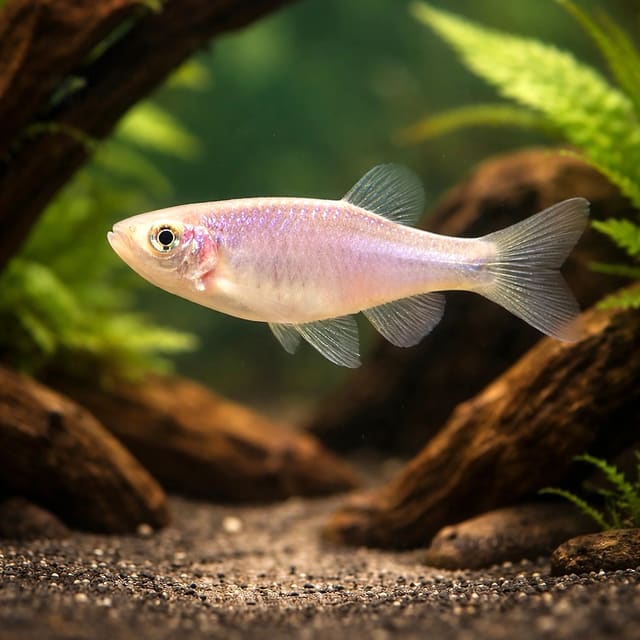
The Gold Harlequin Rasbora (Trigonostigma heteromorpha) is a golden danionid rasbora from the Malay Peninsula, Singapore and Indonesia, reaching a recorded maximum of 5 cm total length. It suits prepared newer keepers; keep eight or more in a mature, filtered 60-litre aquarium, using the FishBase and Seriously Fish overlap of 22–25°C and pH 5.0–7.0. Sold individually in 2,5 cm and 3 cm sizes.
Adult size is the maximum length this species reaches at full maturity (scientific sources). The livestock you receive will be younger and smaller — pick a size above for the actual shipping size. Product-photo provenance and any image-specific limitations are stated on the listing.
Trigonostigma heteromorpha
Shoaling fish: kept in a group they feel safer, stay calmer and show their best colour.
The Gold Harlequin Rasbora (Trigonostigma heteromorpha) is a golden danionid rasbora from the Malay Peninsula, Singapore and Indonesia, reaching a recorded maximum of 5 cm total length. It suits prepared newer keepers; keep eight or more in a mature, filtered 60-litre aquarium, using the FishBase and Seriously Fish overlap of 22–25°C and pH 5.0–7.0. Sold individually in 2,5 cm and 3 cm sizes.
Adult size is the maximum length this species reaches at full maturity (scientific sources). The livestock you receive will be younger and smaller — pick a size above for the actual shipping size. Product-photo provenance and any image-specific limitations are stated on the listing.
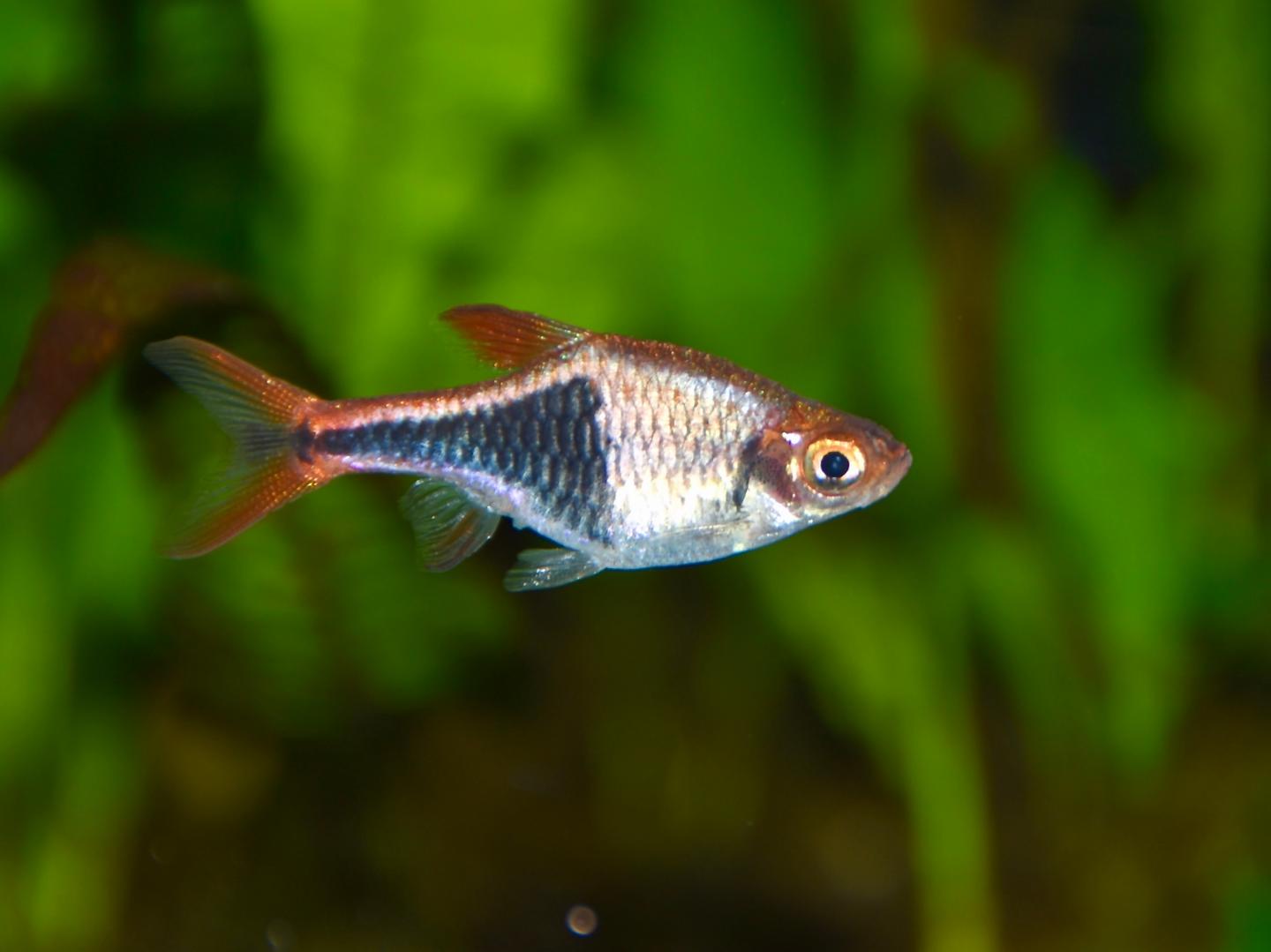
Our conservative starting policy is a mature, filtered aquarium at least 60 cm long and about 60 litres, eight or more fish, and measured water screened against 22-25 °C, pH 5-7 and 5-12 dGH.
Maintain these water conditions for optimal health and vibrant colors
The Gold Harlequin Rasbora (Trigonostigma heteromorpha) is a golden ornamental form of a peaceful freshwater fish in the danionid family. Its natural species range covers the Malay Peninsula, Singapore and Indonesia, and FishBase records a maximum of 5 cm total length. It suits a prepared newer keeper who can provide a mature, filtered aquarium, a proper social group and measured water rather than a small or newly established container.
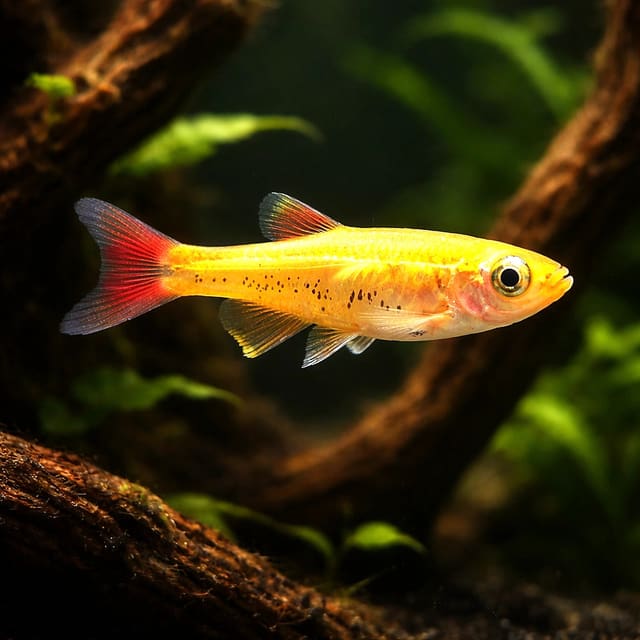
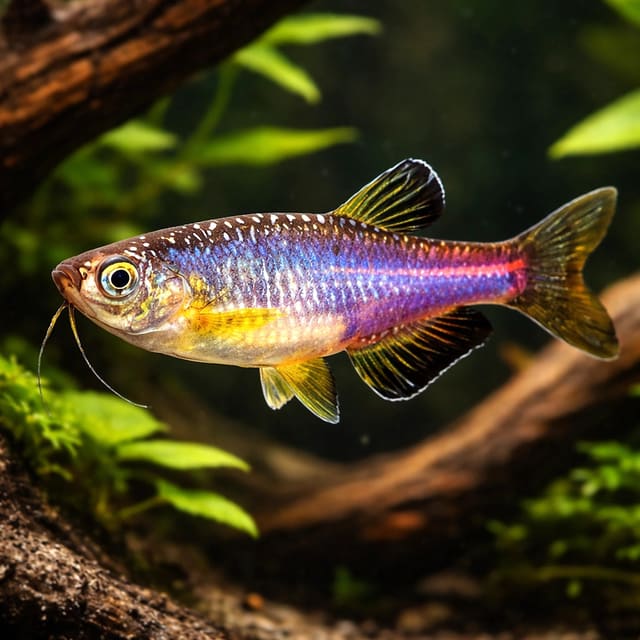
This is the gold, leucistic colour form of the Harlequin Rasbora. Seriously Fish identifies golden forms among the selectively bred ornamental strains and applies the same care as for the wild form. Colour depth and marking shape can vary between individual fish, so use the scientific identity, adult requirements and social needs when deciding whether it fits your aquarium.
Eschmeyer’s Catalog of Fishes places the accepted name in Trigonostigma. FishBase notes that it was previously known as Rasbora heteromorpha, which explains why the older combination still appears in aquarium literature. It is a rasbora, not a tetra.
Wild fish inhabit forest streams and have also been found in primary peat swamps in groups exceeding 100. Plan the aquarium around that social behaviour, with cover and open swimming room. The wild diet includes worms, crustaceans and insects.
Harlequin-like names should not be used by themselves to identify every similar fish. Tan’s revision of the group separates Trigonostigma truncata from true T. heteromorpha and uses several morphological characters rather than colour alone. Keep the binomial attached to the animal whenever identity matters.
Start with a mature, filtered aquarium at least 60 cm long and about 60 litres, then keep eight or more fish where the aquarium’s total capacity allows. The Tropical Fish Co Harlequin Rasbora care guide uses these figures as a conservative house screen. Keep the water at 22–25°C, pH 5.0–7.0 and 5–12 dGH; these values are the overlap of the FishBase and Seriously Fish species ranges.
| Suits | Not suited to |
|---|---|
| A mature, filtered aquarium at least 60 cm long and about 60 litres | A bowl, unfiltered container or short, unstable nano aquarium |
| A social plan for eight or more fish | Keeping one fish, a pair or a token group |
| Measured water within 22–25°C, pH 5.0–7.0 and 5–12 dGH | Water chosen by an assumed national tap-water type |
| Calm companions screened for adult size, temperament and feeding access | Boisterous tank mates, persistent fin-nippers or predators |
| A prepared newer keeper who understands cycling and testing | A keeper relying only on elapsed setup time |
Use the live size selector to choose 2,5 cm or 3 cm. One purchase quantity supplies one fish in the selected size. The size you select is the size supplied, not the adult size. Both dispatch sizes need the same final aquarium plan built around a group and the recorded 5 cm maximum total length.
Sex is guaranteed only when the selected option explicitly states male or female. This Gold Harlequin Rasbora listing has no sex-guaranteed option.
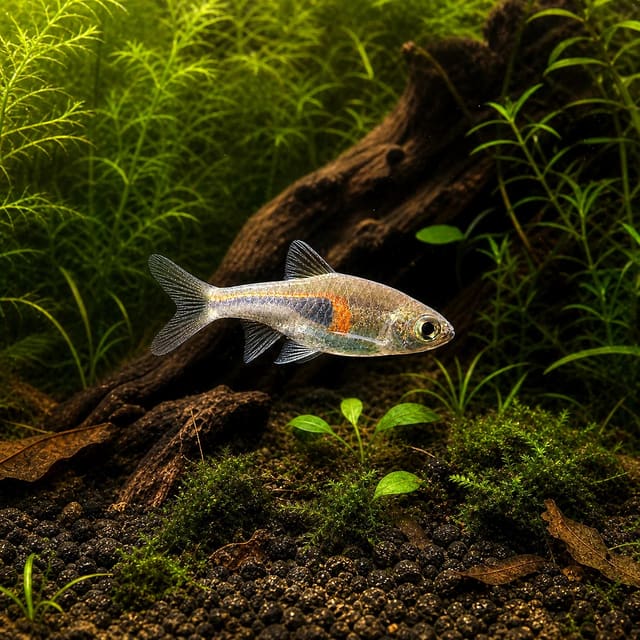
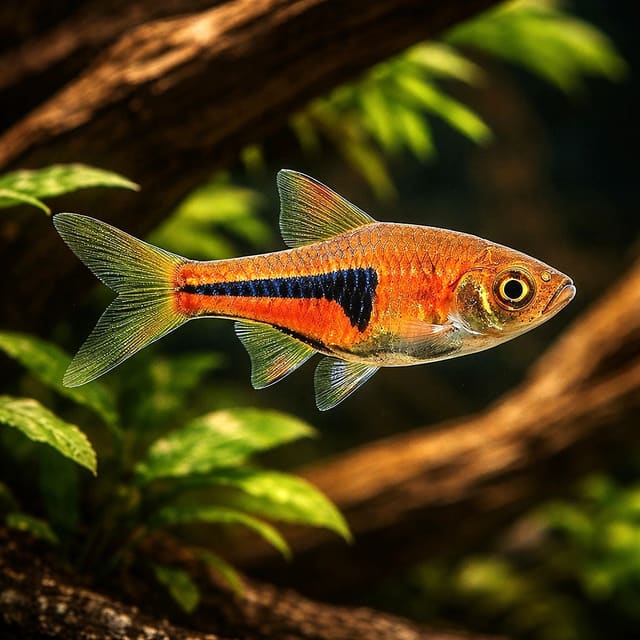
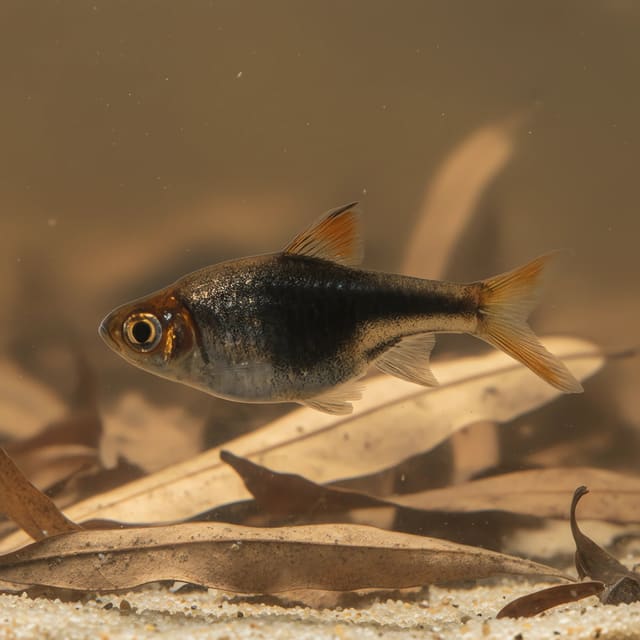
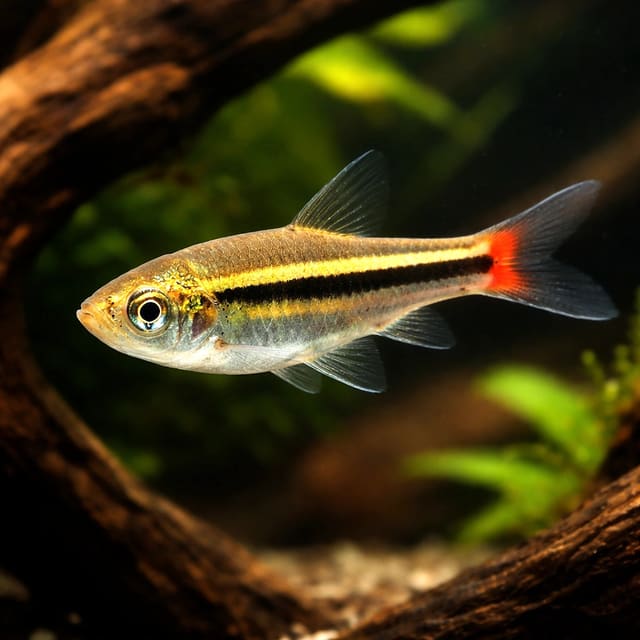
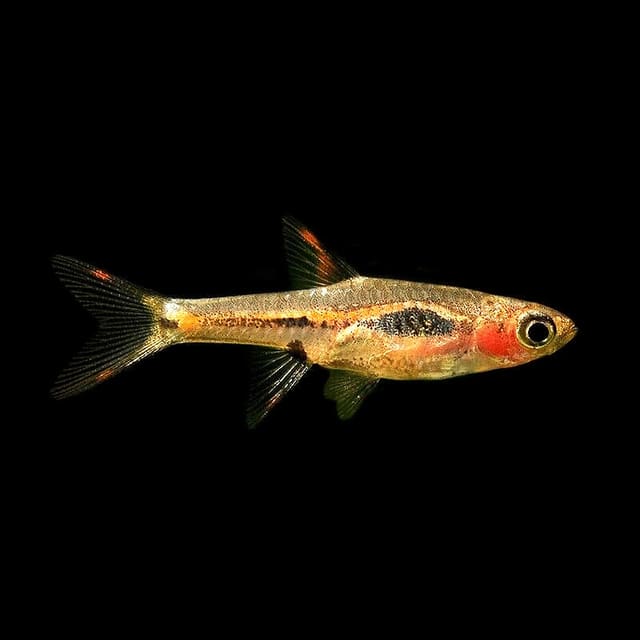
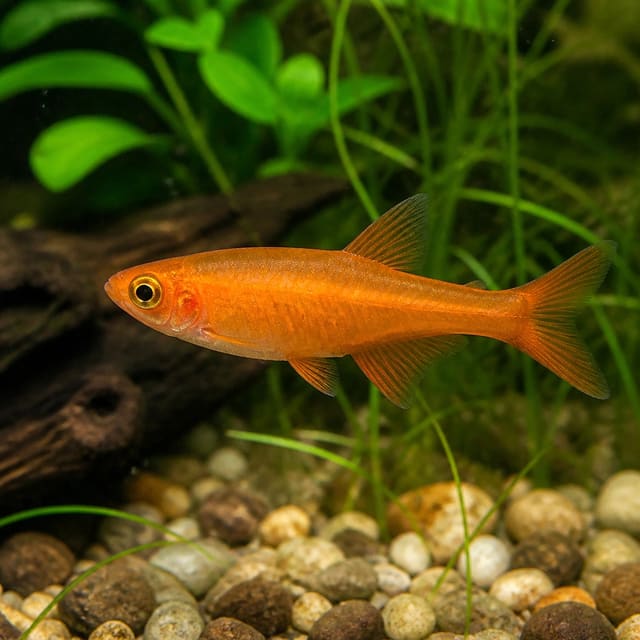
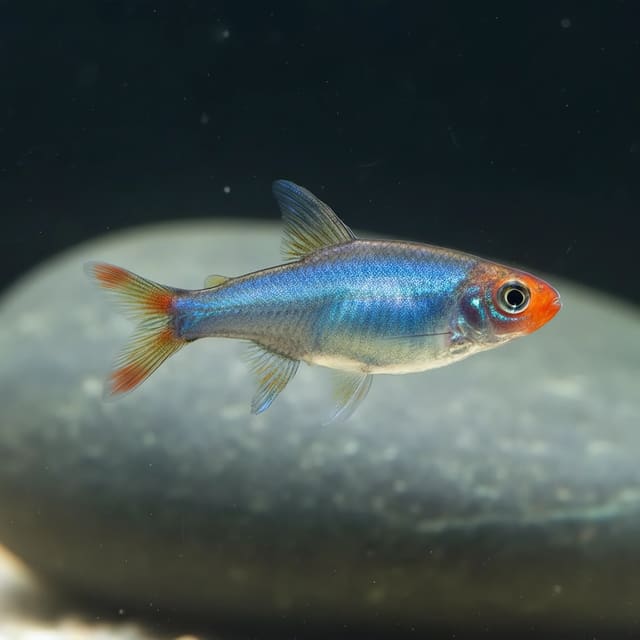
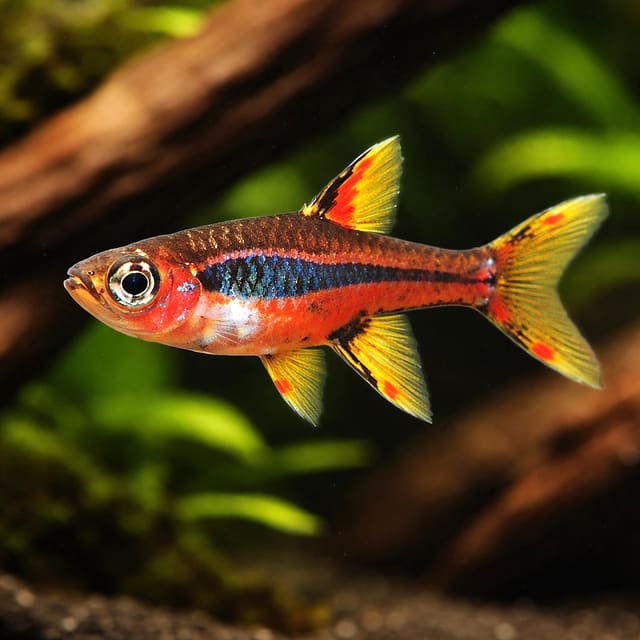
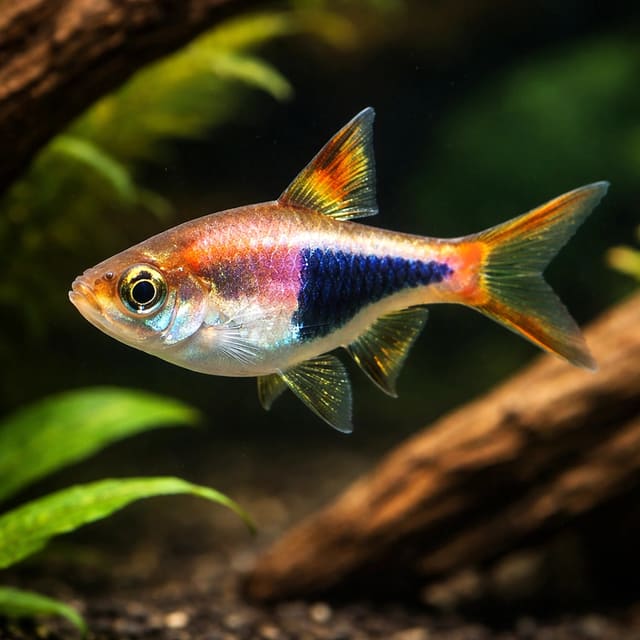
The gallery images are representative, based on reference photographs of this species, so colours can look slightly different from the live animal.
Our intermediate care label reflects the need to manage a mature biological filter, social stocking and measured water. Seriously Fish recommends the species to newcomers, so a prepared beginner can succeed when those foundations are already in place. You can also explore the rasbora and danio collection when comparing identities and adult requirements.
Plan for a maximum of 5 cm total length. FishBase records that figure for male or unsexed fish, and total length includes the tail fin. It is a recorded maximum rather than a promise that every individual will finish at exactly 5 cm.
Use the 5 cm total length, measured to the end of the tail fin, for space, stocking and companion decisions.
A small dispatch fish still needs the final 60 cm swimming length and approximately 60-litre plan. Do not treat a short aquarium as a temporary home on the assumption that there will be time to upgrade later.
Growth also changes compatibility. A companion that appears harmless when young may develop a mouth large enough to swallow a 5 cm rasbora, occupy more territory or dominate feeding. Recheck the full community whenever a resident grows, a group is enlarged or decor changes the usable swimming lane.
Watch body condition rather than trying to force rapid growth. A steady response to food, balanced swimming and normal participation in the group are more useful observations than comparing one fish with a fixed growth calendar. Reduced appetite, weight loss, isolation or unusual breathing should trigger water tests and a health check.
Use a mature aquarium at least 60 cm long and about 60 litres for the first group of eight. FishBase uses five or more fish and a 60 cm aquarium as reference floors, while Seriously Fish treats a 60 × 30 cm base of approximately 54 litres as the smallest to consider because the species should be maintained in numbers. Tropical Fish Co applies the more conservative starting screen of eight or more fish, 60 cm and about 60 litres.
Capacity is not determined by the label on the aquarium alone. Substrate, hardscape, internal filters and dense planting reduce usable space. Companions add waste, occupy swimming or territorial zones and compete for food. A nominal 60-litre aquarium that is short, crowded or biologically immature does not meet the plan simply because its advertised volume reaches the number.
| Check | Action |
|---|---|
| Fewer than eight planned | Increase the rasbora group before using capacity for unrelated companions |
| Less than 60 cm swimming length | Choose a longer aquarium rather than relying on height |
| About 60 litres with companions | Recalculate around every species’ adult size, group and territory |
| Food falls in one crowded point | Distribute small portions so the whole group can feed |
| Ammonia or nitrite is detectable | Stop adding livestock and restore biological stability |
Harlequin rasboras are social fish. FishBase records wild groups exceeding 100 in peat swamps, while OATA explains that rasboras kept singly or in groups that are too small often become stressed. Keep a meaningful group, and give the aquarium the filtration, swimming room and feeding access to carry every fish.
Add livestock gradually so the biological filter can adjust to greater waste and feeding. When practical, plan the intended rasbora group as one coherent stocking step after any quarantine, rather than maintaining a pair and repeatedly adding isolated newcomers. Confirm zero ammonia and zero nitrite before each increase.
Create cover around the sides and rear while preserving an open horizontal lane through the middle of the aquarium. Broad-leaved plants, finer planting and aquarium-safe wood can provide shaded areas and interrupt sight lines. Keep enough clear room for the whole group to turn, spread out and approach food.
Seriously Fish notes that the species often shows better colour in a well-furnished aquarium with a dark substrate. A more natural-looking arrangement can use soft sand, wood roots, branches and shady areas. Dried beech, oak or Ketapang almond leaves may also be used, but they are optional rather than essential.
Use gentle circulation and avoid forcing the fish to hold position continuously against a concentrated jet. At the same time, prevent stagnant corners where waste collects. Position the outlet so it circulates water through the open lane while leaving calmer areas near cover.
A working biological filter is essential. The RSPCA explains that beneficial filter bacteria convert toxic ammonia to nitrite and then to safer nitrate. Prove that the filter is mature through repeated test results rather than assuming that a fixed number of weeks has made the aquarium safe. The first tropical tank guide sets out the preparation sequence before livestock is introduced.
Leaf litter releases tannins and changes the appearance of the water as it breaks down. Add only aquarium-safe material from a traceable source, monitor pH and maintenance needs, and remove or replace leaves when that suits the aquarium plan. Do not use botanicals as a treatment.
Keep the aquarium at 22–25°C, pH 5.0–7.0 and 5–12 dGH. These routine values are the overlap of the FishBase and Seriously Fish species ranges, and Tropical Fish Co uses the same figures as its conservative house screen. Test the aquarium rather than relying on heater settings, water appearance or assumptions about local tap water.
OATA’s rasbora guidance is group-level, not a species-specific optimum, and advises 22–27°C, pH 6.5–8.0, 4–12 dGH, zero ammonia and zero nitrite. For this species, hold pH at 5.0–7.0 rather than moving towards pH 8.0.
Use a thermostatically controlled aquarium heater unless repeated measurements show that the aquarium remains at 22–25°C throughout the year. A heater dial is a setting, so confirm the actual water temperature independently. During warm weather, watch the measured maximum, breathing and surface movement because a heater cannot cool an aquarium.
There is no single UK tap-water chemistry. Test the water that will enter the aquarium, including any effect from domestic treatment. Avoid fixed recipes for mixing tap and reverse-osmosis water because starting GH, KH and product concentrations differ. The aquarium water chemistry guide explains what the measurements mean, and the water matcher can compare your measured results with the stated range.
If a value needs adjustment, make a measured plan and change it gradually. Do not chase a preferred number through repeated unmeasured additions. Stability inside the range, combined with zero ammonia and nitrite, is more useful than creating daily swings around a nominal target.
Use a suitably small, nutritionally complete aquarium food as the staple. FishBase records worms, crustaceans and insects in the wild diet, while Seriously Fish describes the species as a micropredator that also consumes zooplankton. Choose particles that each fish can swallow cleanly and distribute them across the group.
Good-quality flakes or small granules can provide the complete base diet. Offer regular meals of appropriately sourced small live or frozen foods such as bloodworm, Daphnia or Artemia alongside the staple for the best condition and colour. Do not collect live food from an unknown pond.
Feed only what the group can eat within a few minutes once a day. OATA gives that schedule for rasboras and warns that overfeeding leaves food to break down and release toxic waste. Observe the full group during the meal rather than judging the portion by what disappears from the surface.
Do not use colour intensity alone to judge nutrition. Lighting, background, stress and individual variation all affect appearance. Track body condition, appetite and water results together. A fish becoming thin despite approaching food may be unable to swallow the particles or may be losing access to stronger feeders.
Reassess portions whenever the group size, companion population or food type changes. A larger group needs food distributed across more fish, but it does not justify leaving excess in the aquarium. Keep the filter and maintenance routine capable of handling the chosen feeding plan.
Test ammonia and nitrite at least once each week and keep both at zero. OATA also strongly recommends, at least once every week, a 25% partial water change. Treat replacement tap water with conditioner to remove chlorine or chloramine before it enters the aquarium, and match temperature closely enough to avoid a sudden change.
Keep nitrate from rising more than 20 mg per litre above the normal tap-water level, following OATA’s rasbora guidance. Use test trends to decide whether the aquarium needs more frequent maintenance, smaller food portions or a lower total stocking load. A clear-looking aquarium can still contain harmful dissolved waste.
Normal behaviour varies between individuals, so learn how the settled group swims, feeds and uses cover. Warning changes include hanging at the surface, sitting on the bottom, erratic swimming, darker or paler colour, unusual hiding, changed aggression, faster or slower gill movement, spots, fluffy growths, damaged fins, lost scales, swelling, weight change or reduced feeding.
Use the RSPCA’s fish-health guidance to recognise health changes, and act promptly when behaviour or appearance changes. Test water first, then check heater operation, oxygenation, filter flow, recent maintenance, new livestock and aggression. These observations identify urgent risks without treating one sign as a diagnosis.
Do not add salt, raise temperature or use medicine from a generic symptom match. Different problems can look alike, and an unsuitable treatment can harm fish or biological filtration. Contact us about significant changes and seek qualified veterinary help when illness or injury requires diagnosis.
Prepare and test the mature aquarium before the fish travels, and be present to receive the parcel because live fish must not be left unattended. Keep the required group capacity, water range and separation plan ready rather than trying to correct the aquarium after arrival.
These steps come from the Tropical Fish Co delivery and Live Arrival Guarantee policy. Keep the order number and continuous unboxing video if a claim is required, and contact us the same day with both.
Quarantine new fish in a separate mature aquarium with dedicated equipment. The MSD Veterinary Manual recommends at least 30 days in professional biosecurity guidance, with longer periods where circumstances require. Maintain the same 22–25°C, pH 5.0–7.0 and 5–12 dGH screen, mature filtration and social welfare plan during quarantine.
Observe balance, breathing, fins, skin, body condition and feeding response each day. Test ammonia and nitrite rather than assuming a spare filter remains mature under a changing load. Keep nets, siphons and other wet equipment dedicated to the quarantine aquarium to reduce transfer between systems.
If disease is suspected, avoid moving shared wet equipment back to the main aquarium. Record water results, signs and recent changes so a professional can assess the pattern. OATA maintains a public fish-vet directory for keepers seeking qualified help.
Mature females are usually rounder-bellied and often a little larger than the slimmer, more colourful males. Seriously Fish also notes that the dark flank wedge tends to have a sharper outline in males and a rounder appearance in females. Treat these as mature tendencies rather than a dependable conclusion from one photograph, colour or dispatch size.
A 2026 comparative study found small dark breeding tubercles on the dorsal side of the pectoral fins in examined male T. heteromorpha. That close-examination research observation is not a practical basis for assigning the sex of every retail fish.
FishBase records eggs being placed on the underside of broad leaves and similar structures. Seriously Fish describes eggs attached to the underside of broad plant leaves or other objects rather than scattered randomly, and the pair spawns inverted beneath the leaves. The adults provide no parental care.
A densely planted, mature aquarium may occasionally produce small numbers of young, but a deliberate breeding project requires separate planning. Use a mature dedicated system, broad-leaved structures, controlled water and light, protection for eggs and larvae, appropriate first foods and permanent capacity for juveniles. Do not treat leaf posture or an inverted fish as proof that eggs have been laid.
Keep routine care focused on the social group rather than breeding. A fish does not need to reproduce to remain a suitable community resident. If spawning occurs unexpectedly, decide whether the aquarium can support fry without compromising water quality or adult feeding access.
Plan the species as a long-term commitment without relying on a fixed lifespan prediction. Stable water, mature filtration, suitable food, a proper group and prompt health action remain the practical decisions under the keeper’s control.
Choose companions by adult body and mouth size, measured water, temperament, social needs, feeding speed and total aquarium space. Gold Harlequin Rasboras are generally peaceful, but that description does not guarantee that another species or individual will be suitable.
Seriously Fish names other small cyprinids, tetras, livebearers, dwarf cichlids, catfishes and loaches as possible community categories. Each exact species still needs a separate comparison against 22–25°C, pH 5.0–7.0, 5–12 dGH, adult size and the available footprint. A category such as catfish covers animals with very different temperatures, sizes and social requirements.
Keep these fish apart even when the aquarium is heavily planted. Cover can interrupt sight lines and offer retreat, but it does not change a predator’s mouth size, remove a fin-nipping pattern or create extra biological capacity.
| What you see | What to do |
|---|---|
| Repeated stalking or chasing | Separate the conflicting animals before injury develops |
| Rasboras remain hidden at feeding time | Check companion activity, food access and group space |
| Torn fins or missing scales | Separate and assess the injured fish promptly |
| One species takes all food | Change distribution and reconsider the combination |
| Water falls outside either species’ range | Do not keep the combination together |
Prepare a mature backup aquarium before trying any combination with uncertain individual behaviour. Compatibility can change as fish grow, enter breeding condition or occupy rearranged territory. Recheck the plan after every meaningful change instead of relying on the fact that the first few days appeared calm.
A betta may coexist with a Gold Harlequin Rasbora group, but individual bettas vary. The aquarium must provide compatible measured water, enough room for the betta’s surface territory and the rasboras’ midwater swimming, visual cover and fair feeding access.
Watch for stalking, repeated flaring, chasing, torn fins, persistent hiding or missed meals. Separate promptly if either fish cannot use the aquarium normally. Do not add a betta without a mature alternative home ready, because temperament can change as territory develops.
Adult Amano shrimp or larger Neocaridina shrimp may coexist, but small shrimp and shrimplets can be eaten. No fish is completely shrimp-safe, and dense plants cannot guarantee survival. Compare the shrimp’s mineral requirements with the rasbora range of pH 5.0–7.0 and 5–12 dGH before combining them.
If the aim is reliable shrimp reproduction, a fish-free shrimp aquarium removes predation by rasboras. If adults are being considered for a community, provide suitable cover, confirm feeding access and accept that vulnerable young may be lost.
A mixed community can work without representing one geographic habitat. Describe it as a community built around overlapping needs, not as a precise biotope unless every animal, plant, material and water condition genuinely fits that claim.
FishBase records a maximum of 5 cm total length, including the tail. Use 5 cm for adult space and companion planning, without assuming every individual will reach exactly that length.
Start with a mature, filtered aquarium at least 60 cm long and about 60 litres for the first group of eight. Add capacity when companions increase waste, territory or feeding competition.
Keep eight or more under Tropical Fish Co’s conservative house policy. FishBase gives five or more as a reference floor, but the aquarium must have room, filtration and feeding access for the full group.
Seriously Fish recommends it to newcomers, while Tropical Fish Co rates its care intermediate because it needs mature filtration, measured water and planned social stocking. It suits a prepared newer keeper who understands those tasks.
Use a suitably small complete aquarium food as the staple, with small live or frozen bloodworm, Daphnia or Artemia for variety. Feed only what the group eats within a few minutes once daily.
Keep it at 22–25°C, pH 5.0–7.0 and 5–12 dGH. These values are the overlap of the FishBase and Seriously Fish species ranges and match Tropical Fish Co’s conservative house screen.
It is generally peaceful. Avoid persistent fin-nippers, highly territorial fish, boisterous tank mates and fish capable of swallowing a 5 cm rasbora; separate any combination that develops repeated chasing or injury.
Screen small cyprinids, tetras, livebearers, dwarf cichlids, catfishes and loaches individually for matching water, adult size, temperament and space. Bettas need individual assessment, while small shrimp and shrimplets may be eaten.
Start filming the sealed parcel as soon as it is in your hands, before opening it or floating the bag. Fish are hand-bagged in pure oxygen and packed in an insulated box, with a heat pack when the weather calls for it. Be present to receive the parcel, open and inspect it the same day, float the bag for 20–30 minutes before releasing the fish, and contact us the same day with the order number and continuous video if a Live Arrival Guarantee claim is needed.
No reviews for this item yet. Bought one? Honest reviews only, good or bad.
What customers say about ordering from us
I have a small group of long finned mountain minnows. So was delighted to be able to order ten of this variety to increase the genetics in my tank . The ones I recieved are healthy but it’s to early to give a verdict on wether they are of a long finned type since they are small currently.
Gordon Walker · 23 Sept 2026
100% success travel and "installation". Pleased with quality of purchase. The Siamese fighter a bit "shy" so have not yet seen him at his best yet but looking good. Happy customer. GG
George E Garratt · 21 Sept 2026
Reviews of our shop, collected by Judge.me, an independent third-party review collector. Newest first.