Dwarf Rasbora (Boraras maculatus)
24–26°C · pH 5–6
£4.99

One unsexed Phoenix Rasbora (Boraras merah) per selected quantity, in the supplier's approximate 1.5-2 cm dispatch grade. Keep at least eight, preferably ten or more, in a mature planted aquarium with a 45 x 30 cm or larger footprint, stable soft water, gentle flow and very small foods; Chili and Dwarf Rasboras are separate species.
Boraras merah
Shoaling fish: kept in a group they feel safer, stay calmer and show their best colour.
Minimum of 2 per order.
One unsexed Phoenix Rasbora (Boraras merah) per selected quantity, in the supplier's approximate 1.5-2 cm dispatch grade. Keep at least eight, preferably ten or more, in a mature planted aquarium with a 45 x 30 cm or larger footprint, stable soft water, gentle flow and very small foods; Chili and Dwarf Rasboras are separate species.
Maintain these water conditions for optimal health and vibrant colors
Phoenix Rasbora (Boraras merah) is a minute red-and-black freshwater fish for a mature, quiet and densely planted aquarium. Published records place the species in western and southern Borneo, where tiny fishes live among shaded forest water, submerged roots, leaf litter and other fine cover. Its adult body remains very small, but its care is not simply a matter of choosing the smallest tank: stable soft water, tiny food, a proper social group and freedom from larger or boisterous tank mates all matter.
Each selected quantity is one unsexed live fish in the supplier's approximate 1.5-2 cm dispatch grade. It is not a pair, a fixed shoal or a guaranteed male or female. Use the live quantity control for the number required, and plan the complete group before ordering. The centimetre band is a living trade grade rather than a millimetre guarantee; it does not certify age, maturity, sex or final colour.
Phoenix Rasbora is offered here as Boraras merah, also listed in the trade as Rasbora merah. This listing does not guarantee a collection locality, breeder, wild/captive origin, lineage, sex ratio or batch photograph. Those limits are stated because closely related Boraras are often mixed in aquarium lists. This page keeps Chili Rasbora and Dwarf Rasbora as comparison species, not alternative names for the fish supplied.
| Listing detail | What it means |
|---|---|
| Sale unit | One unsexed live fish per selected quantity |
| Supplier grade | Approximately 1.5-2 cm at dispatch |
| Group status | Not a pair or fixed pack; select enough individual fish for the intended social group |
| Scientific identity | Boraras merah (Kottelat, 1991) |
| Batch provenance | No breeder, collection locality, wild/captive origin or lineage supplied |
| Sex | Not selected or guaranteed |
| Current availability | Check the live quantity selector before ordering |
| Gallery | One source-backed representative and four representations; none is the exact fish supplied |
Living fish vary in body condition, colour and marking strength. Transported individuals can be pale, and juveniles may not show the contrast seen in a settled adult. The supplier grade is the useful dispatch reference. Do not use one photograph to promise a particular sex, stripe, blotch shape or exact shade of red.
| Care point | Evidence-led planning guidance |
|---|---|
| Common name | Phoenix Rasbora; Rasbora merah is also used in the trade |
| Scientific name | Boraras merah, family Danionidae in current FishBase placement |
| Published adult size | Up to 2.0 cm standard length; standard length excludes the tail fin |
| Aquarium footprint | At least 45 x 30 cm, with a larger mature footprint preferred for a substantial group or community |
| Temperature | About 25-28°C as a practical specialist-care range; avoid rapid change |
| pH | About 5.0-7.0, stable and matched gradually from the holding water |
| Hardness | Very soft to moderately soft water, roughly 1-8 dGH as a planning range |
| Group | At least eight, with ten or more preferred where footprint, filtration and feeding allow |
| Diet | Very small prepared foods plus frozen or cultured micro-foods |
| Care level | Moderate: tiny mouth, soft-water preference and sensitivity to unstable new aquariums need attention |
These aquarium values are not a claim that this batch came from one measured locality. Natural peat-swamp water can be more acidic and mineral-poor, but copying an extreme pH without the buffering, testing and preparation to keep it stable creates unnecessary risk. Test the actual aquarium and ask for current holding-water information when available.
| A good match when... | Choose another fish when... |
|---|---|
| The aquarium is mature, cycled and biologically stable | The tank has just been filled or is still showing ammonia or nitrite |
| You can provide a proper group and a 45 x 30 cm or larger footprint | You want one or two fish for a tiny unheated container |
| Water is soft or can be prepared to a repeatable recipe | The only aquarium is deliberately hard and alkaline for Rift Lake fish or hard-water livebearers |
| Food can be crushed or selected to fit a very small mouth | Fast tank mates consume every particle before the rasboras can feed |
| The layout offers fine plants, shade and gentle flow | The aquarium is bright, bare or driven by strong current |
A small adult size does not make the species disposable, solitary or maintenance-free. A well-planned group in a stable planted aquarium can be an excellent choice for a careful newer keeper, but a newly set-up nano tank leaves little room for mistakes. Use our small tropical fish guide to compare adult size with the less obvious demands of water stability, feeding and social behaviour.
FishBase records Boraras merah as a valid tropical freshwater species described by Kottelat in 1991. It places the species in western and southern Borneo and gives 2.0 cm as the maximum recorded standard length. Phoenix Rasbora is the useful English aquarium name; Rasbora merah and Phoenix Dwarf Rasbora can also appear in trade lists.
The genus name is important because these fishes were historically placed in Rasbora. The modern combination is Boraras merah, not Rasbora merah, although the older-style trade wording remains understandable. Merah means red in Indonesian and refers to the warm body colour. Scientific names distinguish the species and should not be treated as interchangeable trade names.
The 2013 catalogue of Southeast Asian inland fishes gives the type locality in the Jelai Bila basin of Central Kalimantan. It also discusses why aquarium-trade fish can be difficult to assign from colour alone: known-locality material showed sex-linked spotted and striped patterns, and the real origin of traded stock is often uncertain. The fish is listed as B. merah, without a locality, lineage or guaranteed pattern for the present batch.
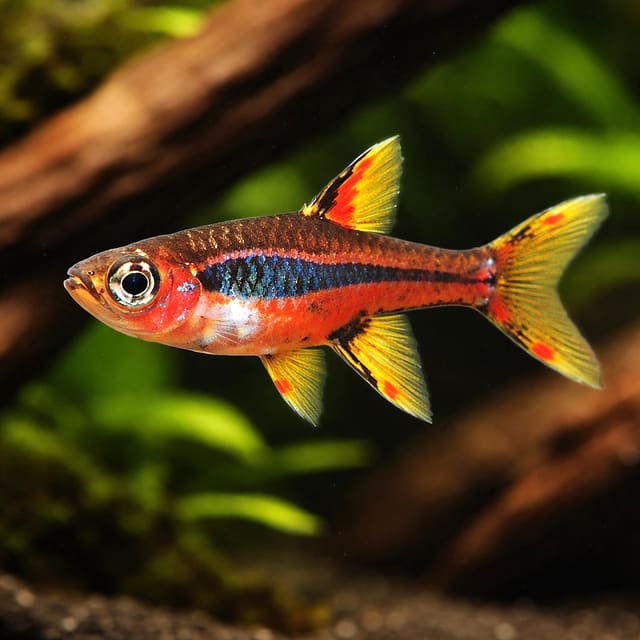
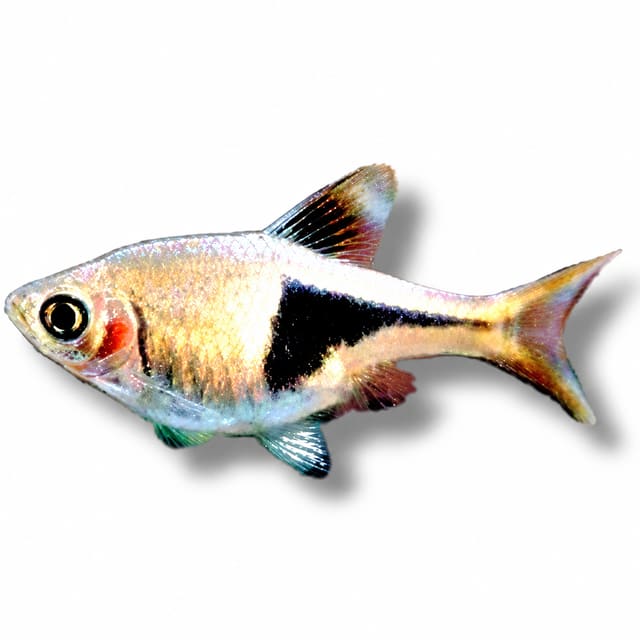
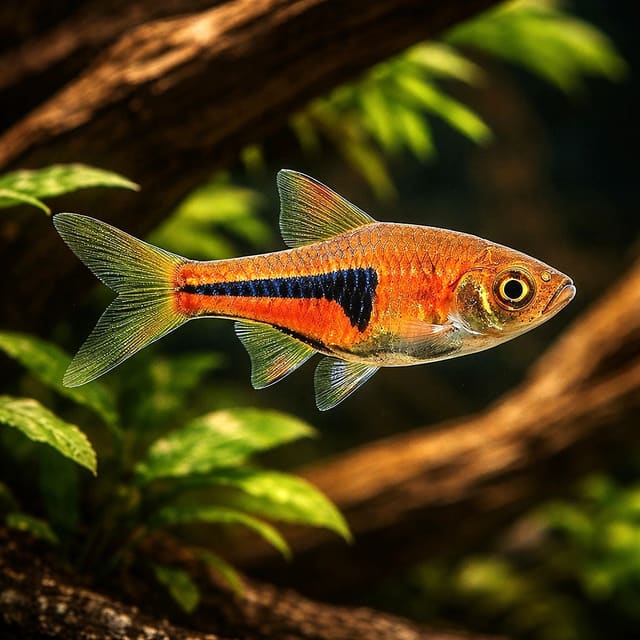
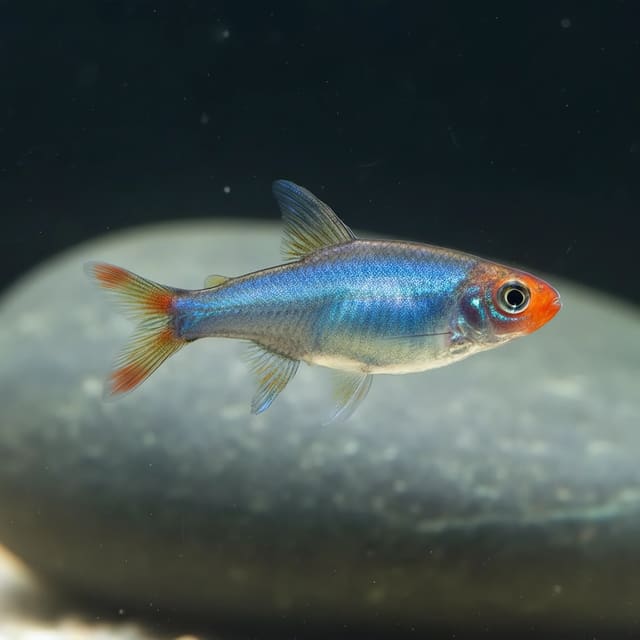
The complete gallery contains five images. The first is a product-specific historical photograph from the former stock source. It shows a small Boraras on a black background with a dark flank blotch and warm lateral colour. It supports the listed identity, but it is not a photograph of the current batch or the exact fish that will be dispatched.
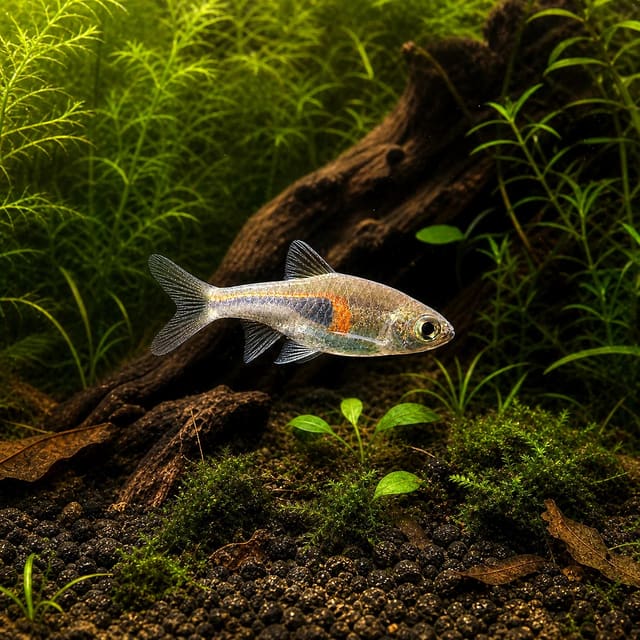
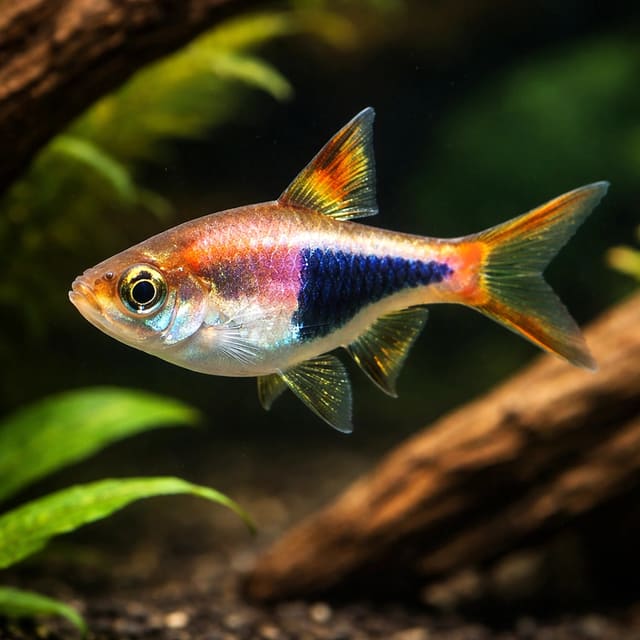
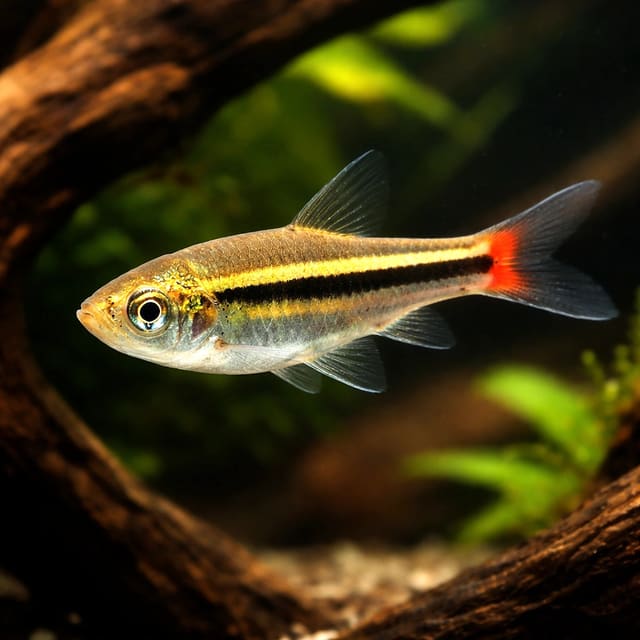
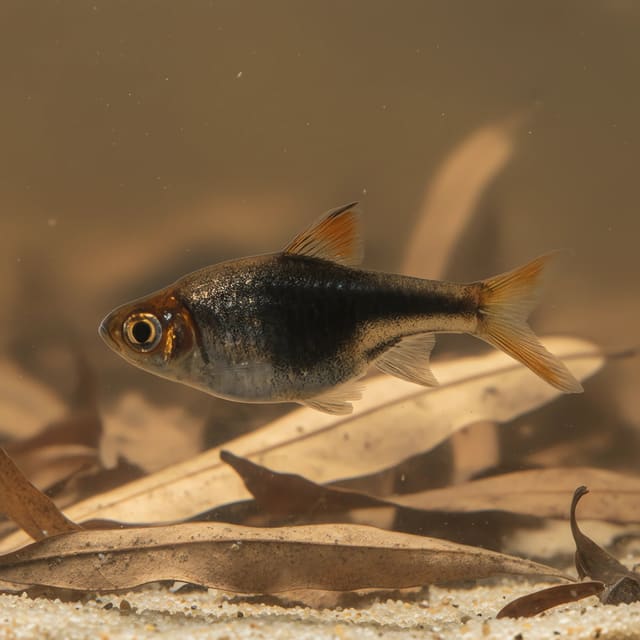
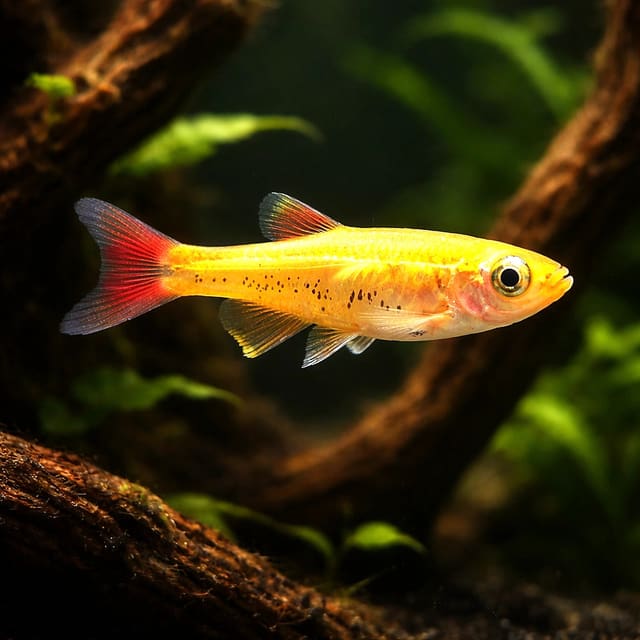
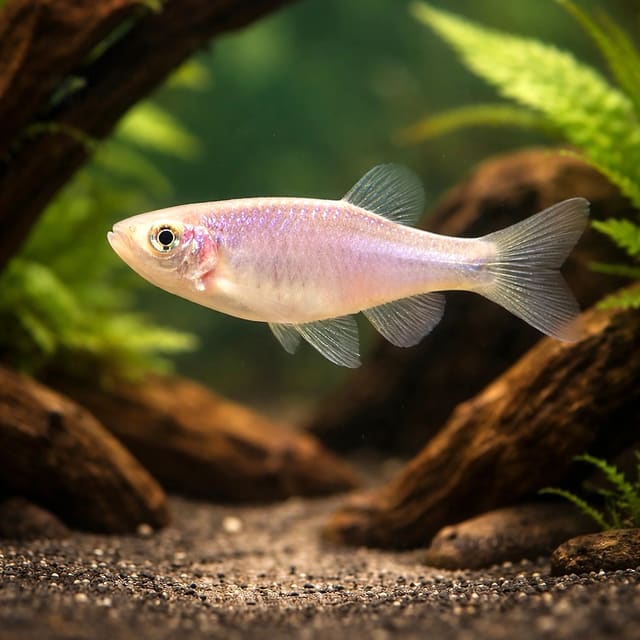
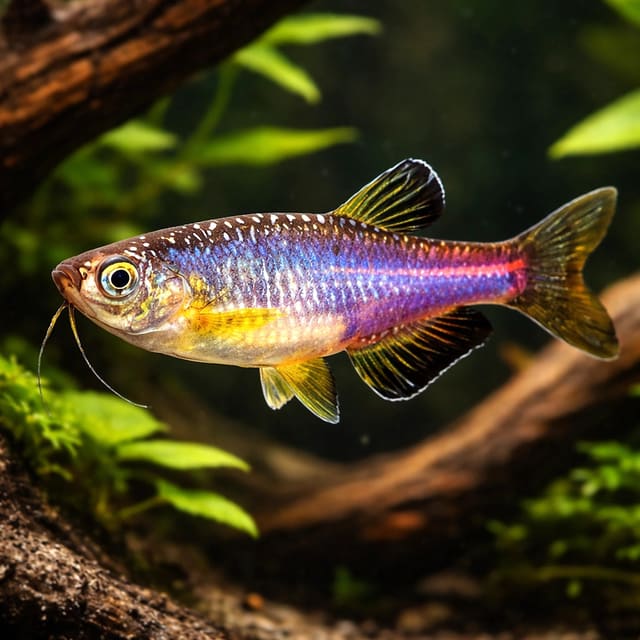
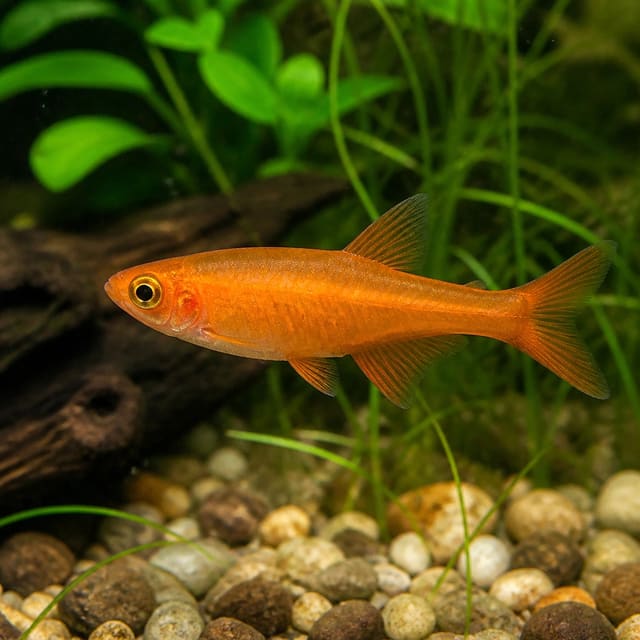
The remaining four images are site-owned representations: a planted driftwood scene, a two-fish shoal context, a clean side view and a plant-scale scene. They help customers visualise the general body plan and aquarium context, but eye, scale, fin and colour details in these images are not diagnostic. The two-fish image does not mean that one selected quantity is a pair, and the leaf does not provide a measured size reference.
The gallery keeps the source-backed photograph first and the four views after it. The image descriptions identify which is which. Compare the complete set with the written identity and selected dispatch grade rather than expecting every living fish to match one pose or colour intensity.
FishBase gives a maximum of 2.0 cm standard length. Standard length is measured from the front of the snout to the base of the tail fin, so the complete fish looks slightly longer when the caudal fin is included. The supplier's 1.5-2 cm band is an approximate living dispatch grade and may therefore include individuals approaching the published adult body length, but it does not certify maturity.
| Measurement | Use it for | Do not infer |
|---|---|---|
| Supplier 1.5-2 cm grade | Approximate size of the living fish at dispatch | Exact millimetres, age, sex or reproductive condition |
| 2.0 cm maximum standard length | Published species-level adult body reference | A guaranteed maximum total length for every individual |
| Gallery image | General body shape and marking context | Measured scale, batch identity or final colour |
| Group photograph | How small fishes may look together in plants | A pair, sex ratio or fixed pack size |
Tiny fish still need swimming length and social space. Tank planning should be based on the group, plant structure, feeding access and water stability, not on multiplying a single fish's body length by a simplistic litres rule. Check the real dimensions with the tank-volume tool; footprint is more informative than litres alone for this active midwater species.
Published distribution covers western and southern Borneo. The type locality lies in Central Kalimantan, and specialist habitat accounts associate the species with blackwater streams and rivers linked to old forest peat swamps. Decomposing leaves, branches and other plant material release tannins and organic acids, staining the water brown. Overhead forest and dense marginal vegetation reduce glare, while roots and litter create countless small refuges.
This context explains the aquarium priorities. The fish benefits from shade, fine cover, gentle water movement and very clean water with low mineral content. It does not mean that the aquarium should be dirty or oxygen-poor. A blackwater-style display still needs mature biological filtration, gas exchange and controlled waste. Botanicals are habitat structure, not permission to leave decaying food or unstable water unattended.
FishBase reports the 2019 IUCN assessment as Data Deficient. That category does not mean the species is secure; it means available information was insufficient for a more precise extinction-risk assessment. Peat-swamp and heath-forest habitats face drainage, fire, agriculture and development pressures. Because the supplier has not supplied origin documentation, this listing does not claim that the current fish are wild-caught, captive-bred or collected from the type locality.
A base of at least 45 x 30 cm is the specialist planning minimum used here. That footprint gives a social group room to move, allows dense cover without filling every swimming route and provides more stable water than an ornamental desktop cube. A larger, mature aquarium is preferable for a group above the minimum or for any community. Height is less valuable than usable length, cover and consistent water quality.
| Plan | Practical starting point | Reason |
|---|---|---|
| Species-focused group | 45 x 30 cm footprint or larger, mature and densely planted | Balances swimming room, cover and stability |
| Ten or more fish | Use the minimum footprint only with disciplined stocking and filtration; larger is easier | A larger group needs more feeding space and oxygen |
| Micro-community | Increase footprint and plant structure beyond the species-only plan | Tank mates consume swimming, retreat and food resources |
| Breeding project | Separate mature spawning and fry-rearing accommodation | Eggs and minute fry are vulnerable to adults and tank mates |
Place fine plants and moss along the rear and sides, then retain a shaded open lane where the group can be observed and fed. Floating plants soften direct light. Dark substrate and a dark background often make translucent red-orange fish easier to see. Use a close-fitting lid because small fish can jump through surprisingly narrow gaps, especially after transport or during maintenance.
A practical aquarium range is about 25-28°C, pH 5.0-7.0 and roughly 1-8 dGH. Natural blackwater may be more acidic and nearly mineral-free, but a home aquarium at the edge of that chemistry has little buffering capacity. For most keepers, a repeatable soft-water recipe in the moderate part of the range is safer than repeatedly dosing chemicals to chase pH 4.
| Measurement | Planning range | Important caution |
|---|---|---|
| Temperature | About 25-28°C | Use a reliable heater and independent thermometer; avoid rapid change |
| pH | About 5.0-7.0 | Do not force acidity with repeated unmeasured dosing |
| GH | Approximately 1-8 dGH | Very hard water is a poor default; prepare any RO blend consistently |
| Ammonia | 0 mg/l | Any detectable reading needs immediate investigation |
| Nitrite | 0 mg/l | Never use these fish to test an uncycled tank |
| Nitrate | Low and consistent | Control through measured feeding and regular water changes |
Test tap water before committing to the species. If it is very hard, use reverse-osmosis water only with a planned remineralisation or blending method; pure RO without appropriate minerals is not automatically safe. Record the recipe so each water change is similar. The water-matcher tool can help compare a proposed community, but actual test results and gradual acclimation remain essential.
Use a mature sponge filter or a well-baffled filter with a guarded intake. The group should not have to swim continuously against a forceful jet, and no fish should be able to enter an intake gap. Gentle flow does not mean poor oxygenation: keep the surface moving, maintain the filter and avoid letting floating plants seal the whole surface.
Nano aquariums respond quickly to overfeeding, dead plant matter and blocked filters. Complete small, regular water changes using prepared water of closely matched temperature and chemistry. Siphon obvious debris from open feeding areas, but do not sterilise every surface or replace all biological media at once. Rinse media gently in removed aquarium water when flow begins to fall.
Observe the group for several minutes after maintenance. Gasping, clamped fins, sudden hiding or frantic movement can reveal a temperature, chlorine, pH or oxygen problem before a test kit is opened. A stable routine should feel uneventful. Large corrective changes are sometimes necessary in an emergency, but they should not be the normal way the aquarium is managed.
Fine-leaved stems, mosses, floating plants and branching roots give cover at the fish's scale. Plants such as Java moss, Taxiphyllum, Ceratopteris and fine Rotala or Limnophila can create sheltered edges while leaving a central feeding lane. Attach epiphytes to smooth wood and secure every piece of hardscape before fish are introduced.
Leaf litter and small botanicals can add tannins, microbial grazing surfaces and visual shelter. Add them gradually to a mature aquarium and watch pH, oxygen and decomposition. Replace or remove material if it becomes a heavy waste trap. A thin, managed layer is easier to inspect than a deep bed in which uneaten food disappears.
Bright aquascape lighting can be used for plants if floating cover and shaded retreats remain available. Increase light gradually and provide a regular dark period. The fish should be able to leave the brightest area at any time. A layout that allows choice usually produces calmer swimming and stronger settled colour than an exposed display built only for photographs.
The mouth is small enough that ordinary community flakes and pellets may need crushing. Use a high-quality micro granule or finely rubbed flake as a measured staple, then rotate appropriately sized frozen or clean cultured foods. Cyclops, small daphnia, microworms and newly hatched Artemia can improve feeding response and condition when they are small enough to swallow.
| Food | Role | How to use it |
|---|---|---|
| Fine micro granule or crushed quality flake | Measured staple | Offer a tiny amount that remains in the upper and middle water long enough to be eaten |
| Frozen cyclops or small daphnia | Variety and feeding enrichment | Thaw, portion carefully and avoid adding excess thaw water |
| Newly hatched Artemia or microworms | Conditioning and natural hunting response | Use clean cultures and suitable particle density |
| Oversized pellets or large bloodworm | Poor fit | Do not expect the fish to tear food intended for much larger species |
| Uneaten food on the floor | Warning sign | Reduce the portion, crush more finely or protect the group from faster feeders |
Feed small portions once or twice daily according to body condition and aquarium maturity. Watch the group eat instead of relying on the amount placed in the tank. A gently rounded abdomen after feeding is useful; persistent hollow bellies, spitting or withdrawal from food need investigation. In a community, spread tiny food through more than one area so one fast species cannot intercept everything.
This is a social micro-fish rather than a solitary display animal. Keep at least eight, with ten or more preferred where the aquarium can support them. A larger group spreads attention, increases confidence and gives a more natural pattern of loose grouping, short displays and movement between cover. Buying two or three does not create a stable social unit.
The word shoaling is more accurate than promising a tight school at all times. Secure fish may spread through the planted area and regroup when startled. Mature males can show stronger colour and may defend very small temporary display spaces around spawning, but this is not comparable with sustained cichlid territory. Dense structure lets subordinate fish move away without leaving the whole aquarium.
Group size cannot compensate for an undersized or unstable tank. Twelve fish in a well-run larger layout may be easier to manage than eight in a crowded decorative cube, but adding fish beyond filtration and food capacity is not beneficial. Select the group according to the finished aquarium, not according to a temporary juvenile holding plan.
Choose tiny, calm species that share soft-water conditions and do not dominate feeding. The rasbora and danio hub is useful for browsing, but every candidate still needs an adult-size and behaviour check. A species-only group is often the clearest and safest display at the minimum footprint.
| Candidate | Assessment | Main question |
|---|---|---|
| Other small Boraras | Possible in a larger specialist aquarium | Can the species be distinguished, fed and kept in adequate groups? |
| Small pencilfish or gentle micro-rasboras | Possible with exact chemistry overlap | Will they outcompete the smaller fish at meals? |
| Dwarf Corydoras | Conditional in a larger footprint | Is there enough floor area, food separation and oxygen? |
| Adult dwarf shrimp | Possible but not risk-free | Do water needs overlap, and is loss of shrimplets accepted? |
| Larger tetras, barbs, gouramis or cichlids | Avoid at the minimum plan | Can they swallow, chase or intimidate a 2 cm fish? |
Compare the separate Dwarf Rasbora, Mosquito or Chili Rasbora and Strawberry Rasbora listings rather than assuming the names describe one interchangeable fish. No named tank mate is automatically safe. Adult size, temperature, hardness, food size, swimming speed and individual behaviour all have to overlap.
Adult dwarf shrimp may coexist in some planted aquariums because the fish are extremely small and not equipped to tackle a healthy adult. That is not a guarantee for eggs, newly hatched shrimplets or weakened animals. Any fish capable of eating moving micro-food can investigate tiny offspring. Provide moss and dense cover if this risk is accepted.
Water chemistry may be the greater conflict. Some Neocaridina lines tolerate moderately soft water, while many snails need more available calcium than an acidic peat-style aquarium provides. Shell erosion is a warning that a snail is being kept outside suitable conditions. Do not harden the aquarium abruptly for a snail while stressing the fish, or acidify a shrimp aquarium without understanding mineral needs.
Small peaceful snails can be useful where chemistry overlaps, but they still add waste and consume food. Quarantine plants and invertebrates where practical, avoid copper exposure and never treat the entire display casually. Medication choice should account for every animal in the tank.
A Phoenix Rasbora can show a translucent to warm red-orange body, a darker blotch or broken stripe on the flank and additional small dark markings toward the tail. Colour changes with sex, maturity, genetics, background, light, social confidence, food, stress and transport. A pale arrival can colour up after several quiet days without becoming identical to a saturated adult photograph.
Kottelat's catalogue is particularly useful here because it describes spotted females and more striped males in known material, while also warning that traded origin is uncertain. Mature males may be slimmer and more strongly coloured; females may be fuller-bodied and retain a spotted pattern. These are contextual tendencies, not a reliable promise for a juvenile-sized unsexed sale.
Do not identify this product as Chili Rasbora solely because one individual develops a stronger stripe, and do not call it Dwarf Rasbora solely because another looks spotted. Diagnostic work uses provenance, morphology and comparison, not one image or a stressed shipping colour. The product identity is based on our stock records plus accepted species references, with the batch limitations made visible.
Specialist aquarium accounts describe Boraras as small egg scatterers without parental care. Well-conditioned adults may release small numbers of eggs among moss or fine plants, and adults or other fish can eat the eggs and minute fry. This listing does not supply sexed, paired, mature, locality-certified or breeding-ready fish.
A deliberate project needs a mature separate aquarium, very soft stable water, dim light, fine cover and cultures of truly minute first food. Newly hatched fry can be too small for Artemia at first, so infusoria and other microscopic foods may be needed before larger live food. Raising fry also requires steady water quality without abrupt cleaning or feeding excess.
Do not buy two unsexed fish and assume they will form a productive pair. Build a healthy social group first, observe mature condition and keep lineage records if breeding is attempted. Conservation value depends on accurate identity and provenance, not simply producing red micro-fish under an uncertain label.
Prepare the aquarium before dispatch. Confirm zero ammonia and nitrite, stable temperature, covered intakes, a secure lid and gentle flow. Dim the room and aquarium before opening the parcel. Inspect the bag without exposing it to strong light, and photograph any genuine arrival concern while the bag remains sealed so the current guarantee process can be followed.
Temperature equalisation is only one part of acclimation. Water chemistry can differ, particularly for a soft-water fish. Use the new-fish acclimation guide and acclimation timer, adjusting the pace to the actual difference and condition of the fish. Avoid leaving an opened shipping bag warm and aerated for an unnecessarily long period, because shipping-water chemistry changes after opening.
Transfer the fish without adding transport water to the display where possible. Keep lighting low for the rest of the day and offer only a very small, correctly sized first meal after the group has settled. During the first week, watch breathing, posture, grouping, appetite and body condition. Avoid major aquascaping, new tank mates and rapid chemistry changes while the fish recover from transport.
| Observation | Check first | Response |
|---|---|---|
| Pale colour after arrival | Transport stress, bright light and lack of cover | Dim the tank, keep conditions stable and judge recovery over several days |
| Rapid breathing | Temperature, oxygen, ammonia, nitrite and recent acclimation | Test immediately and improve gas exchange without creating violent flow |
| Persistent hiding | Group size, aggressive tank mates, exposure and current | Add safe cover, remove pressure and review the social plan |
| Food is chased then spat out | Particle size and hardness | Crush more finely or change to a suitable micro-food |
| Hollow abdomen | Food access, parasites and chronic stress | Observe individual feeding and seek aquatic-veterinary guidance if it persists |
| White spots or damaged fins | Quarantine history, water quality and bullying | Confirm the problem before medication; do not dose by guesswork |
Small body size means decline can become serious quickly. Keep a quarantine or hospital plan, but avoid catching tiny fish repeatedly without cause. If treatment is needed, calculate the real water volume, check the active ingredient and account for shrimp, snails, plants and biological filtration. Seek a fish-experienced veterinary professional for unexplained losses or persistent symptoms.
| Aquarium name | Scientific identity | How it is used here |
|---|---|---|
| Phoenix Rasbora | Boraras merah | The product identity supported by our stock records |
| Chili or Mosquito Rasbora | Boraras brigittae | A separate Bornean species used only for comparison |
| Dwarf Rasbora | Boraras maculatus | A separate species, not an alternative identity for this product |
| Strawberry Rasbora | Boraras naevus | A separate spotted micro-rasbora |
Care overlaps because all are miniature fishes needing small food, calm tank mates and thoughtful group management. Overlap does not make the names synonyms. This fish is identified as B. merah; Chili, Dwarf and Strawberry Rasboras remain separate species. For broader comparison, use the rasbora care guide without applying larger-rasbora size advice blindly to this species.
Read the current livestock delivery policy and check its instructions before ordering. Delivery dates, weather restrictions, postcode eligibility and dispatch options can change, so confirm the policy and checkout options for your order.
Finish cycling the aquarium, prepare the complete group and confirm suitable water before ordering. Check the quantity selector for live availability, the number of individual fish selected and the current price.
Prepare for the intended social group rather than treating each fish as an isolated decoration. Adding one fish now and another much later can mean repeated transport, repeated acclimation and an extended period below the preferred group size. Decide the adult stocking plan first, then confirm that filtration, plant cover, food distribution and quarantine capacity can support it. The right number is constrained by the finished aquarium, not merely by the quantity available on the day.
Introduce the group to an established biological system, not to an aquarium that only looks finished. A planted display can still be immature if the filter has not processed an ammonia source consistently or if newly installed substrate is changing chemistry. Measure ammonia, nitrite, nitrate, temperature, pH, GH and KH before dispatch. Keep a written baseline so an unusual reading after arrival can be compared with a real earlier value.
| Before ordering | Ready when... | Pause when... |
|---|---|---|
| Biological filtration | Ammonia and nitrite remain at zero under the planned feeding load | The aquarium is uncycled, recently reset or showing unstable readings |
| Water recipe | Tap, RO and remineralisation proportions are measured and repeatable | pH is being changed by guesswork or a one-off chemical dose |
| Social plan | The complete group fits the mature footprint and filtration capacity | Only one or two fish are planned for a temporary container |
| Feeding | Several appropriately small foods are ready and can reach the whole group | Only standard pellets or food for much larger fish is available |
| Layout | Plants, shaded retreats, an open feeding lane and a secure lid are in place | Major planting or hardscape work is scheduled immediately after arrival |
| Backup | There is a tested response for heater, filter or water-quality failure | No spare air supply, prepared water or safe temporary accommodation exists |
Consistency is more useful than dramatic intervention. A small planted aquarium can change quickly, so short observations made every day are often more valuable than a long inspection once a month. Watch the fish before feeding, during feeding and again after the food has cleared. Normal behaviour for the settled group becomes the reference against which hiding, rapid breathing, uneven body condition or exclusion from meals can be recognised.
| Frequency | Useful checks | Record or action |
|---|---|---|
| Daily | Count visible fish; check breathing, posture, grouping, appetite, heater and filter flow | Note any individual that repeatedly misses food or remains apart |
| At each meal | Confirm particle size, distribution and whether food is eaten before sinking into inaccessible areas | Adjust crushing, portion size or feeding position rather than simply adding more |
| Weekly | Test key water values, inspect intakes, remove obvious waste and complete the planned matched water change | Write down temperature, pH, GH or conductivity where used, nitrate and changed volume |
| Monthly | Review plant density, shaded swimming space, lid gaps, equipment condition and body condition across the group | Correct slow trends before they become an emergency |
| After any change | Observe for unusual breathing, colour loss, hiding or erratic movement | Test before assuming disease or adding medication |
Do not clean the filter and alter the hardscape, water recipe and stocking on the same day unless an emergency requires it. Staggering routine work makes the cause of any reaction easier to identify and protects biological stability. Replace evaporated water with the appropriate source water rather than treating evaporation as a normal water change; minerals remain behind when water evaporates.
Soft water gives less chemical buffering than hard alkaline water. That makes measurement and repeatability especially important. If reverse-osmosis water is blended with tap water, measure both components and use the same remineraliser, scale and container each time. GH, KH or conductivity can help confirm consistency, while pH should be interpreted alongside buffering rather than as an isolated target.
Botanicals can gradually alter colour and acidity, but their effect depends on water volume, starting chemistry and decomposition. Add leaves or cones in measured stages and record the date. A sudden large botanical load is not a controlled way to correct unsuitable source water. Remove material that traps excessive food, develops an unpleasant anaerobic smell or prevents the substrate from being inspected.
When a reading moves outside the normal record, first check the test method, expiry date and sample container. Then look for a missed water change, dead animal, decomposing plant, excessive food, exhausted filter flow or accidental dosing. Correct the cause at a pace the fish can tolerate, except where ammonia, nitrite, chlorine or oxygen shortage creates an immediate emergency. The written trend is what distinguishes a true shift from one doubtful test.
Warm water carries less dissolved oxygen, and a densely planted nano aquarium can become vulnerable during a summer heat event or power interruption. Keep the aquarium away from direct sun, ensure surface movement and have a battery air pump available. Cooling must be gradual: increase room ventilation, float sealed cool packs only with close temperature monitoring, and never pour ice or untreated cold water directly into the aquarium.
During a power failure, oxygen and filter bacteria become the first priorities. Reduce feeding, keep filter media wet in aquarium water and provide battery aeration. Do not seal wet biological media in a stagnant container for many hours. When power returns, inspect and smell the media before flushing accumulated stagnant water into the display, then monitor ammonia and nitrite.
A failed heater can be just as dangerous as a cold room. Use an independent thermometer and position the heater where guarded circulation can distribute warmth without exposing fish to an intake or hot contact surface. Spare equipment should be tested before it is needed. Emergency preparation is part of keeping a small soft-water fish responsibly; it is not something to improvise after the group begins gasping.
Sources are used within their limits. Species records support identity, distribution and published size; specialist aquarium guidance supports conservative setup planning. Neither proves the breeder, collection locality, wild/captive origin, sex, lineage or exact appearance of the present batch.
No reviews for this item yet. Bought one? Honest reviews only, good or bad.
What customers say about ordering from us
I have a small group of long finned mountain minnows. So was delighted to be able to order ten of this variety to increase the genetics in my tank . The ones I recieved are healthy but it’s to early to give a verdict on wether they are of a long finned type since they are small currently.
Gordon Walker · 23 Sept 2026
100% success travel and "installation". Pleased with quality of purchase. The Siamese fighter a bit "shy" so have not yet seen him at his best yet but looking good. Happy customer. GG
George E Garratt · 21 Sept 2026
Reviews of our shop, collected by Judge.me, an independent third-party review collector. Newest first.