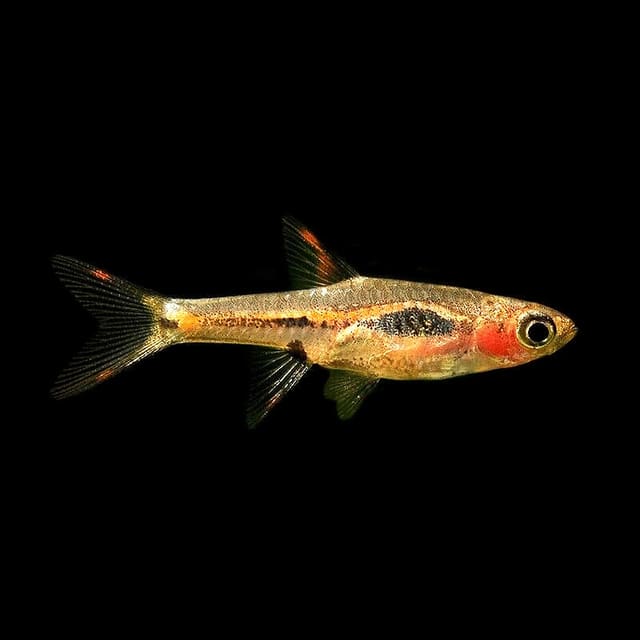
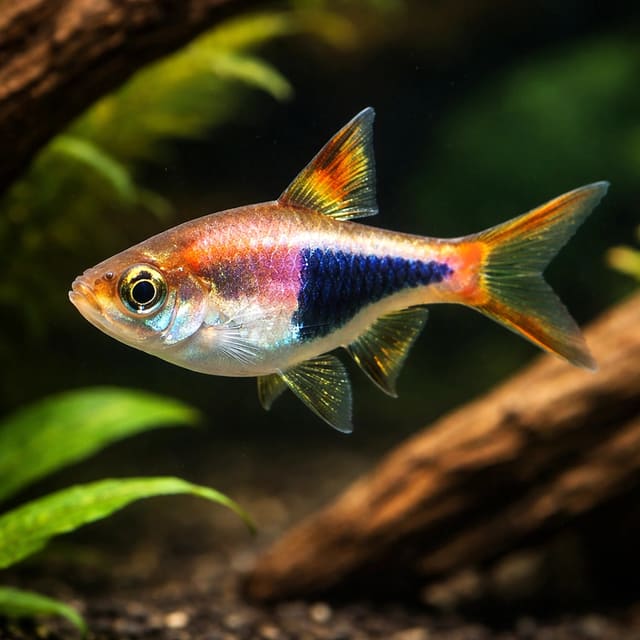
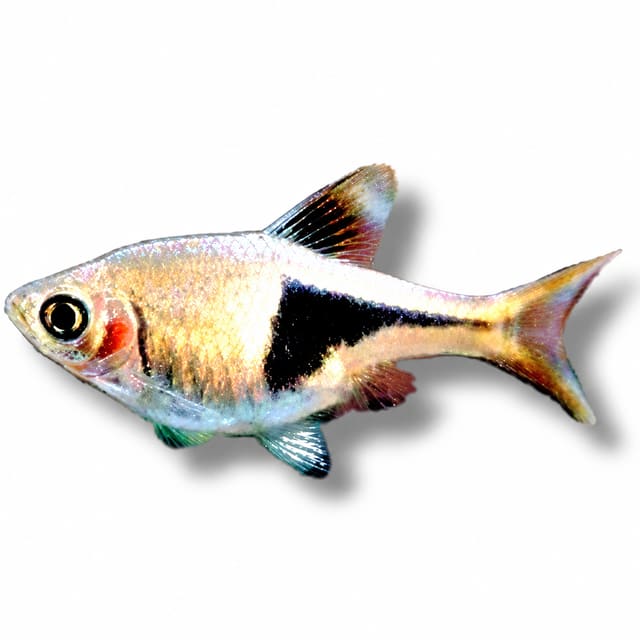
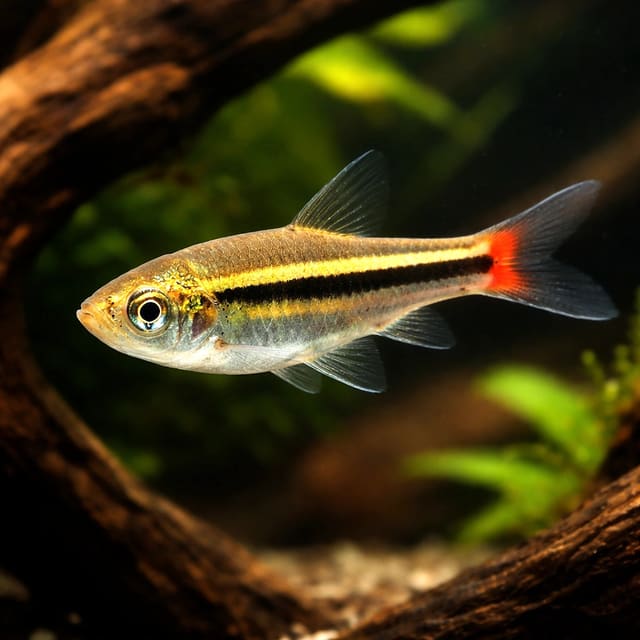
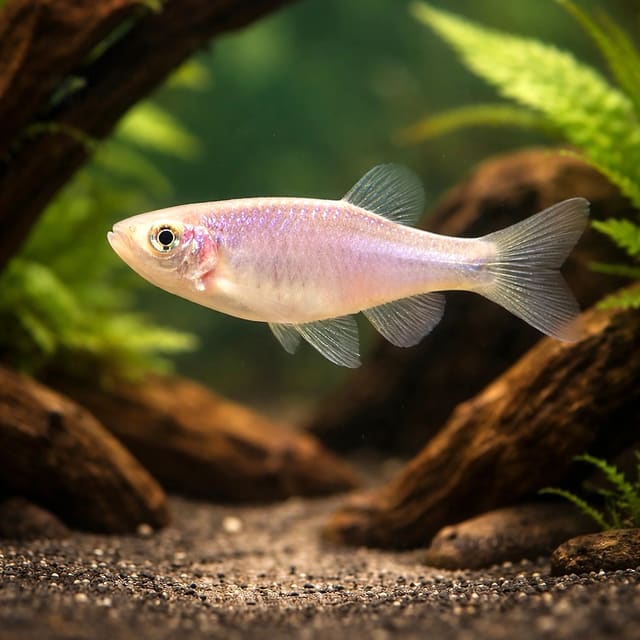
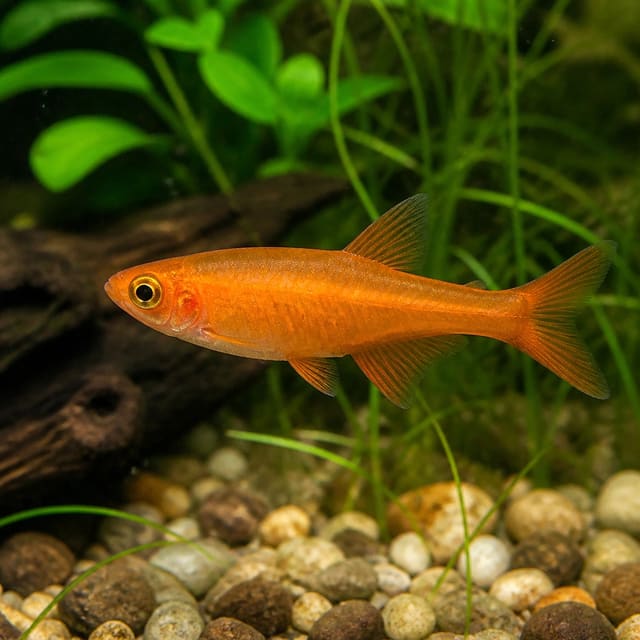
Dwarf Rasbora (Boraras maculatus)
20–28°C · pH 4–6.5 · 41L
£4.99
Tiny, peaceful Exclamation Point Rasbora for mature planted aquariums. Keep 12+ in a stable 40L tank with gentle flow, dense cover and true micro foods.
Adult size is the maximum length this species reaches at full maturity (scientific sources). The livestock you receive will be younger and smaller. Product-photo provenance and any image-specific limitations are stated on the listing.
Boraras urophthalmoides
For a new group, plan at least 12 Least Rasboras. Discount quantities do not set the care recommendation. Smaller quantities can top up an existing group.
Minimum of 2 per order.
Tiny, peaceful Exclamation Point Rasbora for mature planted aquariums. Keep 12+ in a stable 40L tank with gentle flow, dense cover and true micro foods.
Adult size is the maximum length this species reaches at full maturity (scientific sources). The livestock you receive will be younger and smaller. Product-photo provenance and any image-specific limitations are stated on the listing.
Maintain these water conditions for optimal health and vibrant colors
Least Rasbora, also called the Exclamation Point Rasbora, is the miniature Southeast Asian species Boraras urophthalmoides. Its accepted scientific name places it in Boraras; Rasbora urophthalmoides is the older combination still seen on trade lists and in parts of the aquarium hobby. This matters because “Brilliant Rasbora” is a different, much larger fish, Rasbora einthovenii, and should not be used as another name for this product.
This is a genuinely tiny shoaling fish. Published specimens measured 15–19mm standard length, and modern taxonomic work describes every member of Boraras as a miniature fish with an adult standard length below 20mm. Small size does not mean a jar-sized aquarium is suitable. A group needs stable, mature water, enough horizontal space to spread out, dense cover, gentle flow and food particles small enough to swallow.
Plan for a well-established planted aquarium of at least 45 x 30cm footprint and roughly 40 litres, with a group of at least 12. Larger groups and larger mature tanks are easier to keep stable and usually produce more confident behaviour. This guide explains the accepted identity, natural habitat, measured size, setup, feeding, tank mates, breeding, arrival care and the differences between Least Rasboras and other small rasboras.
| Accepted scientific name | Boraras urophthalmoides (Kottelat, 1991) |
|---|---|
| Common names | Least Rasbora; Exclamation Point Rasbora; Sparrow Rasbora in some sources |
| Older scientific combination | Rasbora urophthalmoides |
| Family | Danionidae, subfamily Rasborinae |
| Measured adult size | Usually about 15–20mm standard length |
| Temperament | Peaceful, shy to quietly active, social |
| Recommended group | 12 or more; 15–20 is better where space permits |
| Recommended aquarium | Mature, planted, 45 x 30cm footprint and about 40 litres or more |
| Temperature | 22–28°C; keep stable and avoid the upper limit long term unless required |
| pH | About 5.0–7.5, with stable slightly acidic to neutral water preferred |
| General hardness | Soft to moderately hard, roughly 1–12 dGH |
| Diet | Micro-predator: zooplankton and very small live, frozen or prepared foods |
| Swimming area | Middle and upper levels, especially among or below plant cover |
| Care level | Moderate: tiny food, mature water and calm tank mates are essential |
Eschmeyer’s Catalog of Fishes, NCBI Taxonomy, GBIF and recent scientific literature accept Boraras urophthalmoides. Maurice Kottelat originally described the species as Rasbora urophthalmoides in 1991. Kottelat and Vidthayanon moved it into the newly established miniature genus Boraras in 1993. The older name is therefore useful as a synonym for finding historical records, but it should not be presented as the current accepted name.
The genus change is not cosmetic. Boraras species share miniature anatomy, including reductions in parts of the lateral-line and skeletal systems. They are not simply juvenile versions of larger Rasbora. It belongs to Boraras, not to the larger true Rasbora group.
Brilliant Rasbora is the established common name for Rasbora einthovenii, a streamlined species that can exceed 10cm standard length. It is not a synonym for Least Rasbora. The two fish differ in genus, adult size, appearance, space requirements and community planning. Do not confuse the two when choosing tank size or companions.
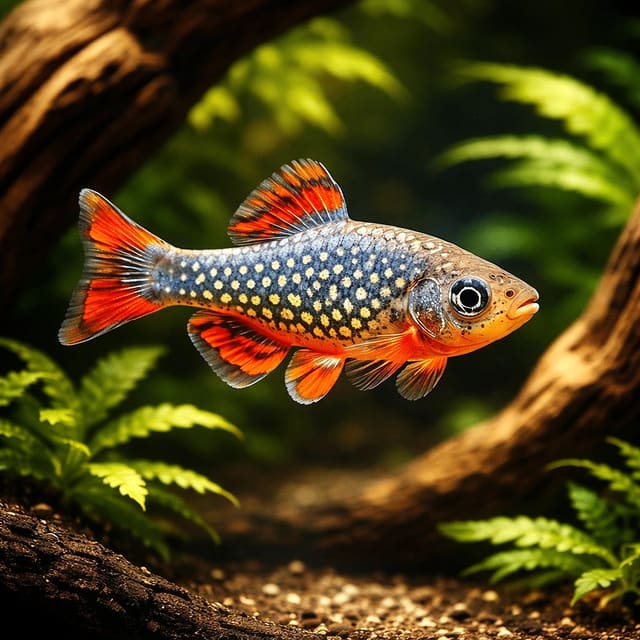
Galaxy Rasbora is a trade name for Celestial Pearl Danio, Danio margaritatus. Phoenix Rasbora is Boraras merah. Glowlight Rasbora is generally Trigonostigma hengeli, and Harlequin Rasbora is Trigonostigma heteromorpha. These are useful comparison species, not alternative names for B. urophthalmoides. Check the scientific name when comparing these species.
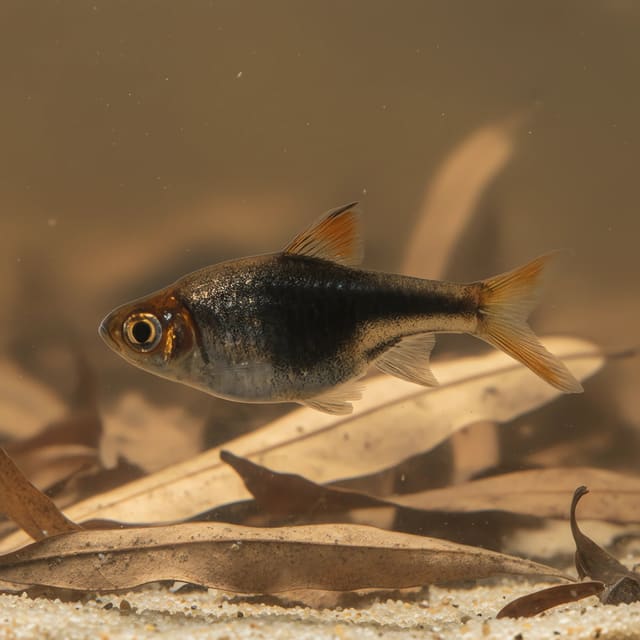
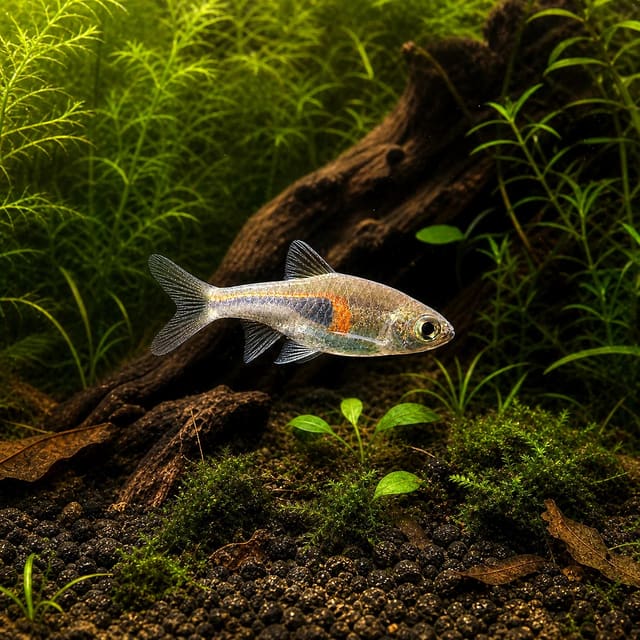
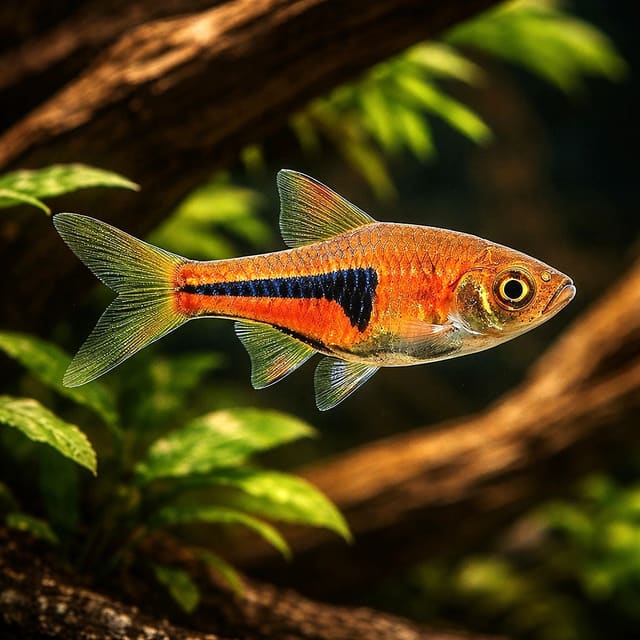
The fish has a slender, laterally compressed miniature body. A prominent dark lateral stripe begins behind the gill cover and runs towards the caudal peduncle, where a distinct dark spot marks the base of the tail. Scientific diagnoses also note a dark spot at the anal-fin base and a darkened first dorsal-fin ray. The line and terminal spot create the punctuation-mark effect behind the common name Exclamation Point Rasbora.
Base colour varies with lighting, background, stress and population. Settled fish can show translucent gold, copper, orange and olive tones, with a reflective line above the dark stripe. Newly transported or intimidated fish may look pale. Colour should be assessed after the group has settled into a dimmer, planted aquarium rather than from a bright retail tank.
Males are often slimmer and can become more intensely coloured. Mature females tend to be fuller through the abdomen, especially when carrying eggs. Sexing young or stressed stock is uncertain, so do not select a small group on the assumption that every slender fish is male or every pale fish is female.
A field study examining 35 specimens recorded 15–19mm standard length. A later taxonomic paper describes all members of Boraras as miniature fishes with maximum adult standard lengths below 20mm. That measured evidence supports an aquarium expectation of roughly 1.5–2cm body length, not a routine adult size of 3–4cm.
Some databases repeat a 4cm total-length figure from an older aquarium atlas. It conflicts with measured specimens and the modern diagnosis of the genus. The measured range is a more useful planning figure than the older atlas estimate.
Miniature fish still need swimming room. Group behaviour, water stability, feeding access and male display territories matter more than body length alone. A 45cm-long aquarium gives the shoal room to disperse and regroup while allowing dense planting at the sides and back.
Catalog records place the species in Southeast Asia, including the Mae Klong, Chao Phraya and Mekong basins, the Malay Peninsula, Thailand, Cambodia and Vietnam. The type locality is a swamp near the Sai Buri River in southern Thailand. A 2012 collection documented 35 fish in a temporary peat-swamp habitat in the Bang Pakong basin of southeastern Thailand.
FishBase and field literature describe marshes, swamps, ponds and bog wetlands with dense growth of fine-leaved aquatic plants. These are shallow, structurally complex environments rather than broad, fast open rivers. The fish probably browses tiny zooplankton among vegetation. This supports an aquarium built around plant cover, fine food and gentle circulation.
Not every known habitat is identical blackwater. Tannins, leaf litter and subdued light can be useful, but the essential features are mature water, abundant fine structure and low stress. Avoid forcing a dramatic low-pH blackwater setup if the keeper cannot maintain it safely or if the supplied fish has been held in different source water.
The IUCN assessment cited by FishBase lists the Least Rasbora as Near Threatened. Wetland drainage, pollution and habitat change are relevant concerns for small specialised fishes. Conservation status can be reassessed, so it should be checked against the current Red List rather than treated as permanent.
Never release aquarium fish, plants, water or substrate outdoors. Do not move unwanted fish into a pond, stream or drainage system. Rehome them through a responsible aquarist or retailer. A small species can still carry pathogens or create ecological risk outside controlled aquaria.
We recommend a mature aquarium of about 40 litres or more with a base around 45 x 30cm for a proper group. This is more responsible than the common 20-litre claim. Extra volume buffers temperature and water-chemistry changes, while the footprint creates both open lanes and separate planted refuges.
A taller tank with little surface area is less useful than a well-proportioned shallow or standard aquarium. The group uses horizontal space and plant edges. Hardscape and plants reduce the actual swimming volume, so choose the tank before calculating the final group and any tank mates.
Use the aquarium as a species display rather than as an excuse to crowd many “nano” species together. Twelve Least Rasboras in a calm 40-litre planted tank can be a complete, engaging display. Adding another mid-water shoal often creates competition without adding welfare value.
Keep at least 12. A group of 15–20 is preferable in a larger tank with adequate filtration and cover. Six fish may survive, but that should not be described as the ideal social unit. Larger groups spread attention, help timid individuals feed and allow natural display behaviour without one fish being constantly exposed.
They are shoaling fish, not a permanently tight synchronized school. A settled group may spread through plants and open water, with males briefly displaying or holding small temporary areas. The fish regroup more closely when disturbed. Constant tight grouping can therefore indicate fear rather than contentment.
Colour and confidence often improve after cover, group size and feeding are corrected. Do not respond to persistent hiding by adding brighter light or boisterous “dither fish”. First check water quality, current, tank mates, group number and whether food reaches every fish.
| Parameter | Recommended working range | What matters most |
|---|---|---|
| Temperature | 22–28°C | Stability, oxygenation and avoiding unnecessary long-term heat |
| pH | 5.0–7.5 | Stable slightly acidic to neutral water; do not chase a number rapidly |
| General hardness | About 1–12 dGH | Soft to moderately hard water with controlled acclimation |
| Ammonia | 0 | Any detectable ammonia requires immediate investigation |
| Nitrite | 0 | These miniature fish should never be used to cycle a tank |
| Nitrate | Kept low and stable | Regular testing and water changes appropriate to the aquarium |
Find out the retailer’s holding-water values where possible. A fish accustomed to neutral, moderately mineralised water may be harmed by being dropped directly into very soft, acidic water, even if the target values look natural on paper. Move gradually and prioritise consistency.
Do not lower pH with unmeasured acids. In very soft water, alkalinity may be low and pH can change quickly. If reverse-osmosis water is used, remineralise it to a planned recipe and test it before every water change.
Cycle the tank fully before purchase. Ammonia and nitrite must remain at zero under the expected feeding load. Allow plants, wood and filter media to develop mature microbial surfaces. This does not mean neglecting maintenance; it means avoiding the instability of a newly assembled system.
Tiny fish have little reserve when oxygen, temperature or water chemistry shifts. A larger mature tank is usually easier than a minimal nano tank. Use a reliable thermometer and liquid tests, and record values rather than relying on appearance alone.
Clear water can still contain ammonia or nitrite. Confirm the nitrogen cycle before ordering, test again on arrival day, and postpone livestock if the aquarium is unstable.
Use gentle, well-distributed circulation. A mature sponge filter or a filter with a sponge-covered intake protects tiny fish and potential fry. Avoid a narrow high-velocity jet that pushes the group continuously to one side of the tank.
Gentle flow does not mean stagnant water. Maintain surface movement and oxygen exchange, particularly at warmer temperatures. Plants consume oxygen at night, and decomposition of excess food or leaf litter also uses oxygen. Check the group if fish gather unusually at the surface or filter outlet.
Rinse filter media in removed aquarium water when flow declines. Do not replace all biological media at once. Secure every intake gap because a 1cm juvenile can enter spaces that look harmless beside larger fish.
Dense fine-leaved plants provide feeding surfaces, visual security and potential spawning cover. Mosses, fine stems, floating plants and root tangles are useful. Leave connected open areas through the front or centre so the group can move without being exposed in a bare tank.
Leaf litter and botanicals can add tannins and microbial life, but use aquarium-safe material and replace it gradually. Do not allow thick decaying layers to hide uneaten food. Wood and dark substrate can make the fish easier to see and often support more confident colour.
Use subdued or diffused lighting. Floating plants can break up bright overhead light. Sudden switching can startle the group, so room light before and after the main aquarium photoperiod helps create a gentler transition.
Fit a secure lid and cover cable, filter and feeding gaps. Small frightened fish can pass through openings that would contain a larger rasbora. Keep the water level below the rim and inspect gaps after moving equipment.
A lid also reduces rapid evaporation, helping water chemistry remain more consistent in a small aquarium. It does not replace ventilation; follow the equipment manufacturer’s clearance and safety instructions.
Wild Least Rasboras are associated with zooplankton among dense vegetation. In the aquarium they need tiny animal-based foods: newly hatched brine shrimp, small daphnia, Cyclops, microworms, rotifers, finely crushed high-quality flakes and true micro granules. The particle must be small enough to swallow, not merely small enough to attract attention.
Feed two or three very small meals daily. Watch the slowest individuals. A full-size flake that one fish tears apart may still leave shy fish hungry, while excess powder can disappear into the filter and raise waste. Portion with a dry fingertip, micro spoon or pipette rather than shaking from a large tub.
| Food | Role | Preparation |
|---|---|---|
| Newly hatched Artemia | Excellent live food and conditioning item | Rinse, then offer a tiny amount the fish finish promptly |
| Small daphnia or moina | Moving prey that encourages natural feeding | Use a size the fish can capture; do not pour culture water into the tank |
| Cyclops | Useful small frozen prey | Thaw a small fragment and distribute with a pipette |
| Microworms or suitable rotifers | Very small live foods, especially useful for juveniles | Culture hygienically and avoid excessive culture medium |
| Micro granules | Convenient prepared staple where accepted | Confirm particle size; soak or crush only when the label allows |
| Finely crushed flake | Prepared-food variety | Crush evenly and feed a controlled pinch |
Our freeze-dried Artemia and freeze-dried Daphnia must be crushed to a genuinely fine particle for this species. Frozen Cyclops can be useful when a small piece is thawed and the suitable particles are offered carefully.
A healthy settled fish should have a smooth body profile, clear eyes, intact fins and controlled swimming. Look at the belly after feeding. A pinched abdomen can indicate inadequate food access, stress, parasites or another health problem; it is not corrected safely by dumping more food into the tank.
Spread food across more than one point if dominant or faster fish take everything. Observe at different times of day. Count the group periodically, because a missing 1.5cm fish can be difficult to notice among plants.
A species-only aquarium is often the best display. If companions are added, choose tiny, calm animals that share the water requirements and do not dominate at meals. Adult dwarf shrimp and peaceful snails can work, but eggs and newly hatched shrimplets may be eaten. “Shrimp safe” should not be interpreted as “will never take baby shrimp”.
Other Boraras can share similar scale and behaviour, but mixed shoals make species identification and planned breeding harder. A larger aquarium is required when adding another fish group. Keep each social species in its own proper number rather than assembling a few individuals of many kinds.
Suitable comparisons include Dwarf Rasbora (Boraras maculatus), Phoenix Rasbora (Boraras merah) and Strawberry Rasbora (Boraras naevus). Check current availability and the separate care requirements before mixing them.
| Aquarium | Responsible starting plan | Reason |
|---|---|---|
| 40–45 litres, 45cm frontage | 12–15 Least Rasboras, snails optional | Simple species display with manageable feeding and stable water |
| 60 litres, mature and heavily planted | 15–20 Least Rasboras with a modest dwarf-shrimp colony | Larger group and more stable water; expect some shrimplet predation |
| 80 litres or more | 15–20 Least Rasboras plus one carefully researched calm bottom-level species | Allows separate feeding zones without adding another competing mid-water shoal |
These are planning examples, not automatic stocking permissions. Hardscape volume, filter capacity, mature surface area, local water and the needs of every companion change the answer.
| Species | Typical identification cue | Planning difference |
|---|---|---|
| Least / Exclamation Point Rasbora B. urophthalmoides |
Dark lateral line ending near a separate caudal spot; tiny gold-orange body | Measured adult standard length around 15–19mm; Thailand and mainland Southeast Asian wetlands |
| Dwarf Rasbora B. maculatus |
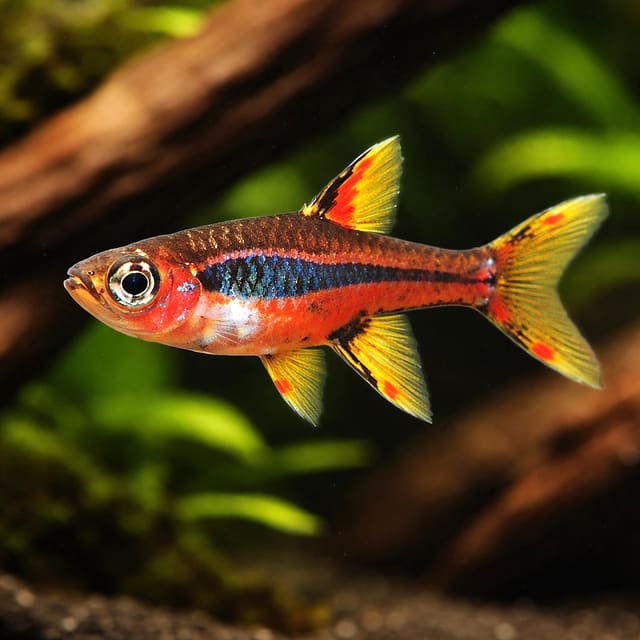
Several rounded dark body spots rather than one long exclamation line | Separate species with its own range and care profile |
| Phoenix Rasbora B. merah |
Warmer red body and different dark lateral blotch pattern | Bornean species; a different species from Least Rasbora |
| Strawberry Rasbora B. naevus |
Prominent rounded mid-body mark, especially in males | Thai species described separately in 2011 |
| Brilliant Rasbora R. einthovenii |
Long streamlined true Rasbora with a dark horizontal stripe | Can exceed 10cm; requires a much larger aquarium and is not this product |
Least Rasboras are small egg scatterers without parental care. Well-conditioned adults may spawn among fine plants in a mature species tank. Eggs and fry are vulnerable to being eaten, so occasional survival in a display does not mean the adults protect their young.
For planned breeding, use a separate mature aquarium or protect a dense area with moss, fine plants or suitable mesh. Stable soft water and a temperature around 26–28°C are commonly used for spawning. Introduce conditioned adults, monitor without disturbance and remove them after a confirmed spawning period if maximum egg survival is the goal.
Newly free-swimming fry are exceptionally small. Infusoria, paramecia, suitable rotifers and the microscopic life on mature wood and plants may be important before the fry can take microworms or newly hatched Artemia. A sterile new breeding box can fail even when visible food is added because the first-food ecosystem is missing.
Breeding is best described as moderate to advanced if the aim is to raise numbers consistently. Do not promise easy breeding based only on adults scattering eggs in plants.
Prepare the aquarium before dispatch: lights dim, lid secure, tests complete and no maintenance planned for the arrival period. On delivery, check the fish and packaging promptly and follow the current live-arrival procedure before opening bags if a claim is needed.
Do not use a fixed hour-long drip routine without considering shipping time, pH and ammonia. If source and destination water differ substantially, ask for specific advice before the fish arrive.
Quarantine new fish in a mature, heated, covered system with a cycled sponge filter and plant or inert cover. A bare, newly filled container is not a safe quarantine tank for miniature soft-water fish. Use separate nets and siphons.
Observe appetite, breathing, faeces, body profile, fins and swimming. Extend quarantine when symptoms appear and seek qualified aquatic-veterinary advice for diagnosis. Do not medicate preventively with a random full-strength dose; tiny fish and invertebrates can be sensitive, and the wrong treatment delays proper care.
| Sign | Immediate checks | Do not assume |
|---|---|---|
| Gasping or gathering at the surface | Oxygen, temperature, ammonia, nitrite, filter flow | That the fish are simply hungry |
| Clamped fins and hiding | Water change history, tank mates, current, lighting, group size | That more “dither fish” will fix stress |
| Pinched belly | Food particle size, competition, parasites, chronic stress | That a large extra meal is safe |
| White spots, excess mucus or flashing | Quarantine history and qualified diagnosis | That every spot is the same disease |
| Sudden losses | Ammonia, nitrite, temperature, toxins, oxygen and recent additions | That a medicine should be added before testing |
Perform regular partial water changes with temperature- and chemistry-matched water. In many aquariums, 20–30% weekly is a sensible starting point, adjusted by test results, stocking and feeding. Avoid large abrupt changes in very soft systems unless responding to an emergency.
Siphon visible waste without stripping every mature surface at once. Thin plants so water still circulates, clean the viewing area and inspect filter flow. Keep a log of temperature, water tests, maintenance and unexplained behaviour changes.
The first three months reveal whether the aquarium, food size and group structure really suit the fish. A group that survives arrival but remains pale, hidden or thin is not yet a successful setup. Use observations and water tests to make measured changes instead of adding products at random.
| Period | What to monitor | Useful response |
|---|---|---|
| Arrival day | Breathing, balance, obvious injury, temperature and water-test results | Keep lights low, complete a controlled transfer, preserve evidence required by the live-arrival terms and avoid a heavy meal |
| Days 2–7 | Whether every fish takes suitably small food, group count, hiding and filter safety | Adjust food particle size and distribution; cover intake gaps; test ammonia and nitrite again |
| Weeks 2–4 | Body condition, colour recovery, social confidence, nitrate trend and uneaten food | Refine portions, maintenance frequency, plant density and current without making several changes at once |
| Months 2–3 | Stable weight, normal loose-shoal behaviour, male displays, plant growth and repeatable water chemistry | Only then consider a carefully researched companion or breeding project |
Counting miniature fish in dense plants is difficult. Pause circulation briefly if the equipment permits, place a tiny food portion in a visible area and count as the fish emerge. Restore the filter immediately. Do not net or chase the group merely to confirm a number unless a welfare concern requires closer inspection.
Fish may rush at food yet fail to swallow particles that are too large. View the group from the side and above where possible. Compare the fullest and thinnest fish each week. Persistent differences suggest uneven access, social pressure, disease or a food-size problem. Correct the cause before increasing the total quantity.
If colour is poor, it is tempting to alter lighting, pH, food and plant cover together. That makes the result impossible to interpret and can destabilise the aquarium. Test water first, then change the most likely factor gradually. Keep notes for at least a week unless an emergency demands immediate action.
Prepare replacement water before disturbing the aquarium. Match temperature closely and keep mineral content consistent. In soft-water systems, even a moderate water change can shift conductivity and pH if the recipe varies. Mark containers, measure remineraliser accurately and never estimate by eye when using concentrated products.
Direct the refill away from the shoal so tiny fish are not pinned by the flow. Check the siphon and bucket before disposal; a juvenile can be removed unnoticed. A fine guard over the siphon protects fish and shrimp, but it can clog quickly, so watch the flow throughout maintenance.
After the change, confirm the filter is running, the heater is submerged correctly and the lid is secure. Observe breathing and swimming for several minutes. Many “mysterious” post-maintenance problems come from temperature mismatch, untreated tap water, displaced equipment or a fish trapped in a filter compartment.
Least Rasboras are peaceful and do not need a huge aquarium, but they are not the easiest first fish. They require a fully cycled mature tank, fine food, restrained tank mates, a proper group and careful acclimation. A beginner who prepares those systems can succeed; a buyer looking for a fish to place immediately into a new 20-litre kit should choose a different plan.
The best preparation is not advanced equipment. It is patience: cycle the aquarium, grow the plants, establish the filter, secure tiny gaps, source appropriate food and test the water before ordering.
Taxonomy and distribution were checked against Eschmeyer’s Catalog of Fishes. The 15–19mm measured range and temporary peat-swamp record come from Petsut, Kulabtong and Petsut (2013). The under-20mm adult diagnosis for the genus is supported by Conway and Kottelat (2011). Habitat and feeding ecology were cross-checked with FishBase.
Aquarium recommendations combine those biological facts with conservative welfare planning. Tank size, group number and working water range are husbandry recommendations, not claims that every wild location has identical conditions.
The accepted name is Boraras urophthalmoides (Kottelat, 1991). Rasbora urophthalmoides is the original combination and remains a useful search synonym.
No. Brilliant Rasbora is Rasbora einthovenii, a much larger species. Least or Exclamation Point Rasbora is the miniature Boraras urophthalmoides.
Published specimens measured 15–19mm standard length, and the genus is scientifically defined as miniature with adults below 20mm standard length. Plan for roughly 1.5–2cm rather than the often-repeated 3–4cm claim.
We do not recommend 20 litres as the normal long-term plan. Use a mature aquarium of about 40 litres or more with at least a 45 x 30cm footprint for water stability, group behaviour and feeding access.
Keep at least 12. A group of 15–20 is even better in a larger mature aquarium. Six is below the recommended social group.
They are micro-predators that browse tiny zooplankton. Offer newly hatched Artemia, small daphnia, Cyclops, microworms, rotifers and appropriately sized micro granules or finely crushed flake.
They are peaceful with adult dwarf shrimp, but may eat eggs or newly hatched shrimplets. Dense cover improves survival but cannot guarantee every baby shrimp will be safe.
Not every recorded habitat is identical blackwater. They benefit from subdued light, plants, gentle flow and stable soft-to-moderate water. Tannins and leaf litter are optional tools, not substitutes for testing and maintenance.
Adults may scatter eggs in mature plants, but raising the exceptionally small fry consistently is moderate to advanced. The fry need microscopic first foods and benefit from mature biofilm-rich surfaces.
They can suit a well-prepared beginner, but they are not forgiving of an uncycled tank, oversized food, rough tank mates or unstable water. Prepare the mature aquarium and food supply before purchase.
Order only after the aquarium is mature, covered and ready for a group of at least 12. Check current stock, selected quantity and delivery date in the buy box and cart. Livestock orders are covered by our published live-arrival terms when the stated conditions and evidence procedure are followed; review the delivery information and aquarium FAQ before dispatch.
The useful buying signals are the correct species, a planned group, mature water and appropriate micro food.
No reviews for this item yet. Bought one? Honest reviews only, good or bad.
What customers say about ordering from us
Easy website plenty of info on fish your buying great to pick a time slot
TRACEY DURRANT · 7 Oct 2026
Got some lovely fish thank you
Kevin Mackie · 7 Oct 2026
Reviews of our shop, collected by Judge.me, an independent third-party review collector. Newest first.