Dwarf Rasbora (Boraras maculatus)
24–26°C · pH 5–6
£4.99

Mosquito Rasbora is a tiny, peaceful Bornean shoaling fish for a mature planted aquarium with gentle flow and suitably small foods.
Adult size is the maximum length this species reaches at full maturity (scientific sources). The livestock you receive will be younger and smaller — pick a size above for the actual shipping size. Product-photo provenance and any image-specific limitations are stated on the listing.
Boraras brigittae
Shoaling fish: kept in a group they feel safer, stay calmer and show their best colour.
Minimum of 2 per order.
Mosquito Rasbora is a tiny, peaceful Bornean shoaling fish for a mature planted aquarium with gentle flow and suitably small foods.
Adult size is the maximum length this species reaches at full maturity (scientific sources). The livestock you receive will be younger and smaller — pick a size above for the actual shipping size. Product-photo provenance and any image-specific limitations are stated on the listing.
Maintain these water conditions for optimal health and vibrant colors
Mosquito Rasboras (Boraras brigittae) are tiny, red-orange shoaling fish from Borneo. Adults reach around 2 cm. They need a mature, planted aquarium with gentle flow, stable warm water and enough cover to settle confidently.
Chili Rasbora is another common name for Boraras brigittae. Kept in a suitable group with appropriately small foods, these peaceful fish show stronger colour and more natural shoaling behaviour.
Boraras brigittae is one of the smallest cyprinid fish kept in aquariums and is closely associated with the rise of planted nano aquariums. In the hobby it is often sold as mosquito rasbora or chili rasbora, and it sits alongside other tiny Boraras species prized for colour, calm temperament, and suitability for carefully stocked community tanks.
In South West Borneo, Boraras brigittae inhabits peat swamps, forest pools and slow-moving blackwater channels. Leaf litter and decaying wood tint the water. This helps explain its preference for soft, acidic water, shade and gentle movement in the aquarium.
Wild fish spend much of their time among submerged roots, fine-leaved plants, leaf litter, and shaded margins. Their natural food is tiny live prey: insect larvae, micro-crustaceans, worms, and zooplankton. This is why a proper mosquito rasboras diet should focus on very small foods rather than standard large flakes. Their habitat also helps explain their shy but peaceful nature. In sparse tanks they can seem nervous, but in a dark, mature, heavily planted aquarium they become far more visible and active.
Its small size and striking colour make it appealing for a planted nano aquarium, but the setup must still provide stable water and room for a proper group. Calm flow, cover and tiny foods matter more than a decorative tank's nominal size.
A shaded blackwater-style display can suit this fish well. Leaf litter, wood and fine plants offer cover while leaving space for the group to move.
Mimicking the natural habitat with leaf litter, driftwood, subdued lighting, and dense planting often improves colour, reduces shyness, and supports stronger feeding responses. Mosquito rasboras kept in bright, bare tanks usually look washed out and remain hidden.
A successful setup starts with stable water. A 20-litre aquarium is the stated minimum for a small species-focused group, while 30–45 litres gives more room for plants, swimming and steadier chemistry. Keep at least 10 fish, with larger groups suited to larger nano systems.
These active midwater fish need horizontal swimming room and visual security. A longer footprint is better than a tall decorative cube. A 20-litre species tank needs careful stocking and maintenance; choose a larger aquarium if adding other fish or shrimp.
Keep the water warm, soft and slightly acidic: 24–28°C, roughly 1–8 dGH and pH 4.0–7.0 are the ranges already used in this guide. Around 25–26°C suits routine maintenance. Stability matters more than forcing the water to the lowest end of a range.
Use mature filtration with gentle circulation. A sponge, air-driven corner filter or well-baffled nano filter can keep the water clean without pushing these small fish across the tank. Have the filter fully cycled before the fish arrive.
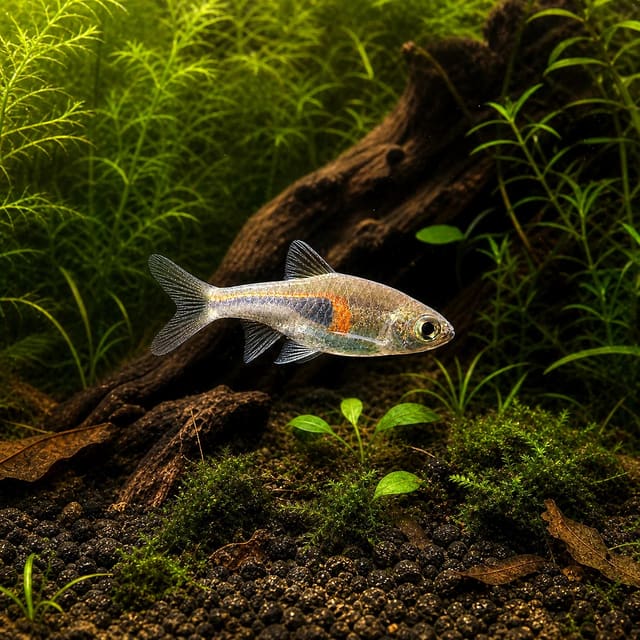
Use dark substrate, fine-leaved plants and gentle shade to help this tiny rasbora feel secure while leaving space for the group to move.
Moderate to subdued lighting is best. Very bright light with no floating cover can make the fish skittish. Floating plants help diffuse light and create a more natural look. If you want display colour for photos, use a dark background, dark substrate, and broken shade rather than harsh white light.
Confirm the aquarium is fully cycled before adding Mosquito Rasboras. Check that ammonia and nitrite remain at zero; elapsed time alone cannot establish that a tank is ready.
A good mosquito rasboras feeding guide starts with scale. These fish are omnivores, but in practice they behave like tiny micro-predators. In the wild they pick at minute invertebrates, insect larvae, and zooplankton. In the aquarium, the best mosquito rasboras diet combines a fine staple food with regular frozen or live additions. Standard community flakes are often too large unless crushed very finely.
Use quality micro pellets, powdered fry food or finely crushed flake as a staple. Offer small particles that the fish can swallow cleanly and remove uneaten food.
Offer suitably sized baby brine shrimp, daphnia, cyclops or finely sieved frozen foods as variety. Watch that every fish can feed without competition from faster tank mates.
Microworms, vinegar eels and newly hatched brine shrimp can be useful when conditioning adults. Choose foods small enough for their mouths and keep portions modest.
Feed once or twice daily in small portions. Overfeeding can damage water quality quickly in a nano aquarium. Prepare suitable micro foods before new fish arrive.
| Time | Food | Amount |
|---|---|---|
| Morning | Micro pellet or crushed flake | Very small pinch, eaten in under 1 minute |
| Evening | Baby brine shrimp or daphnia | Small portion, no leftovers after 2 minutes |
Plan the feeding routine before stocking: this species needs appropriately sized foods more than a large quantity of food.
If you already feed micro foods for Boraras species, these tiny rasboras often fit the same feeding routine and planted nano style.
Another small Boraras species that thrives on finely sized foods, making it useful for aquarists comparing nano shoaling fish diets.
Overfeeding causes ammonia spikes and water quality issues very quickly in small aquariums. Uneaten food trapped in moss or leaf litter can foul the tank long before the water looks dirty.
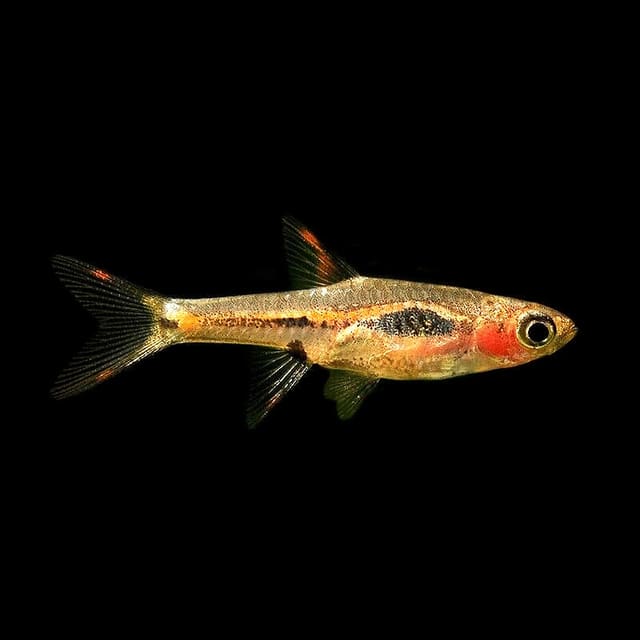
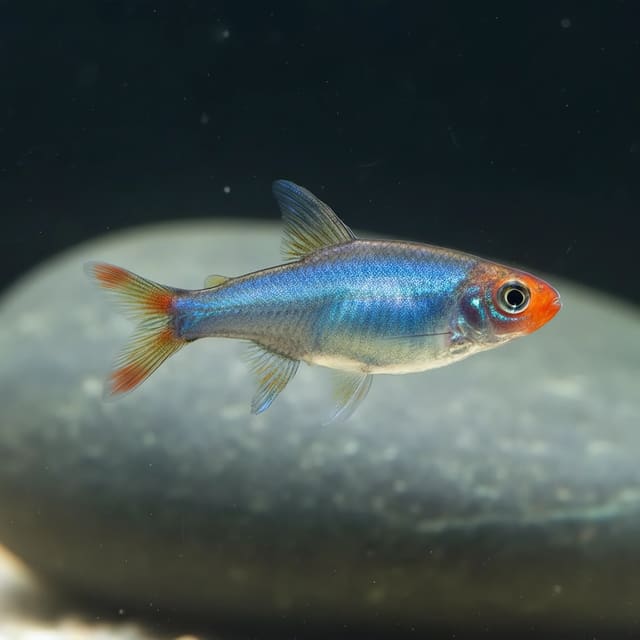
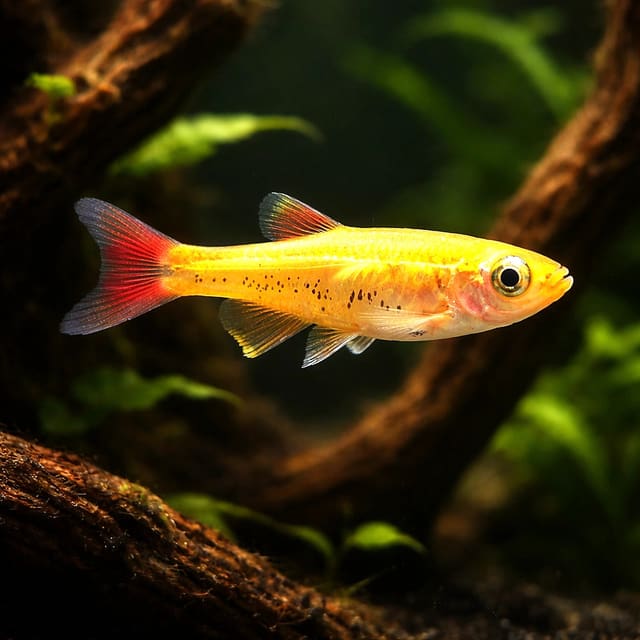
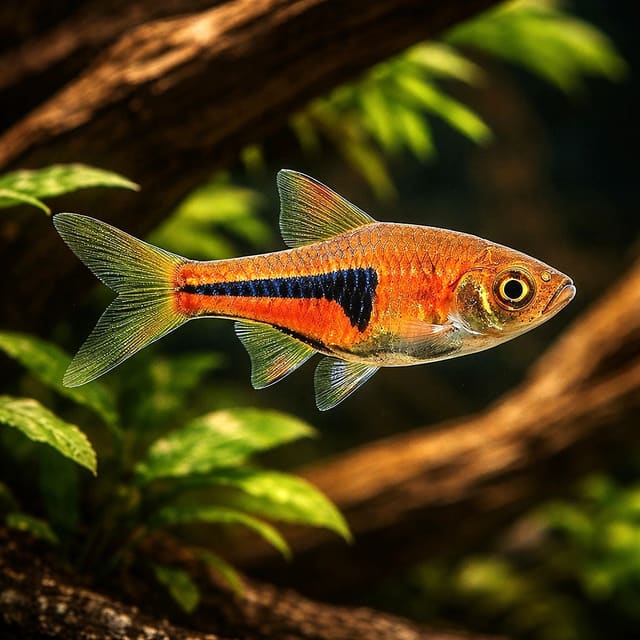
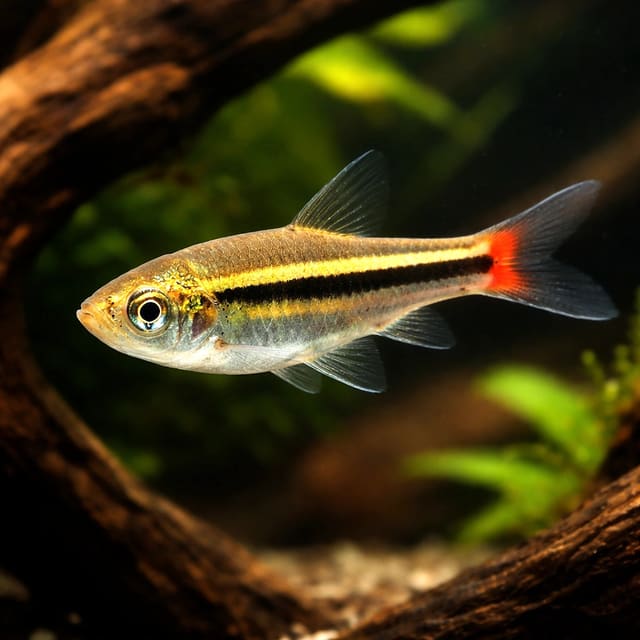
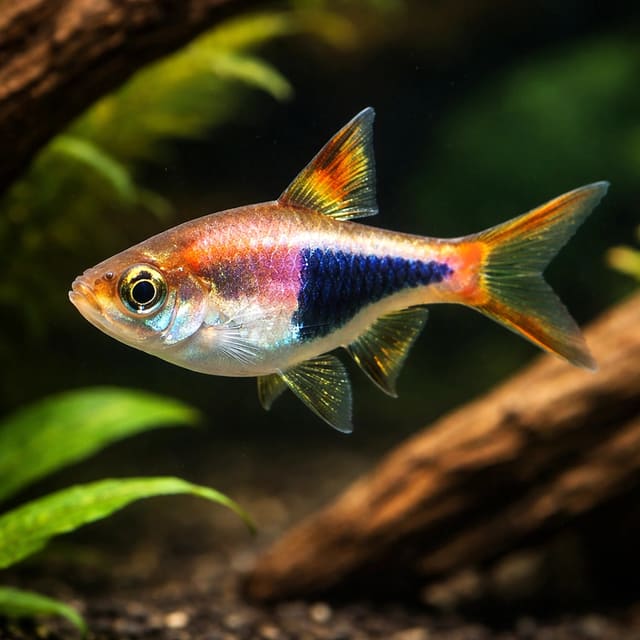
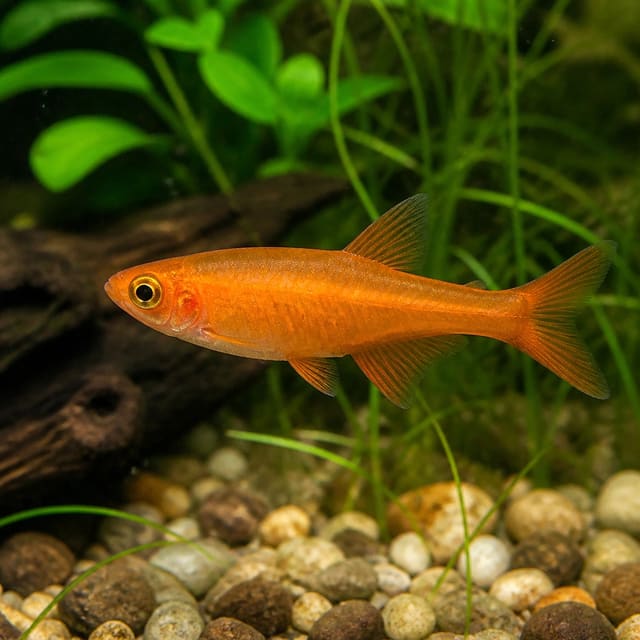
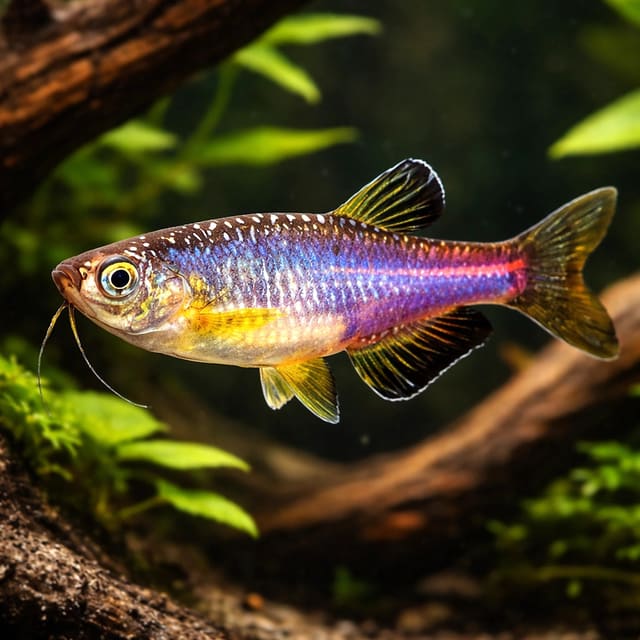
The appeal of Mosquito Rasboras is simple: they look like moving sparks in a planted aquarium. Adults reach about 2 cm, with a slim, delicate body and fine transparent fins washed in red. Most specimens show a rich orange-red to crimson base colour with a darker lateral stripe or blotching that gives the fish extra contrast. In a dimly lit, tannin-tinted aquarium, that colour can look almost luminous.
Healthy fish should be alert, evenly shaped and balanced in the water, with open fins rather than clamped ones. Males are often slimmer and more intensely coloured; females may be fuller when carrying eggs. These differences do not make the offered fish sexed.
Choose companions carefully. Mosquito Rasboras are peaceful, tiny and easily intimidated, so tank mates should be calm, similarly sized and comfortable in warm, soft water. Avoid boisterous feeders and any fish large enough to swallow them.
Consider only small, peaceful fish with similar water and feeding needs; a species-focused group is often easier to feed and observe.
Avoid large, predatory or boisterous fish that can swallow or outcompete Mosquito Rasboras.
In a carefully maintained 20-litre species tank, the existing plan is a group of 10–12 Mosquito Rasboras with shrimp or snails only. A 30–45 litre planted aquarium can allow a larger group and more layout flexibility. Check the actual tank footprint and feeding competition before adding other fish.
Adult shrimp are usually suitable companions, although very small shrimplets may be eaten. Snails are also possible tank mates. Provide cover and do not promise that every shrimp will be safe.
| Species | Compatible? | Notes |
|---|---|---|
| Phoenix Dwarf Rasboras - Boraras | ✅ Yes | Similar size and temperament; best in larger planted nanos |
| Emerald Dwarf Danios - Danio | ⚠️ Caution | Possible in larger, calm tanks; watch activity levels and feeding competition |
| Gold Giant Gourami | ❌ Avoid | Far too large and unsuitable for nano community conditions |
Compare adult size, feeding speed and water needs before mixing species; a shared “peaceful” label alone is not enough.
Always quarantine new arrivals for 2-4 weeks before adding them to a nano community. Tiny fish can be badly stressed by parasites or bacterial issues introduced by apparently healthy new tank mates.
Mosquito Rasboras may scatter eggs in a mature planted aquarium, but raising the tiny fry is more demanding than routine care. Breeding requires soft warm water, cover and very small first foods.
For a planned breeding attempt, use a quiet, separate tank with gentle filtration, soft acidic water and fine-leaved plants or spawning mops. Keep temperature within the normal range and condition adults with appropriately small live foods.
During courtship, males can intensify in colour and display to females; females may look fuller when carrying eggs. These are observations, not a reliable sex guarantee for fish chosen from this listing.
These fish are egg scatterers and may eat eggs, so remove adults after spawning if you want better survival. Eggs are tiny and can be hard to spot. In warm water, hatching is usually quick, often within a couple of days. Keep the tank very clean but avoid strong water movement.
New fry need extremely small foods such as infusoria, powdered fry foods, or green water before moving on to baby brine shrimp. This stage is why many first attempts fail. Good hygiene, tiny frequent feeds, and stable water are essential. Given the right care, fry gradually develop colour and join the shoal.
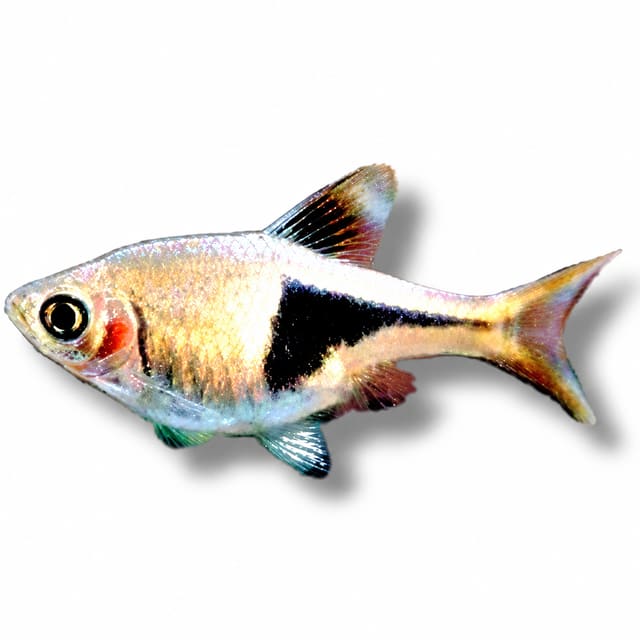
Common challenges are infertile eggs, adults eating spawn and fry starving when food is too large. Moss or a suitable egg guard and tiny first foods may improve survival. Mosquito and Chili Rasbora are common names for Boraras brigittae; Harlequin Rasbora is a larger, different species.
For better fry survival, place a layer of fine moss or a mesh egg guard over the bottom of the breeding tank. This lets eggs fall out of reach of the adults while still keeping the setup gentle and natural.
Compare small red shoaling fish by adult size, feeding needs and aquarium conditions. A species-focused nano setup is often simpler than a mixed community.
| Feature | Mosquito Rasbora | Phoenix Dwarf Rasbora |
|---|---|---|
| Max Size | 2 cm | About 2 cm |
| Care Level | Moderate | Moderate |
| Temperature | 24-28°C | Warm tropical range |
| Best For | Blackwater planted nano tanks | Microfish collectors and planted nanos |
| Feature | Mosquito Rasbora | Neon Tetra |
|---|---|---|
| Max Size | 2 cm | 3.5-4 cm |
| Care Level | Moderate | Easy to moderate |
| Temperature | 24-28°C | 22-26°C |
| Best For | Tiny, gentle, planted displays | General community aquariums |
Neon Tetras and Ember Tetras are larger and suit different community plans. Phoenix Dwarf Rasbora is another tiny red Boraras, but it should be chosen on its own identity and care needs. Mosquito Rasboras are best for a calm, planted setup with suitably small foods.
Choose Mosquito Rasboras if you can provide a mature planted aquarium, a proper group and a reliable micro-food routine. For a busier community, a larger tetra or rasbora may be easier to manage.
Stable water and suitable feeding are central to health. A healthy fish is alert, feeds, swims with good balance and has clear fins without fraying or white spots. Newly delivered fish may show less colour while settling.
Watch for clamped fins, hiding, rapid breathing, loss of colour, flashing, white spots or a hollow belly. Poor water, stress, infection or feeding problems can have overlapping signs, so check the aquarium and seek a sound diagnosis before treatment.
Start with water testing and a large but safe water change if parameters are off. Move sick fish to a quiet hospital tank where possible. Use medications carefully and always check suitability for small cyprinids. If shrimp are present, avoid treatments that can harm invertebrates. Stable heat, clean water, and easy-to-eat foods are often the first line of support.
A mature tank, low stress, suitable group size and properly sized food help prevent problems. Remove detritus from dense planting and avoid aggressive tank mates. Do not treat a typical lifespan estimate as a promise for an individual fish.
Quarantine new fish in a separate, heated, gently filtered aquarium where practical. Observe weight, swimming, feeding and external signs before introducing them to a community.
NEVER use copper-based medications in tanks containing shrimp or other sensitive invertebrates. Copper can be lethal even at low concentrations.
Mosquito Rasboras are peaceful shoaling fish that move through the middle water among plants. A proper group is usually more confident than a few isolated fish, while cover lets them retreat when startled.
They are not aggressive, but males may posture lightly around one another, especially when in breeding condition. This is normal and often accompanied by stronger colour. In a calm blackwater-style setup, they show more natural confidence and tighter schooling. If the tank is too bright, too bare, or too busy, they may hide constantly or lose colour.
In a peaceful nano community, this species rewards subtle planting and patient observation. Watch that companions do not outcompete the shoal at feeding time.
Prepare a mature, planted aquarium with gentle flow and micro foods ready. Choose a group size your aquarium can support and check the live size and availability selector. Review the current livestock delivery and arrival instructions before checkout.
No reviews for this item yet. Bought one? Honest reviews only, good or bad.
What customers say about ordering from us
I have a small group of long finned mountain minnows. So was delighted to be able to order ten of this variety to increase the genetics in my tank . The ones I recieved are healthy but it’s to early to give a verdict on wether they are of a long finned type since they are small currently.
Gordon Walker · 23 Sept 2026
100% success travel and "installation". Pleased with quality of purchase. The Siamese fighter a bit "shy" so have not yet seen him at his best yet but looking good. Happy customer. GG
George E Garratt · 21 Sept 2026
Reviews of our shop, collected by Judge.me, an independent third-party review collector. Newest first.