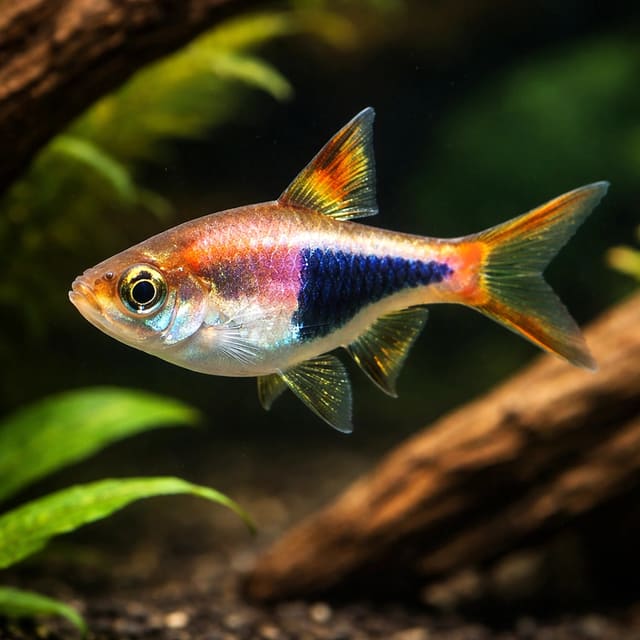
Easy
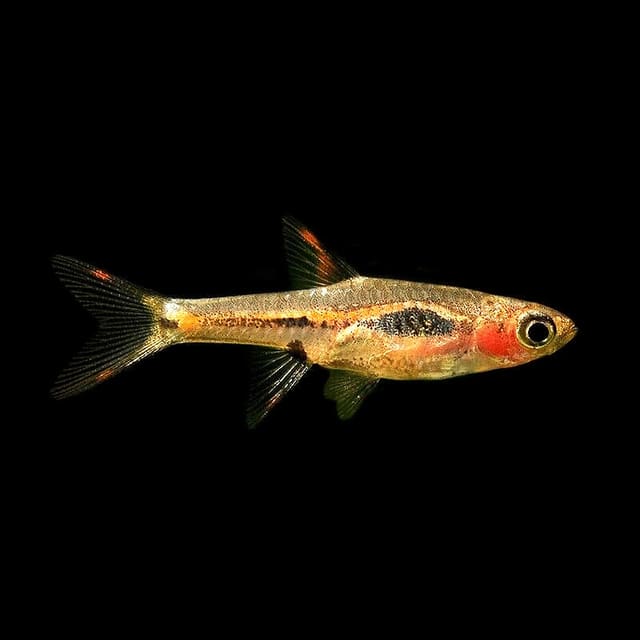
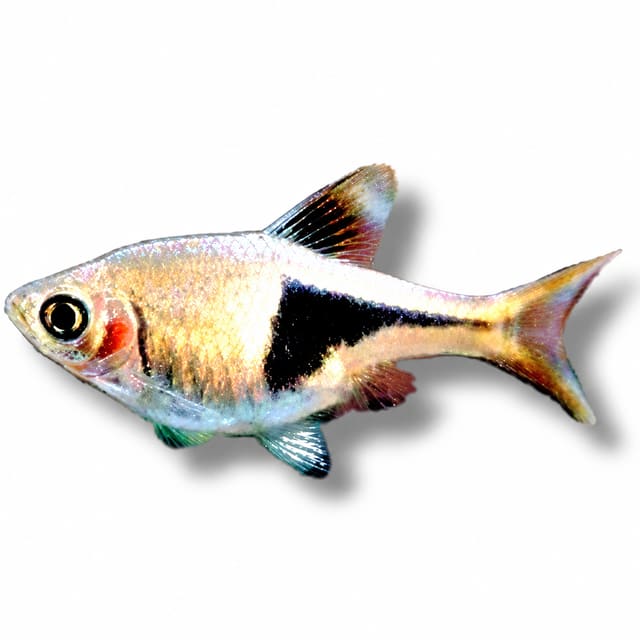
Harlequin (Rasbora heteromorpha)
21–28°C · pH 5–7.5 · 54L
£2.99

The Celestial Pearl Danio (Danio margaritatus) is a social danio from Myanmar that reaches 2.1 cm maximum standard length. It suits intermediate keepers with a mature, densely planted aquarium: Seriously Fish gives a base of at least 45 × 30 cm and 20–26°C with pH 6.5–7.5, while Tropical Fish Co uses ten as a cautious group floor. Sold individually in 1 cm, 1–2 cm, 2–2.5 cm and 2.5–3 cm dispatch sizes.
Danio margaritatus
Shoaling fish: kept in a group they feel safer, stay calmer and show their best colour.
The Celestial Pearl Danio (Danio margaritatus) is a social danio from Myanmar that reaches 2.1 cm maximum standard length. It suits intermediate keepers with a mature, densely planted aquarium: Seriously Fish gives a base of at least 45 × 30 cm and 20–26°C with pH 6.5–7.5, while Tropical Fish Co uses ten as a cautious group floor. Sold individually in 1 cm, 1–2 cm, 2–2.5 cm and 2.5–3 cm dispatch sizes.
Maintain these water conditions for optimal health and vibrant colors
The Celestial Pearl Danio is the spotted freshwater fish long traded as Galaxy Rasbora and often shortened to CPD. Its accepted scientific name is Danio margaritatus, placing it among the danios rather than the true rasboras. FishBase records the species in Danionidae, gives Myanmar as its distribution and records a maximum of 2.1 cm standard length. Standard length stops at the base of the tail, so it is not a tip-to-tip measurement. It suits an intermediate keeper prepared to manage a social group, stable water, feeding access and occasional rivalry in a mature planted aquarium.
This is a small fish with substantial social and environmental needs. Rival males may display, spar and nip within their group, while timid individuals can lose food to larger or faster fish. The aquarium therefore needs useful horizontal space, dense planting, broken sightlines and an open area where every fish can reach suitably small food.
| Decision | Planning figure |
|---|---|
| Adult-size reference | Up to 2.1 cm standard length |
| Base dimensions | At least 45 × 30 cm |
| Approximate volume | About 41 litres for that footprint |
| Temperature | 20–26°C |
| pH | 6.5–7.5 |
| General hardness | 5–15 dGH |
| Social plan | Ten or more; larger groups may work better where capacity permits |
| Suits | Not suited to |
|---|---|
| A mature, densely planted aquarium with a base of at least 45 × 30 cm | A cramped aquarium, pair or trio planned only around the fish’s small body size |
| A keeper who can maintain a social group and watch every fish feed | A community where larger or boisterous fish consistently take the food |
| Stable water at 20–26°C, pH 6.5–7.5 and 5–15 dGH | An aquarium whose inhabitants do not share a stable water range |
| Dense cover, broken sightlines and open feeding access | A layout with no refuge from repeated pursuit |
The aquarium figures come from the Seriously Fish species account. It advises against a group in a base smaller than 45 × 30 cm because dominant males can be combative, and it equates that footprint to roughly 41 litres. Footprint remains the decisive screen: a tall aquarium can hold the same litres while offering less horizontal room.
We classify this fish as intermediate. Its water range is manageable, but the keeper must balance group size, male rivalry, feeding access and stable conditions in a relatively small aquarium. Our complete Celestial Pearl Danio care guide expands on the tank, group and water decisions behind that assessment.
One purchase supplies one animal of the selected size. Use the live size selector to choose 1 cm, 1–2 cm, 2–2.5 cm or 2.5–3 cm, then set the quantity needed for the planned group. The size you select is the size supplied, not the adult size.
A dispatch size and a scientific standard-length record serve different purposes. The selector describes the animal supplied, while the 2.1 cm maximum standard length is the adult planning reference and excludes the tail fin. Do not use a larger dispatch label to infer age, sex or eventual tip-to-tip length.
For example, selecting the 2–2.5 cm size with a quantity of ten means ten animals from that dispatch size. Selecting a quantity of one means one animal, not one group or pack. A larger group also increases feeding demand and biological load, so group planning must remain tied to filtration, floor space and the rest of the aquarium.
Sex is guaranteed only when the selected option explicitly states male or female. This Celestial Pearl Danio listing has no sex-guaranteed option.
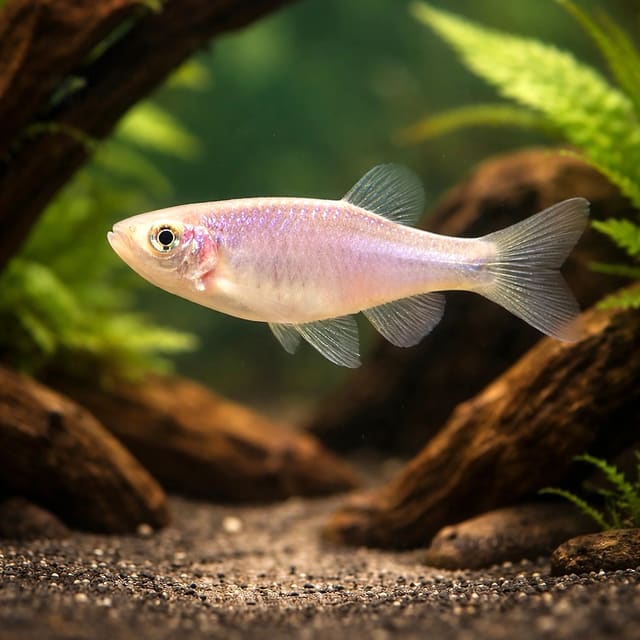
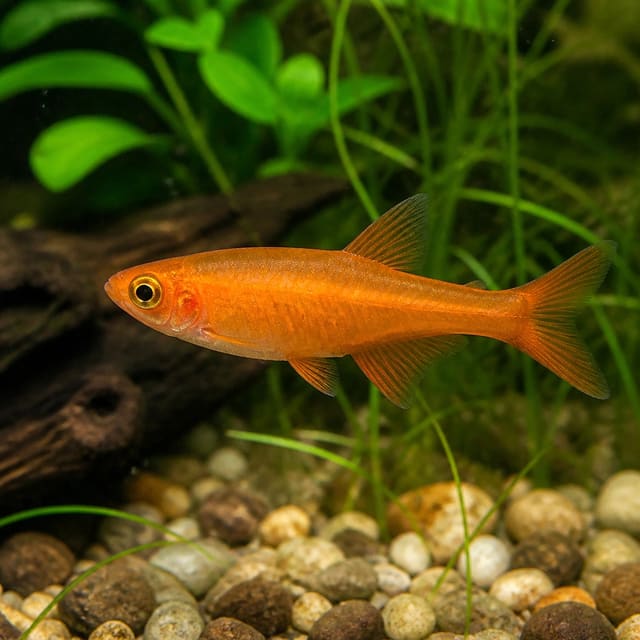
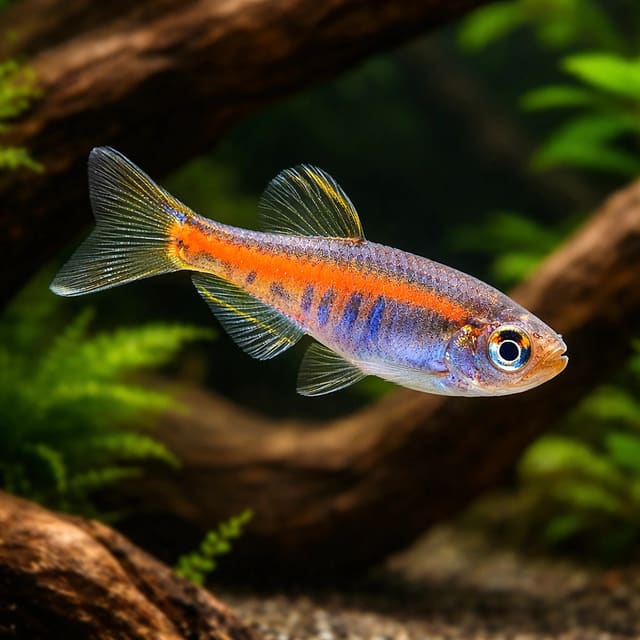
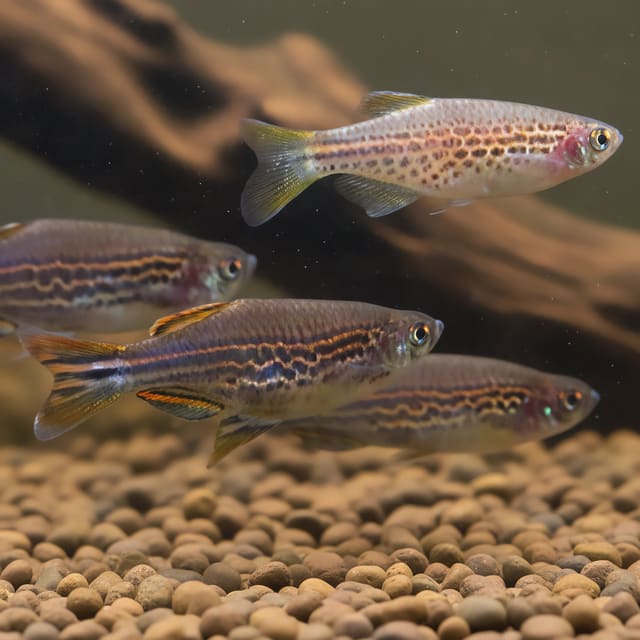
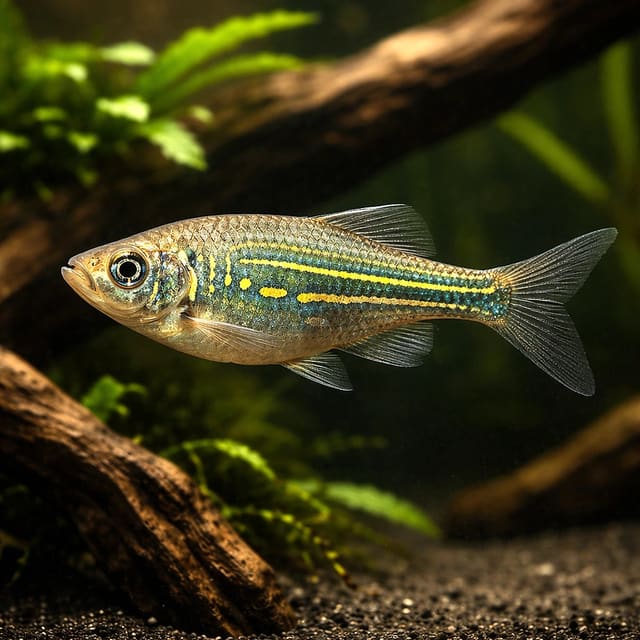
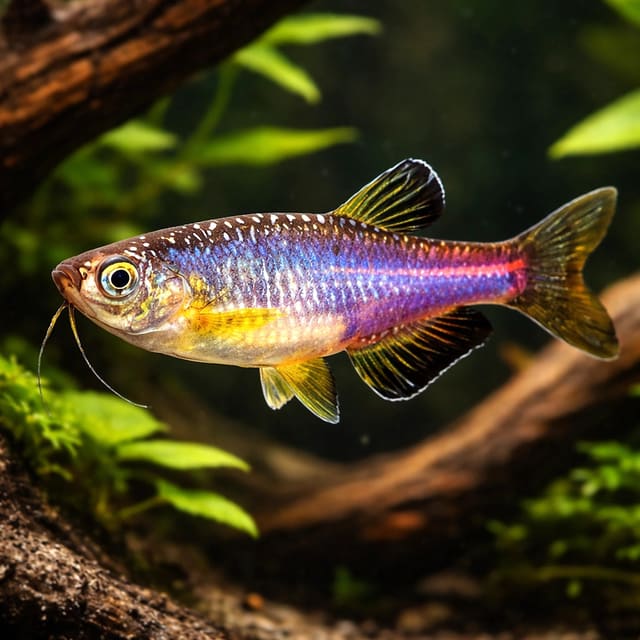
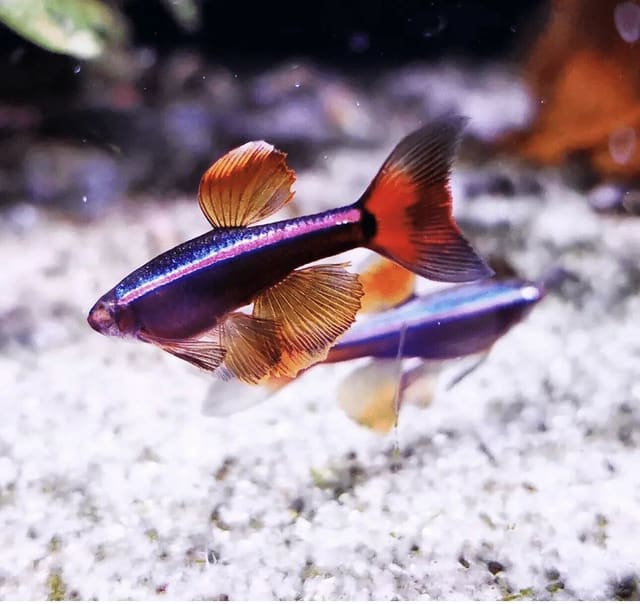
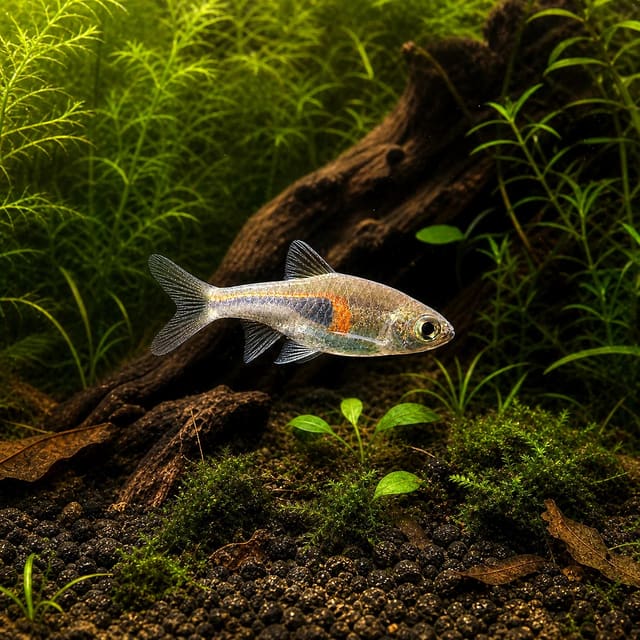
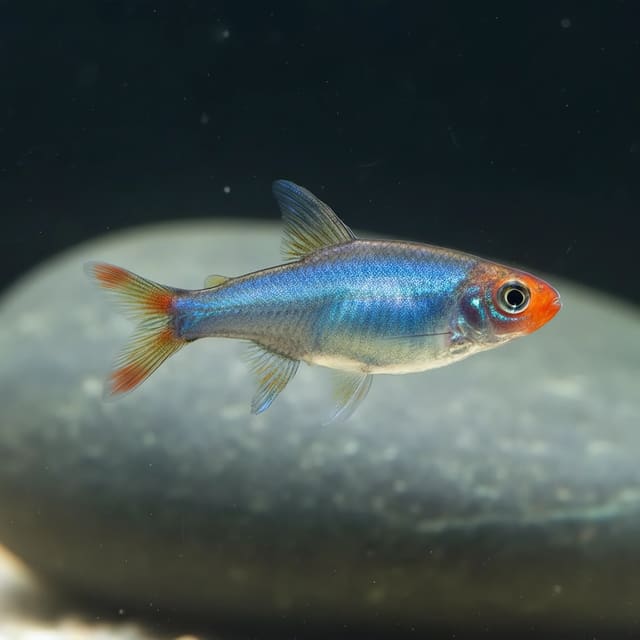
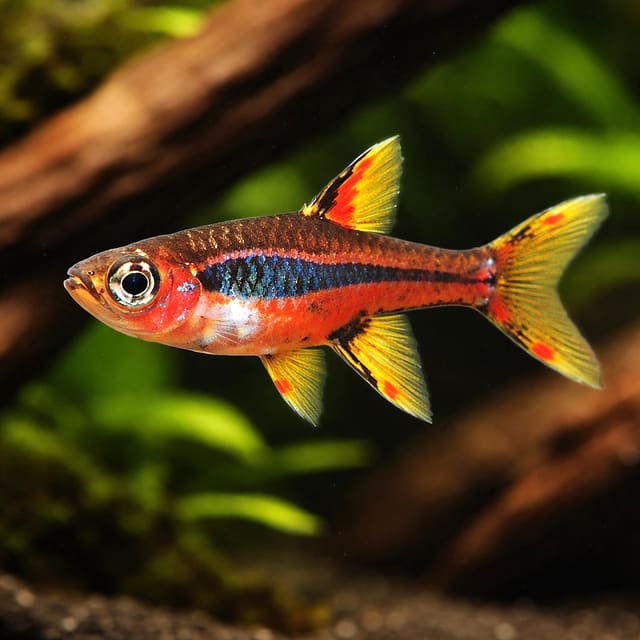
The gallery images are representative, based on reference photographs of this species, so colours can look slightly different from the live animal.
Colour can also vary with condition, breeding state, line and lighting. Choose from the animal name, dispatch size and care requirements rather than using one image to predict the appearance or sex of a separate fish. If you are comparing different fish rather than choosing a CPD size, browse the rasbora and danio collection and assess each candidate on its own adult care needs.
Start with a mature aquarium whose base measures at least 45 × 30 cm after allowing for internal equipment. Around 41 litres is associated with that footprint in the cited species account, but the litre label cannot replace a base measurement. Add capacity whenever the complete adult stocking, group size or tank mates demand more room.
Use dense planting to divide the aquarium into small visual territories. Fine-leaved areas, taller background growth and floating plants can provide cover, while an open feeding area lets you check that every fish eats. Broken lines of sight give a pursued fish somewhere to move out of view instead of being chased from one end of the tank to the other.
A dark substrate is useful for a natural-looking display and may make the pale body spots easier for the keeper to see, but it is an aesthetic choice rather than a treatment. Avoid driftwood and oak, beech or almond leaf litter for this setup because the species account notes that their tannins are not characteristic of its natural waters. Choose aquarium-safe materials that do not push the intended water chemistry outside the selected range.
Use gentle, distributed filtration rather than a concentrated jet. For an aquarium of about 41 litres, the species account gives four to five times the volume per hour, equivalent to roughly 165–205 litres per hour. Actual flow inside the aquarium is shaped by filter media, pipework and layout, so watch the fish: they should be able to hold position, feed and use the planted cover without constantly fighting the current.
A working biological filter is essential. The RSPCA explains how beneficial filter bacteria process toxic ammonia and nitrite. Prepare that system before livestock is introduced; our first tropical aquarium guide gives the practical sequence for setting up and maturing a new tank.
Keep the aquarium between 20 and 26°C, with pH 6.5–7.5 and general hardness of 5–15 dGH. These are screening ranges, not instructions to move between the extremes. Select a stable point within the overlap for every animal in the aquarium, then monitor the water so changes are detected before the fish show distress.
Measure temperature with an independent aquarium thermometer. Whether a heater is required depends on the aquarium’s measured overnight low and seasonal variation, not the room label or postcode. A correctly sized thermostatic heater can prevent cold drops, but it cannot prevent summer overheating; monitor the upper end during warm weather as well.
| Reading | Action |
|---|---|
| 20–26°C | Choose and hold a stable point shared by all inhabitants |
| pH 6.5–7.5 | Avoid rapid chemical chasing of a particular number |
| 5–15 dGH | Compare the aquarium, source water and intended residents |
| Ammonia | Maintain at zero mg/l |
| Nitrite | Maintain at zero mg/l |
| Nitrate trend | Investigate an unexplained rise and adjust maintenance or stocking |
OATA’s danio sheet gives zero mg/l ammonia, zero mg/l nitrite and nitrate no more than 20 mg/l above the normal tap-water level as group guidance; these are maintenance limits rather than species-specific target values. Its broader temperature, pH and hardness figures should not replace the narrower CPD ranges above.
UK tap water varies by area, and the aquarium can differ from the tap after biological activity, substrates and water changes. Test the aquarium itself. Our water chemistry guide explains what the main readings mean, while the water matcher helps compare measured values with the intended range.
When moving a fish, compare measured temperature, pH and hardness rather than assuming two aquariums are alike. Use a gradual acclimation approach suited to the actual difference and avoid abrupt movement to a distant value merely because both values sit within the outer range. Stability and the rate of change matter alongside the final number.
Celestial Pearl Danios are social, but they shoal rather than moving as one tightly coordinated school. Rival males may display and spar during daylight hours, and nipped fins can occur within the group. Dense cover and a complete social group help spread attention, but neither removes the need to monitor each individual.
Tropical Fish Co uses ten as a cautious purchase floor. The specialist account favours larger groups, ideally 20 or more, because greater numbers may spread aggression and help the fish behave more boldly. That recommendation is conditional on adequate footprint, filtration, cover and feeding access; adding fish without increasing capacity can exchange one welfare problem for another.
A group silhouette can look settled while one animal is excluded. Watch where each fish rests, whether it can enter the feeding area and whether the same individual is chased every time it leaves cover. Repeated pursuit, torn fins, weight loss, refusal to feed or an animal held in a corner means the social arrangement needs intervention.
If the aquarium still has adequate space, add or reposition planting to interrupt long sightlines. Make one change and observe its effect rather than repeatedly rebuilding the tank. When cover cannot stop persistent targeting, separate the aggressor or victim into a suitable established system. Do not solve aggression by reducing the whole group below the cautious floor or by placing the fish in a smaller container.
During the first month, compare behaviour at feeding time, under normal lighting and after maintenance. Brief displaying between evenly matched fish differs from one animal being continually driven away. Recording which fish is involved, where conflict occurs and whether fins are deteriorating gives a clearer basis for changing the layout or social plan.
Offer suitably small prepared food alongside appropriately sized live or frozen foods. The species account names Daphnia and Artemia and advises against an exclusively dry diet. Celestial Pearl Danios rarely rise to the surface, so floating food can remain out of reach while faster fish consume it.
Use particles that each fish can swallow without repeated attempts. Fine prepared food can form part of the ration, while small live or frozen items add variety. Introduce unfamiliar foods gradually and watch them enter the fishes’ feeding zone rather than assuming that food added to the aquarium has been eaten.
OATA’s broad danio advice uses one daily feed that can be eaten within a few minutes. Apply that as a measured baseline rather than a licence to add one large pinch. The species guidance prioritises suitably small daily foods and direct observation, so the practical goal is a controlled ration that reaches every fish without leaving waste.
Food competition is a compatibility issue as well as a dietary one. In a mixed aquarium, larger or more boisterous fish may take the ration before a CPD approaches. Distribute tiny portions across more than one point only when you can still watch what is eaten. An open feeding lane beside planted refuge can help nervous individuals move forward without crossing the entire tank.
During the first week, check appetite at every feed. A newly introduced fish that ignores one food may accept a different supported format, but persistent refusal needs a water-quality, health and social assessment. Do not rely on colour alone to judge nutrition: body shape, feeding response and whether the fish is maintaining access to the group provide more useful observations.
A mature planted aquarium may contain biofilm and tiny organisms, but that does not replace a planned diet. Feed the fish directly, confirm intake and keep uneaten food from becoming an avoidable source of ammonia.
Test ammonia and nitrite at least weekly and maintain both at zero mg/l. Track nitrate against the normal tap-water level and investigate a rising trend. Testing becomes especially important after adding fish, increasing food, cleaning equipment or noticing altered breathing, swimming or appetite.
OATA recommends a 25% partial water change at least once every week for danios and white cloud mountain minnows. Treat replacement tap water with a suitable conditioner before it enters the aquarium so chlorine or chloramine does not harm the fish or filter bacteria. Match the replacement water appropriately to avoid an abrupt temperature or chemistry shift.
Clean filter media only when flow or accumulated debris makes it necessary. Rinse it lightly in aquarium water removed during the water change rather than under the tap, because chlorine or chloramine may damage the beneficial bacterial population. Avoid replacing all established media at once unless the equipment instructions and an appropriate biological plan require it.
Do not combine every disruptive task on the same day. A major plant trim, deep substrate disturbance, filter clean and large stocking increase can change several conditions at once and make the cause of a later problem difficult to identify. Stagger work where practical, preserve biological media and observe the fish after each intervention.
A small fish does not create permission to neglect maintenance. The group, food and other inhabitants determine the biological load, while a smaller volume can change quickly. If ammonia or nitrite is detected, treat the reading as an active water-quality problem: stop adding livestock, review feeding and filter function, and restore safe conditions through appropriate water management.
Before introduction, confirm that the aquarium is mature, temperature is stable, ammonia and nitrite are zero, and the planned group fits the footprint and filtration. Compare the fish’s holding-water measurements with the destination aquarium, then choose a gradual acclimation approach appropriate to the difference. Avoid making an abrupt move simply because both sets of readings fall within the outer care range.
Add livestock at a pace the biological filter can support. OATA warns that increasing fish numbers or feeding faster than the beneficial bacteria can respond may lead to new tank syndrome, with harmful ammonia or nitrite. For a social species, balance that biological caution with the need for a responsible group by preparing sufficient mature capacity before the order.
| Time | What to assess |
|---|---|
| After introduction | Breathing, balance and access to cover |
| First feed | Whether each fish approaches and swallows food |
| First week | Ammonia, nitrite, appetite, fins and repeated chasing |
| First month | Body condition, group balance and maintenance trend |
Watch for hanging at the surface, sitting on the bottom, erratic swimming, faster or slower gill movement, unusual darkening or paling, increased hiding, loss of appetite, white spots, fluffy growths, damaged fins, lost scales or changing body condition. A single sign is not a diagnosis, so begin with measured water quality and a clear history of recent additions, maintenance and behaviour.
The MSD Veterinary Manual’s aquarium-fish guidance places water quality, history, quarantine and diagnosis before targeted treatment. Do not automatically raise the temperature or add a random medicine. The correct response depends on the cause, active ingredient, labelled dose, water volume and other animals present.
Quarantine new fish in a separate, suitable established system when practical. If signs persist, worsen, spread, or include severe breathing difficulty, ulcers, loss of balance or repeated deaths, contact us for immediate husbandry guidance and seek a fish-experienced veterinary professional. OATA’s UK fish-vet finder provides a route to specialist help.
Compatibility depends on adult size, water overlap, feeding speed, territorial behaviour and the space used by the complete community. Celestial Pearl Danios can be intimidated or outcompeted by larger or more boisterous fish, so a shared temperature range alone is not enough.
| Question | Pass condition |
|---|---|
| Adult size | The candidate cannot swallow a CPD |
| Water | A stable point fits both animals’ temperature, pH and hardness ranges |
| Feeding | CPDs can reach suitably small food before it is taken |
| Behaviour | The candidate does not repeatedly chase or intimidate them |
| Space | The aquarium supports both complete adult social groups |
Avoid fish able to swallow Celestial Pearl Danios and fish that repeatedly chase or consistently outcompete them. Larger, fast-feeding animals may fail the screen even when they are not overtly aggressive. Persistent food exclusion causes a practical incompatibility because adding more food can degrade water without ensuring the slower fish receives it.
Similarly sized, calm fish may be considered when all five checks pass. The specialist account notes that similarly sized surface-dwelling fish may help reduce shyness, but each candidate still needs its own adult-size, social and water assessment. Do not turn one successful combination into a universal tank-mate list.
Use the adult community rather than the dispatch sizes for planning. A small new arrival may grow, and a tank mate that begins at a similar size can mature into a fish with different feeding or predatory capacity. Include the full social requirement of every shoaling species rather than adding one or two individuals as decoration.
A species-focused aquarium is a complete choice. It simplifies feeding observation and removes interspecies competition, although rivalry within the CPD group still needs planting, sufficient numbers and monitoring. Mixed or species-focused, keep a cycled separation option ready before testing a new combination.
No fish-and-shrimp combination creates a zero-risk nursery. An adult cherry shrimp may be too large for a Celestial Pearl Danio to swallow, but shrimplets, eggs and newly moulted animals can be vulnerable. Moss and dense planting may reduce encounters, yet refuge cannot guarantee that a breeding colony will avoid losses.
| Priority | Safer plan |
|---|---|
| Maximise shrimp recruitment | Use a fish-free shrimp nursery |
| Build a mixed display | Accept predation risk, provide refuge and monitor both animals |
| Observe CPD feeding clearly | Use a species-focused group with an open feeding lane |
| Test a new combination | Prepare a suitable cycled separation system first |
Choose the fish-free nursery when raising shrimp young is the main goal. In a mixed display, assume that vulnerable shrimp may be eaten and avoid describing dense planting as complete protection. Check after lights change, feeding and maintenance because these events can alter where fish and shrimp forage.
Species choice also matters within closely related fish. Avoid keeping the closely related C. erythromicron with this fish because hybridisation may be possible. That concern is separate from aggression: two animals can appear behaviourally compatible while still being a poor breeding combination.
Do not use an image of fish and shrimp sharing one aquarium as a safety guarantee. It shows only that those animals occupied the scene at that moment. Long-term compatibility depends on feeding opportunities, moulting, reproduction, individual behaviour and whether vulnerable young can be reached.
If a mixed setup is chosen, inspect shrimp refuge without repeatedly dismantling it, confirm that CPDs still reach their own food and watch for fish becoming trapped in dense material. Remove a combination when losses, persistent pursuit or food competition conflict with the intended welfare outcome.
A separation plan is part of responsible compatibility testing, not an emergency improvisation. Keep access to a suitable, mature system with matching water conditions, filtration and cover. A small uncycled container cannot safely replace the main aquarium merely because the fish itself is small.
Observe at more than one time of day. Check the community during feeding, ordinary swimming and after layout or maintenance changes. A fish that remains hidden only when one particular tank mate is active gives a different signal from a whole group briefly sheltering after work in the aquarium.
Act when the same CPD is repeatedly pursued, excluded from food, pinned into a corner or losing fin condition. First confirm water quality, because poor conditions can change behaviour across the aquarium. If readings are appropriate, use the prepared separation system and reassess the stocking or layout before attempting another introduction.
More planting can break sightlines, but it also occupies swimming and feeding space. Add cover only while the minimum footprint remains useful and water circulation reaches the whole aquarium. Avoid treating decor as a cure for an adult-size mismatch or a predator-prey risk.
For a stocking and compatibility assessment, contact us with the aquarium’s base dimensions, volume, measured temperature, pH and hardness, existing adult species and numbers, planned additions, filtration and a description of feeding behaviour. Those details allow a conditional assessment; individual behaviour can still require separation after introduction.
FishBase records a maximum of 2.1 cm standard length for the Celestial Pearl Danio; standard length stops at the base of the tail fin.
Use a mature, densely planted aquarium with a base of at least 45 × 30 cm. Seriously Fish equates that footprint to about 41 litres and advises against using a smaller base for a group.
Tropical Fish Co uses ten Celestial Pearl Danios as a cautious purchase floor. Seriously Fish favours larger groups, ideally 20 or more, where footprint, filtration, cover and total adult stocking permit.
We classify it as intermediate because the keeper must balance a complete social group, male rivalry, feeding access and stable water in a mature planted aquarium.
Offer a Celestial Pearl Danio suitably small prepared food plus small live or frozen foods such as Daphnia or Artemia. Feed a measured daily ration and watch every fish swallow food.
Seriously Fish gives 20–26°C, pH 6.5–7.5 and 5–15 dGH for this fish. Choose a stable point shared by every inhabitant and maintain ammonia and nitrite at zero mg/l.
Rival male Celestial Pearl Danios may spar, and nipped fins can occur within the group, although this behaviour does not normally extend to tank mates. Act if one fish is repeatedly chased, excluded from food or losing fin condition.
Consider similarly sized calm fish only after checking adult size, water overlap, feeding speed, behaviour and space. Avoid fish able to swallow, chase or consistently outcompete it, avoid C. erythromicron because hybridisation may be possible, and treat shrimp eggs, shrimplets and newly moulted shrimp as vulnerable.
Start filming the sealed parcel before opening it, continue in one take as it is opened and show the Celestial Pearl Danio still inside the sealed bag. Someone must be present to receive the parcel; float the bag for 20–30 minutes before releasing the fish, and never pour the bag water into the aquarium.
No reviews for this item yet. Bought one? Honest reviews only, good or bad.
What customers say about ordering from us
I have a small group of long finned mountain minnows. So was delighted to be able to order ten of this variety to increase the genetics in my tank . The ones I recieved are healthy but it’s to early to give a verdict on wether they are of a long finned type since they are small currently.
Gordon Walker · 23 Sept 2026
100% success travel and "installation". Pleased with quality of purchase. The Siamese fighter a bit "shy" so have not yet seen him at his best yet but looking good. Happy customer. GG
George E Garratt · 21 Sept 2026
Reviews of our shop, collected by Judge.me, an independent third-party review collector. Newest first.