Moderate
Celestial Pearl Danio (Danio margaritatus)
20–26°C · pH 6.5–7.5 · 41L
From £7.99Some sizes on sale

Six celestial pearl danios (Danio margaritatus), the spotted nano fish also sold as galaxy rasbora, sent at about 1 cm and not sexed. Adults reach about 2.1 cm. They want a heavily planted tank with a base of at least 45 × 30 cm, 20–26 °C, gentle flow and small live or frozen foods.
Danio margaritatus
Six celestial pearl danios (Danio margaritatus), the spotted nano fish also sold as galaxy rasbora, sent at about 1 cm and not sexed. Adults reach about 2.1 cm. They want a heavily planted tank with a base of at least 45 × 30 cm, 20–26 °C, gentle flow and small live or frozen foods.
Maintain these water conditions for optimal health and vibrant colors
This listing is for six celestial pearl danios, Danio margaritatus, sent together in one order. They are the same species as our single Celestial Pearl Danio (Danio margaritatus) listing, grouped so that you start with a little shoal instead of one or two nervous fish. They travel at about 1 cm long and they are not sexed, so your six can be any mix of males and females.
Fully grown, this is still one of the smallest fish we keep. FishBase gives a maximum of 2.1 cm standard length, which is measured from the tip of the snout to the base of the tail and leaves out the tail fin. Wikipedia puts adults at 2–2.5 cm standard length. A fish that small asks for a different kind of thinking from most community fish: smaller food, gentler water movement, calmer neighbours and a tank full of plants.
The names trip people up. The Pearl Danio (Brachydanio albolineatus) is a different species altogether, sharing only part of its common name with this fish. Celestial pearl danio and galaxy rasbora, on the other hand, are two names for the same animal, Danio margaritatus. If the tiny spotted fish in our photo is the one you have been looking for, you are in the right place.
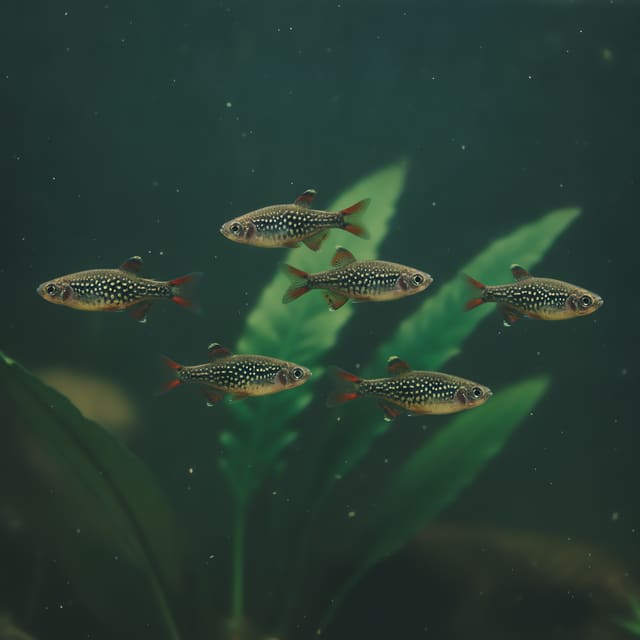
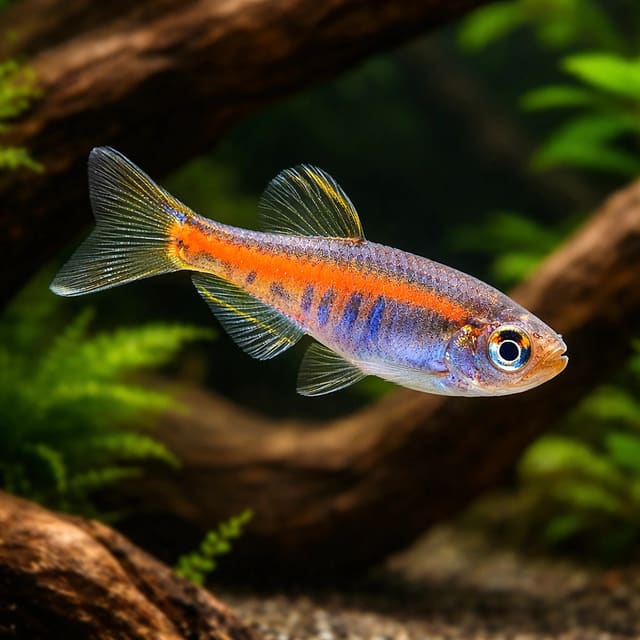
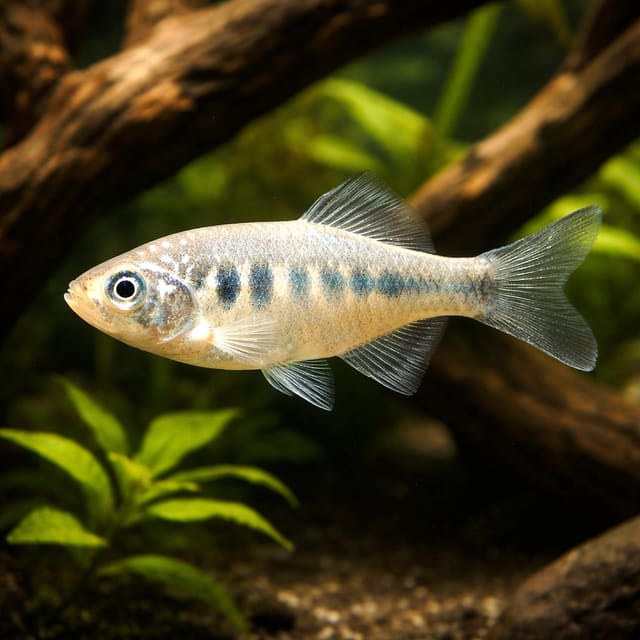
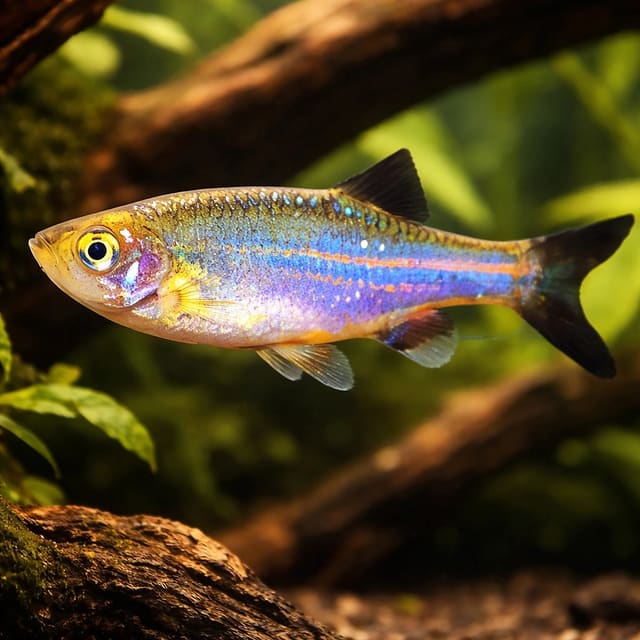
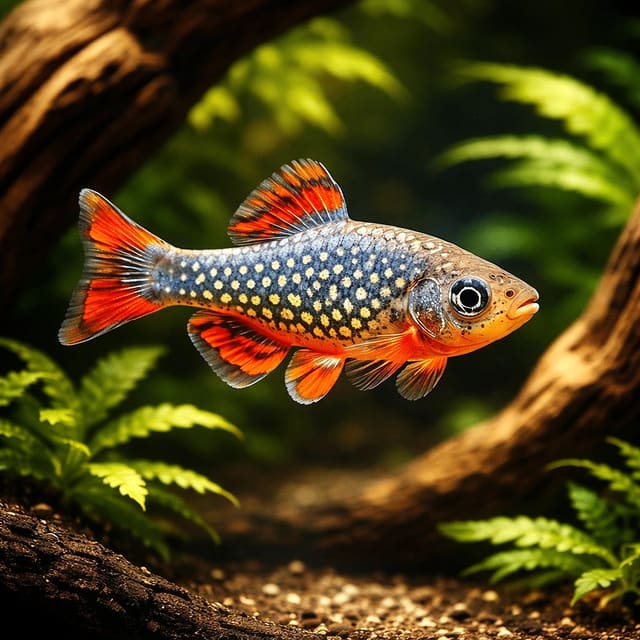
In good condition this is a striking little fish for its size. Wikipedia describes a blue body in males, dull blue-green in females, covered in small pearly dots, with fins carrying two parallel black lines and a bright red area between them on every fin except the pectorals. The photo on this page shows that pattern well: pale, pearl-like spots across the flanks and red fins edged and barred with black.
Seriously Fish describes males as steel blue to deep blue over most of the flanks, with intense red and black striping in all fins except the pectorals and pearly white to cream spots on the body. When a male comes into breeding condition his belly turns reddish, the whole body colour deepens, and a pale stripe running along the top of the head becomes sharper. Wikipedia adds that males have more vibrant fins and a deeper caudal peduncle, the narrow part of the body just in front of the tail.
Females are quieter in colour. Seriously Fish describes a blue-green base colour, weaker red to orange patches in the fins, plain pelvic fins, and body spots that are cream to golden and do not reach the front of the belly. It also notes that females grow a little larger and rounder, especially when carrying eggs. Wikipedia puts it simply: females show a weaker version of the pattern, in the tail and dorsal fins only.
Because the group is not sexed, you may see a mix of brighter males and softer-coloured females, and the balance will vary. Colour is also a good guide to how well the fish are doing. Seriously Fish notes that daily meals of small live and frozen foods bring out the best colouration, and the most intense colour belongs to males in breeding condition.
One more point from Seriously Fish is worth knowing. The species has been bred intensively for the ornamental trade, and fish with spots or blotches instead of stripes in the pelvic and anal fins, or with body deformities, are now common in commercially bred stock. When your fish settle in, it is worth having a look at their fins so you know what you have.
Celestial pearl danios have one of the more remarkable back stories in the hobby. Seriously Fish records their discovery in August 2006 in the Salween River drainage of Shan State, eastern Myanmar, near the town of Hopong at about 1,040 m above sea level. The type locality is described as pools at the foot of a mountain about 30 km east of Taunggyi. Wikipedia places the fish in the Salween basin near Inle Lake, in small ponds fed by seeping groundwater or the overflow from small brooks and springs in the Nam Lang and Nam Pawn river systems.
The water they live in is nothing like a murky jungle stream. FishBase describes small, shallow ponds at most 30 cm deep, with clear water and luxuriant submerged plants such as Elodea. Seriously Fish describes shallow grassland wetlands with dense growth of plants from the frogbit family, Hydrocharitaceae, and transparent water. Wikipedia notes the water is slightly alkaline, and Seriously Fish gives a pH of 7.3 recorded at the type locality. FishBase records 22–24 °C in January 2007, and Wikipedia adds that the fish tolerate temperatures above 26 °C. FishBase lists Microrasbora and Yunnanilus among the fishes found alongside it.
Those habitat notes translate almost directly into tank-keeping decisions.
The fish went into the trade almost as soon as it was found, first under the name galaxy rasbora, and collecting was heavy. Seriously Fish records that the government of Myanmar banned exports in February 2007. Fears for the species eased when later surveys found populations in at least five locations around Hopong. Wikipedia notes that the fish proved prolific, spawning almost every day, and that ponds emptied by collectors were fully restocked a few months later as fry hatched. Seriously Fish records the first UK breeding in February 2007, and intensive commercial breeding is now common. FishBase lists its IUCN status as Data Deficient, assessed in 2010.
The naming has moved around as much as the fish. It was first sold as Microrasbora sp. 'Galaxy', which is where the galaxy rasbora name comes from. In February 2007 T. R. Roberts described it in the Raffles Bulletin of Zoology in a paper titled "The 'celestial pearl danio', a new genus and species", placing it in a new genus as Celestichthys margaritatus. It was moved into Danio in 2008, and Seriously Fish, which follows a 2013 revalidation of Celestichthys, still files it under that name. FishBase currently accepts Danio margaritatus Roberts, 2007, in the family Danionidae, and that is the name we use. If you see any of these names on a label, they all mean this fish.
Seriously Fish gives a minimum base of 45 × 30 cm for celestial pearl danios. At a typical working height, a tank of that footprint holds roughly 40 litres, which is a sensible home for a group of six. More fish, or tank mates, call for more space. What goes inside the tank matters more than the volume, though, because this is a fish that hides when it feels exposed.
Seriously Fish recommends a heavily planted set-up, preferably with a dark substrate, and suggests floating plants as a useful addition. Think back to the wild ponds: shallow, clear water thick with fine-leaved submerged plants. In practice that means dense stands of stem plants, mosses and fine foliage along the back and sides, with some open water at the front where the fish can be seen once they gain confidence. Wikipedia notes that males try to defend a patch of dense vegetation when courting, so several separate thickets can give rival males a patch each rather than one shared bush to squabble over.
Seriously Fish advises against driftwood and oak, beech or almond leaf litter for this species. That fits the habitat, which is clear and slightly alkaline rather than tea-stained and acidic.
Seriously Fish recommends gentle filtration and suggests an air-powered sponge filter should be adequate. A powerful outlet that pushes the water round the tank wears out a fish that is barely 2 cm long and blows fine food away before it can be eaten. If you use a canister or internal filter, turn the flow down or break it up with a spray bar or plants.
| Parameter | Aquarium range | What the wild habitat shows |
|---|---|---|
| Temperature | 20–26 °C (Seriously Fish) | 22–24 °C recorded in January 2007 (FishBase); tolerates over 26 °C (Wikipedia) |
| pH | 6.5–7.5 (Seriously Fish) | 7.3 at the type locality (Seriously Fish); slightly alkaline (Wikipedia) |
| Hardness | 5–15 dGH (Seriously Fish) | not recorded |
| Ammonia and nitrite | zero | clear, well-vegetated water |
Many UK tap waters fall in or near that pH and hardness range once dechlorinated. Check yours with a test kit, and if it is far outside, ask us for advice before ordering. Temperature is the one to watch. The comfortable aquarium range starts at 20 °C, so in a room that drops below that overnight or in winter, a small heater set in the low twenties keeps them where they should be. Stability matters more than any single figure for a fish this small; make water changes with conditioned water at a similar temperature.
Small tanks reward a steady routine more than big occasional clean-outs. This is the pattern we suggest for a group of celestial pearl danios:
Put these fish into an aquarium that has been running for some weeks, with plants growing and ammonia and nitrite reading zero, rather than a freshly filled tank. A settled planted tank also carries a film of algae and tiny organisms on leaves and glass, which suits a fish that Seriously Fish expects to graze on small invertebrates, algae and zooplankton in nature.
Feeding is the part of keeping celestial pearl danios that needs the most thought, because standard flake suits them poorly. Seriously Fish expects the species to eat small invertebrates, algae and other zooplankton in the wild. In the aquarium it will take dried foods of a suitable size, but Seriously Fish advises against feeding them exclusively.
Seriously Fish points out that this species rarely rises to the surface, so floating foods are of little use. Choose foods that sink slowly through the plants, and feed where the fish spend their time. Frozen foods can be thawed in a little tank water and released low down with a pipette, which also stops faster fish snapping everything up at the top.
Seriously Fish notes that the species is easily intimidated or outcompeted for food by larger or more boisterous tankmates. If you see your danios hanging back while others feed, feed at both ends of the tank at once, or give them a few minutes with a pipette after the others have eaten. Small, frequent meals suit a fish with a stomach this size better than one large feed.
Newly arrived fish are often reluctant to eat dried food. Seriously Fish advises that newly imported fish are often in poor condition and can be difficult to acclimatise, and recommends small live foods as the first diet, with dry and frozen products introduced once the fish have settled. A culture of live Daphnia or a hatch of brine shrimp in the first week is the single most useful thing you can prepare for these fish.
This is the most common question we get about this listing, and the sources answer it from two angles. Wikipedia says that in a small tank, a group of six, ideally half males and half females, will do well and show natural behaviour. Seriously Fish takes the bigger view: buy as many as possible, ideally 20 or more, because in larger numbers the aggression between males is spread out, and the fish are bolder, more often seen and better coloured.
Both are right for different tanks. Six fish in a well-planted tank with a 45 × 30 cm base is a sound starting point and a lovely nano display. If your tank is larger, or you want the fish out in the open more of the time, plan for a bigger group from the beginning. Our 10 × Celestial Pearl Danios (Danio margaritatus) listing is the same species in a larger group, and the two can be combined.
Wikipedia's suggestion of half males and half females describes an ideal, and this pack is not sexed, so we cannot promise it. If your six turn out to be mostly males, you can expect more of the sparring described in the next section; that is when extra plant cover and, if space allows, a few more fish help most.
Do not expect a tight school moving as one. Seriously Fish describes celestial pearl danios as gregarious but a shoaling rather than a schooling species. In practice that means a loose group drifting through the plants, with fish breaking off to forage, display or chase a rival before rejoining the others. A group spread across the front of the planting on a calm morning is the sight you are aiming for.
If you decide to enlarge the group, add the new fish in one go rather than one or two at a time, so that newcomers have the cover of numbers. Feed well with small live foods for the first days afterwards, as you did with your first six.
Wikipedia calls the species overall quite peaceful, though some fin-nipping occurs. Seriously Fish adds the detail: rival males spar regularly during daylight hours, and nipped fins within a group are not uncommon, although the behaviour does not normally extend to tankmates. Males display at each other and chase briefly, and Wikipedia notes they try to defend a patch of dense vegetation while courting. It looks dramatic in a fish this small but is normal behaviour, and dense planting with plenty of sight breaks keeps it in check.
Celestial pearl danios are naturally shy. Seriously Fish notes that they are easily intimidated by larger or more boisterous fish, and that the presence of similarly sized, surface-dwelling species seems to help reduce that shyness. A few calm fish near the top of the tank seem to reassure them, and they come out more as a result.
Seriously Fish suggests other small cyprinids from Myanmar as suitable companions, naming the glowlight danio (which it files as Celestichthys choprae) and members of the genus Microdevario, and it suspects the species would also do well with Dario hysginon. Our Glowlight Danio (Danio choprai) is that same glowlight danio. Whatever you choose, keep to fish of a similar size and temperament, and nothing large enough to swallow a 2 cm fish.
A species tank, just the danios and their plants, is never a bad choice for a first group. It is the easiest way to see their natural behaviour and to make sure they get their share of food.
The first fortnight is the time to be most careful, when small, stressed fish meet a new tank and unfamiliar food. Seriously Fish warns that newly imported fish are often in poor condition and can be difficult to acclimatise, which is why it recommends small live foods as the first diet. Get the fish eating well in the first week and the rest is usually straightforward.
Healthy fish move through the plants with fins held open, feed with interest, and show their spots and fin colour clearly. Hiding for the first few days is normal for a shy species in new surroundings. A fish that stays hidden for a long time once the others are out, or refuses food while the rest feed, deserves a closer look.
OATA, the UK aquatic trade association, lists clamped fins, flicking against decor and shimmying as warning signs in its fish care guidance, and describes healthy fish as having clear bright eyes, undamaged fins and intact scales. With celestial pearl danios, also watch for:
When something looks wrong, test before you treat. Ammonia and nitrite should read zero, and the temperature should sit within 20–26 °C. In a small tank, water conditions can change quickly, which is why regular partial water changes with conditioned water at the right temperature are so valuable. If you do need to medicate, remember how small these fish and their tank are, and follow the dosing instructions to the letter.
As mentioned earlier, Seriously Fish notes that commercially bred fish with spotted or blotched pelvic and anal fins, or with body deformities, are now common in the trade. So if one of your fish shows spots rather than stripes on those fins, that reflects how it was bred rather than anything that happened in your tank.
In the right tank these fish breed readily. Wikipedia notes that wild populations proved prolific, spawning almost every day, and Seriously Fish records successful breeding in the UK as early as February 2007. Getting eggs is the easy part. Raising the fry is where the effort goes, because they are tiny.
Celestial pearl danios are egg scatterers with no parental care, according to Seriously Fish. A male displays to a female and chases her briefly before she releases her eggs, which Wikipedia describes as small batches of around 30 eggs per spawning, hidden away in vegetation. Seriously Fish describes the eggs as mildly adhesive. Wikipedia adds that competing males try to fertilise the eggs themselves or eat them, so in a community tank few eggs survive without help.
Seriously Fish notes that daily meals of small live and frozen foods encourage the fish to come into breeding condition. You will see it in the males first: reddened bellies, deeper body colour and more intense displays.
The simplest method is to give a conditioned group a separate small tank packed with fine-leaved plants or moss, and to move the adults back after a few days, or to lift clumps of moss with eggs into a rearing container. Alternatively, a dense, mature planted tank may let a few fry survive on their own, since Wikipedia notes that fry first feed on tiny organisms living among dense plants. Either way, the fry need food small enough for their mouths from the start, so prepare it before you begin.
Small fish need everything ready before they arrive. Please read our delivery and live arrival information before ordering, so you know how the process works and what we need from you.
Start a continuous video while the parcel is still sealed, and open it in the same take so the fish can be seen in their still-sealed bag. If any fish arrives dead, dying or clearly in poor condition, email hello@tropicalfishco.co.uk on the day of delivery with your order number and that video. Photos alone do not meet the policy. Where a claim is accepted under the guarantee terms, the affected fish are replaced with your next order or refunded.
Expect the group to vanish into the plants at first. Watch breathing, appetite and behaviour over the first week, and offer small live foods once or twice a day from the day after arrival, removing anything uneaten. Introduce frozen and fine dried foods gradually once the fish are feeding with confidence, as Seriously Fish advises. Test ammonia and nitrite during the first week, especially if the tank is young. By the end of the second week, a settled group should be starting to come out among the plants, feeding well and showing more colour.
These are the sources used for the facts on this page.
No reviews for this item yet. Bought one? Honest reviews only, good or bad.
What customers say about ordering from us
I have a small group of long finned mountain minnows. So was delighted to be able to order ten of this variety to increase the genetics in my tank . The ones I recieved are healthy but it’s to early to give a verdict on wether they are of a long finned type since they are small currently.
Gordon Walker · 23 Sept 2026
100% success travel and "installation". Pleased with quality of purchase. The Siamese fighter a bit "shy" so have not yet seen him at his best yet but looking good. Happy customer. GG
George E Garratt · 21 Sept 2026
Reviews of our shop, collected by Judge.me, an independent third-party review collector. Newest first.