Easy
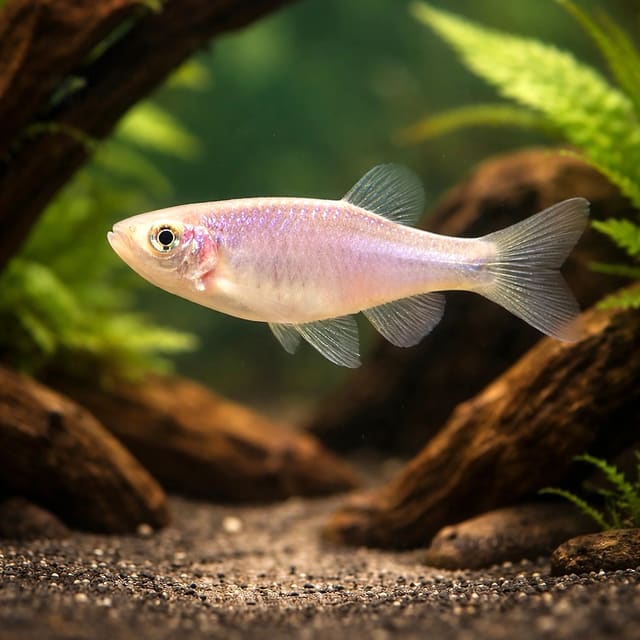
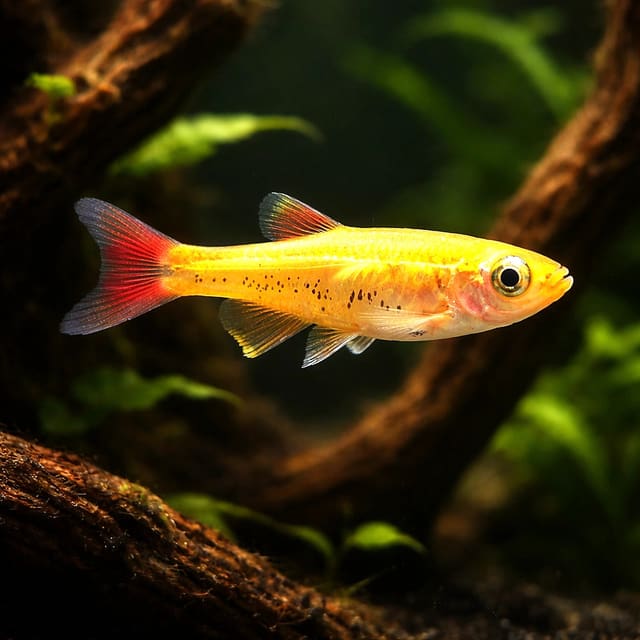
Gold White Cloud Mountain Minnow (Tanichthys albonubes) – 2–3cm Sizes
14–22°C · pH 6–8.5 · 54L
£2.99

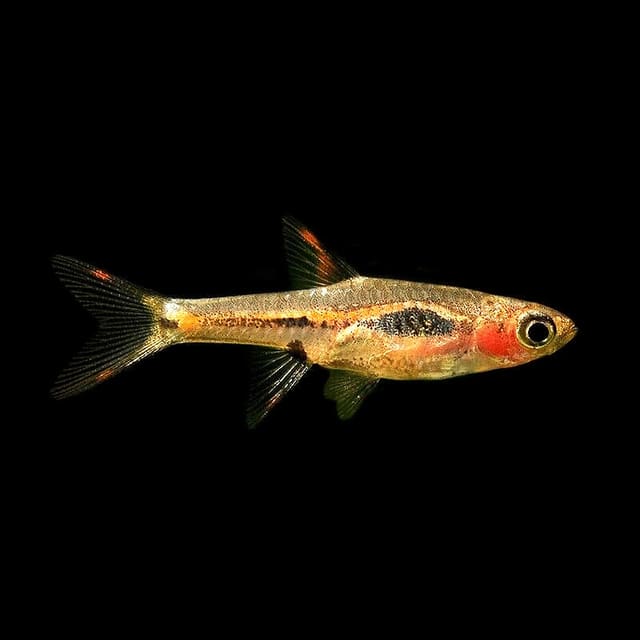
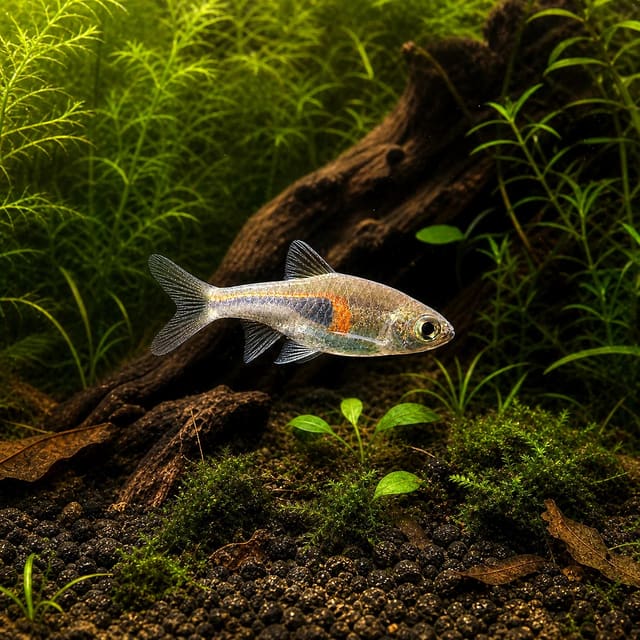
Dwarf Rasbora (Boraras maculatus) is a freshwater danionid from the Malay Peninsula to Sumatra, Indonesia, that reaches 2.5 cm standard length. It suits a quiet planted aquarium: keep at least 8–10, with the FishBase and Seriously Fish overlap at 24–26°C, pH 5.0–6.0 and 5 dGH. Sold individually as one live fish per purchase.
Adult size is the maximum length this species reaches at full maturity (scientific sources). The livestock you receive will be younger and smaller. Product-photo provenance and any image-specific limitations are stated on the listing.
Boraras maculatus
Shoaling fish: kept in a group they feel safer, stay calmer and show their best colour.
Minimum of 2 per order.
Dwarf Rasbora (Boraras maculatus) is a freshwater danionid from the Malay Peninsula to Sumatra, Indonesia, that reaches 2.5 cm standard length. It suits a quiet planted aquarium: keep at least 8–10, with the FishBase and Seriously Fish overlap at 24–26°C, pH 5.0–6.0 and 5 dGH. Sold individually as one live fish per purchase.
Adult size is the maximum length this species reaches at full maturity (scientific sources). The livestock you receive will be younger and smaller. Product-photo provenance and any image-specific limitations are stated on the listing.
Maintain these water conditions for optimal health and vibrant colors
Dwarf Rasbora (Boraras maculatus) is a freshwater schooling fish in the family Danionidae from the Malay Peninsula to Sumatra, Indonesia. It reaches 2.5 cm standard length and suits an aquarist who can provide a quiet, densely planted aquarium for a complete school rather than a busy general community. Pygmy Rasbora is another familiar trade name, while older aquarium literature and trade catalogues may place the fish under Rasbora maculata.
FishBase lists Boraras maculatus at a maximum of 2.5 cm standard length. That adult measurement is the decisive scale for choosing food, companions and planting, but its small body should not be treated as permission to use a cramped container.
The Seriously Fish species profile recommends an aquarium base of at least 45 × 30 cm, approximately 41 litres, because the fish still need swimming room and dominant males may form temporary territories when spawning. It also recommends keeping a school of at least 8–10 specimens.
Keep routine aquarium water at 24–26°C, pH 5.0–6.0 and 5 dGH. These figures are the overlap of FishBase’s recorded environment and the Seriously Fish aquarium range, so all three values should match together before the school is introduced.
| Suits | Not suited to |
|---|---|
| A school of at least 8–10 | Keeping one fish alone |
| A base of at least 45 × 30 cm | A cramped container |
| Dense plants, shade and open routes | A bright, exposed layout without cover |
| Gentle water movement | A fast current |
| Diminutive, peaceful companions | Fish large enough to eat it |
This combination suits a carefully aquascaped aquarium with plants, shade and restrained water movement. It is a less suitable choice when the intended companions are large, boisterous, predatory or quick to dominate feeding. The fish are peaceful but timid, so confidence comes from the school and from cover rather than from physical robustness.
Start by deciding whether the whole aquarium can be planned around these needs. If it can, explore the wider rasboras and danios collection for context, while assessing every animal on its own adult size, water and behaviour requirements.
Dwarf Rasboras are sold individually, with one live fish supplied per purchase. The dispatch grade is 1–2 cm. To build a school of eight, order eight fish; to build a school of ten, order ten. Check the basket quantity before completing the order rather than reading a photograph with several fish as a pack offer.
Dispatch size describes the animal when supplied. It is not the adult size. Plan the aquarium around the maximum recorded length of 2.5 cm standard length, the full school and the required footprint, even when the fish arriving are smaller. This prevents a temporary dispatch measurement from becoming the basis for permanent stocking.
Sex is guaranteed only when the selected option explicitly states male or female. This Dwarf Rasbora listing has no sex-guaranteed option.
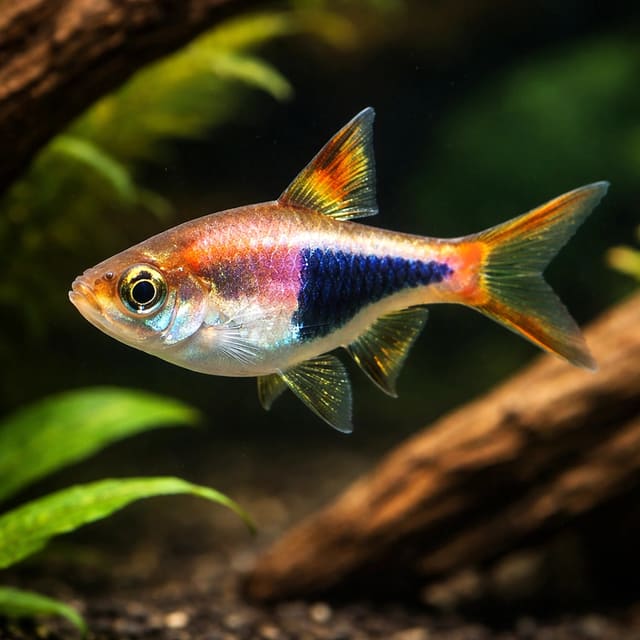
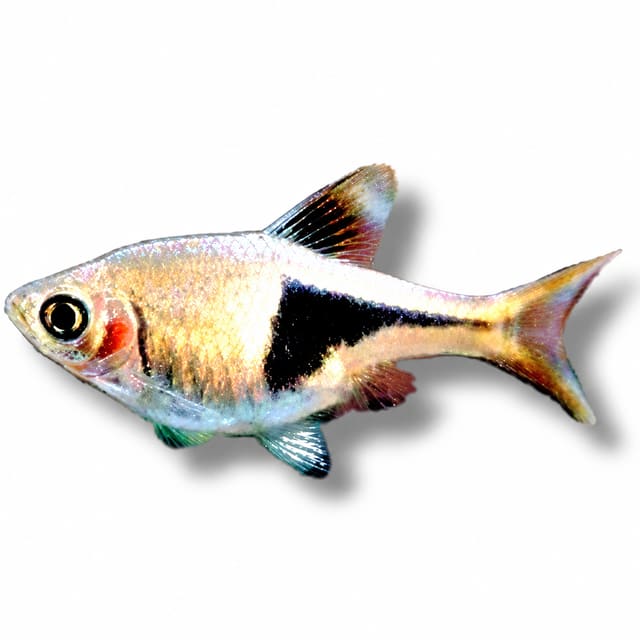
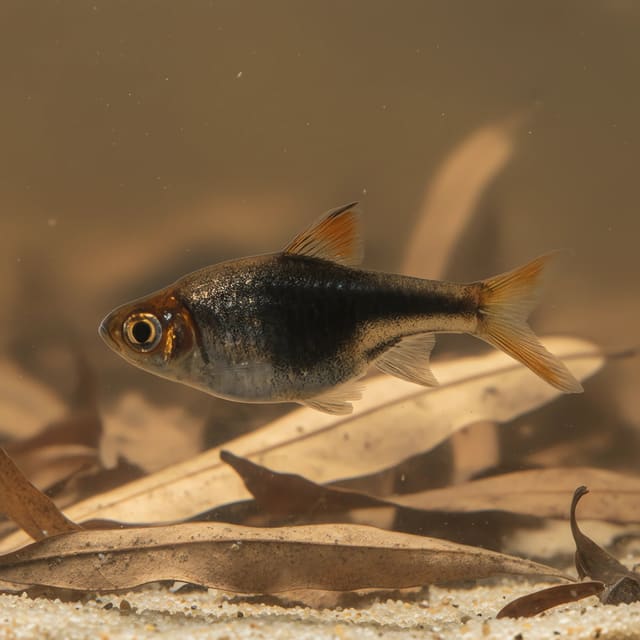
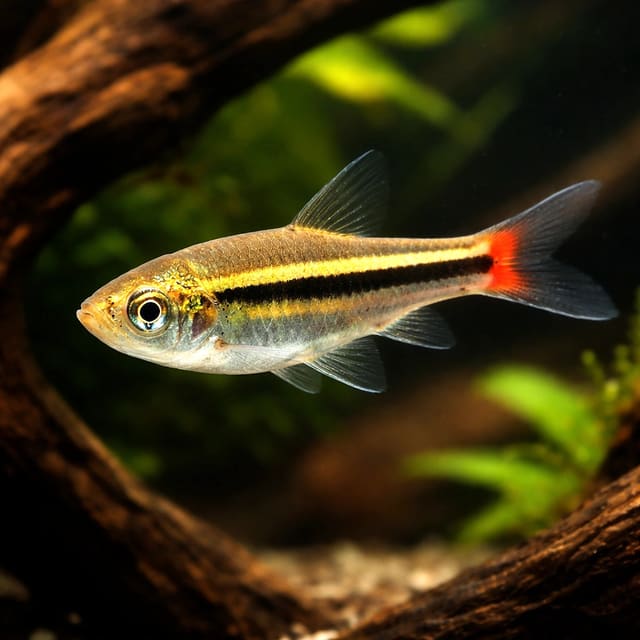
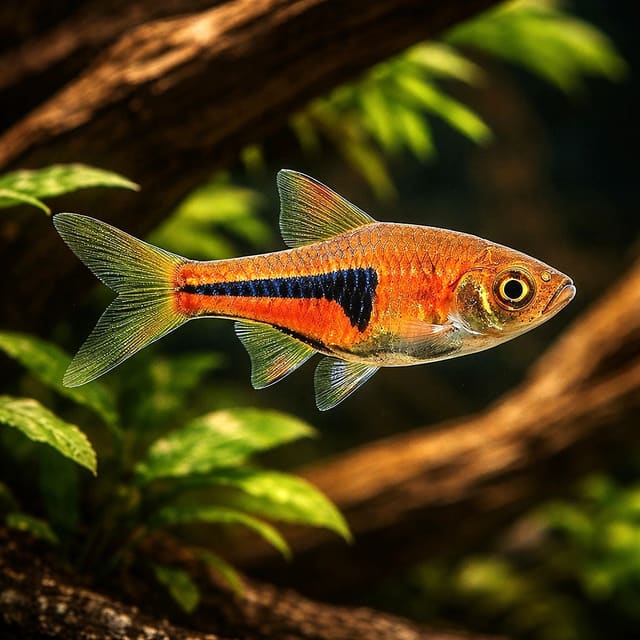
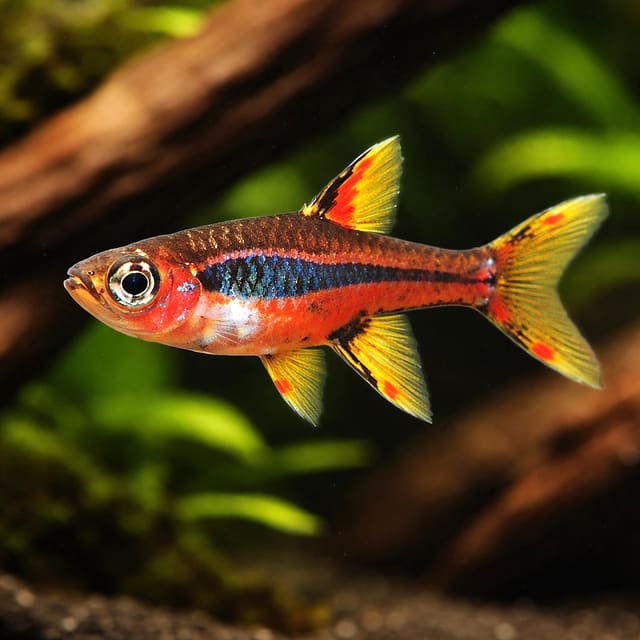
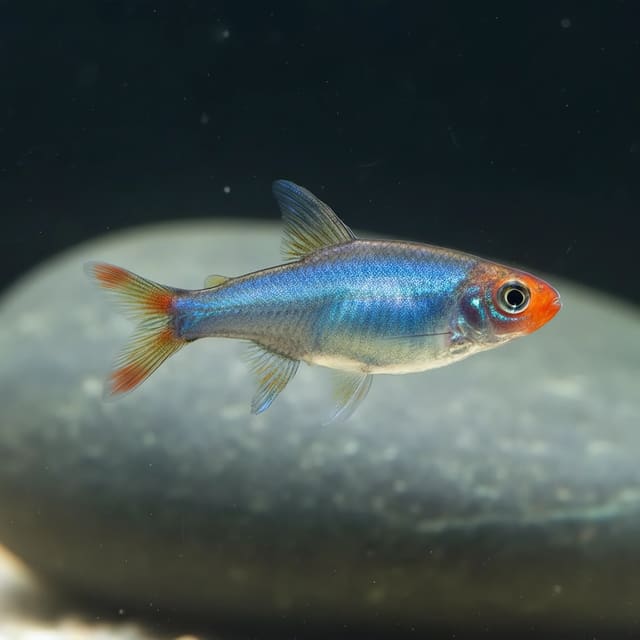
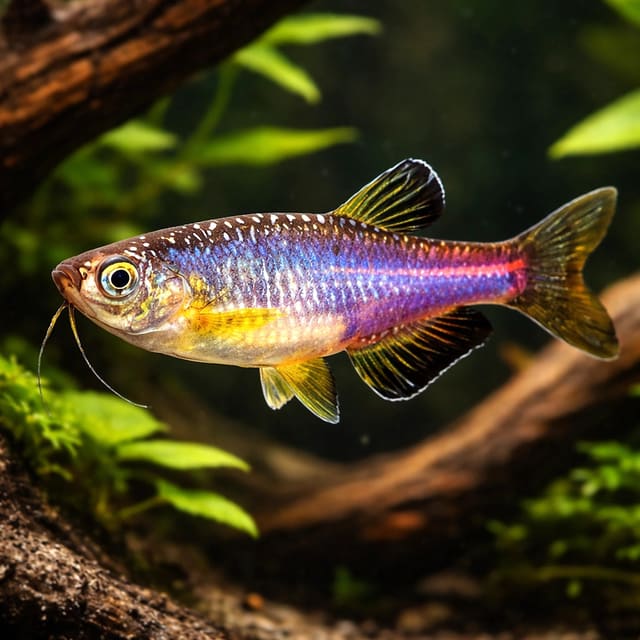
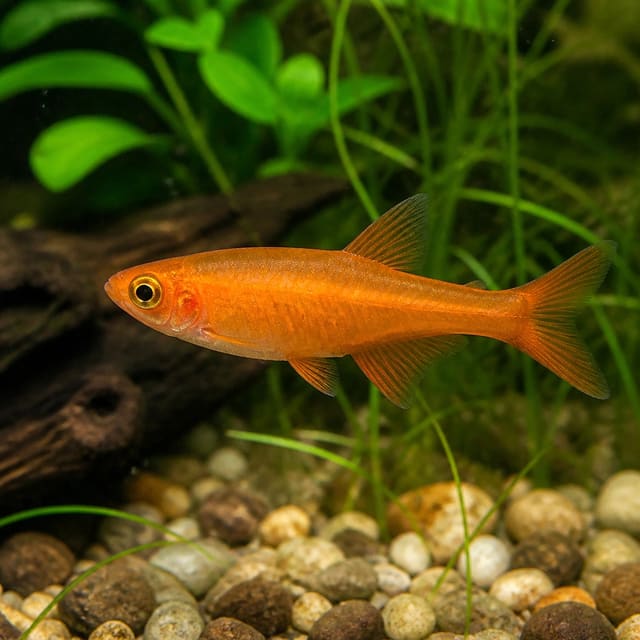
Some gallery images are representative, based on reference photographs of this species, and none shows the exact animal supplied, so colours can look slightly different from the live animal.
One gallery scene shows two fish because two animals are visible in that scene; the sold unit remains one fish. Likewise, markings or body shape shown in an image must not be used as a promise of sex. Mature females may be rounder-bellied and a little larger, while dominant males may show more intense colour, but those traits are not a substitute for an explicitly sexed choice.
Prepare the complete school, aquarium and appropriately sized food before ordering. Review the current delivery and Live Arrival Guarantee policy for packing, receipt, acclimatisation and claim terms.
Use an aquarium with a base measuring at least 45 × 30 cm for a school. The associated volume is approximately 41 litres, but footprint is the firmer decision: a tall aquarium can hold a similar volume while offering too little horizontal room. Measure the internal base rather than relying only on the model name or headline capacity.
The recommended footprint allows the fish to move as a school while leaving room for planted shelter and temporary spawning territories. A small body does not remove those behavioural space requirements. Start with the full intended school when judging the layout, not with the dimensions of one 1–2 cm dispatch-grade fish.
For example, an aquarium holding about 41 litres but measuring only 40 × 35 cm misses the recommended 45 cm length. An aquarium with a 45 × 30 cm base meets the footprint even before extra length is considered. Greater dimensions can make it easier to separate cover from open swimming space and to maintain stable conditions, provided the current remains gentle.
At approximately 41 litres, the species profile suggests looking at a filter rated around 80–125 litres per hour. Treat the rating as an equipment starting point and arrange the return so it does not create a forceful jet through the school’s main swimming area. The fish mostly come from sluggish water and may struggle in a fast current.
For an aquarium of that size, roughly 50 W of heating is suggested when the room is around 20°C. Select and control the heater around the measured aquarium temperature, because the care range applies to the water in the aquarium rather than to a wattage label. Make room for a thermometer, filter access and weekly maintenance when positioning plants and wood.
A densely planted aquarium is the strongest starting layout for Dwarf Rasboras. Use plants to break up exposed areas, then retain clear swimming routes between them. The aim is not to fill every centimetre; it is to let the school move into open water while keeping a nearby retreat.
Floating plants, roots and branches can diffuse the light and give the aquarium a more sheltered character. Position them so shade falls across part of the water without sealing the entire surface or obstructing essential equipment. If the fish repeatedly remain in the darkest corner, reassess whether the open area is too bright, too exposed or crossed by a strong outlet current.
| Element | Purpose |
|---|---|
| Dense planting | Creates nearby cover for a timid school |
| Floating plants | Diffuse overhead light |
| Roots or branches | Form shaded boundaries and visual structure |
| Open route | Leaves room for schooling and feeding |
| Gentle filter return | Avoids forcing the fish into sheltered corners |
A soft sandy substrate is a suitable basis for a more natural-looking arrangement. Roots and branches can be placed to create several shady areas rather than one inaccessible thicket. Dried leaf litter may also be used to strengthen that natural effect. As leaves decompose, they encourage microbe colonies that can become a secondary food source for fry.
Make every decorative choice compatible with routine care. Leave enough access to siphon waste, observe the school and check the filter. A layout that looks dense from the front can still have practical gaps behind wood and around plant groups. Those gaps help you see whether every fish is swimming and feeding normally.
Direct a controllable outlet towards a surface or solid feature if its main stream is too forceful, but continue to confirm the result by watching the fish. Persistent effort against the flow, crowding behind hardscape or difficulty reaching food indicates that the current needs reassessment. Calm movement should coexist with effective filtration; the answer is to manage the return, not to run the aquarium without a filter.
Keep routine aquarium water at 24–26°C, pH 5.0–6.0 and 5 dGH. This is the overlap of FishBase’s recorded environment and the Seriously Fish aquarium range. Measure the established aquarium rather than assuming that tap-water values, a heater setting or a previous test still applies.
Use the aquarium water chemistry guide to understand the values being measured, then compare the results with the fish’s stated range through the water matcher. Record the actual numbers so the decision is based on a repeatable test rather than descriptions such as “softish” or “tropical”.
| Measured result | Decision |
|---|---|
| 24°C, pH 6.0, 5 dGH | All three values sit within the routine range |
| 26°C, pH 6.2, 5 dGH | Temperature and hardness fit, but pH does not |
| 24°C, pH 5.5, 8 dGH | Temperature and pH fit, but hardness does not |
| 27°C, pH 5.5, 5 dGH | Temperature is above the routine range |
A single matching number is not enough. The second and third examples each contain two suitable readings but still fail the complete screen. Decide how the aquarium will remain within the full range before introducing the school, and confirm that the intended companions share those conditions.
Prioritise repeatable conditions over rapid intervention. Test after maintenance and whenever behaviour changes so an outlying result can be found early. If a proposed adjustment would cause an abrupt change, stabilise the aquarium first and reassess the plan rather than moving the fish through repeated swings.
Keep temperature within the range using a controlled heater where room conditions require one. Place the thermometer where it reflects the occupied aquarium rather than immediately beside the heater. Hardness and pH should be checked with suitable tests, especially when the aquarium uses water or décor that may change those readings over time.
Introduce Dwarf Rasboras only to an aquarium with a well-established biological filter. The RSPCA explains why biological filtration is vital: fish release toxic ammonia, beneficial bacteria convert it to nitrite, and further bacteria convert nitrite to the safer nitrate. A filter therefore needs both suitable equipment and a functioning bacterial population.
If this is your first aquarium, complete the steps in our first tropical tank guide before livestock arrives. Do not use the passage of a few days as the test of readiness. Measure the water and confirm that the filter is processing waste.
OATA’s rasbora sheet gives broad group guidance: keep ammonia at zero mg per litre, nitrite at zero mg per litre and nitrate at no more than 20 mg per litre above the normal tap-water level. It recommends a 25% water change at least once a week and testing at least weekly.
Do not rinse filter media under the tap. Chlorine or chloramine may damage the beneficial bacterial population. When cleaning is necessary, rinse the media lightly in aquarium water removed during the partial water change. Avoid replacing or deep-cleaning all biological media at once.
Dwarf Rasboras are micropredators with very small feeding requirements. Analysis of wild fish has found small insects, worms, crustaceans and other zooplankton in the diet. In the aquarium, suitably sized dried food can be accepted, but it should not be the only food offered.
Use fine prepared flake or granules that each fish can take without repeatedly abandoning the piece. Add small live or frozen foods such as Daphnia and Artemia for variety. Daily meals containing appropriately small live or frozen fare support colour and condition while encouraging the fish to feed naturally through the water.
| Food decision | What to do |
|---|---|
| Prepared food | Choose fine flake or granules sized for tiny mouths |
| Live or frozen variety | Offer small Daphnia or Artemia |
| Portion | Give only what is eaten within a few minutes |
| Schedule | Feed once a day |
| Uneaten food | Reduce the next portion and remove accessible waste |
Watch the whole school during the feeding window. Food is appropriately sized only when the fish can swallow it, not merely chase it. If particles are repeatedly taken and rejected, move to a smaller grade. If food reaches the substrate untouched, reduce the amount rather than extending the feeding period.
Mixed aquariums require an extra observation: confirm that the Dwarf Rasboras actually receive food. Larger or faster companions can take the obvious particles first, which is one reason to screen companions for feeding behaviour as well as temperament. Spread a measured fine portion through the school’s occupied area without turning one meal into several uncontrolled feeds.
Overfeeding is a direct water-quality risk. Uneaten food decomposes and adds waste that the biological filter must process. Keep the portion small, monitor consumption for a few minutes and use the weekly ammonia, nitrite and nitrate results to check whether the combined feeding and maintenance routine is working.
Complete the aquarium before the fish arrive. The filter should be established, ammonia and nitrite should both test at zero mg per litre, and the FishBase and Seriously Fish overlap of 24–26°C, pH 5.0–6.0 and 5 dGH should be stable. Dense planting and a gentle filter return should already be in place so the fish enter a settled layout.
Increase the aquarium population gradually. Every addition increases waste and feeding, so the beneficial bacterial population must keep pace with the new load. Adding livestock too quickly can produce new tank syndrome, in which ammonia or nitrite rises because the filter cannot process the increased waste.
| Checkpoint | Action |
|---|---|
| Before introduction | Test temperature, pH, hardness, ammonia and nitrite |
| At introduction | Use a calm area with nearby plant cover and subdued light |
| First feeding | Offer a very small amount of suitably fine food |
| First few days | Check swimming, breathing, hiding and food intake |
| End of first week | Repeat water tests and complete the planned maintenance routine |
Subdued lighting and nearby cover reduce exposure in a species that appreciates diffused light and is naturally timid. Keep the filter operating and maintain gentle movement; do not switch off essential filtration to create calm. Instead, adjust the outlet arrangement if the current crosses the fish’s preferred shelter or feeding area too forcefully.
At feeding time, confirm that food reaches the school and is small enough to swallow. A fish following particles but repeatedly failing to take them needs a smaller food grade. A school that withdraws whenever another fish approaches requires a renewed compatibility assessment rather than a larger meal.
Test promptly if swimming, breathing or feeding changes. The first response should be to compare measured water quality with the required values and inspect the filter for a loss of flow. Avoid adding further animals until the new population is feeding, behaving consistently and producing stable weekly test results.
Observe the school every day during feeding and again when the aquarium is undisturbed. Normal behaviour varies between individuals, so look for a change from the established pattern rather than relying on one fixed pose. Clear, bright eyes, intact scales, undamaged fins and appropriate swimming are useful signs to include in the check.
| Change noticed | First action |
|---|---|
| Hanging at the surface | Test water quality and inspect filtration |
| Sitting on the bottom | Check temperature, ammonia and nitrite |
| Erratic swimming | Measure the water and check current strength |
| Faster or slower gill movement | Test promptly and observe the whole school |
| More hiding than usual | Review companions, flow and exposed areas |
| Reduced food intake | Confirm food size and test the water |
| White spots or fluffy growths | Record the signs and seek health guidance |
| Loss of fins or scales | Inspect companions and aquarium furnishings |
A darker or paler appearance, altered temperament, a change in body condition or separation from the school also deserves attention. Compare several observations: whether the fish can maintain position, whether every fish reaches food and whether the change affects one animal or the entire group.
Water testing comes before guessing at a diagnosis. Confirm ammonia and nitrite are zero mg per litre, check nitrate against the maintenance limit, verify temperature and inspect the filter for obstruction. Correct husbandry problems through the established maintenance routine while avoiding abrupt shifts in the aquarium’s conditions.
If the change persists, if growths or injuries are visible, or if a fish stops eating, contact us for health guidance with the measured water results and a clear description of the behaviour. Do not choose a disease treatment from appearance alone; an accurate account of water, companions, feeding and timing makes the next decision safer.
Dwarf Rasbora is a schooling species and should be kept in a group of at least 8–10 specimens. Adequate numbers make the fish less nervous and create a more natural-looking display. Plan that complete group as the core population rather than adding one fish as a test.
Group size and aquarium size work together. Eight to ten fish still need a base of at least 45 × 30 cm, approximately 41 litres, with planted cover and open swimming room. Do not reduce the footprint because each individual is small. Dominant males may establish temporary territories when spawning, so the layout must give the school more than one usable area.
Temporary displays between fish are not a reason to isolate a Dwarf Rasbora. Retain the school and use plants, branches and sufficient footprint to create visual breaks. Sex should not be inferred from display intensity, body roundness, colour or position within the group.
If a planned aquarium can hold only a few fish after its other inhabitants are counted, choose a different stocking plan. Keeping the correct school is a primary welfare decision, not an optional visual upgrade. A species-focused aquarium can be the clearest solution because the layout, flow, food size and water can all be set around this one small fish.
This fish is very peaceful, but its tiny size and timid nature mean it is not an automatic choice for a general community aquarium. Avoid any fish large enough to eat a Dwarf Rasbora. Boisterous companions are a poor fit because rasboras will not appreciate them.
No companion is universally suitable. Screen each proposed species by its adult size, temperament, feeding speed, preferred current and full water range. A shared label such as “tropical”, “peaceful” or “nano” is not enough when one requirement falls outside the FishBase and Seriously Fish overlap of 24–26°C, pH 5.0–6.0 and 5 dGH.
The species profile names diminutive fish such as Microdevario, Sundadanio, Danionella, Eirmotus and Trigonostigma, along with pygmy Corydoras and small loricariids such as Otocinclus, as possible companions. These examples still require individual screening; genus names do not make every species, aquarium or stocking level equivalent.
Shy anabantoids such as Sphaerichthys, Parosphromenus and more diminutive Betta species are also named as possibilities. Compare their individual water and space needs before combining them. If you want a stocking and compatibility assessment, ask us with the aquarium dimensions, measured water values, filter flow, existing livestock and intended quantities.
A species-only aquarium is the simplest plan when the priority is a settled school, gentle flow and reliable access to tiny food. Dense plants, floating cover and branches can be arranged around the Dwarf Rasboras without having to compromise for a larger or more active fish.
A mixed aquarium can work when every inhabitant is diminutive, peaceful and suited to the same conditions. The compatibility screen must be completed before the visual appeal of a combination is considered. Adult size, not dispatch size, determines whether another fish could become a predator or an intimidating presence.
| Plan | Main decision |
|---|---|
| Species-only school | Set the whole aquarium around at least 8–10 Dwarf Rasboras |
| Diminutive fish community | Confirm adult size, calm behaviour, gentle flow and complete water overlap |
| Planted shrimp aquarium | Use compatible water and retain dense cover |
| Standard community | Choose another plan when larger or boisterous fish create predation or intimidation risk |
In a planted aquarium, the species can be housed alongside freshwater shrimp from the genera Caridina and Neocaridina. That pairing still requires water values suitable for the exact shrimp and fish involved. Choose the aquarium’s pH and hardness from a genuine overlap rather than assuming every shrimp shares the Dwarf Rasbora range.
When combining diminutive fish, retain several sheltered zones and one clear swimming route. Observe feeding access after any population change. If the school becomes more withdrawn or misses food, reassess the companion’s behaviour and the layout rather than waiting for visible injury.
Reject combinations that depend on the Dwarf Rasboras becoming bolder, faster or less vulnerable with time. Their peaceful, timid character and maximum recorded size of 2.5 cm standard length are fixed planning limits. A calm school with appropriate space is a better result than a crowded collection of individually appealing species.
It reaches a maximum recorded length of 2.5 cm standard length.
Use an aquarium with a base of at least 45 × 30 cm, associated with approximately 41 litres, and provide dense planting, open swimming routes and gentle flow.
Keep at least 8–10 specimens; suitable numbers make the fish less nervous and produce a more natural-looking school.
It suits a keeper prepared to establish a filtered, densely planted aquarium, maintain stable soft acidic water and provide tiny foods to a complete school.
Feed suitably fine flake or granules once daily, adding small live or frozen foods such as Daphnia and Artemia; offer only what the school eats within a few minutes.
Keep this fish at the FishBase and Seriously Fish overlap of 24–26°C, pH 5.0–6.0 and 5 dGH, with ammonia and nitrite at zero mg per litre.
It is described as very peaceful and timid. Keep a full school with calm companions, sufficient cover and feeding access rather than placing it in a boisterous general community.
Possible companions include individually screened diminutive species of Microdevario, Sundadanio, Danionella, Eirmotus and Trigonostigma, pygmy Corydoras, Otocinclus, shy diminutive anabantoids, and Caridina or Neocaridina shrimp in overlapping water; avoid fish large enough to eat it.
Have someone present to receive the parcel. Film every delivery continuously from the sealed parcel as it is opened, showing the fish still in the bag; float the bag for 20–30 minutes, then release the fish without pouring the bag water into the aquarium.
No reviews for this item yet. Bought one? Honest reviews only, good or bad.
What customers say about ordering from us
I have a small group of long finned mountain minnows. So was delighted to be able to order ten of this variety to increase the genetics in my tank . The ones I recieved are healthy but it’s to early to give a verdict on wether they are of a long finned type since they are small currently.
Gordon Walker · 23 Sept 2026
100% success travel and "installation". Pleased with quality of purchase. The Siamese fighter a bit "shy" so have not yet seen him at his best yet but looking good. Happy customer. GG
George E Garratt · 21 Sept 2026
Reviews of our shop, collected by Judge.me, an independent third-party review collector. Newest first.