Moderate
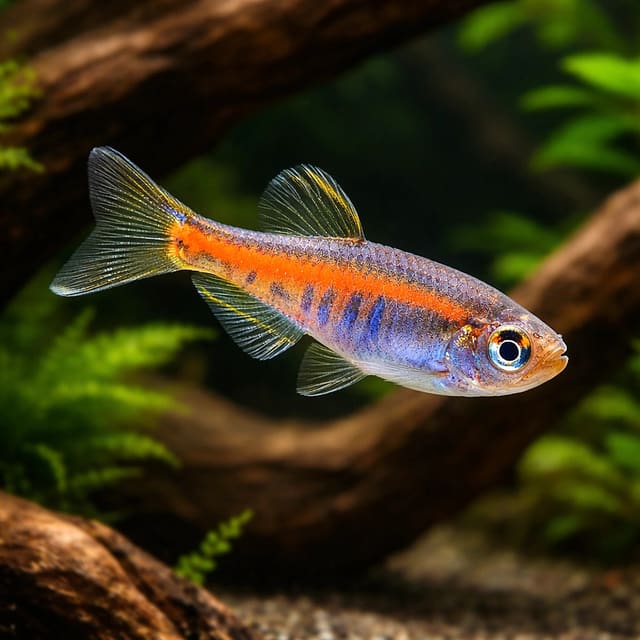
Emerald Dwarf Danio (Danio erythromicron)
20–24°C · pH 7–8
£4.49
Photo coming soon
The size, price and care details on this page are for this listing.
A hybrid of two tiny Myanmar fish once both sold as Microrasbora: the celestial pearl danio (Danio margaritatus) and the emerald dwarf rasbora (Danio erythromicron). Sold as one fish per unit. Nothing is published on the hybrid itself, so its care follows the conditions both parents share.
Water requirements for this listing are not yet confirmed. General care ranges are not a species-specific recommendation. Check temperature, pH and hardness needs with us before ordering.
Danio margaritatus × Danio erythromicron
This offer is one hybrid fish per quantity. Both parent species are social, but there is no independently established group minimum for this hybrid. Ask us to assess the whole group and aquarium; a discount quantity is not a care recommendation.
A hybrid of two tiny Myanmar fish once both sold as Microrasbora: the celestial pearl danio (Danio margaritatus) and the emerald dwarf rasbora (Danio erythromicron). Sold as one fish per unit. Nothing is published on the hybrid itself, so its care follows the conditions both parents share.
Water requirements for this listing are not yet confirmed. General care ranges are not a species-specific recommendation. Check temperature, pH and hardness needs with us before ordering.
This is not a wild species. It is a cross between two tiny fish from the Shan highlands of Myanmar, and it is sold here under the name it carries in our stock records: Microrasbora hybrid marginatus x erythromicron. Before you buy, it is worth knowing exactly what that name means, what it doesn't mean, and how much is and isn't known about a fish like this.
"Microrasbora" is the genus both parents were first known under: the emerald dwarf rasbora was described in it, and the celestial pearl danio was first sold as Microrasbora sp. 'Galaxy'. "Hybrid" tells you the fish is a cross rather than a species. The last two words name the parents, and one of them needs a correction. No fish in Microrasbora or Danio carries the epithet "marginatus" on FishBase's species lists for either genus; the only name in those lists that comes close is margaritatus, the celestial pearl danio, which the trade first called Microrasbora sp. 'Galaxy'. Seriously Fish, the aquarium reference, records that the celestial pearl danio and the emerald dwarf rasbora, erythromicron, are probably able to hybridise. So the cross this name describes is:
celestial pearl danio (Danio margaritatus) × emerald dwarf rasbora (Danio erythromicron)
The epithet marginatus does exist elsewhere, for instance on our dwarf pencilfish (Nannostomus marginatus), but that is an unrelated pencilfish, not a parent of this fish.
It suits a fishkeeper who wants a small, cool-running planted tank with fish that are unusual to look at, and who is happy to keep a hybrid as a display fish rather than as a breeding project. It is not the right buy if:
If the list above rules you out, one of the pure parent species will probably suit you better.
One more honest point. A hybrid is defined by its parents, and we can't hand you a breeding record for this one. It is sold under the hybrid label it arrived with. What follows draws on the published record for each parent and on the one published description of what this cross looks like, and we say clearly wherever we are relying on the parents because there is nothing on the hybrid itself.
Both parents have had a complicated naming history, which is part of why this fish carries an out-of-date genus name.
The first parent was discovered in 2006 and, in Wikipedia's words, "quickly appeared in the aquarium trade", where it was first sold as Microrasbora sp. 'Galaxy' or the galaxy rasbora. T. R. Roberts described it scientifically in 2007 in a new genus, Celestichthys, as Celestichthys margaritatus; a 2008 study moved it into Danio. FishBase now gives the accepted name as Danio margaritatus (Roberts, 2007), with Celestichthys margaritatus and Microrasbora sp. as synonyms, and lists the English names galaxy rasbora and celestial pearl danio.
The second parent is much older in the literature. Annandale described it in 1918 as Microrasbora erythromicron. FishBase now accepts it as Danio erythromicron (Annandale, 1918), and Wikipedia gives its common names as the emerald dwarf danio and emerald dwarf rasbora. According to Wikipedia, molecular work found D. margaritatus and D. choprai to be its closest relatives, which helps explain why the two parents of this fish can cross at all.
You will see both genera in print. FishBase, which we follow for accepted names, places both species in Danio, in the family Danionidae. Seriously Fish uses Celestichthys for both, following Kottelat's 2013 revalidation of that genus. Neither source uses Microrasbora for either fish any more; FishBase's current Microrasbora list holds only M. rubescens and M. microphthalma. For this listing we give the parents' FishBase names, Danio margaritatus × Danio erythromicron, and keep the trade name in the title so that anyone who knows it as a Microrasbora hybrid can find it.
That Endangered listing for the emerald dwarf rasbora is one reason we take the breeding advice further down seriously.
If you'd rather keep the pure species, we also list the emerald dwarf danio (Danio erythromicron), which is also offered as 10 × emerald dwarf danios. Seriously Fish advises against keeping the two parent species together because they can probably hybridise, and the same caution applies to keeping this hybrid with pure fish of either parent.
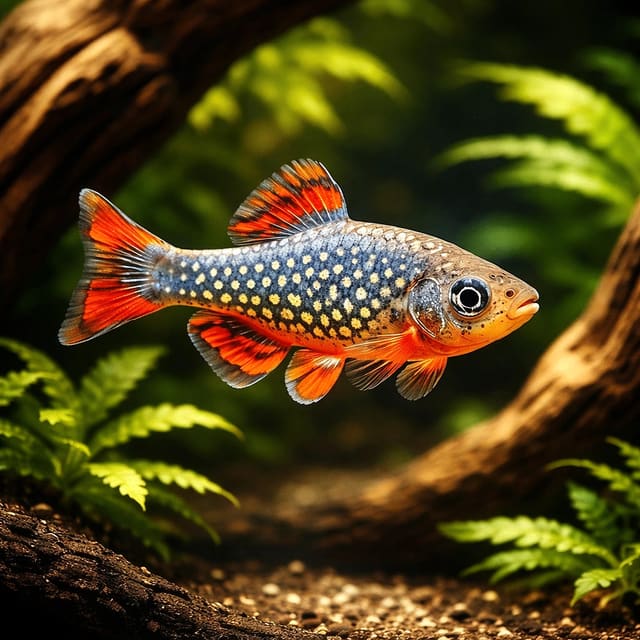
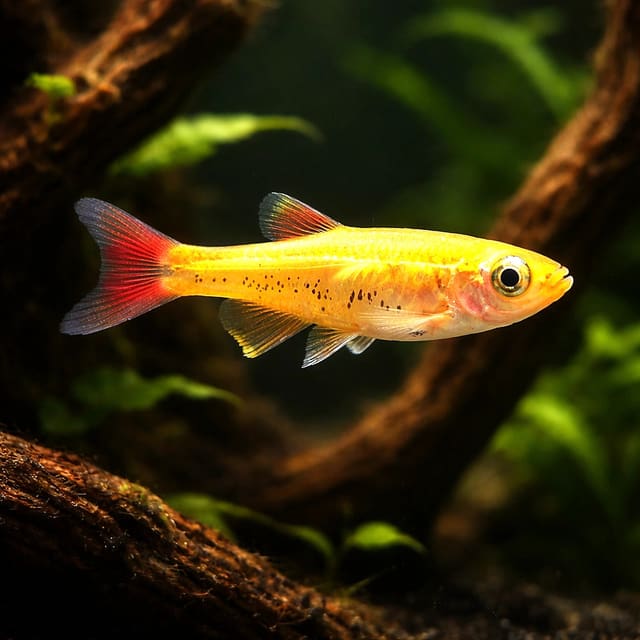
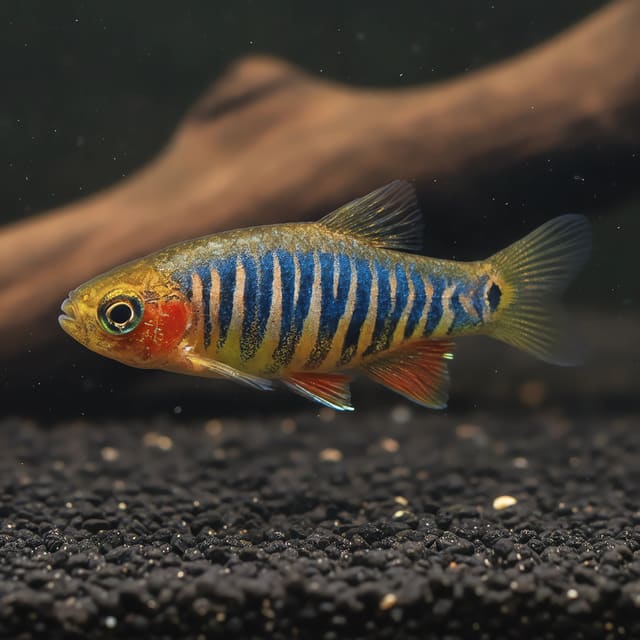
The only published description of this cross we have found is on Seriously Fish's emerald dwarf rasbora page. It describes the hybrid fish as having no stripes in the fins and a dark spot at the base of the caudal peduncle (the narrow stem in front of the tail), as in the emerald dwarf rasbora, but a spotted colour pattern on the body, like the celestial pearl danio. In short: a spotted body, unstriped fins and a dark tail spot. As there are no photographs on this listing, we can't show you how closely the fish we hold match that description; ask us if it matters to you.
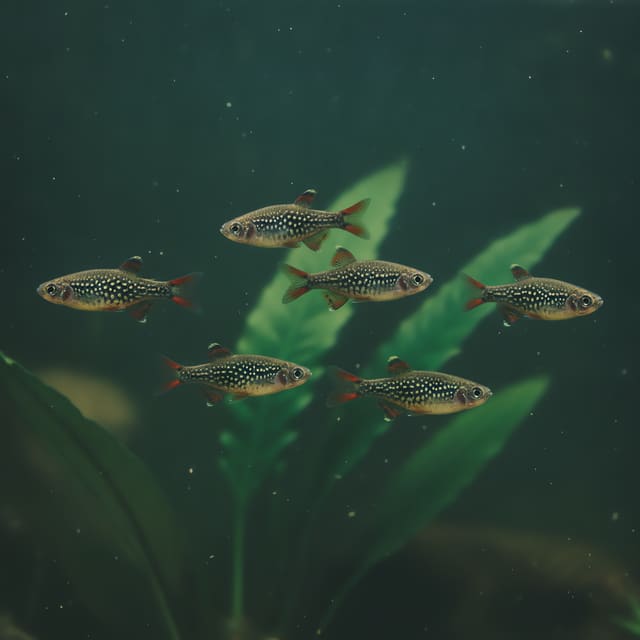
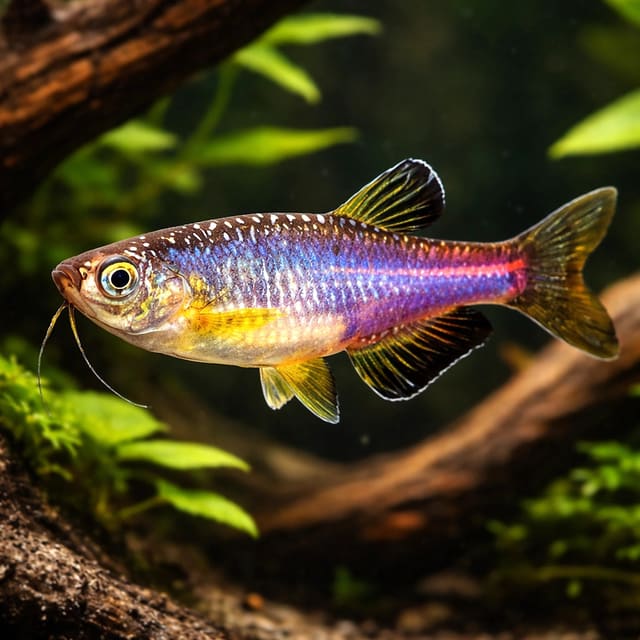
Seriously Fish describes male celestial pearl danios as steel to deep blue on the body, with pearly white to cream spots and intense red and black striping in every fin except the pectorals. Females are blue-green, with weak red to orange patches in the fins, unpatterned ventral fins, cream to golden spots that don't reach the front of the belly, and a larger, rounder body. Wikipedia adds that males have more brightly coloured fins and a deeper caudal peduncle than females. FishBase gives a maximum of 2.1 cm SL for both sexes; Wikipedia says most measure 2–2.5 cm SL and a few reach 3 cm.
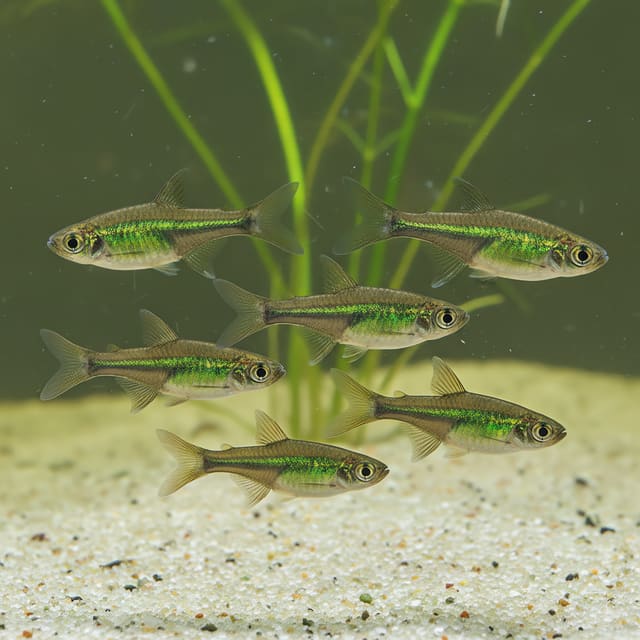
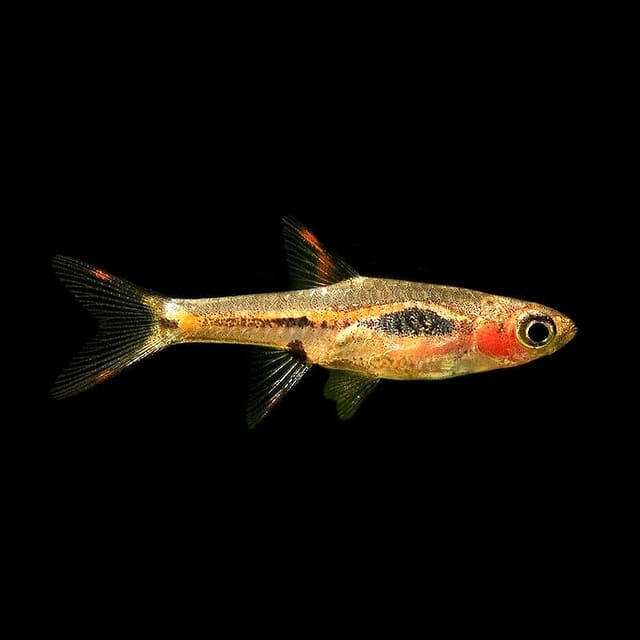
In the emerald dwarf rasbora, according to Seriously Fish, males are the more colourful sex, with well-defined, iridescent blue vertical bars on the flanks and red colour in the fins. Adult females tend to grow slightly larger than males and are noticeably rounder in the belly. Seriously Fish gives a maximum of 20 mm SL. FishBase lists 3.0 cm without saying which length measure is meant, so we read the smaller standard-length figure as the better guide to the fish's body length.
In both parents, fin colour is one of the main clues to sex: bold red-and-black fin stripes in male celestial pearl danios, red fins in male emerald dwarf rasboras. The hybrid, as described, has no fin stripes. Seriously Fish also reports limited evidence that hybrid offspring have been sold as female celestial pearl danios, which tells you how easily a cross can be mistaken for a plain female of the pure species. Nothing has been published on sexing the hybrid itself. In both parents females are rounder-bellied and, in the emerald dwarf rasbora, slightly larger, but whether that carries over to a hybrid isn't documented, so treat any sexing of these fish as a guess.
No size has been published for the hybrid. With parents of 2.1 cm SL and around 2–3 cm, expect a very small fish and plan for one that will need the same care as a 2–3 cm danio. We won't put a single adult-size figure on a fish nobody has measured.
Both parents come from the Shan Plateau in eastern Myanmar, and their homes are close on a map but quite different in character. Knowing both helps when you set up a tank for a fish that is half of each.
Seriously Fish gives the type locality as pools at the foot of a mountain near Hopong, a town about 30 km east of Taunggyi, at 1,040 metres above sea level. The habitat was a permanently flooded grassland created when a spring was dammed for farming: water about 30 cm deep, transparent, and thick with water plants of the family Hydrocharitaceae, such as Elodea, Egeria and Blyxa. FishBase describes the same picture, small, shallow ponds up to 30 cm deep fed by seepage or springs with luxuriant submerged vegetation, and records water temperatures of 22–24 °C. It lists the fish living alongside other Microrasbora, Yunnanilus loaches and the snakehead Channa harcourtbutleri. Wikipedia places the habitat in the Salween basin, in the Nam Lang and Nam Pawn river systems, and notes the species is also known from northern Thailand.
The emerald dwarf rasbora is endemic to Inle Lake, according to both FishBase and Wikipedia. Seriously Fish gives a slightly wider range: the lake and its surrounding watershed in Shan State, with a further record near Loi Kaw in neighbouring Kayah State. Inle is an isolated mountain lake almost 900 metres above sea level. Seriously Fish describes it as clear and shallow, two to three metres deep in most places, with neutral to slightly alkaline water of pH 7.5–8.0. The fish is mostly collected around the margins, where grasses and reed-like plants grow thickly. FishBase classes it as benthopelagic, a fish living near the bottom as well as in mid-water, and records a temperature range of 21–25 °C.
Those shared features are the best guide we have for a hybrid that has never lived in the wild.
Seriously Fish's advice for the two parents is close enough to build one plan around. For the celestial pearl danio it recommends a tank with a base of at least 45 × 30 cm, about 41 litres. For the emerald dwarf rasbora it suggests a base of at least 60 × 30 cm. As this fish is a cross of the two, we'd plan around the larger of those footprints.
Gentle filtration is the recommendation for both parents, and Seriously Fish says an air-powered sponge filter should be adequate. Neither habitat is a fast river: one is a spring-fed pond, the other the margins of a lake. If you use a hang-on or internal filter, keep the outflow soft, baffle it with plants, and protect the intake with a sponge so tiny fish and fry can't be drawn in.
The most important layout decision isn't about plants at all. Seriously Fish advises against keeping celestial pearl danios and emerald dwarf rasboras together because they can probably hybridise. If you already keep either parent species, especially if you breed them, give this hybrid a tank of its own.
Have the aquarium planted, filtered, heated and tested well before you order. A small, heavily planted tank takes time to settle, and fish of 2–3 cm are not the ones to use to find out whether your filter has matured.
Nobody has published water requirements for the hybrid, so we work to the conditions where both parents' published ranges overlap. Here are the figures side by side:
| Measure | Celestial pearl danio | Emerald dwarf rasbora | Overlap we work to |
|---|---|---|---|
| Temperature (Seriously Fish) | 20–26 °C | 20–24 °C | 20–24 °C |
| Temperature (FishBase) | 22–24 °C recorded in the habitat | 21–25 °C | 22–24 °C sits inside every range |
| pH (Seriously Fish) | 6.5–7.5 | 7.0–8.0 | 7.0–7.5 |
| Hardness (Seriously Fish) | 5–15 °dGH | 12–20 °dGH | 12–15 °dGH |
In practice, that points to clear, neutral to slightly alkaline water of moderate hardness, kept around 22–24 °C. That's cooler than many tropical community tanks, and it matters: a tank run at 27 °C for other fish isn't a good home for a cross of two highland species.
FishBase gives the emerald dwarf rasbora a pH range ending at 7.0 and a hardness range of 10–25 °dH, while Seriously Fish gives pH 7.0–8.0 and 12–20 °dGH and says the species will not do well in acidic water. Seriously Fish's figures fit its own description of Inle Lake at pH 7.5–8.0, so we lean on them. Both sources agree that soft, acidic water isn't what this parent comes from.
Both parents live high up. Inle Lake sits almost 900 metres above sea level and the celestial pearl danio's type locality near Hopong is at 1,040 metres, both on the Shan Plateau. FishBase records 22–24 °C in the celestial pearl danio's ponds and gives 21–25 °C for the emerald dwarf rasbora. Those are mild figures for tropical fish, which is why the heater setting here sits a few degrees below the warmer community tanks many people run.
Much UK tap water is moderately hard to hard, which works in this fish's favour, but the numbers vary a lot from one area to the next, so test rather than guess. You need three readings: pH, general hardness (GH) and carbonate hardness (KH).
Whatever you do, change the water the same way each time. Small fish handle a steady, slightly imperfect reading far better than one that jumps about between changes.
Seriously Fish gives very similar feeding advice for both parents, and with nothing published on the hybrid, that is what we'd follow.
Because both parents do best on small live food, it is worth having a supply you control rather than relying on what a shop has that week.
None of these is essential if you can buy small frozen foods, but a live culture makes the first weeks easier, especially for a fish that Seriously Fish suggests should be started on live food.
A well-fed fish should look rounded but not swollen. A thin, pinched belly in a fish that has been with you a week or more means it isn't getting enough, possibly because something else is getting there first.
No one has written about this hybrid's behaviour, but both parents are well described, and they behave alike in the ways that matter for planning a tank.
Both parents are social fish kept in groups, so we wouldn't keep one of these hybrids alone. As each unit is one fish, think about how many you order: a group gives each fish company of the same kind and spreads any squabbling. Whether hybrid males spar the way their parents do hasn't been recorded, so watch the group and make sure no single fish is being chased constantly.
Both parents come from dense, shallow, weedy water, so give the fish plenty of planting to move through and shelter in. That is why the heavily planted layout above matters more than the size of the open swimming space.
For the celestial pearl danio, Seriously Fish suggests similarly sized companions such as Celestichthys choprae, Microdevario species and Dario hysginon, and it names other small Myanmar cyprinids as suitable company for the emerald dwarf rasbora. Whatever you choose should:
Both parents have been bred in aquariums, and Seriously Fish describes how in some detail. That's exactly why a hybrid needs some thought.
Seriously Fish describes both species in the same terms: egg scatterers that give no parental care, laying about 30 mildly adhesive eggs in a typical spawning. The eggs hatch in about 72 hours and the young become free-swimming three to four days later. For the celestial pearl danio, Seriously Fish adds that the adults eat their eggs and need to be removed, and that first foods for the fry can be Paramecium or a very fine dry food of 5–50 microns, moving on to Artemia nauplii and microworm. Wikipedia calls the celestial pearl danio prolific, spawning "almost every day".
We haven't found any published information on whether this cross is fertile, how it breeds, or what its offspring look like. We won't guess. If your hybrids do spawn, treat every fry as a hybrid too.
Kept as a display fish in its own tank, a hybrid is no harm to anyone. The care above simply makes sure it stays that way.
Small, highland fish like these need a calm, unhurried start. Read our delivery and live-arrival page before ordering, then work through this list.
In transit the fish are in bags filled with oxygen, packed in insulated boxes with heat packs when the weather needs them, and carried by a tracked courier licensed for live animals.
For a Live Arrival Guarantee claim, email hello@tropicalfishco.co.uk on the day of delivery with your order number, the affected animals and quantities, and clear photos of the problem and packaging. An unboxing video is optional. Do not delay necessary animal care to film or wait for our reply. Our team reviews the evidence under the current claim terms.
Leave the lights low for the rest of the day and keep disturbance to a minimum. Over the next seven days, watch three things: breathing, appetite and behaviour. Calm, even breathing, an interest in small live or frozen food, and a fish moving about the plants rather than hanging at the surface or hiding motionless are good signs. Rapid breathing, clamped fins, white spots, ragged fins or a pinched belly mean test the water first and then ask for help.
Nothing is known about health problems specific to this hybrid, and neither parent's FishBase page gives a lifespan, so we won't quote one. The best protection for fish this small is the dull, steady routine: stable temperature, clean water, small frequent feeds and a tank without bullies. A fish vet with aquatic experience is the right person if something looks seriously wrong.
These are the sources we used. Most are about the parent species, because nothing has been published on the hybrid itself:
No reviews for this item yet. Bought one? Honest reviews only, good or bad.
What customers say about ordering from us
Easy website plenty of info on fish your buying great to pick a time slot
TRACEY DURRANT · 7 Oct 2026
Got some lovely fish thank you
Kevin Mackie · 7 Oct 2026
Reviews of our shop, collected by Judge.me, an independent third-party review collector. Newest first.