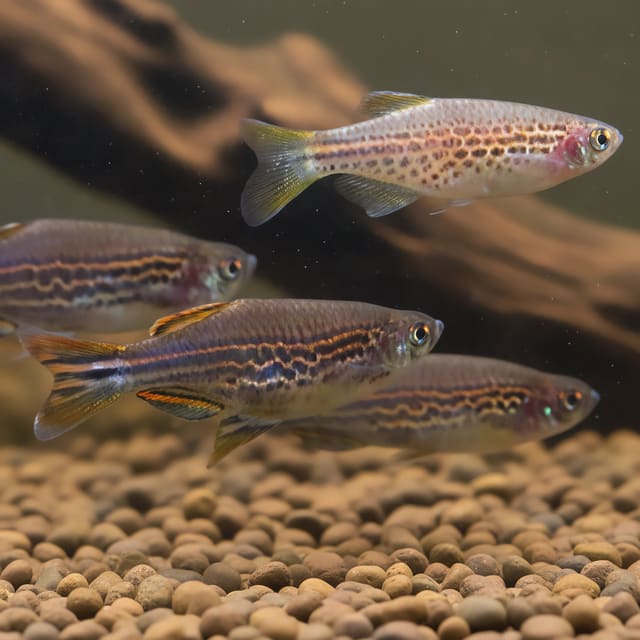
10 × Emerald Dwarf Danios (Danio erythromicron)
21–25°C · pH 6.5–7
£40.99

The Longfin White Cloud Mountain Minnow (Tanichthys albonubes) is a mountain minnow from China and Viet Nam that reaches 4 cm. It suits keepers planning a peaceful cooler-water shoal: keep at least five at 18–22°C and pH 6.5–8.0, the overlap of FishBase, Seriously Fish and OATA guidance. Sold as a pack of five live fish.
Adult size is the maximum length this species reaches at full maturity (scientific sources). The livestock you receive will be younger and smaller. Product-photo provenance and any image-specific limitations are stated on the listing.
Tanichthys albonubes
The Longfin White Cloud Mountain Minnow (Tanichthys albonubes) is a mountain minnow from China and Viet Nam that reaches 4 cm. It suits keepers planning a peaceful cooler-water shoal: keep at least five at 18–22°C and pH 6.5–8.0, the overlap of FishBase, Seriously Fish and OATA guidance. Sold as a pack of five live fish.
Adult size is the maximum length this species reaches at full maturity (scientific sources). The livestock you receive will be younger and smaller. Product-photo provenance and any image-specific limitations are stated on the listing.
Maintain these water conditions for optimal health and vibrant colors
The Longfin White Cloud Mountain Minnow (Tanichthys albonubes) is a freshwater mountain minnow in the family Tanichthyidae. FishBase records the species from China and Viet Nam, with adults living among aquatic plants in clean, sluggish coastal streams. Its recorded maximum adult size is 4 cm total length. This long-finned ornamental form suits keepers who want a small, active and very peaceful shoal and can plan the aquarium around cooler water rather than conventional warm tropical conditions.
Keep it at 18–22°C, pH 6.5–8.0 and 5–12 dGH. These routine values are the overlap of FishBase, the Seriously Fish species profile and OATA guidance for danios and White Cloud Mountain Minnows. OATA's figures are group guidance, not a species-specific optimum. Use a mature, filtered aquarium with a base of at least 60 × 30 cm and a volume of about 54 litres or an equivalent footprint.
| Suits | Not suited to |
|---|---|
| A group of at least five, with ten or more ideal | Solitary keeping or groups below five |
| A mature 60 × 30 cm aquarium of about 54 litres or more | Small aquaria without the required swimming footprint |
| Peaceful community fish sharing the same water conditions | Goldfish |
| Planted layouts with open swimming space | Permanent exposure to water above its temperature range |
| A properly maintained biological filter | An unfiltered or biologically immature aquarium |
The species is schooling by nature. Five is the supported minimum, while a group of ten or more reduces nervousness and creates a more natural display. Establish its own group before considering other fish, then compare every proposed companion's temperature and water requirements.
One purchase supplies a pack of five Longfin White Cloud Mountain Minnows. That pack meets the supported minimum group size of five, while Seriously Fish recommends ten or more where aquarium space and filtration capacity allow. The pack quantity is the purchase unit; the 4 cm figure is the recorded adult size used for aquarium planning, not a statement of each fish's length on arrival.
The longfin form is an ornamental strain of Tanichthys albonubes. Seriously Fish states that care is identical for its ornamental strains, including the long-finned form, so plan the same water, space, diet and social conditions as for the species.
Sex is guaranteed only when the selected option explicitly states male or female. This 5 × Longfin White Cloud Mountain Minnows listing has no sex-guaranteed option.
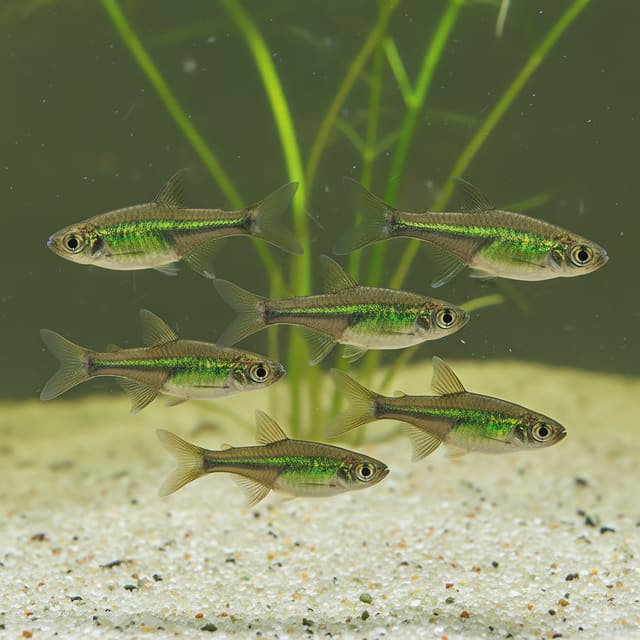
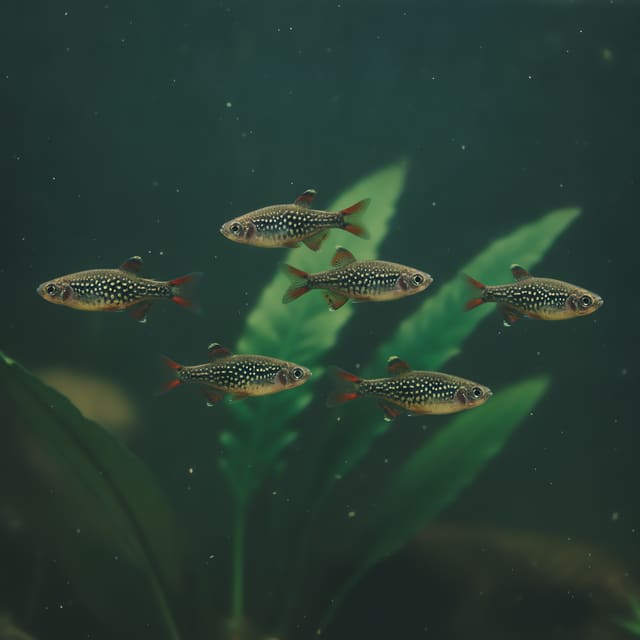
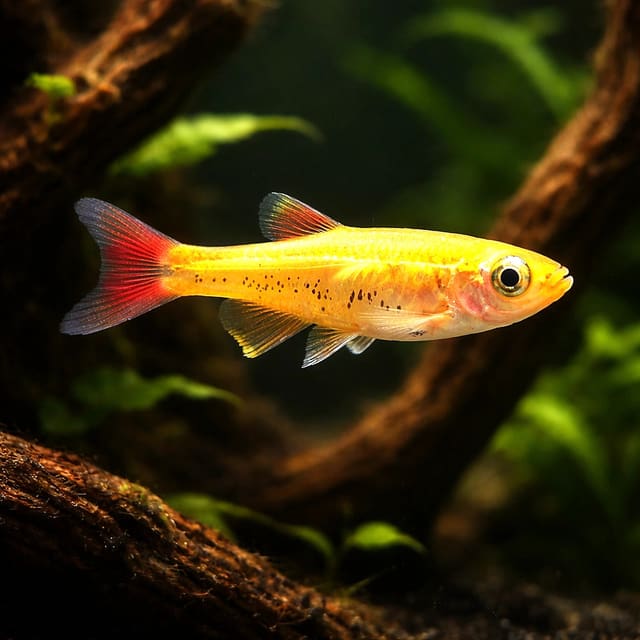
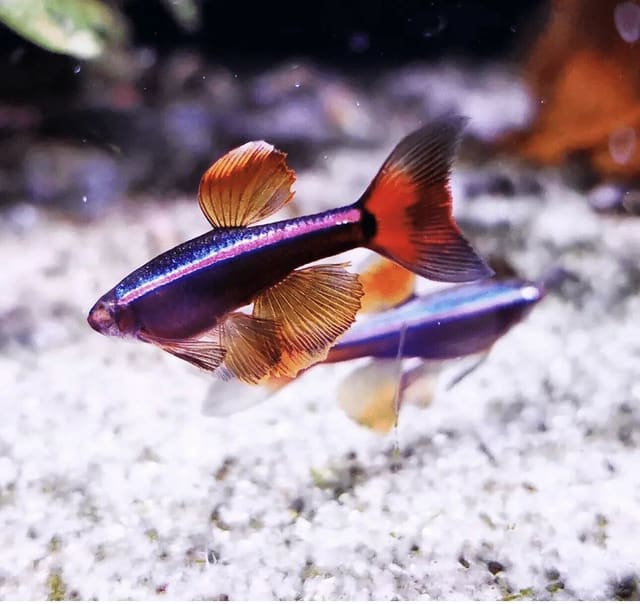
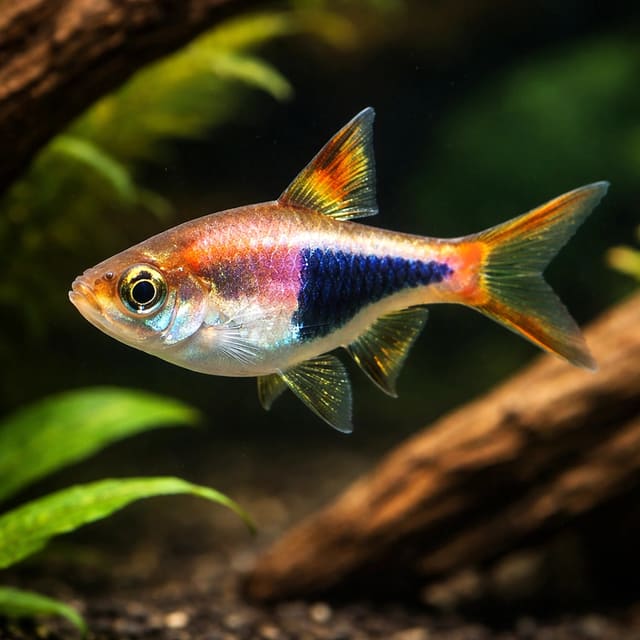
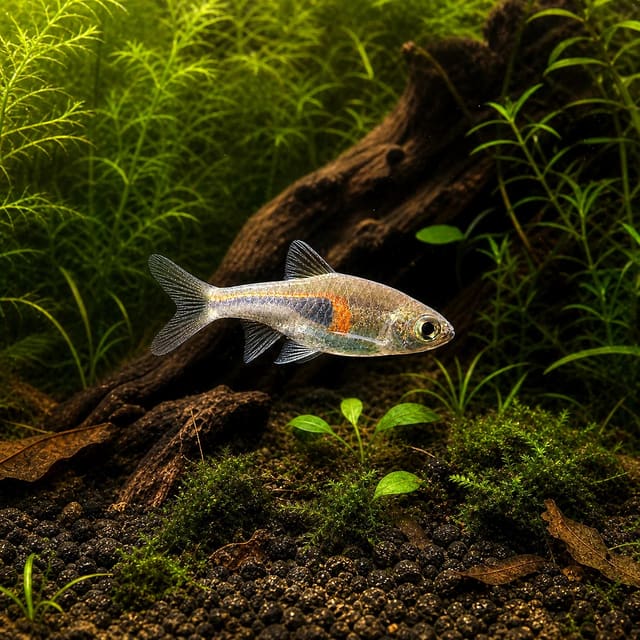
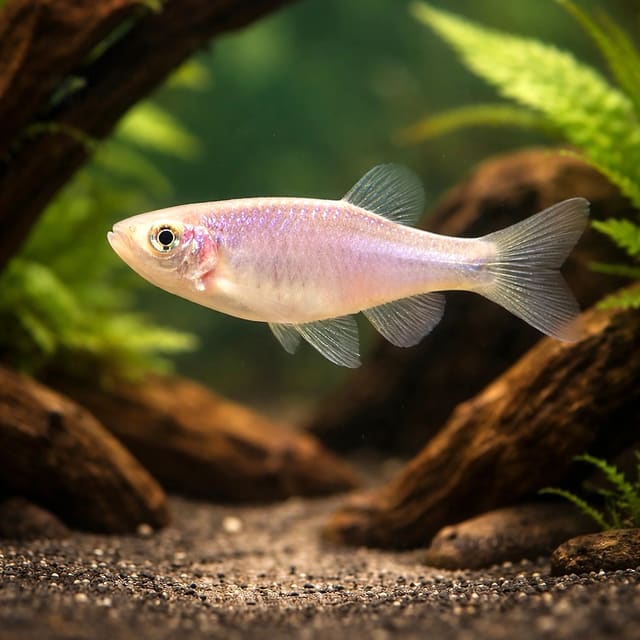
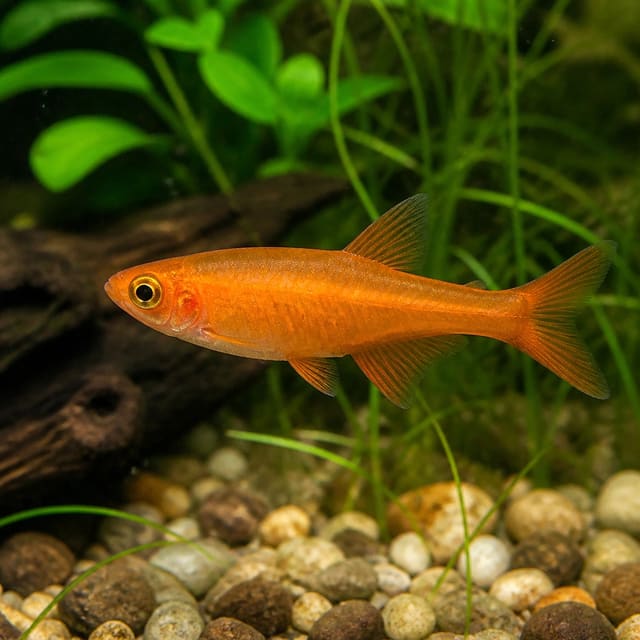
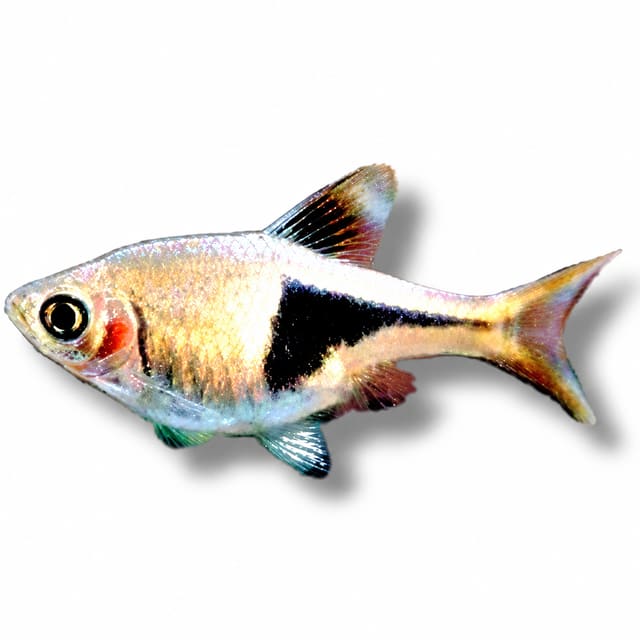
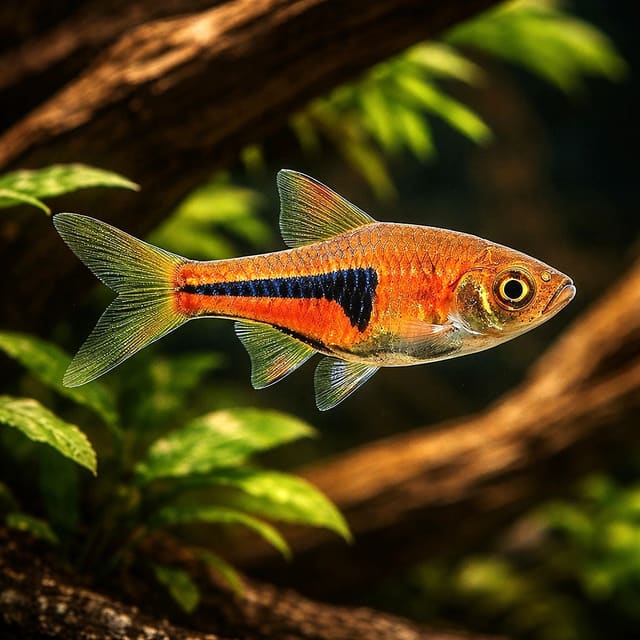
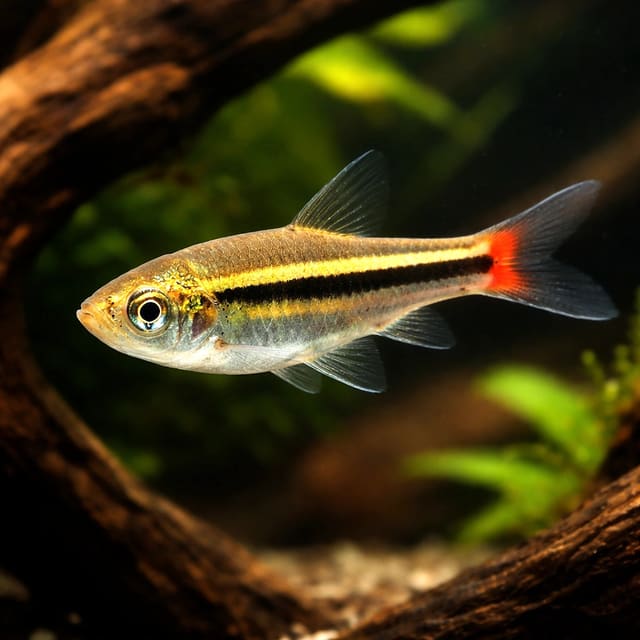
The gallery images are representative of this type of animal rather than photographs of the exact animal supplied, so colours can look slightly different from the live animal.
A five-fish pack establishes the minimum group supported by FishBase and OATA. If the aquarium can accommodate ten or more, Seriously Fish describes that larger group as ideal because individuals become less nervous and produce a more effective natural-looking display. Do not increase the group simply because the fish are small. Check the total swimming footprint, filter capacity and existing livestock before adding more.
Keep the group in a freshwater aquarium that remains within 18–22°C throughout the day and across seasonal room-temperature changes. Well-insulated homes may hold that range without artificial heating, but the thermometer decides whether equipment is needed. Permanent exposure to warmer conditions is likely to shorten the species' lifespan, so do not treat it as a conventional high-temperature tropical community fish.
Plan for an adult size of 4 cm. FishBase records a maximum of 4 cm total length, which is the figure used throughout this care plan. Seriously Fish lists 40 mm standard length in its aquarium profile. Whatever the length of the fish on arrival, provide its permanent adult accommodation from the beginning rather than relying on a smaller temporary aquarium.
Use a base measuring at least 60 × 30 cm or an equivalent footprint, with about 54 litres as the species-level minimum volume. Length and front-to-back space matter because this is an active schooling fish. The minimum must hold the whole group, décor, filter and open swimming lanes while maintaining stable water quality. Groups larger than five or communities containing other fish need additional capacity based on their total biological load and swimming behaviour.
| Area | Plan |
|---|---|
| Edges and rear | Use dense planting to provide cover. |
| Surface | Add some floating plants without closing every swimming lane. |
| Midwater | Retain an open route for the group to swim together. |
| Base | Use aquarium sand or gravel with secure décor. |
Décor is flexible, but Seriously Fish notes that the species tends to show better colour in a heavily planted aquarium with a dark substrate. Floating plants, driftwood roots or branches and leaf litter can add cover and a more natural feel. Secure every item so routine maintenance cannot shift it into a swimming route.
Provide some water movement without turning the aquarium into an excessively forceful flow zone. The species appreciates a degree of movement and can also live in a stream-style arrangement. Watch the whole group after changing filter direction: the fish should be able to use the open area rather than being confined to a sheltered corner by the current.
Keep the aquarium at 18–22°C, pH 6.5–8.0 and 5–12 dGH. These targets sit inside the recorded ranges from FishBase and Seriously Fish while also matching OATA's narrower routine guidance. Measure the aquarium rather than assuming that room temperature or local tap-water reputation represents the water the fish experience.
| Measurement | Routine target |
|---|---|
| Temperature | 18–22°C |
| pH | 6.5–8.0 |
| General hardness | 5–12 dGH |
| Ammonia | 0 mg/l |
| Nitrite | 0 mg/l |
| Nitrate | Not more than 20 mg/l above the normal tap-water level |
Temperature is a boundary for compatibility as well as routine care. A peaceful companion needing sustained water above 22°C is not a sound match. Check the lowest overnight reading and the warmest daytime reading, particularly in well-insulated rooms and during seasonal changes. Artificial heating may be unnecessary when the aquarium naturally remains inside the range, but a single room reading cannot replace an aquarium thermometer.
Use the water chemistry guide to understand ammonia, nitrite, nitrate, pH and hardness before interpreting a test. The water matcher can then compare the measured aquarium values with this fish's routine targets.
If ammonia or nitrite is detected, stop treating the aquarium as stable: check the filter, test again and reduce further stocking until both return to zero. When nitrate rises beyond OATA's limit, perform the scheduled conditioned-water change and review feeding, waste removal and stocking pressure. If pH or hardness sits outside the target, establish the actual tap-water values before making changes. Sudden, repeated adjustments can create instability, so base each decision on measured aquarium and replacement water.
Use a properly established biological filter at all times. The RSPCA explains that fish release toxic ammonia and that filter bacteria convert it first to nitrite, which is also toxic, and then to safer nitrate. A filter is therefore waste-processing life support, not simply a device for making the water look clear.
Prepare and mature the aquarium before the group arrives. Follow the first aquarium setup guide, then confirm ammonia and nitrite are both 0 mg/l. An aquarium can look clean while lacking enough beneficial bacteria to process fish waste, so visual clarity cannot replace water testing.
For the approximately 54-litre minimum aquarium, Seriously Fish uses a turnover of four to five times the aquarium volume each hour and suggests a filter rated around 215–270 litres per hour. Treat that as a worked example for that volume. A different aquarium needs a filter chosen for its own capacity, layout and livestock.
Position the outlet so it creates movement while leaving usable swimming space. This species appreciates some current, but the group should not be pushed continuously into one corner. After changing the outlet angle or cleaning the filter, watch where all five fish choose to swim. If every fish remains behind décor to escape the flow, redirect the outlet while preserving surface movement and filtration.
OATA warns that adding fish too quickly can exceed the bacterial population established in the filter and cause new tank syndrome. The five-fish pack creates a real increase in waste and feeding, even though each animal is small. Test ammonia and nitrite after introduction and before adding further livestock. A result above zero means the biological filter is not yet keeping pace.
Check the filter for blockages during routine maintenance. Reduced flow can indicate that mechanical waste has accumulated, but cleaning must preserve the bacterial population in the media. Use removed aquarium water for any necessary rinse and never run the filter media under the tap.
Feed a varied diet based on suitably small animal foods. FishBase records wild White Cloud Mountain Minnows feeding on zooplankton and detritus, while stomach analyses reported by Seriously Fish found small insects, worms, crustaceans and other zooplankton. In the aquarium, use good-quality dried flakes or small granules alongside small live or frozen foods such as Daphnia, bloodworm and Artemia. Include some dried food containing plant or algal material as part of the varied diet.
Feed once a day and offer only what the group can finish within a few minutes. That schedule and portion limit come from OATA's care guidance for danios and White Cloud Mountain Minnows. Five small fish need a deliberately measured portion; their quick response to food is not a reason to add another pinch.
| Decision | Action |
|---|---|
| Daily staple | Offer fine flakes or suitably small granules. |
| Variety | Rotate small live or frozen Daphnia, bloodworm or Artemia into the diet. |
| Portion | Stop when the food offered can be eaten within a few minutes. |
| Food remains | Remove the excess and reduce the next portion. |
Spread the portion across the group's swimming area rather than dropping one clump in a single position. Watch all five fish during the meal. A fish that repeatedly hangs back, misses food or shows reduced interest needs closer observation alongside an immediate water-quality check.
Uneaten food breaks down and adds waste to the aquarium. If food remains after the feeding period, remove it where practical, test the water when waste has accumulated and reduce the next meal. Do not compensate for a missed meal by doubling the following portion.
Choose food small enough for these 4 cm adults to take cleanly. Large pieces that are repeatedly mouthed and dropped are not an efficient portion. Break flakes into smaller pieces and select appropriately sized granules, live foods and frozen foods so the group can finish the meal within OATA's time limit.
At least once every week, change 25% of the aquarium water. Use a siphon to remove solid waste from accessible areas of the substrate, then replace the removed volume with water treated with conditioner to remove chlorine or chloramine before it enters the aquarium.
Match the replacement water closely enough to keep the aquarium within 18–22°C and pH 6.5–8.0. Test the aquarium at least weekly for ammonia and nitrite, both of which must remain at 0 mg/l. Track nitrate against the normal tap-water level and keep the aquarium result from exceeding that baseline by more than 20 mg/l.
| Observation | Response |
|---|---|
| Ammonia or nitrite above zero | Check filtration, test again and pause further stocking. |
| Nitrate rising beyond the limit | Complete the conditioned-water change and review waste and feeding. |
| Reduced filter flow | Check for a blockage and clean only as necessary. |
| Food or solid waste accumulating | Siphon it out and reduce future portions. |
Do not run filter media under the tap. OATA warns that chlorine or chloramine may kill the beneficial bacterial population established in the media. Rinse it lightly in aquarium water removed during the partial water change. This preserves more bacteria while clearing enough debris to restore flow.
A weekly routine is the minimum rhythm, not a reason to ignore changes between maintenance days. If the fish breathe differently, stop feeding, hide more than usual or swim abnormally, test the water immediately. Correcting a measurable water-quality problem starts with the reading, filter check and conditioned water rather than waiting for the next scheduled change.
Keep a simple record of temperature, pH, ammonia, nitrite, nitrate and the date of each water change. The pattern helps distinguish a one-off reading from a recurring rise after feeding, filter maintenance or additional livestock.
Before the fish arrive, confirm that the aquarium is mature, filtered and inside 18–22°C, pH 6.5–8.0 and 5–12 dGH. Ammonia and nitrite must both read 0 mg/l. Complete major layout changes beforehand so the group can enter an aquarium with secure décor, plant cover and open swimming space.
Follow the current delivery and Live Arrival Guarantee policy when the parcel reaches you. The fish are hand-bagged in pure oxygen and placed in an insulated poly box, with a heat pack when weather conditions call for it.
Report any arrival issue on the same day with the order number and continuous unboxing video. Keep the original recording showing the sealed parcel, opening and fish in the sealed bag for a Live Arrival Guarantee claim.
OATA advises checking that ammonia and nitrite are zero before adding fish and increasing aquarium livestock slowly. This pack adds five fish together, so do not combine their introduction with other new livestock. Feed the supported small daily portion and monitor the water as the filter bacteria adjust to the increased waste.
Observe swimming, breathing, colour, body condition, fins and feeding after release. If the group behaves unusually, test ammonia, nitrite and temperature first. Those readings distinguish an immediate environmental problem from ordinary variation in how individual fish settle.
Watch for changes rather than relying on one fixed picture of healthy behaviour. OATA recommends monitoring swimming, colour, temperament, breathing, appearance, body condition and feeding. Each fish may vary slightly, but a clear departure from its normal pattern deserves a water-quality check.
| Change | First response |
|---|---|
| Hanging at the surface, sitting on the bottom or erratic swimming | Test temperature, ammonia and nitrite immediately. |
| Breathing faster or slower than normal | Check water results and filter operation. |
| Darker or paler colour | Review water stability and recent changes. |
| More hiding or a temperament change | Check group size, companions and water quality. |
| White spots, fluffy growths, damaged fins, lost scales or ulceration | Record the signs and seek prompt guidance. |
| Reduced feeding or changing body condition | Observe the next meal and test the water. |
Start with measurements because ammonia and nitrite are toxic and must remain at 0 mg/l. Check the thermometer, inspect the filter for reduced flow and compare the current readings with the aquarium's recent record. If a reading has changed, correct the environmental problem while preserving the biological filter.
Look at the whole group as well as the individual. When all five change behaviour together, test the shared environment immediately. When one fish differs, still check the water, then note its swimming, breathing, body condition and response to food. Clear observations help separate a group-wide water problem from a change affecting one animal.
If you remain concerned about any fish after checking the water and equipment, contact us for further guidance. Provide the measured temperature, pH, ammonia, nitrite and nitrate results together with the behaviour or appearance change you have observed.
Keep at least five Longfin White Cloud Mountain Minnows together. FishBase records aquarium keeping in groups of five or more, and OATA warns that White Cloud Mountain Minnows may become stressed when kept singly or in groups that are too small. The five-fish pack meets that minimum.
A group of ten or more is ideal where the aquarium has enough swimming space and biological capacity. Seriously Fish explains that larger numbers make individuals less nervous and create a more effective natural-looking display. Group size is therefore the first compatibility decision: establish enough of their own kind before using the remaining capacity for unrelated fish.
The species is schooling and very peaceful. Males may display their best colours while competing for female attention in a larger group, but the offer carries no sex guarantee. Plan numbers around total fish and aquarium capacity rather than an assumed sex ratio.
Observe how the group uses the aquarium. Fish consistently hiding, separating from the shoal or being displaced from food need a review of group size, flow, cover, feeding distribution and companions. Test the water before changing the community because poor water quality can also alter swimming, colour, temperament and feeding.
A larger group does not remove the need for cover. Combine edge planting and floating plants with an open midwater route so the fish can move together and retreat when needed. This arrangement supports schooling without sacrificing access to the whole aquarium.
Choose peaceful community fish that share 18–22°C, pH 6.5–8.0 and 5–12 dGH. Seriously Fish describes the White Cloud Mountain Minnow as a very peaceful community resident when its temperature requirements are considered. Temperament alone is not enough: reject a companion whose long-term temperature needs fall outside this overlap.
Avoid goldfish. Seriously Fish states that White Cloud Mountain Minnows are not suitable goldfish companions, and OATA warns that larger goldfish can eat minnows. Keep that exclusion unconditional rather than trying to manage it through aquarium size or observation.
| Candidate | Decision |
|---|---|
| Goldfish | Avoid. |
| Pethia conchonius, Pethia padamya, ‘Puntius’ semifasciolatus or Macropodus opercularis | Seriously Fish names these as comparable-condition companions; confirm the proposed aquarium meets every species' needs. |
| Stream-style Danio, Devario or Garra species | Consider only species that share the aquarium's water conditions and space. |
| Loaches | Screen the exact species for matching temperature, chemistry, space and behaviour. |
For any candidate, compare adult size, water range, required group size, swimming space and feeding access before combining the fish. The named examples come from a temperature-compatible community context; they do not make every member of a genus suitable for every aquarium.
Watch the first shared meals carefully. All five minnows should reach appropriately sized food within the few-minute feeding period. If another species takes the entire portion first, distribute food over a wider area while keeping the total amount controlled. Continued feeding exclusion means the community plan needs revision rather than larger portions that leave waste behind.
Review compatibility whenever room temperature, equipment or stocking changes. A community that stays within range in winter may warm beyond 22°C during another season. Use measured aquarium values and the exact needs of every proposed species rather than a general cool-water or community label.
They reach a recorded maximum of 4 cm total length according to FishBase. Plan the aquarium around that adult figure rather than the fish's length on arrival.
Use a base of at least 60 × 30 cm or an equivalent footprint, with about 54 litres as the minimum volume. Increase capacity for groups larger than five or for a community.
Keep at least five together. FishBase and OATA support five as the minimum, while Seriously Fish recommends ten or more where space and filter capacity allow.
A first-time keeper should choose it only if they can provide a mature filtered aquarium, a group of at least five, stable cooler water and weekly testing and maintenance. Do not choose it for a small unfiltered bowl.
Feed small flakes or granules once daily, offering only what they finish within a few minutes. Add variety with small live or frozen Daphnia, bloodworm or Artemia, and include some dried food with plant or algal content.
Keep it at 18–22°C, pH 6.5–8.0 and 5–12 dGH. These routine targets are the overlap of FishBase, Seriously Fish and OATA guidance.
Seriously Fish describes it as very peaceful and schooling by nature. Keep at least five, distribute food so every fish can feed and screen companions for shared cooler-water requirements.
Comparable-condition candidates named by Seriously Fish include Pethia conchonius, Pethia padamya, ‘Puntius’ semifasciolatus, Macropodus opercularis, suitable stream-style Danio, Devario and Garra species, and many loaches. Avoid goldfish and screen every exact species for matching conditions.
Start filming the sealed parcel before opening it or floating the bag. The fish are hand-bagged in pure oxygen inside an insulated box, with a heat pack when weather calls for it; open and inspect the parcel that day, float the bag for 20–30 minutes, then release without adding bag water.
No reviews for this item yet. Bought one? Honest reviews only, good or bad.
What customers say about ordering from us
I have a small group of long finned mountain minnows. So was delighted to be able to order ten of this variety to increase the genetics in my tank . The ones I recieved are healthy but it’s to early to give a verdict on wether they are of a long finned type since they are small currently.
Gordon Walker · 23 Sept 2026
100% success travel and "installation". Pleased with quality of purchase. The Siamese fighter a bit "shy" so have not yet seen him at his best yet but looking good. Happy customer. GG
George E Garratt · 21 Sept 2026
Reviews of our shop, collected by Judge.me, an independent third-party review collector. Newest first.