Easy
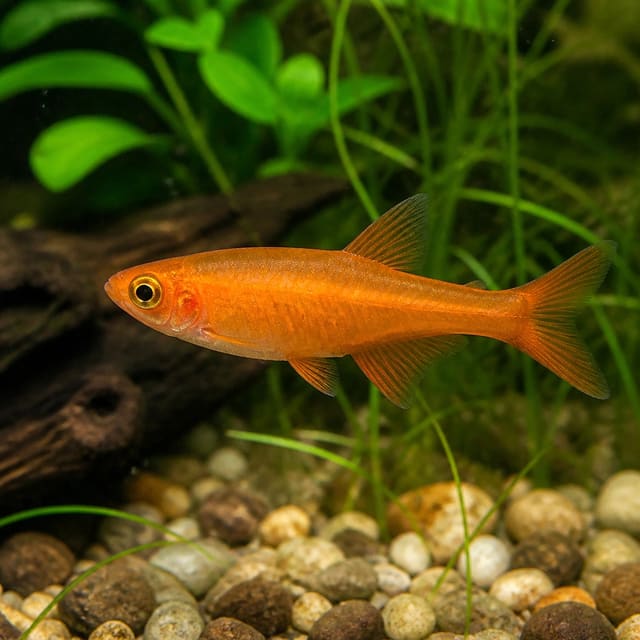
Harlequin (Rasbora heteromorpha)
21–28°C · pH 5–7.5 · 54L
£2.99

The White Cloud Mountain Minnow (Tanichthys albonubes) is a peaceful freshwater schooling fish from China and Vietnam that reaches 4 cm. It suits keepers with a mature aquarium: keep 10 or more at the Seriously Fish and OATA overlap of 17–22°C, pH 6.5–8.0 and 5–12 dGH. Sold individually in 1.5–2 cm, 2.5–3 cm and over 3 cm dispatch sizes.
Adult size is the maximum length this species reaches at full maturity (scientific sources). The livestock you receive will be younger and smaller — pick a size above for the actual shipping size. Product-photo provenance and any image-specific limitations are stated on the listing.
Shoaling fish: kept in a group they feel safer, stay calmer and show their best colour.
Minimum of 2 per order.
The White Cloud Mountain Minnow (Tanichthys albonubes) is a peaceful freshwater schooling fish from China and Vietnam that reaches 4 cm. It suits keepers with a mature aquarium: keep 10 or more at the Seriously Fish and OATA overlap of 17–22°C, pH 6.5–8.0 and 5–12 dGH. Sold individually in 1.5–2 cm, 2.5–3 cm and over 3 cm dispatch sizes.
Adult size is the maximum length this species reaches at full maturity (scientific sources). The livestock you receive will be younger and smaller — pick a size above for the actual shipping size. Product-photo provenance and any image-specific limitations are stated on the listing.
Maintain these water conditions for optimal health and vibrant colors
White Cloud Mountain Minnows are peaceful freshwater schooling fish from China and Vietnam. Their scientific name is Tanichthys albonubes, and FishBase places them in the family Tanichthyidae. FishBase records a maximum length of 4 cm total length. They suit prepared new keepers and experienced aquarists who can provide a mature aquarium, a proper social group and stable cooler conditions.
Their compact size should not be mistaken for permission to use a bowl or an immature aquarium. They are schooling fish, and Seriously Fish recommends a group of 10 or more. A full group gives the fish social choice and produces a more natural display than solitary keeping or a token pair.
For routine care, use the overlap between Seriously Fish’s species profile and OATA’s group guidance: 17–22°C, pH 6.5–8.0 and 5–12 dGH. Seriously Fish also requires a minimum aquarium base of 60 × 30 cm or equivalent, approximately 54 litres.
| Suits | Not suited to |
|---|---|
| Keepers prepared to maintain a mature, filtered aquarium | Bowls or unfiltered aquariums |
| A group of 10 or more | Solitary keeping or undersized groups |
| Stable water at 17–22°C | Communities kept permanently above the species range |
| A base of at least 60 × 30 cm | Tall, narrow tanks without equivalent swimming space |
| Peaceful companions sharing the same conditions | Goldfish, because larger goldfish can eat minnows |
Arrange the aquarium with planted shelter around the edges and open swimming space through the centre. This balance lets the group retreat when needed while preserving a clear horizontal route for schooling and feeding.
Success depends on maturing the filter before introduction, testing the water every week, feeding modest portions and selecting companions by temperature, adult size, mouth size and behaviour. The wider rasboras and danios collection offers other identities to compare, but each fish needs to be assessed against its own care requirements.
One purchase supplies one animal in the size selected on the page. This is not a pre-made group, so set the quantity to match the number of fish required for your aquarium plan. Use the live size selector to compare the three size choices.
The size you select is the size supplied, not the adult size. The dispatch sizes are 1.5–2 cm, 2.5–3 cm and over 3 cm. The final label has no stated upper boundary, so read it simply as more than 3 cm rather than a promise of a particular length.
| Size choice | How to plan around it |
|---|---|
| 1.5–2 cm | Choose food small enough for the selected fish and screen every companion for mouth size and feeding competition. |
| 2.5–3 cm | Continue to plan for the recorded adult size rather than treating the dispatch measurement as final. |
| Over 3 cm | Use the adult aquarium plan from the start; the size label makes no promise about sex or life stage. |
Choosing one dispatch size for a new group simplifies food sizing and compatibility screening. When adding fish to an established group, compare the selected size with the body size of the residents and watch whether every newcomer can reach food without being crowded away. Peaceful fish can still differ in feeding speed.
Sex is guaranteed only when the selected option explicitly states male or female. This White Cloud Mountain Minnows listing has no sex-guaranteed option.
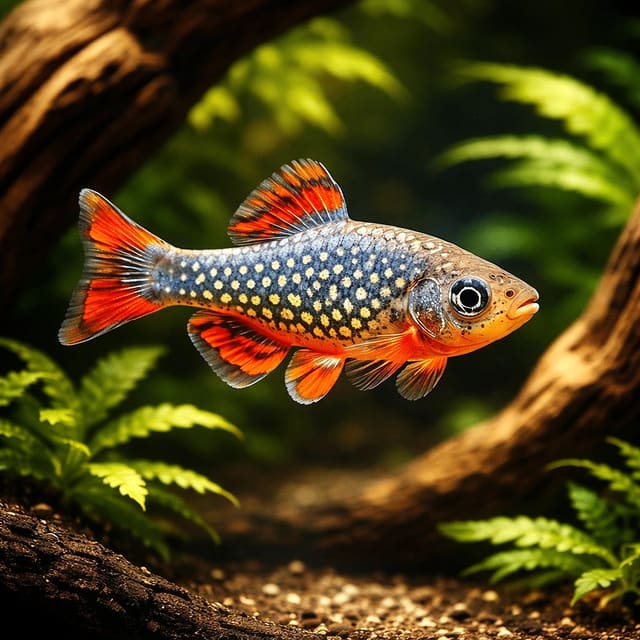
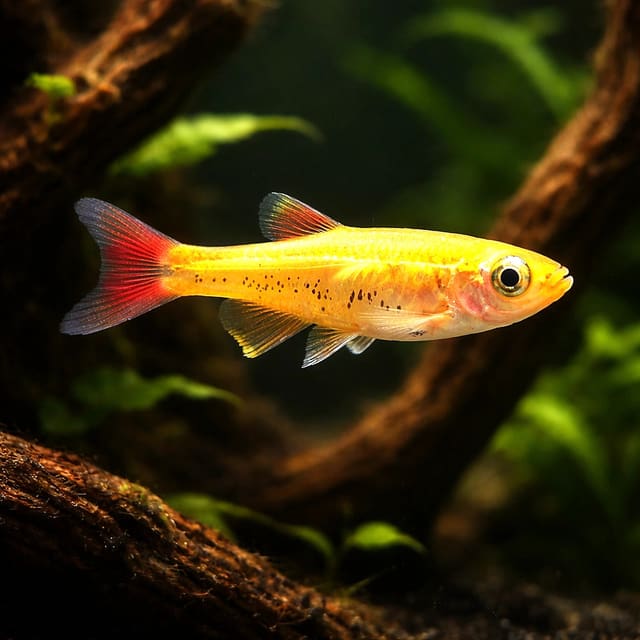
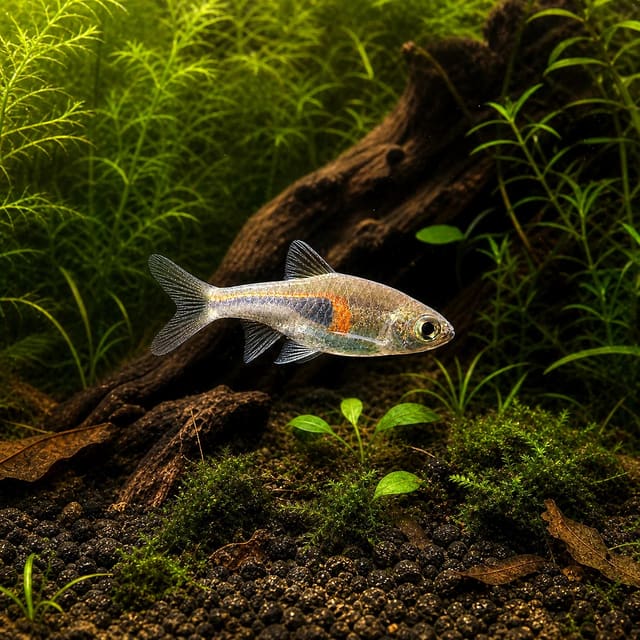
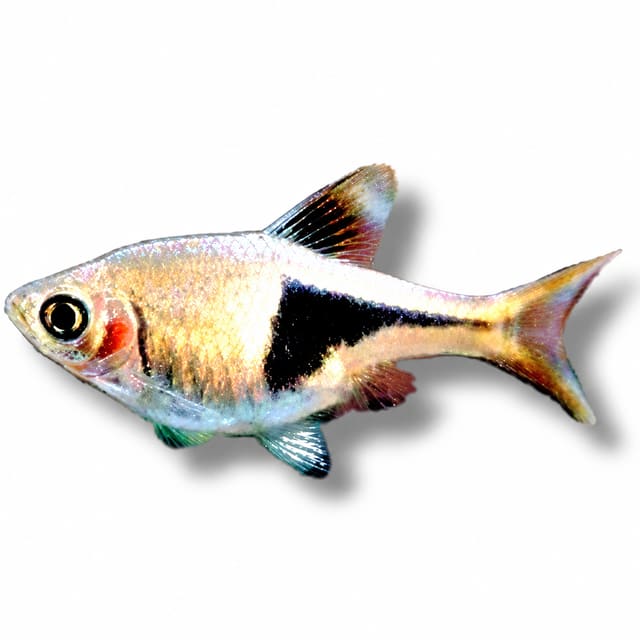
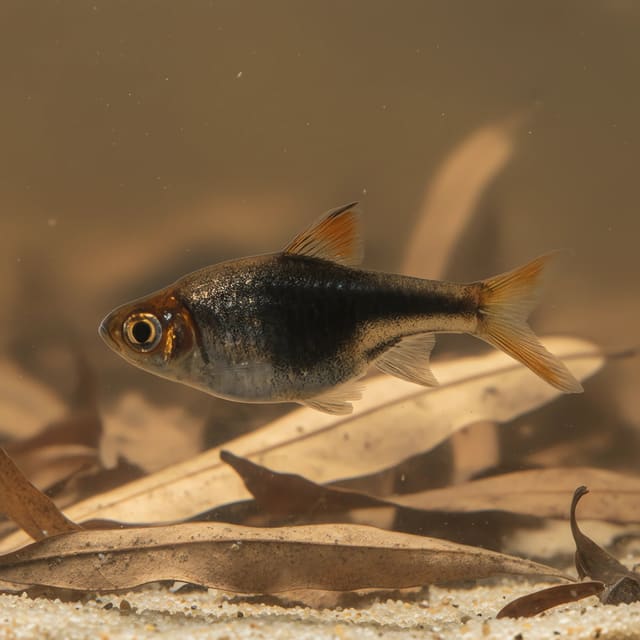
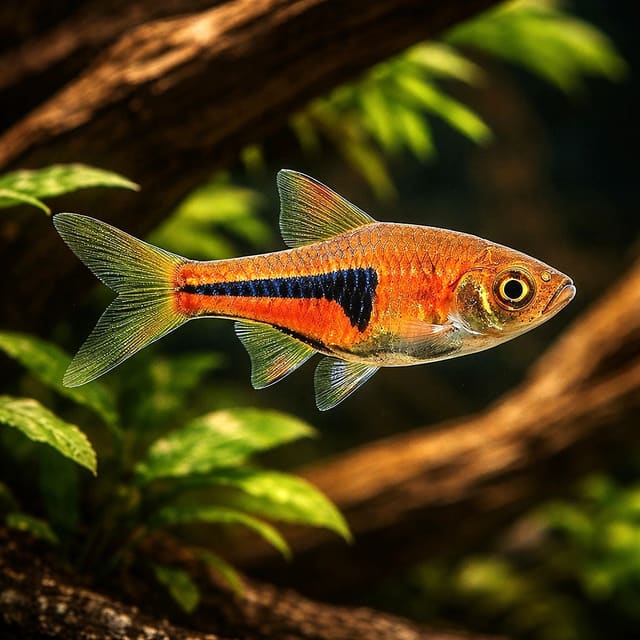
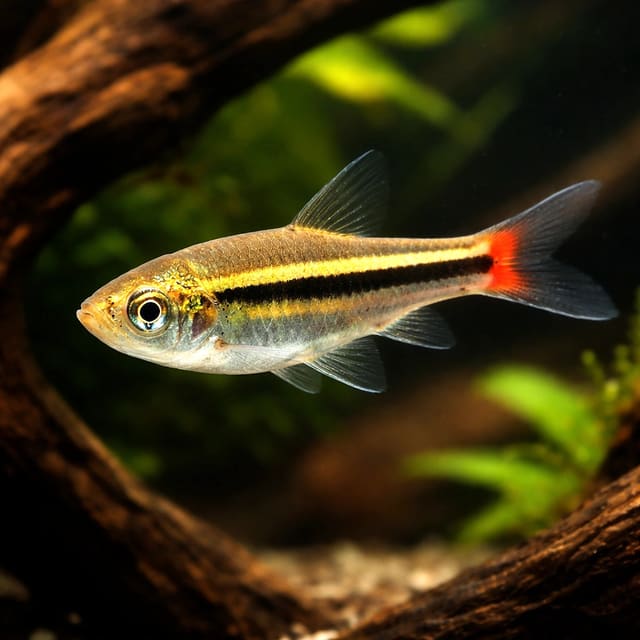
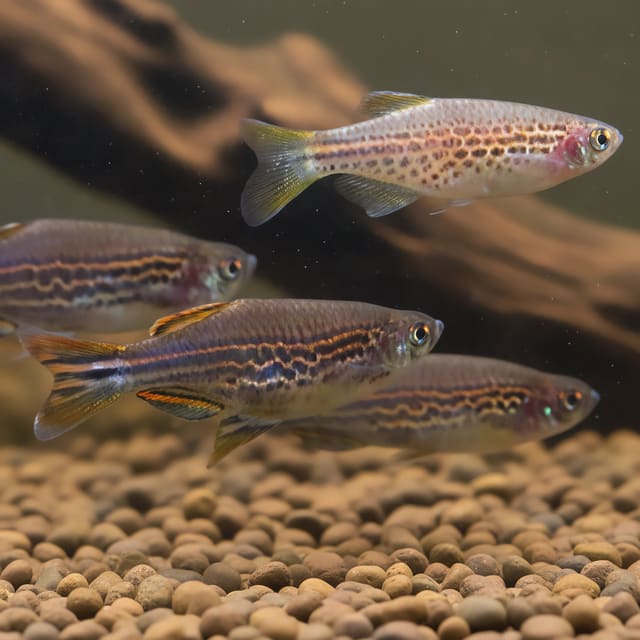
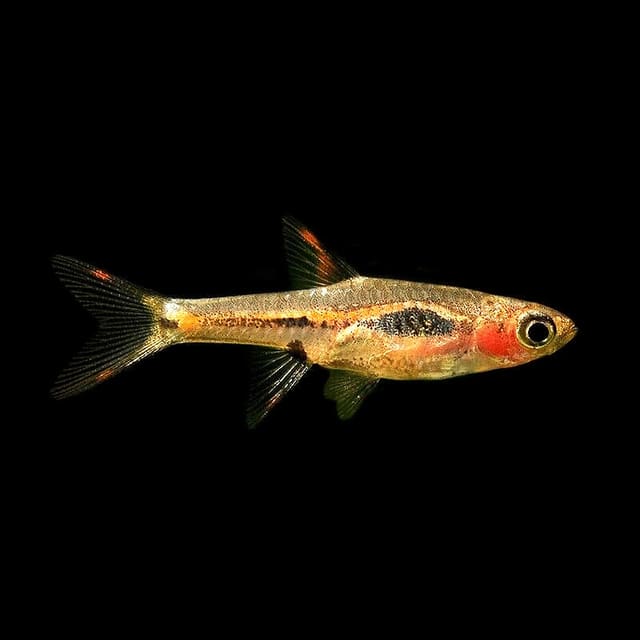
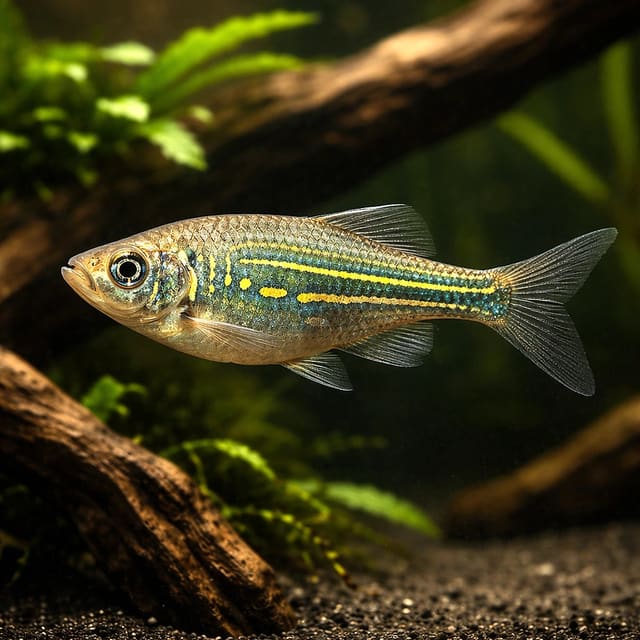
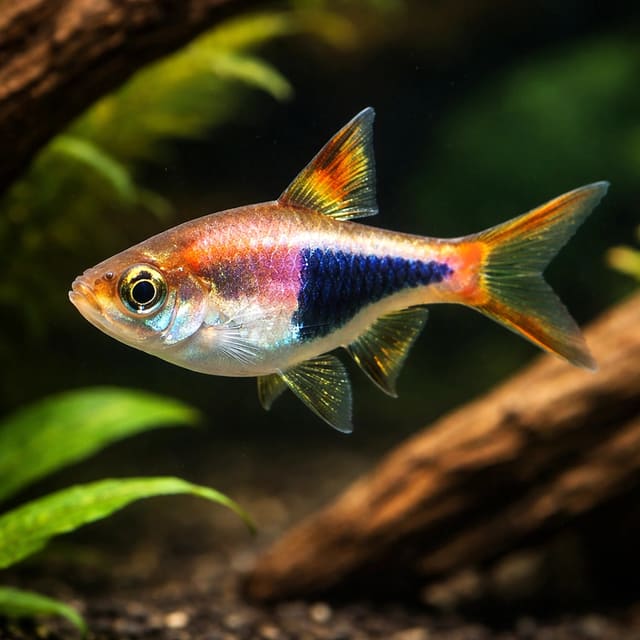
Some gallery images are representative, based on reference photographs of this species, and none shows the exact animal supplied, so colours can look slightly different from the live animal.
Begin with a tank offering a base of at least 60 × 30 cm or an equivalent footprint. The associated planning volume is about 54 litres, but base dimensions remain important because a tall, narrow aquarium can contain the same volume without offering the same horizontal route. Arrange the aquarium around the adult fish and the whole group, not around the smallest dispatch size.
A group of 10 or more is the species-level recommendation. Ten fish in the smallest suitable aquarium already use the social and swimming capacity that the dimensions are intended to support. Increase the footprint when adding more White Clouds or building a mixed community, because every additional animal adds waste, feeding competition and demand for usable space.
For example, a 60 × 30 cm aquarium planned for 10 White Clouds should not automatically receive another shoal merely because both species are small. First compare temperature, adult size, activity, feeding speed and the amount of open water each group uses. If those needs compete, choose a larger aquarium or keep a single-species group.
Planting can occupy the back and sides while leaving a clear route through the main body of the aquarium. This balance gives the fish somewhere to retreat without turning the entire footprint into dense cover. Floating plants, roots, branches and leaf litter can add shelter, but they should not prevent routine observation or maintenance.
Do not use small containers as temporary long-term housing. Lower water volume changes more quickly when waste builds up, room temperature shifts or maintenance is delayed. A properly sized aquarium provides a better margin for stable temperature and water quality while allowing the group to school naturally.
Keep the aquarium at 17–22°C, pH 6.5–8.0 and 5–12 dGH. These routine values are the overlap between Seriously Fish’s aquarium range of 14–22°C, pH 6.0–8.5 and 5–20 dGH and OATA’s group guidance of 17–23°C, pH 6.5–8.0 and 4–12 dGH. Keep the fish in stable, measured conditions rather than moving repeatedly between the limits.
Permanent exposure to warmer conditions is likely to shorten lifespan. Do not place this cooler species in a community maintained continuously above 22°C, even when the proposed companions are peaceful.
| Reading | Action |
|---|---|
| Temperature | Keep within 17–22°C and prevent prolonged warmth or abrupt daily swings. |
| pH | Maintain a stable value within 6.5–8.0. |
| General hardness | Use measured water within 5–12 dGH. |
| Ammonia | Maintain 0 mg/L. |
| Nitrite | Maintain 0 mg/L. |
| Nitrate | Keep no more than 20 mg/L above the normal tap-water level. |
Test the aquarium rather than judging temperature from the room or water chemistry from a postcode. Our water chemistry guide explains what the principal readings mean, while the Water Matcher helps compare measured values with these routine targets. A test result is more useful than labels such as soft, hard, tropical or unheated.
Many well-insulated homes may hold this range without continuous heating. Measure the tank at the coolest and warmest parts of the day before deciding. In a room around 20°C, Seriously Fish uses roughly 25 W as a planning example for an aquarium of about 54 litres; room conditions and aquarium construction affect heat loss.
A working biological filter is essential. Fish release ammonia, which is toxic; beneficial bacteria in a mature filter convert it first to nitrite, which is also toxic, and then to safer nitrate. RSPCA aquarium welfare guidance explains this biological process and why no fish should be kept without a properly established and maintained filter.
Prepare the aquarium before selecting an introduction date. If this is your first system, follow our first aquarium preparation guide, then confirm with tests that ammonia and nitrite are both 0 mg/L. A calendar date on its own cannot show how the filter responds after livestock and feeding increase.
White Clouds appreciate some water movement, although filtration need not be especially strong. For an aquarium of about 54 litres, four to five times the tank volume per hour corresponds to a filter rating of roughly 215–270 litres per hour. Distribute the return so the fish can use moving water without every part of the aquarium becoming a forceful current.
| Checkpoint | Required response |
|---|---|
| Before introduction | Confirm stable temperature and 0 mg/L ammonia and nitrite. |
| After adding fish | Test regularly while the bacterial population adjusts to increased waste and feeding. |
| Routine maintenance | Test the water and complete a 25% partial water change at least once a week. |
| During filter care | Check for blockages and rinse media lightly in removed aquarium water when cleaning is needed. |
Treat replacement tap water with a suitable conditioner before it enters the aquarium. Do not rinse established filter media under the tap because chlorine or chloramine may damage its beneficial bacteria. Removing all mature media at once also removes much of the biological capacity needed to process waste.
Increase the aquarium population slowly. Each increase in fish and food requires the bacterial community to process more waste, and stocking too quickly can lead to new tank syndrome. If ammonia or nitrite appears, pause further additions and restore safe water quality before reconsidering the stocking plan.
Build the layout with cover around the margins and an open route through the aquarium. Décor is flexible, so choose materials that can be cleaned safely and remain stable. A heavily planted arrangement with a dark substrate may show the fish’s colour well, while floating plants, driftwood roots, branches and leaf litter can create a more natural-feeling setting.
Do not fill every centimetre with plants or ornaments. A group of 10 or more needs uninterrupted room to move, regroup and feed. Planting at the back and ends preserves a broad central lane, while scattered cover gives a nervous fish somewhere to retreat without becoming hidden from routine checks.
| Layout element | Purpose |
|---|---|
| Planted edges | Provide shelter while keeping the main route open. |
| Floating plants | Break up bright overhead light without covering the whole surface. |
| Roots and branches | Create structure around the margins. |
| Leaf litter | Add a natural-feeling detail where it can be maintained cleanly. |
| Open central space | Preserve room for schooling and equal feeding access. |
A moderate degree of water movement suits this fish, and a stream-style layout is another workable approach. Position the filter return so movement passes through part of the aquarium while quieter areas remain behind plants or wood. Observe the group after any change: coordinated movement through the tank is preferable to fish constantly working against a concentrated jet.
Keep floating cover from sealing the surface, and remove decaying plant material before it adds unnecessary waste. Décor should not block access to the substrate during the weekly partial water change. A beautiful arrangement still has to permit testing, cleaning and a clear view of breathing, feeding and body condition.
Choose every plant for the same temperature and water chemistry as the fish. A plant that prefers warmer conditions should not dictate permanent heat above 22°C. Likewise, do not alter stable fish-safe water simply to accommodate a decorative choice that needs a different pH or hardness.
White Cloud Mountain Minnows are micropredators in nature, taking small insects, worms, crustaceans and other zooplankton. In the aquarium, use good-quality flakes or granules as the dry foundation and include products with some plant or algal content. Add suitably small live or frozen foods such as Daphnia, bloodworm and Artemia for variety and condition.
OATA’s group-level feeding guidance recommends one meal per day and only as much as the fish can eat within a few minutes. This schedule gives a clear starting point for portion control. Watch the whole group rather than concentrating on the quickest fish, because a portion is not appropriate if food falls uneaten while quieter individuals remain excluded.
| Food choice | How to use it |
|---|---|
| Quality flakes | Break them into pieces that each fish can take easily. |
| Small granules | Select a size suited to the chosen dispatch size. |
| Daphnia | Offer a small live or frozen portion as part of a varied diet. |
| Bloodworm | Use pieces small enough to swallow without struggle. |
| Artemia | Rotate with other foods rather than making it the sole diet. |
The smallest dispatch size needs particularly careful food sizing. Crush flakes finely and check that the pieces remain manageable once wet. For a mixed-size group, spread the food across more than one point so larger or faster fish cannot take the whole portion before smaller fish reach it.
Uneaten food breaks down and adds toxic waste to the water. If material remains after a few minutes, remove what you can and reduce the next portion. Do not compensate for a missed observation by adding extra food, and do not treat repeated leftovers as harmless because the filter appears clear.
Body condition and interest in food are useful daily checks. A fish that repeatedly cannot reach food needs a practical response: review particle size, feeding position, group competition and tank-mate behaviour. A sudden decline in appetite also calls for immediate water testing before any assumption is made about disease.
Complete the aquarium plan before the fish travel. Confirm that the filter is mature, temperature remains within 17–22°C, ammonia and nitrite are 0 mg/L and the intended group fits the 60 × 30 cm minimum base. Read the current delivery and Live Arrival Guarantee policy before ordering so the packing, receipt and claim process are clear.
Increase livestock slowly enough for the filter’s bacterial population to respond to additional waste and food. A newly matured aquarium needs especially close testing after fish are introduced. Do not add an unrelated second group during the same settling period simply because the first readings initially remain at zero.
Keep the layout settled while the group becomes accustomed to it. Repeatedly moving wood, plants or the filter outlet makes it harder to identify whether a behaviour change follows the introduction or the latest alteration. Stable surroundings also make hiding places and feeding routes easier for the fish to learn.
During the first month, keep a simple record of water readings, maintenance and feeding response. If ammonia or nitrite rises above zero, stop further stocking and restore safe water. If one fish is consistently isolated or excluded from food, review group size, current strength, layout and companion behaviour instead of assuming that a peaceful species cannot experience competition.
Observe the group every day during feeding and whenever you pass the aquarium. Normal individual variation exists, so compare each fish with its usual movement, colour, breathing and appetite. A change is more useful than a single snapshot taken without context.
| Change to notice | First response |
|---|---|
| Hanging at the surface | Test water and check temperature, filtration and water movement. |
| Sitting on the bottom | Compare with normal behaviour and check water quality promptly. |
| Erratic swimming | Look for a sudden environmental change or persistent disturbance. |
| Darker or paler colour | Check whether behaviour, breathing or feeding changed at the same time. |
| Faster or slower gill movement | Test ammonia and nitrite and review temperature. |
| White spots or fluffy growths | Record the change clearly and seek appropriate health guidance. |
| Fin or scale loss | Inspect the layout and tank-mate interactions as well as water readings. |
| Reduced food intake | Confirm food size, feeding access and water quality. |
Start with tests because ammonia, nitrite and deteriorating water quality can make fish ill. Both ammonia and nitrite must remain at 0 mg/L. Temperature should stay within 17–22°C, while nitrate control depends on regular testing and partial water changes.
Do not dismiss hiding, colour change or feeding refusal simply because the species is peaceful. Check whether the group contains 10 or more, whether cover and open space remain balanced and whether another resident controls the feeding area. Correcting an environmental or social cause early may prevent a continuing decline.
When health changes are severe, persistent or difficult to interpret, contact us for guidance after recording the water readings and visible signs. Clear details about breathing, swimming, appetite, external marks and the timing of the change make the next decision more focused than a general description that the fish looks unwell.
White Cloud Mountain Minnows are very peaceful and can live in a well-maintained community when every resident shares their temperature requirements. Peaceful behaviour alone is not enough: compare the routine 17–22°C range, pH and hardness needs, adult size, mouth size, activity, feeding speed and use of aquarium space.
| Compatibility check | Decision rule |
|---|---|
| Temperature | Choose fish that can remain healthy within the same long-term range. |
| Adult size and mouth size | Reject combinations in which a larger fish could swallow a minnow. |
| Temperament | Choose peaceful residents that do not prevent normal schooling or feeding. |
| Feeding speed | Ensure every White Cloud can reach appropriately sized food. |
| Space | Increase the aquarium beyond the minimum when another social group is added. |
| Water movement | Provide a pattern that leaves usable areas for every resident. |
A suitable candidate is therefore a peaceful community fish whose own requirements overlap the aquarium conditions and whose adult form presents no feeding or swallowing risk. This is a conditional assessment rather than a universal tank-mate list. Closely related appearance, a shared shop category or the word “community” does not settle the decision.
Avoid keeping White Clouds with goldfish. Larger goldfish can eat minnows, and the pairing should not be treated as safe merely because small individuals may initially occupy the same aquarium. Plan for the adult size and behaviour of both animals from the beginning.
For a worked example, a second shoaling species may share 18–22°C yet still be unsuitable in a 60 × 30 cm aquarium if both groups need substantial swimming room. Matching one temperature number does not create space or filtration capacity. Either choose a larger setup or keep the White Cloud group as the sole open-water shoal.
For a stocking and compatibility assessment, contact us with the aquarium dimensions, measured water values, existing species, group sizes and current body sizes. Those details allow a more useful screen than a tank volume or species name on its own.
Build the White Cloud group before using spare space for unrelated fish. The recommended group is 10 or more, and keeping too few can leave individuals nervous. Adding a different species does not replace companions of their own kind.
A well-planned group can move together, spread out to feed and retreat into cover without one fish remaining isolated. Persistent exclusion, inability to feed or repeated hiding needs investigation. Check the number of White Clouds, layout, current strength and tank-mate pressure before adding more variety.
If an aquarium already contains five White Clouds, adding five more appropriately sized members addresses the social requirement more directly than adding a different five-fish shoal. Recheck the aquarium footprint and filtration before making that increase, because a social need does not override total capacity.
When an existing resident requires water above 22°C throughout the year, do not force a compromise at the edge of both ranges. Choose animals whose normal conditions overlap comfortably. The same principle applies to pH, hardness and water movement: one coincidental number is not a complete compatibility screen.
Observe the smallest selected fish particularly closely in a mixed aquarium. Food must fit its mouth, and faster residents must not take the full daily portion first. Spread food across more than one point when necessary, then reduce the total if uneaten material remains after a few minutes.
White Cloud Mountain Minnows reach 4 cm. FishBase records this as the maximum total length, so plan the aquarium around a 4 cm adult rather than the dispatch measurement.
Use a mature filtered aquarium with a base of at least 60 × 30 cm or equivalent, approximately 54 litres. Seriously Fish gives these minimum dimensions; increase the footprint and filtration capacity for a larger group or mixed community.
Keep 10 or more White Cloud Mountain Minnows together. Seriously Fish recommends this group size because the species schools naturally, while keeping too few can leave individuals nervous.
White Cloud Mountain Minnows can suit a prepared beginner who matures the filter first, tests the water, provides a group of 10 or more and completes a 25% partial water change at least once a week.
Feed White Cloud Mountain Minnows good-quality flakes or small granules once per day, offering only what the group eats within a few minutes. Rotate suitably small Daphnia, bloodworm or Artemia and include some dry food with plant or algal content.
Keep it at the Seriously Fish and OATA overlap of 17–22°C, pH 6.5–8.0 and 5–12 dGH. Maintain ammonia and nitrite at 0 mg/L and nitrate no more than 20 mg/L above the normal tap-water level.
Seriously Fish describes it as very peaceful. Keep a full group, preserve open swimming space and investigate persistent chasing, exclusion, damaged fins or blocked feeding rather than assuming every community combination will work.
Seriously Fish names Pethia conchonius, Pethia padamya, “Puntius” semifasciolatus, Macropodus opercularis and suitable Danio, Devario, Garra and loach species sharing comparable conditions. Avoid goldfish because larger goldfish can eat minnows.
Tropical Fish Co’s policy says fish are hand-bagged in pure oxygen, packed in an insulated box with a heat pack when needed and carried by a licensed live-animal courier. Someone must be present to receive the parcel. Film every delivery continuously from the sealed parcel as it is opened, keeping the fish visible inside the sealed bag; then float the bag for 20–30 minutes and never pour the bag water into the aquarium.
Independently collected by Judge.me from customers who bought this item. All reviews are shown.
Excellent service the fish arrived as promised and all in good health. I will certainly use this company again.
Reply from Tropical Fish Co
<p>Thank you Jennifer, that's exactly how it's meant to go. White Clouds are a good pick too - they're happiest a little cooler than most tropicals and they show their best colour in a group of eight or more, so they're worth building up. We'll look forward to the next one. - Tropical Fish Co</p>