Dwarf Rasbora (Boraras maculatus)
24–26°C · pH 5–6
£4.99

A ready-made shoal of ten dwarf rasboras (Boraras maculatus), about 1–2 cm on dispatch and 2.5 cm at most as adults. A timid, peaceful blackwater nano fish for mature, densely planted tanks of around 40 litres or more with soft, acidic water, gentle flow and very small foods.
Adult size is the maximum length this species reaches at full maturity (scientific sources). The livestock you receive will be younger and smaller. Product-photo provenance and any image-specific limitations are stated on the listing.
Boraras maculatus
A ready-made shoal of ten dwarf rasboras (Boraras maculatus), about 1–2 cm on dispatch and 2.5 cm at most as adults. A timid, peaceful blackwater nano fish for mature, densely planted tanks of around 40 litres or more with soft, acidic water, gentle flow and very small foods.
Adult size is the maximum length this species reaches at full maturity (scientific sources). The livestock you receive will be younger and smaller. Product-photo provenance and any image-specific limitations are stated on the listing.
Maintain these water conditions for optimal health and vibrant colors
One order on this listing is ten dwarf rasboras, Boraras maculatus, sent together as a ready-made shoal. Our stock records grade them at roughly 1 to 2 cm on dispatch, so they arrive as very small fish and finish at not much more: the published adult maximum is 2.5 cm standard length. The sexes aren't specified on this listing.
Why ten? Because this is a fish that only really works in numbers. Seriously Fish calls it a schooling species by nature and says it should be kept in a group of at least eight to ten. The same source says that keeping enough of them makes them less nervous and gives a far more natural display, with the males showing intense colour as they compete with each other. Ten in one order gets you to that minimum straight away, without having to build a group a few fish at a time.
If you already have a group and want to top it up, or you would like more than ten, we also list a single Dwarf Rasbora, which is the same species sold one fish at a time.
Dwarf rasboras are a joy in the right set-up and a struggle in the wrong one. They suit you if:
They are a poor choice for a busy general community tank, for hard, alkaline tap water that you don't plan to treat, or for a newly set up aquarium. Seriously Fish is clear that no Boraras should go into a biologically immature tank, because they are susceptible to swings in water chemistry. We would rather you wait a few weeks than lose a shoal.
We class them as moderate. Nothing about their care is complicated, and they are peaceful and easy to feed once you have the food size right. What earns the moderate rating is the water: soft, acidic and stable, in a tank that has had time to mature. Get that part right before the fish arrive and the rest follows.
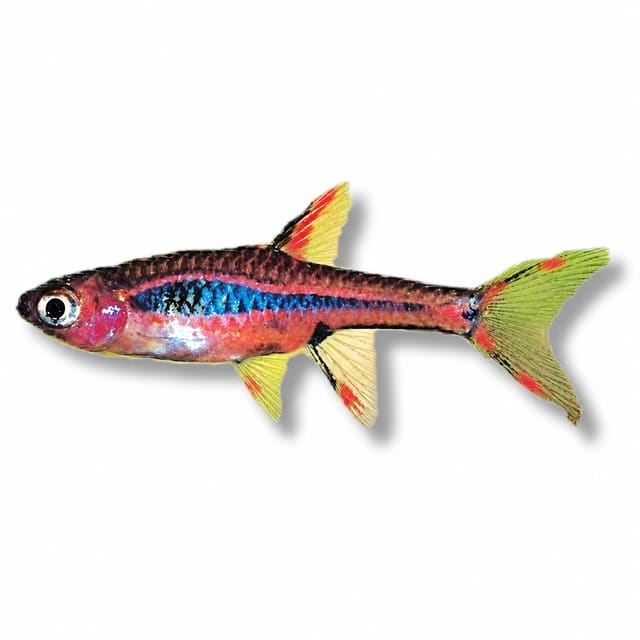
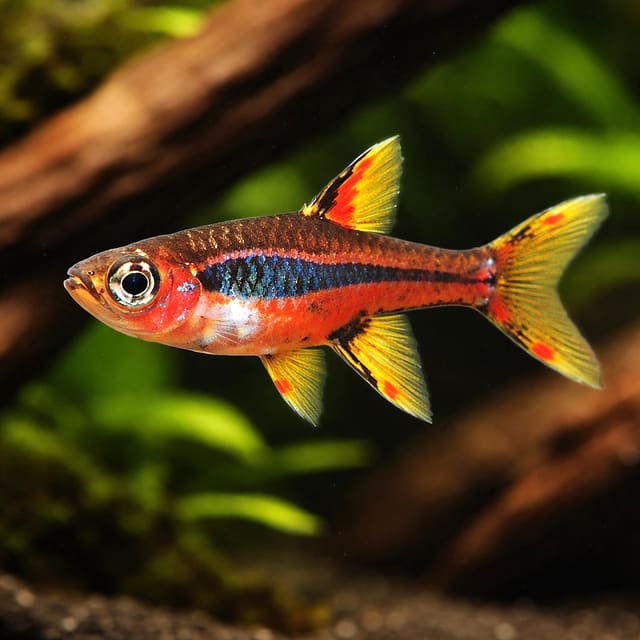
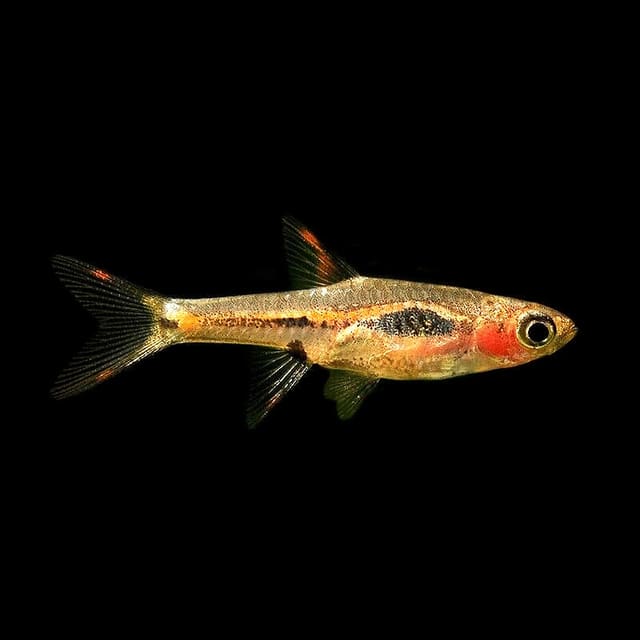
The species name tells you what to look for. Seriously Fish explains that maculatus is Latin for "spotted", and the dark spots are the obvious thing to look for. In our photograph you can see a shoal of orange fish, each with a large round black blotch in the middle of the flank and smaller dark marks further back towards the tail.
Seriously Fish compares it most closely with its relative Boraras naevus, and gives a simple field mark: in B. naevus the red body colour does not carry forward into the head, whereas in the dwarf rasbora it does. The same source notes that the first of the dark blotches along the side is of similar size in both sexes of B. maculatus, while in male B. naevus it is noticeably larger. It also records that the colour varies between wild populations, with some forms showing more intense red than others, so don't be surprised if your shoal is a slightly different shade from fish you have seen elsewhere.
Adult females are noticeably rounder in the belly and often a little larger than the males, according to Seriously Fish. Males are generally the more attractive fish, and the dominant ones show the most intense colour, especially when they are competing for the attention of females. At 1 to 2 cm on dispatch the differences may be slight, and they become clearer as the fish mature in a settled group.
There are several small, red, spotted Boraras in the hobby, and they are easy to mix up in a shop tank. Seriously Fish points out that the species from the Malay Archipelago, which include B. maculatus, B. brigittae and B. merah, tend to have a slimmer, more elongate body than those from Indochina. If you are comparing species, our Mosquito Rasbora (Boraras brigittae) and Least Rasbora (Boraras urophthalmoides) are both on the site. They are different species with their own listings, and we don't suggest mixing species in one shoal: a group of one species reads far better than a scatter of near look-alikes.
You may find this fish in older books as Rasbora maculata. It was described by Duncker in 1904 under that name, and moved when the genus Boraras was set up in 1993 to separate a small group of tiny species from the much larger Rasbora assemblage. Seriously Fish explains that Boraras is an anagram of Rasbora, a nod to the reversed ratio of abdominal to tail vertebrae in these fish. FishBase now places the species in the family Danionidae.
FishBase describes the dwarf rasbora as one of the world's smallest cyprinid species and gives its maximum length as 2.5 cm standard length, for males or unsexed fish. Seriously Fish gives the same 25 mm standard length. Wikipedia puts typical adults at roughly 10 to 20 mm, with 25 mm as the top of the range. The "Max Adult Size" on this page is the FishBase figure, 2.5 cm.
Standard length runs from the tip of the snout to the end of the backbone, where the tail fin begins. It doesn't include the tail fin itself. Total length goes to the tip of the longer lobe of the tail, so the fish you see swimming is a little longer than its standard length suggests. Our dispatch grade of about 1 to 2 cm is a size band from our stock records rather than a scientific measurement, so treat it as a guide to how small the fish will be on arrival, not as a precise figure to compare with the adult maximum.
Seriously Fish explains that Boraras are a textbook case of miniaturisation, the evolutionary process that produces fish which are sexually mature at a size well under 20 mm. Other examples among cyprinids include Danionella, Paedocypris and Barboides. The same source notes that miniature fish like these tend to come from still or slow-moving water, often in nutrient-poor places such as forest peat swamps. That background explains a lot about how to keep them: gentle water movement, very small food, and a tank that is calm rather than busy.
Seriously Fish gives the range as Peninsular Malaysia, southern Thailand, eastern Sumatra, Singapore and the island of Bintan in Indonesia's Riau Islands. FishBase summarises it as the Malay Peninsula to Sumatra. The species was originally described from Muar, also known as Bandar Maharani, in the Malaysian state of Johor.
The habitat is the key to keeping this fish well. Seriously Fish describes black water streams and rivers associated with ancient forest peat swamps. The water is stained brown by tannins and other chemicals released as organic matter decomposes, and the bottom is scattered with fallen leaves, twigs and branches. Such places typically have very soft water of negligible hardness, acidic conditions with pH as low as 4.0, and dim light under the forest canopy. FishBase describes the same picture in fewer words: quiet forest streams with acidic water and slow flow.
FishBase adds a note on spawning in the wild: in shallow water, no more than about 15 cm deep, among thick vegetation. It also records the wild diet as worms and small crustaceans.
FishBase lists the dwarf rasbora as Least Concern on the IUCN Red List, assessed on 24 December 2018, and Wikipedia gives the same category. That is good news, but Seriously Fish warns that across much of South-East Asia these peat swamp biotopes are under serious threat from rubber and palm oil plantations, building developments and other human activity. Least Concern for the species as a whole doesn't mean the habitat is safe.
You don't need to recreate a peat swamp to keep dwarf rasboras, but borrowing from it pays off. Soft, acidic water, subdued light, leaf litter, roots and branches, and a gentle current all echo the wild home, and fish kept that way tend to look and behave far better than the same fish in a bright, bare, hard-water tank. The next two sections turn that into a practical set-up.
Seriously Fish recommends a minimum base of 45 × 30 cm, roughly 41 litres, for a group, and makes the point that although the fish are small they still need space to swim. Males also set up temporary territories when spawning, which is another reason not to cram a shoal into a nano cube. A 45 or 60 cm tank is a comfortable home for ten, and the larger tank gives you more stable water.
A soft, sandy substrate suits them, with roots and branches arranged to create shaded areas. Seriously Fish also encourages dried leaf litter. As the leaves break down they support colonies of microbes, which young fry can feed on, and they release tannins that tint the water and echo the stained water of the wild habitat. Add leaves a few at a time and replace them as they break down.
Dense planting is recommended, along with floating plants and branches. Seriously Fish advises fairly dim lighting to match the shaded conditions the fish meet in nature, and suggests plants that cope with low light, such as Java fern (Microsorum pteropus), Java moss (Taxiphyllum barbieri) and Cryptocoryne species. A practical layout is a thicket of planting along the back and sides, a piece of wood with fern and moss tied on, a scatter of leaves on the sand, and some open water at the front where the shoal can gather.
Filtration doesn't need to be strong. Seriously Fish notes that the species mostly comes from sluggish waters and may struggle if the current is fast. An air-driven sponge filter or a small filter with its output turned down and baffled is ideal, and a sponge on any intake protects fish this small.
This is the single most important point. Seriously Fish warns against introducing any Boraras to a biologically immature aquarium, because they are susceptible to swings in water chemistry. Before ordering, the tank should have been running for several weeks, with the filter fully cycled, ammonia and nitrite at zero, and your soft-water routine settled so that each water change produces the same result. A tank that has had plants growing in it for a while, with a little biofilm on the leaves and wood, is far better than one that was filled last weekend.
If you can tick every line, a shoal of ten has the best possible start.
With tiny soft-water fish, the water is the first thing to check whenever something looks wrong. Bearing in mind Seriously Fish's warning about chemistry swings, the things most likely to upset a stable dwarf rasbora tank are water changes made up differently each time, pH creeping or crashing in poorly buffered water, overfeeding in a lightly filtered tank, and companions that harass or out-eat the shoal. Keep a simple log of test results and water changes, so that if a fish looks off you can see at a glance what has changed. If you add fish later, quarantine them first in a separate tank with similar soft water. Treat any medication with caution in a small tank, and dose by the real volume of water rather than the size printed on the box.
A thermostatic heater is needed to hold the temperature in the range given below. A cover glass keeps the warmth in, cuts evaporation, and reduces how much the water chemistry creeps upwards between changes as water evaporates and minerals are left behind.
Water is where dwarf rasboras are won or lost. The two main sources don't agree on every number, so here are both, and the range we suggest you aim for.
| Parameter | Seriously Fish | FishBase | Aim for |
|---|---|---|---|
| Temperature | 20–28 °C | 24–26 °C | 24–28 °C |
| pH | 4.0–6.5 | 5.0–6.0 | 5.0–6.5 |
| Hardness | 1–5 dGH | 5–12 dH | 1–5 dGH |
The "aim for" column stays inside the Seriously Fish ranges, which are written for aquarium care, and avoids the extremes. The pH of 4.0 at the bottom of the Seriously Fish range reflects the most acidic wild habitats rather than a target for a home tank. On hardness the sources genuinely differ: FishBase gives 5 to 12, while Seriously Fish gives 1 to 5 dGH and describes the wild water as having negligible hardness. We have gone with the softer figure because it matches what is known of the peat swamp habitat.
Before ordering, test general hardness (GH), carbonate hardness (KH) and pH. If your tap water is already soft and slightly acidic, you may only need to dechlorinate it and add leaf litter or wood. If it is hard, you'll need to soften it, and the usual approach is to blend reverse osmosis or distilled water with a measured amount of tap water until you reach the GH you want. Write the ratio down and use it every time, so each water change comes out the same.
Hardness falls in proportion as you dilute. If your tap water tests at 12 dGH and you want about 3 dGH, one part tap water to three parts reverse osmosis water gives roughly 3 dGH, because 12 divided by 4 is 3. Mix a test batch, measure it, and adjust the ratio until it lands where you want it. Then use exactly that recipe for every water change so the fish never see a jump. Bear in mind that very soft water has little carbonate hardness to buffer it, so pH can drift more easily at the soft end of the range. Small, regular water changes and an unchanging routine matter more here than in a hard-water tank.
Because Seriously Fish flags these fish as susceptible to swings in water chemistry, a steady pH of 6.2 is far better than a value that bounces between 5.5 and 6.8 as you chase it with chemicals. Small, regular water changes with water made up the same way every time are the safest routine. Avoid big, sudden changes in either direction, and match the temperature of new water to the tank.
Set the heater somewhere in the middle of the suggested range and leave it there. FishBase's 24 to 26 °C is a comfortable target that sits inside the wider Seriously Fish range, and it leaves a margin for a warm summer.
Leaf litter and bogwood will tint the water the colour of weak tea. That is not dirt. It is the same staining that Seriously Fish describes in the wild habitat, so the fish are coming from water very like it. If you prefer clearer water, activated carbon in the filter will remove the colour, but the fish themselves are perfectly happy with it.
In the wild the dwarf rasbora is a micropredator. Seriously Fish reports that stomach analyses of wild fish found small insects, worms, crustaceans and other zooplankton, and FishBase lists worms and small crustaceans. In other words, it eats very small living animals, and its mouth is built for them.
The species will accept dried foods of a suitable size, but Seriously Fish says the best results come from daily meals of small live and frozen foods such as Daphnia and Artemia, which bring out the colour and help get the fish into breeding condition. Freeze-dried Artemia and Daphnia are also suggested. A workable routine looks like this:
Feed small amounts, once or twice a day, that the shoal clears within a couple of minutes. Dwarf rasboras are timid, so watch every feed for the first couple of weeks to make sure food reaches all ten fish, not just the boldest two or three. If anything is left on the bottom, cut the amount next time. In a soft-water tank with gentle filtration, uneaten food breaks down quickly and destabilises the water, and stability is exactly what these fish need.
If the shoal is slow to take dried food at first, offer small frozen or live foods, which Seriously Fish rates as their best diet anyway, and bring in the dried staples once they are feeding confidently. A fish that hasn't eaten within a few days needs attention: check the water first, then check whether a companion is taking the food.
If the rasboras share the tank with other fish, put their food where they are rather than where the boldest fish wait. A pipette or a turkey baster lets you release a small cloud of thawed food near the shoal's favourite spot. Feeding any bottom dwellers at the other end of the tank, or once the lights have dimmed, stops them hoovering up the rasboras' share.
The microbes that grow on decomposing leaves, which Seriously Fish mentions as secondary food for fry, give the tank a background food supply that adults pick at too. It is one more reason to add leaves to a dwarf rasbora set-up.
Seriously Fish describes the dwarf rasbora as very peaceful, but not an ideal community fish, because of its small size and rather timid nature. That sums up the approach: the problem is never what these fish do to others, it is what others do to them.
Numbers are what make the behaviour work. In a group of eight or more, the males show their most intense colour as they compete with one another for the females, and that competition is a large part of the appeal. Seriously Fish mentions that males set up temporary territories when spawning, so a little rivalry between males in breeding condition is part of normal life in the shoal. Wikipedia also describes them as a shoaling, very peaceful species.
Seriously Fish suggests other small, peaceful fish that share the same needs, including:
Whatever you choose, check that each companion is also at home in soft, acidic water, and that it is calm at feeding time. A species-only tank of dwarf rasboras with a few shrimp is also a lovely, simple option.
Ten dwarf rasboras put a very light load on a 45 cm tank, which leaves room for a few small companions. Keep the stocking modest all the same. In a soft-water tank with gentle filtration, a light bioload makes it far easier to keep the chemistry steady, and a quieter tank brings out the best in a timid fish.
Seriously Fish describes B. maculatus as an egg-scattering, continuous spawner that shows no parental care. In a mature, well-furnished tank, a small number of fry may simply appear without any effort on your part, which is a good sign that the conditions are right.
For more fry, Seriously Fish suggests separate containers of 10 to 15 litres, kept very dimly lit. The base can be left bare, or covered with mesh or plastic grass-type matting so that eggs fall through out of the adults' reach. A fine-leaved plant such as Java moss filling about half the container gives the fish somewhere to spawn. The water should be pH 5.0 to 6.5, 1 to 5 °H, with the temperature towards the upper end of the range. An air-powered sponge filter is optional.
The adults will eat their eggs, but Seriously Fish notes that they don't seem to hunt for them actively, so plenty of cover makes a big difference to how many survive.
The leaf-litter microbes mentioned earlier are a useful extra food for the very youngest fry, and a mature, leafy tank is exactly where Seriously Fish says the odd fry may turn up unaided.
Daily small live and frozen foods are the key here. Seriously Fish links them directly to better colour and breeding condition. Sexes aren't specified on this listing, so if breeding is your aim, a larger group improves the odds of having both. Well-fed males colour up and display as they come into condition.
Before you order, please read our delivery and live-arrival information. Soft-water nano fish reward a careful arrival more than most.
Your ten fish travel in oxygen-filled bags inside insulated packaging, with heat packs added when conditions call for them, and they are carried by a tracked courier licensed to carry live animals.
Before you cut the tape, start recording one continuous video. Keep filming as you open the box and show the fish in the bag while it is still sealed. If any fish arrives dead, dying or clearly compromised, email hello@tropicalfishco.co.uk on the day of delivery, with your order number and that video. Photographs on their own don't meet the policy. The outcome is either a replacement with your next order or a refund for the affected fish, subject to the guarantee terms.
Over the first week, keep an eye on breathing, appetite and behaviour. Don't worry if the shoal stays in the planting at first; give it time. Signs that something is wrong include rapid breathing at the surface, fish lying on the bottom, clamped fins, flicking against décor, or fish that still refuse every food after several days. If you see them, test the water before anything else. Hold off on adding new fish, rearranging the tank or doing big water changes for the first couple of weeks; with a species as sensitive to chemistry swings as this one, steady is everything.
These sources were used for the facts on this page and are worth reading if you want to know more:
No reviews for this item yet. Bought one? Honest reviews only, good or bad.
What customers say about ordering from us
I have a small group of long finned mountain minnows. So was delighted to be able to order ten of this variety to increase the genetics in my tank . The ones I recieved are healthy but it’s to early to give a verdict on wether they are of a long finned type since they are small currently.
Gordon Walker · 23 Sept 2026
100% success travel and "installation". Pleased with quality of purchase. The Siamese fighter a bit "shy" so have not yet seen him at his best yet but looking good. Happy customer. GG
George E Garratt · 21 Sept 2026
Reviews of our shop, collected by Judge.me, an independent third-party review collector. Newest first.