Easy
Scissortailed Rasbora (Rasbora trilineata)
23–28°C · pH 6–7.5 · 200L
£4.99

A peaceful, slender Southeast Asian shoaling fish with a luminous orange-red stripe. Best kept as a properly sized group in a mature, planted soft-water aquarium.
Adult size is the maximum length this species reaches at full maturity (scientific sources). The livestock you receive will be younger and smaller. Product-photo provenance and any image-specific limitations are stated on the listing.
Trigonopoma pauciperforatum
Shoaling fish: kept in a group they feel safer, stay calmer and show their best colour.
Confirm your email, then we’ll send an availability message for this exact item if it returns within 180 days.
This request is only for this product—no newsletter or other promotions. A mail-provider retry may very rarely duplicate the same availability message. Unconfirmed addresses are removed after 48 hours. See our privacy policy.
A peaceful, slender Southeast Asian shoaling fish with a luminous orange-red stripe. Best kept as a properly sized group in a mature, planted soft-water aquarium.
Adult size is the maximum length this species reaches at full maturity (scientific sources). The livestock you receive will be younger and smaller. Product-photo provenance and any image-specific limitations are stated on the listing.
Maintain these water conditions for optimal health and vibrant colors
Redline Rasbora (Trigonopoma pauciperforatum) is a slender Southeast Asian fish with a luminous orange-red to golden lateral stripe, a pointed head and a graceful midwater swimming style. It is also called the Redstripe Rasbora and, in some aquarium literature, the Glowlight Rasbora. Older books and supplier lists may use Rasbora pauciperforata; that is the former scientific combination rather than a different species.
This is a peaceful social fish for a mature, well-planted aquarium with soft, acidic to near-neutral water. It should not be bought as a solitary centrepiece. A UK care profile describes six as the minimum and 10 or more as better, while a second specialist source recommends at least 8–10. For this listing, plan for 8–10, with 10 or more preferred where the aquarium footprint and total stocking permit. A longer tank with shaded cover and open swimming lanes is more useful than a tall tank with the same volume.
Each cart quantity represents one unsexed fish when stock is available; sex, exact shipping size and colour intensity are not guaranteed unless the live product details state otherwise. Adult size is up to about 7 cm total length, not the size necessarily supplied. Current price and availability are shown by the live product controls rather than repeated in this care guide.
| Accepted scientific name | Trigonopoma pauciperforatum (Weber & de Beaufort, 1916) |
|---|---|
| Older name still seen in trade | Rasbora pauciperforata |
| Family | Danionidae, subfamily Rasborinae |
| Adult size | Up to about 7 cm total length |
| Temperament | Peaceful, social and generally non-territorial |
| Swimming area | Mostly midwater to upper levels |
| Recommended group | Plan for 8–10; specialist guidance ranges from six minimum to 10 or more preferred |
| Practical aquarium | About 90 × 40 × 40 cm (roughly 140 litres gross) for a group of around ten |
| Temperature | 23–26°C; the documented wild reference range is 23–25°C |
| pH | 5.0–7.0; soft, acidic conditions are preferred |
| Hardness | About 2–12 dGH, with stability and the soft end of the range preferred |
| Diet | Small insects and zooplankton in nature; appropriately sized dry, frozen and live foods in aquaria |
| Care level | Moderate because water chemistry, group size and tank maturity matter |
Best suited to: established planted aquariums, blackwater-inspired layouts and calm soft-water communities. This is not the best choice for a new, uncycled aquarium, a hard alkaline livebearer setup, an aggressive community or a small tank that cannot hold a proper group.
The accepted name is Trigonopoma pauciperforatum. Eschmeyer’s Catalog of Fishes lists it as a valid species in Danionidae: Rasborinae and gives its distribution as Southeast Asia from Sundaland to Vietnam. The species was originally described as Rasbora pauciperforata, which explains why the older combination remains widespread in the aquarium trade and in search results.
The name change matters because it helps separate this fish from the many unrelated species once grouped broadly under Rasbora. It does not mean older stock labels describe another fish. A listing that says Redline Rasbora, Redstripe Rasbora or Rasbora pauciperforata may still refer to the same species, but visual identification and the supplier’s provenance should be checked rather than relying on one common name alone.
The lateral stripe is not always a uniform traffic-light red. Depending on locality, lighting, condition and mood, it may appear orange, copper, red or golden. A faint darker line can sit below it. The body is very slender and elongated, the snout is pointed, the tail is forked, and the lateral line is incomplete. These features are more useful for identification than expecting every individual to match one highly saturated photograph.
Do not confuse this species with the Glowlight Tetra (Hemigrammus erythrozonus), which has an adipose fin and a different body shape, or with the Glowlight Rasbora (Trigonostigma hengeli), which has a deeper body and a dark wedge-shaped marking. It is also distinct from the Blackline or Red-tailed Rasbora (Rasbora borapetensis). Similar retail names are a reason to check the scientific name before combining stock or planning care.
This species has a broader natural range than “Malaysia and Sumatra” alone. Current catalogues and occurrence summaries place it across Southeast Asia, including parts of Thailand and Cambodia, the Malay Peninsula, Sumatra, Borneo and localities extending towards Vietnam. Within that large range, populations may be separated by river systems and habitat loss, so colour and fine appearance can vary.
FishBase records it from peat and secondary peat-forest streams, clear blackwater, shallow sluggish or standing waters, marshes and swamps under forest canopy. These habitats are usually shaded by dense vegetation. Fallen leaves, branches and other organic material release tannins, while dissolved mineral content is low. The fish occurs from midwater towards the surface and feeds on zooplankton and small insects.
That ecology explains its aquarium preferences. It does not need a theatrical imitation of a swamp, but it benefits from subdued light, visual cover, gentle flow and soft water. A bare, brightly lit aquarium with turbulent current removes many of the cues that help a group settle. Conversely, a dark background, fine-leaved plants, floating cover, wood and some open horizontal space allow the stripe and schooling behaviour to become the visual focus.
Blackwater does not mean dirty water. Natural tannins can tint the aquarium, but ammonia and nitrite must still remain at zero in a correctly cycled system, and nitrate should be controlled through appropriate stocking, feeding and maintenance. Botanical materials should be aquarium-safe, cleaned as appropriate and added gradually because they can influence pH and water chemistry.
FishBase currently records the species as Least Concern, based on the cited IUCN assessment, but local peat-swamp and forest-stream habitats remain vulnerable to degradation. That status should not be interpreted as evidence that every individual in trade is captive bred. This listing does not claim a captive-bred or wild-caught origin because the current batch provenance is not verified.
A settled adult has a streamlined, lightly compressed body and a narrow luminous stripe running along the flank. The effect is more refined than the bold wedge of a Harlequin Rasbora. In a group, the repeated line creates a moving band of colour across the upper half of a planted aquarium. Young or newly transported fish may look paler until they have adjusted to stable conditions and cover.
FishBase gives a maximum length of 7 cm total length. Many aquarium individuals may remain below the maximum, but tank planning should use the adult figure rather than the arrival size. Their shape and swimming style require horizontal room. A group can spread out while calm, pull together when uncertain, and move rapidly when startled, so a secure lid and an unobstructed swimming lane are sensible.
This is a peaceful shoaling species rather than a tight-schooling display every minute of the day. The fish may form a looser group when relaxed and draw closer when conditions change. That is normal social behaviour. Persistent hiding, clamped fins, surface gasping, loss of appetite or one fish being isolated should prompt a check of water quality, oxygenation, group size and tank-mate behaviour.
Mature females are often fuller through the abdomen, while mature males may be slimmer and show stronger colour. These differences are subtle, especially in young retail fish. Fish are sold unsexed, so a particular ratio or breeding pair cannot be promised.
A specialist husbandry source recommends a minimum aquarium of 90 × 40 × 40 cm for a group of around ten. Those dimensions equal about 144 litres gross before substrate, decor and the unfilled space at the top, so the care summary rounds this to roughly 140 litres gross. Treat the footprint and total stocking as the important constraints, not as a claim that every aquarium with a similar litre figure is automatically suitable.
Smaller volume claims seen online often overlook adult length and social needs. A short 60-litre tank may contain enough water on paper but provide little room for a 7 cm fish to move as part of a group. A longer footprint gives the shoal space to change formation and lets quieter tank mates use other areas. For ten or more fish plus companions, additional volume and length are preferable.
Use planting around the back and sides while keeping a clear lane through the middle or front. Fine-leaved stems, crypts and floating plants can provide cover. Smooth driftwood and a dark substrate suit the visual character of the habitat. Leaf litter can be used in a controlled blackwater-style setup, but it is optional and should never obstruct maintenance or be allowed to decay unchecked.
Moderate to subdued lighting is usually more comfortable than an exposed high-intensity layout. Floating plants can diffuse a bright aquarium lamp while leaving selected openings for feeding. Plants should not cover the entire surface because normal gas exchange must be maintained. The tank also needs a secure lid around cable and filter gaps; small active fish can jump when startled.
Provide mature biological filtration and reliable circulation without turning the aquarium into a fast river. A spray bar aimed to soften the return, a well-sized sponge filter or a controllable filter can all work. The goal is clean, oxygenated water with calmer zones, not stagnant water. Observe the fish: if the whole group is constantly fighting the current or confined to one sheltered corner, reduce or redirect the flow.
Never add this species to a tank simply because it has been running for a fixed number of weeks. A tank is ready when the nitrogen cycle is verified with tests, the filter can process the expected waste, temperature and chemistry are stable, and ammonia and nitrite remain at zero. The time required varies with the cycling method. The fish tank nitrogen cycle guide explains the process, but test results are what determine readiness.
Primary species data place the fish in soft, acidic water at 23–25°C, pH 5.0–6.0 and 5–12 dGH. Aquarium references sometimes publish a wider range. For routine home care, 23–26°C, pH 5.0–7.0 and roughly 2–12 dGH is a cautious working envelope, with the softer and slightly acidic part of the range closest to its habitat.
| Parameter | Practical care range | How to use it |
|---|---|---|
| Temperature | 23–26°C | Avoid rapid swings; check the aquarium with a thermometer rather than relying only on the heater dial. |
| pH | 5.0–7.0 | Soft, acidic water is preferred. Do not chase pH with abrupt chemical corrections. |
| General hardness | About 2–12 dGH | Confirm your source water. Hard UK tap water may require a planned RO-water blend rather than additives alone. |
| Ammonia | 0 mg/L | Any detectable reading requires immediate investigation and appropriate corrective care. |
| Nitrite | 0 mg/L | Detectable nitrite means the biological system is not coping or has been disrupted. |
| Nitrate | Keep controlled and stable | Use stocking, feeding, plants and regular partial water changes to prevent accumulation. |
Stability does not mean accepting unsuitable chemistry forever. It means making changes slowly and deliberately. If your tap water is very hard and alkaline, first measure pH, GH and KH. A controlled blend of remineralised reverse-osmosis water and tap water can produce repeatable conditions, but the recipe must be tested before livestock is added. The aquarium water chemistry guide explains pH, GH and KH, and the water parameter matcher can help with an initial comparison.
Do not pour unmeasured pH-lowering products into a stocked tank. In water with low buffering capacity, a small dose can cause a large change. In hard, well-buffered water, the same product may produce only a temporary reading before pH rebounds. A stable source-water plan is safer than repeated corrections.
Regular partial water changes should use dechlorinated water matched closely for temperature and, where practical, chemistry. The appropriate percentage and frequency depend on nitrate, stocking and feeding; there is no universal schedule for every aquarium. Clean filter media in removed aquarium water or according to the manufacturer’s instructions so beneficial biofilm is not unnecessarily damaged.
Redline Rasboras are social fish and should not be kept alone. A UK care profile describes six as the minimum and 10 or more as better; Acquariofilia Consapevole recommends at least 8–10. Because specialist guidance is not identical, this listing recommends planning for 8–10, with 10 or more preferred where the aquarium footprint and total stocking allow. A proper group spreads social attention, improves confidence and produces the coordinated display for which the species is kept.
Buying one or two because more can be added later is not ideal. Small groups may become timid, remain close to cover or fail to show normal movement. If stock or tank capacity does not allow the planned group, wait rather than starting with an isolated fish. Do not compensate for too few rasboras by adding unrelated schooling species; each species needs its own social group.
Group recommendations must still respect total stocking. Ten fish in a long, mature aquarium can be more appropriate than a larger shoal crowded into a small tank. Use adult size, not retail size, in calculations. Leave capacity for bottom dwellers and other companions, and remember that filtration capacity does not replace swimming room.
Use the live purchase controls for current quantity options and price. The biological group recommendation above is independent of any promotion or multi-buy option.
Choose calm species of similar size that overlap in temperature and prefer soft to neutral water. Good candidates can include peaceful small rasboras, pencilfish, small gentle tetras and suitable Pangio loaches, provided each species has enough space and its own group. Small calm bottom dwellers may share the aquarium without competing directly for the same swimming level.
Compatibility is more than temperament. Guppies, mollies and many other livebearers are often peaceful, but they usually prefer harder, more alkaline water than this species. Combining them forces one side of the community away from its preferred chemistry. Match water requirements first, then compare adult size, activity, diet and behaviour.
Avoid large predatory fish, aggressive cichlids, fin-nipping barbs and boisterous feeders that dominate every meal. Giant gouramis, pacu, large bichirs and similar fish are not companions for a slender 7 cm rasbora. Very small shrimp offspring may also be eaten opportunistically; peaceful fish are not automatically safe with shrimplets.
| Compatibility | Examples or conditions | Reason |
|---|---|---|
| Usually suitable | Other calm soft-water rasboras, gentle pencilfish, small peaceful tetras | Similar size, activity and water preferences when all social groups fit. |
| Often suitable with checks | Kuhli loaches and small peaceful bottom dwellers | Different swimming area, but temperature, substrate, group size and footprint must match. |
| Use caution | Gouramis, bettas and faster barbs | Individual temperament, feeding pressure and fin-nipping risk vary. |
| Poor water match | Guppies, mollies and other hard-water livebearers | Temperament may be peaceful, but preferred mineral content differs. |
| Avoid | Large predators, aggressive cichlids, pacu, giant gouramis and bichirs | Predation, intimidation, competition or eventual size makes the combination unsuitable. |
Use the tank mate checker as a first screen, then verify the exact species and your aquarium dimensions. No tool can account for every individual fish or an already crowded tank. If the group is being chased, excluded from food or compressed into one corner, the community needs intervention rather than more decorative cover alone.
In nature, this species feeds on zooplankton and small insects. In the aquarium it can accept fine flakes and appropriately sized micropellets, but a varied diet should also include small frozen or live foods such as daphnia, Artemia and suitable mosquito larvae. Food must fit the mouth and remain available in the midwater or upper feeding zone long enough for the group to take it.
Feed small portions once or twice daily, adjusting to the fish, temperature and total community. Add only what the group can consume before food accumulates. A stopwatch target is less useful than observation because particle size, current and the number of fish vary. If food reaches the substrate uneaten, reduce the next portion and remove excess rather than adding scavengers to solve overfeeding.
Distribute food across more than one point so timid fish can feed. Watch the entire group, not just the boldest individuals at the front. A fish that consistently hangs back may be stressed, unwell or outcompeted. Conversely, a rounded abdomen immediately after feeding is not a reason to keep adding food.
| Food type | Role | Practical note |
|---|---|---|
| Fine flake or micropellet | Convenient staple | Choose a particle size the fish can swallow without repeated spitting. |
| Frozen daphnia or Artemia | Variety and feeding enrichment | Thaw and portion appropriately; avoid adding excessive packing liquid. |
| Small live foods | Encourages natural hunting behaviour | Use clean, reputable cultures to reduce contamination risk. |
| Large pellets or wafers | Usually unsuitable as a primary food | Particles may be inaccessible before sinking or being taken by tank mates. |
Do not rely on one vitamin claim or one premium label. Freshness, suitable particle size, variety and correct quantity matter. Store dry food sealed, cool and dry, and replace it when quality deteriorates. Frozen food should remain frozen until use and should not be repeatedly thawed and refrozen.
This fish is not an algae eater, glass cleaner or snail-control animal. Its presence does not replace aquarium maintenance. It should also not be deliberately left unfed based on generic claims about how long fish can survive without food. For absences, make a species-appropriate plan and test any automatic feeder before travel.
Prepare the aquarium before dispatch. Confirm that it is cycled, covered and within the planned temperature and chemistry range. Do not order the fish while a new tank is still being assembled or while a water-quality problem is unresolved. Review the current delivery and Live Arrival Guarantee terms before checkout because dispatch days, coverage and claim requirements can change.
On arrival, follow the instructions supplied with the order. Minimise bright light and unnecessary handling. Temperature equalisation and water acclimation should account for the difference between transport water and aquarium water; excessively prolonged exposure to an opened shipping bag can create its own water-quality risk. Do not pour shipping water into the display aquarium unless the supplied instructions specifically require it.
A separate observation or quarantine system can reduce the chance of introducing disease, but it must itself be mature, heated, covered and suitable for a social species. An empty, uncycled container is not a safe quarantine tank. If only part of the group is quarantined, consider how social stress and later reintroduction will be managed.
During the first week, check respiration, posture, appetite, fin condition and group behaviour. Keep lighting subdued initially and offer small familiar foods once the fish have settled. Avoid adding multiple new species at the same time because it makes water-quality changes and behavioural problems harder to diagnose.
Some temporary paleness after transport can be normal. Persistent gasping, rolling, severe clamping, visible lesions or rapid deterioration is not. Test water immediately and follow the store’s current support or guarantee process when an arrival concern is present. Do not medicate the display aquarium on guesswork; many symptoms share different causes, and treatment choice depends on diagnosis and livestock present.
Good long-term care is built around repeatable conditions. Test often enough to understand the aquarium’s normal pattern, record unusual readings, and make partial water changes before waste accumulates. Inspect the heater, filter flow and surface movement. Remove decaying plant material while retaining intentional botanicals only where they are part of a controlled setup.
Colour can vary with genetics, locality, age, diet, social confidence, lighting and background. It should not be treated as a single diagnostic. A paler stripe in a bright bare tank may improve after the group settles into cover, while sudden colour loss accompanied by rapid breathing or inactivity requires a water-quality and health check.
Check whether the shoal is large enough, whether the aquarium is brightly exposed, and whether a tank mate is chasing or outcompeting it. Confirm that water chemistry is suitable and stable. Add cover without eliminating open swimming space, and reduce disruptive traffic around the tank where practical.
Surface-oriented swimming can be normal for this species, but persistent gasping is not. Test ammonia and nitrite, check temperature and confirm adequate surface movement. Warmer water holds less oxygen. Do not assume an air stone alone fixes a biological or chemical problem.
Observe for bullying, injury, abnormal respiration, wasting or loss of appetite. Compare both sides of the body and review recent additions. If isolation is needed, use a prepared system and seek qualified aquatic-veterinary or experienced specialist advice for serious or worsening symptoms.
Measure tap and aquarium pH, GH and KH, and consider whether botanicals, substrate or an RO blend are changing buffering. Correct the source-water plan rather than repeatedly dosing the display tank. Sudden changes can be more stressful than a stable value near the edge of an appropriate range.
Breeding is a specialist project rather than a reason to buy an unsexed pair. Mature females may be fuller and males may be brighter, but sexing young fish is uncertain. Begin with a healthy group so adults can mature and natural pair interactions can be observed.
Specialist accounts describe spawning among fine plants or moss in very soft, acidic water, with adults likely to eat eggs. A separate mature breeding aquarium, gentle filtration and appropriately small first foods for fry are needed. Egg and fry development times vary with temperature and conditions, so they should not be presented as a guaranteed timetable.
Do not alter a stable community tank rapidly in an attempt to trigger spawning. Breeding success depends on adult condition, water chemistry, food, sex ratio and a safe rearing plan. Fry require microscopic or very fine foods before they can accept larger live food, and small water changes must avoid abrupt chemistry shifts.
Browse the Rasboras, Danios and Tanichthys category to compare current stock, or see the wider schooling fish collection. Compare adult size, group needs and water chemistry rather than choosing only by colour.
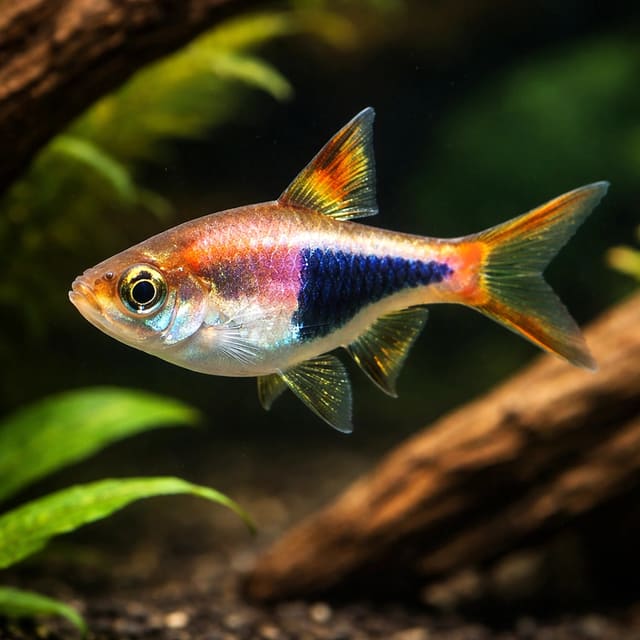
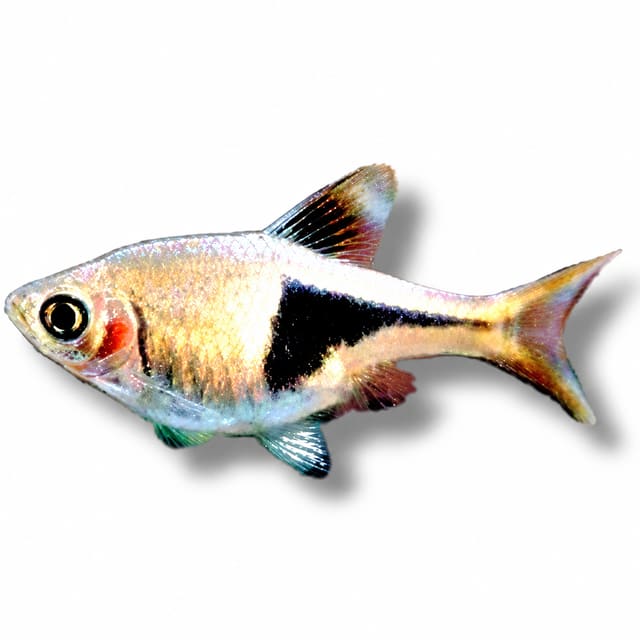
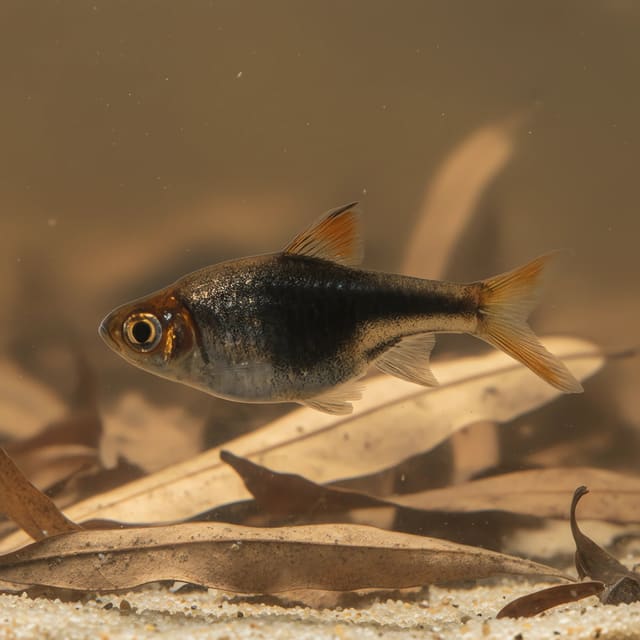
The four gallery images are representative digital illustrations, not photographs of the individual fish that will be supplied. Colour, markings, body condition, sex and shipping size can differ from the illustrations.
Use the images for broad visual orientation, then use the accepted scientific name and live product details for the purchase decision. The gallery does not verify a particular collection locality or current batch.
The accepted name is Trigonopoma pauciperforatum. Rasbora pauciperforata is the original and still-common older combination. Both names may appear in aquarium literature, but the product title now uses the current accepted name.
FishBase records a maximum of about 7 cm total length. Retail fish may arrive smaller, and individual size varies, but the aquarium should be planned around adult length.
Do not keep this species alone. Specialist guidance spans six as a stated minimum through 8–10 as the recommended planning group, with 10 or more preferred where tank dimensions and total stocking allow.
For a group of around ten, use an aquarium about 90 × 40 × 40 cm, roughly 140 litres gross. The footprint is more useful than a short tall tank with a similar volume. Increase space for a larger shoal or a community.
A practical aquarium range is 23–26°C and pH 5.0–7.0 in soft water. FishBase documents 23–25°C and pH 5.0–6.0 from species references, so the acidic part of the aquarium range is closest to the natural habitat.
Very hard, alkaline water is not an ideal match. Measure pH, GH and KH rather than relying on postcode assumptions. A tested blend using remineralised RO water may be appropriate, but chemistry must be stable and repeatable before fish are introduced.
It is peaceful and feeds readily, but its soft-water preference, social needs and requirement for a mature tank make a moderate care rating more honest than calling it universally easy. A prepared keeper with suitable source water can maintain it successfully.
Offer fine flakes or micropellets alongside small frozen or live foods such as daphnia and Artemia. Feed modest portions and distribute food so every fish in the group can eat.
The species are not an ideal water-chemistry match. Guppies usually prefer harder, more alkaline water, while this rasbora favours soft acidic conditions. Choose companions that overlap in both behaviour and chemistry.
No. The gallery contains representative digital illustrations of the species, not current-batch specimen photographs. The fish supplied can differ in size, sex, colour and markings.
This product has one default purchase option, so each cart quantity represents one unsexed fish when available. Always confirm the live price, stock and any quantity controls shown on the product page before ordering.
Use the live stock message and purchase controls on this page. Availability changes and is deliberately not stated as a permanent claim in this care guide.
This listing distinguishes primary species data from practical aquarium recommendations. Taxonomy, distribution, adult size, habitat and wild parameter references were checked against current scientific databases; group size and aquarium setup were cross-checked with specialist husbandry references.
Sources accessed 27 July 2026. Care ranges are conservative aquarium recommendations, not a claim that every population or individual has identical tolerance.
No reviews for this item yet. Bought one? Honest reviews only, good or bad.
What customers say about ordering from us
I have a small group of long finned mountain minnows. So was delighted to be able to order ten of this variety to increase the genetics in my tank . The ones I recieved are healthy but it’s to early to give a verdict on wether they are of a long finned type since they are small currently.
Gordon Walker · 23 Sept 2026
100% success travel and "installation". Pleased with quality of purchase. The Siamese fighter a bit "shy" so have not yet seen him at his best yet but looking good. Happy customer. GG
George E Garratt · 21 Sept 2026
Reviews of our shop, collected by Judge.me, an independent third-party review collector. Newest first.