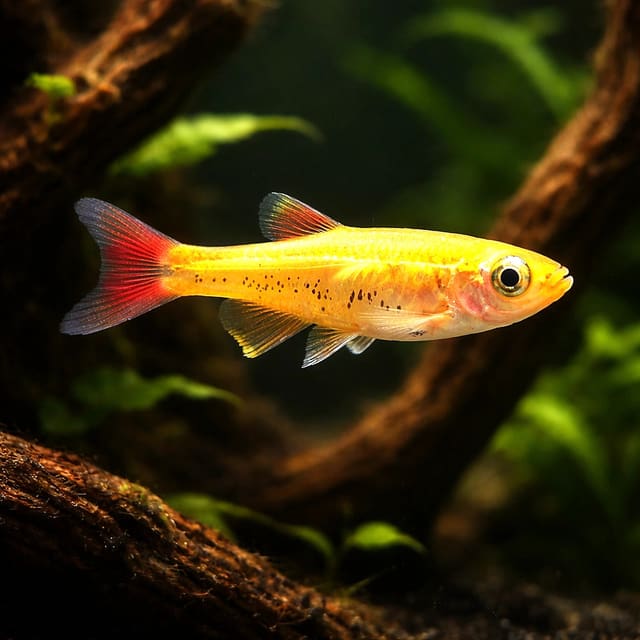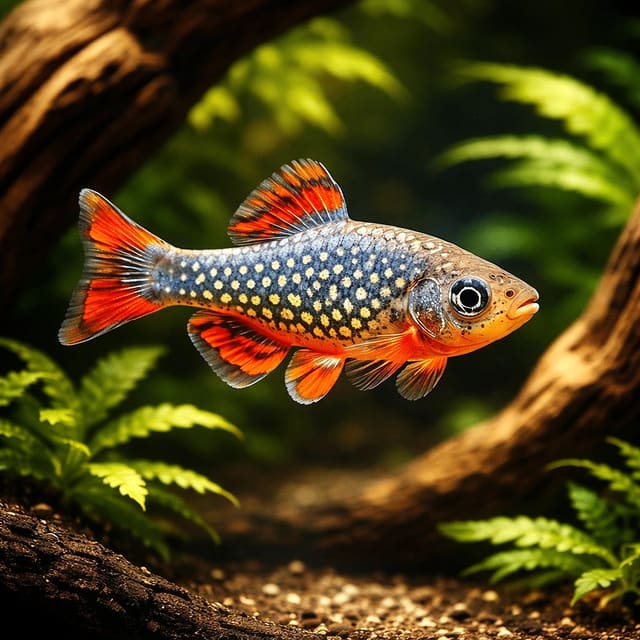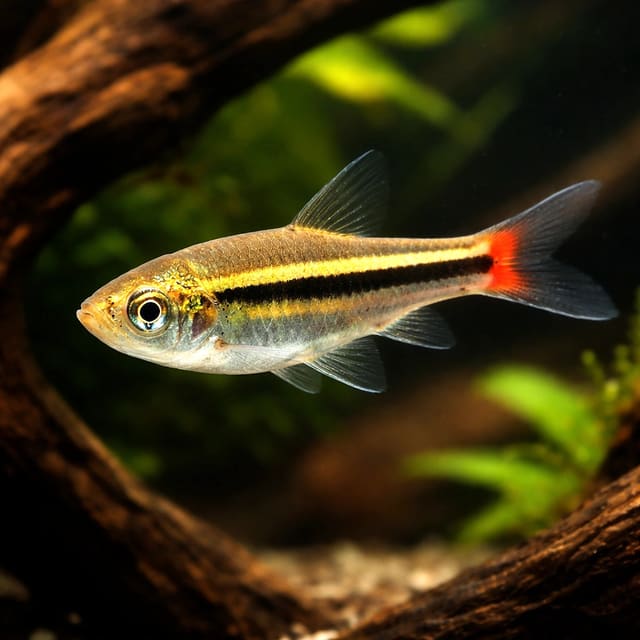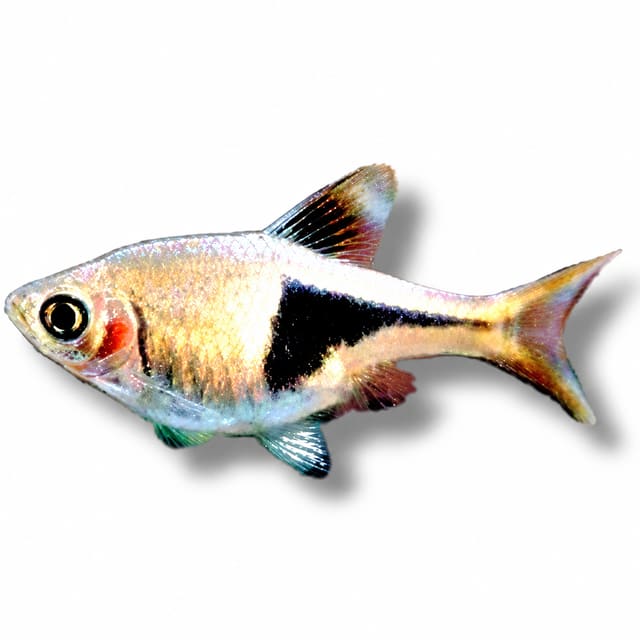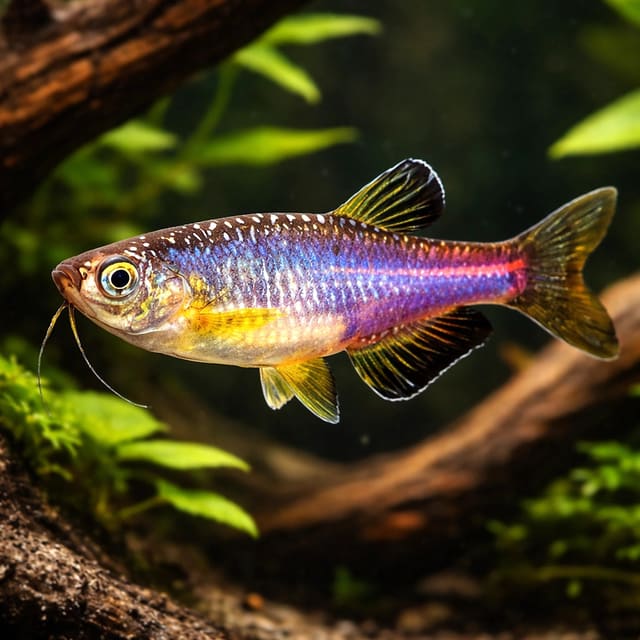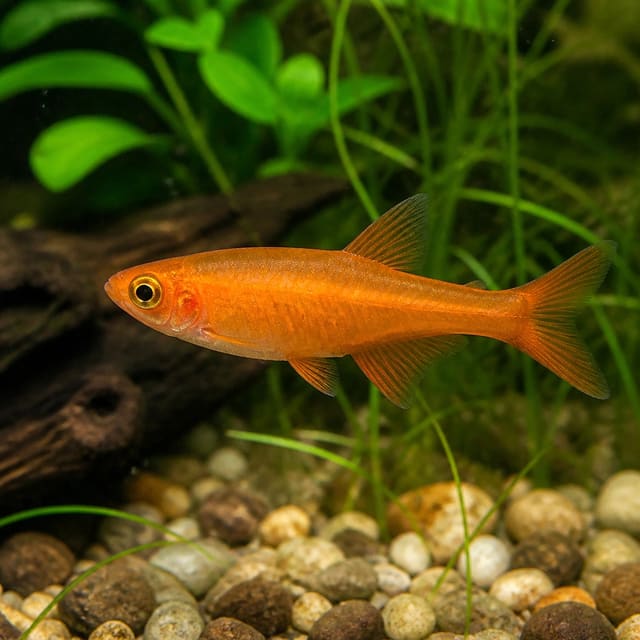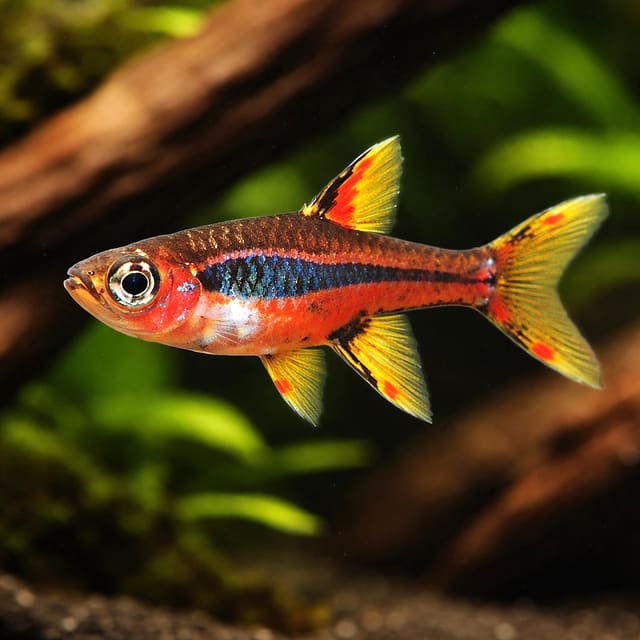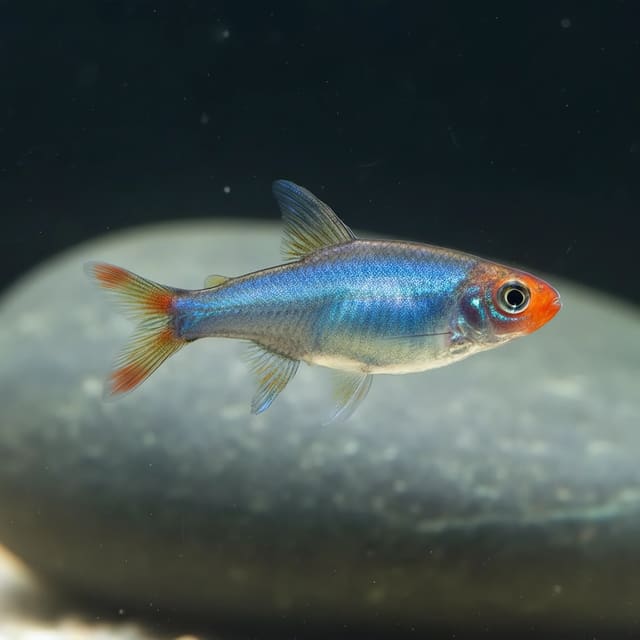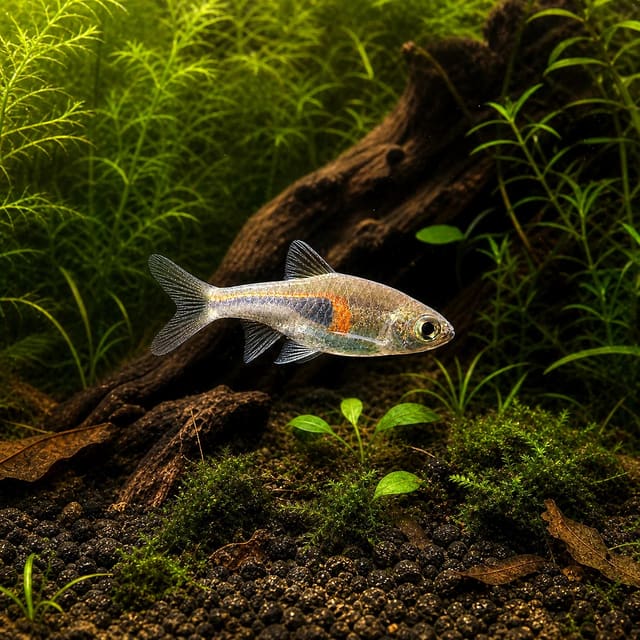
Glowlight Rasbora (Trigonostigma hengeli)
23–28°C · pH 5–7.5 · 54L
£3.99

Lambchop Rasbora (Trigonostigma espei) is a peaceful copper-coloured shoaling fish. One purchase supplies one unsexed fish at a 1.5–2 cm dispatch grade. Plan at least eight to ten together in a mature planted aquarium with horizontal swimming space and calm companions.
Adult size is the maximum length this species reaches at full maturity (scientific sources). The livestock you receive will be younger and smaller. Product-photo provenance and any image-specific limitations are stated on the listing.
Trigonostigma espei
Shoaling fish: kept in a group they feel safer, stay calmer and show their best colour.
Minimum of 2 per order.
Lambchop Rasbora (Trigonostigma espei) is a peaceful copper-coloured shoaling fish. One purchase supplies one unsexed fish at a 1.5–2 cm dispatch grade. Plan at least eight to ten together in a mature planted aquarium with horizontal swimming space and calm companions.
Adult size is the maximum length this species reaches at full maturity (scientific sources). The livestock you receive will be younger and smaller. Product-photo provenance and any image-specific limitations are stated on the listing.
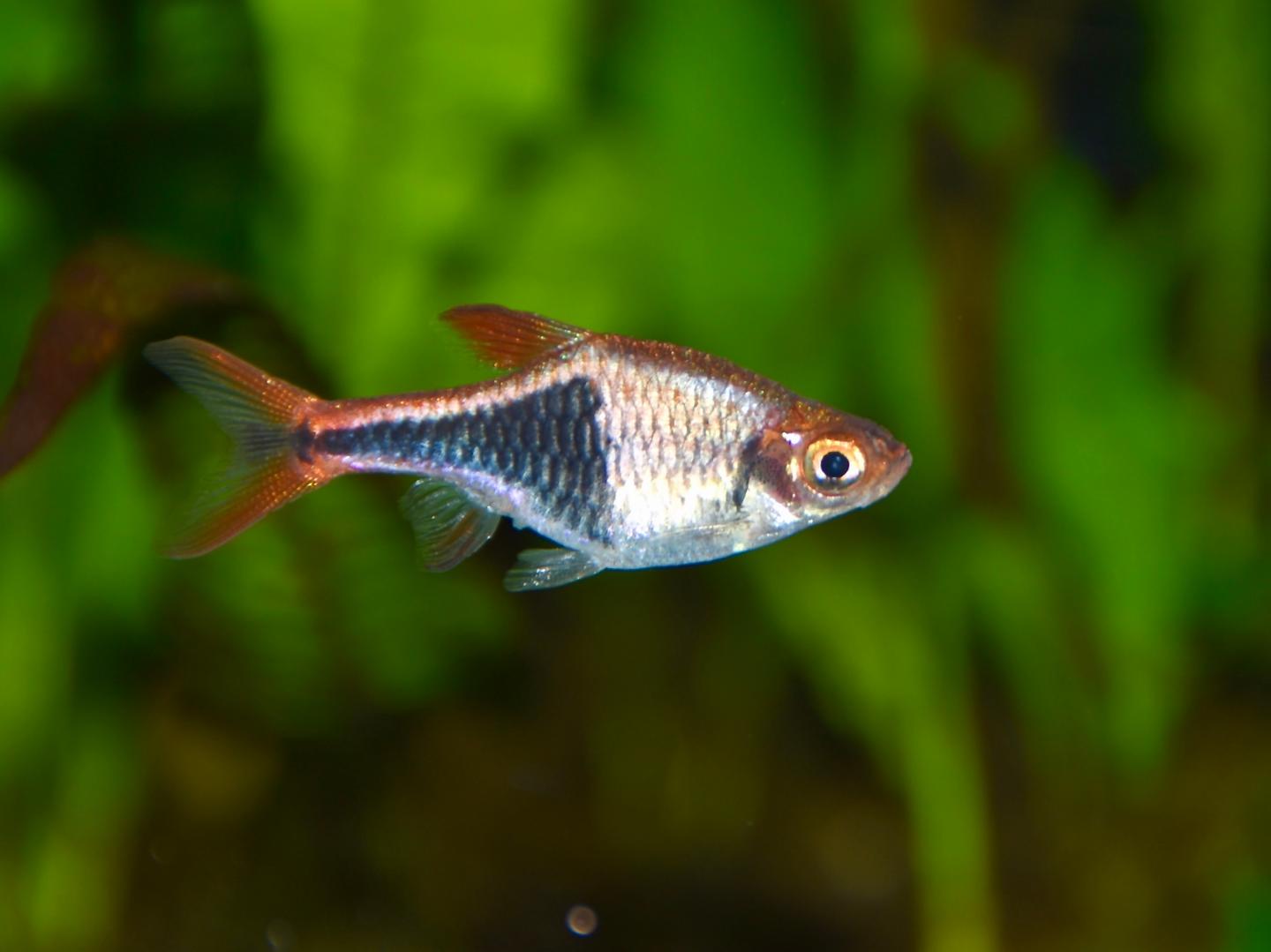
Our conservative starting policy is a mature, filtered aquarium at least 60 cm long and about 60 litres, eight or more fish, and measured water screened against 22-25 °C, pH 5-7 and 5-12 dGH.
Maintain these water conditions for optimal health and vibrant colors
Lambchop Rasbora (Trigonostigma espei) is a peaceful Southeast Asian fish with copper-orange colour and a narrow dark mark on each side. One purchase supplies one live fish at the supplier's 1.5–2 cm dispatch grade. Sex is guaranteed only when the selected option explicitly states male or female. This Lambchop Rasbora listing has no sex-guaranteed option. In a mature, planted aquarium the fish needs a properly sized group, calm neighbours and open horizontal swimming room. Seriously Fish advises at least eight to ten together and an aquarium base around 60 × 30 cm or equivalent, about 54 litres, as the smallest considered for a group.
FishBase records a maximum of 2.5 cm standard length for male or unsexed fish. Seriously Fish gives 3 cm standard length in its species profile. Standard length excludes the tail fin, and both records concern adult fish rather than the size supplied. The accepted name is Trigonostigma espei; the supplier's older Rasbora espei name refers to the same trade identity. Plan water at 23–28°C, pH 5.5–7.5 and 1–10 dGH under the species-specific aquarium guidance, keeping conditions stable and comparing the holding water before introduction.
This fish suits a keeper who can maintain a mature biological filter, offer fine food to every member of the shoal, and screen all companions for adult size, activity and water overlap. A well-furnished aquarium offers shaded margins and cover while leaving a clear midwater route. The body marking and slender shape distinguish this fish from the deeper-bodied Harlequin Rasbora and the similar Glowlight Rasbora.
The answer is usually yes when the aquarium is mature, the planned group fits comfortably and all residents share an overlapping water range. The answer is no when the tank is uncycled, very small, dominated by large or aggressive fish, exposed to strong turbulent flow throughout, or maintained at chemistry far outside the batch’s acclimated conditions.
Compare your measured water with the water matcher and use the first tropical tank guide to prepare filtration before livestock arrives.
| Good fit | Needs a different plan |
|---|---|
| A mature, filtered aquarium with a clear horizontal swimming route | A new aquarium whose filter has yet to process its planned load |
| Space for at least eight to ten Lambchop Rasboras and all other residents | Room for only a solitary fish or a much smaller group |
| Calm neighbours with matching water and feeding needs | Predators, persistent fin nippers or fast competitors that exclude the shoal |
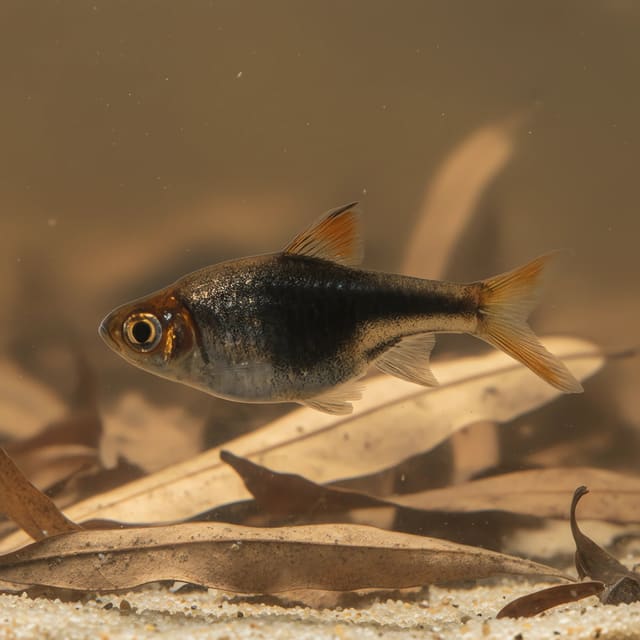
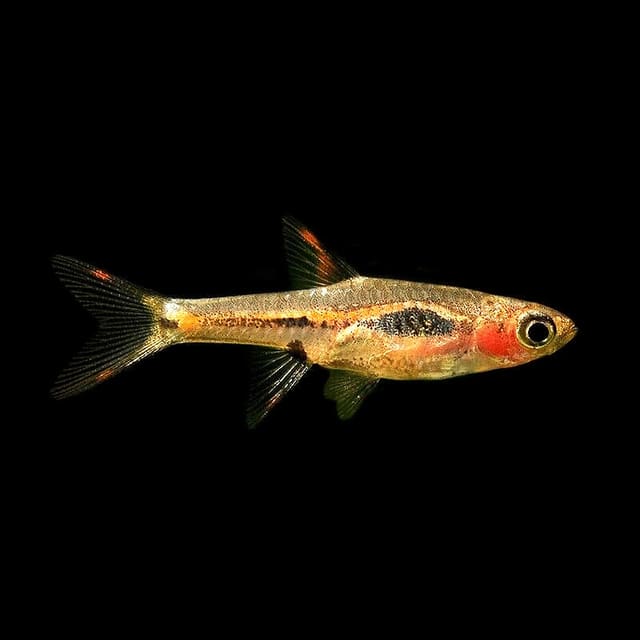
A typical Trigonostigma espei is slender and copper to reddish, with a relatively narrow dark lamb-chop-shaped flank mark. Seriously Fish describes the differences from Harlequin and Glowlight Rasboras. Compare body shape and the marking together when a newly transported fish is pale.
Colour is not a reliable identification test on its own. A fish can look pale after transport, under bright shop lighting or when nervous, and populations from different localities can differ in the intensity of their red or copper colour. Body marking, proportions and provenance should be considered together. Juveniles may also have less dramatic colour than mature, settled fish.
The Harlequin Rasbora, Trigonostigma heteromorpha, is a different species. It generally has a deeper body and a broader, more solid triangular black mark. The Lambchop Rasbora stays more slender and usually carries a narrower mark with a distinct forward expansion. Both are peaceful shoaling fish, but their identity should not be merged in a title, image label or scientific-name field. A care guide for T. heteromorpha is not automatically a species-specific guide for T. espei.
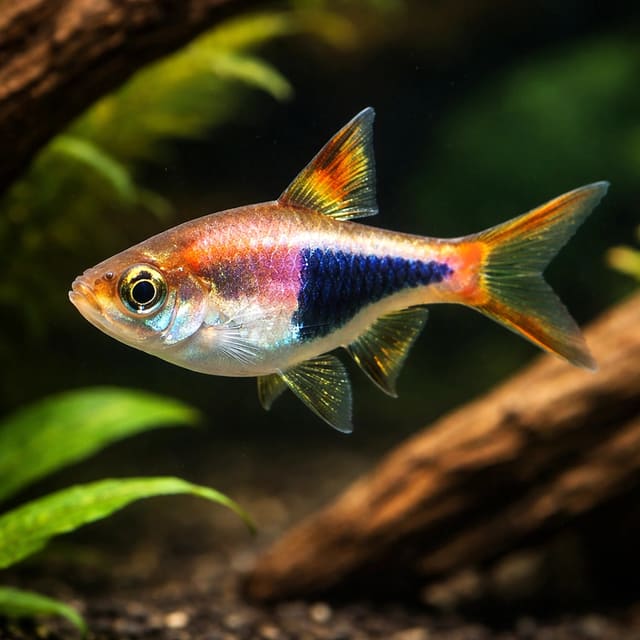
The Glowlight or Hengel’s Rasbora, Trigonostigma hengeli, can be more difficult to separate at a glance. Specialist descriptions usually distinguish T. hengeli by a greyer or less uniformly copper body and a bright orange flash above and around a slimmer dark mark. T. espei tends to show warmer red-orange pigment across more of the body. Because lighting, stress and age alter colour, an uncertain fish should not be identified from one colour cue alone.
FishBase uses the accepted Trigonostigma espei name and Danionidae family. The older Rasbora espei combination appears in supplier material; it does not identify a separate retail species here.
FishBase places Lambchop Rasbora in Thailand and Cambodia, with records from plant-rich ponds, pools, marshes and swamps. This describes wild habitat, not the source locality of this retail batch. Seriously Fish suggests a well-furnished aquarium with shaded spots, wood, plants and an open swimming route. A darker substrate can bring out the copper colour. Add safe botanicals gradually and maintain them as they decay; keep access for cleaning and leave enough midwater room for the group to move together.
Use a base around 60 × 30 cm, roughly 54 litres or equivalent, as the smallest species-specific size considered for a small species-focused group, provided the aquarium offers a base close to 60 × 30 cm and is not already crowded. Litres describe volume but not swimming shape, so footprint matters. A longer aquarium lets the shoal move together and gives nervous individuals space to rejoin the group without being trapped against decor.
Choose more volume for a larger shoal or mixed community. Footprint, filtration, maintenance and every resident's social and territorial needs shape the final plan. Browse the rasboras and danios collection for comparisons, then check each candidate separately.
Create a planted or visually sheltered edge while preserving a clear lane across the middle. Rooted plants, attached epiphytes and floating cover can break up harsh light. Wood and leaf litter can add structure and tannins, but every item must be clean, aquarium-safe and positioned so fish cannot be trapped. A dark background or substrate often makes the copper colour easier to see without using excessively bright lighting.
Leave open water as well as refuge. Put taller planting behind or to the sides, leave a broad route through the centre and keep the surface accessible.
Use a mature filter that processes the aquarium’s waste and maintains gentle surface movement. Lambchop Rasboras can use gently flowing water, but they should not be pinned in one corner by a high-velocity outlet. Spread or redirect a strong return while retaining oxygen exchange. A sponge pre-filter can reduce the risk to very small fish and any fry, provided it is maintained without destroying the established biological media.
A filter is not a substitute for water changes. Test ammonia and nitrite whenever fish behave abnormally, after maintenance that may disturb the biological filter, and during any period of increased feeding or stocking. Do not run filter media under the tap; rinse lightly in removed aquarium water; replacing all mature media at once can remove much of the nitrifying community.
A practical maintenance range is 23–28°C, pH 5.5–7.5 and about 1–10 dGH. Those figures are a compatibility envelope, not targets to swing between. Select a stable point within the range that also suits the fish’s current acclimation and every tank mate. If your tap water differs substantially, ask about the current batch before changing chemistry.
Rapid changes in temperature, dissolved minerals or pH can be more stressful than a steady value near the edge of a suitable range. Avoid adjusting pH with repeated doses of an acid or alkaline product without understanding carbonate hardness. Low KH can make pH easier to move and less buffered; high GH or KH is not corrected safely by guessing. Test the source water and aquarium, then make any necessary change gradually with a repeatable method.
Test the water actually used for this aquarium, prepare it consistently, and make changes gradually. The water chemistry guide explains the readings and why trends matter.
FishBase records a narrower wild pH range of 6.0–6.5, while Seriously Fish supplies 5.5–7.5 for aquarium planning. Keep wild environmental records distinct from aquarium guidance and compare the present holding water with the prepared tank before transfer.
Lambchop Rasboras are social fish, not solitary centrepiece fish. A lone individual or very small group may hide, remain pale or behave nervously. Keeping a proper group distributes attention, allows normal displays and creates the coordinated midwater movement for which the species is valued.
Seriously Fish recommends at least 8–10 in a suitably sized aquarium. Do not increase the group simply to reach a number if the tank is already heavily stocked. Start with tank capacity, adult size, filter maturity and the total community, then choose the largest sensible group.
A shoal will not always swim in a tight formation. Fish may spread out when they feel secure and draw together when startled. That is normal. Persistent hiding, gasping, clamped fins, refusal of food or frantic swimming is not proof that the group merely needs time; test the water and review flow, lighting, tank mates and recent changes.
Mature males may display more intensely, while females are often fuller through the abdomen. Those traits do not guarantee the sex of this unsexed offer. A mixed group normally organises itself without the aggression associated with territorial cichlids.
Feed a varied selection of foods small enough for the fish to take easily. Fine flakes, micro-granules or a quality small-fish pellet can form the regular base. Add suitably sized frozen or live foods such as daphnia, cyclops or Artemia to broaden the diet and encourage natural feeding behaviour. Break up food when necessary rather than assuming a pellet labelled for tropical fish is automatically small enough.
Offer modest portions and watch the whole group. Small rasboras feed in the water column, and slower or newly arrived fish can miss food when kept with very fast feeders. Distribute a small amount across the surface or current so every individual has an opportunity to eat. Remove a large accumulation of uneaten food and reduce the next portion; excess food degrades water quality.
There is no universal number of seconds that proves a meal is correct, and a fixed weekly fasting schedule has no role in this feeding plan. Portion size depends on food density, fish size, group size, temperature and the rest of the community. The useful test is whether all fish maintain a normal body profile and active feeding response without persistent leftovers or declining water quality.
Seriously Fish describes the species as a likely micropredator taking small insects, worms, crustaceans and zooplankton in nature. Supply suitable foods and observe the whole group. If one fish becomes hollow-bellied or repeatedly misses food, check competition, particle size and water quality promptly.
Suitable companions are generally small, peaceful species that tolerate the same temperature and water chemistry. Calm rasboras, small tetras, appropriately sized danios, small cory-type catfish, kuhli-type loaches and some gentle labyrinth fish may work in a sufficiently large aquarium. That is a starting point, not a guarantee: research the exact species, adult size, social group and feeding style before mixing them.
Where dwarf shrimp are present, small fish may take exposed shrimplets. An adult coexistence observation is not a promise about juvenile survival. Every additional animal contributes to the biological load.
Do not select a tank mate merely because another listing calls it “peaceful”. Peaceful fish can still be unsuitable because of temperature, hardness, adult size, activity level or feeding competition. Use the Danio, Rasbora and Tanichthys category for related species, then compare each candidate individually.
A common planning mistake is to fill the same midwater zone with several small shoals. One larger, well-supported Lambchop Rasbora group often creates a calmer and more coherent display than several undersized groups. Bottom and surface residents can add variety if the total stocking level, water conditions and behavioural needs remain compatible.
Read the current delivery and Live Arrival Guarantee policy before dispatch, arrange to receive the parcel, and prepare the aquarium before it arrives. For a Live Arrival Guarantee claim, the policy requires a continuous video starting with the sealed outer parcel and showing the opening and fish still in the sealed bag. Contact the store on arrival day with the order number and required evidence.
On arrival, keep the container out of strong light and inspect the fish with minimal handling. Follow the supplied instructions for acclimation, accounting for journey time, bag condition and the difference between source and destination water. A gradual, condition-led transfer is more useful than a universal timer.
Keep the aquarium lighting low during introduction and avoid a large meal immediately. Give the group visual cover and observe breathing, balance and swimming. Temporary paling can occur with transport stress, but gasping, loss of balance, severe injury or continuing collapse needs immediate attention. Keep the claim evidence process separate from the fish's acclimation and follow the current policy.
If you run a quarantine aquarium, it should be cycled, heated and matched to the fish rather than treated as a bare emergency container. There is no single quarantine duration suitable for every system. Use a documented protocol appropriate to your livestock source and existing collection, and seek qualified aquatic-veterinary advice for suspected disease rather than dosing preventively without a diagnosis.
A settled Lambchop Rasbora should be alert, balanced and willing to join its group. The body should not become progressively hollow, the fins should not remain clamped, and breathing should not stay rapid at rest. Colour varies too much to be used as the only health test. Compare behaviour, appetite, body condition and water results together.
First check ammonia, nitrite, temperature and recent changes. Then review group size, lighting, cover, flow and bullying. Hiding can be a normal short-term response after transport, but persistent hiding should not be dismissed as personality. Increasing the shoal without first confirming water quality can add load to a system that is already struggling.
Test water immediately and check temperature, filter operation and surface movement. Warm water holds less oxygen, and a blocked filter or bacterial bloom can reduce available oxygen further. Do not assume that surface swimming is normal simply because wild fish may occupy upper water. Emergency action should be based on measured conditions and the needs of every resident.
Observe whether it reaches food and can swallow the particle size offered. Separate feeding competition from possible illness. Long-term weight loss, unusual faeces, lesions or repeated isolation warrants expert assessment. Avoid combining medications at random; incorrect treatment can harm the fish and biological filter.
Good long-term care is easier when the decisions are made in the right order. Start with the source water, mature aquarium and existing residents; then decide whether the species fits. Do not buy the fish first and try to force the aquarium to match afterwards. The following sequence turns the care ranges above into a usable plan without pretending that one formula works for every tank.
Observe before intervening. Note whether every fish can maintain balance, join the group and reach food. Test water if breathing, swimming or appetite appears abnormal. Keep lighting subdued at first and avoid rearranging the aquarium repeatedly. A stable environment gives a transported fish a clearer opportunity to settle than a series of well-meant changes.
Do not judge identity or final colour from the first hours. Transport stress can make the body pale and the dark marking less distinct. Compare the shape of the flank mark once the group has settled, but remember that the supplied fish may be juvenile. Photograph any serious arrival concern promptly for the guarantee process without prolonging handling.
Review the aquarium as a system. A successful group should have access to open midwater, shaded refuge and food without being chased. Adjust a filter outlet or plant position only when observation shows a real problem. If one fish remains isolated, first rule out water-quality, injury and feeding competition rather than assuming it needs a larger group automatically.
Keep a simple maintenance record containing water-test results, water changes, filter work, additions and unusual observations. Trends are more useful than an isolated number. A gradual rise in nitrate, repeated pH movement or declining body condition is easier to solve when the sequence of changes is visible.
The aim is not constant tight schooling or maximum artificial colour. A secure shoal may spread out, explore plants and gather again when the environment changes. Good outcomes are stable water, normal body condition, active but unforced swimming, reliable feeding and compatible tank mates. The copper colour and coordinated movement then follow from appropriate care rather than from exaggerated promises in a product description.
The first successful week is a starting point. Plant growth can change the shape of the swimming lane, and a new bottom dweller or midwater species can change how food reaches the rasboras. Recheck the full community whenever livestock is added. The group still needs room to move together and a quiet place to retreat, while each companion needs its own social group, water range and feeding opportunity. A tank that once had generous space can become crowded through gradual additions.
Use regular observation alongside measurements. Before feeding, notice whether all members are balanced, active and willing to join the group. During feeding, watch where the fine food travels and whether one fish repeatedly misses it. After maintenance, confirm that the filter returns to normal flow and the fish can use both shaded and open areas. Record changes in ammonia, nitrite, temperature and other tested values so that a later change in behaviour can be compared with an actual timeline.
OATA's broader rasbora sheet recommends regular tests, a partial weekly water change and care in cleaning filters. It advises against running filter media under the tap because chlorine or chloramine can harm the bacterial population; rinse lightly in removed aquarium water instead. Apply the water-change amount in the context of the aquarium and its occupants, match replacement water sensibly and use conditioner as directed. A predictable maintenance routine supports stability more effectively than an abrupt large correction after several neglected weeks.
When a problem appears, start with the basics that can be checked: water, temperature, equipment, recent changes, food access and interactions with neighbours. Persistent illness or severe signs deserve qualified help. Avoid combining treatments on guesswork, especially in a community containing invertebrates or sensitive companions. The best long-term result is an aquarium in which the rasboras feed reliably, maintain good body condition, move freely as a group and settle into a rhythm that the keeper can recognise.
FishBase records 2.5 cm standard length for male or unsexed fish, while Seriously Fish gives up to 3 cm standard length. Standard length excludes the tail. The 1.5–2 cm supplier grade describes size at dispatch.
Seriously Fish advises a base around 60 × 30 cm, approximately 54 litres or equivalent, as the smallest considered for a group. A larger or mixed community needs more space, mature filtration and an open swimming lane.
This is a social shoaling species. Seriously Fish recommends at least eight to ten fish. One purchase supplies one fish, so plan the complete group and aquarium capacity before ordering.
They can suit a prepared keeper with a mature filtered aquarium, stable measured water and a properly sized shoal. Their small size still requires consistent maintenance and suitable companions.
Offer fine quality flakes or granules that each fish can take, with suitably small frozen or live foods such as Daphnia or Artemia. Watch that every member of the shoal feeds and remove recurring leftovers.
Seriously Fish gives 23–28°C, pH 5.5–7.5 and 1–10 dGH for aquarium planning. Keep a stable point that suits all residents, and compare the fish's holding water with the prepared aquarium before transfer.
Seriously Fish describes them as very peaceful. Their small size makes them vulnerable to predators and boisterous neighbours. Choose companions by adult size, water needs, behaviour and feeding speed.
Other small cyprinids, tetras, some livebearers, dwarf cichlids, catfishes or loaches can be considered where their exact needs overlap. Screen each species and provide its own space and group.
Tropical Fish Co uses a licensed live-animal courier under its current delivery policy. Someone must receive the parcel. For a Live Arrival Guarantee claim, record continuous video from the sealed outer parcel through showing the fish in the sealed bag, then contact the store with the order number on the arrival day.
For identity, wild distribution and recorded standard length, see FishBase. The Seriously Fish species profile supports aquarium size, water, group and feeding guidance. OATA's rasbora sheet gives broader group guidance, and the RSPCA explains general filtration welfare.
No reviews for this item yet. Bought one? Honest reviews only, good or bad.
What customers say about ordering from us
I have a small group of long finned mountain minnows. So was delighted to be able to order ten of this variety to increase the genetics in my tank . The ones I recieved are healthy but it’s to early to give a verdict on wether they are of a long finned type since they are small currently.
Gordon Walker · 23 Sept 2026
100% success travel and "installation". Pleased with quality of purchase. The Siamese fighter a bit "shy" so have not yet seen him at his best yet but looking good. Happy customer. GG
George E Garratt · 21 Sept 2026
Reviews of our shop, collected by Judge.me, an independent third-party review collector. Newest first.