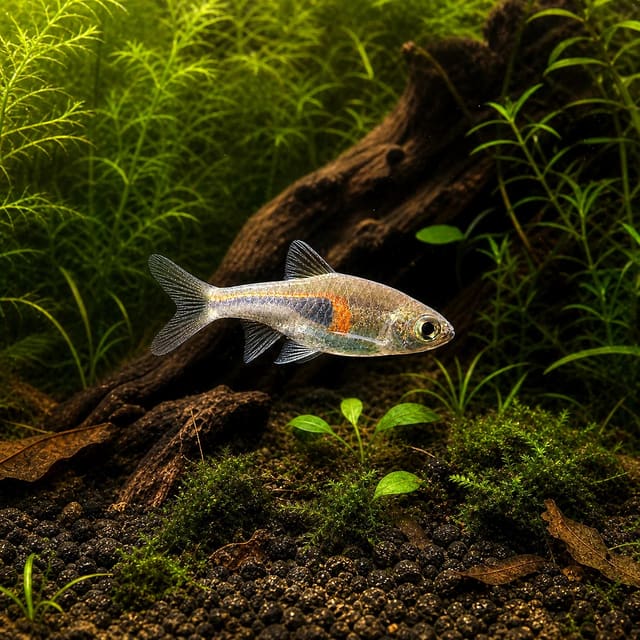
Dwarf Rasbora (Boraras maculatus)
24–26°C · pH 5–6
£4.99

Strawberry Rasbora is a tiny, social Boraras naevus for mature planted aquariums. Plan 45L+, 22-27 C and at least five; one unsexed fish per quantity.
Boraras naevus
Shoaling fish: kept in a group they feel safer, stay calmer and show their best colour.
Confirm your email, then we’ll send an availability message for this exact item if it returns within 180 days.
This request is only for this product—no newsletter or other promotions. A mail-provider retry may very rarely duplicate the same availability message. Unconfirmed addresses are removed after 48 hours. See our privacy policy.
Strawberry Rasbora is a tiny, social Boraras naevus for mature planted aquariums. Plan 45L+, 22-27 C and at least five; one unsexed fish per quantity.
Maintain these water conditions for optimal health and vibrant colors
Strawberry Rasbora (Boraras naevus) is a genuinely miniature, peaceful freshwater fish for mature planted aquariums. Its warm reddish colour, translucent fins and dark body markings reward close viewing, especially when a settled group moves between fine plants and shaded cover. This is a specialist small fish rather than a shortcut to stocking a very small tank: stable water, mature filtration, suitably tiny food and gentle companions matter more than the word "nano".
The species is best considered by aquarists who enjoy subtle behaviour and can plan around its scale. A bare, newly filled aquarium or a busy community of fast feeders will hide much of its appeal. A planted layout with protected swimming routes, quiet flow and a properly sized social group gives these little rasboras a better chance to feed confidently and display naturally.
Sale unit: one selected quantity means one unsexed fish. A gallery image showing two or three fish illustrates social context only; it is not a pair, group or quantity promise. The shoal-pricing feature may offer multi-buy pricing when several individual fish are selected, but it does not change the unit supplied. Browse the wider Boraras and rasbora collection if you are comparing group options.
| Care point | Store recommendation | Why it matters |
|---|---|---|
| Scientific name | Boraras naevus | A valid species described from peninsular Thailand, not a colour name for every small red rasbora. |
| Supplier size band | About 1.5-2 cm by trade measurement | Scientific sources use standard length and report a smaller maximum; the two measurements should not be treated as identical. |
| Temperament | Peaceful, social and easily outcompeted | Large, predatory or very fast-feeding companions can make a group hide or miss food. |
| Group | At least five; eight or more preferred where capacity allows | A social species should not be bought as a solitary display fish or assumed pair. |
| Aquarium | At least 45 litres; more space for a mixed community | Water stability, swimming footprint and refuge are more important than body length alone. |
| Temperature | 22-27 C | Choose one stable point within range and match any companion species to it. |
| Water | pH 6.5-8.0; 4-12 dGH; 3-10 dKH | Stable, dechlorinated water within a shared range is safer than chasing an extreme pH. |
| Nitrogen waste | Ammonia 0; nitrite 0 | Even a small fish needs a fully cycled, correctly maintained filter. |
| Diet | Very small omnivorous foods | Particles must fit a tiny mouth and reach the fish before quicker tank mates take them. |
| Care level | Moderate | The challenge is scale: feeding, flow, filtration safety and companion choice all need attention. |
Boraras naevus was scientifically described in 2011. The original account distinguishes it through a combination of small size, meristic characters and three body blotches. The forward blotch can differ between mature males and females, but that does not turn a photograph into a reliable sexing service. Transport colour, age, posture, lighting and artwork can all change how a mark appears on screen.
The common name refers to the warm red or strawberry-like impression a settled fish may show. Colour is not a fixed paint swatch. Newly arrived individuals can be muted, and fish kept under bright light without cover may look paler than a calm group in a mature planted aquarium. Good husbandry should be used to support natural condition, not to force a guaranteed shade.
Do not use Chili Rasbora, Phoenix Rasbora, Dwarf Rasbora or Galaxy Rasbora as interchangeable names. They refer to other aquarium fishes with their own identities and care considerations. Similar size and search results do not make them synonyms. Correct identity matters for useful care guidance, responsible breeding records and an honest purchase.
| Point to compare | What is supported | What is not promised |
|---|---|---|
| Accepted identity | Strawberry Rasbora, Boraras naevus | A generic name for any red miniature rasbora |
| Scientific scale | Type material reached 12.7 mm standard length; FishBase reports about 1.3 cm maximum standard length | That every fish will measure exactly 1.3 cm from nose to tail |
| Trade size | The supplier band is about 1.5-2 cm by commercial measurement | A guaranteed adult size, age or scientific standard-length value |
| Body pattern | The species description records three blotches and sex-related variation in the front blotch | Exact blotch shape, intensity or sex from the gallery |
| Colour | Reddish tones can strengthen when fish are settled and appropriately housed | An exact hue on arrival or a colour match to images |
| Sex | Natural sexual differences may become clearer in mature, settled fish | A selected male, female or breeding pair |
The type locality is a swamp north of Surat Thani in the lower Tapi drainage of peninsular Thailand. That geographic fact helps explain why quiet margins, plant structure and protected microhabitats are useful design references. It does not mean retail stock was collected at the type locality; no collection locality or wild provenance is supplied for these fish.
An aquarium cannot and should not copy a wild swamp literally. The useful lesson is functional: provide shelter, modest flow, small food and routes through vegetation. Fine-leaved plants, mosses, floating cover and small pieces of wood can create visual security while leaving an open area where the group can feed. The goal is a clean, oxygenated, filtered aquarium with habitat-inspired structure, not stagnant water.
Never release aquarium livestock, plants or water into a UK waterway. If a group can no longer be kept, arrange a responsible rehome through an aquatic retailer or experienced keeper. Correct disposal and rehoming protect local ecosystems as well as the animals.
Fish measurements are easy to misunderstand. Scientific standard length stops at the base of the tail fin, while retail or visual measurements may include the tail. The original description examined tiny fish up to 12.7 mm standard length, and FishBase reports a similar maximum. The supplier's 1.5-2 cm band is therefore best read as a trade size, not a contradiction and not a promise of a 2 cm standard-length adult.
This distinction has practical consequences. A miniature mouth needs finely sized food. A miniature body can pass through gaps that would be safe for a larger tetra. Filter intakes, lid openings and transfer nets all need to be checked. Body size also does not remove the need for swimming room, stable water volume or a social group.
| Your aquarium or routine | Fit | Reason |
|---|---|---|
| Mature, cycled, planted aquarium of at least 45 litres | Good starting point | Provides biological stability, refuge and room for a social group. |
| Larger calm community with very small peaceful fish | Possible after comparison | Water range, feeding speed, adult mouth size and total stocking must all overlap. |
| Newly filled aquarium | Not suitable | A clear-looking tank can still lack the bacteria needed to process ammonia and nitrite. |
| Unfiltered bowl or decorative jar | Not suitable | There is too little stable water volume, filtration capacity or social space. |
| Fast, boisterous community | Poor fit | Tiny fish can be intimidated, outcompeted or eaten even when the larger species is called peaceful. |
| Keeper able to supply measured micro-foods | Good fit | Appropriate particle size and observation at feeding time are central to long-term condition. |
| Purchase of one fish to add colour | Poor fit | This is a social species and should not be planned as a lone specimen. |
Use the tank-volume calculator with the aquarium's internal dimensions rather than the advertised external size. Substrate, hardscape and a low water line reduce real water volume. The stocking calculator can support planning, but it cannot judge temperament, food competition or whether a filter intake is safe for a fish this small.
Use at least 45 litres as the starting point for the smallest rasbora species. A longer footprint is valuable because it creates a gradient from cover to open water and gives a group choices. More volume is recommended when adding another fish species, when local tap water changes quickly, or when the aquascape displaces a large share of the nominal capacity.
A good layout combines dense refuge with unobstructed feeding space. Place fine plants or moss near the sides and rear, add floating cover where it will not block all gas exchange, and leave a calm open corridor at the front or centre. Fish should be able to retreat without disappearing permanently behind a wall of hardscape.
| Layout element | Useful choice | Common mistake |
|---|---|---|
| Filtration | Mature filter with protected intake and gentle distributed return | Strong jet or intake gaps that can trap miniature fish |
| Plants | Fine stems, moss, rooted plants and some floating shade | No refuge, or a surface completely sealed by floaters |
| Open water | A clear feeding and observation area linked to nearby cover | Filling every centimetre with decor |
| Substrate | Easy-to-clean sand or fine gravel suited to the planted design | Deep dirty pockets that are difficult to maintain |
| Wood and leaves | Small aquarium-safe pieces used sparingly | Assuming botanicals replace filtration or water changes |
| Lid | Secure cover with cable and pipe gaps checked | Open escape routes around equipment |
| Lighting | Moderate light with shaded zones and a regular schedule | Very bright, exposed lighting all day |
The conservative UK trade guidance used here is 22-27 C, pH 6.5-8.0, 4-12 dGH and 3-10 dKH. Choose a stable point within those ranges rather than repeatedly adjusting the aquarium to chase a number. Sudden chemical correction can be more stressful than steady, suitable water.
Test the tap supply as well as the aquarium. The difference helps explain whether nitrate is entering with replacement water and whether hardness changes after evaporation. Top up evaporation with an appropriate water source, but remember that a top-up does not remove dissolved waste and is not a substitute for a water change.
| Measurement | Working range or limit | Response |
|---|---|---|
| Temperature | 22-27 C | Use a reliable thermometer; avoid abrupt heating or cooling. |
| pH | 6.5-8.0 | Compare source and aquarium water before any major correction. |
| General hardness | 4-12 dGH | Confirm that every proposed companion shares a useful overlap. |
| Carbonate hardness | 3-10 dKH | Track it when assessing pH stability rather than reading pH alone. |
| Ammonia | 0 mg/l | Any detected value requires prompt investigation and safe corrective action. |
| Nitrite | 0 mg/l | Do not add fish while nitrite is detectable. |
| Nitrate | No more than 20 mg/l above the tap-water baseline | Review stocking, feeding, maintenance and replacement-water quality. |
| Flow | Gentle, with calm refuge | Diffuse the return without allowing stagnant dirty zones. |
Check your source water with the water matcher before choosing companions. The tool is a planning aid; current test results and observation of the aquarium remain essential.
A filter is essential. It provides water movement, captures debris and houses much of the biological community that converts toxic waste. For a miniature fish, the filter must also be physically safe. Fit a suitable intake guard where needed, inspect it during maintenance and make sure reducing the intake risk has not reduced circulation to the point that debris collects.
A cycled aquarium has demonstrated that it can process an appropriate waste source without measurable ammonia or nitrite. Waiting a fixed number of days is not proof. Review the fish-tank nitrogen cycle and the practical guide to aquarium filtration before adding a sensitive, very small group.
Keep some surface movement for gas exchange. A gentle current does not mean an airless aquarium. In warm weather, oxygen can become more limited, so monitor temperature, avoid overfeeding and maintain circulation. Any sudden gasping or loss of balance needs immediate investigation rather than a routine wait-and-see approach.
Keep at least five, with eight or more preferred when the aquarium's volume, footprint and filtration allow. More is not automatically better if the tank is too small or the filter cannot support the total stock. Plan the entire group before ordering so the fish are not left singly while a future purchase is postponed.
A settled group may spread out through plants and gather more closely when uncertain. Constant tight clustering can be a response to exposure or intimidation rather than proof of ideal "shoaling" behaviour. Observe how the fish feed, whether all individuals reach food, and whether larger companions control the open water.
| Observation | Possible meaning | Check next |
|---|---|---|
| Group explores and separates near cover | Fish may be settling confidently | Confirm all individuals eat and maintain condition. |
| Persistent hiding | Exposure, bright light, flow or tank-mate pressure | Review refuge, lighting, current and nearby fish behaviour. |
| One fish isolated | Stress, injury, illness or social pressure | Test water and observe breathing, posture, fins and feeding. |
| Pale colour after delivery | Transport and environmental change can mute colour | Keep conditions calm and verify water quality before intervening. |
| Fish rush food but spit it out | Particles may be too large or hard | Offer a smaller suitable food and remove leftovers. |
| All fish remain in one turbulent corner | Flow may be controlling their position | Redirect the outlet and preserve oxygenation. |
Food size is as important as food quality. Use finely crushed quality flake, true micro-granules and appropriately sized frozen or live foods. A large pellet that softens later can still leave the smallest fish hungry while it pollutes the aquarium. Watch several feeding events instead of assuming that food disappearing means every individual ate.
OATA's general rasbora guidance recommends a measured daily feed that is consumed within a few minutes. Divide or distribute the portion when dominant tank mates intercept everything. Variety can support condition, but every item must be from a safe aquarium source and small enough to swallow.
| Food | Role | Use carefully |
|---|---|---|
| Finely crushed quality flake | Convenient balanced staple | Crush consistently; remove pieces the fish cannot take. |
| Micro-granules | Measured dry-food option | Check the actual particle size rather than the word "micro" on the label. |
| Small frozen foods | Dietary variety and feeding response | Thaw and portion hygienically; do not add excess packing liquid. |
| Appropriately cultured live foods | Variety and natural foraging movement | Use trustworthy cultures and avoid introducing pests or pollutants. |
| Large flakes or pellets | Usually unsuitable without preparation | Do not assume the fish can break them apart. |
| Leftover food | No nutritional benefit | Remove it and reduce the next portion. |
Check bellies and participation, not just colour. A fish can look bright yet slowly lose condition if quicker companions take every particle. If food competition cannot be corrected through placement, particle size and stocking, the community is not a good match.
Peaceful is not the same as compatible. A larger fish can be calm and still swallow a miniature rasbora. Another tiny species can be non-aggressive but so quick at feeding that the quieter group loses condition. Compare adult size, mouth size, water range, flow preference, activity and feeding pace before purchase.
| Companion type | Assessment | Boundary |
|---|---|---|
| Same-species group | Preferred social foundation | Plan at least five and preferably eight or more where capacity permits. |
| Very small peaceful rasboras | Possible in a larger planted aquarium | Confirm identity, water overlap, total stocking and equal food access. |
| Small gentle tetras | Possible with extra room | Observe feeding speed and adult mouth size; a 45-litre minimum is not a universal community plan. |
| Adult dwarf shrimp | No blanket guarantee | Interactions vary, and shrimplets are small enough to be investigated or eaten. |
| Peaceful snails | Often lower conflict | Still account for waste, food and the species' own water requirements. |
| Bettas | Individual-risk decision, not recommended by default | Temperament, predation risk, feeding competition and water overlap must all be assessed. |
| Large, predatory or boisterous fish | Avoid | Small rasboras can be chased, excluded from food or swallowed. |
| Fin nippers or forceful feeders | Avoid | Stress may continue even without obvious injury. |
Comparison is useful when it prevents an unsuitable impulse buy. It becomes misleading when several species are presented as interchangeable red "nano fish". Browse the rasbora and danio shop, then open individual care information before deciding.
| Listing to compare | Why compare | Do not assume |
|---|---|---|
| Dwarf Rasbora | Another miniature Boraras option for a planted-aquarium shortlist | That a shared genus means identical markings, size, stock or care. |
| Phoenix Rasbora listing | Useful for checking the exact identity shown on that product page | That Chili, Phoenix and Strawberry are synonyms or safe to merge in breeding records. |
| Ember Tetra | A different small reddish schooling fish to assess for a larger calm layout | That similar colour means the same mouth size, behaviour or water preference. |
| Another Boraras naevus group | Same-species additions may support social numbers | That unverified stock has the same provenance, health status or quarantine history. |
Mixing several similar Boraras can also make identification and any later breeding records difficult. A same-species display is often clearer and lets one social group use the available space instead of dividing a small aquarium among several undersized groups.
Each quantity is one fish. Selecting six means six individual unsexed fish, subject to live stock availability; selecting one does not provide a "starter shoal" and an image of two fish does not create a pair listing. No sex, pair bond, exact colour, exact body mark or breeding readiness is guaranteed.
Where multi-buy pricing appears, it rewards a larger quantity selected through the product controls. Read the displayed basket total before checkout. The discount mechanism does not alter the care limit: buy the number the aquarium can responsibly support, not simply the point at which a lower unit price appears.
When available, the first-time buyer code WELCOME10 gives 10% off eligible orders under the published offer terms. Current promotions can be checked on special offers. Promotions do not override livestock availability, delivery restrictions or welfare-based order checks.
Complete the aquarium plan first. Confirm the true water volume, cycle evidence, temperature, pH and hardness. Check that the filter intake is safe, the lid closes around cables, and several days of suitably small food are ready. Plan the complete group and any companions rather than ordering one fish as a test.
Compare the current aquarium with the supplier trade size, not only an adult-size number. Make sure transfer containers, nets and isolation equipment are suitable for a fish around this scale. A spare mature sponge filter or other established emergency capacity can be valuable, but avoid moving wet equipment between systems without considering disease control.
Check the live stock and dispatch information shown by the storefront. Availability can change; descriptive care content is not a promise that a fish is ready to dispatch. Review the livestock delivery information before choosing a date and make sure someone can receive and assess the parcel promptly.
Prepare the destination before opening the parcel. Keep the aquarium calm, reduce bright lighting and have clean equipment ready. Follow the current instructions supplied with the order because transit duration, bag temperature and source-water difference affect the safest method. Avoid mixing bag water into the display where the instructions advise otherwise.
| Stage | Action | Avoid |
|---|---|---|
| Before delivery | Test aquarium water, confirm temperature and clear time to receive the parcel | Scheduling arrival when the box may wait unattended |
| On receipt | Inspect the outer parcel and follow the enclosed live-arrival process promptly | Discarding packaging before any required evidence is recorded |
| Acclimation | Use the current order instructions and account for the source-to-tank difference | Following a fixed timer without considering actual conditions |
| Transfer | Use clean, suitably fine equipment and provide immediate refuge | Using a coarse or contaminated net |
| First hours | Keep lighting subdued and observe breathing, balance and group behaviour | Adding food repeatedly because fish do not feed at once |
| First days | Offer tiny measured food and monitor every individual | Assuming a hidden or pale fish is simply shy without testing water |
The acclimation timer can help organise steps, while the guide to acclimating new fish explains the broader decisions. The instructions supplied with the live order take priority over generic timing.
Eligible livestock orders are covered by the published Live Arrival Guarantee terms. Coverage is conditional, so read the current process before dispatch and act within the stated evidence and contact windows if there is a problem. Keep the parcel, bags and labels until the fish have been assessed and any claim requirements are complete.
The guarantee is not a claim that transport causes no temporary stress, and it does not replace preparation of a cycled aquarium. Full conditions and the process for contacting the store are set out in the returns and live-arrival terms.
Use a repeatable maintenance rhythm. Test often enough to understand the aquarium's pattern, remove visible waste, clean accessible debris and change an appropriate amount of water without creating abrupt temperature or chemistry differences. Service filter media in removed aquarium water when needed and avoid replacing all biological media at once.
Observe the group before and during feeding. Count fish, check posture and breathing, and confirm each individual reaches appropriately sized food. A weekly glance from across the room can miss gradual weight loss in such a small species. Close observation is part of normal care, not only an emergency response.
Trim plants so refuge does not become a sealed mass with trapped waste. Keep enough open water to see the group and enough surface movement for gas exchange. Recheck the intake guard after filter cleaning because a shifted sponge or gap can turn a previously safe system into a hazard.
Pale colour alone is not a diagnosis. It can follow transport, bright light or a change of surroundings. More important warning patterns include rapid breathing, loss of balance, persistent isolation, clamped fins, obvious injury, failure to eat, progressive thinning or several fish changing behaviour together.
Test temperature, ammonia and nitrite promptly, then compare recent maintenance, additions and feeding. Avoid adding several medications without a diagnosis. If urgent husbandry correction does not explain the problem, seek advice from an aquatic veterinarian or an experienced fish-health professional and provide clear water-test results, stocking history and photographs.
The scientific description records sex-related variation in the anterior body blotch, but retail sexing from a product image is not reliable. Fish may be immature, stressed or positioned so that key details are unclear. This listing supplies unsexed individuals and does not promise a breeding pair.
Breeding miniature egg-scattering fishes is a specialist project. Adults may not protect eggs or fry, and first foods can be extremely small. A keeper who wants to breed should research a separate controlled setup, plan how to protect eggs, culture suitable first foods and maintain water quality without exposing fry to unsafe filtration. Do not buy a group on the assumption that spawning or fry survival is guaranteed.
Species-focused aquarium: start with at least 45 litres, mature gentle filtration, a secure lid, planted refuge and a same-species group of at least five. Prefer eight or more where the actual footprint, filter and maintenance plan support them. A species-focused design makes feeding and observation easier because no faster fish competes for the smallest particles.
Larger calm community: add water volume and horizontal room before considering another fish species. Choose companions only after checking adult mouth size, water range, activity and feeding speed. Introduce stocking gradually and keep the Strawberry Rasboras as a complete social group, not a token pair among larger fish.
Shrimp-planted display: do not promise that every adult shrimp or shrimplet is safe. Dense structure may provide refuge, but tiny young shrimp remain potential food and feeding interactions vary. Build the plan around the welfare of both species and accept that a fish-and-shrimp aquarium is not the same as a protected shrimp-breeding tank.
The first image is a source-derived representative group view. The other four are visual representations showing planted context, a two-fish scene, a side view and a plant-scale composition. All five are retained in their original order. They are useful for orientation, but they are not dispatch photographs and should not be used to guarantee exact anatomy or colour.
Markings differ across the gallery, which is one reason the scientific description, not artwork, guides identity. The two- and three-fish scenes do not state the sale quantity. Actual individuals vary with age, sex, condition, lighting and stress, and the fish received may not match a pictured blotch shape or red intensity.
Choose Boraras naevus for a quiet, detailed display where miniature scale is part of the appeal. The fish can bring gentle midwater movement to a carefully planted aquarium without needing a large-bodied centrepiece. Its value is most visible to a keeper prepared to sit close, watch the group settle and provide food at the right scale.
Choose another fish if the aquarium is new, under 45 litres, strongly flowing, brightly exposed or occupied by fish large enough to swallow these rasboras. Also choose another route if you need a single specimen, a guaranteed male or female, an exact colour match, or a fish that can compete with forceful feeders.
The species identity and size distinction are grounded in the original 2011 species description, the FishBase species record and the current Eschmeyer Catalog entry for Boraras. Aquarium ranges and welfare recommendations use the UK OATA rasbora care guidance. Store recommendations are deliberately conservative where a source is general to rasboras rather than exclusive to this species.
Keep at least five. Eight or more is preferred where the aquarium's real volume, footprint, filtration and total stocking allow. Do not buy one as a solitary display fish.
No. This guide uses at least 45 litres for the smallest rasbora species. The fish's short body does not remove its need for stable water, filtration, swimming room and a social group.
Use a stable temperature within 22-27 C. Choose companions that share a useful overlap and avoid abrupt changes during maintenance or acclimation.
The conservative working ranges are pH 6.5-8.0, 4-12 dGH and 3-10 dKH. Stability and accurate testing are more useful than repeatedly dosing to chase an extreme value.
Scientific records report up to about 1.3 cm standard length, which excludes the tail fin. The supplier band of about 1.5-2 cm uses a commercial measurement, so the figures describe different measuring conventions.
No. One quantity is one unsexed fish. Select the number of individual fish needed for a responsible group, subject to live stock and the aquarium's capacity.
No. Individuals are sold unsexed. Body-blotch differences can be associated with sex in mature fish, but age, condition and viewing angle prevent a reliable retail guarantee.
Offer finely crushed quality flake, suitably small micro-granules and appropriately sized frozen or live foods. Feed one measured daily portion that the group can consume within a few minutes.
They suit a prepared keeper, but their tiny size makes them less forgiving than many larger community fish. A mature cycled aquarium, safe filtration, micro-foods and careful companion choice are essential.
There is no blanket safety guarantee. Adult shrimp may coexist in some planted aquariums, but interactions vary and small shrimplets can be investigated or eaten.
Do not treat this as a default match. Individual betta temperament, predation risk, feeding competition, water overlap and available space all need assessment, and separation may be necessary.
It may be possible in a larger carefully planned aquarium, but each species still needs adequate social numbers. Mixing similar fish can also complicate identification and breeding records.
Transport, bright light and a new environment can temporarily mute colour. Keep conditions calm, test water and observe breathing and feeding; do not assume every persistent colour change is harmless.
No extreme blackwater setup is required by this guide. Provide stable water within the stated ranges, planted refuge, gentle circulation and proper filtration. Botanicals do not replace maintenance.
Yes. Use a mature filter with an intake that is safe for very small fish and a return that creates circulation without forcing the group into one corner.
Watch the entire group through several feeds. Use very small particles, distribute them where slower fish can reach them, and monitor body condition rather than assuming disappearing food reached everyone.
No. The gallery contains one source-derived representative group image and four representations. It does not guarantee exact colour, markings, sex, scale, quantity or dispatch appearance.
Prepare at least 45 litres of mature cycled aquarium space, safe gentle filtration, a secure lid, suitable test results, tiny food, a complete group plan and time to receive and acclimate the order promptly.
No reviews for this item yet. Bought one? Honest reviews only, good or bad.
What customers say about ordering from us
I have a small group of long finned mountain minnows. So was delighted to be able to order ten of this variety to increase the genetics in my tank . The ones I recieved are healthy but it’s to early to give a verdict on wether they are of a long finned type since they are small currently.
Gordon Walker · 23 Sept 2026
100% success travel and "installation". Pleased with quality of purchase. The Siamese fighter a bit "shy" so have not yet seen him at his best yet but looking good. Happy customer. GG
George E Garratt · 21 Sept 2026
Reviews of our shop, collected by Judge.me, an independent third-party review collector. Newest first.