Easy
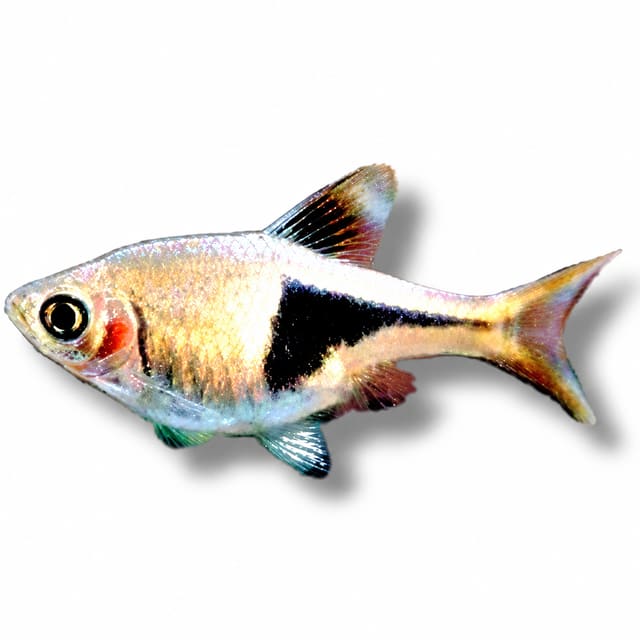
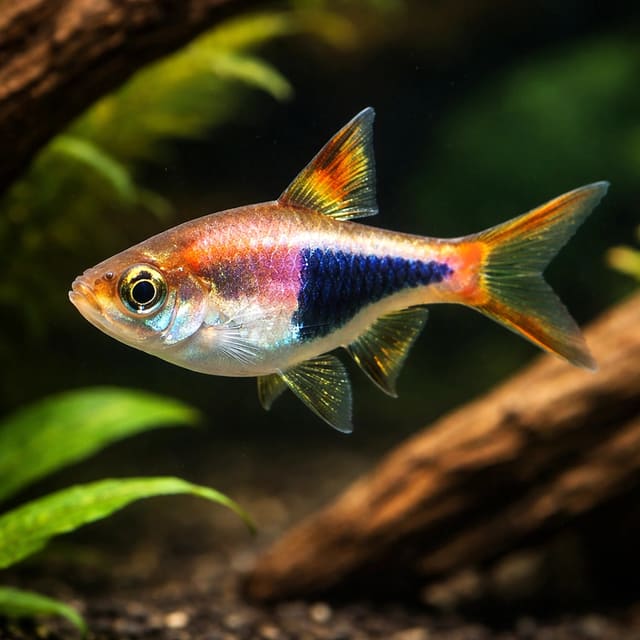
Harlequin (Rasbora heteromorpha)
21–28°C · pH 5–7.5 · 54L
£2.99

Rasbora Borapetensis, the blackline rasbora (Rasbora borapetensis), is a peaceful Southeast Asian schooling fish supplied as one animal per purchase, with 2–3 cm and 3–4 cm dispatch sizes. Plan a group of at least 8–10 in a mature, gently filtered aquarium around 60 × 38 cm or larger. Sex is not guaranteed, and FishBase records a conservative maximum of 10 cm total length.
Adult size is the maximum length this species reaches at full maturity (scientific sources). The livestock you receive will be younger and smaller — pick a size above for the actual shipping size. Product-photo provenance and any image-specific limitations are stated on the listing.
Rasbora borapetensis
Shoaling fish: kept in a group they feel safer, stay calmer and show their best colour.
Rasbora Borapetensis, the blackline rasbora (Rasbora borapetensis), is a peaceful Southeast Asian schooling fish supplied as one animal per purchase, with 2–3 cm and 3–4 cm dispatch sizes. Plan a group of at least 8–10 in a mature, gently filtered aquarium around 60 × 38 cm or larger. Sex is not guaranteed, and FishBase records a conservative maximum of 10 cm total length.
Adult size is the maximum length this species reaches at full maturity (scientific sources). The livestock you receive will be younger and smaller — pick a size above for the actual shipping size. Product-photo provenance and any image-specific limitations are stated on the listing.
Our conservative starting policy is a mature, filtered aquarium at least 60 cm long and about 60 litres, eight or more fish, and measured water screened against 22-25 °C, pH 5-7 and 5-12 dGH.
Maintain these water conditions for optimal health and vibrant colors
Rasbora Borapetensis is the trade listing for Rasbora borapetensis, also known as the blackline or red-tailed rasbora. One purchase supplies one fish in the size band chosen: 2–3 cm or 3–4 cm. The size you select is the size supplied, not the adult size. Both are genuine recurring dispatch grades, so keep both choices in the long-term plan even though stock can change independently.
Sex is guaranteed only when the selected option explicitly states male or female. This Rasbora Borapetensis listing has no sex-guaranteed option. Mature males tend to be slimmer, smaller and more intensely coloured, while mature females tend to be fuller-bodied, but those tendencies are not a safe way to promise the sex of a dispatched juvenile.
| Suits | A keeper with a mature, filtered aquarium, gentle flow, open middle-to-upper swimming room and space for a school of at least 8–10. |
|---|---|
| Water | Species-level aquarium guidance gives 22–26 °C, pH 6.0–7.5 and 2–12 dGH. Stability and a gradual match to the fish's present water matter more than chasing an edge value. |
| Temperament | Very peaceful and social. Its needs are group security, calm companions, feeding access and room to move rather than territory. |
| Feeding | A small omnivorous micropredator that accepts appropriately sized dried food and benefits from safe small live or frozen variety. |
Seriously Fish recommends a base around 60 × 38 cm, roughly 68 litres at 30 cm high, for a small group. That is a useful starting footprint rather than a stocking entitlement: a community containing several social groups, larger companions or active bottom fish needs more room and biological capacity.
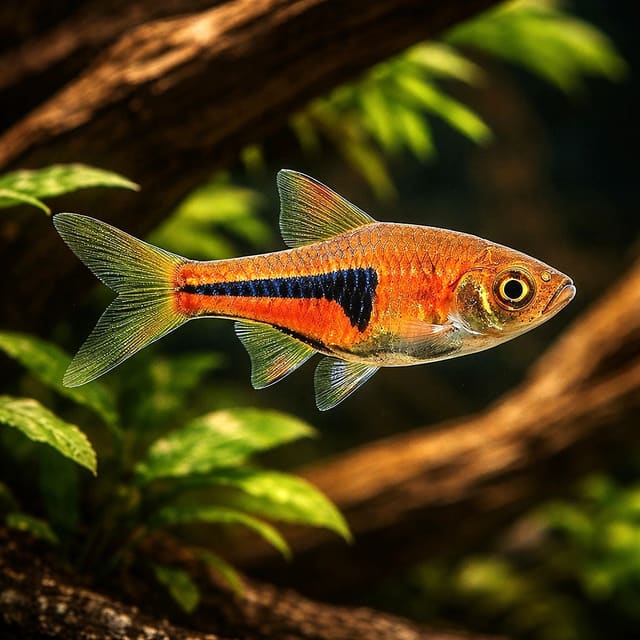
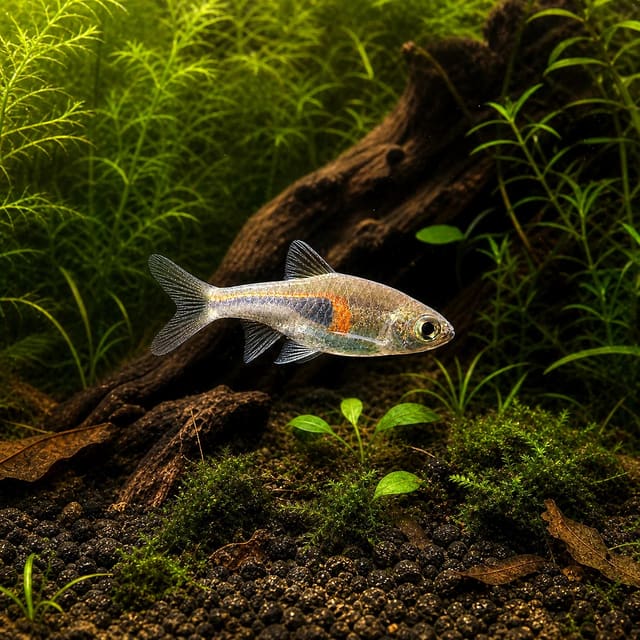
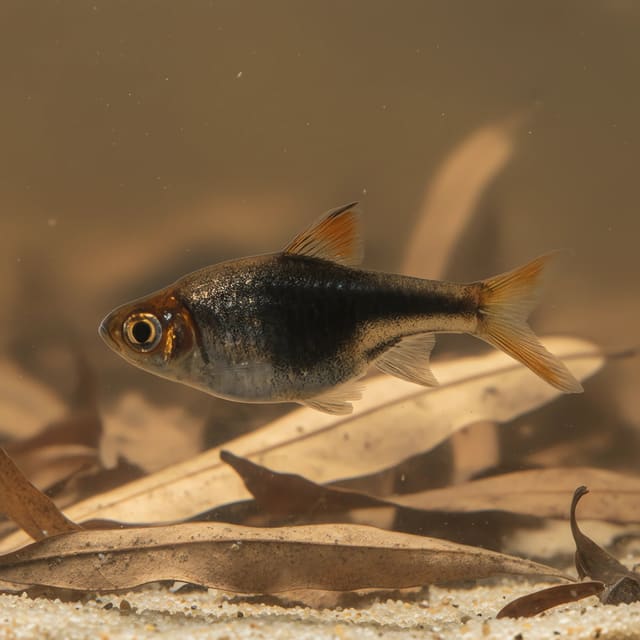
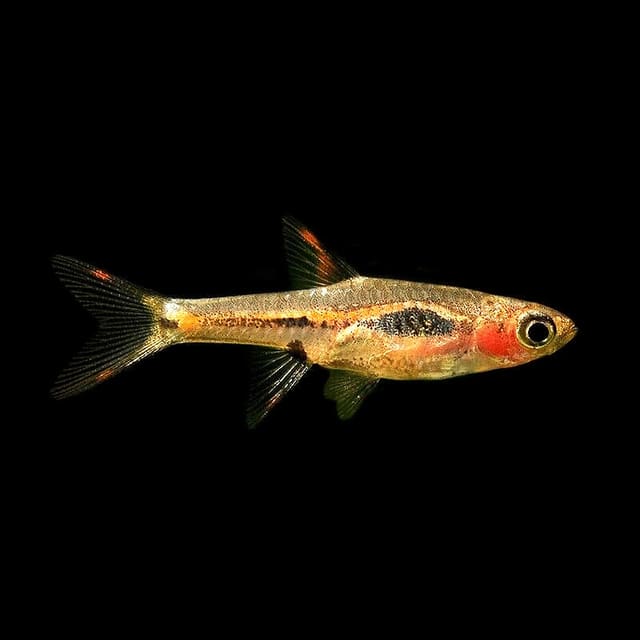
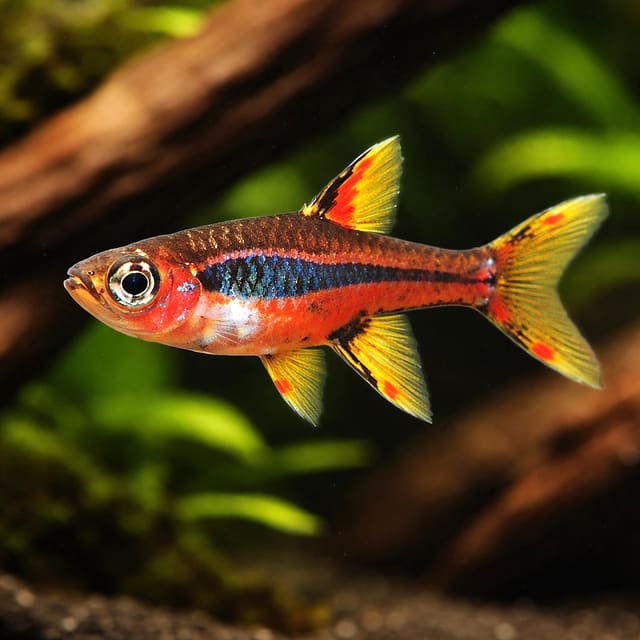
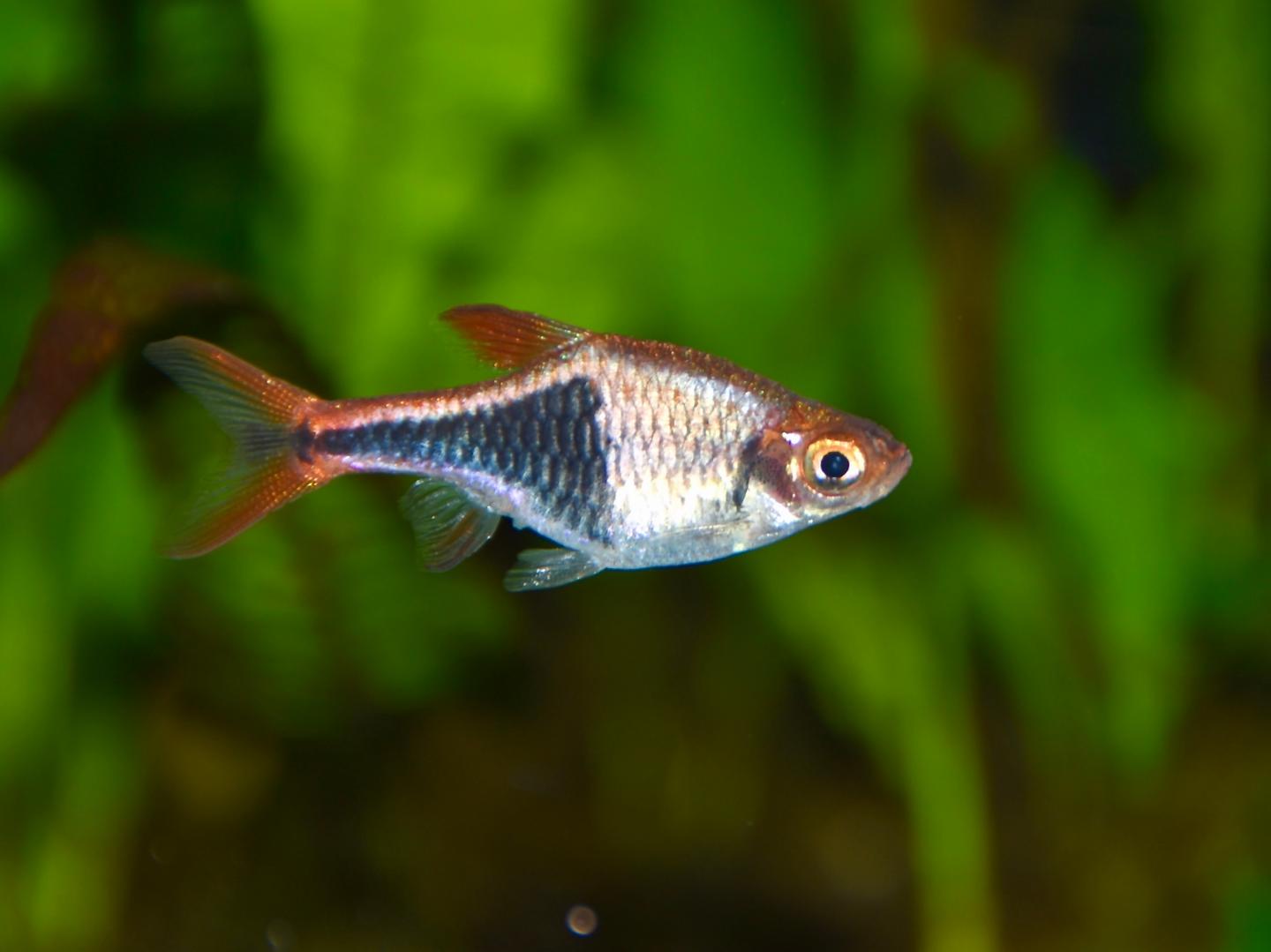
A dark stripe runs along the side and finishes near the red marking at the tail base, with a gold-toned line above it. Those features explain the blackline and red-tailed common names. They help distinguish the overall form, but they do not identify sex, exact maturity or the final colour of one dispatched fish. Light, background, condition and camera processing all change how strongly the gold and red appear.
Observe body line, fin condition, balance and breathing rather than judging health from colour intensity alone. A recently transported fish can look subdued, while a brightly lit photograph can exaggerate contrast. The most useful buying decision combines recorded species identity, the selected dispatch size and a suitable long-term aquarium.
The rasbora and danio collection can help compare other schooling offers without treating them as automatic tank mates. Choose this species for its calm, coordinated movement and care fit, not for a promise that every individual will show the same intensity of gold, black or red.
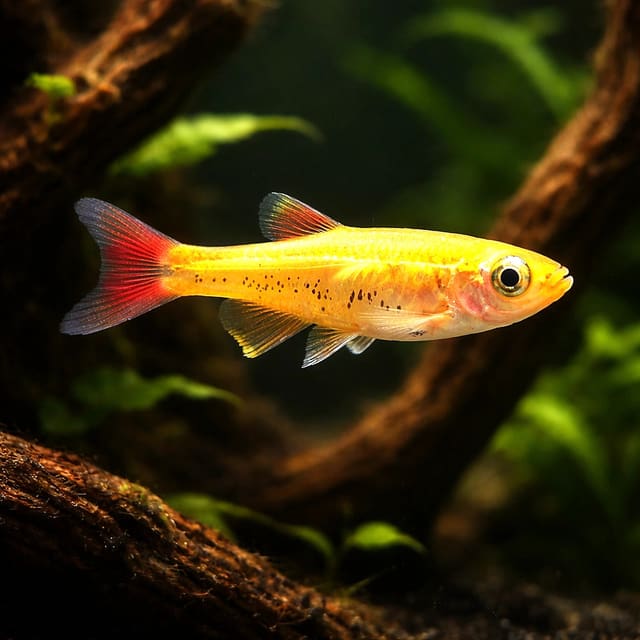
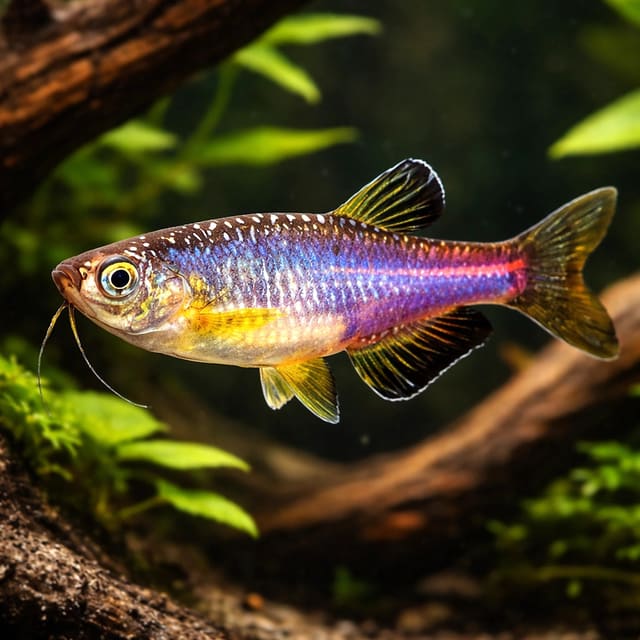
Gallery images have been digitally enhanced to improve image quality. Natural colour, pattern, size and maturity can vary between live animals.
Rasbora borapetensis belongs to Danionidae in the current FishBase record. Its range covers the Mekong, Chao Phraya and Meklong basins and extends into the northern Malay Peninsula. The familiar blackline or red-tailed appearance reflects the dark lateral stripe and red at the base of the caudal fin, but colour intensity varies with condition, maturity, lighting and individual variation.
Wild records place it in swamps, ponds, streams, drains, flooded fields, brooks and the margins of reservoirs, often in slow-flowing or somewhat turbid water from midwater to the surface. This variety argues for a calm, adaptable aquarium layout rather than an attempt to copy one photograph as the only correct habitat. Plants, branches and a darker substrate can provide security, while open lanes preserve the swimming space a school uses.
Seriously Fish gives 50 mm standard length, which measures the body to the base of the tail. FishBase records 10 cm total length for a male or unsexed fish, which includes the tail. The records differ in both value and measuring convention, so the conservative listing card uses the largest documented figure: 10 cm total length. That does not predict that every aquarium specimen will finish at exactly 10 cm.
The 2–3 cm and 3–4 cm choices are dispatch sizes. They describe what is supplied, while adult-size records guide long-term housing and companion selection. A juvenile fitting easily between decor today still needs a school and an aquarium designed around adult movement, filtration and feeding access.
Biological filtration is essential. Beneficial bacteria convert toxic ammonia through nitrite to nitrate, but the community takes time and a suitable ammonia source to establish. Confirm zero ammonia and zero nitrite with reliable tests before adding fish. A calendar alone cannot prove that a filter is ready. The first tropical aquarium guide explains the sequence for preparing and testing a new system.
Add livestock at a rate the biological filter can support. A schooling species creates an awkward choice if the aquarium is too immature for the intended group, so solve that before purchase: fish should not be left alone for weeks merely to make a weak filter's workload easier. Seed and mature sufficient filtration, verify its performance and choose an aquarium with capacity for the whole plan.
Seriously Fish gives 22–26 °C, pH 6.0–7.5 and 2–12 dGH for Rasbora borapetensis. FishBase's wild environmental record overlaps at 22–26 °C and pH 6.5–7.0, with hardness to 12 dH. Use the aquarium range as a practical screen, then ask about the fish's present holding water and make changes gradually.
OATA's broader rasbora sheet gives 22–27 °C, pH 6.5–8.0 and 4–12 dGH. That is group-level UK guidance, useful for general husbandry but not a reason to widen the exact-species card. The water chemistry guide explains pH, GH and KH, while the water matcher helps compare measured aquarium values with the stated range.
Use a thermostatically controlled heater when the room cannot hold the target throughout the year, and verify it with an independent thermometer. Test source water as well as the aquarium because UK supplies vary and can be blended. Avoid abrupt pH or hardness changes made only to reach a neat number; stability inside an appropriate range is safer than repeated large corrections.
A base around 60 × 38 cm offers a practical starting footprint for a small school. Arrange plants and wood around the sides or rear so the fish have both refuge and open middle-to-upper lanes. Floating cover can soften bright light. A darker substrate often makes the fish easier to observe without becoming a welfare requirement.
The species comes largely from sluggish water and may struggle in a fast current. Choose filtration that maintains water quality and surface movement without turning every swimming lane into a treadmill. Watch the group: fish constantly sheltering behind one object, leaning into flow or unable to feed evenly may need a revised outlet direction or gentler circulation.
Assess current by watching the fish, not by relying on the filter label. Check whether every school member can hold position and reach several feeding points without sheltering continuously. Redirect the outlet against the glass or use decor to break the strongest jet while retaining surface movement for gas exchange. Recheck after filter maintenance because restored flow can be stronger. The aim is clean, oxygenated water with quieter routes, not a motionless aquarium.
Use a secure cover, particularly around cable and filter gaps. An active small fish can jump when startled. Covering the aquarium is a simple physical safeguard; it should accompany, not replace, a calm layout and appropriate group size.
Wild stomach records describe a micropredator feeding on zooplankton, insects, worms and crustaceans. In the aquarium it accepts appropriately sized dried food, but Seriously Fish recommends that dried food is not the only offering. Use a quality small flake or micro-granule as a reliable base, with safe small live or frozen foods such as daphnia or Artemia for variety.
Scatter food across more than one point so every fish gets a chance. Watch whether particles are swallowed rather than repeatedly spat out, and check the quieter members of the school rather than judging the portion by the fastest fish. A larger food may look economical but is useless if it falls past the group or remains too big to eat.
OATA's broad rasbora sheet suggests one daily portion eaten within a few minutes. Treat that as a starting household routine. Adjust to the actual group, food density, temperature and body condition. Remove repeated leftovers before they decay, and reduce the next portion rather than relying on extra maintenance to compensate for overfeeding.
OATA recommends a partial water change of 25% at least once every week. Condition replacement tap water for chlorine or chloramine and bring it close to aquarium temperature. Siphon open areas where debris gathers while leaving the fish enough undisturbed cover.
Clean or replace different parts of a filter in stages where its design allows. A sparkling filter with most of its mature media removed can leave clear-looking water but weak biological processing. The purpose of maintenance is stable function, not making every surface look new at the same time.
Rasbora Borapetensis is social and should be kept in a group of at least 8–10 under the species profile. Secure fish may spread through the available water and tighten their formation when disturbed; the goal is not a permanently synchronised ball. Judge the group by normal feeding, steady breathing, intact fins, confident use of the aquarium and the ability of every fish to move away from pressure.
A small group, harsh light, forceful flow, predatory tank mates or poor water can keep the fish tense. Review those causes before adding more animals. Extra fish cannot repair ammonia, inadequate swimming length or an unsuitable companion.
Warning signs include surface hanging, loss of balance, clamped or damaged fins, spots, wounds, unusual swelling, isolation and loss of appetite. Test temperature, ammonia and nitrite first, then check oxygenation, flow, recent maintenance, new animals and social access to food. Similar outward signs can have different causes, so a symptom alone should not select a medication.
Use a separate mature observation aquarium and dedicated equipment where isolation is needed. Record water readings and photographs, and seek an aquatic vet or experienced professional for severe or persistent signs. Avoid combining treatments speculatively, especially in a community containing sensitive invertebrates.
On the first settled day, note where the group swims, how quickly it responds to food and whether every fish can use open water. Recheck at similar times so feeding and lighting do not create misleading comparisons. Count the school during a calm feed; a missing fish may be trapped, hiding from pressure or affected by equipment.
Look along both sides of each fish where possible. Check the body line, tail base, fins and gill movement without repeatedly chasing the group. A single fish breathing faster than the rest can point to an individual problem, while the whole school at the surface directs attention to oxygenation, temperature and water quality.
Keep a simple record of temperature and test results after arrival, after a water change and after any filter work. Patterns are easier to recognise when values and observations are written down. If one fish misses food, distribute a smaller portion across several points before assuming it is not hungry; feeding exclusion can be subtle in an otherwise peaceful community.
The species is an egg-scattering spawner with no parental care. In a mature, densely planted aquarium, small numbers of fry may sometimes appear. That possibility does not require every keeper to breed, but it does mean fine cover, filtration intakes and stocking capacity should be considered together.
Breeding projects need a separate evidence-based plan for adult conditioning, egg protection and tiny first foods. Do not turn a general product guide into a fixed hatching timetable or promise a particular yield. If fry appear unexpectedly, test water, protect them from the filter intake and provide appropriate mature accommodation rather than moving them into an uncycled container.
Seriously Fish describes Rasbora borapetensis as very peaceful and suitable for a well-furnished community. Possible companion categories include other small cyprinids, tetras, livebearers, rainbowfish, anabantoids, catfish and loaches. Each category contains animals with different adult sizes, water needs and behaviour, so the exact species still needs checking.
Start with overlapping temperature, pH and hardness. Then compare adult size, predation risk, activity, feeding speed, required group size and total footprint. A calm bottom group may use different space from the rasboras, but it still adds waste and needs its own social numbers. A surface fish may share the same water values while competing at every feed.
Large predators are unsuitable because this is a relatively small, slender fish. Persistent fin-nippers or highly boisterous feeders can also keep the school compressed into cover and prevent equal feeding. Long-finned or territorial companions need individual assessment rather than a blanket yes.
Adult shrimp may coexist in a suitable planted aquarium, but shrimplets and other tiny invertebrates can be eaten. Dense plants reduce exposure without guaranteeing survival. Snails are less likely to be treated as prey, though their mineral needs and contribution to bioload still matter.
When adding fish to an existing group, compare body condition and feeding confidence as well as length. A smaller newcomer may need food distributed more widely, while a larger individual can still be the less confident fish after transport. The two dispatch bands describe supplied size, not status within a fixed hierarchy.
Count the group during calm feeding and again after lights have been on for a while. Normal movement may make a school look smaller at a glance. Confirm that each fish can enter open water, reach food and leave another's path. Persistent isolation, rapid breathing or one fish repeatedly missing meals deserves investigation even when there is no obvious attack.
Do not solve a behaviour concern by immediately increasing numbers. Check water, flow, lighting, cover, footprint and the behaviour of every companion first. If the aquarium is already near its biological or spatial capacity, adding fish can intensify the original problem. A larger group is appropriate only when the system can support it.
Introduce livestock only when the aquarium has biological capacity for the addition. Watch the first feeds closely: a companion that looks calm between meals may still exclude smaller fish once food appears. Recheck at different times of day and provide a mature separation option for persistent chasing, predation attempts or feeding exclusion.
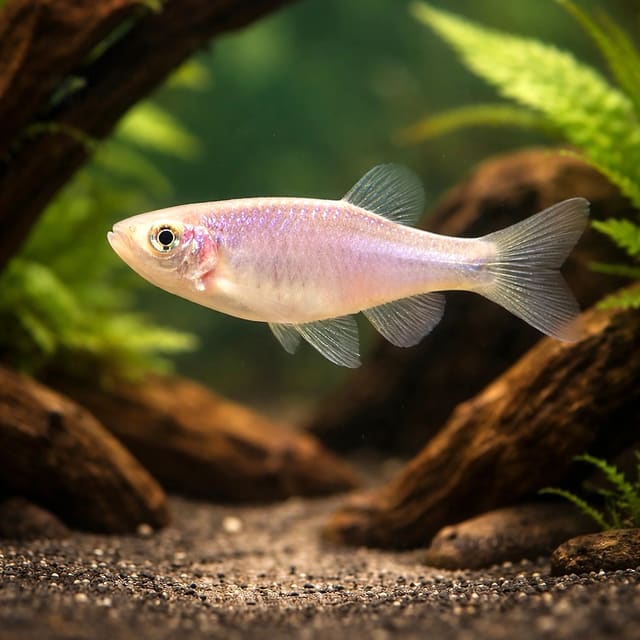
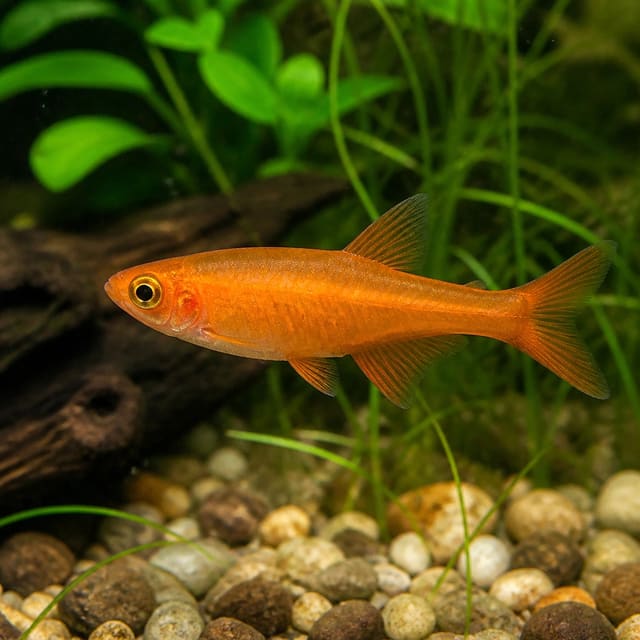
Related products in the shop are alternatives to consider, not proof of compatibility. A Harlequin or Rosy Danio offer may suit a different display goal, but neither should be added automatically beside this school. The most reliable rule is conditional: combine only calm animals that share the water range, fit the adult-size relationship, have room for all required groups and allow every fish to feed.
Confirm the aquarium is mature, the heater and filter are working, and the social group can be introduced without exceeding biological capacity. Someone must be present at the delivery address because live fish cannot be left unattended. Tropical Fish Co uses oxygenated bags, an insulated box and a heat pack when weather calls for one, with a licensed live-animal courier.
For the Live Arrival Guarantee, begin one continuous unboxing video while the parcel is still sealed. Show the outer box, the opening and the fish still inside the sealed bag before anything is disturbed. Inspect the fish on arrival and report a concern the same day with the order number and video. The current delivery and Live Arrival Guarantee policy contains the complete terms and reporting route.
Keep the bag closed until the arrival evidence and condition check are complete. Follow the supplied directions for matching the transport and aquarium water, and avoid pouring bag water into the aquarium. After introduction, observe breathing, balance, schooling and feeding without repeated netting or crowding.
Transport colour can be subdued, but pale appearance should be judged with breathing, posture, balance and fin condition rather than dismissed automatically. Retain the arrival evidence and use the same-day reporting route if something is wrong.
FishBase records a maximum of 10 cm total length, while Seriously Fish gives 5 cm standard length. Total length includes the tail and standard length stops at its base, and the records also come from different material. Use the conservative 10 cm total-length figure for long-term planning rather than treating either number as a guaranteed final size.
Seriously Fish recommends a base around 60 × 38 cm, approximately 68 litres at 30 cm high, for a small group. Treat that as a starting footprint for a species-only group. A community containing several schools, larger companions or active bottom fish needs space and filtration for every animal.
Keep at least 8–10 under the species profile. They are schooling fish, and a suitable group improves social security and display behaviour. Establish the group in a mature aquarium with enough biological capacity rather than leaving one fish isolated while a weak filter catches up.
Yes, it can suit a prepared beginner because it is peaceful and adaptable within the stated range. Success still depends on a fully cycled filter, water tests, a complete school, gentle flow and suitable companions. “Easy” is a relative store assessment, not a shortcut around those basics.
It is an omnivorous micropredator. Use an appropriately small complete flake or micro-granule as a staple and add safe small live or frozen variety such as daphnia or Artemia. Spread food so every fish receives some, and reduce portions when leftovers repeatedly reach the bottom.
Species-level aquarium guidance gives 22–26 °C, pH 6.0–7.5 and 2–12 dGH. FishBase's wild environmental record overlaps within those values. Test both source and aquarium water, keep conditions stable and make necessary changes gradually.
It is described as very peaceful. Problems are more likely when the group is too small, flow is harsh, feeding is unequal or a companion is predatory or boisterous. Watch the whole group for fin damage, persistent hiding and feeding exclusion rather than assuming a peaceful label prevents every conflict.
Seriously Fish names categories including small cyprinids, tetras, livebearers, rainbowfish, anabantoids, catfish and loaches. Choose the exact species only when temperature, chemistry, adult size, behaviour, feeding speed and total group-space needs all align. Adult shrimp may coexist, while shrimplets remain at risk.
Tropical Fish Co packs live fish in oxygenated bags inside an insulated box, using a heat pack when weather requires, and sends them with a licensed live-animal courier. Someone must receive the parcel. For the Live Arrival Guarantee, start one continuous video with the parcel still sealed, show it being opened and the fish still inside the sealed bag, then report any concern the same day with the order number.
FishBase supports the accepted species identity, Danionidae placement, distribution, wild habitat, diet and 10 cm total-length record. The Seriously Fish species profile supplies the aquarium footprint, 5 cm standard-length value, species-level water range, schooling number, diet and conditional community guidance.
OATA's rasbora care sheet provides broad UK group guidance for water, maintenance, social care and feeding; its values are labelled as group-level rather than a species-specific optimum. The RSPCA aquarium environment guidance supports the need for mature biological filtration and stable water.
No reviews for this item yet. Bought one? Honest reviews only, good or bad.
What customers say about ordering from us
I have a small group of long finned mountain minnows. So was delighted to be able to order ten of this variety to increase the genetics in my tank . The ones I recieved are healthy but it’s to early to give a verdict on wether they are of a long finned type since they are small currently.
Gordon Walker · 23 Sept 2026
100% success travel and "installation". Pleased with quality of purchase. The Siamese fighter a bit "shy" so have not yet seen him at his best yet but looking good. Happy customer. GG
George E Garratt · 21 Sept 2026
Reviews of our shop, collected by Judge.me, an independent third-party review collector. Newest first.