
Albino Senegal Bichir (Polypterus senegalus) - UK
Buy Albino Senegal Bichir for a striking, prehistoric look in your aquarium. Moderate care and UK delivery available with live arrival guarantee.
Premium Quality
Healthy, vibrant fish from trusted suppliers
Expert Care
Detailed care guides and support
Live Arrival Guarantee
Your fish arrives healthy or we'll replace it
Acclimated
Properly quarantined and ready for your tank
Why Choose This Fish?
Buy Albino Senegal Bichir for a striking, prehistoric look in your aquarium. Moderate care and UK delivery available with live arrival guarantee.
The Albino Senegal Bichir, also sold as Polypterus Senegalus “Albino”, is one of the most unusual choices in the tropical fish UK hobby. With its eel-like body, armoured scales, external nostrils, and habit of rising to the surface for air, this prehistoric predator looks more like a living fossil than a standard aquarium fish. In the right setup, this Polypterus senegalus becomes a calm but powerful display fish that can reach 25-35 cm, live for 10-20 years, and develop a confident personality that owners quickly recognise. It is a favourite among aquarists looking for rare tropical fish UK, large tropical fish UK displays, and a true conversation piece for a roomy freshwater aquarium.
If you are researching polypterus senegalus care, how to care for polypterus senegalus “albino”, or whether this is the best bichir for community tank projects, the key is understanding its size, feeding style, and need for secure cover. This is not a fish for tiny tanks or delicate nano communities, but it is an excellent choice for experienced keepers who want a hardy, air-breathing predator with fascinating behaviour. See our detailed photos showing the pale cream body, pinkish eyes, and long dorsal finlets that make the Albino Senegal Bichir stand out in any tropical fish uk freshwater collection.
🔹 Quick Facts
- Scientific Name: Polypterus senegalus
- Common Form: Albino Senegal Bichir
- Care Level: Intermediate
- Min Tank Size: 300 litres (66 gallons)
- Recommended Tank Size: 500 litres+
- Temperature: 23-28°C (73-82°F)
- pH Range: 6.2-7.8
- Hardness: 5-20 dGH
- Lifespan: Up to 20 years
- Temperament: Semi-aggressive predator
- Diet: Carnivore
- Swimming Level: Bottom to lower midwater
Classification
- Order: Polypteriformes
- Family: Polypteridae
- Genus: Polypterus
Polypterus senegalus is one of the best-known bichirs in the aquarium trade and is often recommended as the entry point into keeping polypterus bichir species. The albino form is selectively bred for its pale body and red or pink eyes. Within the hobby, it sits alongside related species such as Polypterus Senegalus - Senegal Bichir -, Polypterus Delhezi - Barred Bichir -, and Polypterus Endlicherii, each with different adult sizes, patterns, and care demands.
Where Do Albino Senegal Bichirs Come From? Natural Habitat Explained
The standard wild form of Polypterus Senegalus comes from tropical Africa, where it is found across slow rivers, floodplains, marshes, and vegetated margins. This wide distribution explains why the species is considered fairly adaptable in captivity when the basics are right. The albino form does not occur commonly in nature in the same way it does in aquariums; instead, it is a selectively maintained colour morph based on the same species. So when aquarists ask about polypterus senegalus “albino” habitat, the answer is to look at the natural environment of the normal Senegal Bichir and recreate that feel in the aquarium.
In the wild, bichirs spend much of their time near the bottom, weaving through roots, submerged branches, leaf litter, and dense marginal plants. Water is often warm, slightly stained, and not especially fast-moving. That is why the best polypterus senegalus “albino” ideal conditions usually include dimmer lighting, a soft substrate, shaded resting areas, and gentle flow rather than a high-energy river setup. They are opportunistic carnivores that feed on worms, insect larvae, crustaceans, and smaller fish, especially during lower-light periods.
Because they possess primitive lungs as well as gills, bichirs regularly rise to the surface to gulp air. This is normal behaviour, not a sign of poor oxygenation. It does mean every polypterus senegalus “albino” tank setup must leave a clear path to the surface and include a tight-fitting lid, because bichirs are strong escape artists. Many keepers searching for freshwater bichir UK stock are surprised to learn that this species can survive short periods in oxygen-poor water better than many other fish, but that should never be used as an excuse for poor maintenance.
Compared with larger species such as polypterus endlicheri or the more patterned polypterus ornatipinnis, the Senegal Bichir is often considered the smallest bichir commonly offered to hobbyists, making it a more manageable first step into bichir keeping. It still needs space, however, and should not be confused with a small community fish just because juveniles are often sold at a modest size.
💡 Expert Tip
Mimicking the natural habitat of this species improves confidence, feeding response, and long-term health. Use shaded caves, driftwood arches, and open floor space. A bichir that feels secure will spend more time visible and less time hiding all day.
How Do You Set Up the Perfect Tank for an Albino Senegal Bichir?
The most common care mistake is underestimating adult size and waste output. A juvenile may look suitable for a medium aquarium, but the correct polypterus senegalus “albino” minimum tank size is 300 litres, and the better long-term polypterus senegalus “albino” tank size is 500 litres or more, especially if you want tank mates. This species is heavy-bodied, muscular, and produces a notable bioload. Floor space matters more than height, so choose a long, wide aquarium rather than a tall narrow one.
Tank Size Requirements
For a single specimen, 300 litres is the realistic starting point. For a pair, mixed predator setup, or anyone asking how many polypterus senegalus “albino” in a tank, 500 litres+ is strongly recommended. Multiple bichirs can work, but only if the aquarium is spacious, well-structured, and each fish has room to rest without constant contact. In cramped quarters, even a normally calm bichir becomes stressed and may compete aggressively at feeding time.
Water Parameters
The ideal polypterus senegalus “albino” water parameters are stable rather than extreme. Aim for a polypterus senegalus “albino” temperature of 23-28°C, with a polypterus senegalus “albino” water temperature around 26°C for most mixed tropical setups. The suitable polypterus senegalus “albino” pH level is 6.2-7.8, with neutral around 7.0 being a safe target. For polypterus senegalus “albino” water hardness, 5-20 dGH is acceptable. Stability matters more than chasing exact numbers.
Filtration and Flow
Strong biological filtration is essential because polypterus senegalus “albino” filtration needs are higher than many fish of similar length. They are messy carnivores and leave uneaten food if meals are too large. Use oversized external filtration, maintain excellent oxygenation, and keep flow moderate to gentle. They do not appreciate being blasted constantly by powerheads. If you are planning to buy aquarium fish online uk and prepare the tank first, this is one species where filtration should be upgraded before the fish arrives, not after.
Substrate, Plants, and Decor
Fine sand or smooth rounded gravel is best. Sharp gravel can damage the belly and lower fins as the fish glides along the bottom. A thoughtful polypterus senegalus “albino” aquarium setup should include caves, bogwood, broad hiding areas, and open feeding zones. A polypterus senegalus “albino” in planted tank arrangement can work if plants are sturdy and attached to hardscape. Choose robust species and leave open space. Floating plants help reduce glare and make this nocturnal fish feel more secure.
For larger companion fish, setups often pair well with species such as Gold Giant Gourami in very spacious aquariums, though only with careful monitoring. If you prefer a bichir-only route, compare this fish with Polypterus Delhezi - Barred Bichir - or Polypterus Endlicherii before stocking.
Lighting and Security
Moderate to subdued lighting suits this species best. Bright, exposed aquariums often make them shy. Keep the lid tight with all gaps sealed around pipes and cables. This is one of the most important points in any honest polypterus senegalus “albino” care guide. Bichirs can push through surprisingly small openings, especially at night.
Quick Setup Checklist
- Tank of 300 litres minimum, 500 litres recommended for long-term comfort
- Tight-fitting lid with no escape gaps
- External filter sized for a messy carnivore
- Soft substrate and shaded hiding places
- Gentle to moderate flow
- Stable warm water at around 26°C
- Open route to the surface for air breathing
💡 Pro Tip
Always cycle the aquarium for 4-6 weeks before adding bichirs. Test ammonia and nitrite until both remain at zero. A newly set-up predator tank may look ready, but unstable water quality is a major cause of early losses.
What Do Albino Senegal Bichirs Eat? Complete Feeding Guide
The Albino Senegal Bichir is a true carnivore, so the correct polypterus senegalus “albino” diet is based on meaty foods rather than algae wafers or generic flake. In nature, polypterus senegalus feeding centres on worms, insect larvae, crustaceans, and small fish. In captivity, the best results come from a varied menu of sinking carnivore pellets, frozen foods, and occasional fresh meaty items. If you are researching a polypterus senegalus “albino” feeding guide, think high protein, moderate portions, and feeding when the fish is most active.
Staple Foods
Good staples include quality sinking predator pellets, carnivore sticks, frozen mussel, prawn pieces, lancefish, bloodworm for juveniles, and chopped earthworms. Many keepers of senegal bichir feeding routines prefer evening meals because the fish is naturally more active in lower light. Juveniles can be fed once daily; adults usually do well on 4-6 meals per week depending on body condition and tank temperature.
Supplemental Foods and Treats
Supplemental items can include krill, cockle, white fish fillet, and occasional live foods from safe sources. Variety helps avoid nutritional gaps and keeps feeding response strong. If your bichir shares space with robust tank mates such as Piaractus Brachypomus - Red-Bellied Pacu - or X Red-Bellied Pacu - Piaractus Brachypomus, target feeding with tongs can prevent food theft.
A useful comparison species if you want to see how the standard wild-coloured form differs in feeding response and display style from the albino morph.
Another bichir option for keepers building a larger predator setup and comparing appetite, patterning, and adult size.
Feeding Frequency and Portion Control
Overfeeding is common because bichirs beg convincingly. Offer only what is eaten within a few minutes. A slightly rounded belly after feeding is fine; a constantly swollen fish is not. For adults, many experienced keepers alternate richer foods with lighter meals to maintain condition without excess fat. This is especially important in warm tanks where metabolism stays high.
| Time | Food | Amount |
|---|---|---|
| Morning | Usually none for adults, or small sinking pellet feed for juveniles | Light |
| Evening | Carnivore pellets, prawn, mussel, worm, or frozen meaty mix | What is eaten in 2-3 minutes |
Foods to Avoid
Avoid mammal meat, heavily processed feeder fish, and foods that float for long periods if tank mates dominate the surface. Do not rely on live feeder fish, as they can introduce parasites and encourage poor feeding habits. Small community fish are not “clean-up crew”; they are prey. That is why this species is never suitable with guppies such as Albino Sky Blue Guppy or Red Black Guppy.
⚠️ Feeding Warning
Overfeeding causes ammonia spikes, oily surface films, and obesity. Remove uneaten food promptly, especially in warm water. A bichir can go without food for a short period far more safely than it can live in polluted water.
What Does an Albino Senegal Bichir Look Like? Colors, Patterns & Varieties
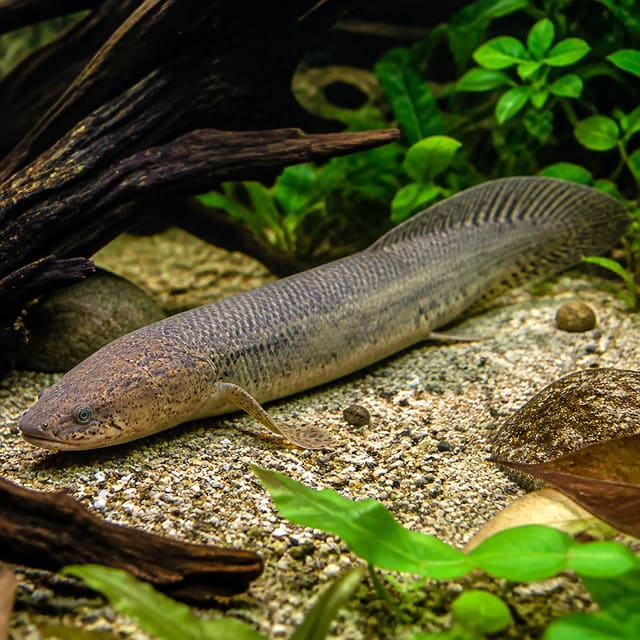
The Albino Senegal Bichir has a long cylindrical body, flattened head, thick pectoral fins used almost like limbs, and a row of separate dorsal finlets that give it a dragon-like outline. Adult polypterus senegalus “albino” size is usually 25-35 cm, though growth rate depends on diet, water quality, and tank space. The albino morph replaces the usual grey-brown body of the standard bichir de senegal with creamy white to pale yellow colouring and pink or red eyes.
Compared with the standard form, the albino tends to stand out more strongly against dark substrate and wood. This makes it especially attractive in dimly lit display tanks. If you are comparing polypterus senegalus “albino” vs senegal bichir, the body shape and care are the same; the major difference is colour. In contrast, a barred bichir such as Delhezi shows clear vertical markings, while the ornate bichir or polypterus ornatipinnis has a much bolder black-and-yellow pattern and reaches a larger, heavier build.
Sexing is subtle. In polypterus senegalus “albino” male vs female comparisons, males usually develop a broader, thicker anal fin, especially when mature, while females often appear fuller-bodied when carrying eggs. This is not always obvious in juveniles. Hobbyists also compare this species with polypterus senegalus meridionalis references online, but in the aquarium trade the key practical distinction is usually between common Senegal Bichirs and larger species such as polypterus endlicheri endlicheri.
Our photos show the pale body tone and soft blush around the eyes that make this morph so striking under warm aquarium lighting. A dark background, natural wood, and sandy base usually create the best contrast.
What Fish Can Live With an Albino Senegal Bichir? Compatibility Guide
This is one of the most searched topics for good reason. The Albino Senegal Bichir is not a relentless attacker, but it is a predator. The basic rule for polypterus senegalus “albino” tank mates is simple: if another fish can fit in its mouth, it is at risk. When people ask about polypterus senegalus “albino” with other fish or polypterus senegalus “albino” compatible fish, the safest choices are robust species too large to swallow and calm enough not to harass a slow bottom predator.
Ideal Tank Mates
Good senegal bichir tank mates include large cichlids, substantial catfish, and other bichirs of similar size. In very large aquariums, fish such as Gold Giant Gourami can work if temperaments are matched carefully. Other bichirs, including Polypterus Senegalus - Senegal Bichir -, Polypterus Delhezi - Barred Bichir -, and Polypterus Endlicherii, are often chosen by keepers building a species-focused predator tank. This is one reason many hobbyists consider Senegal forms the best bichir for community tank attempts among bichirs: they stay smaller than many relatives and are generally less aggressive than some larger species.
Species to Avoid
Avoid tiny tetras, guppies, rasboras, and slim juvenile fish of almost any kind. Also avoid very fast, frantic feeders that steal food before the bichir can locate it. Fin-nippers are a poor choice, as are hyperactive top-dwellers that create constant stress. Invertebrates are unsafe; shrimp and small snails are likely to disappear sooner or later.
Community Stocking Examples
In a 500-litre aquarium, one Albino Senegal Bichir with a few similarly sized robust fish can work well. In larger systems, a bichir group with mixed Polypterus species is possible, but size matching is important. If you are comparing polypterus senegalus “albino” vs ropefish, note that erpetoichthys calabaricus is slimmer, more delicate, and easier to outcompete at feeding time. Ropefish may coexist in some large, peaceful setups, but they require careful observation and secure lids just like bichirs.
| Species | Compatible? | Notes |
|---|---|---|
| Polypterus Senegalus - Senegal Bichir - | ✅ Yes | Very similar size and behaviour; works best in a spacious tank with multiple shelters. |
| Polypterus Delhezi - Barred Bichir - | ⚠️ Caution | Usually compatible, but monitor feeding competition and size difference. |
| Small guppies and nano fish | ❌ Avoid | Will be viewed as prey. |
A common customer question is, “Can an Albino Senegal Bichir live in a community tank?” The answer is yes, but only in a large predator or oddball community, not a standard peaceful tropical setup. Another frequent question is, “Can bichirs live together?” Yes, but monitor size, feeding, and floor space closely. A third is, “Do Senegal Bichirs eat tank mates?” If the fish is small enough to swallow, assume yes.
💡 Compatibility Tip
Always quarantine new arrivals for 2-4 weeks before adding them to a bichir tank. This reduces the risk of parasites and gives you time to see whether a new fish is too aggressive, too timid, or too small to be safe.
How Do You Breed Albino Senegal Bichirs? Complete Breeding Guide
Polypterus senegalus “albino” breeding is possible, but it is not considered easy in the average home aquarium. This is not a routine species for casual spawning projects, and most keepers should treat it as an advanced challenge. If you are wondering whether polypterus senegalus “albino” for beginners applies to breeding, the answer is no. Basic care is manageable for intermediate aquarists, but breeding requires space, mature fish, conditioning, and patience.
Breeding Setup
A dedicated breeding group needs a very large aquarium with warm, stable water, excellent filtration, and plenty of open floor space. Mature fish should be conditioned on a rich varied diet of worms, prawns, mussel, and quality carnivore pellets. The best results are usually seen when fish are kept in excellent condition over a long period rather than being pushed with sudden heavy feeding.
Spawning Behaviour
In mature pairs or groups, the male may show increased attention to the female and use his enlarged anal fin during spawning. This is one of the clearest clues in polypterus senegalus “albino” male vs female identification. Eggs are scattered among plants or fine decor. Because adults may eat eggs, they should be removed or the eggs transferred after spawning if breeding is intentional.
Egg Care and Fry Rearing
Eggs need clean, well-oxygenated water and protection from fungus. Fry are delicate and require tiny live foods at first before moving onto larger prey. Growth is steady but not instant, and young bichirs need close monitoring for uneven size. This is one reason commercial production of live polypterus senegalus “albino” UK stock is more demanding than many customers realise.
Common Challenges
The biggest obstacles are obtaining a true pair, sexing them correctly, and giving them enough room and time to mature. Questions such as “How long is the polypterus senegalus “albino” lifespan?” matter here, because these are long-lived fish that may take time to reach full breeding condition. Their polypterus senegalus “albino” behaviour can also be subtle, so many hobbyists miss courtship signs entirely.
Advanced Breeding Tip
Condition a small group rather than relying on a guessed pair. Mature males usually show a noticeably broader anal fin, but keeping multiple fish increases the chance of getting both sexes and observing natural courtship behaviour.
Albino Senegal Bichir vs Similar Species: Which Should You Choose?
Choosing the right bichir matters because different species vary hugely in size, pattern, and long-term tank demands. The Albino Senegal Bichir is often selected by aquarists who want the bichir look without jumping straight to the biggest species. If you are comparing polypterus senegalus “albino” or delhezi bichir, or polypterus senegalus “albino” vs endlicheri bichir, the most important differences are adult bulk, pattern, and space requirements.
| Feature | Albino Senegal Bichir | Delhezi Bichir |
|---|---|---|
| Max Size | 25-35 cm | Around 35-40 cm |
| Care Level | Intermediate | Intermediate |
| Temperature | 23-28°C | 24-28°C |
| Best For | First bichir, oddball predator tanks | Keepers wanting stronger patterning |
| Display Style | Pale albino morph, very visible | Striped/barred pattern |
| Feature | Albino Senegal Bichir | Endlicheri Bichir |
|---|---|---|
| Max Size | 25-35 cm | Much larger and heavier-bodied |
| Care Level | Intermediate | Advanced due to size |
| Temperament | Semi-aggressive | More imposing predator |
| Best For | Manageable bichir projects | Very large predator aquariums |
| Visual Appeal | Albino cream body | Powerful prehistoric look |
In a best bichir species comparison, the Albino Senegal Bichir usually wins for keepers wanting a manageable size, strong personality, and unusual colour morph. The polypterus endlicheri group is better for giant predator tanks, while Delhezi appeals to those who prefer a patterned fish over an albino form. If you are shopping for a bichir for sale UK listing and want a species that balances impact with practicality, the Senegal form is often the smartest choice.
Another common question is, “Is the Senegal Bichir the easiest bichir?” Among commonly available species, it is certainly one of the more forgiving. That is why many aquarists who want to buy bichir UK stock start here before progressing to larger forms.
What Are the Common Health Problems in Albino Senegal Bichirs and How Can You Prevent Them?
Good polypterus senegalus “albino” health starts with clean water, a secure environment, and appropriate food. A healthy bichir has clear eyes, intact fins, smooth skin, steady breathing, and a strong feeding response. It should be able to rest calmly, move with control, and rise to the surface for air without distress. Most polypterus senegalus “albino” diseases seen in captivity are linked to poor water quality, injuries from rough decor, stress, or parasite introduction from unquarantined fish.
Common Issues
Skin abrasions are common in tanks with sharp gravel or rough ornaments. Bacterial infections may follow if water quality slips. External parasites can appear after adding new fish without quarantine. Because bichirs are scalier and more heavily armoured than many tropical fish, some medications affect them differently, so always dose carefully and research before treatment.
Treatment and Prevention
Large regular water changes, stable temperature, and prompt removal of uneaten food solve many early problems. If treatment is needed, use a separate hospital tank when possible. Watch appetite closely; a bichir that stops feeding is often signalling stress before obvious disease appears. Keep the lid secure, because escape injuries are another real risk with this species.
⚠️ Medication Warning
Never medicate blindly. Predator fish can be sensitive to overdosing, and mixed tanks may contain species with different tolerances. If invertebrates are present elsewhere in your fish room, remember that copper-based medications are lethal to shrimp and many snails.
Quarantine Protocol
- Use a separate tank for 2-4 weeks
- Match temperature and pH to the main aquarium
- Observe feeding response daily
- Check for flashing, excess mucus, fin damage, or spots
- Perform regular partial water changes
- Only move the fish once it is feeding confidently and symptom-free
Customers often ask, “Are bichirs hardy?” Yes, compared with many oddball fish, they are robust when their environment is correct. But hardy does not mean immune to neglect. Long-term success depends on proper setup from day one.
What Is Albino Senegal Bichir Behaviour Like in the Aquarium?
Polypterus senegalus “albino” behaviour is one of the main reasons people fall in love with this fish. It is mostly crepuscular to nocturnal, meaning it becomes most active in the evening and under dim light. During the day it may rest under wood, beside rocks, or tucked into a shaded corner. At feeding time it becomes surprisingly alert, using smell and movement to locate food along the bottom.
This species is not a schooling fish, but it can coexist with others of similar size in the right aquarium. It is generally less frantic and more deliberate than many predator fish, which makes it enjoyable to watch. Owners often notice that their bichir learns the feeding routine and begins surfacing when they approach the tank.
If you are wondering whether polypterus senegalus “albino” with other fish changes its personality, the answer is yes to some extent. Confident tank mates can bring it out more often, while aggressive or hyperactive species may make it hide. To encourage natural behaviour, provide cover, feed at consistent times, and avoid harsh lighting.
Why Buy from Tropical Fish Co?
When customers look for tropical fish uk for sale, tropical fish for sale uk, or the best place to buy tropical fish online uk, they usually want more than a fish in a bag. With bichirs, condition on arrival matters. A healthy Albino Senegal Bichir should arrive alert, well-fleshed, and free from shipping damage, with clear eyes and no rubbing of the snout or flanks. We focus on that practical standard because this species is a long-term commitment, not an impulse purchase.
Each specimen is assessed for feeding response and general condition before dispatch. Because bichirs are escape-prone and sensitive to poor packing, they are bagged with care for secure transport. For customers wanting to buy live fish online uk, order tropical fish online uk, or arrange tropical fish delivery uk, insulated packaging and seasonally appropriate heat protection are especially important for this species. That same attention matters whether you are searching online tropical fish uk, tropical fish uk online, or tropical fish buy online uk.
If you are trying to buy polypterus senegalus “albino” UK, compare listings carefully. Questions like polypterus senegalus “albino” price UK, where to buy polypterus senegalus “albino” UK, and polypterus senegalus “albino” for sale UK should always be weighed against fish condition, holding standards, and aftercare support. This is a species that benefits from proper acclimation advice, especially for keepers moving from smaller community fish into oddball predators.
Whether you are buying tropical fish online uk, looking for tropical fish for sale online uk, or comparing uk tropical fish delivery options, the goal is simple: receive a strong, feeding fish that settles quickly into a prepared aquarium. Order your Albino Senegal Bichir today with confidence if your tank is fully cycled, covered, and sized for its adult needs.
Why Choose Tropical Fish Co for Albino Senegal Bichir
- Selected for alert behaviour, good body weight, and clean fins before sale
- Packed with the security and insulation needed for air-breathing oddball fish
- Supported by practical setup guidance for lids, feeding, and tank mate choices
You Might Also Like
If you are building a bichir or oddball setup, compare the Albino form with the standard Polypterus Senegalus - Senegal Bichir - for wild-type colouration. For stronger patterning, the Polypterus Delhezi - Barred Bichir - is a classic choice, while Polypterus Endlicherii suits keepers with very large predator tanks. In giant mixed aquariums, Gold Giant Gourami can be an interesting companion species with careful planning. If you are exploring larger oddball communities, Piaractus Brachypomus - Red-Bellied Pacu - and X Red-Bellied Pacu - Piaractus Brachypomus are also worth comparing for size and setup needs.
You Might Also Like


Senegal Bichir (Polypterus senegalus) - UK

Saddled Bichir (Polypterus endlicherii) - UK

Teugelsi Bichir (Polypterus teugelsi) - UK

Laprade's Bichir (Polypterus senegalus) - UK

Ropefish (Erpetoichthys calabaricus) - UK

Barred Bichir (Polypterus senegalus) - UK
Popular Right Now

Yellow Vampire Crab (Geosesarma sp.) - UK

Aulonocara sp. 'Firefish' - Tropical Fish for Sale UK

Yellow Lepturus Cichlid - UK

Apistogramma agassizii “Super Red” - UK

Endler Gold Guppy Breeding (Poecilia wingei) - UK

X Neon Green Rasbora - UK

Rasbora Heteromorpha (Trigonostigma heteromorpha) - UK