Moderate
Gombe Compressiceps Cichlid (Altolamprologus compressiceps)
24–28°C · pH 8–9 · 243L
£23.99

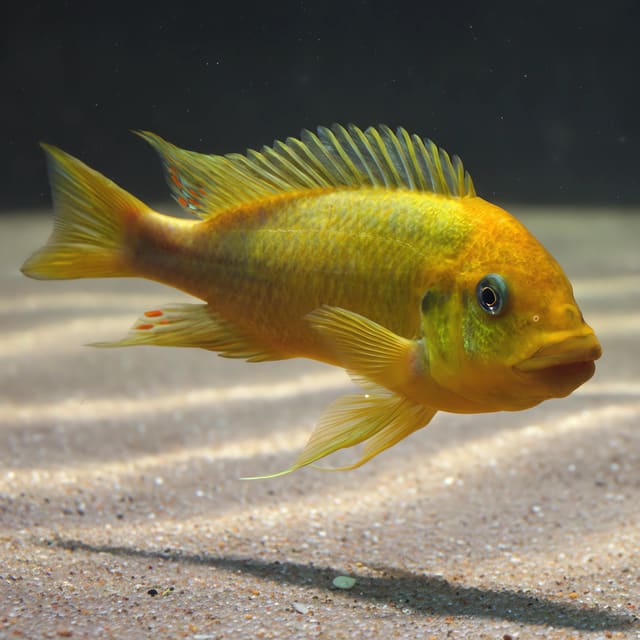
Gold Head Compressiceps is the Kantalamba form of Altolamprologus compressiceps. One quantity is one unsexed 3-4 cm juvenile for a mature hard-water Lake Tanganyika aquarium.
Altolamprologus compressiceps
Save when buying multiple fish. Each quantity is one fish; sex and pair formation are not guaranteed unless the selected variant explicitly states them.
Gold Head Compressiceps is the Kantalamba form of Altolamprologus compressiceps. One quantity is one unsexed 3-4 cm juvenile for a mature hard-water Lake Tanganyika aquarium.

Cichlids are a family of roughly 1,800 accepted species, not one care type. Before buying, identify the exact species and source, then compare adult measurement, usable tank dimensions, social system, territory, tested water, diet and an exit plan. No family-wide minimum tank, water range or tank-mate list is safe.
Maintain these water conditions for optimal health and vibrant colors
Gold Head Compressiceps is the aquarium trade name used here for the Kantalamba form of Altolamprologus compressiceps, a laterally compressed rock-dwelling cichlid from Lake Tanganyika. The warm gold across the head, upright body profile, dark vertical bars and deliberate crevice-hunting behaviour make it a distinctive fish for a mature Tanganyika aquarium. It is best suited to an aquarist who can provide hard, alkaline water, secure rockwork, a measured feeding routine and enough space to manage territorial behaviour.
What you receive: one quantity is one unsexed juvenile fish, approximately 3-4 cm at dispatch. The fish is not sold as a confirmed male, female or bonded pair. Choosing two through a pair or multi-buy offer means ordering two unsexed fish; it does not guarantee that they will form a compatible breeding pair. The aquarium and a spare separation plan should be ready before ordering more than one.
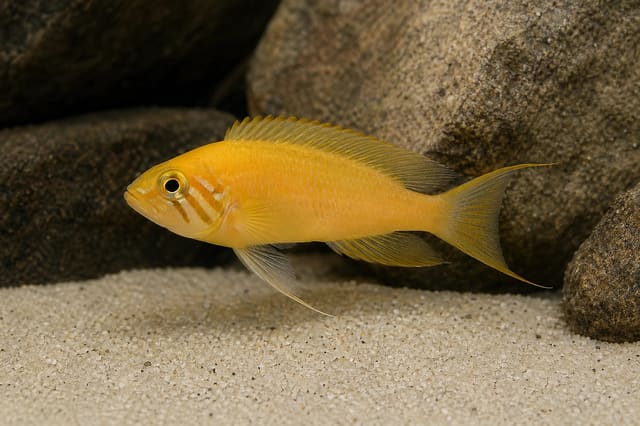
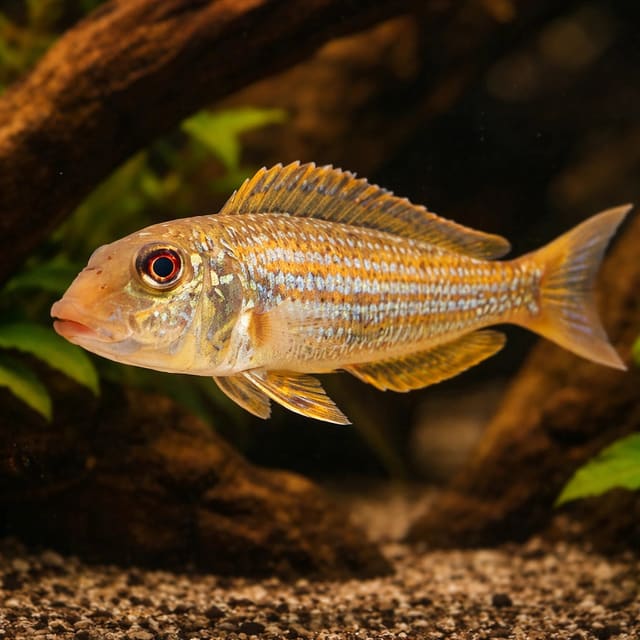
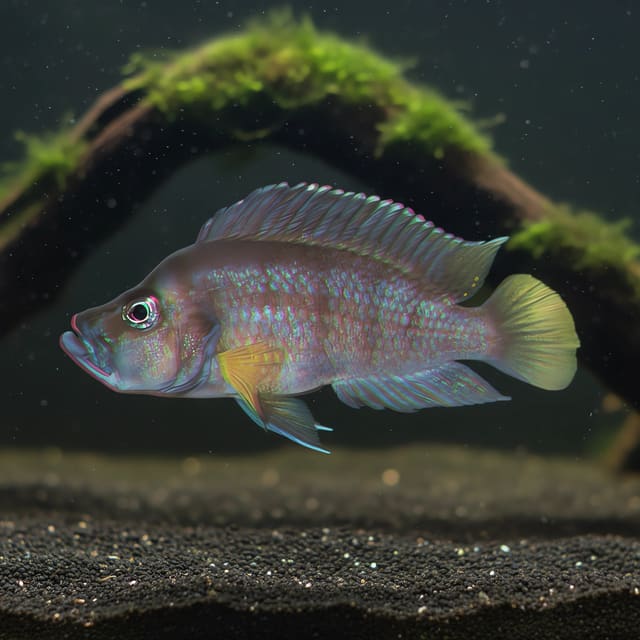
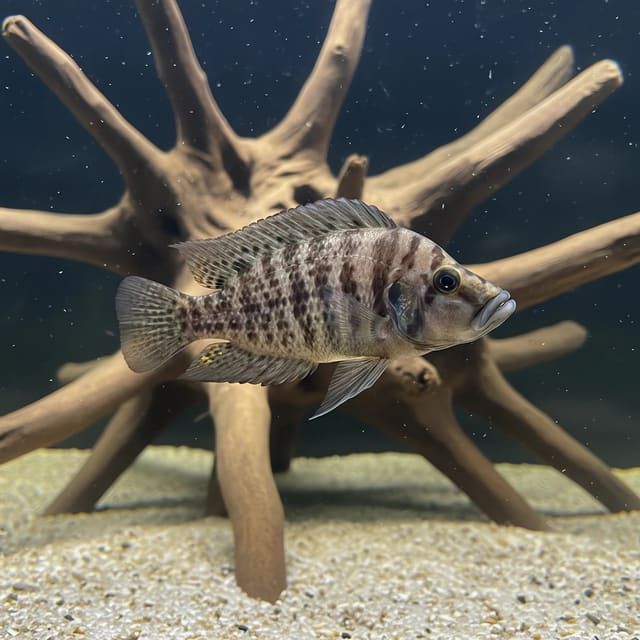
The supplier identifies this stock as Gold Head Kantalamba. That locality label is kept because it is useful trade provenance, but it should not be read as a claim that the individual fish was wild collected at Kantalamba. The photographs show the expected form rather than the exact fish that will be sent. Juveniles, recently transported fish and subordinate individuals may appear darker or less golden than a settled adult, and natural variation in bars, head colour and markings is normal.
| Scientific name | Altolamprologus compressiceps (Boulenger, 1898) |
|---|---|
| Trade label | Gold Head Kantalamba |
| What one quantity buys | One unsexed juvenile fish |
| Approximate dispatch size | 3-4 cm; live fish naturally vary slightly |
| Family and tribe | Cichlidae; Lamprologini |
| Wild distribution | Endemic to Lake Tanganyika, East Africa |
| Recorded adult size | FishBase records 12.3 cm total length; specialist locality guidance reports males around 12-15 cm and smaller females around 9 cm |
| Care level | Moderate to specialist |
| Temperament | Territorial rock cichlid and opportunistic predator; often watchful rather than constantly aggressive when correctly housed |
| Aquarium planning point | About 200 litres for an adult or compatible pair; more space and footprint for a mixed Tanganyika community |
| Temperature | 23-27°C, kept stable |
| Aquarium pH target | Approximately 7.8-9.0 in a stable Tanganyika-style setup |
| Hardness | Hard, mineral-rich water with adequate carbonate hardness |
| Diet | Carnivorous: quality cichlid pellets plus varied frozen or other suitable small meaty foods |
| Key habitat feature | Secure rocks with caves, narrow crevices, visual barriers and open sand |
Before ordering, confirm that the filter is mature, ammonia and nitrite remain at zero, mineral content is stable and the rocks cannot shift. The aquarium needs more shelters than fish plus a separation plan if more than one compressiceps is ordered. Use the Lake Tanganyika cichlid collection to compare broadly similar water requirements, then check territory, diet, adult size and swimming zone species by species.
Eschmeyer's Catalog of Fishes accepts Altolamprologus compressiceps as a valid species in the family Cichlidae. George Albert Boulenger originally described it as Lamprologus compressiceps in 1898 from Lake Tanganyika material, and the accepted combination later moved it into Altolamprologus. The species belongs to the Lamprologini, a group containing many of the lake's rock-, cave- and shell-associated cichlids.
The word compressiceps refers to the fish's compressed head and body form. Viewed from the side, the fish appears high-backed and substantial; viewed from the front, it is remarkably narrow. That shape is not merely decorative. It allows the fish to hold position beside vertical rock faces and inspect gaps that broader-bodied cichlids cannot enter easily.
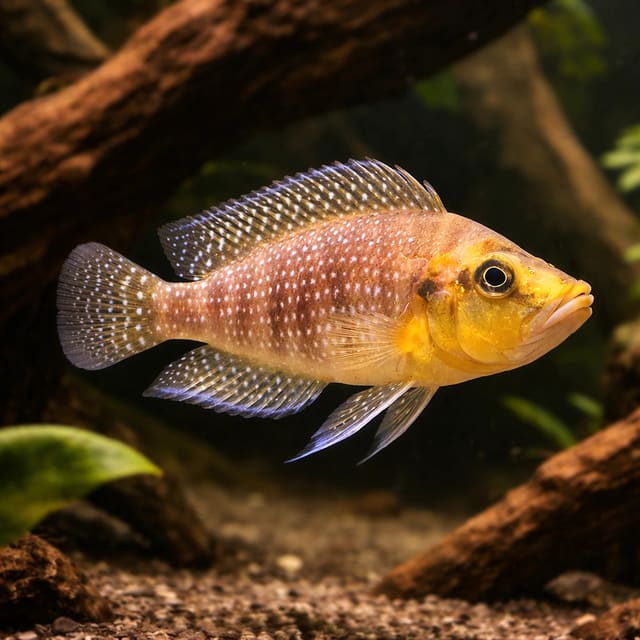
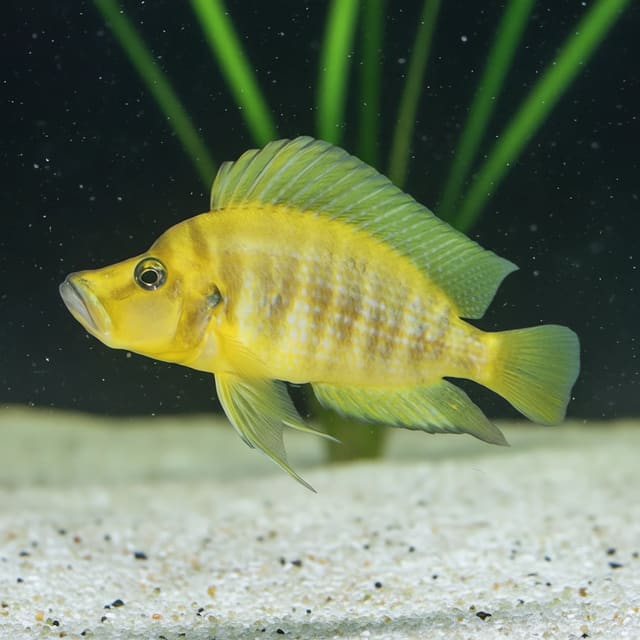
Gold Head describes the yellow to golden colour concentrated around the face and upper body. Kantalamba is the locality name supplied for this commercial form. Lake Tanganyika populations of rock-associated cichlids can differ in colour, markings and genetics, and research on A. compressiceps has found meaningful population structure. For that reason, locality labels are worth retaining in aquarium records even when the fish is captive bred or its individual collection history is unavailable.
A locality label is not the same as a separate formally described species. Gold Head Kantalamba remains Altolamprologus compressiceps. It should also not be silently relabelled as Gold Head Muzi, Kasanga, Mutondwe or another trade form simply because the fish has yellow on the head. Where locality preservation matters, keep purchase records and avoid mixing forms in a breeding project.
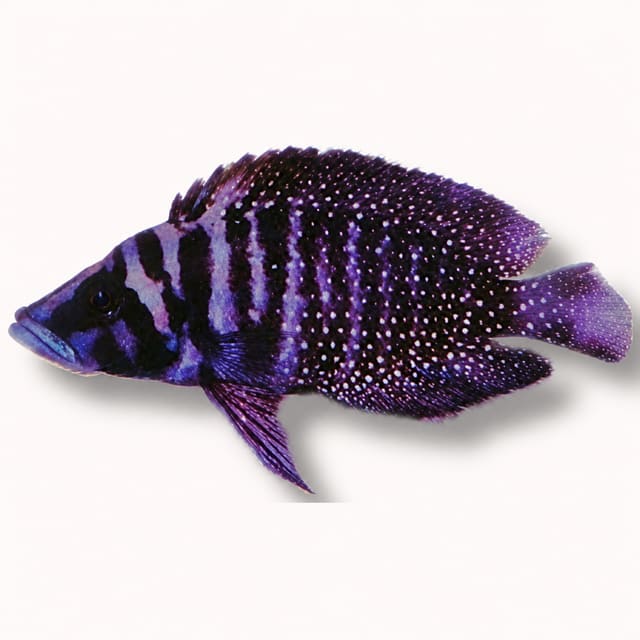
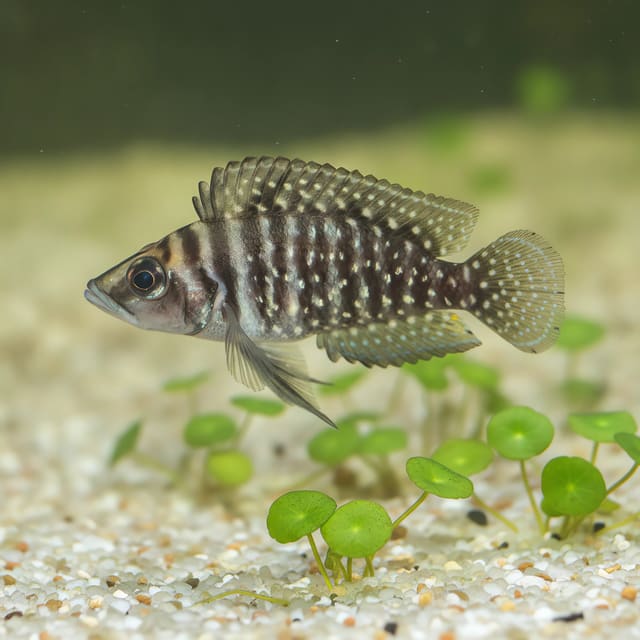
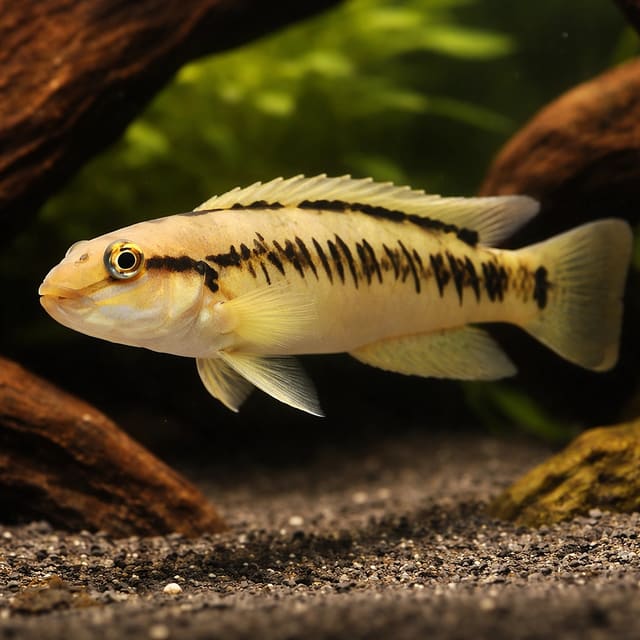
The expected profile combines a deep body, steep forehead, short upturned snout, strong lips and dark vertical bars. Mature specimens often show a more imposing head and stronger contrast than juveniles. The Kantalamba trade form is valued for warm gold around the head, but colour is responsive rather than fixed like paint. Age, sex, hierarchy, background, lighting, diet, stress and the time since transport can all alter how the same fish appears.
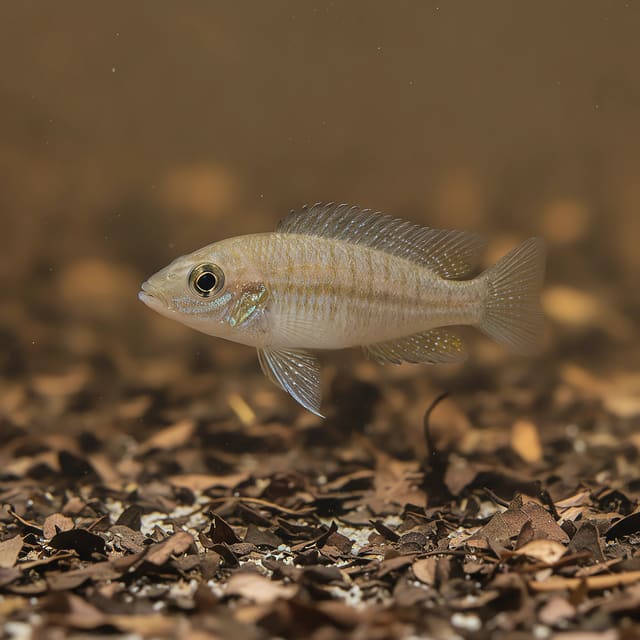
A 3-4 cm juvenile may have proportionally large eyes, a darker body and less developed gold than an adult shown in a mature display. Newly arrived fish commonly seek the darkest available retreat. Give the fish time to establish a territory before judging its final colour or behaviour. Bright lights, an exposed aquascape and constant disturbance can keep it hidden and subdued.
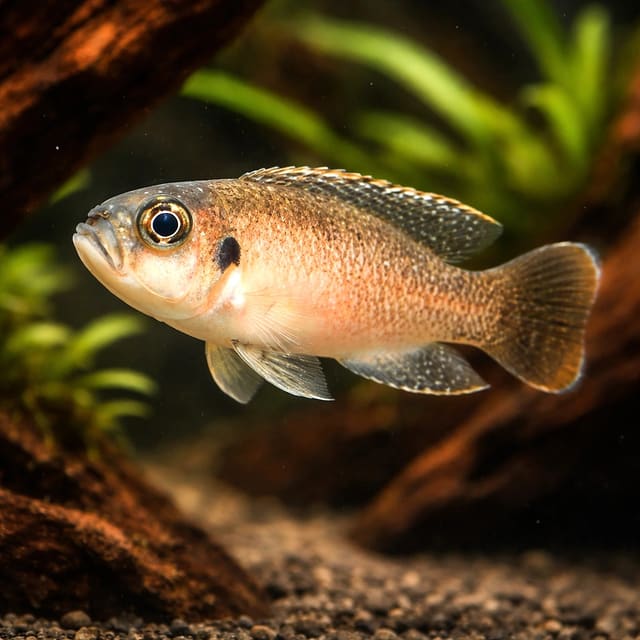
The two photographs represent the expected form rather than the exact fish sent. If identity is genuinely uncertain, check provenance and our stock records instead of assigning a locality from appearance alone.
Altolamprologus compressiceps is endemic to Lake Tanganyika. Specialist records associate it with sediment-free rocky shoreline habitat, caves and narrow crevices. Peer-reviewed population work describes it as a habitat-bound rock-dwelling cichlid. This background explains why an open aquarium with one ornamental cave does not meet the species' behavioural needs: the fish is adapted to navigate a complex three-dimensional stone environment.
The compressed body lets the fish approach prey and shelter within tight gaps. Its movement can be economical. Instead of constantly crossing the aquarium, it may hover beside rock, angle the body towards a crevice and wait. Research has described a hunting posture in which it remains nearly motionless while aiming at prey. In an aquarium, this can look like inactivity to someone expecting an open-water cichlid, but controlled hovering and careful inspection of cover are normal behaviours when breathing and body condition are healthy.
The species also has notably hard scales. A zoological study investigated whether that armour reduces damage from scale-eating cichlids in the lake. The finding is interesting natural-history context, not a reason to regard the fish as injury proof. Sharp decor, unstable stones and aggressive tank mates can still damage skin, eyes and fins.
FishBase records a maximum published size of 12.3 cm total length. A specialist Kantalamba reference reports males around 12-15 cm total length and females commonly smaller, around 9 cm. These figures are planning guides, not a promise that every fish reaches exactly the same measurement. Genetics, sex, age, nutrition and conditions affect final size, while total length includes the tail and should not be confused with standard length.
The fish sent at approximately 3-4 cm is therefore an early life-stage animal, not a permanently tiny cichlid. Growth is generally considered slow compared with many fast-growing community fish. A small juvenile may fit through narrow gaps that will not suit it later, so caves should include a range of entrances and the overall aquarium should be selected for adult size from the start.
Slow growth does not justify an undersized temporary aquarium. Territory and water-quality needs exist before full adult length is reached. Establish the final layout early, follow body condition rather than trying to force rapid growth, and avoid repeatedly netting or moving the fish.
Around 200 litres is a practical adult planning point used by specialist Kantalamba guidance. Treat this as a starting recommendation for an appropriately proportioned aquarium, not a universal biological threshold. A long, wide footprint with usable rock territories is more valuable than a tall narrow tank holding the same nominal volume. A community containing several territorial species needs more room than a carefully managed species-focused setup.
| Planned setup | Practical starting point | Main requirement |
|---|---|---|
| One established adult | About 200 litres | Several caves, visual security and reliable feeding access |
| Two fish or a compatible pair | About 200 litres or larger | Separate retreats, broken sight lines and a separation plan |
| Mixed Tanganyika community | Often 250-300 litres or larger | Distinct rock territories plus open-water space for other species |
| Juvenile group used for pair formation | Large specialist aquarium | Many shelters, close observation and spare accommodation for rejected fish |
Measure the aquarium's usable internal dimensions and account for displacement by rock, substrate and equipment. The tank volume calculator can help estimate actual water volume, while the final stocking decision should also consider floor area, rock-face length and where each species feeds.
Place the main stones on a stable base before adding loose sand around them. A fish moving substrate must not be able to undermine a heavy stack. Use aquarium-safe stone, avoid sharp unstable shards and test every structure by hand before filling the tank. Adhesive or supports may be appropriate for complex designs, but they must be aquarium safe and fully cured.
Create several caves and passages with different entrance widths. Narrow crevices provide security and are relevant to the species' natural behaviour; wider retreats allow a growing fish to turn and leave safely. Avoid a single dead-end hole where a dominant tank mate can trap another fish. Each important territory should have more than one route into open water where possible.
Break long sight lines. Two separate rock islands or an interrupted ridge can reduce the amount of time rivals remain in direct view. This is often more effective than adding one extra cave to a continuous wall. Leave enough open sand to observe the fish and remove uneaten food, and keep filter intakes accessible for maintenance.
Use a tight-fitting lid and check openings around pipes and cables. Moderate lighting and shaded sections can help a new fish settle, but the fish must remain visible enough for daily health checks.
Fine sand suits a Tanganyika-style layout and is easier for the fish to move without injury than coarse sharp gravel. Rinse it thoroughly before use and keep the layer practical rather than excessively deep. Waste can collect around the base of rocks, so use a narrow siphon and maintain accessible channels during water changes.
Plants are optional. The habitat priority is secure rock and open substrate, not dense planting. If plants are used, choose species able to tolerate hard alkaline water and protect roots or rhizomes from disturbance. Plants should not block cave entrances, reduce circulation behind the rockwork or create the false impression that a soft-water planted community is suitable.
Use a reliable heater, an independent thermometer and a filter sized for the real livestock load. Rock structures can create low-flow pockets, so adjust outlets to keep water moving without blasting every shelter and maintain oxygenation through surface movement or additional aeration where necessary.
Gold Head Compressiceps belongs in stable hard, alkaline water. For aquarium care, use approximately 23-27°C and pH 7.8-9.0 as practical targets. OATA's broader African lake cichlid guidance describes hard water around 12-18 dGH and carbonate hardness around 10-15 dKH. These are husbandry planning ranges rather than experimental tolerance limits, and local tap water should be tested rather than assumed from postcode or appearance.
| Parameter | Planning range or target | Why it matters |
|---|---|---|
| Temperature | 23-27°C | Keep daily conditions stable and avoid rapid transport-to-tank differences |
| pH | Approximately 7.8-9.0 | Provides the alkaline conditions expected in a Tanganyika-style aquarium |
| General hardness | Hard; OATA broadly guides 12-18 dGH for African lake cichlids | Reflects dissolved calcium and magnesium and affects osmotic stability |
| Carbonate hardness | Substantial buffering; OATA broadly guides 10-15 dKH | Helps resist sudden pH decline |
| Ammonia | 0 mg/L | Toxic waste that becomes more dangerous at higher pH |
| Nitrite | 0 mg/L | Toxic intermediate produced during the nitrogen cycle |
| Nitrate | Low and stable | Managed through stocking, feeding, filtration and regular partial changes |
Do not chase a chosen pH with repeated unmeasured doses. Sudden changes can be more harmful than a stable value near the appropriate range, and ammonia becomes more toxic as pH rises. If the source water is naturally soft or poorly buffered, establish a repeatable preparation method before buying the fish. Test the prepared water and the aquarium after it has aerated and reached temperature.
The water parameter matcher can screen another fish's chemistry, but it cannot assess territory, prey risk or individual behaviour.
A mature biological filter is essential. Fish waste and uneaten food produce ammonia; beneficial bacteria convert ammonia to nitrite and then to nitrate. Clear-looking water can still contain harmful dissolved waste, so visual clarity does not prove that the aquarium is cycled. Test results, stable livestock behaviour and a maintained filter provide the evidence.
Ammonia and nitrite should remain at zero. This matters especially in alkaline water because un-ionised ammonia becomes more toxic as pH rises. Do not respond to poor results only by adding chemicals while continuing to overfeed or overstock. Reduce the cause, make appropriate partial water changes with conditioned temperature-matched water, and protect the filter bacteria.
Rinse biological media gently in removed aquarium water, never replace it all at once, and clean mechanical media before flow is badly restricted. Oxygen supports the fish and filter bacteria, so maintain surface agitation and investigate rapid breathing, surface hanging or unusual crowding near an outlet.
Use a consistent routine rather than waiting for visible dirt. Test pH, ammonia, nitrite and nitrate at least weekly while a setup is new, after adding livestock or whenever behaviour changes. Once the aquarium is demonstrably stable, the exact schedule can be adapted, but important parameters should never become assumptions.
OATA notes that partial changes remove nitrate and that frequency depends on species, aquarium size and stocking. A weekly change around 20-25% is a useful starting routine for many established aquariums, but test results should set the final schedule and large chemistry or temperature swings must be avoided.
The species is a specialised carnivorous predator. Research identifies shrimp feeding in the wild, while specialist references also describe crustaceans, other invertebrates and cichlid fry as prey. In captivity, use a complete quality carnivorous cichlid pellet as the nutritional foundation and rotate suitable frozen foods for variety and feeding response.
| Food | Role | Practical use |
|---|---|---|
| Quality sinking or slow-sinking carnivore cichlid pellet | Staple | Offer a measured portion sized for the fish's mouth |
| Frozen mysis | Useful naturalistic variety | Thaw and offer in a controlled amount |
| Frozen brine shrimp | Variety and juvenile-friendly food | Useful while a small fish learns the feeding routine |
| Small krill, prawn or similar aquatic invertebrate pieces | Occasional rotation | Cut appropriately and remove uneaten pieces |
| Newly hatched Artemia | Very small fry food | Relevant to breeding, not a complete adult staple |
| Feeder fish | Not recommended | Unnecessary and may introduce parasites or poor nutrition |
| Mammal or poultry meat | Avoid | Not an appropriate routine diet for this cichlid |
Feed small portions that are consumed promptly, usually once or twice daily depending on fish size and the wider stocking plan. A newly arrived juvenile may be cautious and can lose out to fast open-water feeders. Deliver some food near its chosen rock face, then watch to confirm that it eats rather than assuming food entering the tank reaches every fish.
Overfeeding increases waste and may produce swelling, poor appetite and unstable water. A pinched belly can indicate insufficient access, stress or illness. Live feeder fish are unnecessary; secure rockwork allows natural searching and stalking while a safe prepared and frozen diet supplies nutrition.
Gold Head Compressiceps is territorial, but its aggression is often concentrated around caves, rock faces, rivals and breeding opportunities rather than expressed as nonstop open-water pursuit. A settled fish may spend long periods observing from cover. That calm appearance should not be confused with harmlessness towards tiny prey or tolerance of every other compressiceps.
Territory changes as the fish matures. A cave ignored by a 3-4 cm juvenile may become valuable later, and a previously quiet relationship can change as sex and maturity become apparent. Review the layout and behaviour over time instead of treating the first peaceful week as a permanent compatibility test.
Male-male aggression is a recognised risk. Females can also defend a cave, and two fish sold unsexed can be the same sex. Adding two at once therefore does not create a pair by default. Visual barriers and extra caves reduce pressure but cannot make an incompatible combination safe indefinitely.
Intervene if one fish is confined to a corner, repeatedly pursued, blocked from food, losing weight or sustaining fin damage. Rearranging territory may help temporarily, but separation can still be necessary.
One fish can be maintained in an appropriately planned Tanganyika setup with complex habitat. Two unsexed juveniles may form a pair, remain indifferent or become incompatible; the pair-price option is a multi-buy discount, not a sex or bond guarantee, and both fish need separate refuges.
Specialist sources describe forming pairs from a larger juvenile group in a sufficiently large aquarium. This is an advanced method. It requires much more room than an ordinary pair setup, numerous territories, close observation and another aquarium ready for fish that are excluded. It should not be simplified into a recommendation to place seven fish in a standard 200-litre tank.
Choose tank mates by adult size, water chemistry, diet, feeding speed and the part of the aquarium they occupy. A well-proportioned Tanganyika community can combine rock-dwelling and open-water species so that every fish is not competing for the same cave. No species list removes the need to observe individual behaviour.
| Potential companion | General assessment | Main consideration |
|---|---|---|
| Suitable-sized Cyprichromis | Often considered in larger communities | Uses open water, but needs enough group space and reliable feeding |
| Selected Julidochromis | Possible with careful layout | Shares hard water but also claims rock territory |
| Selected Neolamprologus | Case dependent | Adult size, cave use and breeding aggression vary widely by species |
| Other Altolamprologus forms | High planning requirement | Territorial overlap and locality mixing can create problems |
| Tropheus or other intense grazers | Usually avoided in cramped setups | Different diet, feeding pace and social pressure |
| Nano fish, small fry and ornamental shrimp | Unsuitable | May be treated as prey |
| Soft-water community fish | Unsuitable | Conflicting chemistry, habitat and often behaviour |
Open-water companions are not automatically safe if they are small enough to swallow, and another rock cichlid is not automatically compatible because it comes from the same lake. Consider how large every fish becomes, what happens during breeding, whether the aquarium contains independent territories and whether slower feeders can still eat.
For another form of the same species, compare the Mutondwe Compressiceps listing. Use the comparison to understand form and provenance, not as encouragement to mix locality variants in a breeding project. The broader Altolamprologus collection provides further context for related fish.
The 3-4 cm fish supplied is unsexed. Juvenile appearance is not a reliable basis for promising sex, and the listing does not offer a male or female choice. Adults can show a substantial size difference, with specialist locality guidance reporting larger males and smaller females, but size is useful only after fish have matured under comparable conditions.
A compatible pair is a behavioural relationship, not simply two opposite-sex fish placed together. Specialist notes describe a relatively weak pair bond outside spawning. Each adult therefore needs a refuge even after spawning has occurred. A male may occupy the wider surrounding territory while a female uses a narrow cave, but the exact relationship varies between individuals and stages of reproduction.
Pair formation takes patience. Do not force continued contact when one fish is losing weight or sustaining damage in the hope that aggression will produce a bond. A spare cycled aquarium or secure divider is an essential part of attempting a pairing, not an optional emergency purchase after injury.
Altolamprologus compressiceps is a substrate cave or crevice spawner. Specialist accounts describe the female selecting a narrow opening that she can enter but the larger male cannot. The male releases milt near the entrance while the female remains with the clutch. This breeding method is one reason secure caves of several widths are important even before the fish mature.
The relationship may become more territorial around spawning. The female can defend the immediate cave while the male patrols a larger area. Other cave-oriented fish may be driven away, and fry in the wider community remain at risk from predators. A community aquarium that appears peaceful outside breeding can change quickly.
Successful spawning is not guaranteed by purchasing two fish. They are unsexed juveniles and may not become a compatible male and female. Maturity, condition, water stability, territory and individual choice all matter. Avoid making repeated disruptive changes to force a spawn.
Prepare before the delivery day. Confirm the aquarium is cycled, the heater and filter are working, the lid is secure and several caves are available. Test temperature, pH, ammonia and nitrite rather than relying on the last test from weeks earlier. If the aquarium has recently been medicated, moved or heavily cleaned, allow it to prove stable before adding a specialist cichlid.
On arrival, follow the current acclimation instructions supplied with the order. Keep lighting low and minimise noise. Temperature equalisation and the pace of water mixing should account for the condition of the transport bag and the difference between transport and aquarium water. Do not leave a bag open for a prolonged improvised acclimation, and do not pour transport water into the display tank.
Release the fish near cover without chasing it. Hiding on the first day is expected. Offer a small amount of suitable food after it settles, remove leftovers, and closely observe breathing, balance and body condition.
Review the current Live Arrival Guarantee and delivery conditions before selecting a dispatch date. The guarantee depends on the published evidence and timing requirements; it is not a promise that every fish will display settled adult colour immediately after transport.
Quarantine is strongly recommended where practical, especially before adding a fish to an established specialist collection. A separate cycled aquarium allows observation of appetite, waste, breathing, skin and behaviour without exposing existing fish or dismantling a complex rock display. It also makes accurate feeding and treatment easier if professional advice identifies a problem.
Do not medicate automatically "just in case." Unnecessary treatment can stress fish, affect filter bacteria and make later diagnosis harder. Observe, test the water and seek knowledgeable aquatic-veterinary or specialist advice when symptoms persist or worsen. Product labels and professional instructions take priority over generic internet dosing.
Healthy behaviour includes controlled hovering, deliberate movement around rocks, interest in food, clear eyes, open fins and steady breathing appropriate to activity. A fish may spend time hidden without being unwell, especially after transport, but its pattern should gradually become predictable. Learn what is normal for the individual so meaningful change is easier to notice.
| Observation | Possible concern | First checks |
|---|---|---|
| Rapid breathing or surface hanging | Low oxygen, ammonia/nitrite, temperature stress or illness | Test water, check flow and aeration, compare other fish |
| Clamped fins, flashing or loss of balance | Irritation, water-quality problem, injury or disease | Test water and inspect skin and tank-mate behaviour |
| Persistent refusal to feed | Stress, competition, unsuitable food or illness | Confirm private feeding access, water stability and body condition |
| Pinched abdomen or weight loss | Insufficient intake, chronic stress or internal problem | Observe feeding closely and seek specialist advice |
| Torn fins or confinement to one corner | Territorial aggression | Identify the aggressor and separate before damage escalates |
| White spots, excess mucus, sores or growths | Injury, parasite or infection | Quarantine where appropriate and obtain diagnosis-led advice |
Test water whenever behaviour changes, but remember that a normal result does not rule out injury or disease. Record results and symptoms. If the fish deteriorates, persistently refuses food, breathes abnormally or develops lesions, seek aquatic-veterinary or experienced professional advice and separate it when necessary.
Altolamprologus compressiceps is often compared with Altolamprologus calvus. Both are laterally compressed rock cichlids from Lake Tanganyika and share many broad aquarium requirements. Specialist descriptions distinguish compressiceps by its shorter snout, deeper body and scales on the head, with generally stronger vertical bars and less pronounced spotting than calvus. Individual appearance varies, so identity should use provenance as well as visual characters.
| Feature | Gold Head A. compressiceps | A. calvus |
|---|---|---|
| Head and body | Deeper profile with a shorter, more upturned snout | Usually a longer sloping facial profile |
| Typical pattern emphasis | More distinct vertical bars; Gold Head form adds yellow-gold facial colour | Spotting is often more pronounced |
| Habitat use | Rock faces, caves and narrow crevices | Also a rock-associated crevice user |
| Dietary ecology | Predatory, with crustaceans and fry relevant | Predatory invertebrate and small-prey feeding |
| Identification caution | Retain the supplier locality label | Do not relabel from appearance alone |
Gold Head Muzi, Kasanga, Kantalamba and other locality names are not interchangeable marketing adjectives. They refer to fish traded from or associated with different localities or form histories. Core husbandry may overlap, but the correct label matters for records and breeding. This listing is for the supplier-designated Kantalamba form.
Gold Head Compressiceps suits an aquarist who enjoys specialised behaviour and can test water, maintain mineral stability, feed measured carnivorous foods and adjust the social plan when behaviour changes. It is not an impulse purchase for an uncycled, soft-water or nano aquarium, and the 3-4 cm dispatch size must not obscure the adult footprint and long-term commitment.
For broader planning before choosing livestock, explore the aquarium care guides and the complete freshwater fish collection. Use category browsing to compare options, then return to the exact species requirements before ordering.
One quantity is one unsexed Gold Head Compressiceps juvenile, approximately 3-4 cm at dispatch. The fish is not sold as a confirmed male, female or pair.
No. It is a multi-buy discount for two unsexed fish. Sex, compatibility and pair formation are not guaranteed, so provide separate shelters and have a separation plan.
No. It is a locality or trade form of the valid species Altolamprologus compressiceps. The Kantalamba label is retained as supplier provenance.
FishBase records 12.3 cm total length. Specialist Kantalamba guidance reports males around 12-15 cm and females commonly smaller, around 9 cm. Plan for the larger adult figure.
About 200 litres is a practical starting point for an adult or compatible pair, with a long usable footprint and secure rock territories. Mixed Tanganyika communities commonly need 250-300 litres or more, depending on species and layout.
One fish can be maintained in an appropriately planned Tanganyika aquarium. It still needs complex rockwork, stable hard water and suitable surrounding activity; it should not be kept in a bare holding tank.
Two unsexed juveniles may become compatible or may not. Give each fish its own retreats, monitor feeding and aggression, and be ready to separate them. Purchasing two is not proof of a pair.
No reliable safety should be expected. The species is a crustacean and small-prey predator, so ornamental shrimp, fry and nano fish may be eaten.
Appropriately sized Tanganyika cichlids that share hard alkaline water may work in a spacious structured setup. Open-water Cyprichromis and selected Julidochromis or Neolamprologus are often considered, but compatibility depends on the exact species and aquarium.
Use a complete carnivorous cichlid pellet as the staple, with frozen mysis, brine shrimp and other suitable small aquatic invertebrate foods for variety. Avoid feeder fish and routine mammal or poultry meat.
Age, transport stress, hierarchy, background and lighting can all suppress colour. A 3-4 cm juvenile is also less developed than an adult. Stable water and secure cover allow the expected pattern to emerge naturally.
Yes. Maintain stable hard, alkaline Tanganyika-style water, approximately pH 7.8-9.0, and test both general and carbonate hardness. Do not create sudden changes by dosing to chase a number.
No. A balanced prepared carnivore diet and suitable frozen foods can support normal feeding. Live feeder fish are unnecessary and can introduce disease or nutritional problems.
It is territorial and predatory, particularly around caves and towards rivals, but often behaves in a watchful, measured way when correctly housed. Calm behaviour does not make tiny tank mates safe.
The supplied juvenile is unsexed. Adult males are often larger than females, but juvenile appearance does not support a reliable sex guarantee. A true compatible pair is established through behaviour, not size alone.
It is a cave or crevice substrate spawner. A female uses a tight shelter while the male fertilises near the entrance. Purchasing two juveniles does not guarantee a male, female or successful pair.
No. They are related species with similar rock-associated habits. Compressiceps generally has a deeper profile, shorter snout and stronger bar emphasis, while calvus often shows a longer face and more spotting.
Yes, when the current Tropical Fish Co delivery, timing and evidence conditions are followed. Read the linked delivery information before choosing a dispatch date.
This listing uses our stock records for the exact 3-4 cm sold form and sale unit; Eschmeyer's Catalog of Fishes for accepted identity and distribution; FishBase for the recorded maximum total length; peer-reviewed research for rock-associated population structure, shrimp-feeding ecology, hunting posture and scale morphology; specialist Lake Tanganyika references for Kantalamba identification, aquarium layout, social behaviour and breeding; and OATA guidance for hard-water planning, biological filtration and water-quality monitoring.
Natural-history evidence, aquarium husbandry guidance and supplier provenance answer different questions. Where sources differ, the guide separates the published species record from practical aquarium targets and labels uncertainty instead of presenting one number as universal. The sold fish remains an unsexed juvenile with natural variation, and no source can guarantee an individual adult size, sex, colour, temperament or pair bond.
No reviews for this item yet. Bought one? Honest reviews only, good or bad.
What customers say about ordering from us
I have a small group of long finned mountain minnows. So was delighted to be able to order ten of this variety to increase the genetics in my tank . The ones I recieved are healthy but it’s to early to give a verdict on wether they are of a long finned type since they are small currently.
Gordon Walker · 23 Sept 2026
100% success travel and "installation". Pleased with quality of purchase. The Siamese fighter a bit "shy" so have not yet seen him at his best yet but looking good. Happy customer. GG
George E Garratt · 21 Sept 2026
Reviews of our shop, collected by Judge.me, an independent third-party review collector. Newest first.