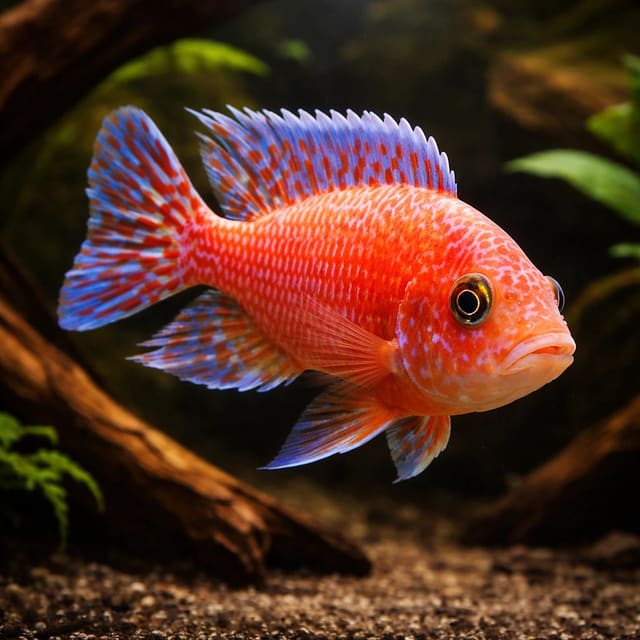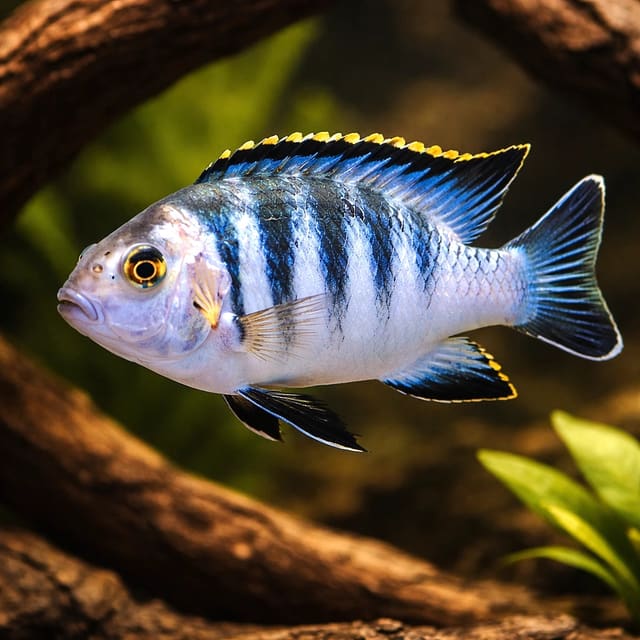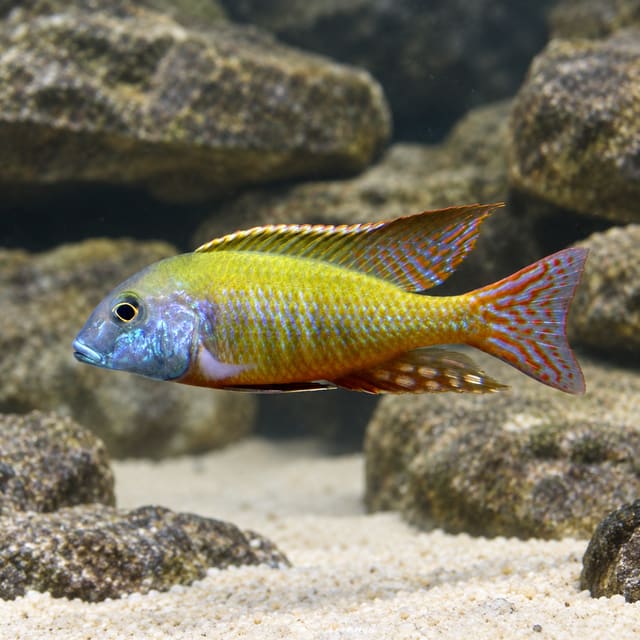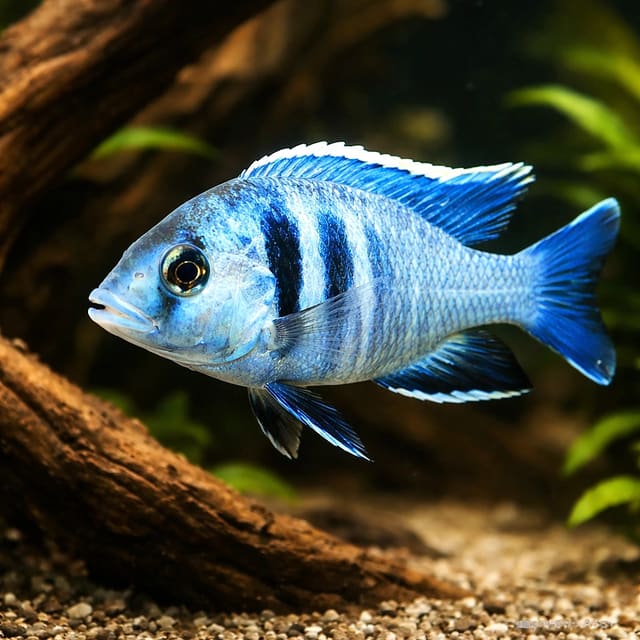
Moderate
Acei Cichlid (Pseudotropheus sp. 'Acei')
24–26°C · pH 7.5–8.5 · 300L
£7.99
Photo coming soon
The size, price and care details on this page are for this listing.
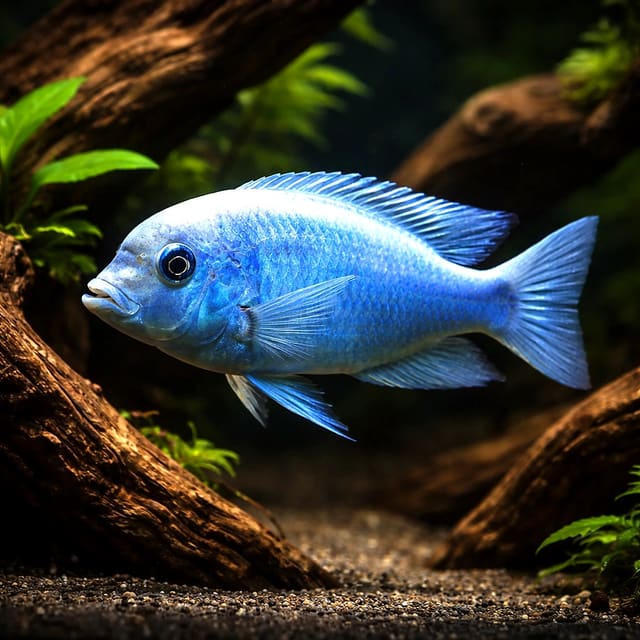
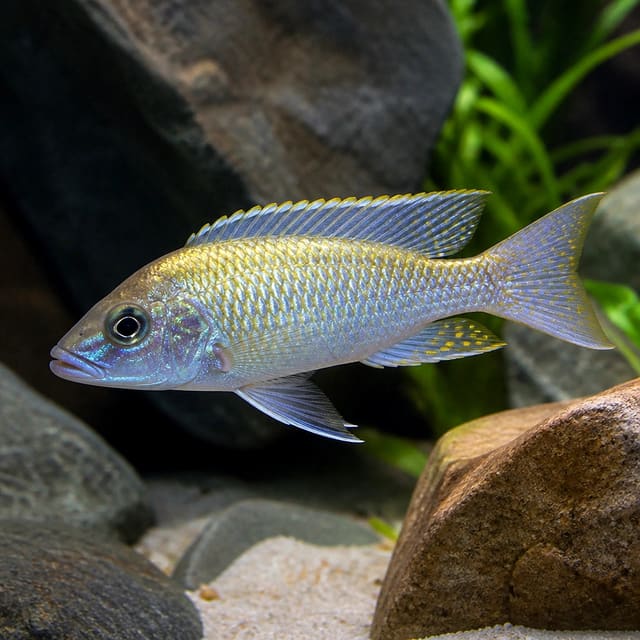
The Gold Electra Deep-Water Hap (Cyrtocara electra) is a Lake Malawi cichlid that reaches a recorded maximum of 12 cm standard length. It suits a planned peaceful Malawi aquarium kept at the FishBase, Seriously Fish and OATA overlap of 24–26°C, pH 8.0 and 12–18 dGH, with several females per male in a mixed-sex group. Sold individually as one live fish.
Adult size is the maximum length this species reaches at full maturity (scientific sources). The livestock you receive will be younger and smaller. Product-photo provenance and any image-specific limitations are stated on the listing.
Cyrtocara electra
Save when buying multiple fish. Each quantity is one fish; sex and pair formation are not guaranteed unless the selected variant explicitly states them.
The Gold Electra Deep-Water Hap (Cyrtocara electra) is a Lake Malawi cichlid that reaches a recorded maximum of 12 cm standard length. It suits a planned peaceful Malawi aquarium kept at the FishBase, Seriously Fish and OATA overlap of 24–26°C, pH 8.0 and 12–18 dGH, with several females per male in a mixed-sex group. Sold individually as one live fish.
Adult size is the maximum length this species reaches at full maturity (scientific sources). The livestock you receive will be younger and smaller. Product-photo provenance and any image-specific limitations are stated on the listing.
Cichlids are a family of roughly 1,800 accepted species, not one care type. Before buying, identify the exact species and source, then compare adult measurement, usable tank dimensions, social system, territory, tested water, diet and an exit plan. No family-wide minimum tank, water range or tank-mate list is safe.
Maintain these water conditions for optimal health and vibrant colors
The Gold Electra Deep-Water Hap (Cyrtocara electra) is a freshwater cichlid from Lake Malawi in Africa. It is endemic to the lake, with occurrence around Likoma Island, and FishBase records a maximum of 12 cm standard length. This fish suits a keeper prepared to maintain hard, alkaline water, a sandy aquarium with open floor space and a carefully selected peaceful Malawi community.
FishBase now lists it as Placidochromis electra, with Cyrtocara electra treated as a synonym. The Deep-water hap name comes from an earlier belief that it lived only in much deeper water than it is now known to inhabit. Wild fish are commonly found over sand and may be seen in shallower water, but prefer a depth of 7 m, and feed by collecting stirred-up material such as invertebrates and algae.
| Suits | Not suited to |
|---|---|
| A peaceful Lake Malawi aquarium | The hurly-burly of a mbuna community |
| Hard, alkaline water maintained at pH 8.0 | A soft, acidic general community |
| A sandy base with open feeding and swimming areas | A cramped layout filled entirely with rock |
| A base measuring 120 × 45 cm and a volume around 205 litres | An aquarium chosen around the fish's dispatch size |
| Carefully screened Aulonocara, Copadichromis and other peaceful Malawi species | Another colour form of Placidochromis electra |
This is a very gentle hap rather than a fish to add simply because another cichlid also comes from Lake Malawi. Choose the surrounding community by temperament, water requirements and adult space needs. If you are comparing it with other focal animals, browse the centrepiece fish collection, then screen every proposed combination before deciding.
One purchase supplies one live fish. The dispatch grade associated with this offer is 4–5 cm, which describes the fish at dispatch rather than its eventual adult length. Plan the aquarium, filtration and community around the adult fish from the beginning; a smaller individual does not make a smaller permanent aquarium suitable.
Sex is guaranteed only when the selected option explicitly states male or female. This Gold Electra Deep-Water Hap listing has no sex-guaranteed option.
FishBase records a maximum of 12 cm standard length for this species. Seriously Fish recommends a 120 × 45 cm aquarium base and a volume around 205 litres. Keep that footprint when planning: floor area matters because the fish lives and feeds close to sandy substrate, and the open sections must remain usable after rocks, caves and equipment have been installed.
A 120 × 45 cm base gives a concrete way to assess shape as well as nominal volume. A tall aquarium with much less floor area is not equivalent merely because its litre figure is similar. Start with the required base, preserve open sand between rock structures and choose an aquarium of around 205 litres, the volume Seriously Fish gives for a 120 × 45 × 38 cm tank.
Do not assume the sex of a young fish from its colour or size. Seriously Fish notes that males grow larger and are much more colourful than females, while OATA explains that many Malawi cichlids only show differences between the sexes once they become adults, not as juveniles. Build any intended sex ratio from fish that have been identified reliably rather than from an early visual assumption.
Use a sandy substrate and leave broad open areas between groups of rocks. Seriously Fish describes sand as essential for this species and recommends piles of rock arranged into caves and hiding places without filling the whole floor. That layout reflects how the fish feeds over substrate while still giving it caves and hiding places.
Start with an aquarium base of 120 × 45 cm and a volume around 205 litres. Place the larger rock structures before finalising the open areas, then look at the aquarium from end to end: the fish should be able to cross open sand without every route narrowing into a single passage.
| Zone | Purpose |
|---|---|
| Open sand | Allows natural substrate-focused feeding and preserves clear swimming room |
| Rock piles | Create caves and hiding places |
| Filter outlet area | Keeps circulation unobstructed across the aquarium |
| Maintenance access | Leaves substrate reachable with a siphon during weekly care |
Plants are not necessary, although Seriously Fish says this species leaves them alone. OATA warns that Malawi cichlids will often dig and rearrange the substrate, which will uproot any plants present, so use only the hardiest plants that grow attached rather than rooted in the sand. Do not sacrifice open sand merely to create a densely planted appearance.
Prepare and mature the aquarium before livestock enters it. The biological filter must already be able to process waste, with ammonia and nitrite both reading zero. Our first tropical aquarium guide explains how to establish the system before the fish arrives. Increase the aquarium population gradually because the beneficial bacterial population must respond whenever fish numbers and feeding increase.
Inspect the finished layout as a working environment rather than a decoration. Confirm that rocks cannot shift when the substrate is disturbed, open sand remains accessible, equipment can be serviced and no planned companion will remove the retreats this gentle species needs. Make those decisions before filling the aquarium with a full community.
Keep the aquarium at 24–26°C, pH 8.0 and 12–18 dGH. These routine values are the overlap of FishBase's recorded environment, Seriously Fish species guidance and OATA's Malawi cichlid group guidance. OATA also gives a carbonate hardness of 10–15 dKH for the group. The overlap keeps the aquarium inside every named temperature, pH and general-hardness range.
Measure the aquarium rather than relying on labels such as hard, alkaline or Lake Malawi water. Temperature, pH, general hardness and carbonate hardness answer different questions: the thermometer confirms heat, pH shows acidity or alkalinity, general hardness reflects dissolved minerals, and carbonate hardness helps describe buffering. Use the water chemistry guide to understand those measurements and the water matcher to compare your results with the target values.
| Measurement | Instruction |
|---|---|
| Temperature | Maintain 24–26°C |
| pH | Maintain pH 8.0 |
| General hardness | Maintain 12–18 dGH |
| Carbonate hardness | Use OATA's 10–15 dKH Malawi guidance |
| Ammonia | Keep at 0 mg/l |
| Nitrite | Keep at 0 mg/l |
| Nitrate | Do not exceed 20 mg/l above the normal tap-water level |
OATA says a Malawi cichlid aquarium should have coral sand or a similar substrate to buffer the water. This can also satisfy the need for a sandy floor, but it does not replace testing. Check the water that enters the aquarium as well as the water already inside it, especially when the normal tap-water chemistry changes or a maintenance routine is adjusted.
Do not chase a pH number through abrupt additions. Prepare replacement water with tap-water conditioner, measure it and keep routine changes consistent. The larger planned aquarium helps environmental conditions remain more stable, but volume does not remove the need for regular measurements. A stable reading inside the target is the objective at every routine check.
Run a well-established biological filter continuously. The RSPCA explains that fish release toxic ammonia and that beneficial bacteria in a working filter convert it first to nitrite and then to the safer nitrate. A filter is therefore life-support equipment, not simply a way to make the water look clear.
For an aquarium around 205 litres, Seriously Fish recommends a turnover of four to five times the aquarium volume each hour. That corresponds to a filter rated at 820–1025 litres per hour. Use those figures as the starting requirement, then make sure the installed filter can operate without its intake or outlet being blocked by rocks, plants or accumulated debris.
OATA recommends an oversized filter and aggressive aeration for Malawi communities. This does not mean directing a harsh jet into the only resting area. Arrange circulation so oxygenated water reaches the whole aquarium while caves and sheltered spaces remain usable. Surface movement is a practical sign that gas exchange is occurring, but water tests are still required to assess waste.
Seriously Fish estimates roughly 125–175 W across two heaters to hold 24–28°C in an aquarium of this size when the room is around 20°C. The routine target for this fish is narrower at 24–26°C. Two heaters spread across the aquarium can distribute heat, but both need clear circulation and must be set and checked against a separate thermometer.
Respond to a reduced filter flow by checking for blockages. If the media needs cleaning, rinse it lightly in aquarium water removed during a partial water change; do not run it under the tap. Preserve the bacterial population and avoid cleaning every component so aggressively that biological capacity is lost just when the fish still produce the same amount of waste.
Feed a varied combination of quality dried, frozen and live foods, including some algae or vegetable matter. FishBase describes wild Placidochromis electra collecting stirred-up material such as invertebrates and algae, while Seriously Fish recommends live, frozen and dried foods with spirulina flake or blanched spinach. The staple plan should therefore cover both animal material and the recorded plant or algae component.
Offer only what the fish can finish within a few minutes, twice a day. This schedule comes from OATA's Malawi cichlid guidance. Watch the fish eat rather than dropping in a fixed quantity and walking away: uneaten food breaks down, increases waste and makes it harder for the filter to maintain ammonia and nitrite at zero.
| Food role | Suitable choices |
|---|---|
| Quality dried food | A suitable dried cichlid product |
| Animal component | Live or frozen foods |
| Algae component | An algae-based food or spirulina flake |
| Fresh vegetable component | Blanched spinach |
A practical portion is the amount the fish actually consumes within the stated few minutes. If food remains after that period, remove what you can and reduce the next serving. If a faster companion takes everything before this fish can forage, change how the food is distributed or reconsider that companion rather than continually increasing the total amount.
Use more than one suitable food across the routine instead of relying on a single product. Variety reflects the mixture of invertebrates, algae and other morsels taken in nature. It also lets you observe whether a sudden refusal concerns one unfamiliar item or represents a wider change in appetite.
Link feeding to water care. Check for pieces trapped behind rocks or lying beyond the reach of the fish, and keep open sand accessible for observation and siphoning. A cloudy patch of disturbed sediment is consistent with the species' natural feeding association, but decomposing leftovers are a maintenance problem and should not be left as forage.
Reduced intake or a complete lack of interest in food is one of OATA's warning signs. When that change appears, test ammonia, nitrite, nitrate, temperature and pH, then compare the result with the fish's normal behaviour and the target range before adding another meal.
At least once every week, make a partial water change of 25%. Use a siphon to remove solid waste from accessible substrate, especially where debris gathers beside rocks. Treat replacement tap water with conditioner to remove chlorine or chloramine before it enters the aquarium.
Test the water at least once per week. Ammonia and nitrite must remain at 0 mg/l, while nitrate should not exceed 20 mg/l above the normal tap-water level. Record temperature, pH and hardness alongside those waste readings so a change can be recognised before it becomes a persistent trend.
Healthy fish should have clear, bright eyes, undamaged fins, intact scales and appropriate swimming and breathing. Watch for hanging at the surface, sitting on the bottom, erratic swimming, a darker or paler colour, increased hiding, unusual aggression, a change in gill movement, white spots, fluffy growths, loss of fins or scales, changes in body condition and reduced feeding.
If any of those changes appears, test the water first. Correct measurable husbandry problems within the established target instead of treating appearance alone. Contact us for further guidance whenever the fish's health concerns you.
Do not compensate for missed maintenance with one unusually disruptive clean. The beneficial bacteria live on filter media and other wet surfaces, so preserving biological stability matters. Consistent 25% changes, controlled feeding, waste removal and gentle filter care are safer than allowing debris and nitrate to build before stripping the system down.
Use the fish's normal behaviour as the baseline. A gentle hap resting briefly in shelter is different from an individual that suddenly hides, breathes faster and refuses food. Regular observation makes that distinction possible because it gives you a familiar pattern against which to compare a change.
Be present to receive the parcel and follow the Tropical Fish Co delivery and Live Arrival Guarantee policy. The fish is hand-bagged in pure oxygen and placed in an insulated poly box, with a heat pack used when the weather calls for it.
Prepare the aquarium before the parcel arrives. Ammonia and nitrite must already read zero, temperature must be 24–26°C, pH must be 8.0 and general hardness must be 12–18 dGH. These checks belong to normal aquarium preparation and should not be postponed until the bag is floating.
OATA advises adding Malawi cichlids in groups so that no individual receives unnecessary aggression as it settles, and adding the more peaceful species first. Apply that principle only within a pre-screened stocking plan. Do not respond to aggression by immediately adding several unplanned fish, because rapid stocking can exceed the filter's biological capacity.
Observe without repeatedly dismantling the layout. Open sand should remain accessible, shelter should remain usable and the fish should be able to feed without persistent pursuit. If aggression concentrates around one established territory, reassess the community and use the compatibility plan rather than treating hiding as an acceptable settling period.
Choose Aulonocara, Copadichromis or other peaceful Malawi species only after checking adult space, water requirements and temperament. Seriously Fish describes this hap as very gentle and specifically says it is not suited to the hurly-burly of a mbuna community. Sharing Lake Malawi as an origin is therefore not enough to make two cichlids compatible.
| Decision | Animals or situation |
|---|---|
| Suitable after screening | Aulonocara, Copadichromis and other peaceful Malawi species |
| Possible after screening | Some species of Synodontis catfish that naturally inhabit Lake Malawi |
| Avoid | A mbuna community |
| Avoid | Another colour form of Placidochromis electra, because the forms may hybridise |
| Avoid | Fish other than Malawi cichlids and some Lake Malawi Synodontis catfish |
| Use caution | Members of its own species when breeding territories develop |
It is peaceful with members of its own species, although breeding fish become mildly territorial. In a mixed-sex group, keep several females per male; OATA advises more females than males in Malawi cichlids to prevent males harassing one individual female. No option guarantees sex, so confirm the sex of each fish reliably before building that ratio.
OATA says Malawi cichlids should only be kept with other Malawi cichlids or some species of Synodontis catfish that also inhabit Lake Malawi, so avoid all other fish; within those groups, avoid mbuna communities and favour peaceful Malawi species. A proposed Synodontis must still be assessed for its own adult space, water, diet and behaviour rather than being treated as a universal catfish companion.
Plants can be included because Seriously Fish says this species leaves them alone, although Malawi cichlids will often dig and rearrange the substrate, which will uproot any plants present. Attach robust plants securely and preserve the open sandy areas required by the fish.
Do not use a simple aggressive-or-peaceful label for the whole aquarium. Check how every animal feeds, where it occupies the tank and whether it competes for the same retreat. A companion that repeatedly takes food before this substrate-feeding hap can reach it is a poor match even if obvious fighting is absent.
Assess the complete community before adding this fish. Begin with the aquarium's 120 × 45 cm base and volume around 205 litres, then account for the adult size, territory and waste production of every proposed animal. The nominal volume does not guarantee enough floor space once rocks, caves and open sand have been divided among several fish.
Contact us with the aquarium dimensions, measured water values, filtration, present inhabitants and intended additions for a stocking and compatibility assessment. Names alone are not enough because the number and arrangement of territories affect the practical result.
Add the more peaceful Malawi species first, as OATA advises, and keep every later addition within the peaceful community this hap needs. OATA also recommends adding Malawi cichlids in groups to prevent one new fish receiving all the aggression as animals settle. Increase the overall population slowly enough for beneficial filter bacteria to respond to additional waste and feeding; the aggression strategy must not create a water-quality problem.
When tensions appear, identify the pattern before changing the community. Repeated pursuit by the same fish, one individual being excluded from food, a fish remaining at the surface or bottom, darker or paler colour and increased hiding all require attention. Mild territoriality during breeding does not justify persistent injury or loss of access to food and shelter.
Rearranging décor can reduce aggression by changing established territories. Preserve the required open substrate while doing so, and confirm that rocks remain secure. After any rearrangement, watch feeding and breathing and check that circulation has not been blocked.
Do not combine different colour forms of Placidochromis electra. Seriously Fish warns that the forms may hybridise, so this remains an avoid decision rather than a combination to try after observation. Likewise, the explicit warning against a mbuna community is not removed by adding extra caves or a stronger filter.
FishBase records a maximum of 12 cm standard length; plan its aquarium around that adult figure, not its dispatch size.
Use an aquarium with a 120 × 45 cm base and a volume around 205 litres, leaving open sand between rock piles and caves.
For a mixed-sex group, keep several females per male; identify the fish reliably because many Malawi cichlids only show differences between the sexes once they become adults.
Keep it only if you can mature the filter before it arrives, hold hard, alkaline water at 24–26°C, pH 8.0 and 12–18 dGH, and screen a peaceful Lake Malawi community carefully.
Feed it varied quality dried, frozen and live foods with an algae or vegetable component, offering only what it eats within a few minutes twice a day.
Keep it at the FishBase, Seriously Fish and OATA overlap of 24–26°C, pH 8.0 and 12–18 dGH.
Seriously Fish describes it as very gentle, although it becomes mildly territorial when breeding; avoid mbuna communities and watch for persistent pursuit or exclusion from food.
Screen Aulonocara, Copadichromis, other peaceful Malawi species and some Lake Malawi Synodontis; avoid mbuna communities, other colour forms of Placidochromis electra and any fish other than Malawi cichlids and Lake Malawi Synodontis.
Tropical Fish Co hand-bags it in pure oxygen inside an insulated poly box; make sure someone is at the delivery address to receive the parcel, film from the sealed parcel onward and float the bag for 20–30 minutes before release.
No reviews for this item yet. Bought one? Honest reviews only, good or bad.
What customers say about ordering from us
Easy website plenty of info on fish your buying great to pick a time slot
TRACEY DURRANT · 7 Oct 2026
Got some lovely fish thank you
Kevin Mackie · 7 Oct 2026
Reviews of our shop, collected by Judge.me, an independent third-party review collector. Newest first.