Moderate
Acei Cichlid (Pseudotropheus sp. “acei”)
24–26°C · pH 7.5–8.5 · 300L
£7.99
The White Dolphin Cichlid (Cyrtocara moorii) is a pale cichlid endemic to Lake Malawi that reaches 20 cm. It suits keepers able to maintain a group in at least about 257 litres at 25–26°C, pH 8.0–8.6 and 12–18 dGH; these values overlap FishBase, Seriously Fish and OATA group guidance. Sold individually in sizes from 3–4 cm to 6–8 cm.
Adult size is the maximum length this species reaches at full maturity (scientific sources). The livestock you receive will be younger and smaller — pick a size above for the actual shipping size. Product-photo provenance and any image-specific limitations are stated on the listing.
Cyrtocara moorii
Save when buying multiple fish. Each quantity is one fish; sex and pair formation are not guaranteed unless the selected variant explicitly states them.
The White Dolphin Cichlid (Cyrtocara moorii) is a pale cichlid endemic to Lake Malawi that reaches 20 cm. It suits keepers able to maintain a group in at least about 257 litres at 25–26°C, pH 8.0–8.6 and 12–18 dGH; these values overlap FishBase, Seriously Fish and OATA group guidance. Sold individually in sizes from 3–4 cm to 6–8 cm.
Adult size is the maximum length this species reaches at full maturity (scientific sources). The livestock you receive will be younger and smaller — pick a size above for the actual shipping size. Product-photo provenance and any image-specific limitations are stated on the listing.

Cichlids are a family of roughly 1,800 accepted species, not one care type. Before buying, identify the exact species and source, then compare adult measurement, usable tank dimensions, social system, territory, tested water, diet and an exit plan. No family-wide minimum tank, water range or tank-mate list is safe.
Maintain these water conditions for optimal health and vibrant colors
The White Dolphin Cichlid is the pale white black-eye trade form of Cyrtocara moorii, the Blue Dolphin or Hump-head Cichlid. It is a substantial Lake Malawi haplochromine rather than a small general-community fish. Its rounded forehead, deep body and measured swimming style make it suited to a spacious hard-water aquarium built around open swimming room.
FishBase records Cyrtocara moorii as a freshwater cichlid endemic to Lake Malawi, occurring over sandy bottoms in relatively shallow water. It records a maximum of 20 cm total length for male or unsexed fish. That figure describes the recorded wild animal and should not be confused with the dispatch size chosen on this page.
Seriously Fish uses 25 cm standard length as its aquarium-planning reference and recommends a base of at least 150 × 38 cm, equivalent to about 257 litres in its 150 × 38 × 45 cm example. Plan conservatively around the stated footprint rather than treating a dispatch measurement as the fish’s final scale.
| Decision | Planning point |
|---|---|
| Adult scale | 20 cm maximum total length recorded by FishBase |
| Minimum aquarium | At least about 257 litres with a base of at least 150 × 38 cm |
| Routine water | 25–26°C, pH 8.0–8.6 and 12–18 dGH |
| Layout | Sand, open swimming space and peripheral rockwork |
| Social plan | Maintain as a group and screen companions carefully |
This fish suits a keeper prepared to maintain hard, alkaline water, substantial biological filtration and a deliberately planned Malawi or compatible Rift Lake community. Its peaceful reputation is relative to other Malawi cichlids: it still becomes large, may intimidate small fish and can be pressured by rougher species.
| Suits | Not suited to |
|---|---|
| A long aquarium with open sand and hard, alkaline water | A small general-community aquarium |
| A planned group with enough adult swimming room | Long-term solitary keeping |
| Large peaceful haps or suitable Rift Lake Synodontis after screening | Boisterous mbuna |
| A mature aquarium with established biological filtration | A new aquarium without a mature filter |
Use the adult footprint, group requirement and companion plan as the buying test. If those elements are already settled, you can also browse our African cichlid collection while comparing suitable aquarium roles; do not treat every cichlid in that collection as automatically compatible.
One purchase supplies one animal of the selected option. Use the live size selector to choose from the dispatch labels shown there: 3–4 cm, 4–5 cm, 5–6 cm or 6–8 cm. The size you select is the size supplied, not the adult size.
| Selector label | What the label means |
|---|---|
| 3–4 cm | The animal is supplied in this dispatch-size band |
| 4–5 cm | The animal is supplied in this dispatch-size band |
| 5–6 cm | The animal is supplied in this dispatch-size band |
| 6–8 cm | The animal is supplied in this dispatch-size band |
A larger dispatch choice does not reduce the long-term space requirement, while a smaller choice does not turn the species into a permanent small-fish option. Every size must be assessed against the same adult footprint, group plan, water chemistry and final tank mates. Do not infer sex, age, origin or future dominance from the selected size.
Before selecting a size, compare it with the scale and temperament of the fish already in the aquarium. A peaceful individual can still be intimidated by persistent chasing, while its eventual bulk can unsettle much smaller fish. The selector should therefore be the final choice after the long-term stocking plan, not a substitute for that plan.
Sex is guaranteed only when the selected option explicitly states male or female. This White Dolphin Cichlid listing has no sex-guaranteed option.
Both sexes can display the nuchal hump and similar colouration, and males generally becoming larger can take several years to become apparent. Appearance in a dispatch-size animal is therefore not a sound basis for assigning sex or building a precise male-to-female ratio.
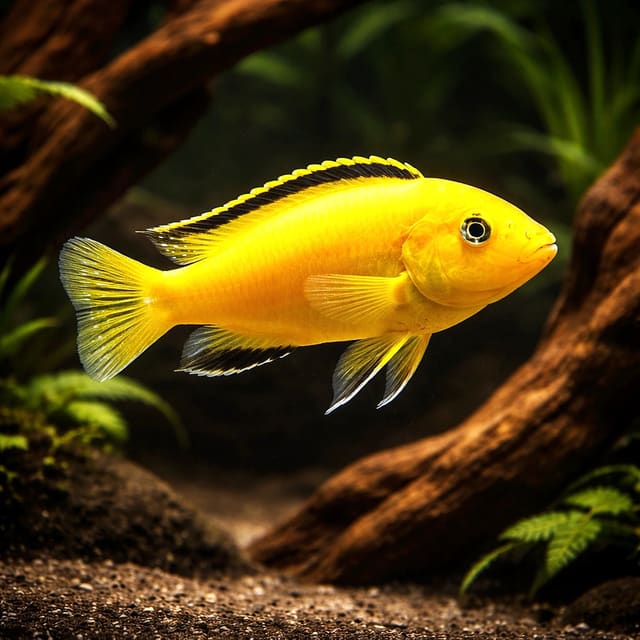
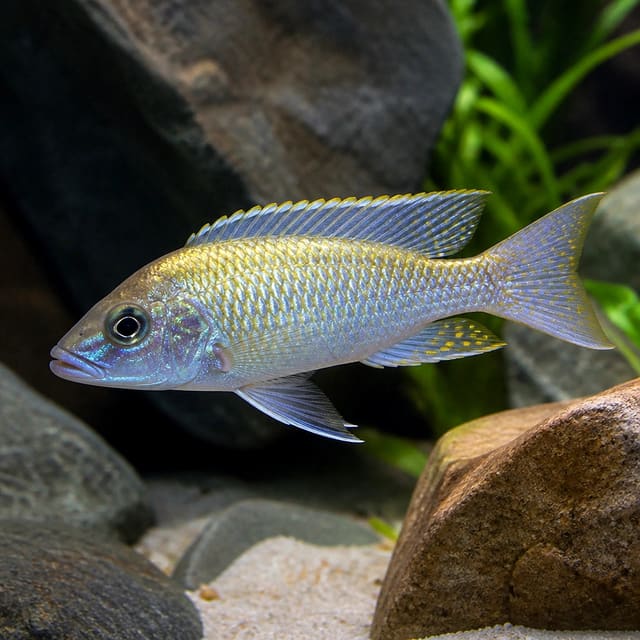
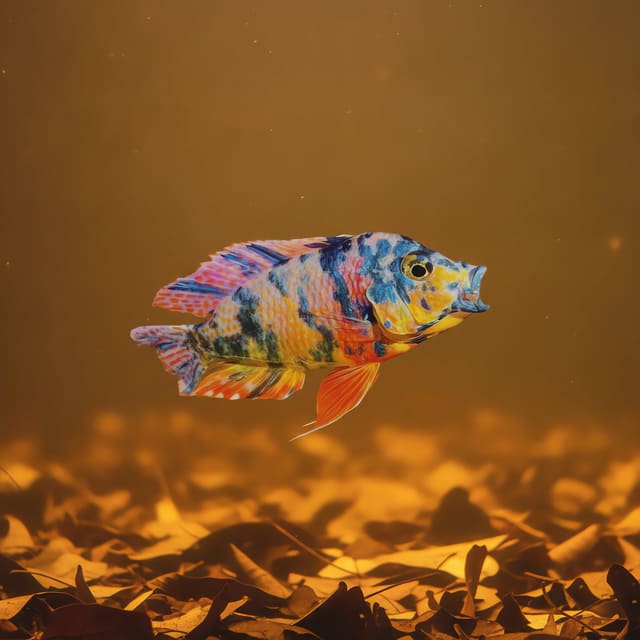
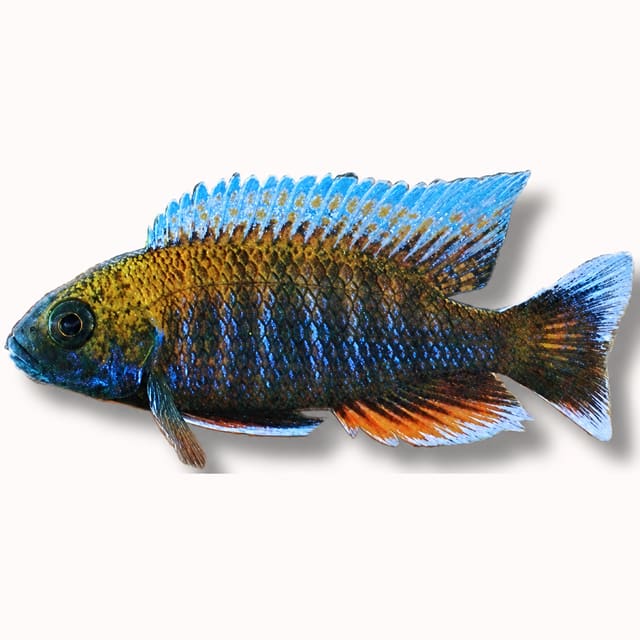
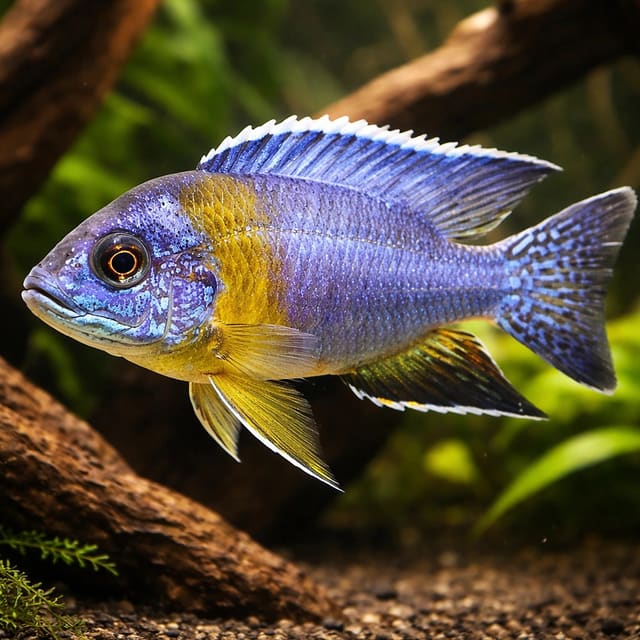
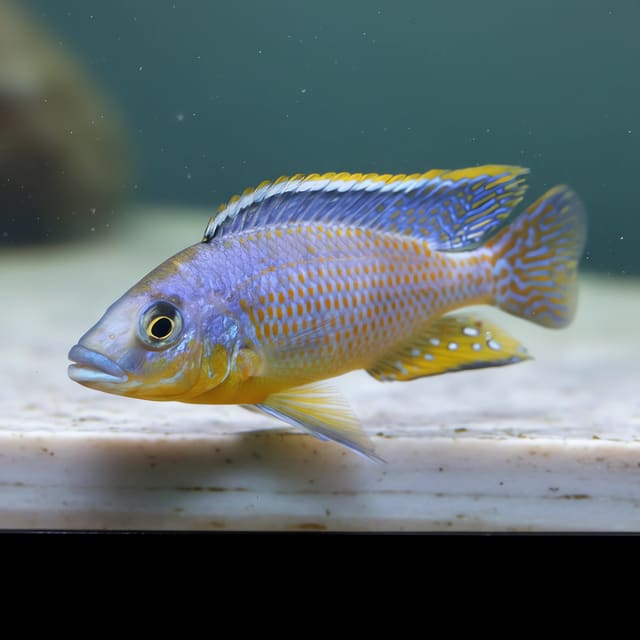
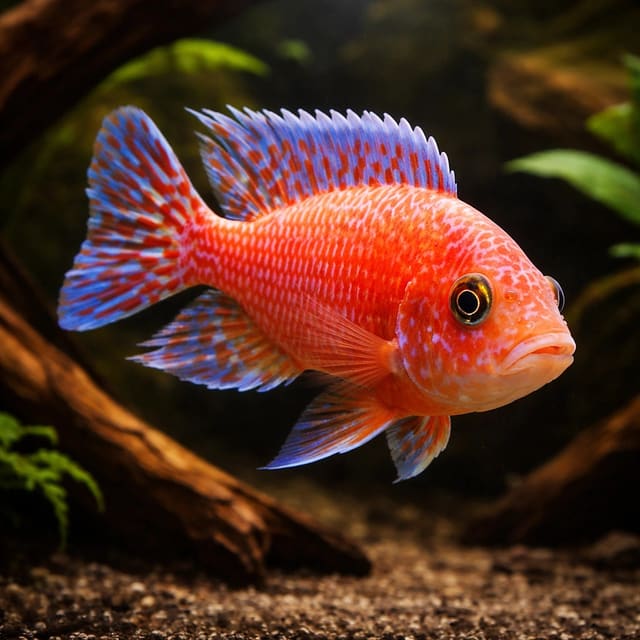
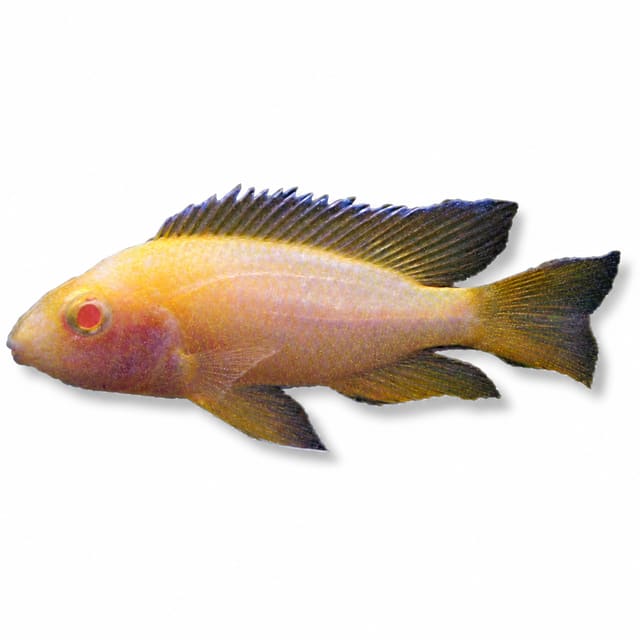
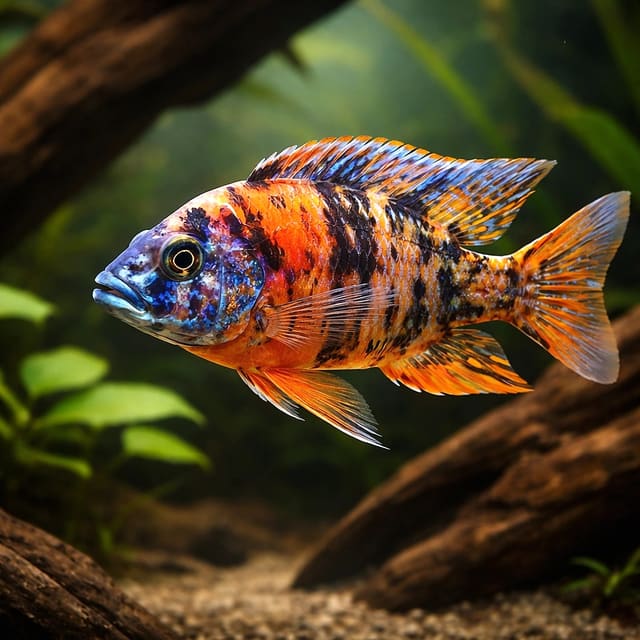
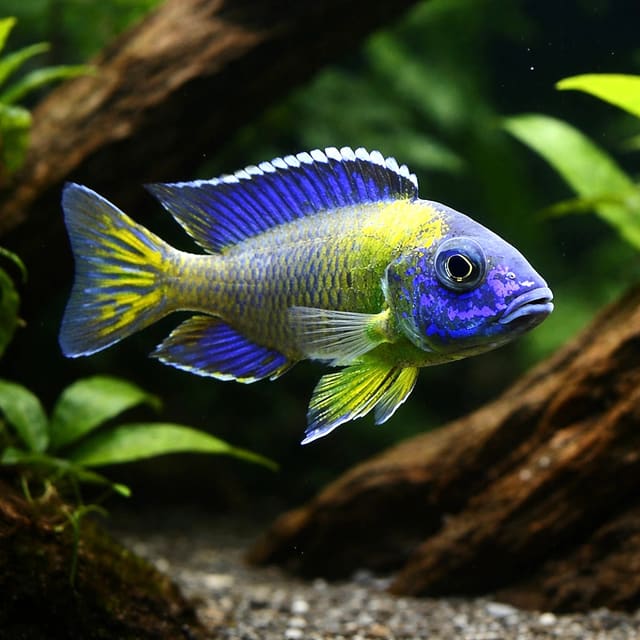
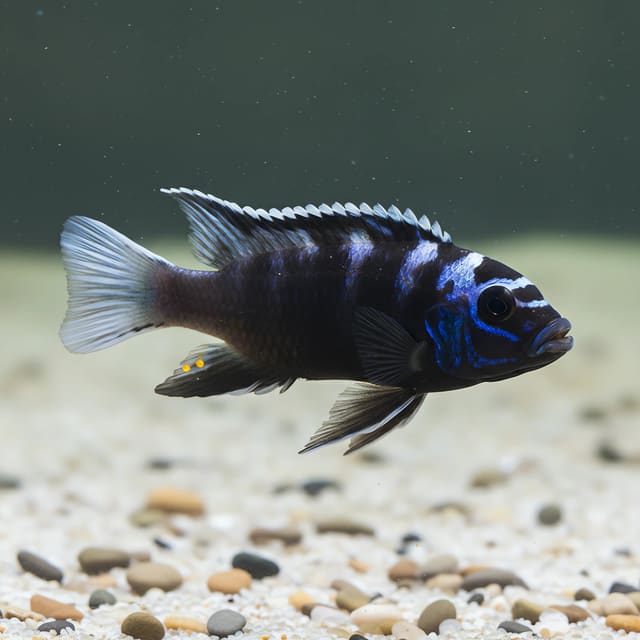
The gallery images are representative of this type of animal rather than photographs of the exact animal supplied, so colours can look slightly different from the live animal.
The pictured fish shows the pale white-blue body, rounded forehead, robust cichlid form and translucent blue-edged fins associated with this trade form. Use those features to understand the general appearance, while judging the purchase by the identity, selected dispatch size and care requirements rather than expecting an exact visual match.
Start with a base of at least 150 × 38 cm and about 257 litres. Seriously Fish presents a 150 × 38 × 45 cm aquarium, approximately 257 litres, as the minimum that should be considered for this species. Treat both the footprint and the volume as minimum limits: a shorter aquarium does not become suitable simply by gaining height and reaching a similar litre figure.
The 150 cm length supports sustained swimming, while the base allows a central area of open sand and keeps rockwork away from the main route through the aquarium. Build the layout around the fish’s ability to cross the tank, turn without entering narrow gaps and move away from social pressure.
| Situation | Decision |
|---|---|
| Species group only | Begin with the stated minimum and assess the room occupied by every adult fish |
| Group with companions | Provide more usable space when the combined adult stock needs it |
| Tall but short aquarium | Do not substitute height for the 150 cm base length |
| Rock-filled aquarium | Remove central obstacles that reduce swimming and turning room |
A litre figure cannot account for every combination of group size, companion size, décor and filtration. The practical test is whether all intended adults can use open water without continuous crowding or forced contact. If the aquarium only meets the minimum before rockwork and other large fish are added, choose a larger footprint.
Mark out the 150 × 38 cm base if you are planning a new aquarium. Place the intended filter equipment and peripheral décor on that plan, then check that the middle still functions as open swimming space. This simple check prevents a nominally large aquarium becoming cramped once rocks and equipment occupy the base.
Allow room for weekly access as well. Sand must be siphoned, filters checked and water changed without dismantling the entire layout. A maintainable aquarium is more likely to hold stable water than one where every routine job requires moving heavy décor.
Use sand as the main substrate and preserve a broad open area. The species occurs over sandy bottoms in Lake Malawi, and the aquarium guidance calls for sand with plenty of swimming room. This is not a rock-dwelling mbuna layout: a dense wall of stone through the centre removes the open space the fish needs.
Restrict rockwork to the sides and rear unless the aquarium is exceptionally large. The fish may be flighty, and Seriously Fish warns that it can injure itself in a rock-filled setup. Peripheral rocks can still provide structure without forcing a large fish through narrow passages.
| Layout feature | How to use it |
|---|---|
| Sand | Cover the main open area with a suitable sandy substrate |
| Rockwork | Keep it mainly around the perimeter |
| Swimming route | Leave the centre open from end to end |
| Plants | Expect digging and substrate rearrangement to uproot vulnerable planting |
Malawi cichlids often dig and rearrange their substrate, so do not make rooted plants essential to the layout. The aquarium can include plants, but their placement must not compromise open water or depend on undisturbed sand. Check the base after digging and restore the open swimming route when displaced substrate begins to narrow it.
Coral sand or a similar substrate may help buffer Malawi water, according to OATA’s group advice, but the measured water values still determine whether the aquarium is suitable. Do not assume the substrate alone will hold the required pH and hardness. Test the aquarium and replacement water and use a repeatable approach that keeps the target stable.
Watch where the group actually swims and where individuals hesitate or turn back. Repeated dashes into rockwork, restricted turning or one fish controlling the only open route indicate that the arrangement needs attention. Move peripheral décor only as necessary to restore space and reduce fixed territories, then reassess behaviour before adding more fish.
Keep the aquarium at 25–26°C, pH 8.0–8.6 and 12–18 dGH. These routine values are the overlap of FishBase’s recorded environment, Seriously Fish aquarium guidance and the Malawi-group figures.
FishBase records 24–26°C, pH 7.2–8.8 and 10–18 dH, while Seriously Fish gives 25–29°C, pH 7.5–8.8 and 10–25 dGH. OATA’s Malawi-cichlid sheet gives 23–27°C, pH 8.0–8.6 and 12–18 dGH for the group; here those figures are narrowed against the ranges recorded for Cyrtocara moorii. OATA also gives a carbonate-hardness range of 10–15 dKH.
| Routine value | Target |
|---|---|
| Temperature | 25–26°C |
| pH | 8.0–8.6 |
| General hardness | 12–18 dGH |
| Carbonate hardness | 10–15 dKH |
| Ammonia | Zero mg per litre |
| Nitrite | Zero mg per litre |
| Nitrate | Up to 20 mg per litre above the normal tap-water level |
Test temperature, pH, hardness, ammonia, nitrite and nitrate before introducing the fish. Our water chemistry guide explains what the principal measurements mean, while the water matcher helps compare measured aquarium values with this target.
Record the tap-water baseline as well as the aquarium result. The nitrate limit is expressed relative to normal tap water, so a tank reading only becomes meaningful when that baseline is known. Use the same test method each time and investigate a trend before it reaches the edge of the target.
Prepare replacement water so that temperature and chemistry remain close to the aquarium. Treat tap water with conditioner before adding it, because chlorine or chloramine can harm the biological filtration. A stable result within the stated range is preferable to repeated abrupt adjustments that move the aquarium back and forth across it.
A mature biological filter is essential. The RSPCA explains that biological filtration supports bacteria that convert toxic ammonia into nitrite and then into the safer nitrate. The aquarium must be matured before livestock is introduced, and filtration must continue to cope as feeding and the fish population increase.
For the approximately 257-litre example, Seriously Fish recommends turnover of four to five times the aquarium volume per hour. It illustrates this with two filters rated at 515–645 litres per hour each. Together, those ratings provide about 1,030–1,290 litres per hour.
| Filtration calculation | Planning result |
|---|---|
| 257 litres × 4 | About 1,028 litres per hour |
| 257 litres × 5 | About 1,285 litres per hour |
| Two 515 lph filters | About 1,030 litres per hour combined |
| Two 645 lph filters | About 1,290 litres per hour combined |
Use the calculation for the real aquarium volume rather than copying the example onto a larger tank. OATA recommends oversized filtration and strong aeration for crowded Malawi communities because a greater fish load consumes oxygen and produces more waste. Direct the system so that the aquarium is well circulated without sacrificing the open swimming area.
Follow our first tropical tank guide when preparing a new aquarium. The practical readiness test is not how long the tank has contained water; it is whether the biological filter is established and repeated tests show zero ammonia and zero nitrite.
Add livestock slowly enough for the bacterial population to respond to increased waste and feeding. A sudden increase can cause new tank syndrome, with ammonia and nitrite rising because the filter bacteria cannot process the new load.
Seriously Fish estimates roughly 150–200 W across two heaters for its 257-litre example when the room is around 20°C and the aquarium is being held within its stated 25–29°C range. Treat that as a conditional equipment reference. Choose heater capacity for the actual aquarium volume, room temperature and routine target of 25–26°C, then confirm the result with a thermometer.
Cyrtocara moorii is described as a micro-predator. In Lake Malawi, shoals follow substrate-sifting fish and take morsels stirred from the sand. In the aquarium, build the bulk of its diet around suitable live and frozen foods rather than treating it as an algae-grazing mbuna.
Seriously Fish names bloodworm, brine shrimp, chopped earthworms and prawns among the foods taken by the species. Dried foods are also accepted but should not be fed exclusively. OATA’s Malawi guidance adds that larger, more predatory fish may take pellets with a higher animal content alongside frozen foods.
Feed only what the fish consume within a few minutes, twice a day. Start with a small measured portion, watch how quickly it is cleared and adjust the next portion rather than adding repeated handfuls. Uneaten food breaks down and adds toxic waste to the water.
| Feeding decision | Action |
|---|---|
| Main food type | Use varied live and frozen foods suited to a micro-predator |
| Dried food | Use as part of the rotation, not as the exclusive diet |
| Frequency | Feed twice a day |
| Portion | Give only what is eaten within a few minutes |
| Food remains | Reduce the next portion and protect water quality |
Peaceful does not mean every individual receives an equal share. Observe whether one fish hangs back while another takes most of the food. Spread suitable portions across the open swimming area so that feeding observation covers every member of the group, while keeping the total amount within the few-minute limit.
A change in appetite is also a health signal. If a fish that normally feeds stops showing interest, test ammonia, nitrite, nitrate and temperature and compare its breathing, colour and swimming with its normal pattern. Do not respond by adding richer food or increasing the overall portion before checking water quality.
Prepare the aquarium before arranging the arrival. Confirm 25–26°C, pH 8.0–8.6, 12–18 dGH, zero ammonia and zero nitrite, then check that the filter is mature and the open-sand layout is complete. Introducing the fish first and trying to correct the aquarium afterwards exposes it to avoidable instability.
These steps come from our delivery and Live Arrival Guarantee policy, which also sets out the requirements for a claim.
Every added fish and every increase in feeding creates more waste for the established bacteria to process. Increase the aquarium population slowly and test ammonia and nitrite after additions. Both must remain at zero mg per litre.
When introducing the fish to an established Malawi community, assess the temperament of the residents before release. OATA recommends adding more peaceful species before more aggressive ones and notes that rearranging décor can reduce established territorial pressure. Keep any rearrangement compatible with this species’ need for peripheral rocks and an open centre.
Record where the fish swims, how rapidly it breathes, whether it joins feeding and whether another fish repeatedly displaces it. Check the water rather than assuming that hiding, colour change or reduced appetite is solely a social issue. A clear baseline makes later changes easier to recognise.
Continue the normal twice-daily measured feeding routine and weekly maintenance schedule. Do not add further fish simply because the first introduction appears calm; allow the filtration and social pattern to settle while tests remain stable.
Test the aquarium at least once each week and complete a 25% partial water change at least once a week. The routine target remains zero ammonia, zero nitrite and nitrate no more than 20 mg per litre above the normal tap-water level. Record temperature and pH at the same time so a gradual drift is visible.
Treat replacement tap water with conditioner before adding it. Match its temperature and chemistry closely enough to avoid abrupt change, then siphon solid waste from the substrate while preserving the open sandy area.
Check filters for blockages during maintenance. If media needs cleaning, rinse it lightly in aquarium water removed during the partial water change. Do not rinse established biological media under the tap, because chlorine or chloramine may kill the bacteria that process ammonia and nitrite.
| If you see this change | Do this first |
|---|---|
| Hanging at the surface | Test water and check filtration and aeration |
| Sitting on the bottom | Compare with normal behaviour and test water |
| Erratic swimming | Check water values, décor hazards and social pressure |
| Faster or slower breathing | Test water and confirm circulation |
| Darker or paler colour | Check water, feeding and aggression |
| White spots or fluffy growths | Record the change and seek health guidance |
| Damaged fins or scales | Inspect tank-mate behaviour and the rock layout |
| Reduced food intake | Test water before changing the diet or portion |
Individual fish vary, so a change from the established pattern is more useful than one isolated observation. Track feeding response, body condition, swimming position, hiding and the level of aggression. Several changes occurring together deserve prompt attention even when a single test result looks acceptable.
If health changes continue after water quality, filtration, aeration and social pressure have been checked, contact us with the test results and a clear description of the signs. Those details make the next welfare decision more useful than a symptom name alone.
At each weekly check, compare the new readings with the previous week. Rising nitrate, recurring uneaten food or filter blockage indicates that feeding, maintenance or stocking pressure needs adjustment. Continue the 25% water change at least once a week and respond sooner when tests or behaviour move away from the established baseline.
Seriously Fish describes Cyrtocara moorii as a shoaling species that should be maintained in a group. Plan the aquarium around that social requirement rather than treating one fish as the finished long-term arrangement. The group and its adult footprint come before optional tank mates.
Where sexes are known, the stated target is two or three females per male if possible. Both sexes can develop the nuchal hump and show identical colouration, while males generally growing larger may take several years to become apparent. Do not assign sex from forehead shape, colour or dispatch size.
| Situation | Planning response |
|---|---|
| One known male | Aim for two or three known females if possible |
| Sexes unknown | Do not label individuals from appearance or size |
| Spawning behaviour | Watch for increased male territoriality |
| Repeated displacement | Reassess footprint, décor, group structure and companions |
The ratio is a planning aid, not a reason to infer the identity of individual fish. If the intended arrangement depends on exact sexes, build it only from options that explicitly guarantee them. Otherwise, allow for uncertainty in the group and maintain enough open space to observe interactions clearly.
Maintaining a group does not mean filling the aquarium without regard to adult size. Each fish must still have access to the open swimming route, feeding area and water quality supported by the filter. Slight overstocking is sometimes used across Malawi communities to distribute aggression, but that broad technique does not replace the species minimum footprint or justify rapid stocking.
Male fish may become territorial when spawning. If one individual begins controlling the open centre or repeatedly drives another into the perimeter, review the social arrangement before adding more fish. Rearranging peripheral décor may disrupt fixed territories, but retain the open sand and do not create a dense obstacle course.
Observe at feeding time as well as between meals. A fish that remains physically undamaged may still be under pressure if it cannot enter the feeding area. Social success means the entire group can swim, feed and rest without one individual being persistently excluded.
This species is peaceful by Malawi-cichlid standards, but its companions still require deliberate screening. Seriously Fish says it should not be kept with boisterous species such as mbuna. At the other extreme, its sheer adult size may intimidate small fish even without persistent chasing.
| Compatibility decision | Guidance |
|---|---|
| Avoid | Boisterous mbuna that subject the group to persistent pressure |
| Consider conditionally | Large peaceful haps, including the cited example Fossorochromis rostratus |
| Consider conditionally | Frontosa in a sufficiently spacious, carefully matched Rift Lake setup |
| Consider conditionally | Suitable Rift Lake Synodontis species |
| Use caution | Small fish that may be intimidated by the adult cichlid’s size |
OATA’s Malawi guidance takes a narrower approach, recommending other Malawi cichlids or some Synodontis catfish. Use the named examples as screening starting points rather than universal pairings. Compatibility varies with the individual fish, aquarium footprint, group structure, décor and the temperament of every resident.
A fish sharing Lake Malawi is not automatically suitable, and a peaceful label does not guarantee calm interactions. Watch whether each fish can cross the aquarium, feed and leave another fish’s immediate area. Persistent chasing, blocked access to food or repeated hiding requires a stocking review.
For a stocking and compatibility assessment, contact us with the aquarium dimensions, measured water values, filtration, current fish and intended adult group. Those details allow a meaningful screen; a tank-mate name by itself cannot account for the pressure created by the whole community.
Add peaceful fish before more aggressive residents where possible, increase the population slowly and retest ammonia and nitrite after each addition. If the existing aquarium centres on boisterous mbuna, choose a different plan rather than expecting the White Dolphin group to adapt to constant aggression.
The White Dolphin Cichlid reaches a recorded maximum of 20 cm total length. Seriously Fish also uses 25 cm standard length as an aquarium-planning reference, so provide the full adult footprint from the start.
Cyrtocara moorii needs at least about 257 litres and a base of at least 150 × 38 cm, with open sand and rockwork kept mainly around the perimeter.
Seriously Fish says the White Dolphin Cichlid should be maintained in a group. Where the sexes are known, aim for two or three females per male if possible.
Choose Cyrtocara moorii only if you can provide at least about 257 litres, a 150 × 38 cm base, a mature filter, stable hard alkaline water and a carefully screened group.
Feed the White Dolphin Cichlid varied live and frozen foods such as bloodworm, brine shrimp, chopped earthworm and prawn twice a day, giving only what it eats within a few minutes; dried food should not be the exclusive diet.
Keep it at 25–26°C, pH 8.0–8.6 and 12–18 dGH. These routine values are the overlap of FishBase, Seriously Fish and OATA’s Malawi-group guidance.
This fish is described as peaceful, although males may become territorial when spawning. Avoid boisterous mbuna and watch for persistent chasing, blocked feeding access or repeated hiding.
Consider large peaceful haps, Frontosa or suitable Rift Lake Synodontis only after matching water, adult scale, temperament and space. Avoid boisterous mbuna, while small fish may be intimidated by its size.
Film every delivery continuously from the sealed parcel as it is opened, showing the fish still inside the sealed bag before anything is disturbed. Have someone present to receive the parcel, inspect it on the day it arrives, float the bag for 20–30 minutes and never pour the bag water into the aquarium.
No reviews for this item yet. Bought one? Honest reviews only, good or bad.
What customers say about ordering from us
Easy website plenty of info on fish your buying great to pick a time slot
TRACEY DURRANT · 7 Oct 2026
Got some lovely fish thank you
Kevin Mackie · 7 Oct 2026
Reviews of our shop, collected by Judge.me, an independent third-party review collector. Newest first.