Moderate
Acei Cichlid (Pseudotropheus sp. “acei”)
24–26°C · pH 7.5–8.5 · 300L
£7.99

The Red Albino Peacock Cichlid (Aulonocara sp.) is a haplochromine cichlid from Lake Malawi in East Africa, identified to genus rather than species. It suits keepers planning a mature Malawi community; OATA’s group guidance gives 23–27°C, pH 8.0–8.6 and hard water. Sold individually in sizes from 3 - 4 cm to > 9 cm.
Aulonocara sp.
Save when buying multiple fish. Each quantity is one fish; sex and pair formation are not guaranteed unless the selected variant explicitly states them.
The Red Albino Peacock Cichlid (Aulonocara sp.) is a haplochromine cichlid from Lake Malawi in East Africa, identified to genus rather than species. It suits keepers planning a mature Malawi community; OATA’s group guidance gives 23–27°C, pH 8.0–8.6 and hard water. Sold individually in sizes from 3 - 4 cm to > 9 cm.
Cichlids are a family of roughly 1,800 accepted species, not one care type. Before buying, identify the exact species and source, then compare adult measurement, usable tank dimensions, social system, territory, tested water, diet and an exit plan. No family-wide minimum tank, water range or tank-mate list is safe.
Maintain these water conditions for optimal health and vibrant colors
The Red Albino Peacock Cichlid belongs to Aulonocara, an accepted genus in the cichlid family Cichlidae. It is a haplochromine cichlid from Lake Malawi in East Africa and suits a keeper prepared to maintain hard, alkaline water, powerful biological filtration and a deliberately planned Malawi community. The scientific label Aulonocara sp. means that the fish is identified to genus rather than to one named species. Build its aquarium around the Malawi targets of 23–27°C, pH 8.0–8.6 and hard water, while retaining enough space and filtration capacity to adjust the plan as the fish develops.
The World Register of Marine Species recognises Aulonocara within Cichlidae and the order Cichliformes. The red albino wording is the trade identity for this animal; it does not turn Aulonocara sp. into a species name. Keep the genus-level label in aquarium notes so future stocking decisions are not accidentally based on the biology of a different peacock species.
The Aulonocara genus summary describes these fish as haplochromine cichlids endemic to Lake Malawi in East Africa. Peacock cichlids are also called aulonocaras or simply peacocks, while keepers often shorten haplochromine to “hap”. All members of the genus are maternal mouth brooders, and the genus is strongly sexually dichromic. Individual colour, sex and breeding behaviour can vary.
| Suits | Not suited to |
|---|---|
| A mature Lake Malawi cichlid setup | A conventional mixed tropical community |
| Hard, alkaline water | Fish needing different water chemistry |
| Deliberate aggression management | An unplanned small Malawi group |
| Measured water testing and strong filtration | An aquarium without an established filter |
Build the aquarium around Malawi conditions and make every companion choice against the same water, adult scale and behavioural screen. This approach gives the fish a stable environment while allowing the keeper to respond to growth and interactions within the complete community.
One purchase supplies one animal in the size selected. Use the live size selector to choose between the labels “3 - 4 cm”, “4 - 5 cm”, “5-7 cm” and “> 9 cm”. The size you select is the size supplied, not the adult size. These measurements describe the fish at dispatch; plan its permanent aquarium around future growth and the needs of the complete Malawi community.
Sex is guaranteed only when the selected option explicitly states male or female. This Red Albino Peacock Cichlid listing has no sex-guaranteed option. Do not use colour, dispatch size or gallery appearance to predict the sex of the animal received.
OATA’s African Malawi cichlid guidance gives 23–27°C, pH 8.0–8.6, general hardness of 12–18°dH and carbonate hardness of 10–15°dKH for the group. It recommends an aquarium of at least 200 litres for a reasonable-sized community, an oversized filter and strong aeration. Use those figures together: the volume is a community baseline, and filtration, adult dimensions and aggression must also be assessed before fish are added.
OATA notes that most Malawi cichlids grow to around 10 cm, while some grow up to 25 cm. Use that group pattern for conservative planning and leave enough flexibility to revise décor, filtration and stocking as this unidentified Aulonocara grows.
| Planning point | Baseline |
|---|---|
| Temperature | 23–27°C |
| pH | 8.0–8.6 |
| General hardness | 12–18°dH |
| Community aquarium | At least 200 litres |
| Ammonia and nitrite | 0 mg/l |
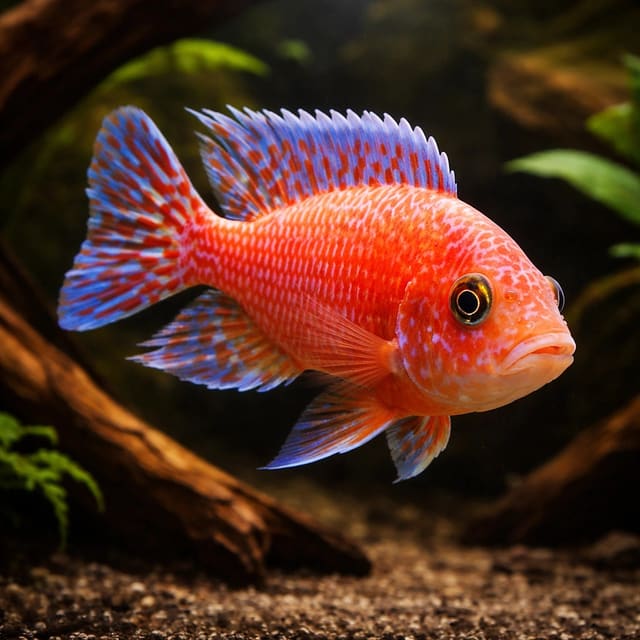
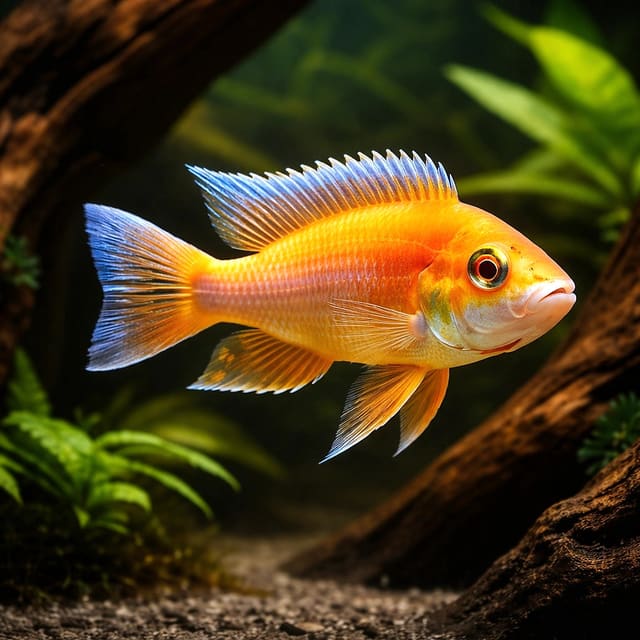
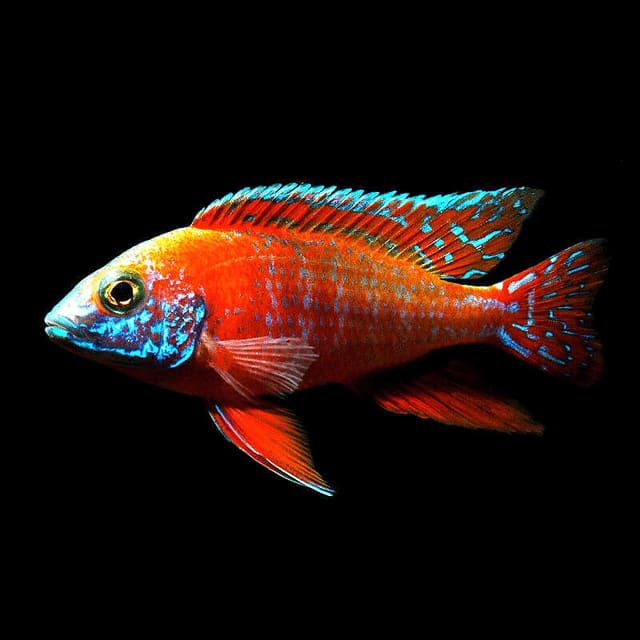
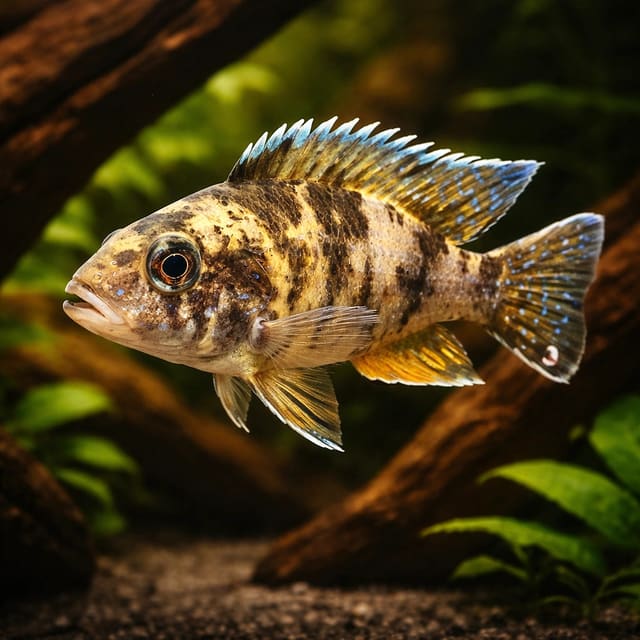
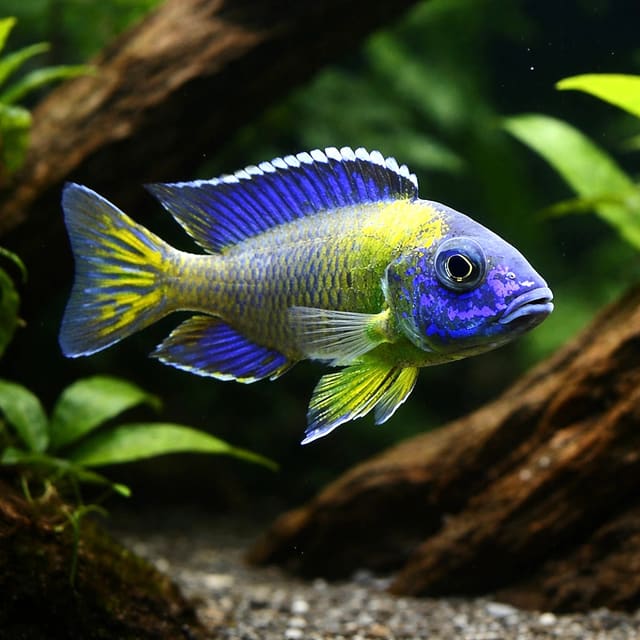
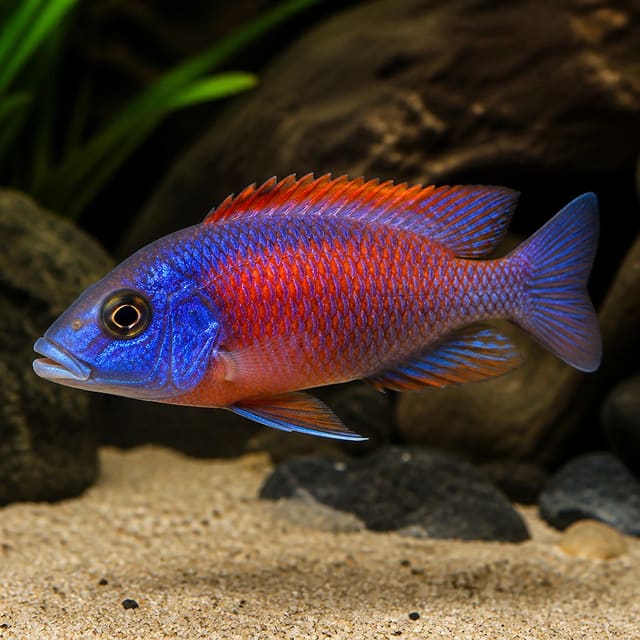
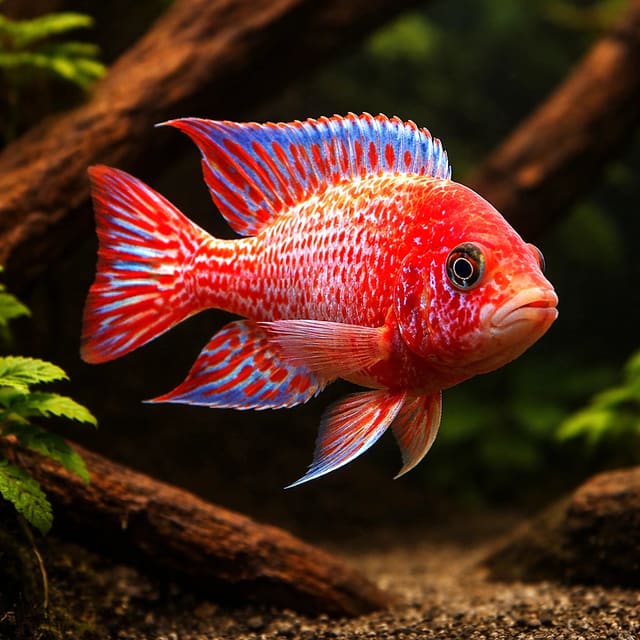
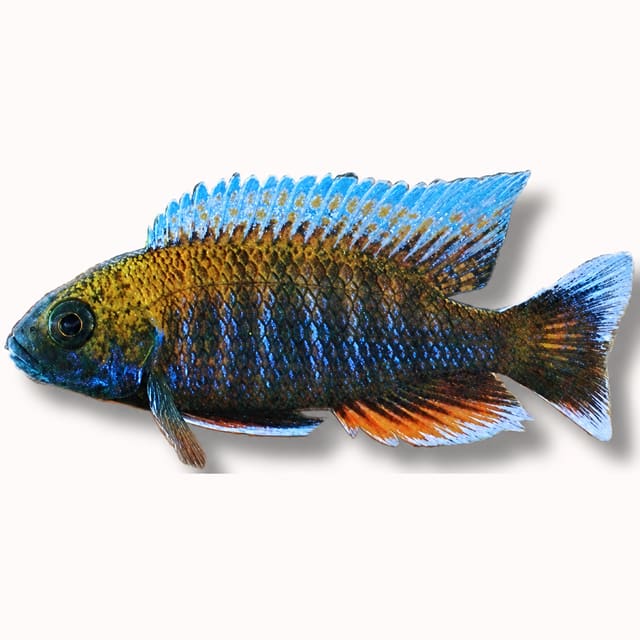
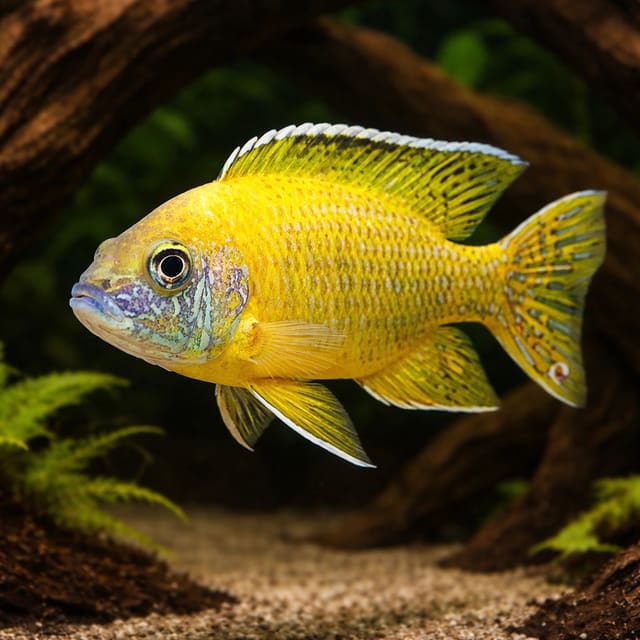
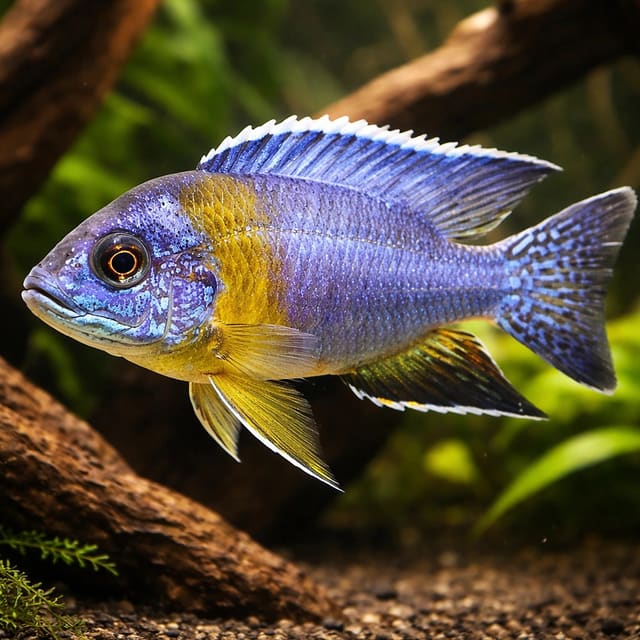
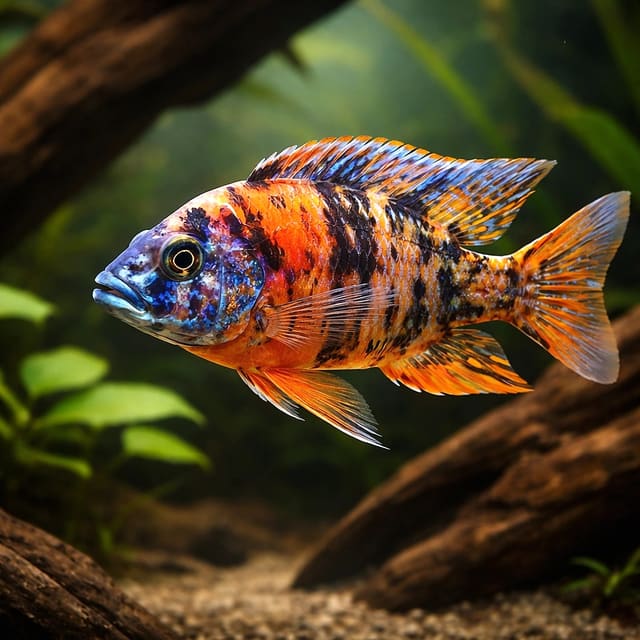
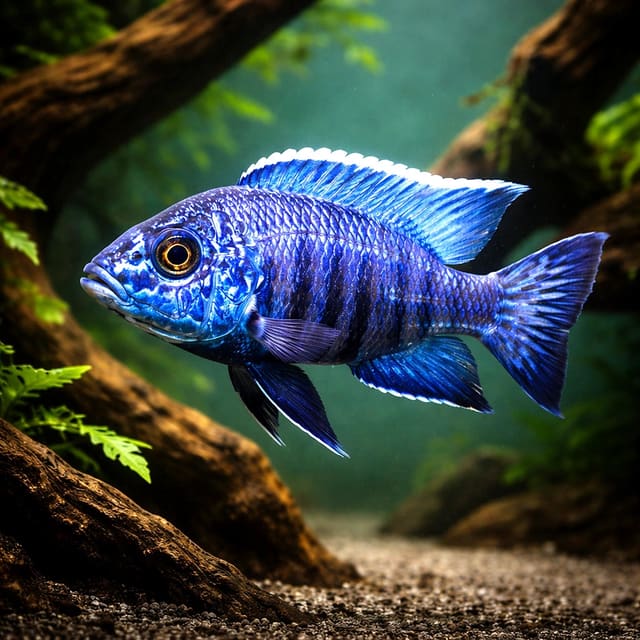
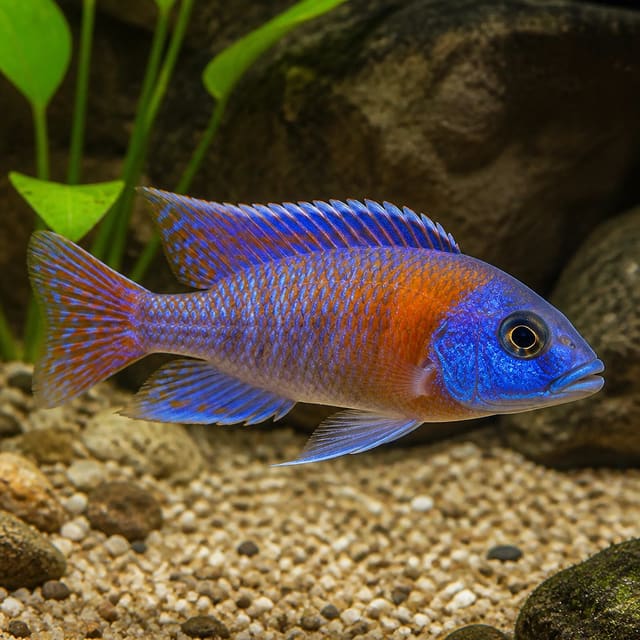
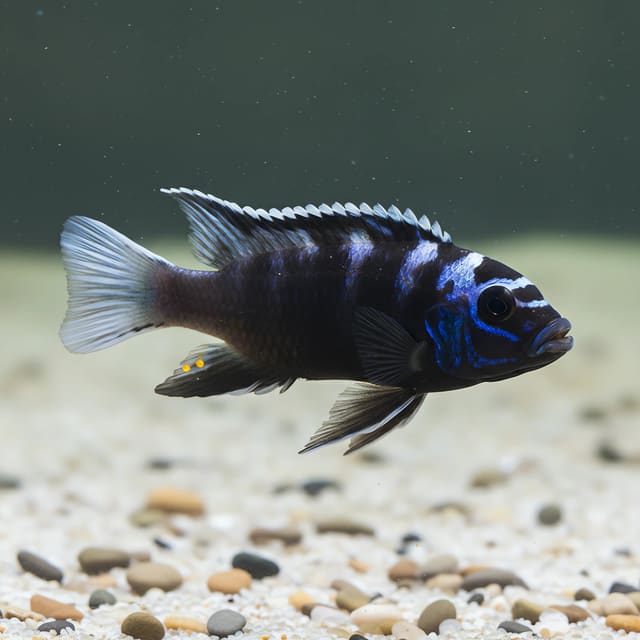
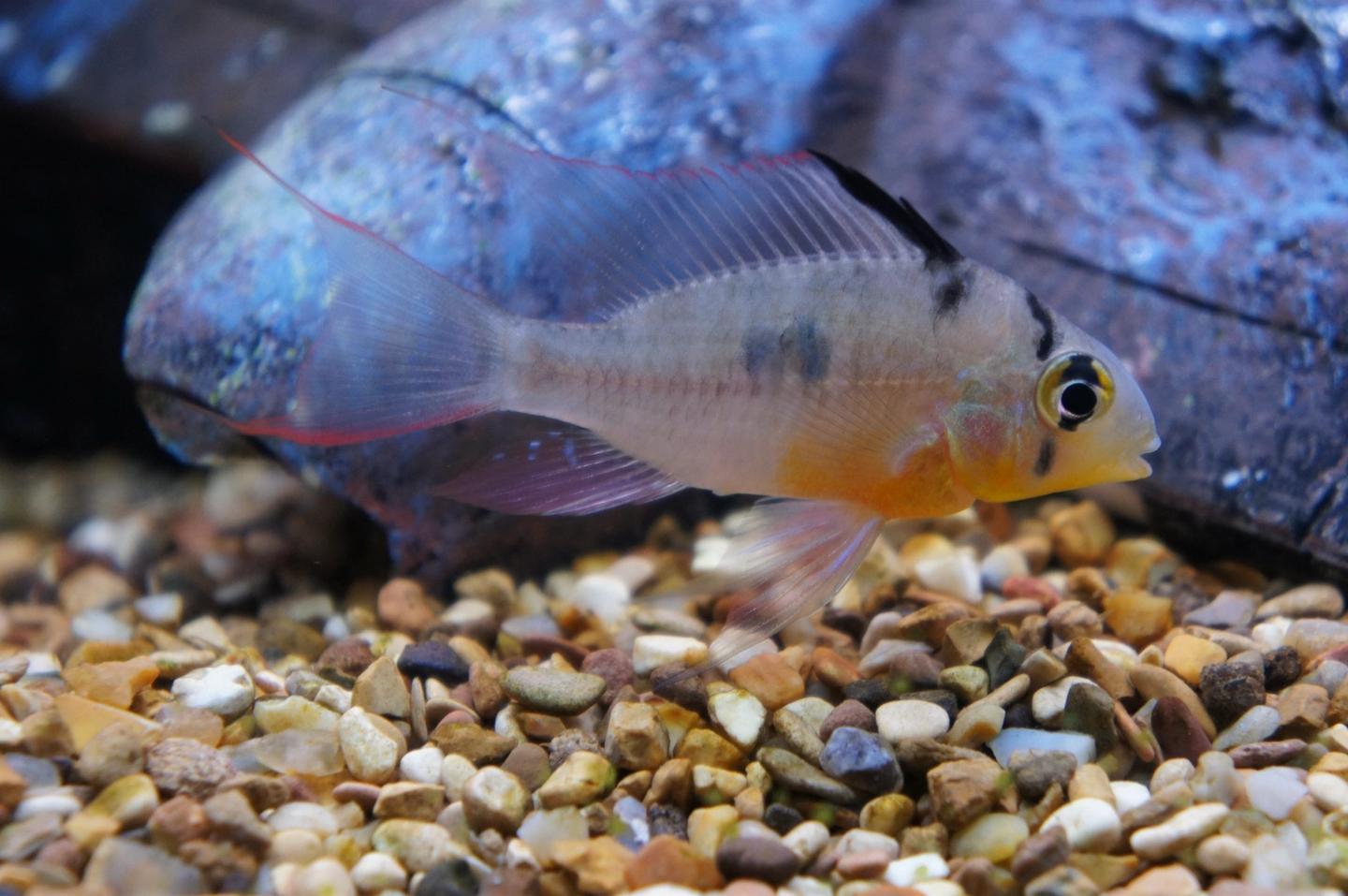
The gallery images are representative illustrations of this type of animal, not photographs of the animal supplied, so pattern and colours can differ from the live animal. Use them to understand the illustrated cichlid shape and scene, while assessing the live fish by its own markings and colour.
The exact species has not been identified, so the care advice here follows the genus Aulonocara and its care group.
Set the aquarium between 23 and 27°C, with pH from 8.0 to 8.6, general hardness from 12 to 18°dH and carbonate hardness from 10 to 15°dKH. Stability inside those ranges is the daily objective. Test before introducing the fish, after additions to the community and whenever behaviour, breathing, colour or appetite changes.
Our aquarium water chemistry guide explains what each measurement means. Use the water matcher to compare measured aquarium values with the Malawi targets rather than estimating hardness or pH from the appearance of the water.
| Measurement | Action point |
|---|---|
| Ammonia | Keep at 0 mg/l |
| Nitrite | Keep at 0 mg/l |
| Nitrate | No more than 20 mg/l above tap-water level |
| Routine testing | At least weekly |
Measure the tap water as well as the aquarium when interpreting nitrate. If conditioned tap water measures 10 mg/l nitrate, the aquarium target is no more than 30 mg/l because that is 20 mg/l above the starting level. This relative limit matters in areas where tap-water nitrate is already measurable.
Any ammonia or nitrite reading requires immediate attention because both should remain at zero. Pause further livestock additions, check the filter and increase testing while the biological system catches up. OATA warns that Malawi cichlids can be stressed by even small amounts of ammonia and nitrite, so act on the reading before visible illness develops.
Write down temperature, pH, hardness and nitrogen readings on the same day each week. A value inside range can still signal a developing problem if it is moving steadily towards an edge. For example, a pH change from 8.5 to 8.1 remains within the stated range but deserves a check of substrate, replacement water and maintenance routine before it falls further.
Test replacement water before making a major adjustment. Match it closely enough that a water change restores cleanliness without creating an abrupt temperature or chemistry swing. Make measured corrections and retest rather than changing several parts of the system at once.
A well-established biological filter is essential. The RSPCA’s aquarium welfare guidance explains that fish release toxic ammonia and that beneficial filter bacteria convert it first to toxic nitrite and then to safer nitrate. Ammonia and nitrite must both read 0 mg/l before this cichlid is introduced.
Prepare the aquarium and establish its biological filtration before livestock arrives. Our first tropical aquarium guide gives a practical route through preparation and maturation. The result matters more than a fixed number of days: test results must show that the filter is processing waste.
OATA recommends an oversized filter because Malawi communities use comparatively dense stocking to spread aggression. It also recommends strong aeration so the fish have adequate dissolved oxygen. Treat filtration and aeration as part of the stocking capacity rather than optional accessories added after problems appear.
Add fish gradually because beneficial bacteria need time to increase when the livestock population and feeding load rise. Adding too many fish too quickly can cause new tank syndrome, in which the filter cannot process the increased waste and ammonia or nitrite rises to harmful levels.
Do not rinse established filter media under the tap. Chlorine or chloramine can kill beneficial bacteria. When cleaning is necessary, rinse the media lightly in aquarium water removed during a partial water change. Avoid cleaning every component aggressively at the same time; the goal is to clear blockages while preserving the bacterial population that performs the nitrogen conversion.
If water movement weakens, inspect the intake and media rather than assuming the filter is still performing normally. Reduced flow can lower oxygen distribution and allow solid waste to collect. Restore flow, test ammonia and nitrite, and check again after the system has been running.
Use at least 200 litres when planning a reasonable-sized Malawi community, then increase space whenever the adult dimensions, number of fish or aggression pattern require it. The aquarium must hold the selected community after growth, not merely accommodate one dispatch-sized fish on arrival.
OATA recommends coral sand or a similar substrate that helps buffer the water. Malawi cichlids often dig and rearrange the substrate, so leave areas where that behaviour does not undermine equipment or trap large pockets of debris. Expect loose plants to be disturbed and prioritise a layout that remains functional after digging.
Keep filter intakes and outlets clear of shifted substrate. Check them during weekly maintenance because a fish can alter the base gradually between services. If digging repeatedly exposes or blocks equipment, revise the arrangement rather than continually replacing the substrate in the same vulnerable position.
Décor should create visual separation without consuming all usable swimming room. OATA notes that rearranging décor can help reduce aggression because fish must establish new territories. This is useful when adding a planned group or when one established territory causes repeated conflict.
| If you observe | Change the layout by |
|---|---|
| One fish controls a direct route | Breaking the long line of sight |
| Substrate blocks an intake | Clearing and protecting the intake area |
| Plants are repeatedly uprooted | Reducing reliance on loose planting |
| A new group is being introduced | Rearranging décor before release |
Make each alteration for a defined reason. Adding décor without considering water movement can create waste traps, while removing too much structure can leave weaker fish in constant view. After a change, watch how fish move between areas and confirm that filtration and aeration still reach the whole aquarium.
Use the Malawi adult-size pattern as a warning against tight layouts: most members of the group reach around 10 cm, but some grow up to 25 cm. Keep access around décor and equipment so the arrangement can be revised as this genus-level animal develops. Its selected dispatch size is the starting measurement, not the finished design brief.
Malawi cichlid diets vary, so do not treat every food carrying a Malawi label as interchangeable. OATA separates its examples into two dietary branches: smaller mbuna may benefit from specialised Malawi feeds with a high algae content and fresh vegetables, while some larger utaka may need pellets with more animal content and frozen brine shrimp, prawns or cockles.
Use those branches as a decision tool rather than combining them into an unrestricted menu. This fish is an Aulonocara peacock identified to genus. Settle the appropriate dietary branch as part of the aquarium and stocking assessment, choose food that matches that branch, and then keep the routine consistent enough to judge appetite and body condition.
Feed twice a day and offer only what the fish can eat within a few minutes. Stop adding food once feeding slows instead of using excitement at the first bite as a reason to add another portion. The aim is a measured meal, not food left to drift into the substrate or filter.
| At each feed | Decision |
|---|---|
| Fish eat promptly | Continue only within the few-minute limit |
| Food remains | Reduce the next portion |
| Interest falls suddenly | Check water and observe the fish |
| Waste begins to build up | Reduce excess food and restore maintenance |
Overfeeding leaves uneaten material that breaks down and adds toxic waste to the water. It can push a filter that was stable at the current livestock load beyond its processing capacity. Portion control therefore supports both nutrition and the zero-ammonia, zero-nitrite targets.
Watch feeding interest, body condition and the amount of waste produced. A sudden reduction in food intake is one of OATA’s warning signs, especially when it appears alongside altered breathing, colour, swimming or behaviour. Test the water before changing several foods at once, because an appetite change can coincide with a water-quality problem.
Keep the adult and dispatch measurements separate when portioning. A fish from a smaller size choice needs a portion it can finish within the same few-minute window; it does not need an adult-sized ration. Adjust the amount from observation while retaining the twice-daily schedule.
Make a partial water change of 25% at least once every week. Use a siphon to remove solid waste from the substrate, especially where food and waste collect around décor. Treat replacement tap water with a conditioner that removes chlorine or chloramine before it enters the aquarium.
This order links measurements to actions. Testing before the water change shows what developed during the week; testing again when a reading was outside target shows whether the maintenance corrected it.
Only clean media when flow or accumulated dirt makes it necessary. Rinse it lightly in the aquarium water removed during the change, never under the tap. This protects the bacteria that convert ammonia and nitrite while still clearing debris that restricts flow.
A filter service is not a substitute for the water change. The filter processes waste but does not remove every dissolved end product from the aquarium. Likewise, a large water change cannot compensate for a blocked or biologically damaged filter. Keep both parts of the routine working together.
| Weekly result | Next action |
|---|---|
| Ammonia or nitrite above zero | Pause additions and test more frequently |
| Nitrate rising quickly | Review feeding, waste removal and stock load |
| Flow is reduced | Inspect intake and lightly rinse blocked media |
| Water values remain steady | Continue the same measured routine |
Keep weekly notes through the first month after introduction. Record test values, feeding response, aggression and any change in filter flow. A consistent record makes gradual drift easier to see and prevents normal behaviour for this individual from being confused with a new warning sign.
If the aquarium repeatedly returns to harmful readings before the next weekly service, reduce the pressure on the system rather than relying on emergency maintenance as the normal routine. Reassess feeding, stocking pace, filter capacity and waste collection points.
Arrange for someone to receive the parcel because live fish must not be left unattended. Confirm in advance that the aquarium is mature, the temperature and Malawi chemistry are in range, and ammonia and nitrite are both 0 mg/l. Complete cycling and compatibility planning before the fish arrives.
Read the current delivery and Live Arrival Guarantee policy before the delivery day so the receipt, acclimatisation and claim steps are clear.
Keep the bag attended while it floats, and make sure the aquarium is already at its intended stable temperature before release.
Healthy fish generally show clear, bright eyes, undamaged fins, intact scales and swimming appropriate to the animal. Individual behaviour can vary, so establish a baseline rather than expecting constant movement or immediate feeding. Pay closest attention to change: hanging at the surface, sitting on the bottom, erratic swimming, altered gill movement, unusual hiding or a sudden shift in aggression all justify a water test.
During the first week, test ammonia and nitrite more closely because the filter must adjust to the extra waste and feeding. Both readings should remain at zero. Also check that established fish do not focus repeated aggression on the newcomer and that the new fish can move through the aquarium without being continually intercepted.
| Checkpoint | What to confirm |
|---|---|
| Before release | Correct water and zero ammonia and nitrite |
| First hour | Breathing and swimming remain appropriate |
| First day | No individual receives continuous aggression |
| First week | Tests remain stable as feeding begins |
Increase the community only slowly after this introduction. A stable first few days do not mean the filter can immediately accept several more fish. Let testing and observed behaviour determine the next stocking step.
Learn the fish’s normal swimming, colour, feeding response, breathing and position in the aquarium. OATA advises watching for changes in those areas because a departure from the individual baseline can reveal a developing problem before it becomes severe.
| Change observed | First response |
|---|---|
| Surface hanging or bottom sitting | Test water and check aeration |
| Erratic swimming | Test water and observe interactions |
| Faster or slower gill movement | Check water quality and oxygenation |
| Darker or paler colour | Check behaviour, water and aggression |
| Reduced food intake | Test water before changing the routine |
| White spots or fluffy growths | Record the change and seek guidance |
| Fin or scale loss | Check décor and aggression |
| Weight or condition change | Review feeding and water trends |
Start with measurements because ammonia and nitrite must remain at zero and nitrate must stay within its stated limit. Also check temperature, pH, hardness, filter flow and aeration. A complete set of readings is more useful than changing food, décor and maintenance simultaneously without knowing which condition shifted.
Restore the stated environmental targets when a test shows a problem, using conditioned replacement water and a measured partial change. Check for a blocked filter, reduced flow, accumulated waste or recent rapid stocking. Continue testing until the values remain stable rather than assuming one corrective action has finished the job.
Appearance and behaviour can point to a concern, but they do not identify a treatment by themselves. If health changes persist, record the test results and contact us for further guidance. Include when the change began, whether appetite or breathing changed, and whether another fish is directing aggression at the affected animal.
Observe at feeding time and during weekly maintenance, when changes are easiest to compare. Check eyes, fins, scales, body condition, swimming, breathing and response to other fish. A short consistent check is more useful than occasional long observations with no baseline.
Do not dismiss repeated hiding or aggression as inevitable cichlid behaviour. Compare it with the fish’s usual pattern and the community structure. When one animal is continually displaced, move to the compatibility actions rather than waiting for fin or scale damage.
Malawi cichlids are colourful but aggressive fish and must be mixed cautiously. OATA advises keeping them only with other Malawi cichlids or with some species of Synodontis catfish that also naturally inhabit Lake Malawi. Avoid building this aquarium as a conventional mixed tropical community.
That rule defines the pool for assessment; it does not make every Malawi fish or every Lake Malawi Synodontis an automatic match. The animal is identified only as Aulonocara sp., so screen each proposed companion for adult dimensions, aggression, water requirements, feeding access and the space needed by the full community.
Browse the African cichlid collection to build a shortlist, then assess each fish rather than treating collection placement as a compatibility guarantee. Product size choices are dispatch measurements and cannot replace adult planning.
| Candidate | Decision |
|---|---|
| Another Malawi cichlid | Assess conditionally |
| Lake Malawi Synodontis | Assess the particular species |
| General tropical community fish | Avoid |
| Fish needing different chemistry | Avoid |
Compatibility is a property of the complete aquarium, not a label attached to one pair of fish. A combination may fail because of limited capacity, an established territory or the order of introduction even when both fish belong to the Malawi pool.
Contact us with the aquarium volume, dimensions, measured water values, existing species and sizes, and the proposed additions for a stocking assessment. Include the number of each fish, because aggression management depends on the community structure rather than names alone.
Malawi cichlids are not social fish in the usual community sense and may be highly aggressive. OATA says they can be kept in groups of at least 15 and slightly overcrowded to spread aggression, while small groups often fight. Apply that method only within an aquarium and filtration plan capable of handling the resulting waste and oxygen demand.
One purchase here supplies one animal; it is not a ready-made social group. If using the Malawi group method, plan the full community deliberately instead of stopping at a token pair or trio. The OATA baseline is at least 200 litres for a reasonable-sized community, but the final capacity must also account for growth, adult dimensions, behaviour and filter performance.
Where possible, OATA recommends more females than males of each species to reduce the risk of one female receiving repeated harassment. This offer does not guarantee sex, and many Malawi cichlids show sexual differences only after becoming adults. Do not build a precise sex ratio around colour, an illustration or a juvenile-sized fish.
Add Malawi cichlids in groups rather than leaving one newcomer to receive all the attention. Introduce more peaceful species before more aggressive ones. Rearranging décor before release can disrupt established territories and make the aquarium less predictable to a dominant fish.
| If this happens | Take this action |
|---|---|
| One newcomer is singled out | Reassess introduction method and territory layout |
| A route is continuously guarded | Break the line of sight with revised décor |
| A small group repeatedly fights | Reassess the complete stocking plan |
| Aggression rises after an addition | Check capacity, order and community balance |
Slight overstocking is an aggression-management technique, not permission to exceed the biological capacity of the aquarium. Pair it with an oversized filter, strong aeration, gradual stocking, weekly testing and a 25% water change at least once a week. If ammonia or nitrite appears, the aquarium is failing a basic water-quality requirement regardless of whether aggression seems reduced.
Observe whether every fish can feed and occupy space without continuous pursuit. Short displays or chasing may occur in an aggressive cichlid community, but a fish that cannot settle, feed or escape attention needs an immediate review of the stocking and layout.
This fish is identified as Aulonocara sp., so plan flexibly as it grows; OATA’s Malawi-group guidance says most Malawi cichlids reach around 10 cm while some grow up to 25 cm.
OATA recommends at least 200 litres for a reasonable-sized Malawi community, with an oversized filter and strong aeration; increase capacity when the community’s adult dimensions, numbers or aggression require it.
One purchase supplies one fish, while OATA says Malawi cichlids can be kept in aggression-spreading groups of at least 15 because small groups often fight; plan that number as a complete Malawi community rather than 15 of this unidentified peacock.
It suits a keeper able to maintain hard, alkaline water, zero ammonia and nitrite, oversized filtration and a deliberately managed Malawi community; no store care-level rating has been assigned.
Match its food to the appropriate OATA Malawi dietary branch, then feed twice a day and offer only what it can finish within a few minutes.
OATA’s Malawi-group guidance gives 23–27°C, pH 8.0–8.6, general hardness of 12–18°dH and carbonate hardness of 10–15°dKH.
OATA describes Malawi cichlids as aggressive and advises mixing them cautiously; watch for repeated chasing, displacement, fin damage or a fish that cannot feed or settle, then revise the stocking and layout.
OATA limits the companion pool to other Malawi cichlids or some Synodontis species that naturally inhabit Lake Malawi; screen every candidate for adult dimensions, aggression, water needs, feeding access and aquarium capacity.
Someone must be present to receive it. Film every delivery continuously from the sealed parcel as it is opened, showing the fish still in the sealed bag; then float the bag for 20–30 minutes and never pour the bag water into the aquarium.
No reviews for this item yet. Bought one? Honest reviews only, good or bad.
What customers say about ordering from us
I have a small group of long finned mountain minnows. So was delighted to be able to order ten of this variety to increase the genetics in my tank . The ones I recieved are healthy but it’s to early to give a verdict on wether they are of a long finned type since they are small currently.
Gordon Walker · 23 Sept 2026
100% success travel and "installation". Pleased with quality of purchase. The Siamese fighter a bit "shy" so have not yet seen him at his best yet but looking good. Happy customer. GG
George E Garratt · 21 Sept 2026
Reviews of our shop, collected by Judge.me, an independent third-party review collector. Newest first.