−11%
Moderate
Calico Peacock Cichlid (Aulonocara sp. calico)
24–28°C · pH 7.5–8.5 · 200L
£17.79£19.99

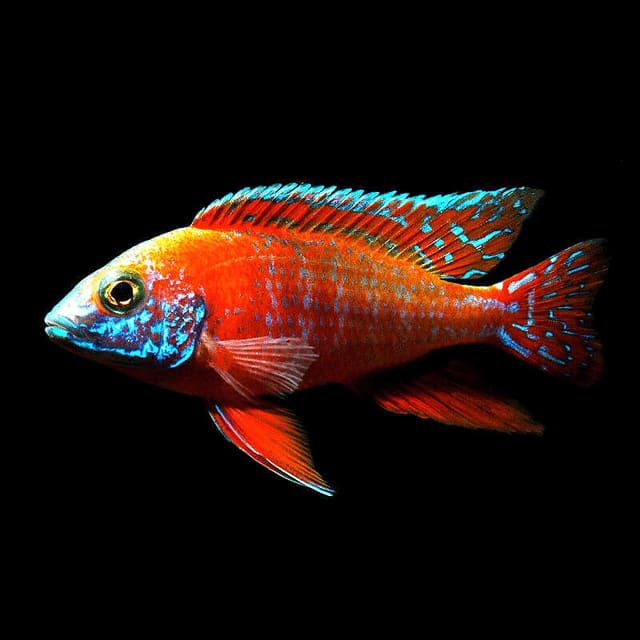
The Red Peacock Cichlid (Aulonocara sp. Red) is a haplochromine cichlid from Lake Malawi in East Africa. It suits keepers planning a Malawi community around OATA’s guidance of at least 200 litres, 23–27°C, pH 8.0–8.6 and 12–18°dH. Sold individually in 3 - 4 cm, 4 - 5 cm, 5 - 6 cm and XL dispatch sizes.
Aulonocara sp. Red
Save when buying multiple fish. Each quantity is one fish; sex and pair formation are not guaranteed unless the selected variant explicitly states them.
The Red Peacock Cichlid (Aulonocara sp. Red) is a haplochromine cichlid from Lake Malawi in East Africa. It suits keepers planning a Malawi community around OATA’s guidance of at least 200 litres, 23–27°C, pH 8.0–8.6 and 12–18°dH. Sold individually in 3 - 4 cm, 4 - 5 cm, 5 - 6 cm and XL dispatch sizes.
Cichlids are a family of roughly 1,800 accepted species, not one care type. Before buying, identify the exact species and source, then compare adult measurement, usable tank dimensions, social system, territory, tested water, diet and an exit plan. No family-wide minimum tank, water range or tank-mate list is safe.
Maintain these water conditions for optimal health and vibrant colors
The Red Peacock Cichlid (Aulonocara sp. Red) is a live freshwater haplochromine cichlid for a hard, alkaline Lake Malawi aquarium. Wikipedia describes Aulonocara as a genus endemic to Lake Malawi in East Africa, while WoRMS places Aulonocara in the family Cichlidae. It suits a keeper who can prepare a mature, filtered aquarium, hold stable Malawi water values and manage an aggressive cichlid community deliberately. This is not a soft-water community fish or a choice for adding casually to an established mixture of unrelated tropical species.
Keep the aquarium at 23–27°C, pH 8.0–8.6 and 12–18°dH. OATA’s African Malawi cichlid guidance gives those figures as broad guidance for the group, together with carbonate hardness of 10–15°dKH. Use measured values rather than judging water by appearance. Ammonia and nitrite must remain at zero, while nitrate should not exceed 20 mg per litre above the normal tap-water level.
For a reasonable-sized Malawi community, start with an aquarium of at least 200 litres. OATA says Malawi cichlids can be kept in groups of at least 15 and that small groups will often fight. That is a whole-community planning reference, not a reason to add fish faster than the biological filter can support. The aquarium, filtration and stocking plan must work together before any animal is introduced.
| Suits | Not suited to |
|---|---|
| A mature, filtered aquarium of at least 200 litres planned as a Malawi community | A new or unfiltered aquarium |
| Hard, alkaline water maintained at 23–27°C and pH 8.0–8.6 | Soft, acidic community water |
| A keeper prepared to manage aggression and assess every companion | Casual mixed-community stocking |
| A planned group of at least 15 Malawi cichlids where the aquarium can support it | A small Malawi group likely to concentrate aggression |
OATA describes Malawi cichlids as usually undemanding and easy to keep, but it also calls them aggressive and identifies specialised water requirements. The practical challenge is therefore planning rather than complicated daily handling: establish the water chemistry, mature the filter, allow sufficient community space and make compatibility decisions before the fish enters the aquarium.
The exact species has not been identified, so the care advice here follows the genus Aulonocara and its care group. The trade name Aulonocara sp. Red places the fish in the genus without naming a species. Plan around the stated Malawi community values and seek a firmer identification before using any species-level adult length, diet or social formula.
One purchase supplies one live fish in the selected size. The live selector uses the labels 3 - 4 cm, 4 - 5 cm, 5 - 6 cm and XL. The size you select is the size supplied, not the adult size. Treat the centimetre labels as dispatch measurements and XL as its displayed grade; do not turn XL into a centimetre measurement or use any dispatch grade as a mature-length prediction.
Sex is guaranteed only when the selected option explicitly states male or female. This Red Peacock Cichlid listing has no sex-guaranteed option. Wikipedia describes Aulonocara as strongly sexually dichromic, but colour, markings, apparent maturity and gallery appearance must not be used as a sex promise for the fish supplied.
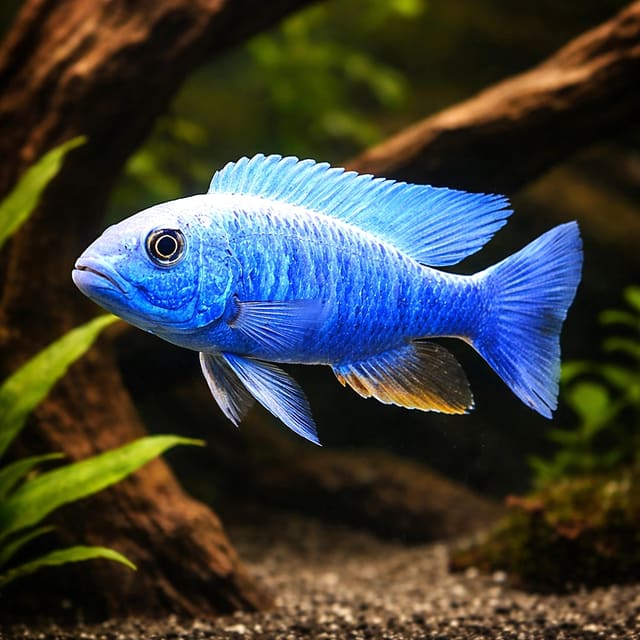
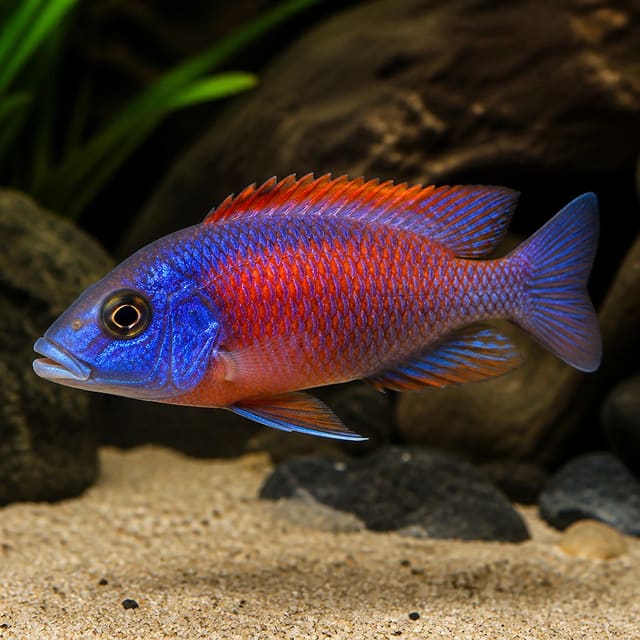
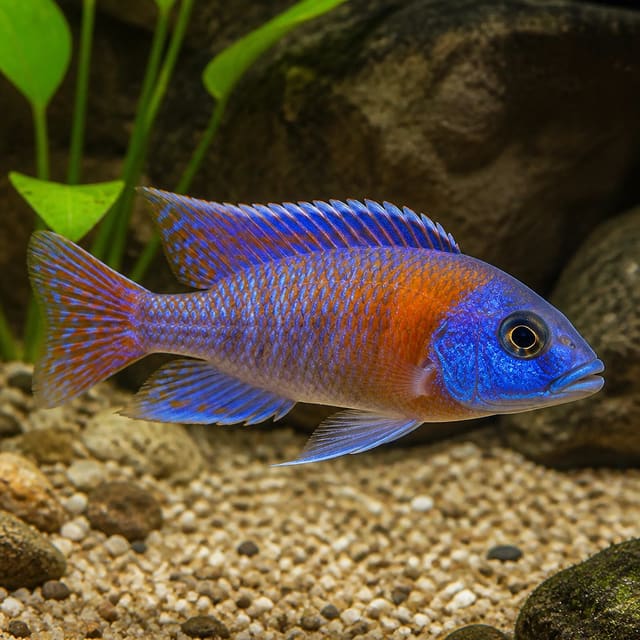
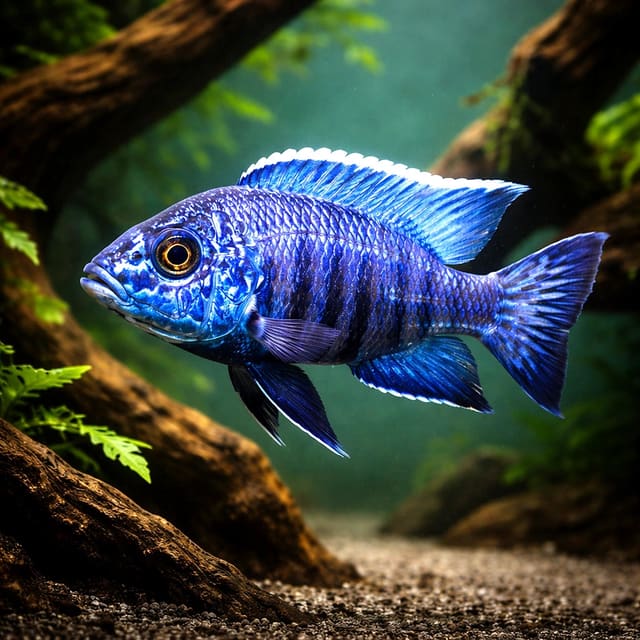
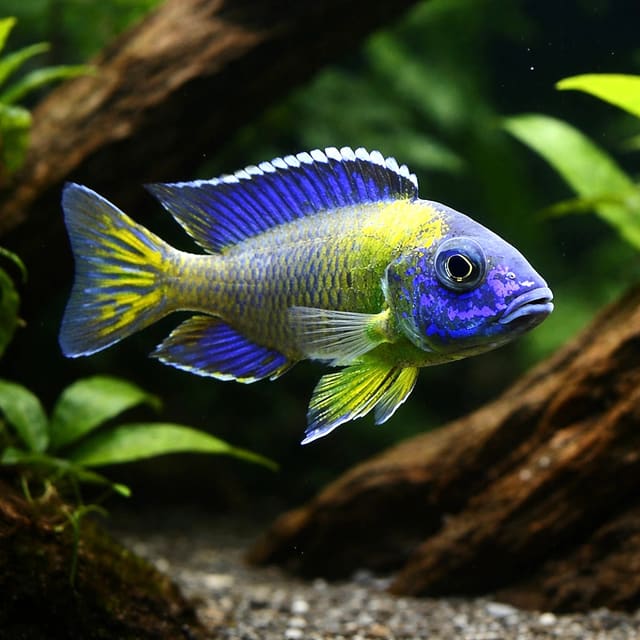
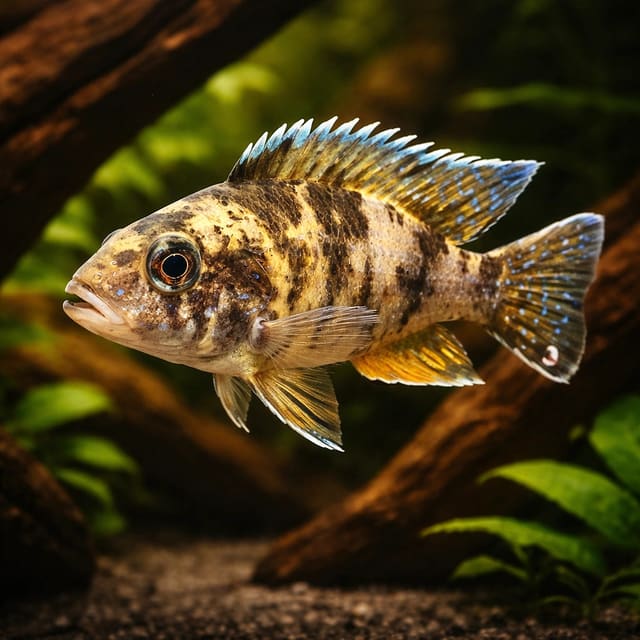
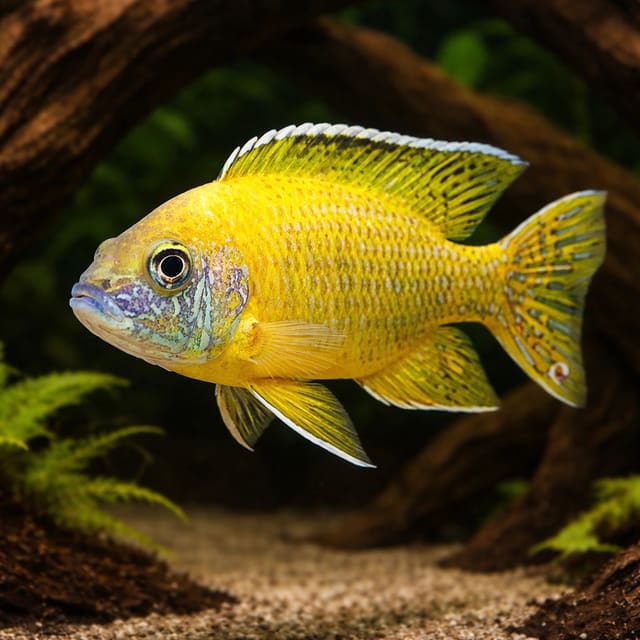
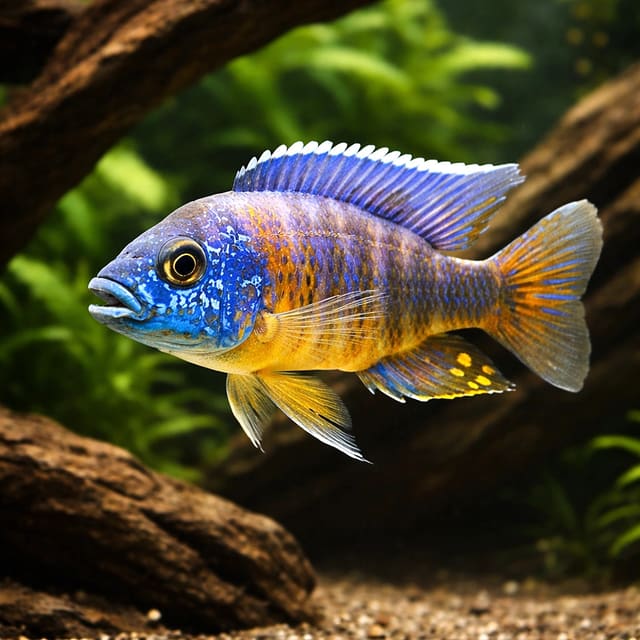
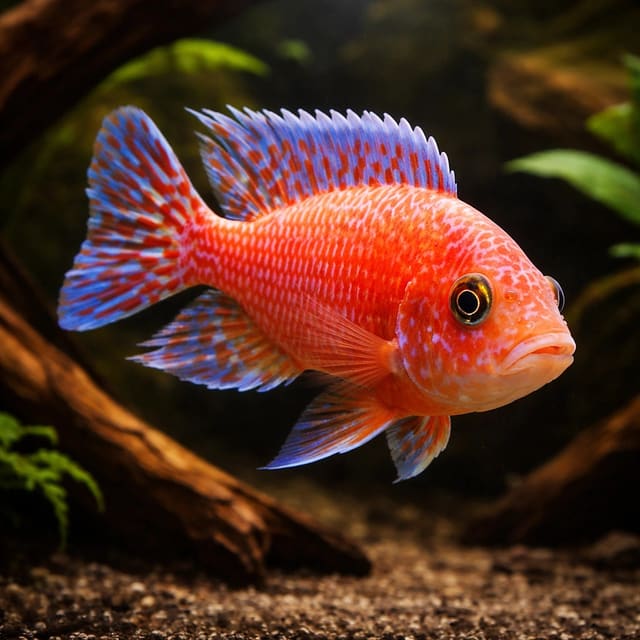
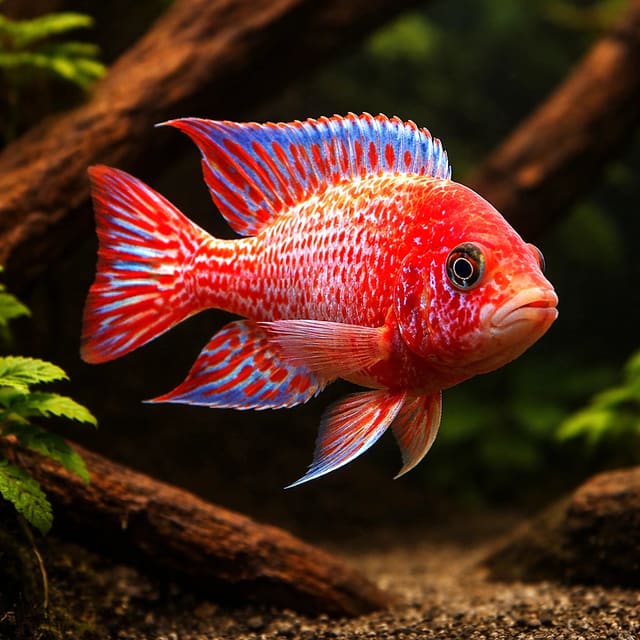
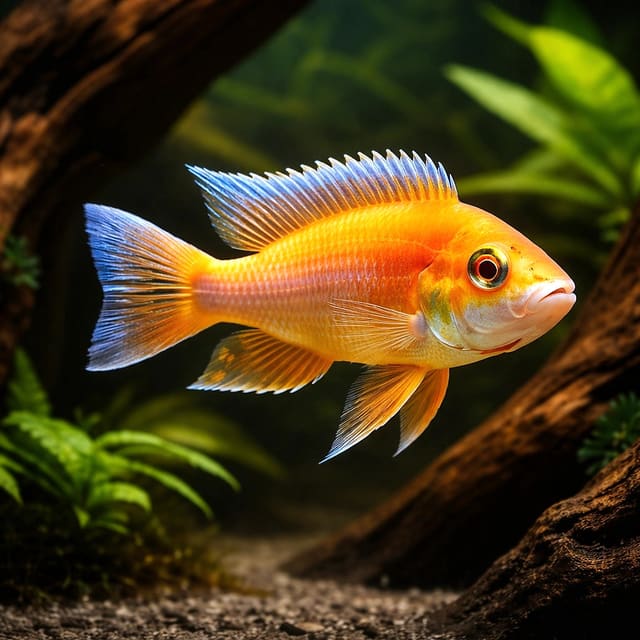
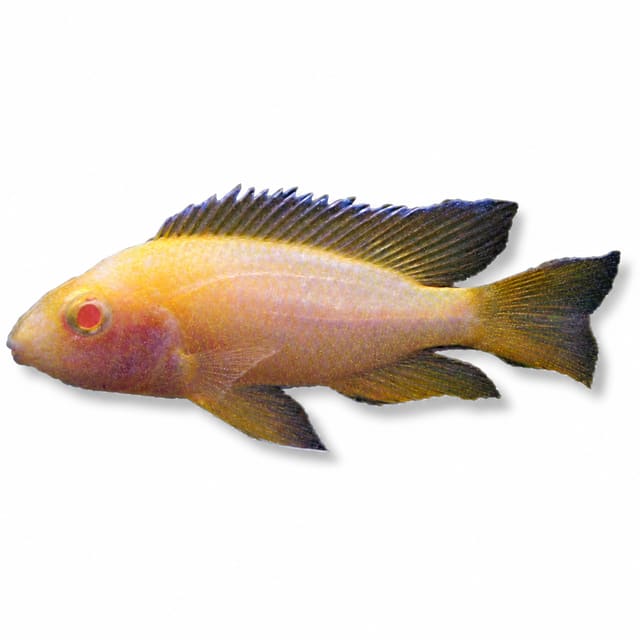
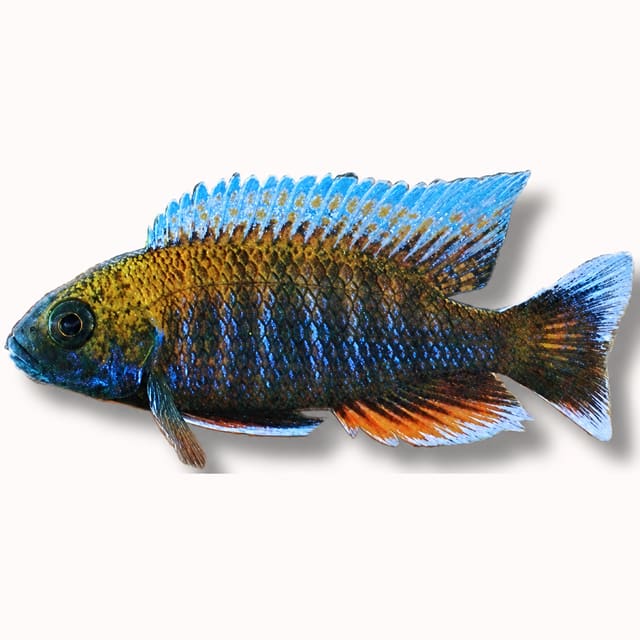
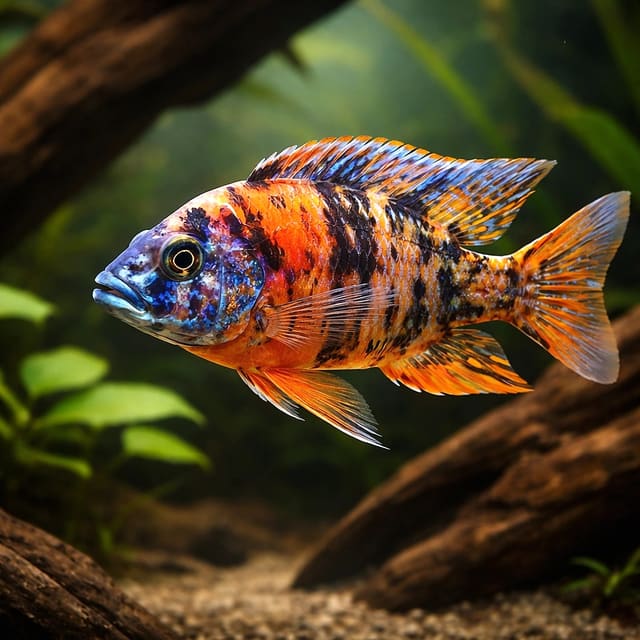
The gallery images are representative, based on reference photographs of this kind of animal, so colours can look slightly different from the live animal. Treat the gallery as an illustration of this kind of fish, and expect the fish supplied to differ in colour, pattern and markings. Two animals appearing in a scene does not alter the sold unit: each purchase quantity supplies one fish.
If this aquarium is still at the research stage, browse the African cichlid collection to compare identities and plan a coherent Malawi community. Similar colouring is not enough to establish compatibility; water requirements, aggression and the role of every fish in the complete stocking plan matter more.
Use at least 200 litres for a reasonable-sized Malawi cichlid community, then assess whether the aquarium can support the intended number and behaviour of fish. OATA recommends buying as large an aquarium as reasonably possible because a larger volume gives more stable temperature and water quality. The 200-litre figure is a community reference for the care group, so do not treat it as an exact volume calculated for one unidentified Red Peacock Cichlid.
Plan the complete population before choosing fish. Malawi cichlids can be kept in groups of at least 15, and OATA warns that small groups will often fight. It also says a slight overstocking is required to spread aggression evenly through the population, which increases the importance of filtration, aeration, testing and maintenance. That does not mean exceeding the aquarium’s biological capacity or adding a large population to an immature filter.
A useful planning exercise is to write down the aquarium volume, current livestock, intended additions and latest ammonia, nitrite and nitrate readings. If the aquarium is empty but newly set up, complete the first tropical aquarium preparation and maturation steps before setting an arrival date. If fish are already present, assess the proposed addition against both water capacity and the existing aggression pattern.
Additions must be paced around the filter. OATA explains that beneficial bacteria need to increase whenever fish numbers and feeding rise. Stocking too quickly can cause new tank syndrome because the bacterial population cannot process the additional waste, allowing toxic ammonia and nitrite to rise. A large aquarium does not remove that risk when its filter is immature.
Review the plan whenever the population changes. A stable reading before an addition is the starting point; continue testing afterwards so a developing waste problem is found early. If ammonia or nitrite rises above zero, stop further additions and restore safe water quality before reconsidering the stocking schedule.
Keep the Red Peacock Cichlid at 23–27°C, pH 8.0–8.6 and general hardness of 12–18°dH. Maintain carbonate hardness at 10–15°dKH. These OATA values give one coherent target range for planning, testing and water changes. Choose readings inside all four ranges rather than adjusting one measurement while ignoring the others.
Ammonia and nitrite must remain at zero mg per litre. Nitrate should not exceed 20 mg per litre above the level in the normal tap water. Test the source water as well as the aquarium so the nitrate result can be interpreted against that baseline. The Tropical Fish Co water chemistry guide explains what the principal measurements mean, while the water matcher helps compare measured aquarium values with the range used here.
| Measurement | Action |
|---|---|
| Temperature | Hold between 23°C and 27°C and investigate movement outside the range. |
| pH | Maintain 8.0–8.6 and compare readings taken with the same method. |
| General hardness | Keep at 12–18°dH. |
| Carbonate hardness | Keep at 10–15°dKH. |
| Ammonia and nitrite | Maintain both at zero mg per litre. |
| Nitrate | Keep it from exceeding 20 mg per litre above normal tap-water levels. |
Test at least weekly as part of the regular maintenance cycle. Also test when fish change their swimming, breathing, feeding, colour or aggression, because water quality is the first practical factor to check. Record results rather than relying on memory; a sequence of readings makes gradual movement easier to detect than one isolated test.
Prepare replacement water with a tap-water conditioner before adding it to the aquarium so harmful chlorine or chloramine is removed. OATA says the aquarium should have coral sand or a similar substrate to buffer the water. Test after any deliberate change to the water or substrate so the result is measured rather than assumed.
If a reading moves outside the target, deal with the measured problem before adding more fish or food. Check the filter for blockages, inspect for uneaten food and carry out the scheduled conditioned-water change. Avoid changing several parts of the system without measuring the outcome; a written before-and-after reading shows whether the action restored the intended range.
Run a well set up and maintained filter at all times. The RSPCA explains that biological filtration supports beneficial bacteria that convert toxic ammonia into nitrite and then into the safer nitrate. The filter is therefore living infrastructure for the aquarium, not simply a device that removes visible debris.
Use an oversized filter and aggressive aeration for a Malawi community. OATA links that recommendation to the crowded environments needed for successful Malawi communities: more fish and food create more waste, while every fish still requires sufficient dissolved oxygen. Check water movement and the filter for blockages as part of each maintenance session.
Change 25% of the aquarium water at least once every week. A busier community may create visible waste sooner, but any additional action should be led by testing and observation. Do not wait for cloudy water or distressed fish before completing the scheduled work.
When filter media needs cleaning, do not run it under the tap. Rinse it lightly in aquarium water removed during the partial water change. This reduces the loss of beneficial bacteria that chlorine or chloramine could cause. Avoid cleaning every part of the biological system aggressively at the same time; the goal is to remove blockages while preserving the bacterial population.
Feeding and filtration are directly linked. Food left uneaten breaks down and adds toxic waste, so portion control protects both the fish and the filter. After any increase in fish numbers, watch ammonia and nitrite closely while the beneficial bacteria respond to the higher waste load. Further stocking waits until the readings are back at zero and stable.
Use visible changes as prompts for an immediate test. Surface hanging, bottom sitting, erratic swimming or altered gill movement can accompany a water-quality problem. Testing turns an observation into a practical decision and prevents blind changes to an otherwise stable aquarium.
Use coral sand or a similar substrate that helps buffer the hard, alkaline water. Malawi cichlids will often dig and rearrange the substrate, which will uproot any plants present. Keep equipment functional and make sure rearranged substrate cannot obstruct an intake, reduce flow or conceal an area that needs cleaning.
Use only the hardiest attached-growing plants, because digging will uproot any plants in the substrate. Treat planting as an optional part of the layout rather than relying on delicate growth to make the aquarium suitable. Inspect plants during maintenance and remove damaged material before it decays into the water.
OATA says rearranging the aquarium décor can help to reduce aggression as fish find new territories. That intervention has a specific purpose: it changes the territorial layout. Observe the community afterwards and confirm that aggression is spread rather than redirected relentlessly towards one animal.
Do not use visual resemblance to Lake Malawi as a substitute for the measurable requirements. A convincing display still needs 23–27°C water, pH 8.0–8.6, hard water, zero ammonia and zero nitrite. Conversely, a simple layout that keeps filtration, aeration and maintenance access working can support better decisions than an elaborate arrangement that traps waste or blocks equipment.
Before the fish arrives, complete the layout and confirm that the filter and aeration operate correctly with the substrate in place. Check the aquarium again after the first period of digging. If sand has accumulated around equipment or solid waste is collecting in inaccessible areas, adjust the arrangement and verify water movement before the problem affects water quality.
Use a complete Malawi cichlid food matched to the fish’s confirmed feeding type, and feed only what is eaten within a few minutes, twice a day. OATA explains that Malawi cichlid diets vary: smaller mbuna are more herbivorous and appreciate specialised high-algae feeds and fresh vegetables, while some larger utaka may be more predatory and require pellets with higher animal content plus suitable frozen feeds.
Do not choose between those two feeding patterns from red colour, dispatch size or a trade label alone. Establish which feeding type applies before making either an algae-rich or higher-animal-content formula the staple.
The time limit applies to the whole portion, not to a race to add more food. If food remains after a few minutes, reduce the next portion. If one fish is consistently excluded, treat that as a social and compatibility problem rather than repeatedly adding food that the dominant fish may consume.
Variety must stay within the appropriate feeding pattern. For a fish confirmed as one of the smaller, more herbivorous mbuna, OATA says specialised Malawi cichlid feeds with a high algae content and fresh vegetables will be appreciated. For one confirmed as a more predatory utaka, it says pellets with a higher animal content will be required, with frozen feeds such as brine shrimp, prawns or cockles. Confirmation comes before selecting between those examples.
Overfeeding creates two connected risks. The fish receives more than it can eat, and the leftovers release toxic waste as they decompose. Check ammonia and nitrite if feeding interest drops, food begins accumulating or the community has recently changed. Both readings must remain at zero.
Keep a simple feeding note during the first weeks: record the food used, portion response and whether any animal is being displaced. This creates a practical baseline for appetite. A later reduction in intake can then be recognised promptly and considered alongside swimming, breathing, colour, body condition and the current water-test results.
Be present to receive the parcel and start filming before it is opened. Tropical Fish Co’s delivery and Live Arrival Guarantee policy instructs customers to make a continuous unboxing video beginning with the parcel still sealed and the outer box visible. The video must then show the parcel being opened and the fish still inside the sealed bag before anything is disturbed.
Prepare the aquarium before the parcel arrives. OATA’s introduction advice is to confirm that ammonia and nitrite are zero and that the aquarium is an appropriate size for the intended Malawi population. Complete these aquarium checks before receiving the fish.
Coordinate the addition with the social plan. OATA recommends adding Malawi cichlids in groups so one new individual does not receive unnecessary aggression while settling in. It also recommends adding more peaceful species first and more aggressive species later. Apply that sequence only after the aquarium’s biological capacity and the identities of the intended group have been assessed.
Adding in groups does not mean adding fish faster than the filter can support. Beneficial bacteria must increase as fish numbers and feeding rise, and rapid stocking can cause new tank syndrome. Test after additions and pause the stocking plan if ammonia or nitrite rises above zero.
Watch how the existing fish respond after release. Persistent attacks, concentrated chasing or damage require action; rearranging décor can make established fish find new territories. Continue observing the newcomer’s swimming, breathing and feeding while testing the water, because social pressure and water-quality changes can appear at the same time.
Keep the order number and continuous video accessible. For a Live Arrival Guarantee claim, the policy requires same-day contact together with the order number and video showing the sealed parcel, continuous opening and fish still in the sealed bag.
Use the fish’s normal behaviour and appearance as the baseline, then act on changes. OATA describes healthy fish as having clear, bright eyes, undamaged fins, intact scales, no ulcerations or bumps and appropriate swimming. Appetite, breathing and body condition should also remain consistent for that individual.
Check ammonia and nitrite first and require both to be zero. Measure temperature, pH, general hardness, carbonate hardness and nitrate at the same time so the assessment covers the whole Malawi water target. Inspect the filter for blockage, confirm aeration and look for uneaten food or accumulated solid waste.
If a social problem is visible, identify the fish giving and receiving aggression. Rearranging décor may break established territories, but observation afterwards is essential. The intervention has worked only when attacks are reduced or spread rather than focused on another individual.
Do not diagnose a disease from one non-specific sign. Reduced feeding, hiding or colour change can accompany several problems, including poor water quality or aggression. Record the observed change and measured water results, and contact Tropical Fish Co for further guidance whenever you are concerned about the fish’s health. Avoid selecting medication or a treatment recipe from appearance alone.
Keep maintenance steady while investigating. Continue conditioned-water changes, protect the biological filter and remove uneaten food. Do not rinse filter media under the tap, because chlorine or chloramine may kill beneficial bacteria and create an additional water-quality problem.
A short written log makes subtle changes easier to judge. Note the date, water readings, appetite, breathing, swimming and aggression. This separates a momentary variation from a continuing decline and gives a clear account of what changed and which practical checks have already been completed.
Keep this fish only with other Malawi cichlids or some species of Synodontis catfish that naturally inhabit Lake Malawi. That is OATA’s compatibility boundary for Malawi cichlids. The exact companion still needs screening for identity, water values, expected behaviour, aquarium capacity and its place in the stocking sequence.
Do not add unrelated tropical community fish, whatever their size or colour. The Malawi plan requires 23–27°C, pH 8.0–8.6 and hard water, while aggression must be managed across the whole population. Only other Malawi cichlids and some Lake Malawi Synodontis belong in this community, even when another fish would tolerate the same water.
Do not treat “other Malawi cichlid” as a universal approval. OATA describes the group as aggressive and says all mixes require caution. Species identity, aquarium size and the existing social pattern determine whether a proposed addition belongs in a particular community.
Some Lake Malawi Synodontis fall within the permitted category, but “Synodontis” alone is too broad for a decision. Confirm that the proposed catfish is one of the species covered by the Lake Malawi condition and that its care fits the aquarium before including it.
Sex ratios also require care. OATA advises keeping more females than males of each species where possible so one female does not receive all of a male’s attention. That advice cannot be converted into a fixed ratio for this offer because sex is not guaranteed. Build the stocking plan from animals whose identities and sexes are genuinely known rather than inferring either from colour or size.
Treat aggression as an expected Malawi cichlid risk. OATA calls these fish aggressive, says small groups will often fight, says they can be kept in groups of at least 15 and says a slight overstocking is required to spread aggression evenly. Those measures work only as part of a sufficiently large, strongly filtered and well-aerated community.
Use at least 200 litres for a reasonable-sized community and choose a larger aquarium where practical. Pair the stocking plan with an oversized filter, aggressive aeration, weekly testing and a 25% partial water change at least once every week. Social management must not come at the expense of oxygen or water quality.
| If you see | Do this |
|---|---|
| One newcomer receiving repeated attacks | Review the introduction group and rearrange décor to disrupt established territories. |
| A small group fighting repeatedly | Reassess the whole community plan rather than adding one unplanned fish. |
| Torn fins or missing scales | Test water, identify the aggressor and protect the injured fish from continuing attacks. |
| More hiding or reduced feeding | Check aggression, water values and access to food together. |
| Ammonia or nitrite above zero | Pause additions and restore biological stability before changing the population again. |
When several fish are introduced, keep the biological filter’s response in view. Every addition increases waste and feeding, and beneficial bacteria need time to increase. An aggression-management plan that creates new tank syndrome has exchanged one serious risk for another.
Introduce more peaceful species before more aggressive species. Adding Malawi cichlids in groups can reduce the chance that one new fish receives all the aggression, but the group must have passed the compatibility and capacity checks first. Do not use this advice to mix categories outside other Malawi cichlids and eligible Lake Malawi Synodontis.
Observe changes in both directions. An established fish may become more aggressive, while the new fish may hide, stop feeding or show fin damage. Continue monitoring after the first encounter rather than deciding compatibility from a brief calm period. A successful community maintains safe water values and avoids sustained attacks on any one animal.
Plan its space around OATA’s reference of at least 200 litres for a reasonable-sized Malawi cichlid community. The labels 3 - 4 cm, 4 - 5 cm, 5 - 6 cm and XL describe dispatch sizes and must not be treated as adult measurements.
Use an aquarium of at least 200 litres for a reasonable-sized Malawi cichlid community. OATA gives this as a community planning figure and recommends choosing as large an aquarium as reasonably possible for more stable temperature and water quality.
OATA says Malawi cichlids can be kept in groups of at least 15 and warns that small groups often fight. Plan that as a complete Malawi community, with sufficient aquarium capacity, oversized filtration and aggressive aeration.
It can suit a prepared beginner because OATA describes Malawi cichlids as usually undemanding and easy to keep. The keeper must still maintain specialised hard, alkaline water and manage an aggressive community in a mature aquarium.
Feed a complete Malawi cichlid food matched to its confirmed feeding type, twice daily, offering only what it eats within a few minutes. OATA separates algae-rich feeding for smaller mbuna from higher-animal-content foods for some larger utaka, so confirm the applicable type first.
Keep the Red Peacock Cichlid at 23–27°C and pH 8.0–8.6, with general hardness of 12–18°dH. OATA gives these Malawi cichlid values and also requires zero ammonia and zero nitrite.
Treat it as an aggressive Malawi cichlid and monitor chasing, hiding and fin condition. OATA warns that small groups often fight; rearrange décor if established territories cause concentrated attacks and reassess any fish receiving persistent aggression.
Use only other Malawi cichlids or some Synodontis species that naturally inhabit Lake Malawi. Screen the exact companion, shared water values, aquarium capacity and aggression pattern before mixing.
Tropical Fish Co hand-bags the fish in pure oxygen and uses an insulated poly box, with a heat pack when the weather calls for it. Be present to receive it, film continuously from the sealed parcel, float the bag for 20–30 minutes and release the fish without pouring bag water into the aquarium.
No reviews for this item yet. Bought one? Honest reviews only, good or bad.
What customers say about ordering from us
I have a small group of long finned mountain minnows. So was delighted to be able to order ten of this variety to increase the genetics in my tank . The ones I recieved are healthy but it’s to early to give a verdict on wether they are of a long finned type since they are small currently.
Gordon Walker · 23 Sept 2026
100% success travel and "installation". Pleased with quality of purchase. The Siamese fighter a bit "shy" so have not yet seen him at his best yet but looking good. Happy customer. GG
George E Garratt · 21 Sept 2026
Reviews of our shop, collected by Judge.me, an independent third-party review collector. Newest first.