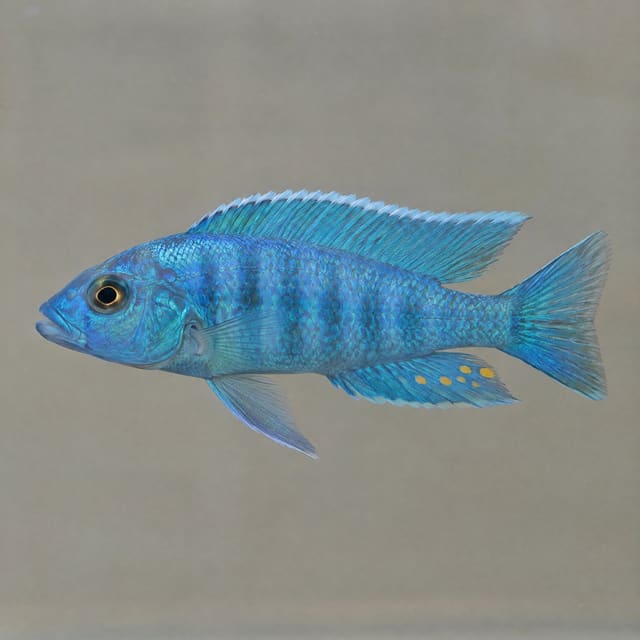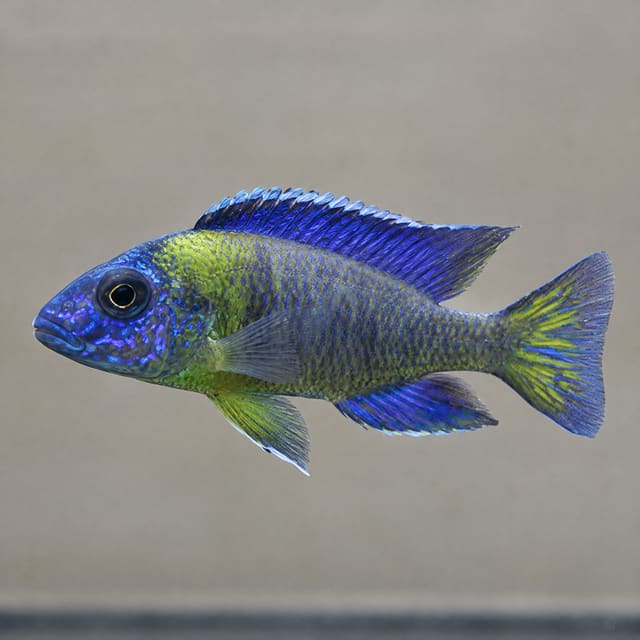
Steveni Blue Neon Peacock Cichlid (Aulonocara stuartgranti)
23–26°C · pH 8–8.6 · 243L
£12.99
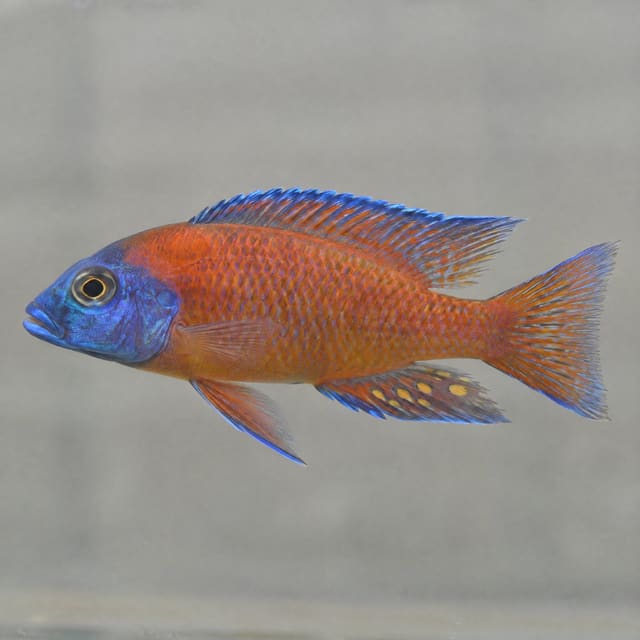
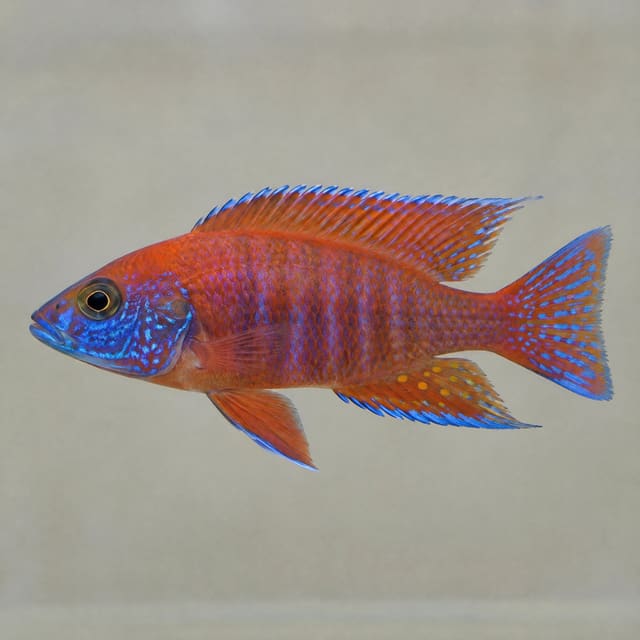
The Blue Red Sided Peacock is a captive-bred Lake Malawi peacock cichlid (Aulonocara sp.) whose males have a bright blue head and back with red-orange flanks. It grows to about 12–15 cm and suits a hard-water Malawi aquarium with a base of 120 × 45 cm or more, open sand and stable rockwork. Sold individually as one live fish.
Adult size is the maximum length this species reaches at full maturity (scientific sources). The livestock you receive will be younger and smaller. Product-photo provenance and any image-specific limitations are stated on the listing.
Aulonocara sp.
Save when buying multiple fish. Each quantity is one fish; sex and pair formation are not guaranteed unless the selected variant explicitly states them.
The Blue Red Sided Peacock is a captive-bred Lake Malawi peacock cichlid (Aulonocara sp.) whose males have a bright blue head and back with red-orange flanks. It grows to about 12–15 cm and suits a hard-water Malawi aquarium with a base of 120 × 45 cm or more, open sand and stable rockwork. Sold individually as one live fish.
Adult size is the maximum length this species reaches at full maturity (scientific sources). The livestock you receive will be younger and smaller. Product-photo provenance and any image-specific limitations are stated on the listing.
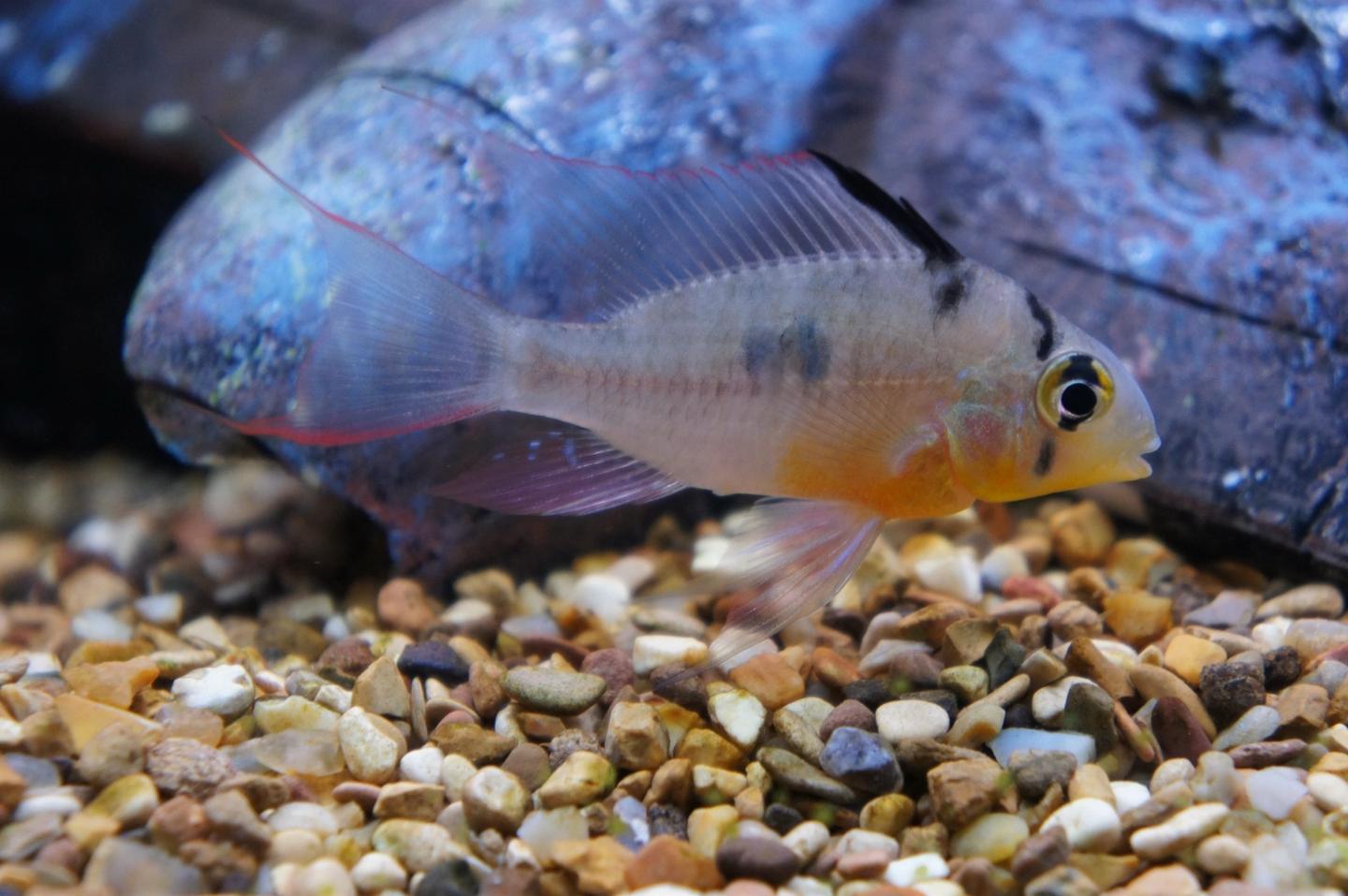
Cichlids are a family of roughly 1,800 accepted species, not one care type. Before buying, identify the exact species and source, then compare adult measurement, usable tank dimensions, social system, territory, tested water, diet and an exit plan. No family-wide minimum tank, water range or tank-mate list is safe.
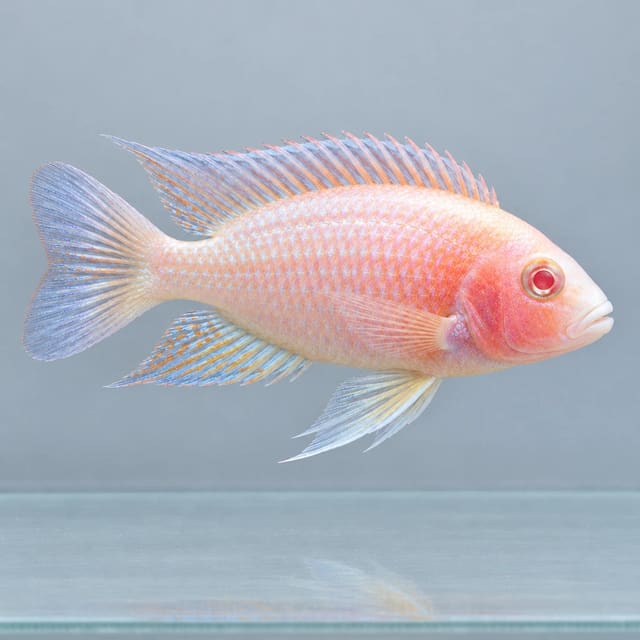
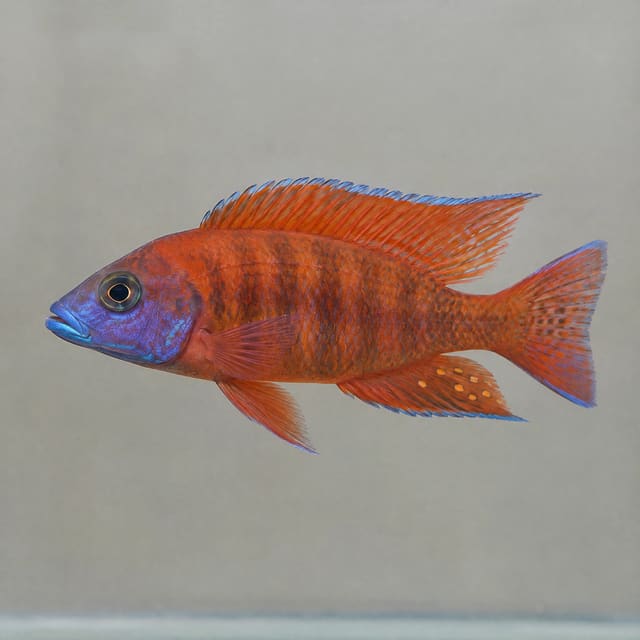
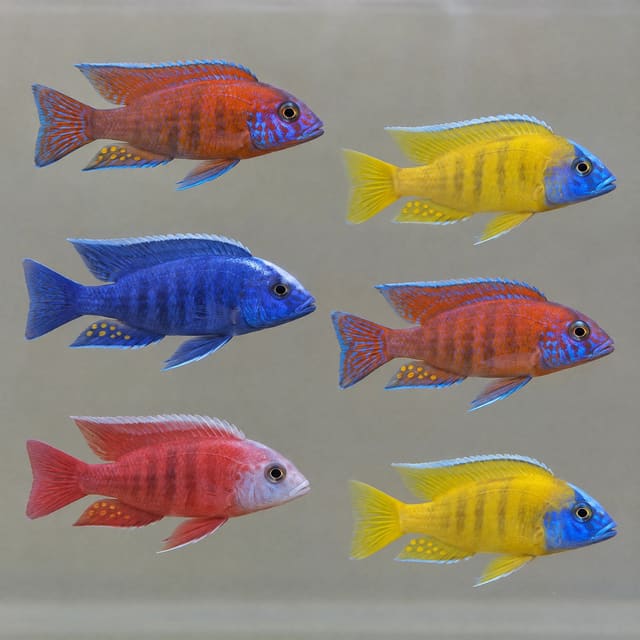
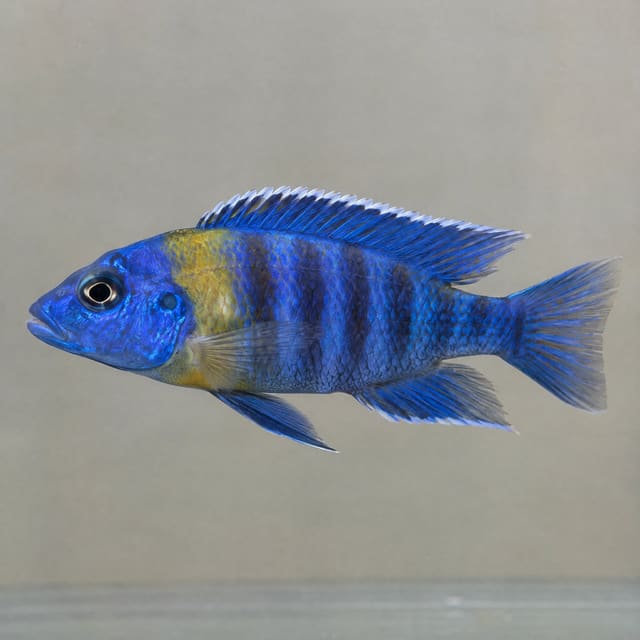
The Blue Red Sided Peacock is a captive-bred peacock cichlid whose males combine an electric-blue head and back with red-orange flanks. The scales on the sides carry blue edges over the red, the dorsal fin runs from blue at the front to red-orange at the back, and the tail and anal fin are red-orange with blue rays and pale spots. In a 120 cm Malawi aquarium with pale sand and grey rock, a mature Blue Red Sided Peacock male is one of the most striking fish you can keep.
Peacocks belong to the genus Aulonocara. Seriously Fish profiles eight of them, all endemic to Lake Malawi in East Africa, and explains that the genus name refers to the greatly enlarged sensory canal system in the skull. Wild peacocks live where rocky shores give way to sand; FishBase records Aulonocara stuartgranti along the lake's coast, feeding on sand-dwelling invertebrates.
Blue Red Sided Peacock is a trade name. The fish is sold as Aulonocara sp. because the name is not tied to one described species or wild collecting site, and we have found no scientific description of a fish under this name. Blue-and-red peacocks reach the trade under several names: Seriously Fish, for example, lists red peacock, red flash and red flush among the trade names used for Aulonocara hansbaenschi. The table shows similar-looking peacocks we sell, so you can compare.
| Peacock | Name on our listing | Notes |
|---|---|---|
| Red Flash Peacock Cichlid | Aulonocara stuartgranti | A described species; Seriously Fish gives 130 mm standard length |
| Fort Maguire Peacock Cichlid | Aulonocara hansbaenschi | The red shoulder peacock; Seriously Fish gives 120 mm standard length |
| Ngara Peacock Cichlid | A. stuartgranti 'Ngara' | Traded as the flametail, according to Seriously Fish |
| Rubin Red Peacock Cichlid | Aulonocara sp. 'Rubin Red' | An aquarium colour form |
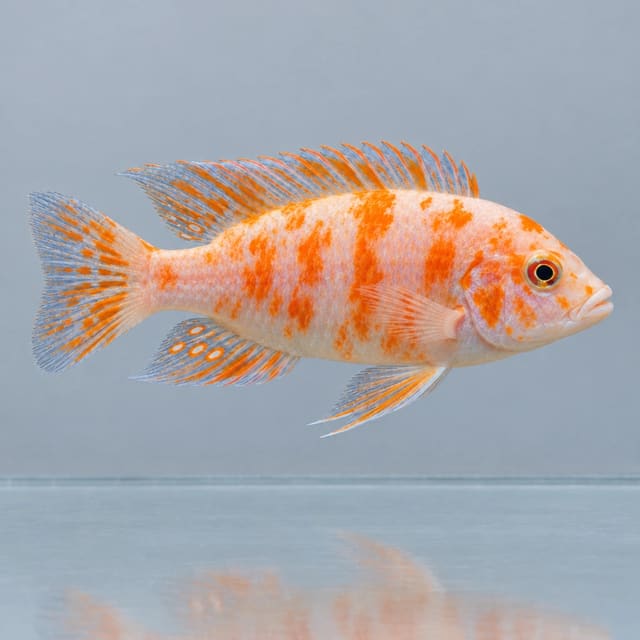
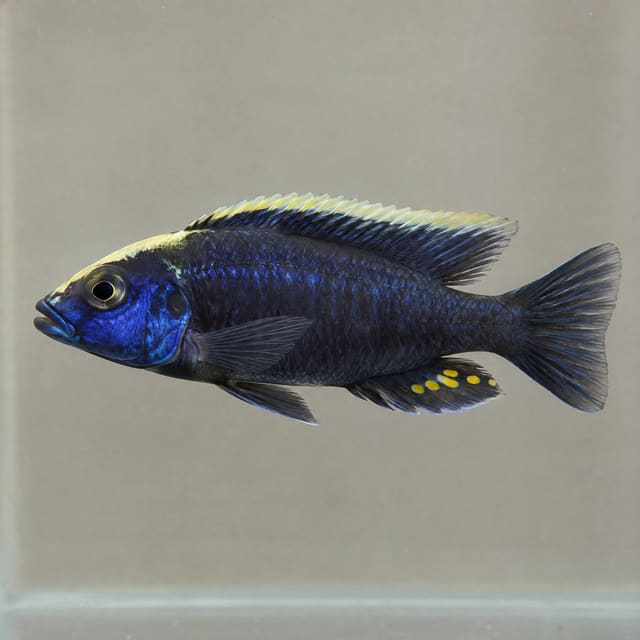
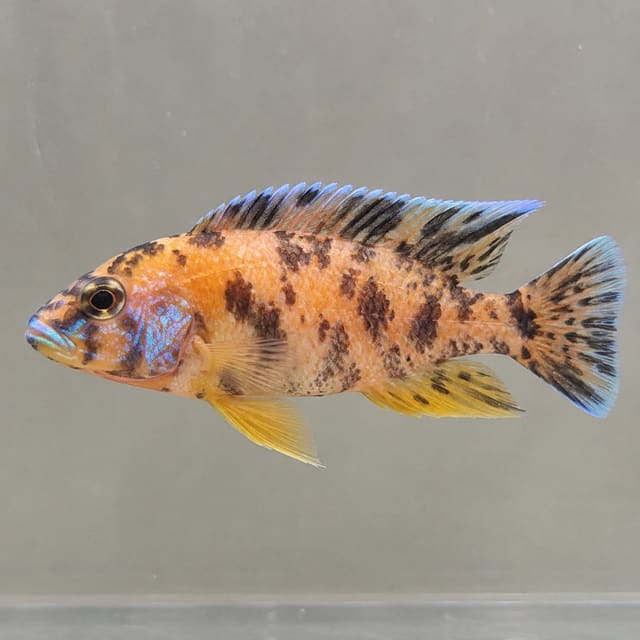
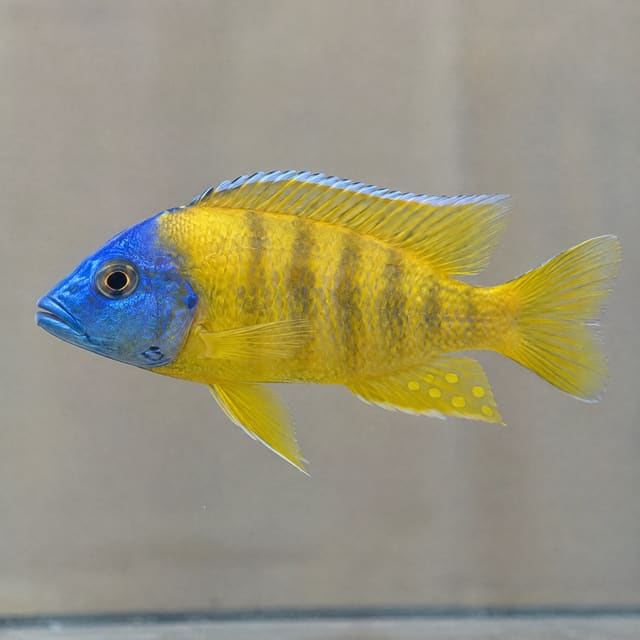
One purchase supplies one live Blue Red Sided Peacock at the standard size currently available. Sex is not chosen or guaranteed. Seriously Fish describes peacock males as larger and more colourful than females, with egg spots on the anal fin, so the full blue-and-red colour shown in the photographs belongs to an adult male. Young fish and females are much plainer, and colour builds as males mature.
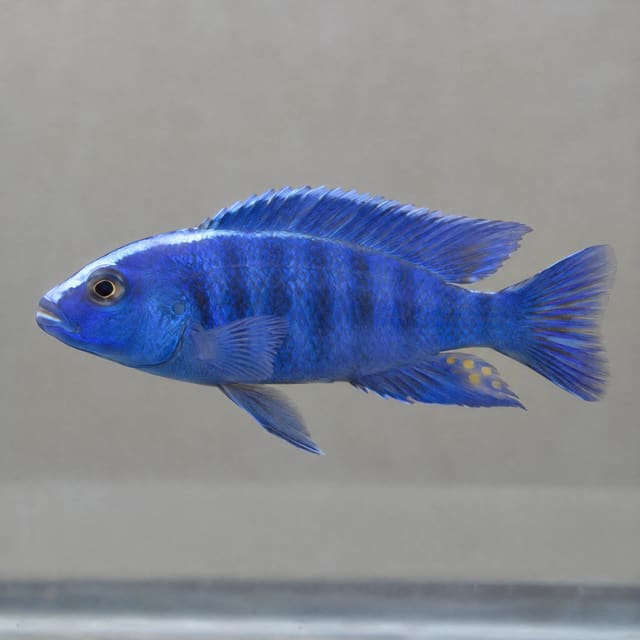
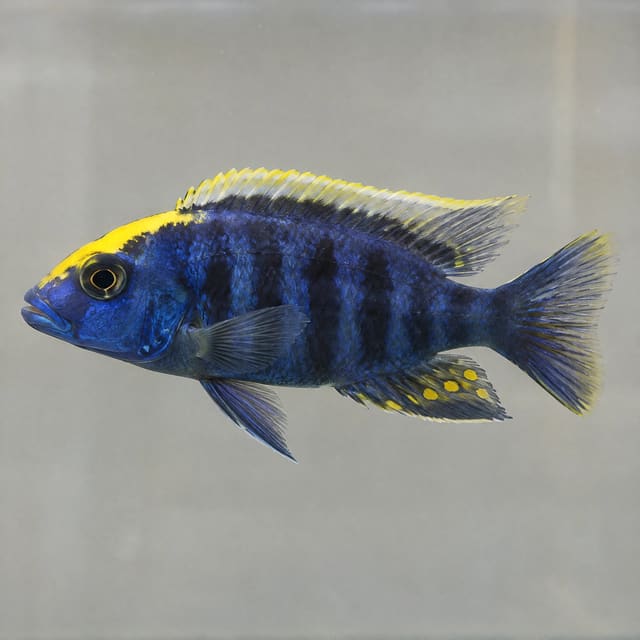
The photographs show the colour form, not the individual you will receive. The balance of blue and red varies from fish to fish and changes with mood, age and lighting.
Our delivery and Live Arrival Guarantee details explain dispatch days and what to do on arrival.
Seriously Fish gives 120 mm standard length for A. hansbaenschi and 130 mm for A. stuartgranti, both measured without the tail, while FishBase gives 11.8 cm total length for A. stuartgranti, so the sources disagree slightly. Plan for a male of 12–15 cm.
Seriously Fish recommends a base of at least 120 × 45 cm, about 243 litres, for A. stuartgranti and 90 × 45 cm, about 182 litres, for the slightly smaller A. hansbaenschi. OATA recommends at least 200 litres for any Malawi community and notes that larger aquariums stay more stable. A 120 cm tank with a 45 cm base is the sensible minimum for this fish and its companions.
Seriously Fish describes peacocks living in the intermediate zone where rocky shores meet open sand, and recommends fine sand with rock piles that leave open spaces for feeding. It warns that gravel or small pebbles stop peacocks feeding naturally and can damage gill filaments or be swallowed. FishBase notes that some A. stuartgranti are shy and stay in caves while others school over open sand, so give both options.
| Feature | Purpose |
|---|---|
| Fine coral sand across the front | Feeding ground; OATA notes coral sand helps buffer the water |
| Rock piles with caves, built on the glass | Territories, refuges and spawning sites |
| Flat stones beside open sand | Seriously Fish suggests flat rocks and open sand as spawning sites |
| Gaps between piles | Break lines of sight, which OATA says limits aggression |
The Maidenhead Aquatics database notes that peacocks show better colour over a darker substrate, which suits a blue fish especially well. Our cichlid care guide has more ideas for African cichlid layouts.
Seriously Fish gives 24–29°C, pH 7.4–9.0 and 10–25 dGH for A. hansbaenschi, and 23–29°C, pH 7.5–9.0 and 10–25 dGH for A. stuartgranti. FishBase gives 22–26°C for A. stuartgranti. OATA gives 23–27°C, pH 8.0–8.6, 12–18 dGH and 10–15 dKH for Malawi cichlids in general. The target below sits inside all of them.
| Reading | Target |
|---|---|
| Temperature | 24–26°C |
| pH | 8.0–8.6 |
| General hardness | 12–18 dGH |
| Carbonate hardness | 10–15 dKH |
| Ammonia and nitrite | 0 mg/l |
| Nitrate | No more than 20 mg/l above your tap water (OATA) |
Look up your area's hardness on your water company's postcode report. If your tap water is soft, coral sand in the substrate, or coral sand or aragonite in a mesh bag in the filter as the Maidenhead Aquatics database suggests, will help keep pH and hardness up. Condition all new water. Our water matcher checks your tap water against these values, and our page on water chemistry explained covers pH, GH and KH.
Seriously Fish describes peacocks as very sensitive to falling water quality and chemical swings, and recommends heavy filtration in a biologically mature aquarium. OATA recommends an oversized filter with strong aeration. Our filtration guide explains turnover, media and cleaning.
Seriously Fish explains that peacocks take in mouthfuls of sand, sift out food and expel the rest through the gills, and that they hover just above the bottom detecting tiny movements with enlarged sensory pores on the head. It recommends high-quality fine prepared foods, some dried food with vegetable matter such as spirulina, and live or frozen foods such as bloodworm, brine shrimp and mosquito larvae.
Check that ammonia and nitrite read zero before the fish arrives. OATA advises turning off the lights, floating the sealed bag for 10 minutes, adding small amounts of tank water over up to 20 minutes and releasing the fish while keeping the bag water out of the aquarium. Our guide on how to acclimatise new fish shows the method. OATA also suggests rearranging the decor when new fish are added, so established fish lose their claimed territories.
| Day | Check |
|---|---|
| Arrival | Lights off after release; rocks rearranged beforehand |
| Day 1 | A small sinking feed; confirm it eats |
| Days 2–6 | No resident male pinning it down; fins whole |
| Day 7 | Water retested; routine water change |
Seriously Fish describes peacocks as relatively peaceful but notes that males are aggressive towards any fish with a similar colour pattern, that most mbuna are too boisterous, and that other Aulonocara are best avoided because most can hybridise. A blue-and-red male is therefore best kept with fish of clearly different colours. OATA advises keeping Malawi cichlids only with other Malawi cichlids or Synodontis catfish from the lake.
| Suits | Avoid |
|---|---|
| Easygoing yellow mbuna such as the Yellow Lab Cichlid | Other blue-and-red peacock males |
| Calm golden haps such as the Gold Electra Deep-Water Hap | Boisterous mbuna |
| The Malawi Squeaker catfish | Pure peacock species kept for breeding |
| Peacock females of its own kind | Soft-water community fish |
Check any planned mix with our tank mates tool, read our Lake Malawi cichlids UK guide, and browse the Malawi cichlid collection, our wider range of African cichlids, the Lake Malawi and Victoria cichlids and the Aulonocara category.
OATA's healthy Malawi cichlid has clear, bright eyes, undamaged fins, intact scales without ulcers or lumps, normal swimming and steady breathing. A male that loses his blue and red, hides or clamps his fins is reacting to something, usually water quality or a rival.
| Sign | First step |
|---|---|
| Colour fading, hiding, clamped fins | Test the water; look for a dominant rival |
| Fast breathing or hanging at the surface | Test ammonia and nitrite; boost aeration |
| White spots, fluffy patches, flicking | Confirm water quality, then get treatment advice |
| A female with a full throat refusing food | Probably mouthbrooding; leave her in peace |
Peacocks are maternal mouthbrooders. Seriously Fish describes the female carrying the brood for up to four weeks, often without eating, with fry that can be sexed at around four months; OATA gives 21–40 days of mouthbrooding for Malawi cichlids. Because this fish has no species name, breed it only with its own kind and never sell the young as a named wild species; Practical Fishkeeping warns that cross-breeding muddies the genetics of wild peacocks.
It is a captive-bred peacock cichlid sold as Aulonocara sp. under the trade name Blue Red Sided Peacock. Males have a bright blue head and back with red-orange flanks and red-orange fins edged in blue. The genus Aulonocara is endemic to Lake Malawi.
The trade name is not tied to one described species or wild location, which is why it is sold as Aulonocara sp. Blue-and-red peacocks are sold under several names: Seriously Fish, for example, lists red peacock, red flash and red flush among the trade names of Aulonocara hansbaenschi. Care is the same as for those wild peacocks.
We cannot confirm that. Peacock trade names are used loosely, and the same name can be applied to different fish. Treat the Blue Red Sided Peacock as its own form, and keep only one blue-and-red male per aquarium unless the tank is very large.
Plan for 12–15 cm. Seriously Fish gives 120 mm standard length for A. hansbaenschi and 130 mm for A. stuartgranti, measured without the tail, and FishBase gives 11.8 cm total length for A. stuartgranti. Males grow larger than females.
A tank with a base of at least 120 × 45 cm, about 243 litres, which Seriously Fish gives for A. stuartgranti. OATA recommends at least 200 litres for any Malawi community.
Hard, alkaline and very clean: 24–26°C, pH 8.0–8.6 and 12–18 dGH satisfies the Seriously Fish, FishBase and OATA ranges together, with ammonia and nitrite at zero.
Only in a large aquarium with plenty of rockwork and several females for each male. Seriously Fish advises one male with four to six females in most aquariums and notes that males are aggressive to fish with a similar colour pattern.
One live Blue Red Sided Peacock at the standard size currently available. Sex is not chosen or guaranteed.
No reviews for this item yet. Bought one? Honest reviews only, good or bad.
What customers say about ordering from us
Easy website plenty of info on fish your buying great to pick a time slot
TRACEY DURRANT · 7 Oct 2026
Got some lovely fish thank you
Kevin Mackie · 7 Oct 2026
Reviews of our shop, collected by Judge.me, an independent third-party review collector. Newest first.
Moved by UK carriers licensed to handle live animals
Hand-packed with oxygen bags, poly box, heat pack
Email photos the same day; an optional unboxing video helps us review problems faster — claim terms apply
Klarna & PayPal Pay in 3 at checkout