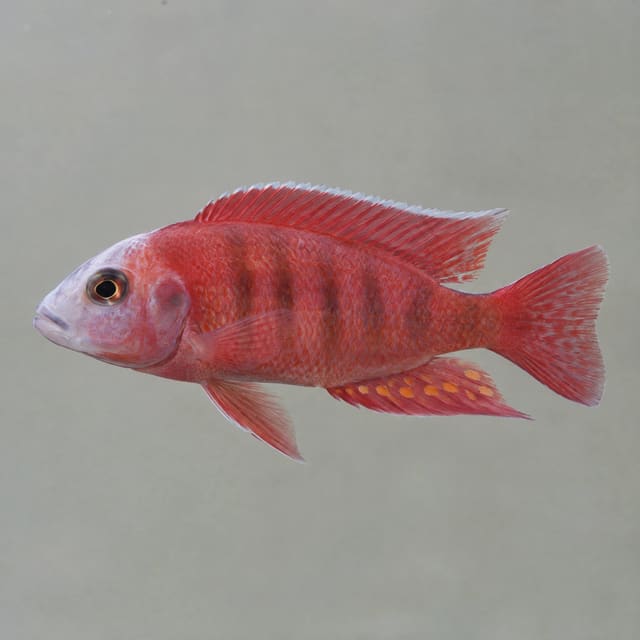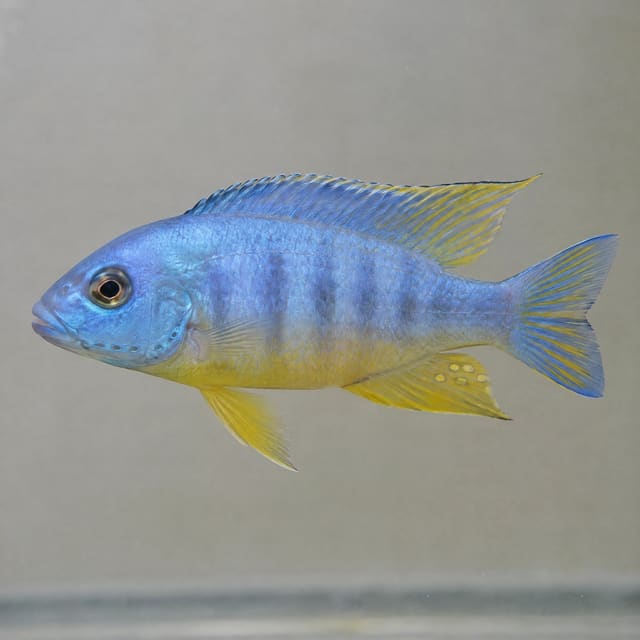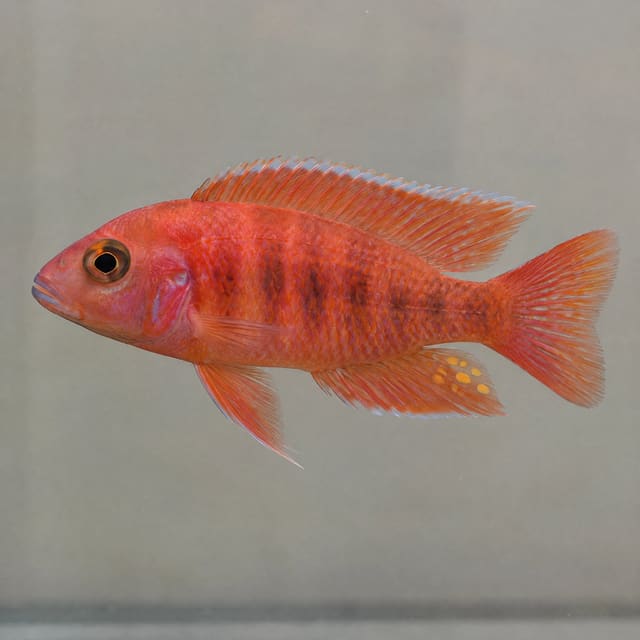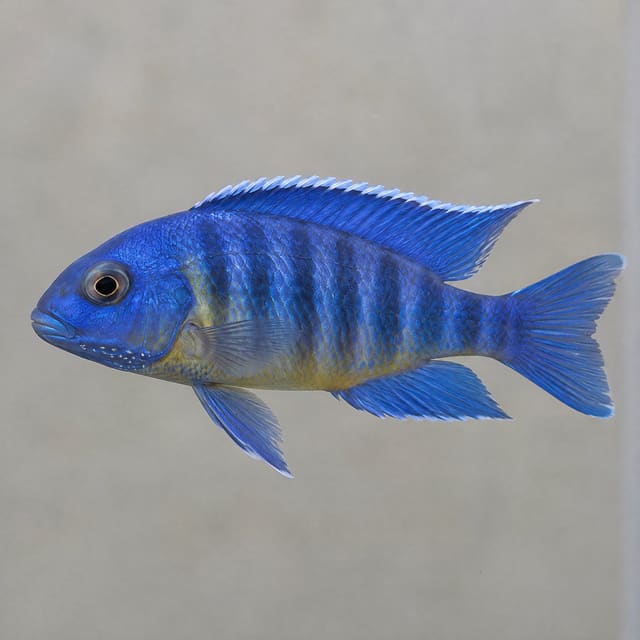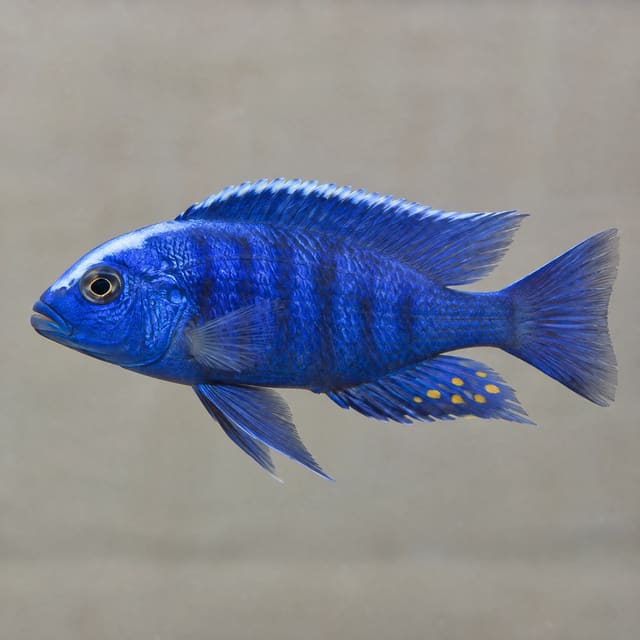
New Blue Orchid Peacock Cichlid (Aulonocara sp.)
23–27°C · pH 8–8.6
£11.99
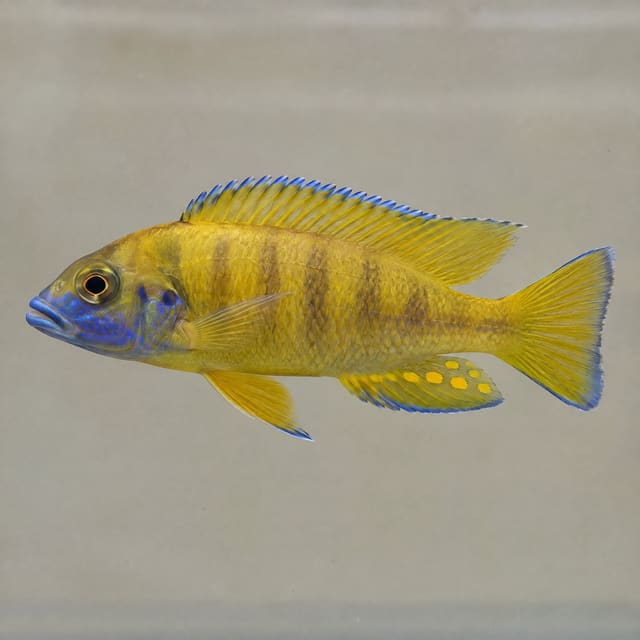
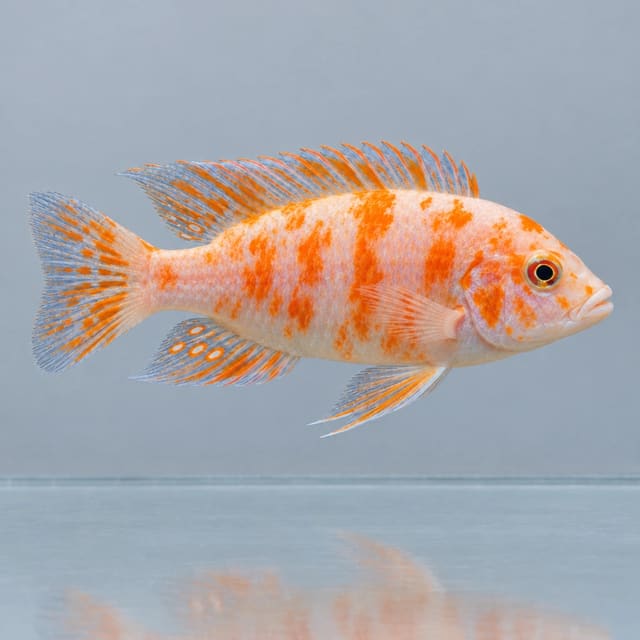
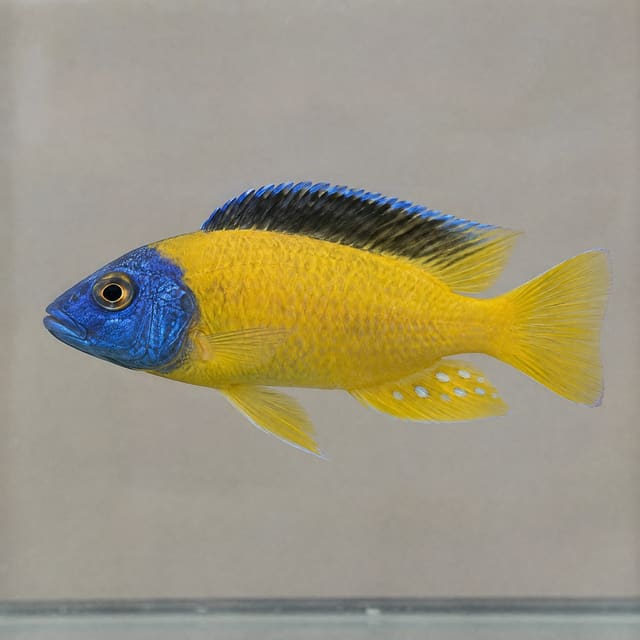
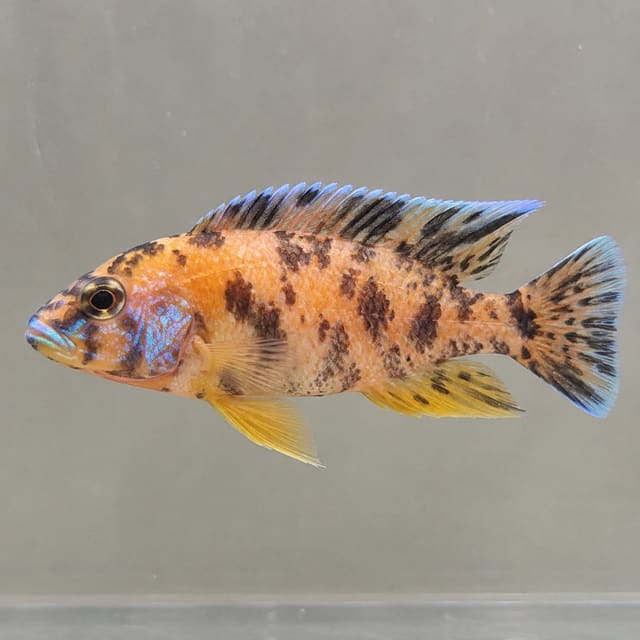
The Yellow Orange Blotch Peacock (Aulonocara sp. OB) is an aquarium-bred peacock cichlid with a bright yellow body broken by irregular orange blotches and blue-edged fins. It grows to about 12–15 cm and suits a 120 cm hard-water Malawi aquarium with open sand, stable rockwork and calm companions. Sold individually as one live fish.
Adult size is the maximum length this species reaches at full maturity (scientific sources). The livestock you receive will be younger and smaller. Product-photo provenance and any image-specific limitations are stated on the listing.
Aulonocara sp. OB
Save when buying multiple fish. Each quantity is one fish; sex and pair formation are not guaranteed unless the selected variant explicitly states them.
The Yellow Orange Blotch Peacock (Aulonocara sp. OB) is an aquarium-bred peacock cichlid with a bright yellow body broken by irregular orange blotches and blue-edged fins. It grows to about 12–15 cm and suits a 120 cm hard-water Malawi aquarium with open sand, stable rockwork and calm companions. Sold individually as one live fish.
Adult size is the maximum length this species reaches at full maturity (scientific sources). The livestock you receive will be younger and smaller. Product-photo provenance and any image-specific limitations are stated on the listing.
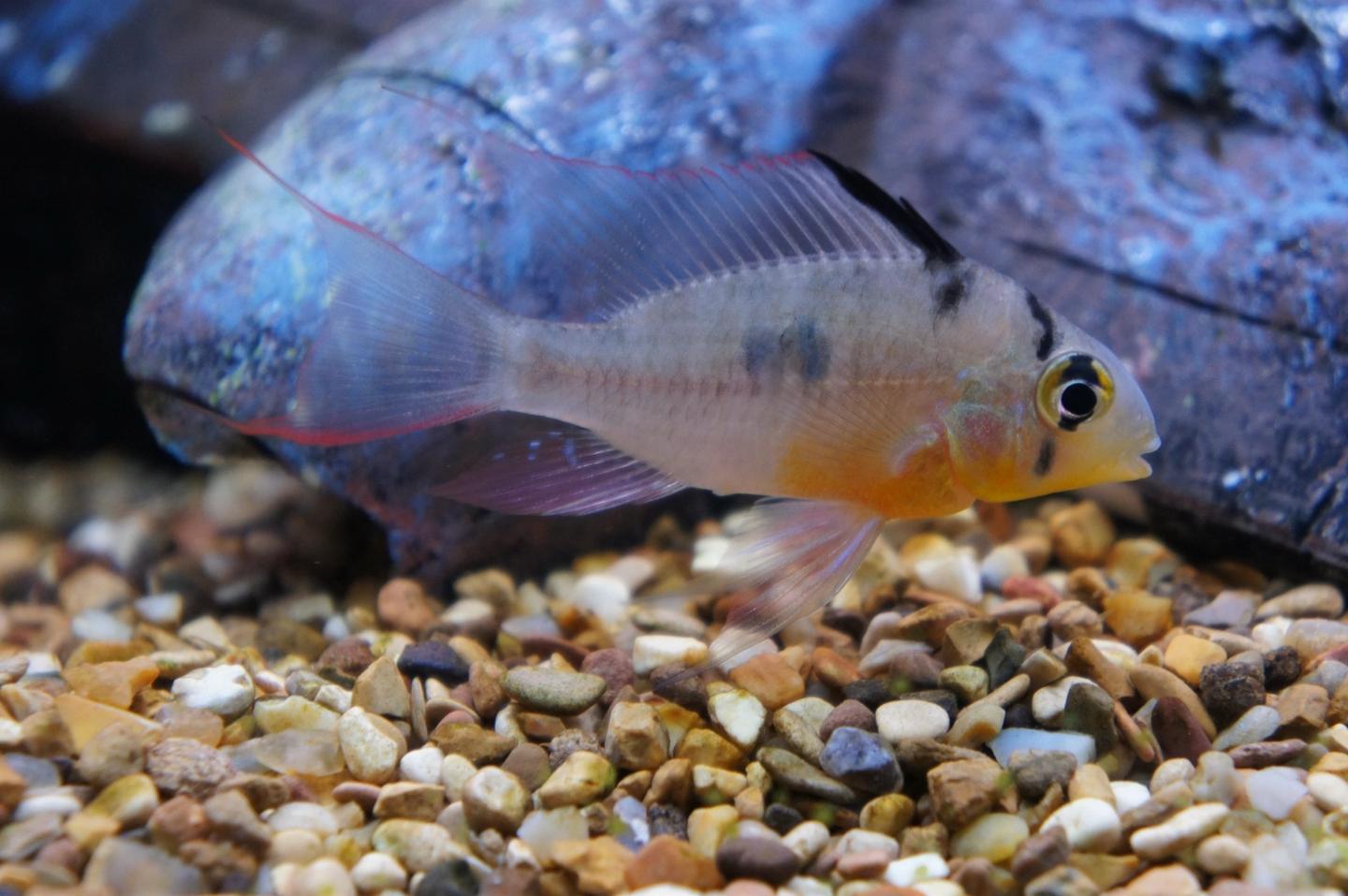
Cichlids are a family of roughly 1,800 accepted species, not one care type. Before buying, identify the exact species and source, then compare adult measurement, usable tank dimensions, social system, territory, tested water, diet and an exit plan. No family-wide minimum tank, water range or tank-mate list is safe.
The Yellow Orange Blotch Peacock is an aquarium-bred peacock cichlid with a bright golden-yellow body broken by irregular orange blotches that form loose bands across the flanks and freckles on the head. The dorsal fin and tail are yellow with blue edges, and adult males show a row of pale egg spots on the anal fin. Sold as Aulonocara sp. OB, the Yellow Orange Blotch Peacock brings warm colour to a hard-water Malawi aquarium without the rough behaviour of many mbuna.
OB peacocks are man-made. The Maidenhead Aquatics fish database describes hybrid peacocks such as the calico or OB peacock as aquarium-produced fish, thought to come from an Aulonocara cross, possibly with a haplochromine, that was later crossed with an orange-blotched mbuna and then line-bred to keep the peacock body shape and temperament while maximising colour. Aquarium Glaser confirms that O and OB peacocks were created by cross-breeding. The fish does not occur in Lake Malawi, but every wild Aulonocara in its background is endemic to the lake, and its care follows theirs.
| Name or code | What it tells you |
|---|---|
| Yellow | The base colour of the body and fins |
| Orange Blotch (OB) | The broken pattern of orange patches over the yellow; Aquarium Glaser explains O as orange and OB as orange blotch |
| Peacock | The common name for Aulonocara, the sand-feeding cichlids of Lake Malawi |
| Aulonocara sp. OB | A peacock-type fish with no single species name, because the line mixes more than one species |
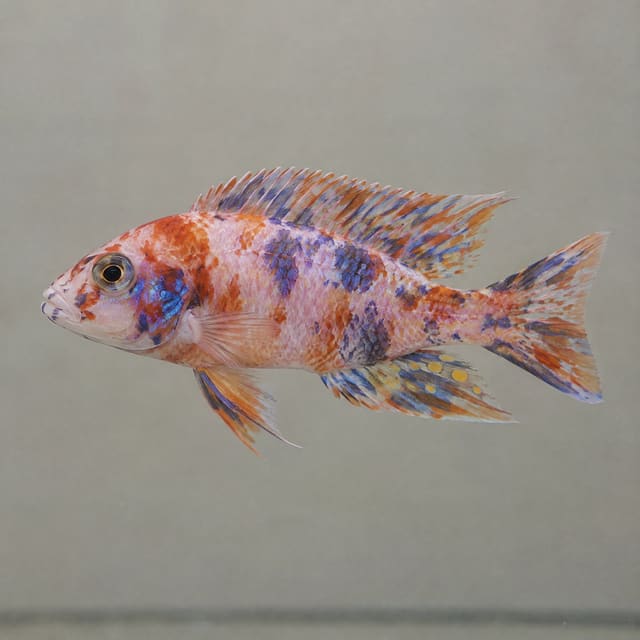
OB colouring also appears in our Orange Blanche Peacock Cichlid, which has dark blotches on orange, and in the multicoloured Calico Peacock Cichlid. For a wild-type yellow peacock, compare the Benga Yellow Peacock Cichlid, Aulonocara baenschi.
One purchase supplies one live Yellow Orange Blotch Peacock at the standard size currently available, which is a young fish rather than a finished adult. Sex is not chosen or guaranteed. Aquarium Glaser notes that the O and OB colours are not necessarily tied to sex, so both males and females can carry the blotched pattern; males grow larger, colour up more strongly and develop pointed dorsal and anal fins with more obvious egg spots.
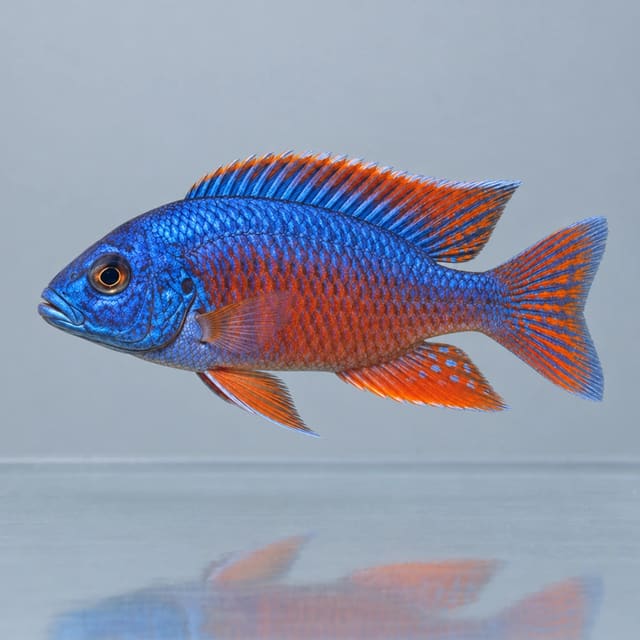
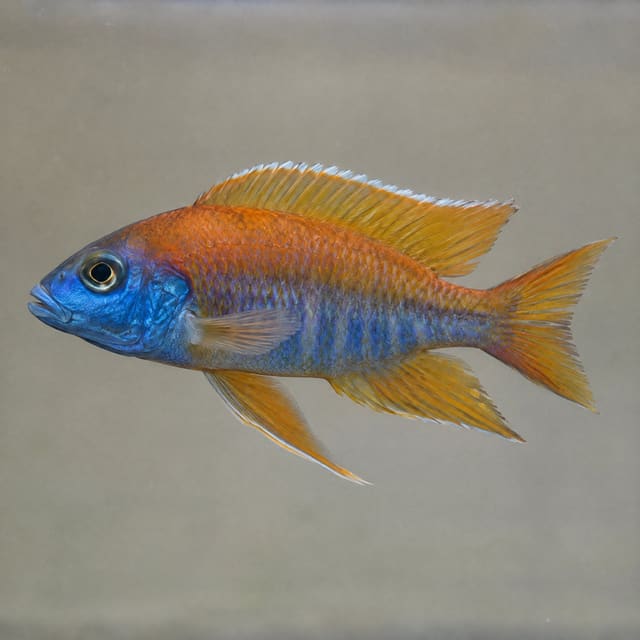
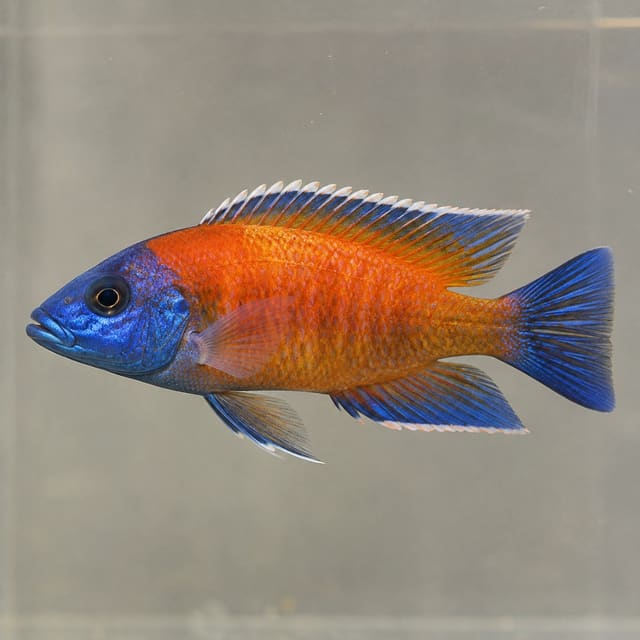
No two OB fish carry the same blotches. The photographs show the colour form, and your fish will have its own pattern, with colour that the Maidenhead Aquatics database says improves with age.
Check our delivery information for dispatch days and the Live Arrival Guarantee before you order.
The Maidenhead Aquatics database gives a maximum of 12 cm for hybrid peacocks, while Aquarium Glaser gives 10–15 cm for OB and similar peacock hybrids. Plan for a fish of 12–15 cm, with males at the top of that range.
The Maidenhead Aquatics database asks for a tank at least 4 ft long with open sand and stable rock structures. Seriously Fish gives a minimum base of 120 × 45 cm, about 243 litres, for Aulonocara stuartgranti, and OATA recommends at least 200 litres for a reasonable Malawi community. A 120 cm tank of about 240 litres or more suits a small peacock group.
Wild peacocks live where rocky shores meet open sand, and they feed over the sand. Seriously Fish advises fine sand with rock piles that leave open feeding areas, warning that gravel or small pebbles can stop natural feeding, damage the gill filaments and be swallowed. OATA recommends coral sand or a similar substrate to help buffer the water, and complex rockwork that creates territories and breaks up lines of sight.
The Maidenhead Aquatics database notes that peacocks show better colour over a darker substrate, so a pale yellow fish like this one looks especially bright against darker sand or rock. Build rock structures directly on the glass base and make sure they cannot topple if the fish dig.
| Zone | Job |
|---|---|
| Open sand along the front | Feeding ground where peacocks sift and hunt |
| Two or three separate rock piles | Territories for males and escape routes for females |
| Open water above the rocks | Swimming space for midwater haps and display room for the males |
| Hardy plants fixed to rock | Green cover that survives digging; OATA expects only the hardiest attached plants to last |
All the published ranges ask for hard, alkaline water, and Seriously Fish stresses that peacocks are sensitive to sudden chemical changes. The table compares the two main sets of figures and shows the overlap we recommend.
| Reading | OATA (Malawi cichlids) | Maidenhead Aquatics (hybrid peacock) | Our target |
|---|---|---|---|
| Temperature | 23–27°C | 22–26°C | 23–26°C |
| pH | 8.0–8.6 | 7.5–8.5 | 8.0–8.5 |
| General hardness | 12–18 dGH | Up to 25 dH | 12–18 dGH |
| Ammonia, nitrite | 0 mg/l | — | 0 mg/l |
| Nitrate | No more than 20 mg/l above tap water | — | As OATA |
Much of England has hard tap water, but supplies vary from area to area, so check your water company's postcode report. If your water is soft, the Maidenhead Aquatics database suggests coral sand or aragonite in a mesh bag inside an external filter to buffer it. Always use a tap water conditioner. Our water matcher shows how your tap water compares, and our water chemistry guide explains pH, GH and KH.
OATA recommends an oversized filter with strong aeration for Malawi cichlids, and Seriously Fish recommends heavy filtration in a biologically mature aquarium. Peacocks produce plenty of waste and react badly to a build-up of ammonia or nitrite, so let the filter mature fully before the fish arrive; our nitrogen cycle guide explains how.
The Maidenhead Aquatics database describes hybrid peacocks as omnivores and recommends good-quality flake, granules of a suitable size and small frozen foods such as mysis and enriched brine shrimp, with vegetable matter such as cucumber, blanched spinach or romaine lettuce. Seriously Fish explains that peacocks sift mouthfuls of sand and hover just above the bottom to pick up small movements with enlarged sensory pores on the head, and FishBase records wild peacocks eating sand-dwelling invertebrates.
| Meal type | How to use it |
|---|---|
| Sinking cichlid granules | The everyday staple, sized for the fish's mouth |
| Flake with spirulina or other plant content | Most days, alongside the granules |
| Frozen mysis or enriched brine shrimp | Two or three times a week, thawed first |
| Blanched spinach, cucumber or lettuce | Occasionally; remove leftovers within the day |
OATA suggests feeding twice a day, only as much as the fish eat within a few minutes; Seriously Fish prefers three or four smaller portions a day. Small, frequent meals suit a sand-sifter, provided nothing is left uneaten.
Test the water first: ammonia and nitrite must both read zero. OATA advises switching off the lights, floating the sealed bag for 10 minutes, adding small amounts of aquarium water over up to 20 minutes and then releasing the fish while leaving as much bag water out of the tank as you can. Our step-by-step acclimatisation guide covers this in detail.
Seriously Fish describes peacocks as relatively peaceful, but males turn on any fish with a similar colour pattern, and most mbuna are too boisterous for them. The Maidenhead Aquatics database adds that the mbuna in the OB line's ancestry made these hybrids more aggressive than pure Aulonocara, and suggests midwater haps such as Copadichromis, Cyrtocara and Placidochromis, and easygoing mbuna such as Labidochromis caeruleus, as companions. OATA recommends keeping Malawi cichlids only with other Malawi cichlids or Synodontis catfish from the lake.
| Suits | Avoid |
|---|---|
| Copadichromis such as the Red Fin Kadango Cichlid | A second yellow or orange-blotched peacock male |
| Placidochromis such as the Blue Otter Cichlid | Rough mbuna that chase at feeding time |
| Easygoing mbuna such as the Electric White Cichlid | Soft-water fish such as tetras and gouramis |
| The Malawi Squeaker catfish | Pure peacock species kept for breeding |
Run your planned mix through our tank mates checker, read our Lake Malawi cichlids guide, and browse the full Malawi cichlid range, the Lake Malawi and Victoria cichlids category and our peacock cichlids (Aulonocara).
OATA describes a healthy Malawi cichlid as having clear, bright eyes, whole fins, intact scales, normal swimming and steady breathing. Its warning signs include clamped fins, flicking against objects, hanging at the surface, sitting on the bottom, colour changes, unusual hiding, white spots and reduced feeding. A Yellow Orange Blotch Peacock that loses its yellow and turns dull or dark is usually stressed.
| Sign | Action |
|---|---|
| Faded colour and hiding | Check for a bullying male and test the water |
| Fast gill movement or hanging at the surface | Test ammonia and nitrite; increase aeration |
| White spots, fluffy patches or flicking | Confirm water quality, then seek treatment advice |
| A female with a swollen throat that will not eat | Probably holding eggs: leave her undisturbed |
Peacocks are maternal mouthbrooders. The Maidenhead Aquatics database describes the male's colour intensifying as he digs a small depression, the female laying eggs one or two at a time while he fertilises them, and around three weeks of incubation in her mouth, with the fry held for a few days more. Seriously Fish gives up to four weeks of brooding. Because this is a hybrid line, Practical Fishkeeping discourages crossing it with pure species, which muddies their genetics; keep it away from wild-type Aulonocara you intend to breed, and never sell its young as a wild species.
OB stands for orange blotch, the irregular patches of orange over the body. Aquarium Glaser explains that O means orange and OB orange blotch. In this strain the blotches sit on a bright yellow body, which is where the full name comes from.
No. OB peacocks are aquarium-produced hybrids. The Maidenhead Aquatics fish database describes them as peacocks crossed, probably with a haplochromine, and later with an orange-blotched mbuna, then line-bred for colour while keeping the peacock body shape. It is sold as Aulonocara sp. OB because there is no single species name.
No. Aquarium Glaser notes that O and OB colours are not necessarily tied to sex, so both males and females of this strain can show the blotched pattern. Males grow larger, carry more colour and usually show more prominent egg spots on the anal fin.
Plan for 12–15 cm. The Maidenhead Aquatics database gives 12 cm for hybrid peacocks and Aquarium Glaser gives 10–15 cm for OB and similar peacock hybrids.
At least 120 cm long. The Maidenhead Aquatics database asks for a tank of at least 4 ft, and Seriously Fish gives a 120 × 45 cm base, about 243 litres, for a typical peacock of this size.
The Maidenhead Aquatics database suggests one or three males with a group of five or more females; Seriously Fish suggests one male with four to six females in most aquariums. Two males of the same colour in a small tank usually fight.
Only with easygoing mbuna. Seriously Fish says most mbuna are too boisterous for peacocks; the Maidenhead Aquatics database names the Yellow Lab (Labidochromis caeruleus) as a suitable mbuna companion.
One live Yellow Orange Blotch Peacock at the standard size currently available. Sex is not chosen or guaranteed, and colour strengthens as the fish matures.
No reviews for this item yet. Bought one? Honest reviews only, good or bad.
What customers say about ordering from us
Easy website plenty of info on fish your buying great to pick a time slot
TRACEY DURRANT · 7 Oct 2026
Got some lovely fish thank you
Kevin Mackie · 7 Oct 2026
Reviews of our shop, collected by Judge.me, an independent third-party review collector. Newest first.
Moved by UK carriers licensed to handle live animals
Hand-packed with oxygen bags, poly box, heat pack
Email photos the same day; an optional unboxing video helps us review problems faster — claim terms apply
Klarna & PayPal Pay in 3 at checkout