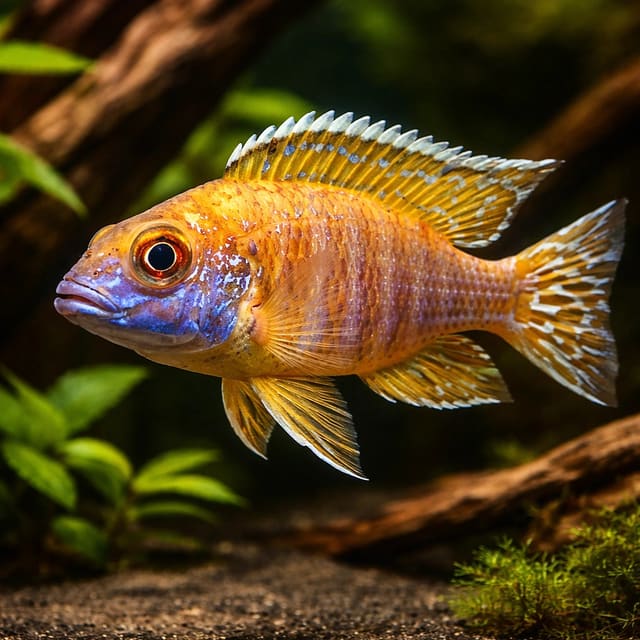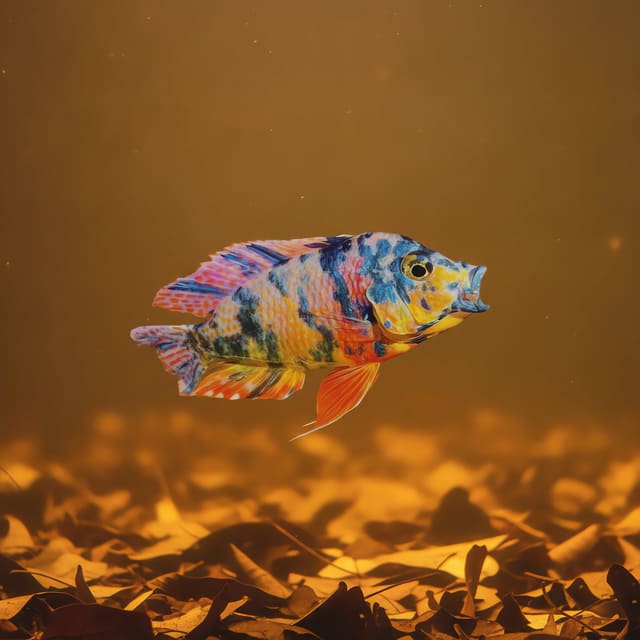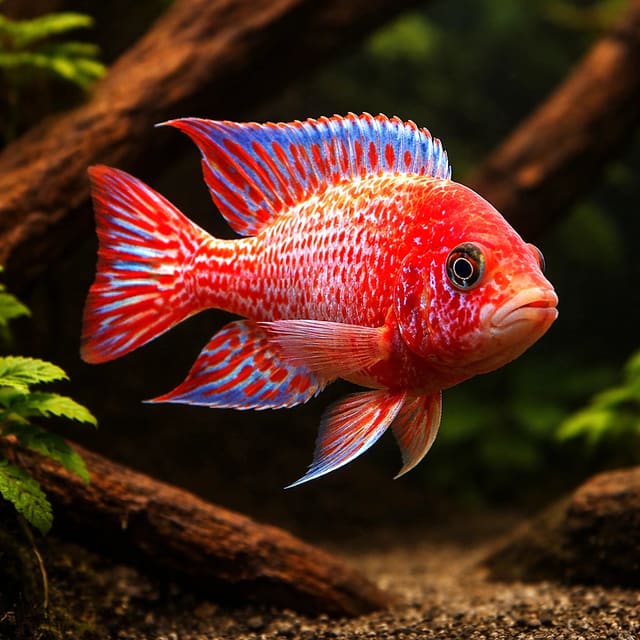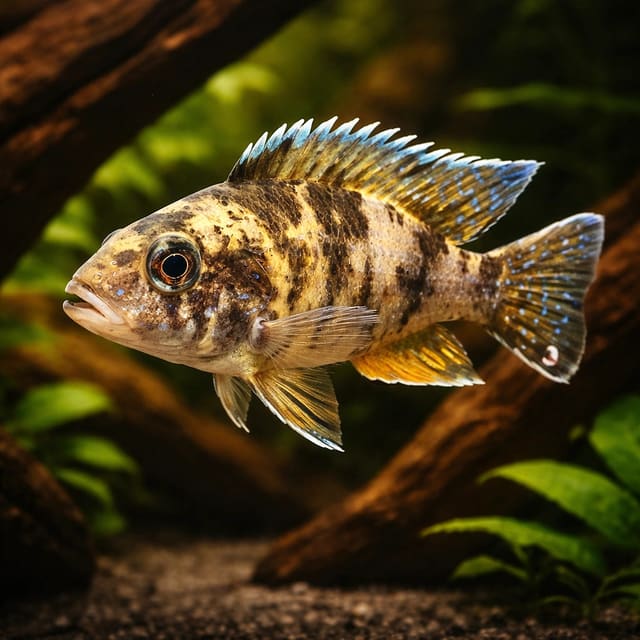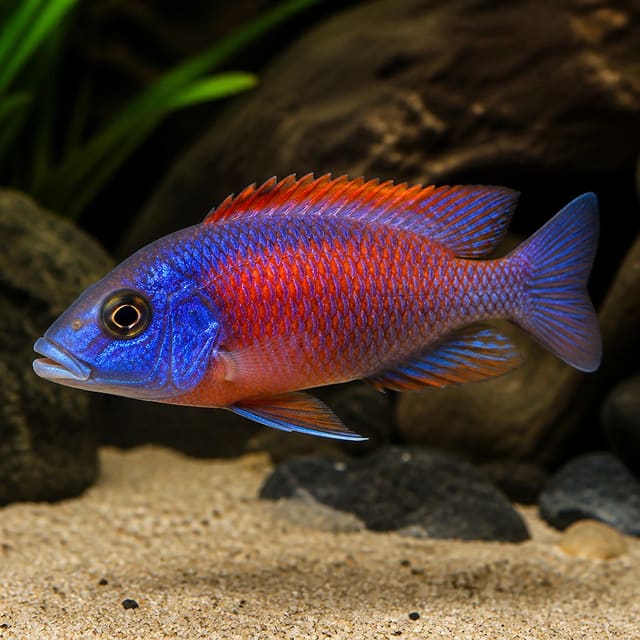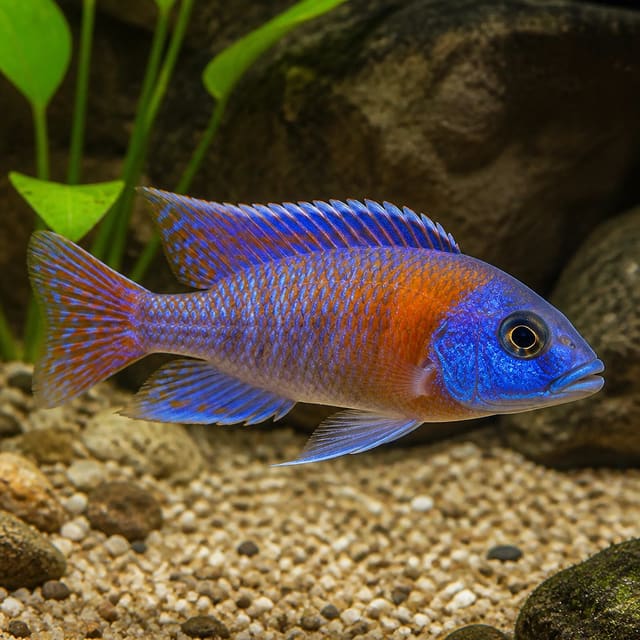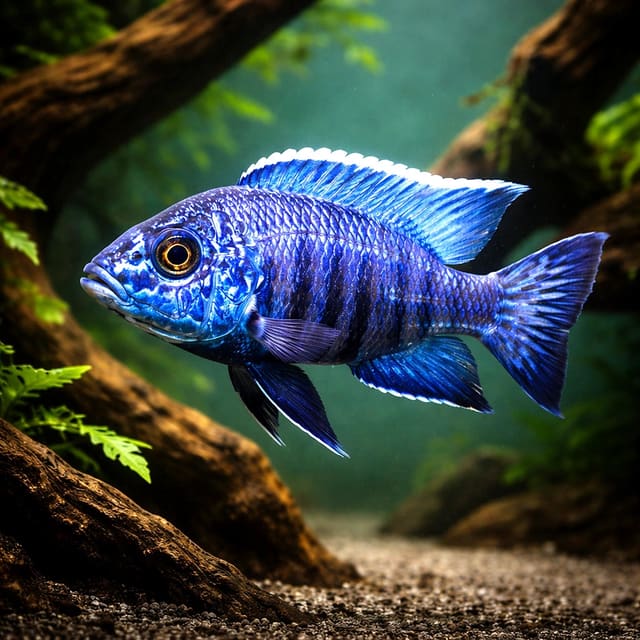
Steveni Blue Neon Peacock Cichlid (Aulonocara stuartgranti)
23–26°C · pH 8–8.6 · 243L
£18.99

Calico Peacock Cichlid (Aulonocara sp. calico) is an aquarium-bred Malawi peacock with orange, black and blue blotching. Sold as one unsexed fish in a 4-5, 6-7 or 7-9 cm dispatch size; plan a 120 cm tank of hard, alkaline water with fine sand, rockwork and calm Malawi company.
Adult size is the maximum length this species reaches at full maturity (scientific sources). The livestock you receive will be younger and smaller — pick a size above for the actual shipping size. Product-photo provenance and any image-specific limitations are stated on the listing.
Aulonocara sp.
Save when buying multiple fish. Each quantity is one fish; sex and pair formation are not guaranteed unless the selected variant explicitly states them.
Calico Peacock Cichlid (Aulonocara sp. calico) is an aquarium-bred Malawi peacock with orange, black and blue blotching. Sold as one unsexed fish in a 4-5, 6-7 or 7-9 cm dispatch size; plan a 120 cm tank of hard, alkaline water with fine sand, rockwork and calm Malawi company.
Adult size is the maximum length this species reaches at full maturity (scientific sources). The livestock you receive will be younger and smaller — pick a size above for the actual shipping size. Product-photo provenance and any image-specific limitations are stated on the listing.
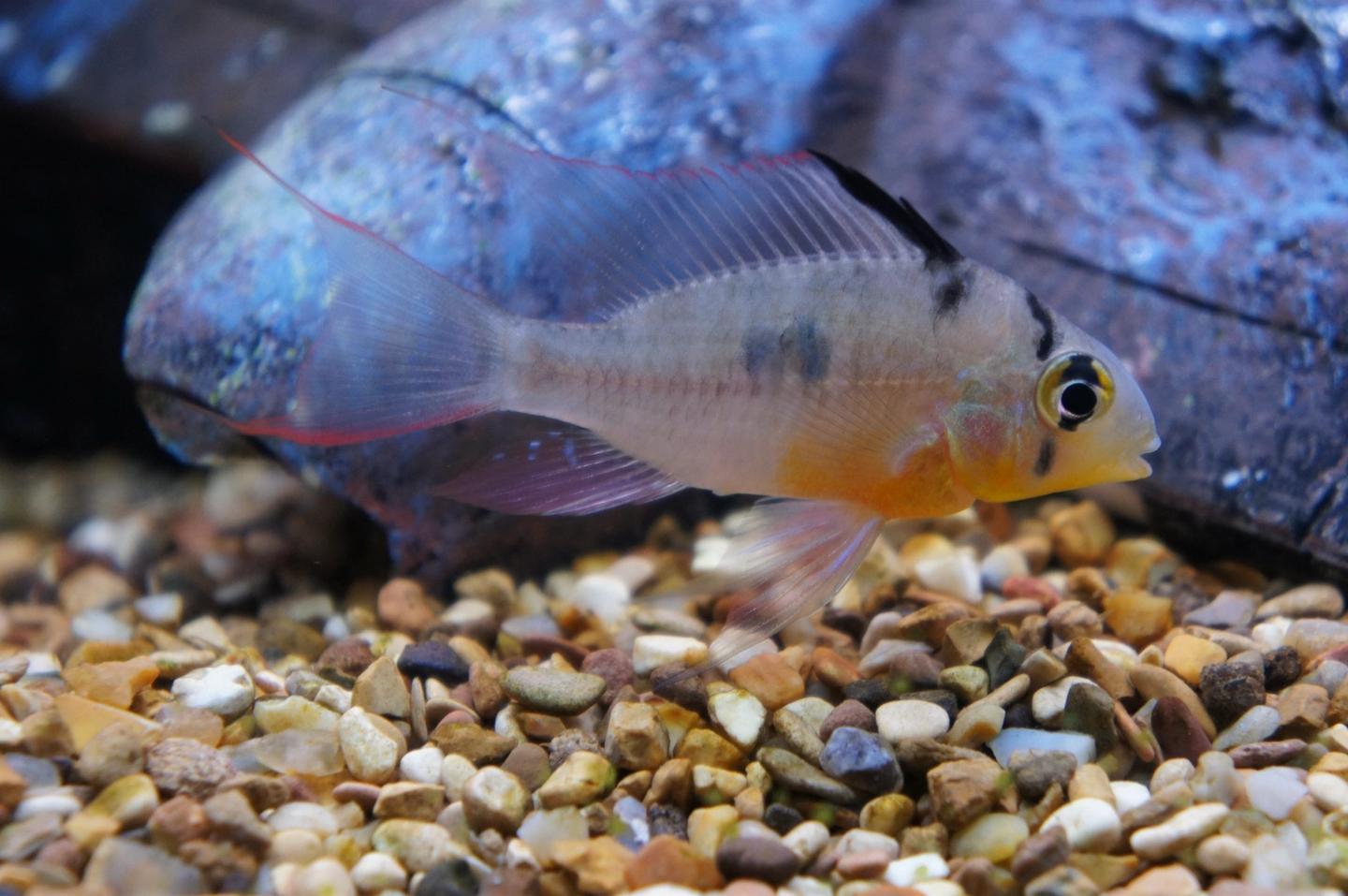
Cichlids are a family of roughly 1,800 accepted species, not one care type. Before buying, identify the exact species and source, then compare adult measurement, usable tank dimensions, social system, territory, tested water, diet and an exit plan. No family-wide minimum tank, water range or tank-mate list is safe.
Maintain these water conditions for optimal health and vibrant colors
The Calico Peacock Cichlid is an aquarium-bred peacock whose coat looks as though someone has flicked orange, black and blue paint across it. In the trade it goes by the name Aulonocara sp. calico, and that little "sp." is doing honest work. FishBase lists 22 described Aulonocara species, every one of them from Lake Malawi, and not one of them is called calico. There is no wild population by this name and no stretch of lake shore you could visit to find it. It is a man-made form, kept going by breeders who choose the best-marked fish as parents, and its exact ancestry has not been recorded anywhere we can point you to. So we describe it plainly: a line-bred peacock of uncertain, possibly mixed, parentage that needs the same care as its wild relatives.
None of that makes it a lesser fish to keep. It simply means two things. First, the care advice on this page comes from the wild peacocks that have been properly studied, chiefly Aulonocara stuartgranti and Aulonocara baenschi, together with the Lake Malawi care sheet published by OATA, the UK's ornamental aquatic trade association. Second, if your fish ever breed, the youngsters should be passed on as calico peacocks and never under the name of a wild species.
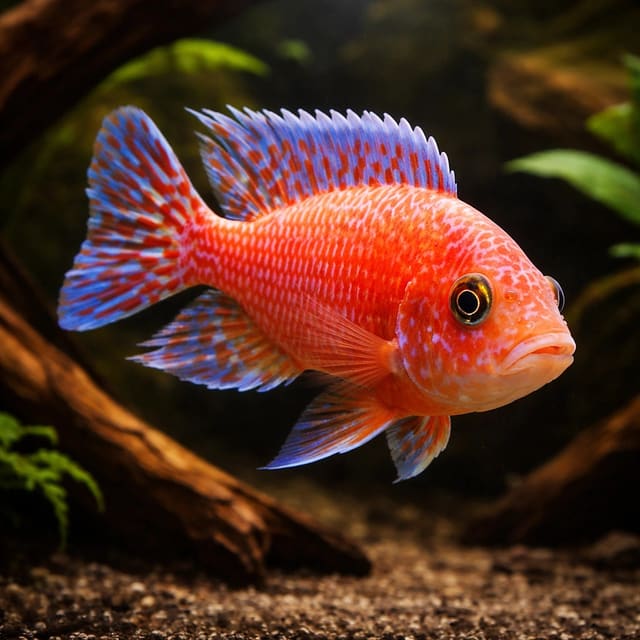
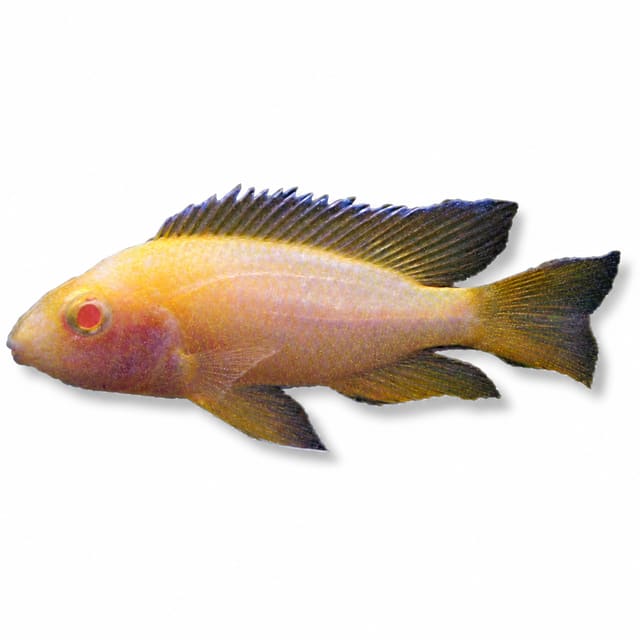
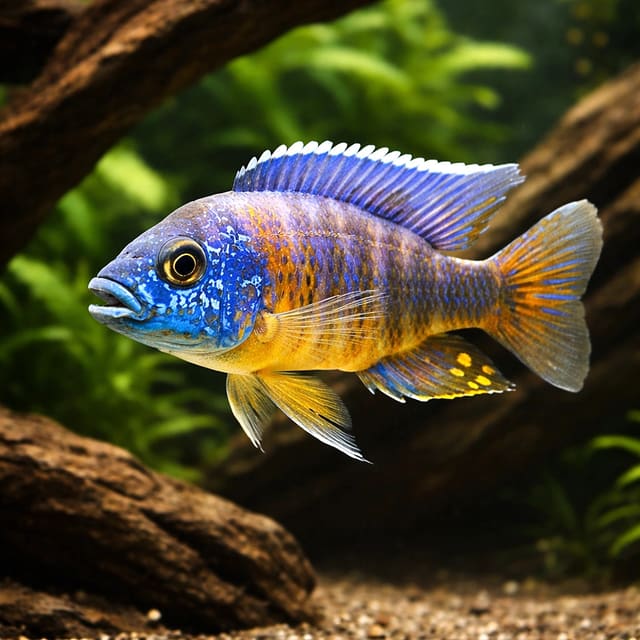
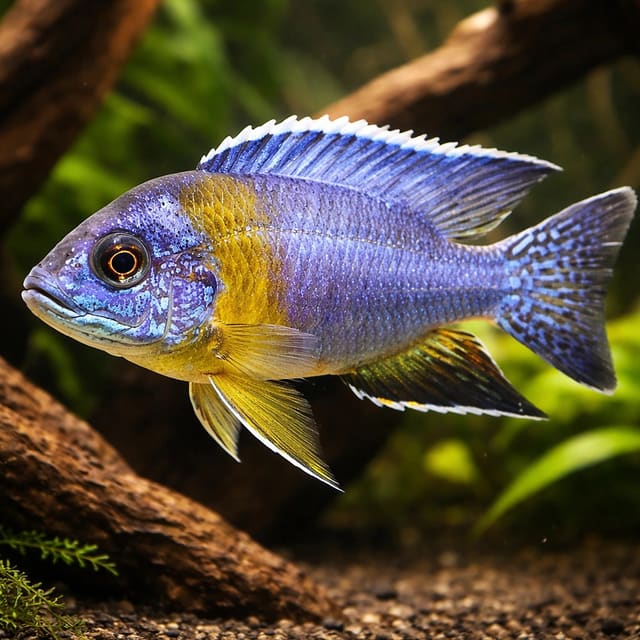
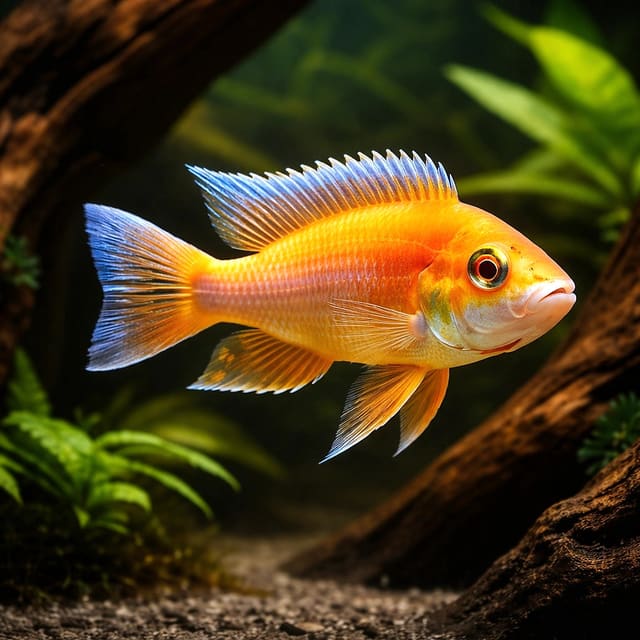
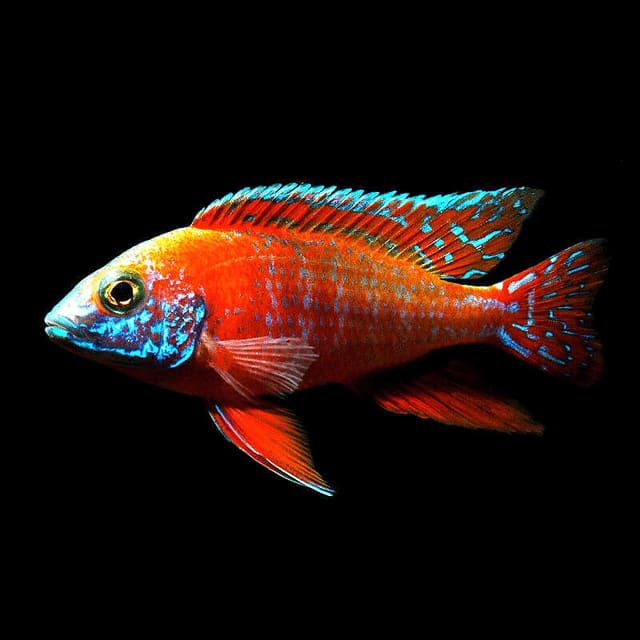
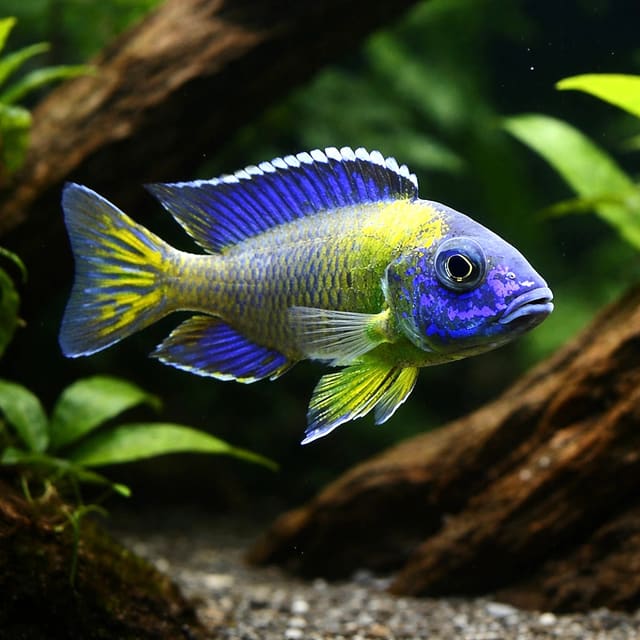
The fish in our photos show the look you are paying for. The face and cheeks are washed in blue and freckled with darker spots. Behind the gill cover the body turns bright orange, broken up by irregular black blotches that run from the shoulder to the base of the tail. The long dorsal fin has rays edged in blue and orange, the pelvic and anal fins are orange, and the tail carries the same orange with smaller dark flecks. Because the blotches are irregular, the balance of orange, black and blue differs between individuals, so expect each fish to be marked a little differently from its neighbour.
Each unit on this listing is one fish. You choose its size from three options: 4-5 cm, 6-7 cm or 7-9 cm. Those are the lengths the fish measure when they leave us, not the size they will reach, and at these sizes you should not expect finished adult colour. The listing is not sold by sex, so your fish come unsexed. In wild peacocks the males carry the bright colour and the females are much plainer; Wikipedia describes the genus as strongly sexually dichromatic, even compared with other haplochromine cichlids. How strongly that shows in a man-made calico line varies, so judge your own fish as they grow rather than relying on photographs of adults.
Blotched orange-and-black colouring has a natural counterpart in the lake itself. Research on Lake Malawi cichlids describes a wild colour pattern called orange blotch, usually shortened to OB. In 2009 Roberts, Ser and Kocher, writing in the journal Science, traced it to a regulatory mutation in a gene called Pax7. Their explanation is a tidy piece of biology: the blotching camouflages females, but it breaks up the species-specific colours that males rely on for mate recognition, so the same trait helps one sex and hinders the other.
Whether this particular calico line took its blotching from that wild source is not recorded, and we will not pretend otherwise. What we can say is that peacocks are bred for colour in captivity. Seriously Fish's page on Aulonocara baenschi, for example, shows an adult male of an ornamental strain sold as "red-orange". Line-breeding works the same way whatever the colour: keep the parents that show the pattern you want, raise their young, choose again, and repeat over many generations. The result is a fish that looks consistent within its line but does not match any wild population.
The practical consequence is hybridisation. Both Seriously Fish species pages we used warn that other Aulonocara species are best avoided as companions, because most of them can interbreed. If you keep a calico with another peacock, any youngsters may be crosses, and once crosses are passed on there is no way for the next keeper to know what they have. If you want a wild species with a traceable name, the Steveni Blue Neon Peacock (Aulonocara stuartgranti) and the Benga Peacock (Aulonocara baenschi) are described species, and they are best kept in a separate tank from this calico form if you intend to breed either. If it is the patchwork look that appeals, the Calico Red Neon Peacock Cichlid is another calico-patterned peacock we list, again one to choose instead of, rather than alongside, this fish if you want tidy breeding lines.
For a keeper who simply wants a striking display fish, none of this is a problem. It just pays to know what you own before a female turns up with a mouth full of eggs.
Lake Malawi is one of the great Rift Valley lakes of East Africa, shared by Malawi, Mozambique and Tanzania. Wikipedia gives its length as roughly 560 to 580 km, its width as up to 75 km and its greatest depth as 706 m, although below about 250 m the water holds no oxygen. At least 700 cichlid species live there, and all but four of the lake's cichlids are found nowhere else on earth. The water is warm, clear and alkaline: surface temperatures run between 24 and 29 °C, the pH sits between 7.7 and 8.6, and visibility can reach 20 m, although a little under half that is more usual.
Fishkeepers tend to talk about two broad groups of Malawi cichlid. The mbuna are the rock-dwellers, usually smaller fish and often colourful in both sexes. The "haps" are a looser collection that takes in larger predators and the open-water utaka. Peacocks are not mbuna, and Wikipedia's article on the genus describes them as less aggressive than their mbuna counterparts, which is the single most useful fact to keep in mind when you plan a tank around one.
Wild peacocks live where rock meets sand. Seriously Fish describes the habitat of Aulonocara stuartgranti as the intermediate zones, where rocky shores give way to open sand with scattered rocks. FishBase adds that some individuals of that species keep to caves while others gather in large groups over the sand, and that they feed on the invertebrates living in it. FishBase classes the species as benthopelagic, meaning it lives close to the bottom while also moving up into mid-water.
The way peacocks find their food is what sets them apart. They carry enlarged sensory pores on the head, and Seriously Fish explains that these help the fish pick up tiny movements in the substrate. Once something is detected, the fish takes a mouthful of sand and sifts it, keeping the food and pushing the unwanted grains back out through the gills and mouth. Seriously Fish calls this benthophagous feeding. In a sand-floored aquarium you can watch the same behaviour: a mouthful of sand taken in and the grains pushed back out from behind the gill covers.
Two practical lessons follow. A peacock needs a sandy floor if it is to feed the way its body is built to, and it needs open ground as well as rock. The calico is a man-made form, but the care for its wild relatives is the best guide available, so we set it up in exactly the same way.
Start with the size the fish will become, not the size it arrives at. FishBase's list of the 22 described Aulonocara species runs from 5.5 cm standard length for A. stonemani up to 18 cm total length for A. rostratum, with A. jacobfreibergi, A. maylandi and A. guentheri each listed at 15 cm total length. Seriously Fish gives adult males of A. stuartgranti 130 mm standard length, and puts A. baenschi males at 120 mm and females at 90 mm. Because the calico line has no single parent species, we plan for an adult of up to about 15 cm. Standard length runs from the snout to the base of the tail; total length includes the tail fin, so it is the bigger number of the two.
OATA's care sheet for Malawi cichlids asks for at least 200 litres for a community, and that is the floor we work to. Seriously Fish goes further for a group of one peacock species, recommending a base of 120 × 45 cm, which it puts at about 243 litres. Our honest advice is to buy a tank 120 cm long or longer. Footprint matters more than height, because peacocks spend their time near the bottom and the males claim floor space. A juvenile at 4-5 cm will look lost in a 4ft tank for a while, but it will not stay that size.
Use fine sand. Seriously Fish is specific about this: the fish sift sand for food, and coarser options such as gravel or small pebbles can stop them feeding properly, damage the gill filaments and even be swallowed, with a risk of internal damage or blockages. OATA suggests coral sand or a similar substrate because it helps buffer the water towards the hard, alkaline side. A few centimetres of sand gives them plenty to sift; a very deep bed only gives waste somewhere to collect.
Seriously Fish recommends piles of rockwork around the tank with open spaces between them and sand on the floor. OATA asks for complex rockwork so that individuals can hold territories. The two fit together well: build two or three separate rock piles with caves and broken sightlines, and leave clear sand between them for feeding and swimming. The A. baenschi page notes that flattish rocks next to open sand serve as spawning sites, so include one or two. Stand every rock on the base glass before the sand goes in, so that nothing can be undermined if the sand gets moved around.
Both sources want strong filtration. OATA recommends an oversized filter and vigorous aeration, plus a heater to hold the temperature all year. Seriously Fish calls for heavy filtration and says these fish should never go into a biologically immature aquarium, so cycle the filter fully before the fish arrive. Plants are optional; Seriously Fish notes that A. stuartgranti does not tend to harm them. If you want greenery, choose hardy species that cope with hard, alkaline water and fix them to rock or wood rather than relying on the sand to hold them.
Peacocks want hard, alkaline water, which is the opposite of what many community tanks are run on. The numbers below show where our recommendations come from. Where the sources differ we have taken the range they share, not the extremes of any one of them.
| Parameter | Our target | What the sources say |
|---|---|---|
| Temperature | 24-28 °C | OATA 23-27 °C; Seriously Fish 23-29 °C (A. stuartgranti) and 25-29 °C (A. baenschi); FishBase 22-26 °C (A. stuartgranti); lake surface 24-29 °C |
| pH | 7.5-8.5, ideally about 8 | OATA 8.0-8.6; Seriously Fish 7.5-9.0; lake 7.7-8.6 |
| General hardness | 10-20 °dGH | OATA 12-18 °dH; Seriously Fish 10-25 °dGH |
| Carbonate hardness | 10-15 °dKH | OATA 10-15 °dKH |
| Ammonia and nitrite | Zero | OATA: zero mg per litre |
| Nitrate | As low as you can keep it | OATA: no more than 20 mg per litre above your tap water |
OATA describes water-testing kits as essential and asks for a check at least once a week. Seriously Fish explains why: these cichlids are extremely susceptible to falling water quality and to swings in chemistry. Steady conditions matter more than hitting a perfect number. OATA recommends a partial water change of at least 25% every week; Seriously Fish suggests 30-50% weekly for the peacock species it covers. We find 30% a week a sensible routine for a well-filtered tank, rising towards the higher figure if your nitrate creeps up. Treat new water with a tap-water conditioner and bring it close to tank temperature before it goes in.
Test your tap water's general and carbonate hardness before you buy anything. If it comes out soft, the coral sand OATA suggests will help hold the pH and hardness up, and crushed coral in the filter or a Malawi buffer product can help in the same way. Whatever you use, add it gradually and test as you go, because sudden jumps in pH are exactly the kind of swing these fish handle badly. Have the water settled at your target before the fish arrive rather than adjusting it with them in the tank.
When you clean the filter, OATA's advice is to rinse the media lightly in tank water you have just removed, never under the tap. Chlorinated tap water kills the bacteria that break down ammonia and nitrite, and losing them is how a stable tank suddenly turns unstable. Clean the filter and change the water on different days so that you never disturb everything at once.
In the wild a peacock spends much of its day taking mouthfuls of sand and filtering out small invertebrates. In the aquarium the aim is to give it food it can find and handle in a similar way. Seriously Fish recommends a high-quality, fine-grade prepared food as the base of the diet, with small live or frozen foods such as chironomid larvae (bloodworm), Artemia and mosquito larvae added for variety. Our care sheet records the calico as an omnivore that does well on cichlid pellets and frozen foods, which fits that advice.
The sources approach portions from slightly different angles. Seriously Fish suggests three or four smaller portions a day instead of one large meal, so the fish can browse as they would in the lake. OATA's Malawi sheet says to feed only what the fish will clear within a few minutes, twice a day, and notes that the larger Malawi cichlids may need pellets with a higher animal content alongside frozen food. Put together: two to four small meals a day, each eaten within a few minutes, with nothing left lying on the sand. If you can only manage twice a day, keep the portions small rather than making up the difference with one big feed.
Size matters with juveniles. A 4-5 cm calico needs a small pellet or crumb it can take easily; move up a size as the fish grows. A sinking food lets the fish feed close to the sand, which is where it is most at ease. Frozen foods should be thawed in a little tank water first and fed in modest amounts. Rotate two or three foods through the week rather than relying on one product, so that any gap in one is covered by another.
Feeding time is the best health check you get each day. A settled calico should come out from the rocks and feed with interest. A fish that hangs back, spits food out repeatedly or stays tucked away while the others eat deserves a closer look, both at the fish and at the water. Leftover food that rots on the sand pushes up ammonia and nitrate, which is the main way overfeeding harms a Malawi tank, so if food is still lying around after a few minutes, feed less next time.
In a mixed Malawi tank, check that the peacocks are actually getting their share. Faster, bolder fish can take most of a meal before a shy peacock reaches it. Scattering food over more than one spot, or feeding a sinking pellet after the surface feeders have had theirs, usually solves it.
Peacocks are among the calmer Malawi cichlids, but calm is relative. Seriously Fish describes A. stuartgranti and A. baenschi as relatively peaceful, while warning that males act aggressively towards any fish with a similar colour pattern. Wikipedia's article on the genus recommends other medium-sized, non-aggressive Malawi cichlids as companions. Our care sheet records the calico as semi-aggressive, which is a fair summary: a mature male will defend his patch of sand, and he will be hardest on fish that look like him.
For a single peacock species, Seriously Fish recommends one male with four to six females. OATA's wider Malawi advice points the same way: keep more females than males so that no single fish takes all the attention. Because this listing is sold unsexed, the usual approach is to buy a small group of youngsters, grow them on, and decide what to keep once you can tell them apart. Seriously Fish says peacocks usually become sexable at around four months. Have a plan for surplus males before you start, whether that is a second tank or rehoming them through a local club.
Seriously Fish suggests differently patterned Copadichromis, Placidochromis and Otopharynx lithobates, and among the mbuna only peaceful kinds such as Labidochromis caeruleus. OATA adds that Malawi cichlids should be kept with other Malawi cichlids or with some species of Synodontis catfish. The common thread is fish from the same lake, with the same water needs and a temperament no rougher than the peacock's own. Choose companions that look clearly different from a calico, so that a male does not read them as rivals.
OATA recommends adding Malawi cichlids in groups rather than one at a time, and introducing the more peaceful species first and the more assertive ones later. That suits peacocks well: let them settle and claim their space before anything bolder arrives. If you have to add fish to an established tank, moving a few rocks at the same time breaks up existing territories and spreads any squabbling around.
Most problems with peacocks begin with the water, so the first thing to check when a fish looks wrong is your test kit, not the medicine shelf. Seriously Fish's warning that these fish are extremely susceptible to deteriorating water quality and chemical swings is worth taking literally. A missed water change, an overfed weekend or a filter cleaned under the tap can all show up as an unhappy fish a few days later.
OATA's care sheet lists the signs of a healthy fish: clear, bright eyes, undamaged fins, intact scales and no ulcers or bumps on the body. A healthy calico swims with its fins spread, comes forward at feeding time and moves between rock and sand with purpose. Colour can fade a little when a fish is stressed or newly moved; it should strengthen again as the fish settles.
OATA picks out three behaviours that should make you look more closely:
The same sheet asks keepers to watch for any change in swimming, colour, temperament, breathing rate, appearance, body condition or response to food. Fast breathing at the surface points towards poor water or low oxygen; a fish that suddenly stops eating needs watching closely; a fish that has gone thin while others thrive may not be getting its share.
In a cichlid tank, torn fins and missing scales are often signs of bullying rather than disease. Watch the tank for a few minutes at a quiet time and see who is chasing whom. If one fish is constantly pinned in a corner, move rocks to break up sightlines, add more cover, or move either the bully or the victim. A peacock that is harassed for weeks is unlikely to colour up or grow well.
Seriously Fish's point about coarse substrate is a health issue as well as a feeding one: gravel can damage the gill filaments of a fish that sifts it, and swallowed pieces can cause internal damage or blockages. If your calico is kept on anything coarser than sand and you see laboured breathing or a fish that stops sifting, the substrate is worth changing.
If something looks wrong and your water tests are fine, take a clear photo or short video and contact us or a vet with fish experience before reaching for treatments. Many medications affect filter bacteria or water chemistry, and in a hard-water tank that can create a second problem on top of the first.
All Aulonocara are maternal mouthbrooders, according to Wikipedia: the female carries the eggs, and then the young fish, in her mouth. Seriously Fish describes how the males of the wild peacock species carry egg spots on the anal fin that play a part in fertilisation, and how a spawning pair uses flattish rocks next to open areas of sand. In a well-run tank with a settled male and several females, spawning is often the easy part.
After spawning the female holds the brood for weeks. Seriously Fish says up to four weeks for A. stuartgranti and A. baenschi, and OATA's Malawi sheet gives a wider 21 to 40 days across Malawi mouthbrooders. She is best left undisturbed during this time; Seriously Fish notes that some breeders strip the fry from the mother's mouth at around two weeks, but that is a job for an experienced breeder, not something to try on your first brood.
Seriously Fish explains that the fry may still have some yolk left when released and need no food until it is gone; if they come out with the yolk fully absorbed, newly hatched Artemia nauplii or a similar fine food can be offered straight away. OATA notes that Malawi mouthbrooder fry are larger than most other fry and feed readily, which makes them a good first breeding project. In a mixed tank, plenty of rockwork with small gaps gives newly released young somewhere to hide.
This is where the calico's man-made origin matters. Seriously Fish advises against keeping different Aulonocara species together because most can hybridise, and a calico line already has unrecorded ancestry. If your calicos breed, label the youngsters honestly as calico peacocks when you pass them on, and never under the name of a wild species. If you also keep wild-type peacocks, do not let them share a tank with your calicos if you want either line to stay true. Other man-made peacock forms, such as the Red Dragon Peacock Cichlid, raise exactly the same question, and the answer is the same: one line per tank if you are breeding.
Breeding is never guaranteed, and because the blotching is irregular, youngsters will not be marked exactly like their parents. Keep the fish you like best as your next parents.
All three size options are the same calico form at different ages. A 4-5 cm calico is the youngest and has the most growing ahead of it, which suits a keeper who wants to raise a group together and decide later which to keep. The 6-7 cm and 7-9 cm options are further along, so they settle into an adult community more confidently and their colour may already be developing; we still cannot promise a sex at any size. Whichever you choose, set the tank up for the 15 cm adult, not the juvenile in the bag.
Please read our delivery and live-arrival information before ordering; the details are on our delivery page. The aquarium must be ready before the parcel arrives: filter running and fully cycled, water tested, and temperature matched to the range on this page. Someone must be at the delivery address to receive the parcel, because live fish should never be left waiting on a doorstep.
Your calicos travel in oxygen-filled bags inside insulated packaging, with heat packs when the weather calls for them, carried by a tracked courier licensed to carry live animals. We email you the confirmed delivery date and the tracking details, so you know when to be in.
Before you open anything, start recording a continuous unboxing video while the parcel is still sealed, then open it in the same take and show the fish in their still-sealed bags. If a fish arrives dead, dying or clearly compromised, email hello@tropicalfishco.co.uk on the day of delivery with your order number and that video. Photos on their own do not meet the policy. The resolution is a replacement with your next order or a refund for the affected fish, subject to the guarantee terms.
Expect a newly arrived calico to hide among the rocks for a day or two and to look paler than in our photos. Offer a small feed the day after arrival and only what is eaten within a couple of minutes. Over the first week, watch breathing, appetite and behaviour, and test the water more often than usual, as OATA recommends for any new arrival. If you have added several young fish at once, expect some sorting out of who goes where; brief chases are normal, but a fish that is pinned down constantly needs more cover or a different home.
These are the sources behind the facts on this page. They are well worth reading in full if you are planning a Malawi tank.
No reviews for this item yet. Bought one? Honest reviews only, good or bad.
What customers say about ordering from us
I have a small group of long finned mountain minnows. So was delighted to be able to order ten of this variety to increase the genetics in my tank . The ones I recieved are healthy but it’s to early to give a verdict on wether they are of a long finned type since they are small currently.
Gordon Walker · 23 Sept 2026
100% success travel and "installation". Pleased with quality of purchase. The Siamese fighter a bit "shy" so have not yet seen him at his best yet but looking good. Happy customer. GG
George E Garratt · 21 Sept 2026
Reviews of our shop, collected by Judge.me, an independent third-party review collector. Newest first.