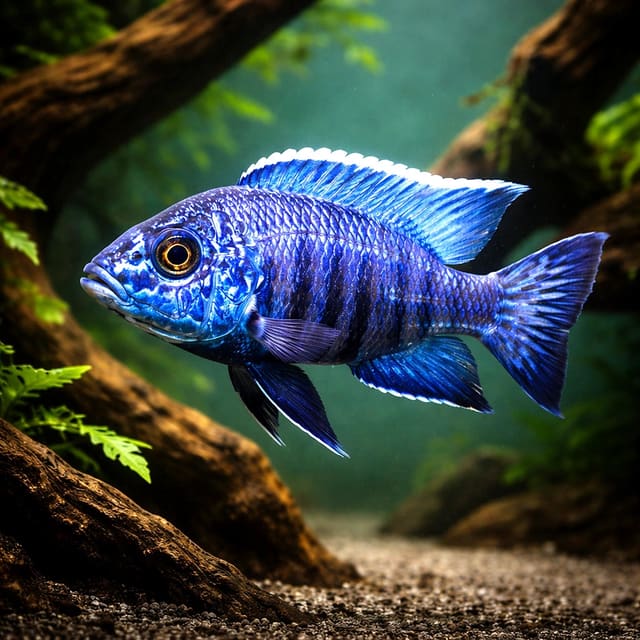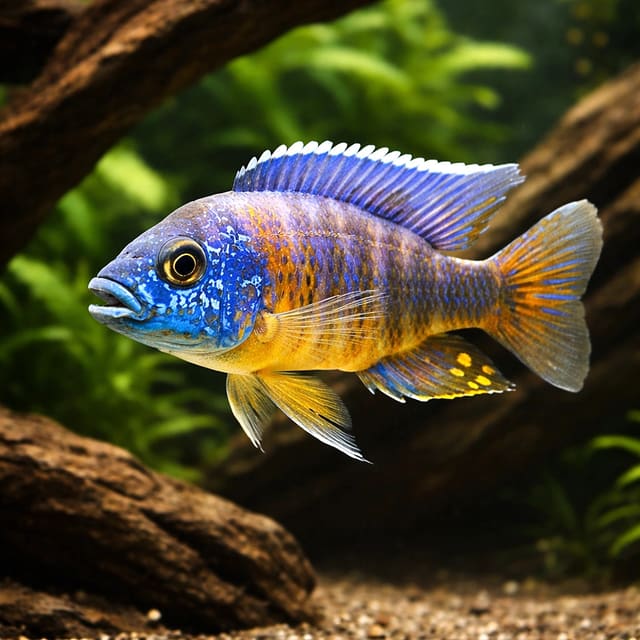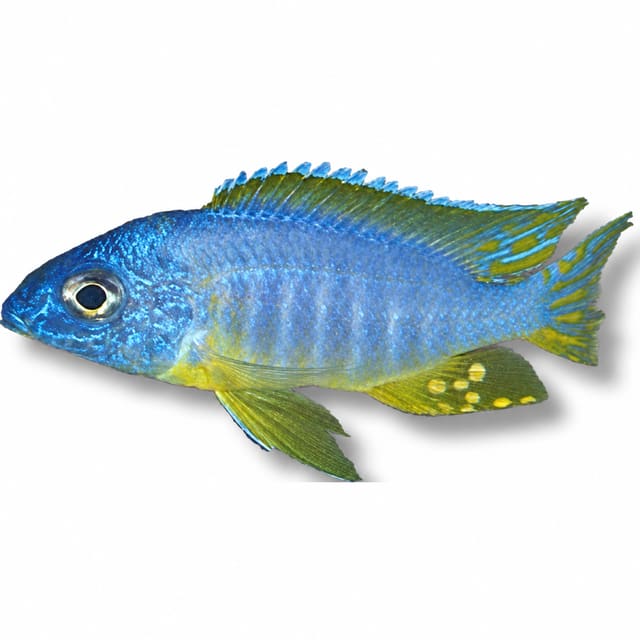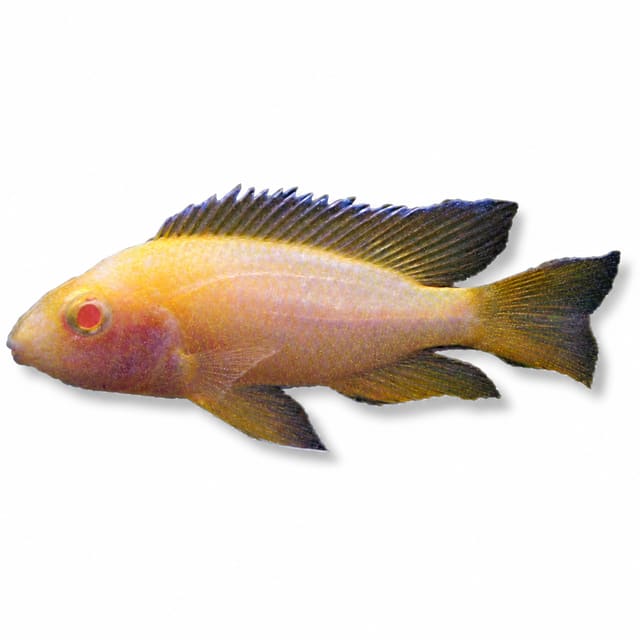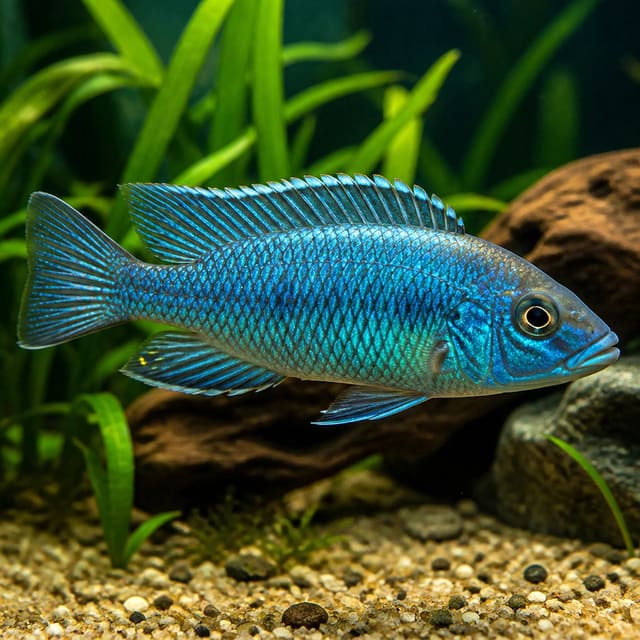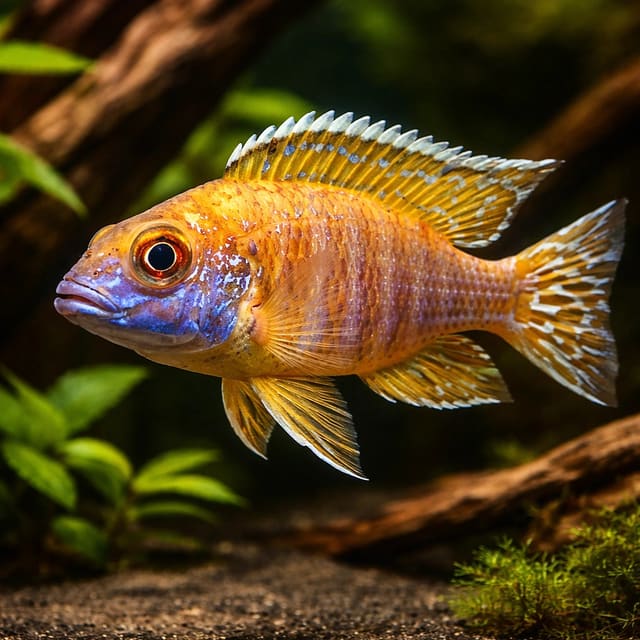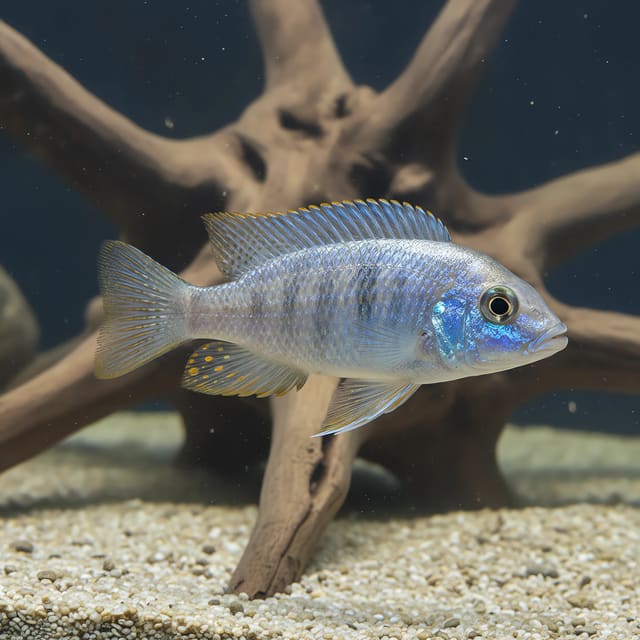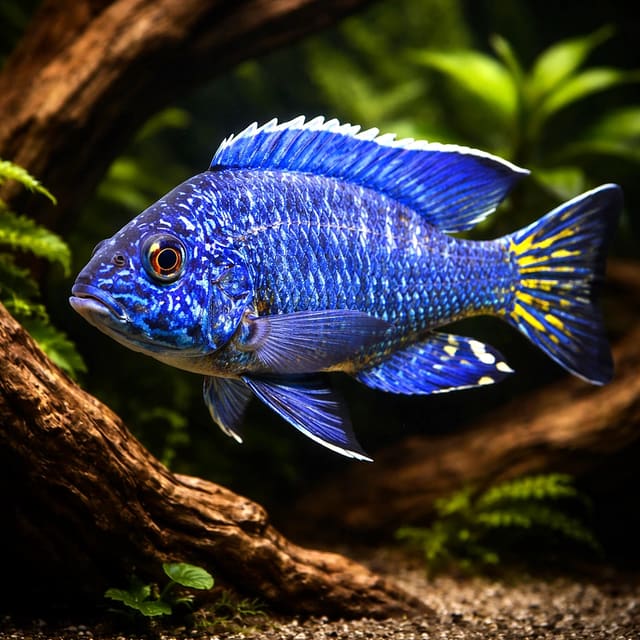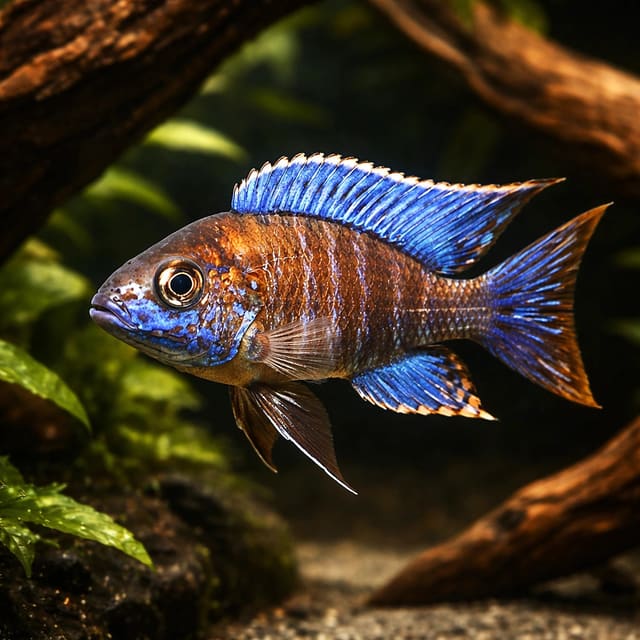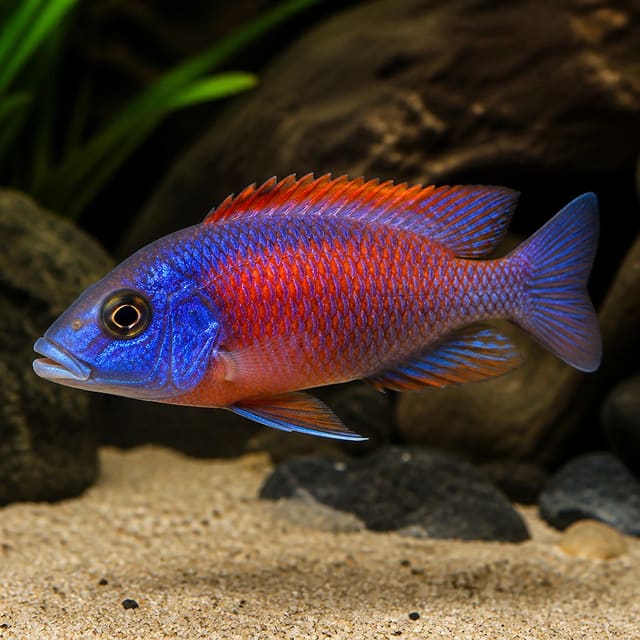
Steveni Blue Neon Peacock Cichlid (Aulonocara stuartgranti)
23–26°C · pH 8–8.6 · 243L
£18.99
Blue Neon Peacock Cichlid is an unidentified Aulonocara trade form for a mature Lake Malawi aquarium. One purchase supplies one fish in the selected 3–4 cm, 4–5 cm, 6–7 cm or 7–9 cm dispatch grade; sex is not guaranteed.
Aulonocara sp.
Save when buying multiple fish. Each quantity is one fish; sex and pair formation are not guaranteed unless the selected variant explicitly states them.
Blue Neon Peacock Cichlid is an unidentified Aulonocara trade form for a mature Lake Malawi aquarium. One purchase supplies one fish in the selected 3–4 cm, 4–5 cm, 6–7 cm or 7–9 cm dispatch grade; sex is not guaranteed.
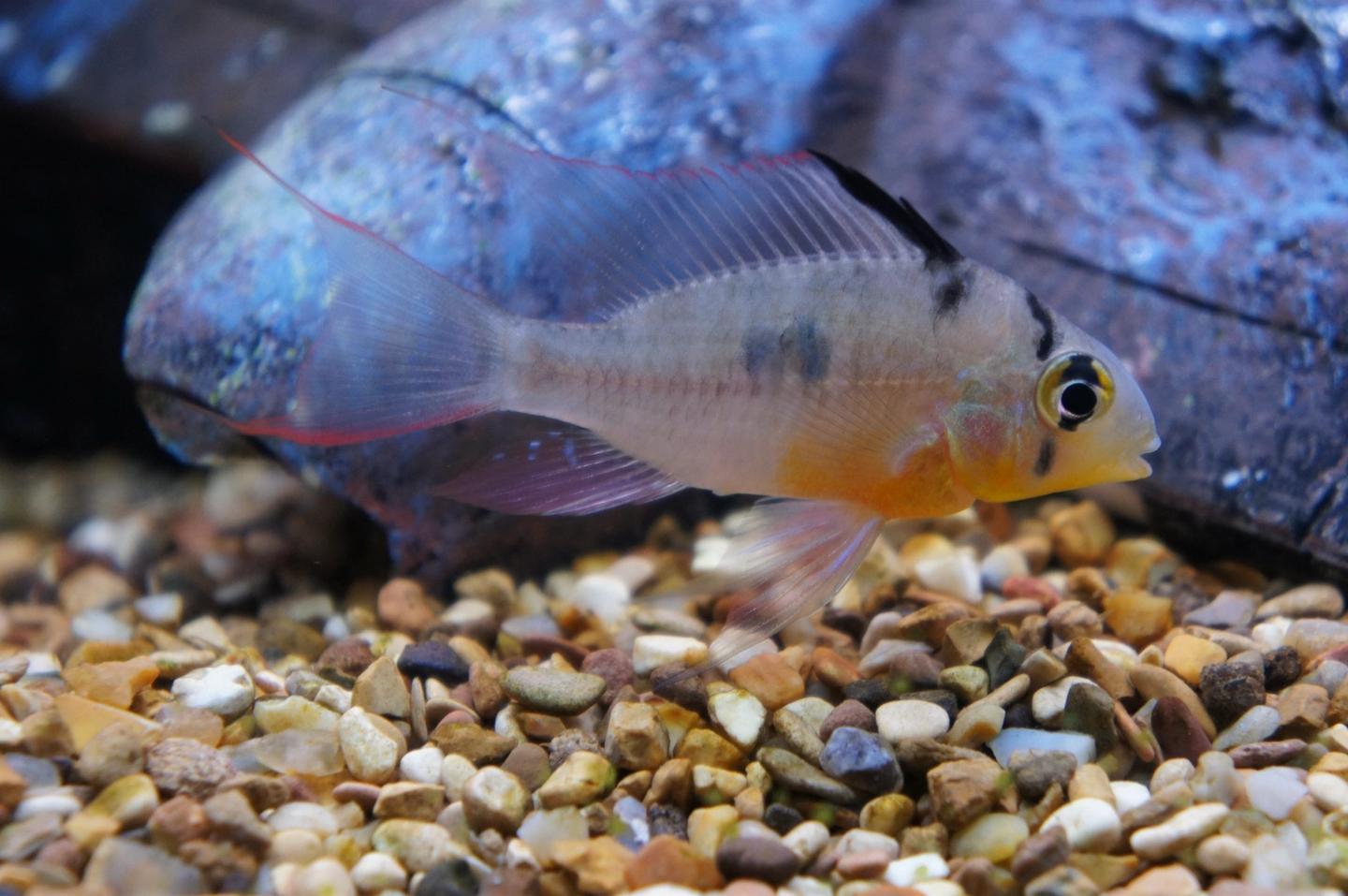
Cichlids are a family of roughly 1,800 accepted species, not one care type. Before buying, identify the exact species and source, then compare adult measurement, usable tank dimensions, social system, territory, tested water, diet and an exit plan. No family-wide minimum tank, water range or tank-mate list is safe.
Maintain these water conditions for optimal health and vibrant colors
Blue Neon Peacock Cichlid is the trade name for this vividly coloured Aulonocara peacock cichlid. The scientifically honest label is Aulonocara sp. because the exact species has not been identified. That distinction matters: Blue Neon may describe a locality-associated or selectively bred aquarium form, but it is not a valid species name that can safely be turned into a Latin binomial. The exact species has not been identified, so the care advice here follows the genus Aulonocara and its care group.
One purchase supplies one live fish in the size grade you choose. The established grades are 3–4 cm, 4–5 cm, 6–7 cm and 7–9 cm. These are dispatch grades for the fish supplied, not statements about final adult length, and static copy cannot tell you which grade is available at the moment you order. The size you select is the size supplied, not the adult size. Choose a dispatch grade that will not be swallowed, pinned away from food or overwhelmed by the established inhabitants, then plan the aquarium for an adult Malawi cichlid community rather than for the juvenile arriving today.
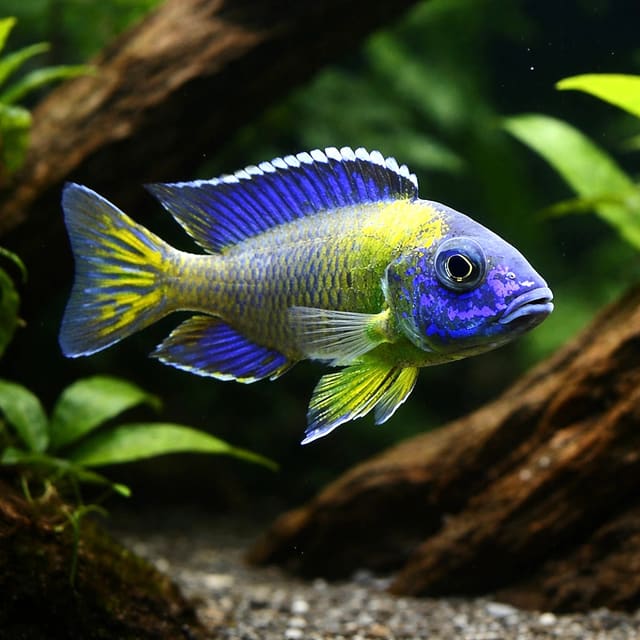
This listing does not sell a guaranteed male, female or pair. Sex is guaranteed only when the selected option explicitly states male or female. This Blue Neon Peacock Cichlid listing has no sex-guaranteed option. A bright blue appearance in a gallery scene cannot turn an unspecific offer into a male guarantee. Young fish may also look different as they settle, mature and find their place in a hierarchy. Natural colour is affected by maturity, sex, social position, stress, diet, lighting and water quality, so colour alone should never be used as the only health check.
At genus level, Aulonocara belongs to the cichlid family and is endemic to Lake Malawi. Peacock cichlids are known for conspicuous colour and a specialised sensory system associated with locating small prey around sandy habitat. That natural context helps explain why an aquarium with open sand, measured feeding space and rock cover is more useful than a cramped wall of décor. It does not prove a precise adult size, temperament or diet for an unidentified trade form, so this page keeps species-level numbers out where the source cannot support them.
| Identity | Blue Neon trade form; Aulonocara sp. at genus level |
|---|---|
| Sold unit | One live fish in the selected dispatch grade |
| Size grades | 3–4 cm, 4–5 cm, 6–7 cm and 7–9 cm |
| Sex | Not guaranteed by this product or its size choices |
| Water style | Stable, hard and alkaline Lake Malawi conditions |
| Best suited to | Keepers able to manage cichlid social behaviour, mineral-rich water and strong biological filtration |
This is an intermediate store-suitability choice rather than a beginner's impulse buy. The challenge is not a complicated daily ritual; it is getting the whole environment right before the fish arrives. A mature biological filter, predictable water chemistry, enough room for a thoughtfully composed Malawi community, protected feeding access and a plan for aggression all matter together.
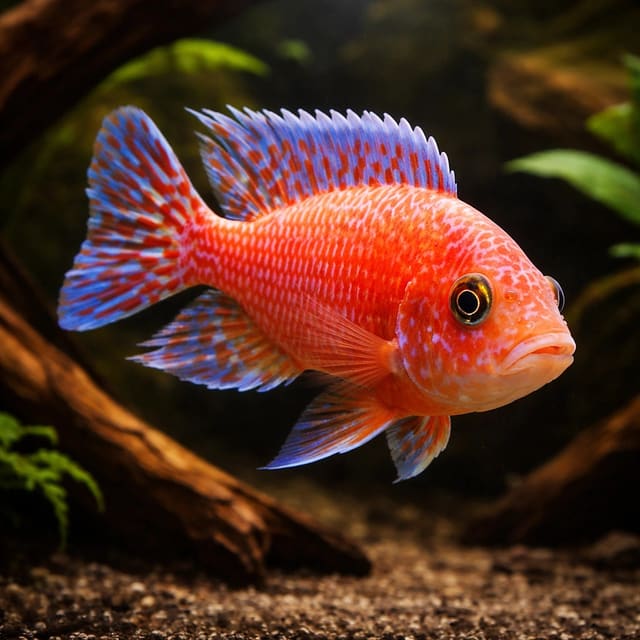
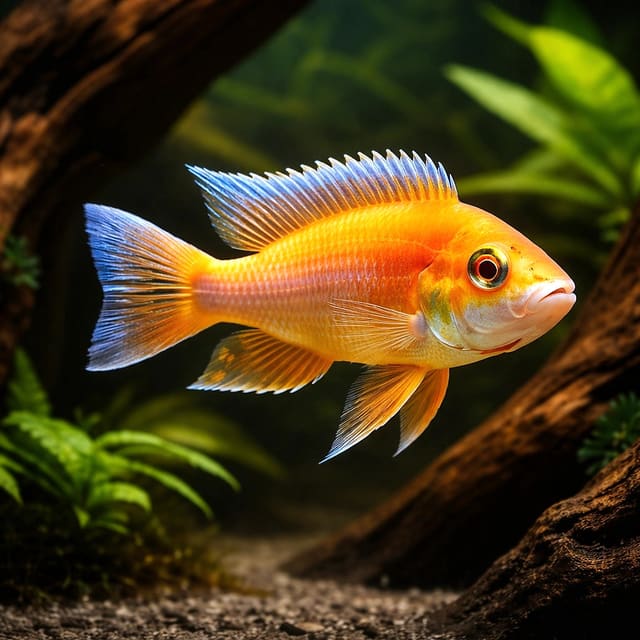
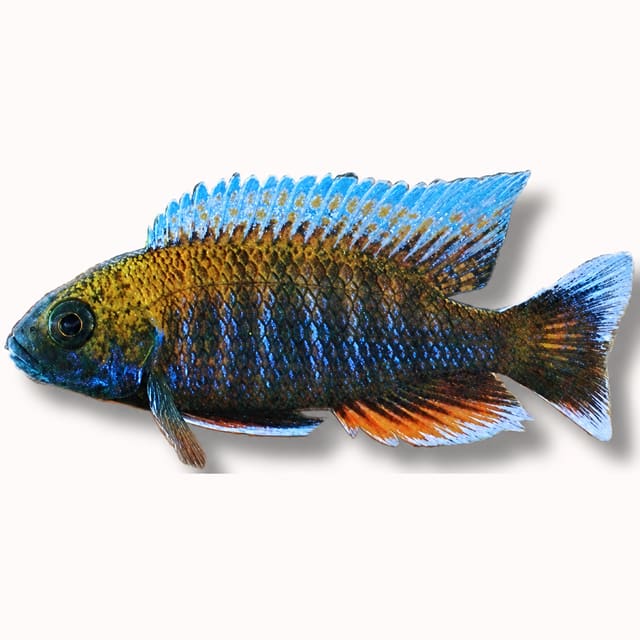
Gallery images have been digitally enhanced to improve image quality. Natural colour, pattern, size and maturity can vary between live animals.
If you are still building the aquarium, start with the step-by-step tropical tank setup guide. It explains cycling and maturation before livestock is added; a bright fish is never a substitute for a ready filter.
The safest way to plan for this Blue Neon Peacock Cichlid is to separate what is known about the exact offer from what is only broad Malawi-cichlid guidance. The offer establishes the genus, trade form, one-fish sale unit and four dispatch grades. OATA's Malawi care sheet supplies a useful group-level framework for water, filtration, layout and community management, but it explicitly says those values are general and that individual species may differ. Because no species has been confirmed here, every number below keeps that limitation attached.
OATA gives 23–27°C, pH 8.0–8.6, general hardness of 12–18°dH and carbonate hardness of 10–15°dKH as broad guidance for Malawi cichlids. These are not a proven optimum for a species called “Blue Neon”; they are the applicable care-group window for an Aulonocara trade form whose species remains unresolved. Use them as a planning framework, then keep the aquarium steady within the appropriate hard, alkaline range rather than making repeated large adjustments in pursuit of a single perfect reading.
| Temperature | 23–27°C, broad Malawi-cichlid guidance |
|---|---|
| pH | 8.0–8.6, broad Malawi-cichlid guidance |
| General hardness | 12–18°dH, broad Malawi-cichlid guidance |
| Carbonate hardness | 10–15°dKH, broad Malawi-cichlid guidance |
| Ammonia and nitrite | 0 mg/L |
| Nitrate | OATA advises no more than 20 mg/L above the normal tap-water level |
Test the source water as well as the aquarium. A pH result without hardness context can be misleading: water can read alkaline today but lack enough carbonate reserve to resist a later fall. The aquarium water-chemistry guide explains what the common tests measure, and the water parameter matcher helps compare your measured values with the broad care range without pretending that an instant chemical correction is harmless.
Make changes gradually. Large, abrupt shifts in temperature, pH or mineral content add stress even when the final number sits inside a published range. Prepare replacement water consistently, treat chlorine or chloramine, and avoid adding water containing chlorine or chloramine straight to the aquarium. If your local water is naturally soft, learn how your chosen buffering approach behaves before the fish arrives; do not improvise with repeated handfuls of mineral products after livestock is present.
A mature biological filter is essential. Fish continually release ammonia, which is toxic. Established filter bacteria convert it to nitrite, also toxic, and then to nitrate, which is less immediately dangerous but still needs control. A clear-looking aquarium can therefore be unsafe, while a biologically mature aquarium with some harmless algae may be stable. Measure ammonia and nitrite rather than judging the water only by appearance.
Malawi community aquariums can carry a substantial feeding and waste load. OATA recommends an oversized filter and strong aeration for the group. Choose equipment that provides dependable biological capacity and good surface movement across the actual aquarium volume after substrate and rocks displace water. Arrange outlets so oxygenated water circulates behind rock structures without forcing every fish to fight a harsh jet. Watch for quiet pockets where uneaten food and waste settle.
Never replace all filter media at once. When maintenance is needed, rinse reusable media gently in removed aquarium water, not under the tap, so the established bacterial population is not exposed to chlorine or chloramine. Keep an eye on falling flow: a filter that sounds as though it is running may still be clogged. If ammonia or nitrite appears, stop adding livestock, reduce feeding, protect oxygenation and identify the cause; do not treat a biological-filter problem as though it were merely cloudy water.
There is no approved species-specific minimum for this Blue Neon Peacock Cichlid because the species and adult size are unresolved. OATA recommends an aquarium of at least 200 litres for a reasonable Malawi cichlid community. That is broad group planning guidance, not a promise that every 200-litre aquarium suits any combination of peacocks, haps or mbuna. Footprint, adult stock, territory, sight lines, filtration and owner experience can make two tanks with the same nominal volume behave very differently.
Start with the final community, not the smallest fish. List the adult identity and behaviour of every intended inhabitant, reserve open swimming room, then decide whether the footprint still leaves safe retreat routes. A long aquarium usually offers more options for spacing and sight breaks than a tall narrow one of the same litres. If the exact adult size of a fish is unresolved, conservative planning means leaving more margin, not filling the gap by guessing a centimetre figure.
Use a fine sand or smooth sand-based substrate that can be kept clean. OATA notes that coral sand or a similar material may help buffer hard-water cichlid systems. The key is to know what the substrate does in your water and to avoid sharp material that could injure fish as they investigate the bottom. Open sand also lets food be seen and removed rather than disappearing into coarse gravel.
Build rockwork on a stable base so digging cannot undermine it. Create caves and broken sight lines around the rear and sides, but keep generous open areas. The aim is not to reproduce a solid rock wall. Subordinate fish need routes that do not end in a corner, while confident fish need room to swim and display without colliding continually. Check behind every large structure during maintenance because trapped detritus becomes a long-term water-quality problem.
Plants are optional. Malawi cichlids will often dig and rearrange the substrate, and will uproot plants, so use only robust, securely positioned species if you want greenery. Never rely on plants to replace filtration or regular testing. A secure lid is sensible around active cichlids, with service gaps closed while still allowing ventilation and safe cable runs.
The four size grades describe the fish supplied: 3–4 cm, 4–5 cm, 6–7 cm or 7–9 cm. They are not four separate products and they are not adult-size promises. A smaller grade may settle well in a juvenile grow-on group, but it can be a poor choice for a tank already ruled by larger cichlids. A larger grade may resist immediate intimidation better, yet it also contributes more waste and may challenge an established hierarchy sooner.
Before choosing, compare the actual body size and mouth size of existing fish, not just their label. Avoid a gap large enough for the new fish to be swallowed. Also consider feeding speed: a fish can survive without being attacked yet still decline because dominant tank mates take every meal. If you cannot watch feeding and provide a safe route away from established territories, delay the addition.
Quarantine is valuable where you have a suitable mature system and a routine that avoids transferring water and equipment between tanks. On introduction day, keep activity around the aquarium calm and check the transport bag and fish before opening. Use the current delivery acclimation method and match water conditions gradually. Do not pour transport water into the display. Give the fish time to recover before offering a small meal, and watch breathing, balance and access to shelter rather than demanding instant colour.
Diet varies across Malawi cichlids. OATA describes more plant-focused feeding for some mbuna and more animal-rich pellets and frozen foods for some larger open-water forms. Research on named Aulonocara species documents their ability to locate small invertebrate prey associated with sandy substrate, but this offer is not identified to that species. The practical response is a measured, varied diet appropriate to a peacock-type Malawi cichlid, not a rigid claim that this Blue Neon form is purely carnivorous, herbivorous or omnivorous.
Use a good-quality, appropriately sized complete Malawi-cichlid pellet or granule as the dependable base. Add modest variety selected for the fish's mouth size and the wider community, such as suitable frozen foods, without turning rich extras into every meal. Spread food so several fish can feed at once. Watch that the newcomer swallows food rather than merely chasing it, and stop when the portion has been eaten within a few minutes.
Overfeeding creates two problems: excess energy for the fish and excess waste for the aquarium. Uneaten food breaks down into the same nitrogen cycle that the filter must process. Feed less when fish are unsettled, when water quality is questionable or when the filter has recently been disturbed. Avoid using appetite alone as permission to keep adding food; cichlids can remain eager after receiving enough.
OATA strongly recommends a 25% partial water change at least once every week for Malawi cichlids. Treat that as a sound starting routine and adjust only in response to measured water quality, stocking and feeding. Siphon accessible waste from the substrate, inspect behind rocks, condition replacement water and match temperature closely. A huge irregular change after weeks of neglect is more stressful than a consistent routine.
Health monitoring starts with knowing what is normal for your aquarium. Look for changes in breathing, posture, swimming level, colour, appetite, body condition and social position. A fish hiding more than usual may be avoiding aggression, but it may also be reacting to water quality or illness. Test the water first, observe the whole group and seek appropriate aquatic-veterinary or experienced retailer help rather than guessing at a treatment. No disease recipe belongs in a general product listing.
A newly arrived cichlid may be paler, quieter or less willing to feed while it recovers from transport and learns the hierarchy. Give it calm conditions and observe breathing, balance and access to shelter. Do not try to force display colour with rich food, forced display conditions or repeated changes to the water. Stable conditions are more useful than chasing the appearance of a mature show fish.
Separate normal caution from sustained exclusion. A fish that retreats briefly when a dominant animal passes may still return to feed and swim normally. A fish held in one corner, blocked from every meal or chased whenever it leaves cover needs intervention. Check water quality because poor oxygen or detectable ammonia can make every social problem worse, then change the stocking or territory arrangement safely if one individual remains targeted.
Keep notes during the first fortnight. Record test results, feeding response and which areas each fish uses. Short observations at the same times each day reveal patterns that a single long look may miss. If colour drops across the whole aquarium, several fish breathe rapidly or multiple animals refuse food, investigate the shared environment first. If only one fish is affected, examine injury, bullying and body condition while still confirming the water is safe.
Compatibility is a plan, not a label. Calling two animals “African cichlids” does not make them suitable companions: Lake Malawi and Lake Tanganyika fish can have different behaviour and social structures even when both prefer mineral-rich water. For this Blue Neon Peacock Cichlid, begin with fish that genuinely share the required hard, alkaline environment, then compare adult size, aggression, swimming level, diet and the amount of territory each species needs.
OATA advises keeping Malawi cichlids with other Malawi cichlids or with some suitable Synodontis, while mixing with caution because Malawi cichlids can be aggressive. That is a category-level rule, not a universal tank-mate list. A particular Synodontis still needs its own adult-size, group, diet and water assessment. Another peacock cichlid may share the water but compete intensely for colour, display space or females. A mbuna may fit the chemistry yet be too forceful for the available footprint.
| Potentially suitable | A deliberately planned Lake Malawi community with comparable adult size, water needs and manageable behaviour |
|---|---|
| Consider individually | Other Aulonocara, open-water Malawi cichlids and suitable Synodontis, after checking the exact species |
| Use caution | Assertive mbuna, similar-looking males, large size gaps and established territories |
| Avoid | Soft or acidic-water fish, very small or timid community species, and any animal likely to be swallowed or excluded from food |
Do not use the supplied alternative products as a ready-made stocking list. They are catalogue alternatives for a buyer comparing kinds of African cichlid, not companions guaranteed to live together. The most useful broader browsing route is the African cichlid collection; use it to identify possibilities, then research each proposed combination separately.
Aggression often changes with maturity, feeding, spawning condition and rearranged hierarchy. A calm juvenile group can become territorial later. Provide sight breaks, several escape routes and feeding spread across a broad area. Do not place one new small fish into a mature community and assume that plenty of caves will solve the problem; a dominant fish can control cave entrances as easily as open water.
OATA describes group additions, adding calmer fish before more aggressive ones and rearranging décor as possible ways to reduce focused aggression in Malawi communities. These methods still require enough filtration, oxygen and floor space. Slight crowding is sometimes used by experienced keepers to distribute aggression, but it is not permission to exceed the aquarium's biological capacity. If you cannot maintain zero ammonia and nitrite, dependable oxygenation and fair feeding access, the stocking plan is not safe.
Watch for repeated chasing aimed at the same fish, damaged fins, a fish pinned behind equipment, refusal to feed or rapid breathing. Occasional display is not the same as relentless exclusion. Keep a realistic separation plan before mixing assertive cichlids; waiting until an injured fish has nowhere to go is too late.
The genus is strongly sexually dichromic, meaning mature males and females can differ noticeably in colour, but the exact species and sex of this offer are not guaranteed. Do not buy a particular size expecting it to become the bright blue individual shown in a gallery scene. Colour can strengthen or fade with maturity, stress and hierarchy. Judge compatibility by welfare and behaviour, not by whether a fish shows maximum display colour immediately.
Aulonocara are maternal mouthbrooders at genus level. Breeding behaviour can intensify attention from males and place pressure on females. The listing does not supply a pair, a ratio or a breeding group, and the broad suggestion to keep more females than males cannot be fulfilled reliably when sex is not guaranteed. Build the community around space and behaviour first; treat any later breeding as a separate specialist responsibility.
No dependable adult figure can be given for this offer because Blue Neon is a trade form identified only as Aulonocara sp. The 3–4 cm, 4–5 cm, 6–7 cm and 7–9 cm choices are dispatch grades, not adult-size records.
No species-specific minimum is established here. OATA recommends at least 200 litres for a reasonable Malawi cichlid community, but the final requirement depends on the exact adult stock, footprint, territories, open swimming space and filtration.
There is no reliable species-specific group number for a genus-level trade form. Plan this fish as part of a deliberately stocked Malawi community and assess aggression, adult size, sex uncertainty, feeding access and available territory rather than copying a generic number.
It is an intermediate store-suitability choice. A keeper should already be comfortable cycling a tank, keeping hard alkaline water stable, testing ammonia and nitrite, maintaining strong filtration and managing cichlid aggression.
Use an appropriately sized complete Malawi-cichlid pellet or granule as the dependable base, with modest suitable variety. Diets vary across Malawi cichlids, so avoid an extreme species-specific feeding claim for this unidentified trade form and remove uneaten food promptly.
OATA's broad Malawi-cichlid guidance is 23–27°C and pH 8.0–8.6, with 12–18°dH general hardness and 10–15°dKH carbonate hardness. These are group-level aquarium values, not a proven species-specific optimum.
Malawi cichlids can be aggressive and should be mixed cautiously. This offer's exact species-level temperament is unresolved, so provide sight breaks, fair feeding access and a separation plan, and avoid timid or long-finned community fish.
Start with a carefully researched Lake Malawi community whose members share hard alkaline water and comparable adult size. Some suitable Synodontis may work, but no named animal is universal; check species, behaviour, diet and territory before combining them.
Tropical Fish Co hand-packs live fish in oxygen with an insulated box and a heat pack when weather requires it, then uses a licensed live-animal courier. Follow the current delivery page, be present to receive the parcel and record the sealed parcel being opened if you need to make a Live Arrival Guarantee claim.
The scientific identity is deliberately conservative. Blue Neon is the trade-form name, while the World Register of Marine Species record for Aulonocara supports the genus and family but not a Blue Neon species epithet. The Aulonocara genus summary is used only for broad natural-history context such as Lake Malawi endemism, mouthbrooding and strong sexual colour differences.
The water, filtration, maintenance and broad compatibility framework comes from OATA's African Malawi cichlid care sheet. OATA explicitly describes its parameters as general group guidance, which is why this page does not present them as an exact species optimum. The RSPCA's aquarium environment guidance supports the need for established biological filtration and explains the ammonia-to-nitrite-to-nitrate process.
No approved source establishes a species-level adult size, lifespan, home-breeding recipe, disease treatment, guaranteed sex, exact stock origin or precise Blue Neon temperament for this offer. Those details are omitted instead of being filled from another retailer's copy. Dispatch grades and adult size remain separate.
For fulfilment terms rather than husbandry, read the current Delivery and Live Arrival Guarantee. The sealed-parcel video is evidence for a claim, not part of routine animal care.
No reviews for this item yet. Bought one? Honest reviews only, good or bad.
What customers say about ordering from us
Easy website plenty of info on fish your buying great to pick a time slot
TRACEY DURRANT · 7 Oct 2026
Got some lovely fish thank you
Kevin Mackie · 7 Oct 2026
Reviews of our shop, collected by Judge.me, an independent third-party review collector. Newest first.