−13%
Advanced
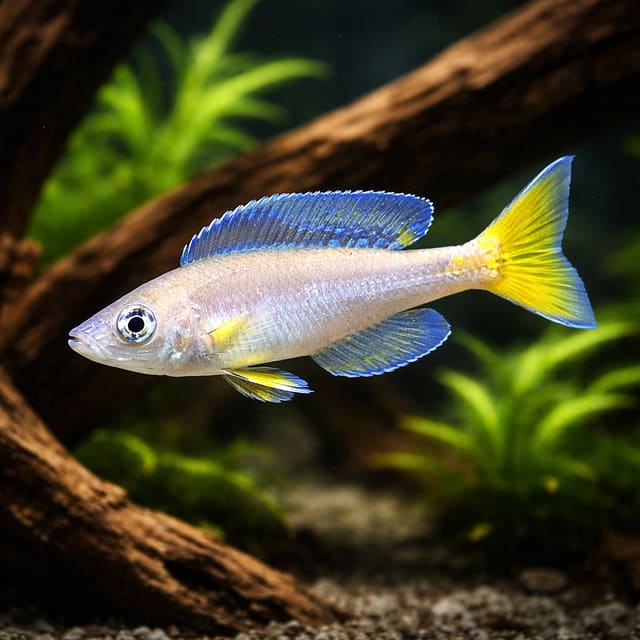
Duboisi, White-Spotted Cichlid (Tropheus duboisi)
23–27°C · pH 8–8.6 · 110L
£17.39£19.99

Bemba Tropheus (Tropheus moorii “Bemba”) is a specialist Lake Tanganyika cichlid sold as one animal in the dispatch size selected. Plan a 150 cm aquarium, hard alkaline water, an algae-led diet and a carefully managed group of 15–20 fish.
Adult size is the maximum length this species reaches at full maturity (scientific sources). The livestock you receive will be younger and smaller — pick a size above for the actual shipping size. Product-photo provenance and any image-specific limitations are stated on the listing.
Tropheus moorii
Save when buying multiple fish. Each quantity is one fish; sex and pair formation are not guaranteed unless the selected variant explicitly states them.
Bemba Tropheus (Tropheus moorii “Bemba”) is a specialist Lake Tanganyika cichlid sold as one animal in the dispatch size selected. Plan a 150 cm aquarium, hard alkaline water, an algae-led diet and a carefully managed group of 15–20 fish.
Adult size is the maximum length this species reaches at full maturity (scientific sources). The livestock you receive will be younger and smaller — pick a size above for the actual shipping size. Product-photo provenance and any image-specific limitations are stated on the listing.
Cichlids are a family of roughly 1,800 accepted species, not one care type. Before buying, identify the exact species and source, then compare adult measurement, usable tank dimensions, social system, territory, tested water, diet and an exit plan. No family-wide minimum tank, water range or tank-mate list is safe.
Maintain these water conditions for optimal health and vibrant colors
Bemba Tropheus is a form of Tropheus moorii, the Blunthead cichlid. FishBase places the species in the cichlid family and records it as endemic to Lake Tanganyika. It is a freshwater, rock-associated fish whose aquarium care centres on hard alkaline water, grazing food, excellent oxygenation and deliberate management of its relationships with other Tropheus.
This is an advanced-care choice rather than a general community fish. The Seriously Fish profile for Tropheus moorii describes it as unsuitable for beginners because water quality and social management are particularly important. Keepers who can test water every week, maintain a stable biological filter and respond promptly to exclusion or appetite changes are better placed to manage it.
| Suits | Not suited to |
|---|---|
| Experienced keepers prepared for advanced care | Beginners seeking an undemanding community fish |
| A 150 cm aquarium planned for a group of 15–20 | Groups of five or six, which may fail to settle |
| Hard alkaline water at 24–26°C, pH 8.0–8.6 and 12–18 dGH | Aquariums outside those routine water values |
| Active companions that pass the full compatibility screen | Shy species |
| An algae-based dried staple with vegetable matter | Feeding based on beefheart or other animal meat |
Its appeal comes with purposeful behaviour rather than passive display. Tropheus remain active, graze surfaces and establish a pecking order. Choose one when the aquarium can be planned around those behaviours from the outset.
One purchase supplies one Bemba Tropheus of the option selected. Use the live size selector to choose the dispatch size; its labels include 3 cm, 3,5 - 4 cm, 4,5 - 5 cm, 5 - 7 cm and 7 - 9 cm. Similar size bands can appear more than once on the selector, so make the selection directly on the page rather than relying on a size written elsewhere.
The size you select is the size supplied, not the adult size. A 3 cm or 5 - 7 cm choice therefore changes the size at dispatch, not the long-term space, water or social plan. Every size should ultimately be accommodated as a fish that may reach the recorded maximum of 14.5 cm.
Sex is guaranteed only when the selected option explicitly states male or female. This Bemba Tropheus listing has no sex-guaranteed option. The sexes are difficult to distinguish, and colour or body shape should not be used to promise what will be supplied.
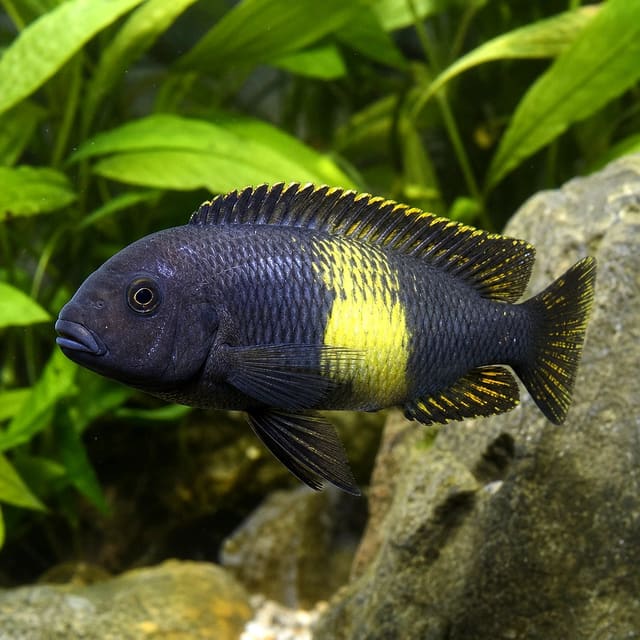
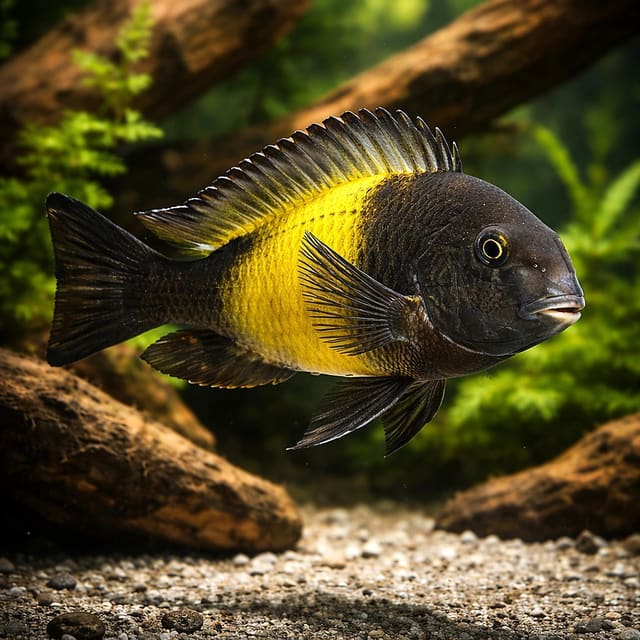
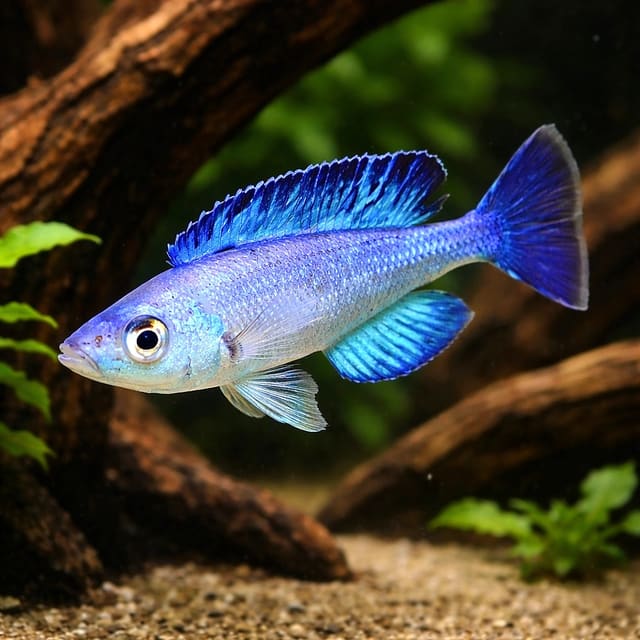
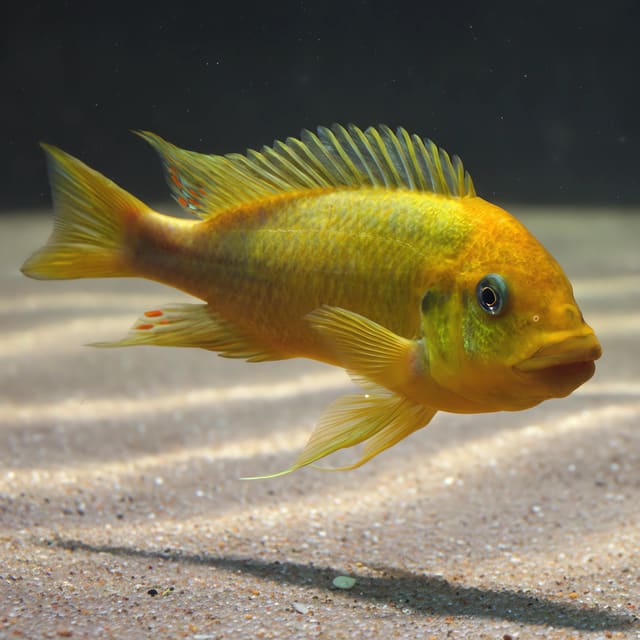
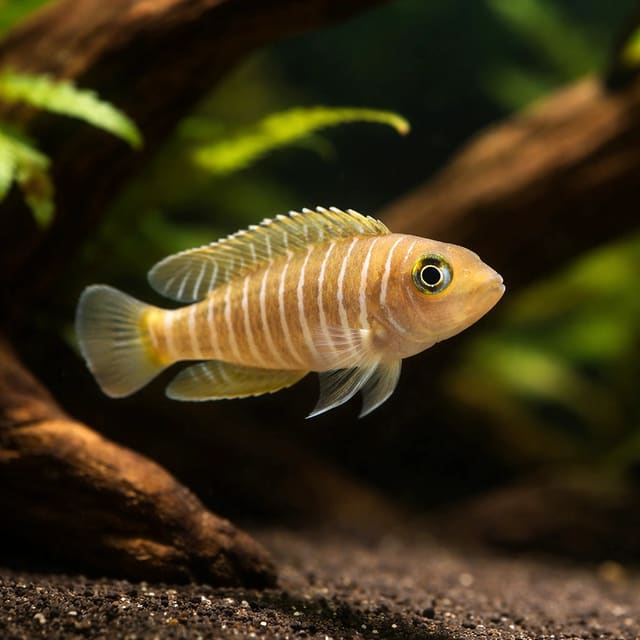
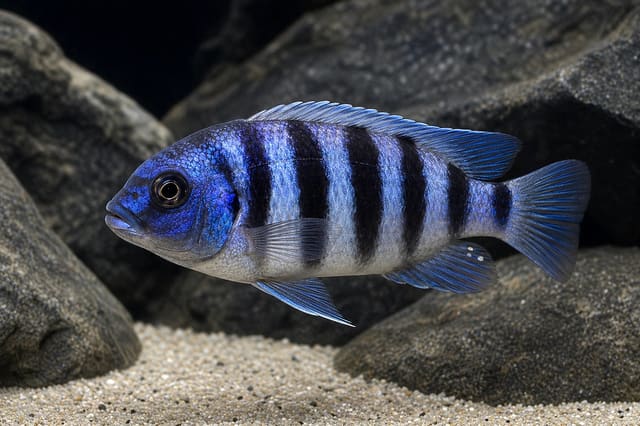
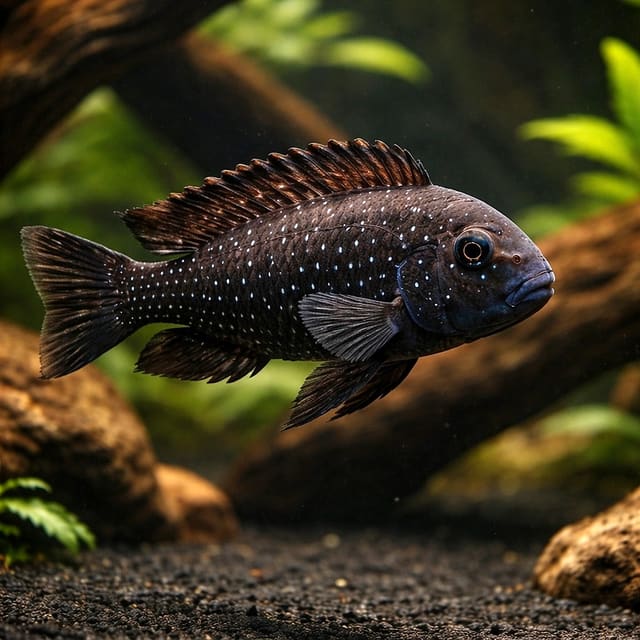
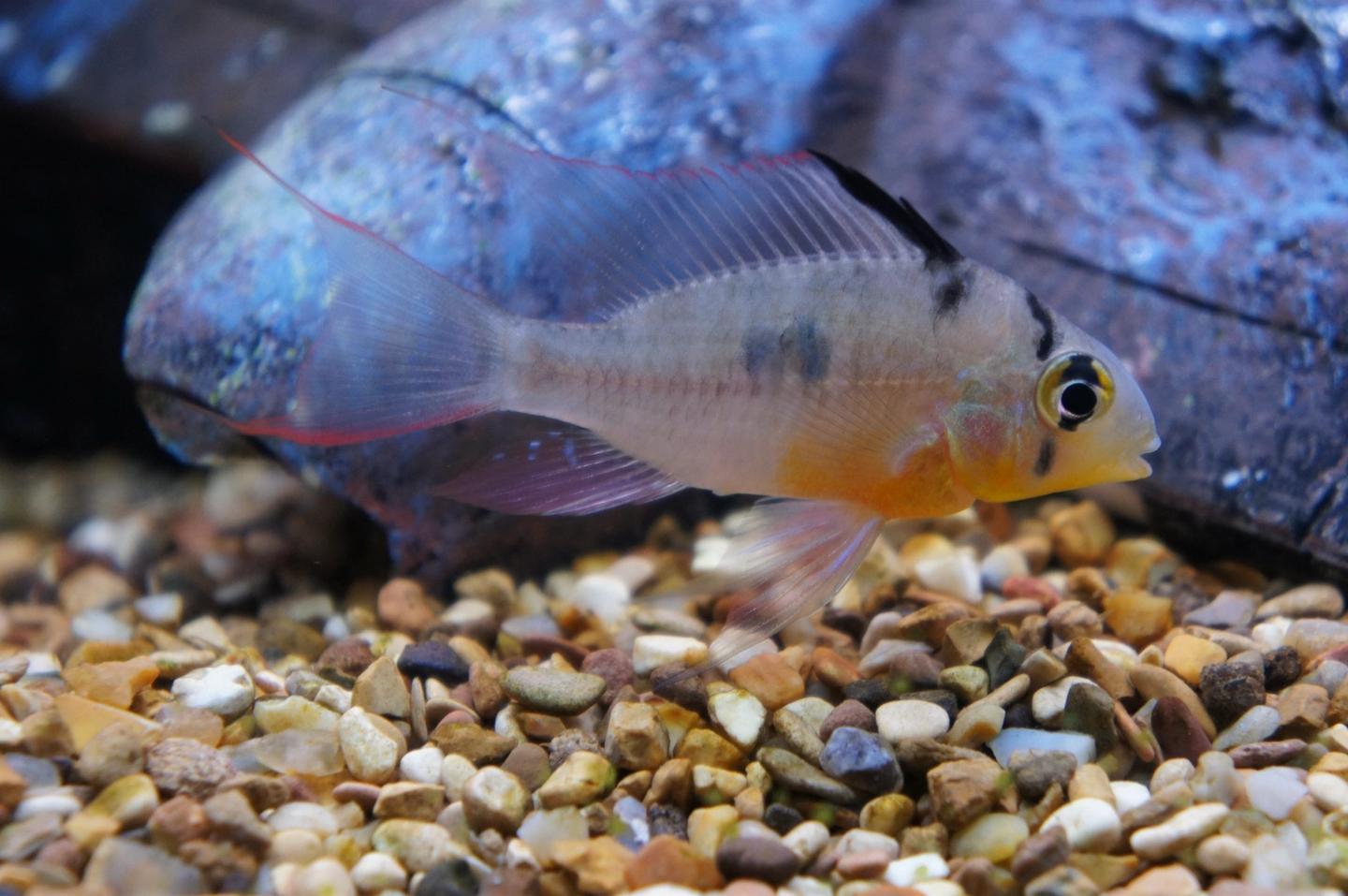
The gallery images are representative of this type of animal rather than photographs of the exact animal supplied, so colours can look slightly different from the live animal. The pictured fish shows the dark body and broad orange band associated visually with this form, but the image should guide identification rather than set an exact colour expectation.
FishBase records a maximum length of 14.5 cm and a minimum aquarium size of 150 cm for Tropheus moorii. Seriously Fish gives 120 × 30 × 30 cm and 110 litres as a reference for one specimen, then says a group requires a much larger aquarium. Because Tropheus are normally managed around a social group, do not treat 110 litres as a colony minimum.
Aquarium length matters because these fish need rock structures, open swimming areas and room for a pecking order to develop. A larger water volume also changes more slowly when feeding or waste increases. Use 150 cm as the decisive starting dimension, then provide more room when the intended group, rockwork or tank mates would crowd that footprint.
The practical social target is 15–20 fish. Groups of five or six may fail to settle and can direct severe aggression towards individual fish. A large group is not a substitute for space: both group planning and a suitably large aquarium are needed.
| If your plan is… | Decision |
|---|---|
| A short aquarium with high litres | Reconsider, because usable length and territories remain limiting |
| A 110-litre single-fish setup | Do not use it as the basis for a Tropheus group |
| A 150 cm aquarium for 15–20 | Assess rock layout, filtration and oxygenation before proceeding |
| A mixed Tanganyika aquarium | Allow additional room for every species and territory |
Set the water target before the fish arrives: 24–26°C, pH 8.0–8.6 and 12–18 dGH. Those figures sit within the published ranges for the species while following the narrower African lake cichlid guidance used for routine care.
Start with sand and create several rock piles separated by open areas. Seriously Fish recommends piles of rockwork that form cave-like structures and hiding places, interspersed with swimming space. This gives a chased fish somewhere to break visual contact while allowing the group to move between feeding and territorial areas.
A bare aquarium is another recognised approach and may reduce territorial behaviour, but it removes much of the visual structure used to interrupt chasing. If you choose a decorated aquarium, avoid one continuous wall of rock that lets a dominant fish oversee the whole footprint. Several distinct structures create more boundaries and escape routes.
Rock surfaces also support the fish’s characteristic grazing behaviour. FishBase describes epiphyton as an aquarium food for this species, while its wild biology includes plant matter alongside worms, crustaceans and insects. In the aquarium, grazing behaviour should be served primarily through an algae-led feeding routine rather than by trying to recreate every wild food item.
Do not use decoration to force too many fish into too little space. If every cave entrance becomes contested or fish cannot cross the aquarium without entering another territory, the answer is more usable space or a revised stocking plan, not another tightly packed rock pile.
Walk around the completed aquarium and inspect it from the front and both ends before filling it with fish. A useful arrangement should provide several routes around the rocks rather than one narrow channel. Check that no stone blocks the filter intake or traps an inaccessible pocket of waste. After maintenance, return movable pieces to the planned positions unless you are deliberately resetting territories for an introduction.
OATA’s African lake cichlid sheet gives 23–27°C, pH 8.0–8.6 and 12–18 dGH for the group, not as a species-specific optimum. FishBase records 24–26°C, pH 8.0–9.0 and 9–19 dGH for the species’ environment, while Seriously Fish gives 23–27°C, pH 8.0–9.5 and 8–25 dGH for aquarium care.
Use 24–26°C, pH 8.0–8.6 and 12–18 dGH as the routine aquarium target. This keeps temperature inside FishBase’s tighter recorded range and uses OATA’s narrower pH and hardness values without exceeding the wider species ranges. Stability within that target matters more than repeatedly moving between its upper and lower limits.
| Measurement | Routine decision |
|---|---|
| Temperature | Keep between 24 and 26°C |
| pH | Keep between 8.0 and 8.6 |
| General hardness | Keep between 12 and 18 dGH |
| Ammonia | Maintain at 0 mg/l |
| Nitrite | Maintain at 0 mg/l |
| Nitrate | Keep no more than 20 mg/l above normal tap-water level |
Measure the aquarium and its source water rather than judging hardness from appearance. Our water chemistry guide explains what the readings mean, and the water matcher helps compare measured values with this target.
If a reading changes unexpectedly, test again before altering the aquarium. Check recent water changes, source-water values and maintenance activity, then make controlled adjustments that preserve the required hard alkaline conditions. A sudden correction can create another instability even when the intended final number is suitable.
Record the results on the same day each week so a gradual change becomes visible before it reaches the edge of the target. For example, a pH that moves from 8.5 to 8.3 and then 8.1 deserves investigation even though every individual result remains within range. Compare the aquarium with the replacement water before the next change and review anything recently altered in the routine.
A mature biological filter is essential. The RSPCA explains how aquarium filtration supports bacteria that convert toxic ammonia into nitrite and then nitrate. For African lake cichlids, OATA recommends an oversized filter where stocking is dense and vigorous aeration to maintain dissolved oxygen.
Prepare and mature the aquarium before livestock is introduced; our first aquarium guide covers that setup sequence. A running filter alone is not enough: test ammonia and nitrite and proceed only when both are 0 mg/l.
Tap water may contain chlorine or chloramine that harms the bacteria established in filter media. Cleaning every piece of media aggressively at the same time can also remove too much of the biological population. Preserve functioning media while restoring flow.
| Observation | Response |
|---|---|
| Ammonia or nitrite above zero | Treat it as an immediate water-quality problem and pause further additions |
| Rising nitrate | Review water-change volume, feeding and waste removal |
| Weak surface movement | Check blockages and restore vigorous aeration |
| Waste trapped behind rocks | Improve access, siphoning and water circulation |
Increase livestock and feeding only at a pace the filter can support. Every addition raises waste production, so continue testing after each stocking change rather than assuming a previously stable filter will absorb the increase immediately.
Use the first month to establish a written baseline for the aquarium. Note the normal nitrate reading before each weekly change, the amount of water removed and whether filter flow has weakened. If nitrate rises faster from one week to the next, review portions and trapped waste before simply increasing maintenance. A consistent log separates a one-off test result from a developing pattern.
Base the aquarium diet on vegetable matter and algae-rich prepared food. Spirulina flakes, a quality algae-based dried food, blanched spinach and nori are suitable examples in the species guidance. Small feeds of live or frozen food may supplement that base, but they should not displace it.
Never feed beefheart or other animal meat. Seriously Fish warns that animal meat interferes with the digestive system of Tropheus, while also noting that the species is particularly susceptible to bloat when water quality or care fails. FishBase records a mixed wild diet, but that natural-history detail is not a reason to make rich animal food the aquarium staple.
OATA recommends feeding African lake cichlids twice daily and offering only what they can eat within a few minutes. Start with a small measured portion distributed across the group. If food remains after the feeding window, remove what you can and reduce the next portion rather than allowing it to decay.
| Feeding result | Next decision |
|---|---|
| Food disappears quickly and every fish feeds | Keep the portion consistent and continue observing body condition |
| Food remains after a few minutes | Reduce the following portion and remove waste |
| One fish controls the feeding point | Spread the same portion across several areas |
| One fish repeatedly misses meals | Assess exclusion, injury and water quality promptly |
| Interest in food falls across the group | Test the water before changing the menu |
A large group does not justify uncontrolled feeding. Uneaten food breaks down and adds to the ammonia load that the filter must process. Twice-daily portions, broad food distribution and weekly water testing connect nutrition directly to water quality.
Keep the staple familiar when fish are introduced. Consistency makes it easier to judge appetite and reduces the number of simultaneous changes during the settling period. Add vegetable variety in controlled portions while retaining the algae-rich dried food as the basis of the routine.
Watch the entire group through the feeding window rather than stopping when the first fish takes food. Divide the measured portion between separated areas so subordinate fish have more than one route to a meal. If the same individual repeatedly arrives late or retreats without eating, treat that pattern as a social or health signal. Do not compensate by scattering an unlimited second portion that leaves waste behind.
Before delivery, confirm that ammonia and nitrite are 0 mg/l, temperature is 24–26°C and the rock layout provides several separated areas. Arrange for someone to receive the parcel so live fish are not left unattended.
Follow our delivery and acclimatisation policy. Start filming every delivery before the sealed parcel is opened, continue through opening to show the fish inside the sealed bag, then float the bag for 20–30 minutes before releasing the fish. Never pour bag water into the aquarium.
OATA advises increasing fish numbers slowly because biological filtration must adjust as waste and feeding rise. It also notes that adding African lake cichlids in groups and rearranging décor may reduce aggression during settlement. Tropheus add a further constraint: an isolated newcomer can receive concentrated attention from an established pecking order.
Plan the complete sequence before the first introduction. Additions must be small enough for the filter to support but socially coherent enough to avoid repeatedly placing one fish into an established territory map. Rearrange the rock structures immediately before a planned group introduction when a reset of territories is needed.
| Checkpoint | What to do |
|---|---|
| Before release | Confirm water readings and open swimming routes |
| First feeding | Distribute algae-based food and check that each fish can reach it |
| First day | Watch for persistent exclusion, damaged fins or abnormal breathing |
| After stocking changes | Retest ammonia and nitrite as the filter adjusts |
| Before another addition | Confirm stable readings and reassess territories |
Some chasing is consistent with establishment of a pecking order, but relentless pursuit of one fish is a different decision point. Intervene through the stocking and layout plan before damage accumulates. A backup separation arrangement is useful when one animal cannot feed or rest within the group.
During the first week, make observations at feeding time and again when no food is present. This distinguishes competition for a meal from continuous territorial pressure. Record which fish is chased, where it shelters and whether it returns to open water. Retest ammonia and nitrite after feeding and stocking have increased; both must remain at 0 mg/l before the next planned addition.
Learn the group’s normal feeding, breathing, colour and use of the aquarium. A change is most useful when compared with that normal pattern. OATA highlights surface hanging, bottom sitting, erratic swimming, darker or paler colour, increased aggression, unusual hiding, altered breathing, white spots, fluffy growths, fin or scale loss, body-condition changes and reduced food intake.
| If you see… | Do this first |
|---|---|
| Several fish breathing differently | Test ammonia, nitrite and temperature and check aeration |
| One fish hiding and missing meals | Check for exclusion, damage and blocked access to food |
| White spots or fluffy growths | Record the appearance and test water before choosing a response |
| Fin or scale damage | Assess chasing routes, territories and the affected fish’s ability to rest |
| Changing body condition | Review measured portions, appetite and waste levels |
Tropheus are noted as particularly susceptible to bloat, which makes appetite, body condition and water quality important daily observations. A swollen appearance or reduced feeding should prompt immediate checks rather than an automatic change to richer food.
When several fish change at once, look first for a shared environmental cause. Confirm filter flow, surface movement and recent maintenance as well as the measured water values. When one fish changes, examine social access and visible damage without ignoring the same water checks.
Contact us for guidance if a health change persists or the fish cannot feed, swim or rest normally. Give the measured temperature, pH, ammonia, nitrite and nitrate values together with the behavioural change; concrete readings make the next decision more useful.
A short daily check should cover every part of the aquarium. Compare breathing rates, note whether all fish leave shelter and confirm that each can reach food. Check again after lights and feeding have settled rather than judging the group from one startled response. A dated note or brief video can show whether colour, swimming or body condition is improving or declining between checks.
Wild adult Tropheus moorii are recorded as solitary, and aquarium groups do not behave like a peaceful schooling species. Individuals establish a pecking order and will squabble with their own kind. The practical reason for a larger group is to spread territorial pressure rather than to recreate schooling behaviour.
Seriously Fish generally recommends 15–20 fish. Groups of five or six may not settle and can fight severely, although exceptions involving pairs or small groups have occurred. Build the normal plan around 15–20 rather than assuming your aquarium will be one of those exceptions.
Sex ratios sometimes form part of advanced Tropheus management, and FishBase mentions many females for one male. This offer does not permit a reliable ratio to be selected, so do not build the initial stocking plan around visually guessed sexes. Use aquarium length, total group number, territory distribution and observed behaviour as the practical controls.
Keep different geographical forms of Tropheus separate. Seriously Fish warns that forms hybridise freely when mixed. Separation protects the identity of the group and avoids turning an uncertain mix into a breeding combination.
Assess the group at more than one point in the day. A fish that joins both feeds and uses open water between them is coping differently from one that remains pinned behind the same rock. Map repeated chasing to a particular route or structure. If one territory controls the only passage between shelters and food, alter that layout rather than expecting group size alone to solve the bottleneck.
The safest compatibility screen starts with Lake Tanganyika origin, hard alkaline water, an appropriate algae-led feeding plan and enough space for every territory. OATA generally recommends keeping African lake species with others from the same location and advises against mixing Malawi and Tanganyikan cichlids because their temperament and behaviour differ.
Bemba Tropheus are relatively peaceful towards other species compared with their conspecific squabbles, but they are very active and should not be kept with shy fish. A companion that shares the water values but cannot compete calmly at feeding time still fails the screen.
Seriously Fish lists Julidochromis, Eretmodus and Tanganicodus as possible companions because they require a similar diet. “Possible” remains conditional: species, number, adult size, aquarium footprint and territory use still need assessment. There is no universal tank-mate list that overrides those details.
Use the African cichlid collection for comparison, not as an automatic compatibility list. Contact us with the aquarium dimensions, existing livestock and intended group number for a stocking assessment.
Work through one candidate at a time. First compare its full water range with 24–26°C, pH 8.0–8.6 and 12–18 dGH. Next decide whether its normal food can be delivered without changing the Tropheus staple. Finally, draw where both fish would feed, shelter and swim in the actual 150 cm-or-longer footprint. A failure at any stage is enough to reject that combination.
It is a form of the Lake Tanganyika Blunthead cichlid, a specialist grazing fish that may reach 14.5 cm and needs hard alkaline water and carefully managed social conditions.
One purchase supplies one animal of the option selected; increase the purchase quantity only as part of a planned group, aquarium and filtration decision.
No. Labels such as 3 cm, 3,5 - 4 cm, 5 - 7 cm and 7 - 9 cm are dispatch sizes; plan every selected fish around a recorded adult maximum of 14.5 cm.
Plan a minimum aquarium size of 150 cm with sand, separated rock piles, cave-like shelters, open swimming areas, strong biological filtration and vigorous aeration.
A group of 15–20 fish is generally recommended because groups of five or six may fail to settle and can direct severe aggression at individual fish.
Use 24–26°C, pH 8.0–8.6 and 12–18 dGH, with ammonia and nitrite at 0 mg/l and nitrate no more than 20 mg/l above normal tap-water level.
Feed algae-based dried food and vegetable matter twice daily in portions eaten within a few minutes; small live or frozen supplements may be used, but never feed beefheart or other animal meat.
Start filming every delivery before opening the sealed parcel and continue through opening to show the fish inside the sealed bag. Then float the bag for 20–30 minutes before release and never pour bag water into the aquarium.
Consider active Lake Tanganyika species that share its hard alkaline water and algae-led diet; avoid shy fish, Malawi–Tanganyika mixes and different Tropheus forms.
No reviews for this item yet. Bought one? Honest reviews only, good or bad.
What customers say about ordering from us
I have a small group of long finned mountain minnows. So was delighted to be able to order ten of this variety to increase the genetics in my tank . The ones I recieved are healthy but it’s to early to give a verdict on wether they are of a long finned type since they are small currently.
Gordon Walker · 23 Sept 2026
100% success travel and "installation". Pleased with quality of purchase. The Siamese fighter a bit "shy" so have not yet seen him at his best yet but looking good. Happy customer. GG
George E Garratt · 21 Sept 2026
Reviews of our shop, collected by Judge.me, an independent third-party review collector. Newest first.