Advanced
Duboisi, White-Spotted Cichlid (Tropheus duboisi)
23–27°C · pH 8–8.6 · 110L
From £17.39Some sizes on sale

Tropheus Ilangi is a yellow to orange Lake Tanganyika colour form for an experienced keeper with a 150 cm+ hard-water aquarium and a carefully planned same-form group. One unsexed 3.5-4.5 cm juvenile is supplied per quantity, not a pair or colony; the preserved gallery is representative.
Tropheus moorii 'Ilangi'
Confirm your email, then we’ll send an availability message for this exact item if it returns within 180 days.
This request is only for this product—no newsletter or other promotions. A mail-provider retry may very rarely duplicate the same availability message. Unconfirmed addresses are removed after 48 hours. See our privacy policy.
Tropheus Ilangi is a yellow to orange Lake Tanganyika colour form for an experienced keeper with a 150 cm+ hard-water aquarium and a carefully planned same-form group. One unsexed 3.5-4.5 cm juvenile is supplied per quantity, not a pair or colony; the preserved gallery is representative.
Cichlids are a family of roughly 1,800 accepted species, not one care type. Before buying, identify the exact species and source, then compare adult measurement, usable tank dimensions, social system, territory, tested water, diet and an exit plan. No family-wide minimum tank, water range or tank-mate list is safe.
Maintain these water conditions for optimal health and vibrant colors
Tropheus Ilangi (Tropheus moorii 'Ilangi') is a yellow to orange locality colour form from the southern Lake Tanganyika region. It is an active, deep-bodied rock grazer for an experienced keeper who is ready to manage hard alkaline water, a large same-form group, a plant-dominant diet and serious aggression. This is not a beginner community fish, a peaceful shoaling species or a fish to add casually to an existing collection.
The Ilangi name describes a recognised colour form within Tropheus moorii, not a separate formally described species. More than 100 local Tropheus colour forms have been discussed in research, and populations can differ across short sections of rocky shoreline. The supplier identifies this line as Ilangi Yellow, but no collection certificate accompanies the fish, so this listing does not promise a precise wild locality, generation or bloodline.
Group warning: one quantity supplies one fish, but one Tropheus should not be started as a new group on its own. Do not order two fish as a supposed breeding pair. If you are creating a group or adding to an established colony, contact us before ordering so current stock, form, size and introduction risk can be reviewed together.
| Care point | Reviewed guidance | Why it matters |
|---|---|---|
| Accepted identity | Tropheus moorii 'Ilangi' | Ilangi is a locality or trade colour form, not a separate species name. |
| Natural range | Rocky southern Lake Tanganyika shoreline associated with the Ilangi colour form | The exact lineage of the supplied fish is not documented. |
| Maximum reported size | About 14.5 cm total length | Plan the adult aquarium before buying juveniles. |
| Aquarium baseline | 150 cm long and roughly 450 litres or more for a planned group | Length, width and territory distribution matter more than litres alone. |
| Temperature | 24-26°C | Stable temperature and high oxygen are safer than running at the warm edge. |
| pH and hardness | pH 8.0-9.0; hard, well-buffered water | Sudden chemical correction is more dangerous than a stable reading within range. |
| Diet | Plant-dominant aufwuchs-grazer diet | Natural grazing includes incidental animal material, but rich captive foods can cause digestive trouble. |
| Temperament | Highly territorial toward its own kind | Aquarium groups are used to spread aggression, not because adults form a peaceful school. |
| Breeding | Temporary pairing; maternal mouthbrooder | The species does not form a lasting bonded pair. |
| Care level | Advanced | Water stability, diet, stocking and introductions all require specialist planning. |
The accepted species name is Tropheus moorii Boulenger, 1898. In aquarium use, quotation marks around 'Ilangi' signal a named colour or locality form. Writing Tropheus moorii 'Ilangi' is therefore clearer than presenting "ilangi" as a formal third part of the scientific name. The common labels Ilangi Tropheus, Tropheus Ilangi and Ilangi Blunthead Cichlid all refer to the same trade form in this listing.
Tropheus taxonomy and population history are complex. Genetic studies have found that visually distinct populations do not always fit a simple species tree, while research on colour-assortative mating shows that colour forms can mate preferentially within their own form. That is one reason responsible keepers avoid mixing different Tropheus forms in a breeding group. A visually attractive mixed display can create uncertain offspring and erase useful locality identity.
The supplier name includes "Ilangi Yellow" and an approximate juvenile size. It does not document wild-caught status, captive generation, exact collecting point or parentage. This page uses the recognised Ilangi trade identity without turning missing provenance into a claim.
Tropheus moorii is endemic to Lake Tanganyika. Ilangi-type yellow or orange fish are associated in research with the southern shoreline, including the region northwest of the Lufubu estuary between Cape Inangu and Moliro. Commercial names sometimes add Nkamba Bay, but this listing does not attach that locality to the supplied fish without a lineage record.
Wild Tropheus use rocky littoral habitat where sunlight supports an epilithic food layer on the stone surfaces. Wave action and the enormous lake volume create clean, oxygen-rich, mineralised water. Adults maintain individual feeding territories rather than moving as a conventional open-water school. They spend much of the day cropping the thin aufwuchs community from rock.
The aquarium should reproduce the functional parts of that habitat: stable alkaline chemistry, high oxygen, mature biological filtration, secure rock faces for grazing and enough horizontal room to reduce constant confrontation. It does not need to copy every stone in a photograph, and decorative claims should never take priority over safety or maintenance access.
FishBase records a maximum reported total length of 14.5 cm for Tropheus moorii. Aquarium adults may remain smaller, but stocking should use the cautious maximum because body depth, activity and territorial reach add more pressure than length alone suggests. A 4 cm juvenile is not evidence that a small aquarium will remain suitable.
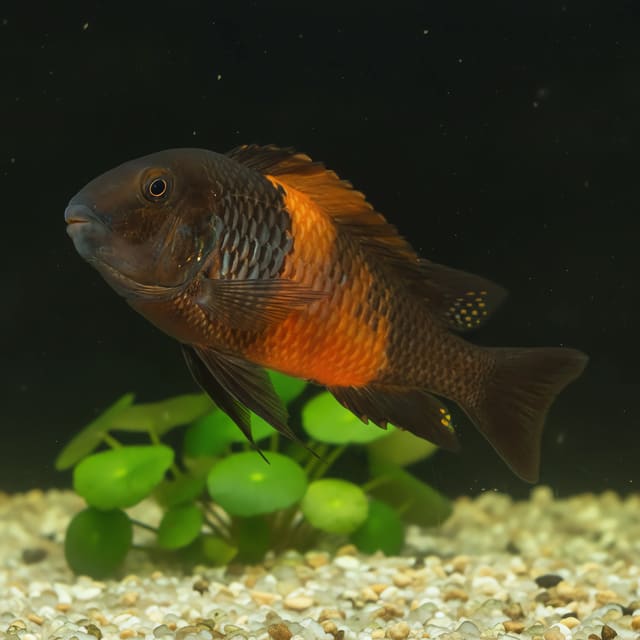
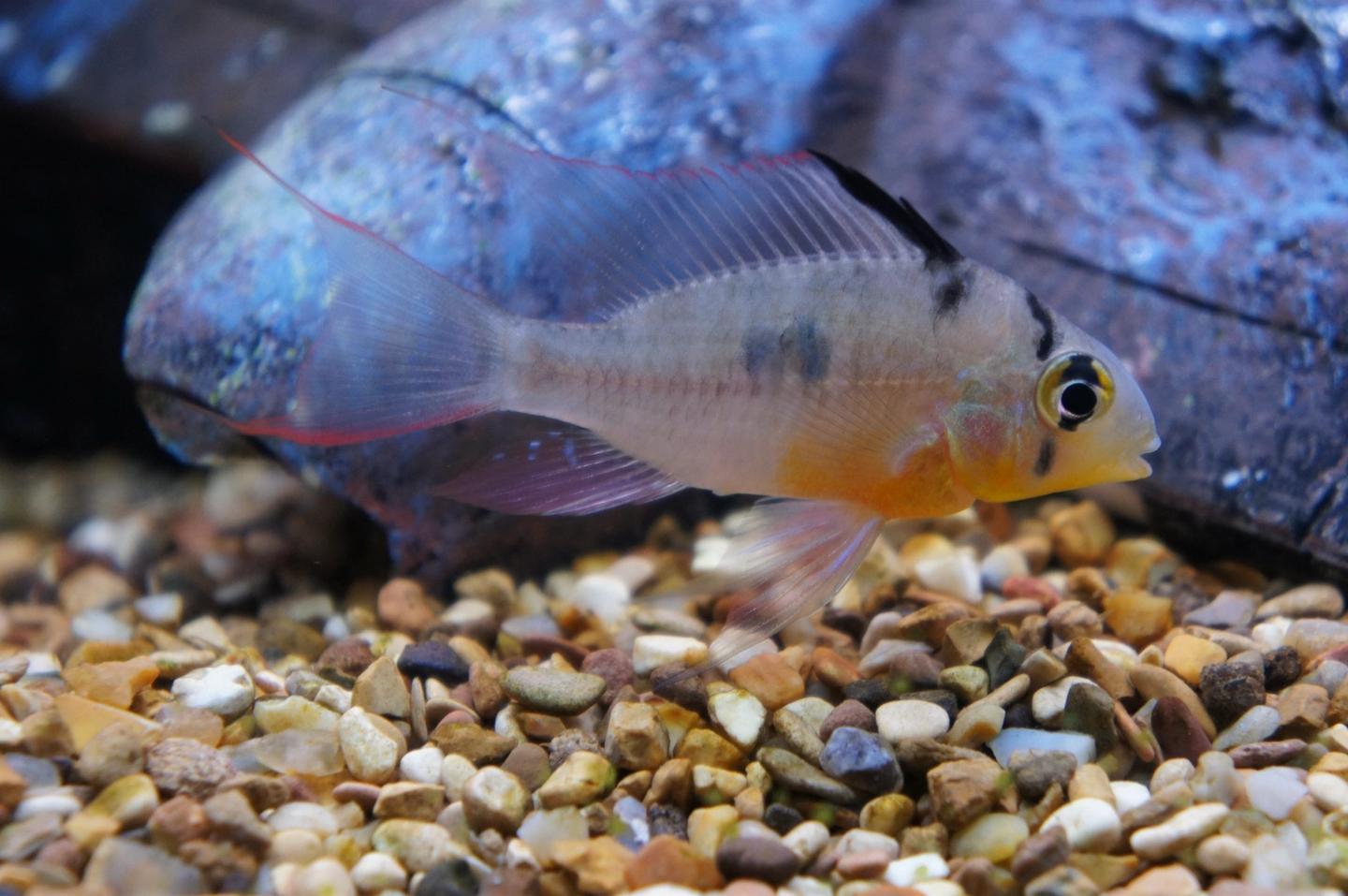
Ilangi fish are known for a yellow to orange central body area against darker head, rear body and fins. The exact width and intensity of the coloured field varies with lineage, maturity, sex, hierarchy, health, stress, diet and lighting. Juveniles can look different from settled adults, and a subordinate fish may remain much darker than a dominant individual.
The gallery is representative artwork. It shows a plausible yellow-and-dark Tropheus form, but it cannot prove the sex, adult colour, pattern, collecting locality or appearance of the fish delivered. The actual juvenile should be assessed as an individual animal, not compared frame by frame with an illustration.
Use an aquarium at least 150 cm long for a permanent Ilangi group. A volume around 450 litres or more is a responsible starting point when the tank also has useful width, secure rockwork and strong filtration. A narrow or tall aquarium can hold the same litres while offering far less territory and turning space, so dimensions should be considered before the headline volume.
The group plan must fit the finished adult aquarium, not a temporary juvenile grow-out tank. Rock displacement reduces real water volume, and a heavily structured interior changes circulation. Leave open routes across the front and between rock zones so a chased fish is not forced into a dead end.
A larger tank does not automatically make a poor group safe. Too few fish, several dominant males, mixed locality forms, a late newcomer or one exposed feeding point can still focus aggression. Use the cichlid care guide for broader planning, then make a Tropheus-specific stock plan before any order is placed.
Tropheus are kept in substantial aquarium groups to distribute conspecific aggression. Specialist guidance commonly recommends about 15 or more fish in a 150 cm or longer aquarium, often with one male to several females when sex can be established. This is an aquarium management method, not proof that wild adults form a calm shoal.
Starting the group together is normally safer than adding fish one at a time. An established hierarchy may treat a newcomer as an intruder, and rearranging rocks does not guarantee acceptance. If an addition is attempted, it should match the same colour form, have compatible size and health, and be supported by a divider or separate cycled aquarium.
Do not reduce the advice to one rigid number. Fifteen poorly matched fish in a short tank can fail, while a carefully planned larger group in substantial specialist space may work well. Sex ratio, age, tank dimensions, line of sight, feeding access and individual temperament all matter. Persistent biting, cornering or food exclusion means intervention is needed, not that the hierarchy should be allowed to "sort itself out" indefinitely.
| Situation | Risk | Safer response |
|---|---|---|
| One fish in a new aquarium | Abnormal social plan and no aggression distribution | Plan the complete same-form group before purchase. |
| Two fish sold as a supposed pair | Sex is unconfirmed and one fish may receive all aggression | Do not treat two unsexed juveniles as a breeding pair. |
| One newcomer added to an established group | Focused attack and food exclusion | Seek specialist advice, match the form and prepare immediate separation. |
| Several colour forms mixed | Aggression, hybridisation and loss of lineage identity | Keep one documented form in a breeding group. |
| Fish pinned behind equipment | Injury, starvation and rapid decline | Separate immediately and reassess the group and layout. |
Maintain stable hard, alkaline water. FishBase gives pH 8.0-9.0, hardness around 9-19 dH and a temperature reference of 24-26°C. The practical goal is not to chase a perfect decimal point; it is to keep an appropriate reading stable, with strong buffering and no detectable ammonia or nitrite.
Test tap water before adding salts or buffers. Where source water is already hard and alkaline, unnecessary products can create avoidable swings. Where water is soft, prepare replacement water consistently outside the aquarium and measure pH, carbonate hardness and general hardness rather than dosing by guesswork.
Temperature affects oxygen demand. Running at the warm edge while surface movement is poor leaves less margin during hot weather or a filter problem. Use a reliable heater with a guard, confirm it with a separate thermometer and maintain vigorous gas exchange across the surface.
| Measurement | Planning target | Action |
|---|---|---|
| Temperature | 24-26°C, stable | Check daily and increase aeration during warm weather. |
| pH | 8.0-9.0, stable | Investigate alkalinity before correcting a trend. |
| General hardness | Hard, mineral-rich water; FishBase reference 9-19 dH | Match replacement water consistently. |
| Ammonia | 0 | Any detectable result needs immediate water-quality action. |
| Nitrite | 0 | Detectable nitrite means biological filtration is not coping. |
| Nitrate | Controlled and stable | Use test trends, stocking and water changes rather than waiting for distress. |
A Tropheus group places a large demand on filtration. Use mature biological media, efficient mechanical filtration and circulation that prevents waste collecting behind every rock pile. The system should process the planned adult stock, not merely the small juveniles present on the first day.
High dissolved oxygen is essential. Aim for broad surface movement and circulation through the whole aquarium without creating one violent jet. Clean blocked pre-filters before flow falls, and keep a battery air pump or another emergency aeration option for power interruptions.
Regular partial water changes help control dissolved waste and replace minerals, but sudden large differences in temperature or chemistry can be harmful. Match replacement water carefully. Clean mechanical media as needed and preserve biological capacity by avoiding the simultaneous sterilisation of every filter component.
Maintenance frequency must follow measurements and feeding load. A fixed weekly percentage is a starting routine, not a substitute for testing. Siphon accessible detritus, inspect hidden low-flow pockets and make sure no fish is trapped behind equipment.
Build with aquarium-safe rock placed securely on the tank base before loose substrate is added. Tropheus do not excavate like some large cichlids, but movement and maintenance can still undermine unstable stacks. Use broad stable contact points and leave enough access to inspect the rear of the aquarium.
Provide many grazing faces and broken sightlines, but avoid creating one premium cave that a dominant fish can control along with the only feeding route. Open swimming channels are as important as cover. A sand or fine-gravel substrate suits the visual theme and is easy to siphon where it remains accessible.
Moderate lighting can encourage a natural biofilm on rock, but the aquarium should not be driven into uncontrolled nuisance algae for the sake of grazing. A mature safe surface layer is useful; thick decaying growth and trapped food are not. Hardy attached plants can be tried, although they are optional and the fish may browse or dislodge them.
Field research describes Tropheus moorii as an epilithic algal eater, and FishBase diet data records a strongly plant-dominant diet. FishBase also lists worms, crustaceans and insects among natural foods. These findings are not contradictory: aufwuchs is a mixed living layer, so grazing plant material also brings incidental small animal prey.
Calling the fish a strict herbivore is therefore biologically too absolute. In practical aquarium care, however, the safest staple remains high-fibre, algae- and plant-rich food designed for Tropheus or herbivorous African cichlids. The incidental animal material in wild grazing is not a reason to feed repeated bloodworm, rich meat or high-fat cichlid diets.
Choose foods with a small particle size that juveniles can take easily. Spirulina-based flakes, quality vegetable-rich granules and suitable complete Tropheus foods can be rotated. Check the ingredient profile and the fish's response rather than relying on a green label alone.
Offer small portions two or three times daily if the aquarium schedule allows, spreading food so subordinate fish can feed. The group should clear each portion quickly without a cloud of food entering the rockwork. Reduce the next meal if waste remains.
Digestive illness commonly called Tropheus bloat is associated in aquarium practice with interacting stressors: unsuitable food, overfeeding, deteriorating water, social pressure and sometimes infection. No single ingredient explains every case. Prevention begins with stable conditions, a plant-dominant diet, sensible portions and daily observation.
| Food | Role | Guidance |
|---|---|---|
| Complete Tropheus or herbivore cichlid flake | Main staple | Feed small fresh portions and store the container dry. |
| Small algae- and plant-rich granule | Staple rotation | Choose a size juveniles can swallow without prolonged chewing. |
| Natural safe rock biofilm | Behavioural grazing | Useful in a mature aquarium, but not a complete measured diet by itself. |
| Courgette or other suitable vegetable | Occasional variety | Offer sparingly and remove uneaten material before it decays. |
| Bloodworm, rich meat or fatty food | Unnecessary risk | Avoid as routine feeding for this plant-dominant grazer. |
Watch faeces, appetite, abdominal shape and social access. A fish that stops feeding or produces persistent pale stringy waste needs prompt assessment of water, diet and aggression. Do not mix several medications blindly or continue feeding heavily to "tempt" a fish with digestive distress.
The safest display is usually a dedicated group of the same Tropheus form. Tank mates must share hard alkaline water, tolerate high activity and eat a compatible plant-dominant diet. Even then, adding another species reduces territory and feeding margin.
Do not combine Ilangi with other Tropheus colour forms merely because their care sheets look similar. Research supports colour-assortative mating, but hybrid or uncertain fry can still result in aquaria. Similar fish may also compete intensely for the same rock and grazing space.
Peaceful tetras, guppies, gouramis, discus and most ordinary community fish are unsuitable. Their water, diet and behavioural needs do not match. Large predatory cichlids and fish requiring rich meaty food also make poor companions. Browse the Lake Tanganyika cichlid collection for comparison, not as a blanket compatibility list.
An established Tropheus group can react violently to a newcomer. The resident fish already control feeding territories and recognise their hierarchy. Similar colour does not guarantee acceptance, and a much smaller fish may be unable to compete.
Before attempting an addition, confirm that the new fish is the same form, review health and quarantine history, and prepare an immediate separation option. Some specialists use a secure divider or introduction box, but no technique guarantees success. Rearranging every rock can also destabilise the entire group.
If the fish is repeatedly bitten, trapped at the surface or bottom, denied food or breathing hard, remove it. Waiting for severe injury is not group management. Because this listing supplies one fish per quantity, customers topping up an existing group should contact us before ordering.
One quantity supplies one unsexed juvenile at approximately 3.5-4.5 cm. It does not supply a male and female, a breeding pair, a guaranteed number of females or a complete colony.
Juvenile sex cannot be guaranteed from colour or size alone. Adult males may be larger or more territorial, but behaviour is not a reliable sales-time sexing method either. Specialist vent examination can help with mature fish, yet it should be done only by someone experienced and still does not create a bonded pair.
The live product selector, stock status and checkout are authoritative for availability and price. If stock returns and you need a particular group plan, contact us before paying so the current supply size and quantity can be discussed.
Tropheus moorii is a maternal mouthbrooder. Field observations found that females leave their feeding territories to pair temporarily with males in the males' territories. After spawning, the female carries the developing brood in her mouth for about a month.
This temporary mating relationship is not a lasting bonded pair. A product tagged or described as a breeding pair would therefore be misleading unless two mature, sex-confirmed fish with documented compatibility were specifically offered. This listing makes no such offer.
Breeding is best left to a stable same-form group with known adults and substantial space. Mouthbrooding females need to avoid relentless pressure and maintain body condition. Do not distribute fry under a locality label unless the parentage and form are known.
A healthy settled Tropheus should graze, hold its place in the group, breathe evenly and take appropriate food. Daily observation matters because social and digestive problems can progress quickly. Look at the whole group rather than only the most dominant fish at the front glass.
First check ammonia, nitrite, temperature, oxygenation, recent diet and aggression. Separate a bullied fish before it becomes exhausted. If disease is suspected, seek an accurate diagnosis and check that any treatment is compatible with the fish and biological filter. Blindly combining medications can worsen stress and water quality.
FishBase lists ten years as a maximum reported age, but this is not a lifespan guarantee for the supplied juvenile. Long-term outcome depends on genetics, handling, diet, group stability, water quality and veterinary care where needed.
Quarantine is strongly recommended before a fish enters an established Tropheus group. Use a fully cycled, heated and aerated system with chemistry close to the main aquarium. Observe appetite, faeces, respiration, fins and body condition without exposing the established fish.
Read the current live-fish delivery process before ordering. Someone must be available to receive livestock, and the main aquarium or quarantine system must be ready before the parcel arrives.
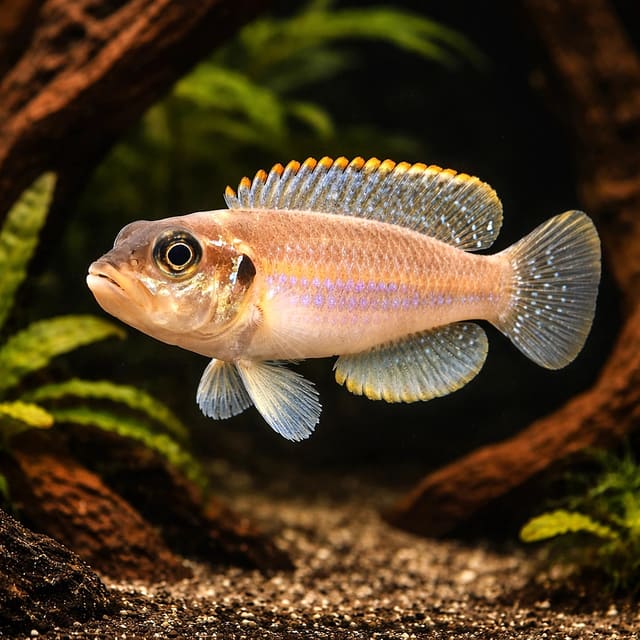
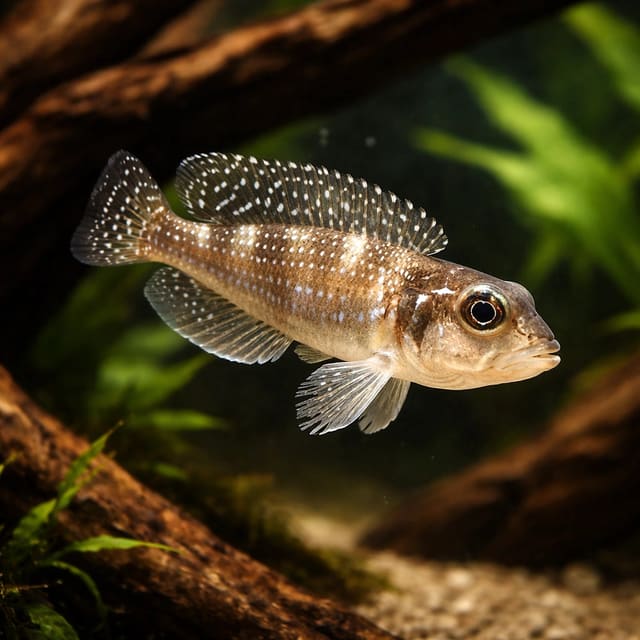
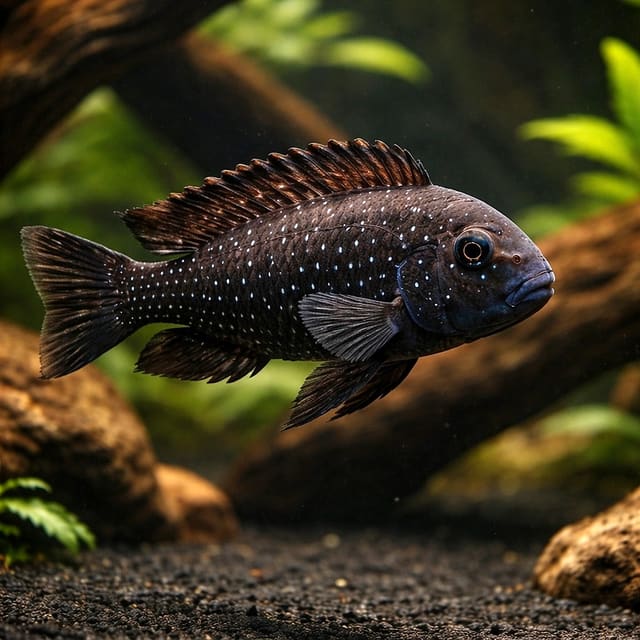
The existing gallery contains one 1024 x 1024 representative illustration. It is retained to protect the listing's media history and because the owner has instructed that existing images must not be removed. It is not a photograph of the exact juvenile supplied.
The image should be used for broad recognition only. It cannot guarantee sex, adult colour, the exact shape of the yellow field, locality provenance or wild appearance. Natural fish may be darker, paler or differently patterned, especially during transport and hierarchy changes.
Comparison helps a keeper choose one suitable form before building a group. The Bemba Orange Tropheus is another Tropheus moorii colour form, while the Duboisi White-Spotted Cichlid is a different Tropheus species with its own juvenile pattern.
The Kiriza Blunthead Cichlid and Red Rainbow Tropheus illustrate the range of locality forms sold in the hobby. These links are alternatives, not suggestions to mix the fish in one breeding group.
Choose one form based on adult appearance, verified availability, group cost and the permanent aquarium. A complete healthy group of one form is more valuable than a collection of single specimens chosen only for colour.
Eligible live-fish orders are sent using the current tracked livestock-delivery service and are covered by the Live Arrival Guarantee subject to destination, receipt, evidence and reporting terms. Review the Live Arrival Guarantee terms and be available on the confirmed delivery date.
The active WELCOME10 code currently offers 10% off an eligible customer's first order. Checkout confirms current eligibility and restrictions. A discount does not override stock, dispatch, welfare or destination limits, and it should never be the reason to order an incomplete Tropheus group.
Stock and price can change independently of this care guide. The live buy box and checkout are authoritative. Contact us before ordering when the product returns to stock if you need help confirming the current dispatch size or integrating fish into an existing Ilangi group.
Species identity, maximum size, water range, natural food and mouthbrooding were checked against FishBase's Tropheus moorii record. The description of feeding territories, temporary pairing and maternal care comes from Yanagisawa and Nishida's peer-reviewed field study of the social and mating system.
Ilangi colour-form context and the caution around mixing forms are supported by peer-reviewed work on colour-assortative mating and Tropheus population genetics. Aquarium group and tank-length planning was cross-checked with a UK care profile.
Where field biology and aquarium practice differ, the distinction is stated. Wild adults defend individual feeding territories; substantial aquarium groups are a husbandry strategy to spread aggression. Where supplier evidence is absent, this page does not invent locality, generation, sex or exact colour.
The accepted species is Tropheus moorii. Ilangi is a named locality or trade colour form, so Tropheus moorii 'Ilangi' is clear aquarium wording rather than a separate formal species name.
No. It is treated here as a colour form of Tropheus moorii. Tropheus population history is complex, but our stock records do not support a different formal species name.
Research associates Ilangi-type yellow or orange fish with the southern Lake Tanganyika shoreline. The exact collection locality and lineage of the supplied fish are not documented, so this listing does not make a narrower provenance claim.
FishBase records Tropheus moorii to about 14.5 cm total length. Plan the permanent aquarium around that cautious maximum rather than the 3.5-4.5 cm dispatch size.
Use at least 150 cm of tank length and roughly 450 litres or more where the footprint is suitable. Group size, sex balance, rock displacement, filtration and escape routes can make a larger aquarium necessary.
Do not start a new setup around one fish. This listing supplies one fish per quantity, but long-term care normally involves a substantial same-form group planned as a whole. A single sale unit is mainly relevant to a carefully reviewed existing group.
Specialist guidance commonly uses around 15 or more to spread aggression, often with one male to several females where sex is known. This is not a guarantee; aquarium dimensions and individual hierarchy still determine welfare.
No. Wild adults defend feeding territories. Aquarium keepers use a large group to distribute aggression, not because the fish forms a peaceful school like small open-water tetras.
No. The juveniles are unsexed, and Tropheus moorii does not form a lasting bonded pair. Two fish can result in concentrated aggression and are not sold as a male-and-female set.
One unsexed juvenile fish at approximately 3.5-4.5 cm.
No sex choice is offered. Juvenile colour, size and behaviour are not reliable enough for a guarantee, and the listing does not promise a male or female.
A stable 24-26 C is the reviewed target. Confirm the heater with a separate thermometer and maintain strong oxygenation, especially during warm weather.
Plan for pH 8.0-9.0 and hard, well-buffered water. FishBase gives a hardness reference around 9-19 dH. Test source water and avoid sudden chemical adjustment.
Yes. A substantial group creates a high biological load. Use mature biological and mechanical filtration, broad circulation and vigorous surface movement, with an emergency aeration plan.
Strict herbivore is too absolute. They are plant-dominant aufwuchs grazers that ingest incidental small animal material. In captivity, use high-fibre algae- and plant-rich staples and avoid repeated rich meaty meals.
It is not needed and is a poor routine choice for this plant-dominant grazer. Use foods formulated for Tropheus or herbivorous African cichlids and keep portions small.
The label covers digestive decline associated with interacting risks such as unsuitable food, overfeeding, poor water, stress and possible infection. Prevention depends on stable husbandry, and an affected fish needs diagnosis rather than blind medication.
Keeping one form is safer for lineage identity, diet and social planning. Mixing forms can increase competition and produce uncertain offspring, so comparison listings should be treated as alternatives rather than tank-mate recommendations.
No. Peaceful soft-water fish do not match the chemistry, diet or territorial behaviour required by a Tropheus group.
A female pairs temporarily with a male for spawning and then carries the brood in her mouth for about a month. The adults do not maintain a lasting bonded pair.
FishBase lists ten years as a maximum reported age. It is useful commitment context, not a guarantee for an individual aquarium fish.
No. The preserved gallery image is a representative illustration. Exact sex, colour, markings, locality and the individual fish are not promised.
No. It is best for an experienced keeper comfortable with hard-water chemistry, large-group aggression, plant-dominant feeding, quarantine and emergency separation.
It can be high risk because the hierarchy is already established. Contact us before ordering, match the exact form and size, quarantine, and prepare an immediate separation option. No introduction method guarantees acceptance.
The active code currently offers 10% off an eligible customer's first order. Checkout confirms current eligibility and restrictions; the code does not override stock or delivery limits.
Eligible livestock orders are covered subject to the current destination, receipt, evidence and reporting terms. Read the live policy and be available on the confirmed delivery date.
No reviews for this item yet. Bought one? Honest reviews only, good or bad.
What customers say about ordering from us
I have a small group of long finned mountain minnows. So was delighted to be able to order ten of this variety to increase the genetics in my tank . The ones I recieved are healthy but it’s to early to give a verdict on wether they are of a long finned type since they are small currently.
Gordon Walker · 23 Sept 2026
100% success travel and "installation". Pleased with quality of purchase. The Siamese fighter a bit "shy" so have not yet seen him at his best yet but looking good. Happy customer. GG
George E Garratt · 21 Sept 2026
Reviews of our shop, collected by Judge.me, an independent third-party review collector. Newest first.