−10%
Advanced
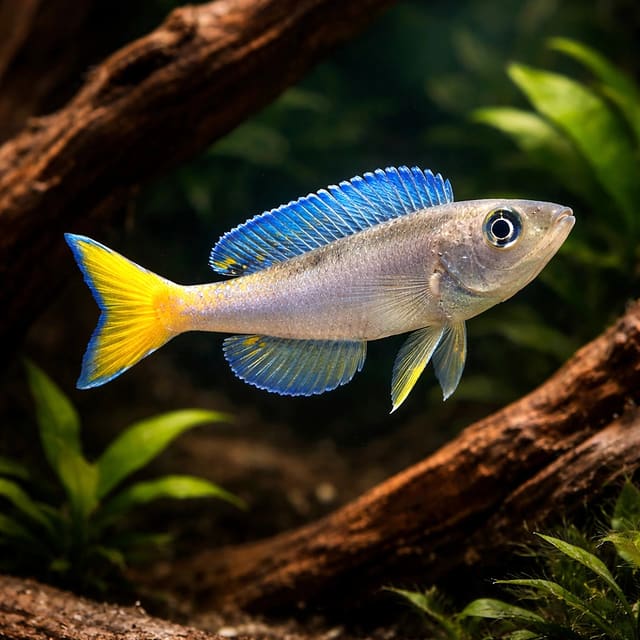
Bemba Tropheus (Tropheus moorii “Bemba”)
24–26°C · pH 8–8.6
£38.69£42.99

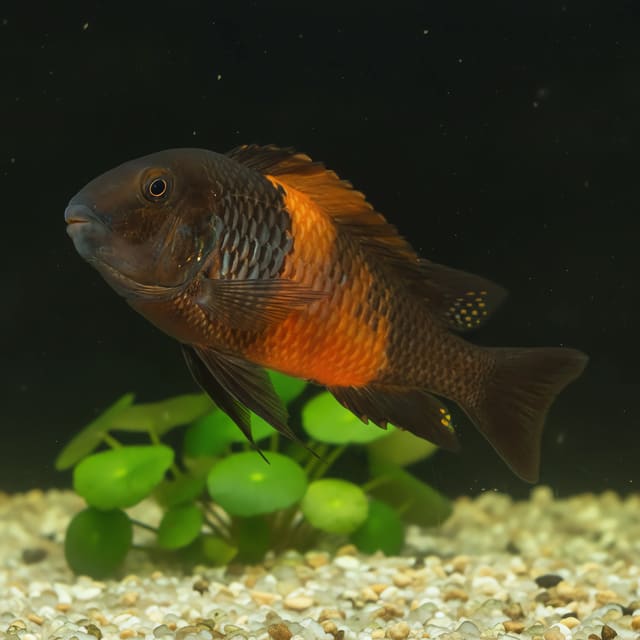
Duboisi, White-Spotted Cichlid (Tropheus duboisi) is a cichlid endemic to Lake Tanganyika that reaches 12 cm. It suits advanced keepers planning a group of 15–20 in a 150 cm or longer, well-oxygenated aquarium at 23–27°C and pH 8.0–8.6. Sold individually in dispatch sizes from 2–3 cm to over 9 cm.
Adult size is the maximum length this species reaches at full maturity (scientific sources). The livestock you receive will be younger and smaller — pick a size above for the actual shipping size. Product-photo provenance and any image-specific limitations are stated on the listing.
Tropheus duboisi
Shoaling fish: kept in a group they feel safer, stay calmer and show their best colour.
Duboisi, White-Spotted Cichlid (Tropheus duboisi) is a cichlid endemic to Lake Tanganyika that reaches 12 cm. It suits advanced keepers planning a group of 15–20 in a 150 cm or longer, well-oxygenated aquarium at 23–27°C and pH 8.0–8.6. Sold individually in dispatch sizes from 2–3 cm to over 9 cm.
Adult size is the maximum length this species reaches at full maturity (scientific sources). The livestock you receive will be younger and smaller — pick a size above for the actual shipping size. Product-photo provenance and any image-specific limitations are stated on the listing.
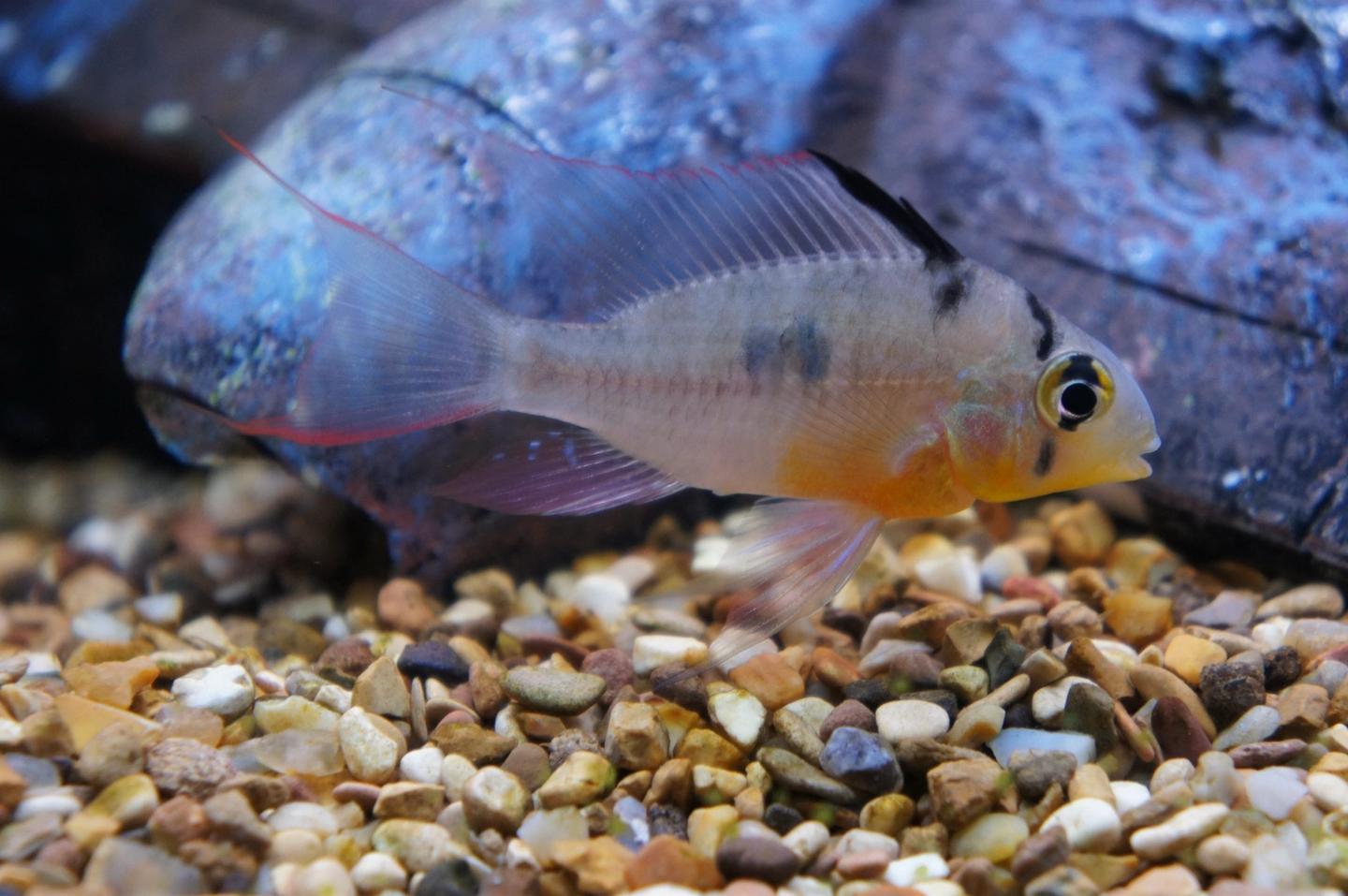
Cichlids are a family of roughly 1,800 accepted species, not one care type. Before buying, identify the exact species and source, then compare adult measurement, usable tank dimensions, social system, territory, tested water, diet and an exit plan. No family-wide minimum tank, water range or tank-mate list is safe.
Maintain these water conditions for optimal health and vibrant colors
Duboisi, White-Spotted Cichlid (Tropheus duboisi) is a freshwater cichlid endemic to Lake Tanganyika. FishBase describes it in upper rocky habitat, where it feeds on algae attached to the rocks. That grazing biology should shape the aquarium: provide rock surfaces, open swimming room, oxygen-rich water and an algae-led diet rather than treating it as a general community fish.
FishBase records a maximum length of 12 cm and a patchy natural distribution in the northern part of Lake Tanganyika. It lists the species as Endangered, so its wild status deserves recognition without making assumptions about the origin of an individual aquarium fish.
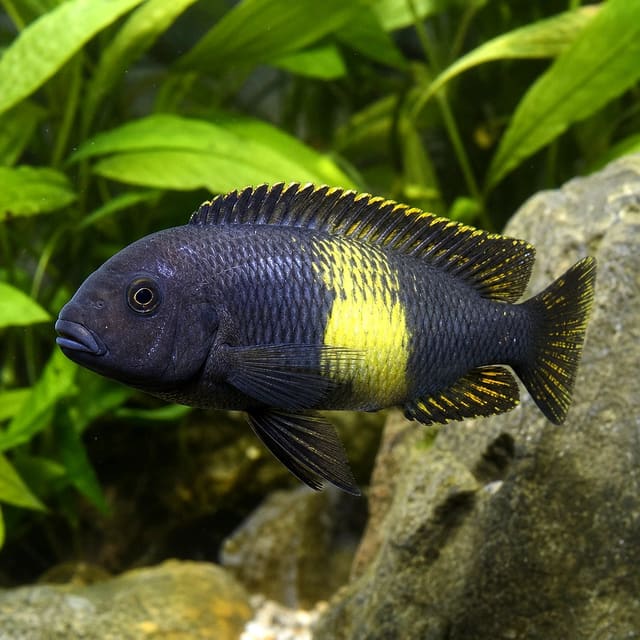
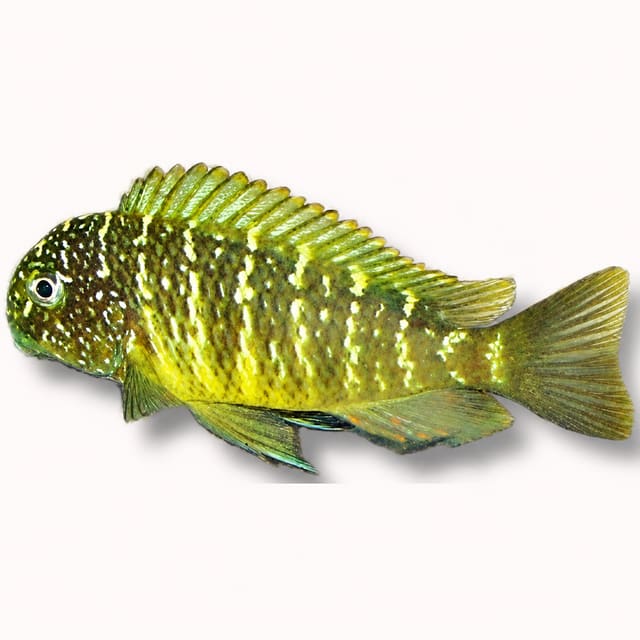
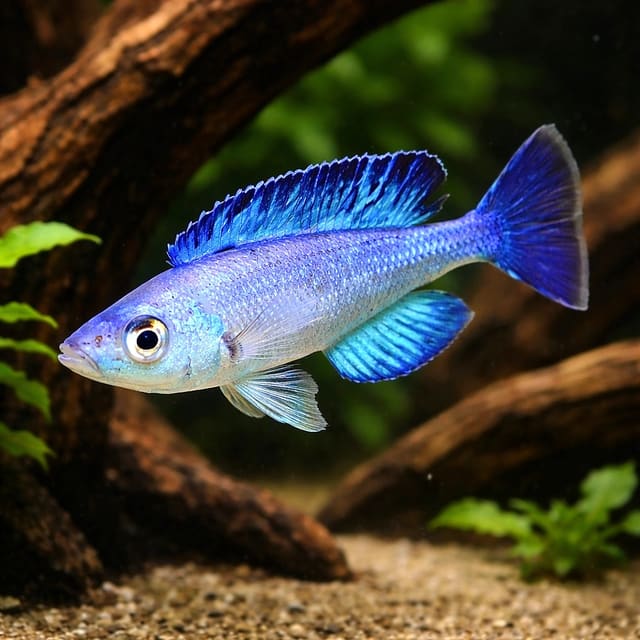
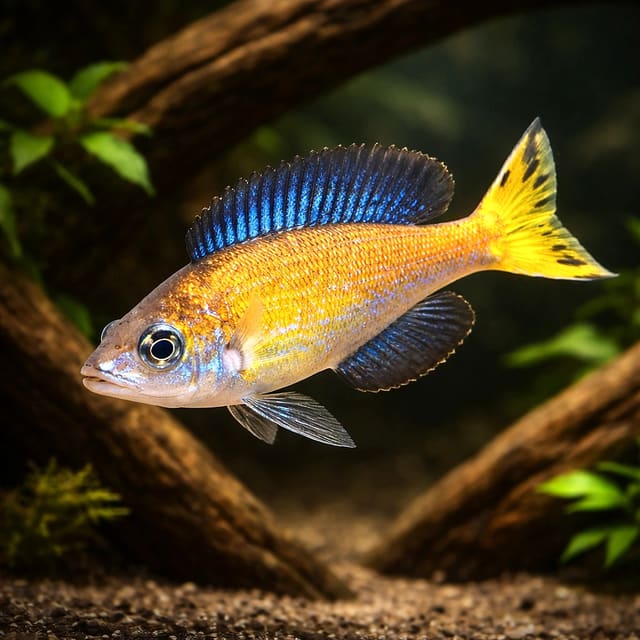
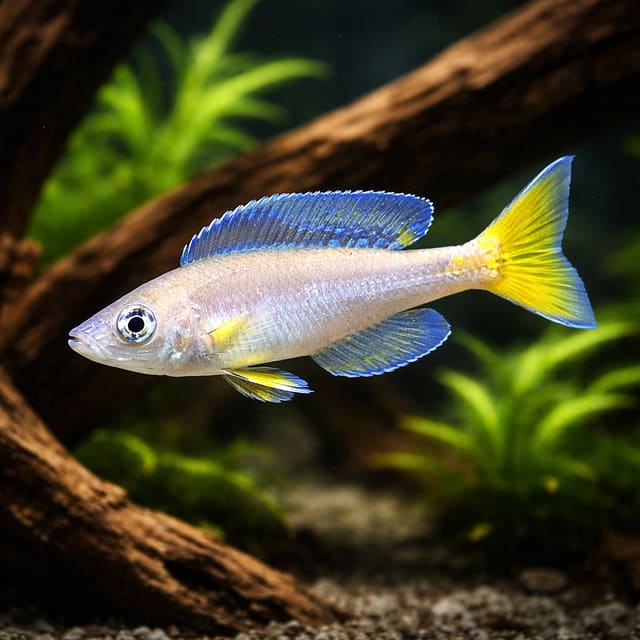
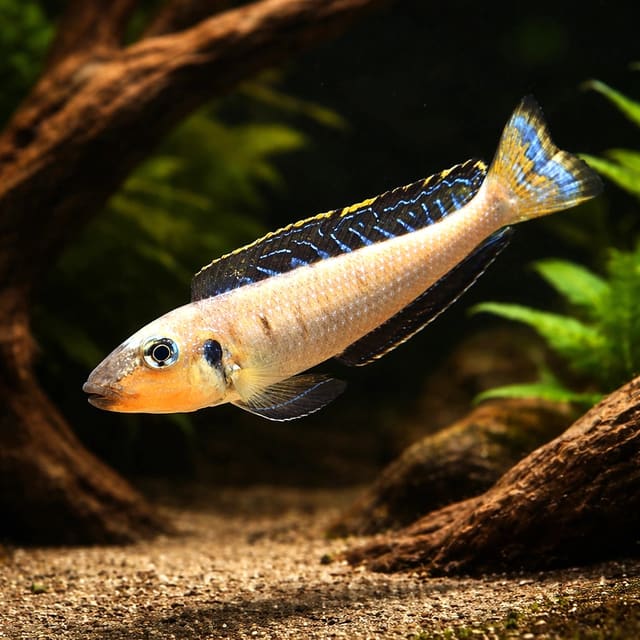
Young fish are described as dark with white or light-blue spots. As they mature, that pattern may fade towards a blue-black body with a yellow or white vertical bar. Dispatch size describes the fish at supply; life stage, sex and individual colour pattern require separate evidence. Several geographical forms occur, and they should not be mixed because hybridisation may result.
This is an advanced keeper’s cichlid. It is active, sensitive to poor water quality and challenging to organise socially. It suits an aquarist prepared to test hard alkaline water, maintain a mature biological filter, plan a large group before purchase and watch interactions closely. Its difficulty lies less in one unusual task than in keeping water, diet, space and group structure consistently aligned.
Seriously Fish gives an aquarium range of 23–27°C, pH 8.0–9.5 and 8–25 dGH for this fish. OATA’s African lake cichlid sheet gives group guidance of 23–27°C, pH 8.0–8.6 and 12–18 dGH. Use the narrower pH and hardness figures as the routine target while remaining inside the wider species range.
| Planning point | Working decision |
|---|---|
| Adult size | Up to 12 cm; plan for the adult fish. |
| Aquarium length | At least 150 cm under the FishBase aquarium reference. |
| Volume context | 110 litres is a single-specimen reference; a group requires a much larger aquarium. |
| Group plan | 15–20 fish is the general species recommendation. |
| Routine water | 23–27°C, pH 8.0–8.6 and 12–18 dGH. |
| Waste control | Ammonia 0 mg/l, nitrite 0 mg/l and nitrate no more than 20 mg/l above the normal tap-water level. |
Length, volume and social planning must be considered together. A 110-litre aquarium measuring 120 × 30 × 30 cm is cited for one specimen, but the same account calls for a much larger aquarium for a group. FishBase gives a 150 cm minimum aquarium length. For the usual group approach, begin with the 150 cm length requirement and choose substantially more volume than the single-fish reference.
Rock piles should divide the aquarium into distinct areas while leaving open swimming room. Sand, strong biological filtration and vigorous aeration complete the basic plan. Do not use a dispatch measurement to justify a temporary undersized setup; the social structure and biological load also develop as the fish grow.
One purchase quantity supplies one animal of the selected option. Use the live size selector to choose the dispatch measurement that suits your established group and aquarium plan. Labels may include “2 - 3 cm”, “2,5 - 3,5 cm”, “3,5 - 4 cm”, “3,5 - 4.5cm”, “4.5-5.5 cm”, “5 - 6 cm”, “6 - 8 cm” and “> 9 cm”. Refer to the selector itself when ordering because it is the live control for the choice.
The size you select is the size supplied, not the adult size. Every choice must therefore be assessed against the recorded 12 cm maximum and the needs of the intended group. A smaller dispatch fish is not permission to postpone filtration, water preparation or the adult aquarium. A larger choice does not establish sex or compatibility with fish already holding territories.
Sex is guaranteed only when the selected option explicitly states male or female. This Duboisi, White-Spotted Cichlid listing has no sex-guaranteed option.
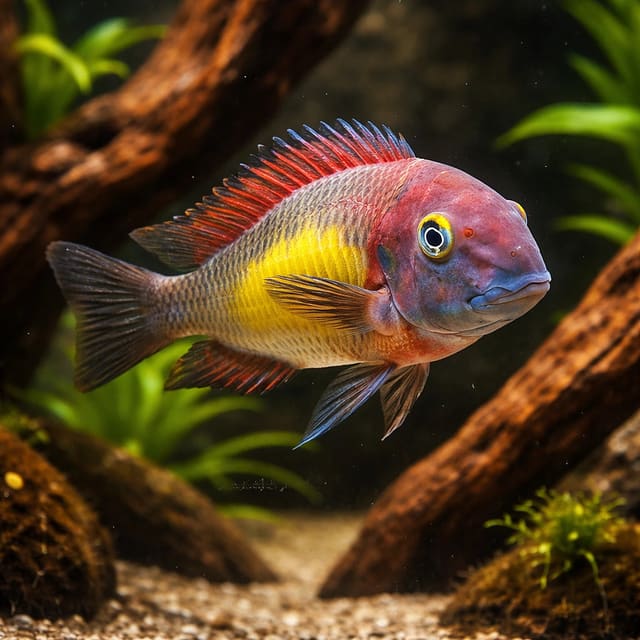
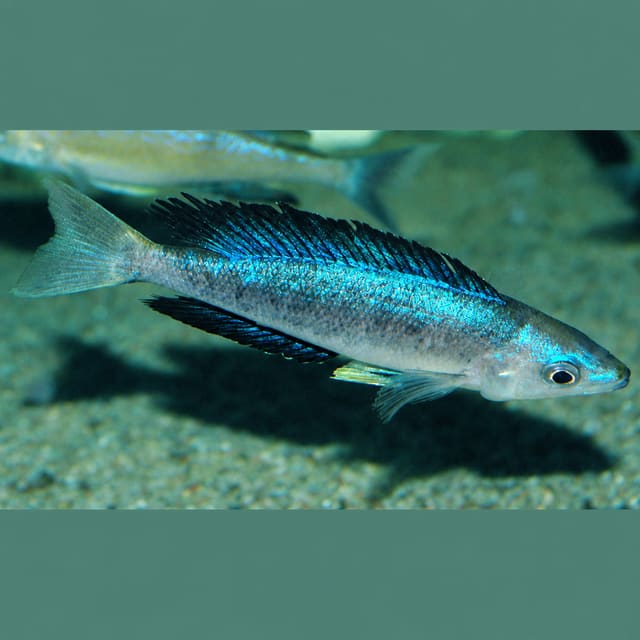
Some gallery images have been digitally enhanced to improve image quality. They show the listed type of animal rather than guaranteeing the exact markings of the individual supplied, so natural colour and pattern can vary.
When choosing between measurements, compare body size with the fish already in the aquarium and consider how established territories will affect an introduction. Size matching is only one screen: diet, activity, water chemistry, aquarium length and group structure remain decisive.
| Suits | Not suited to |
|---|---|
| Stable aquarium water maintained at 23–27°C and pH 8–8.6 | Water outside 23–27°C and pH 8–8.6 |
| Julidochromis species after individual screening | shy species |
Start with an aquarium at least 150 cm long and large enough to exceed the 110-litre single-specimen reference by a substantial margin when keeping the recommended group. Aquarium length creates room for separate areas, while the extra volume gives the filter and keeper more capacity to manage the waste produced by numerous active cichlids.
Use piles of rockwork to form cave-like structures, hiding places and broken lines of sight. Interspace those piles with open areas where the fish can swim and graze. One continuous wall of rock can allow a dominant fish to control too much of the aquarium; separated piles create more distinct areas for group members to use.
Sand is the recommended substrate. A decorated aquarium can work well when it combines numerous shelters with open room. Bare setups are also used to reduce territorial behaviour, but they give up the visual barriers and cave-like retreats created by a planned rock arrangement. Choose one approach deliberately rather than adding scattered ornaments without a territorial plan.
Before adding fish, view the aquarium from both ends as well as from the front. If every shelter can be watched from one central position, divide the view with another rock pile or reposition the existing structures. If rockwork occupies nearly all the swimming room, remove or consolidate pieces. The aim is not the greatest possible quantity of décor; it is a useful balance of cover, grazing surface and movement space.
When aggression becomes concentrated around established areas, rearranging décor may reduce territorial certainty. That is a management tool rather than a substitute for adequate length, a suitable group or compatible tank mates.
Set the routine aquarium target at 23–27°C, pH 8.0–8.6 and 12–18 dGH. Carbonate hardness should remain hard at 10–15 dKH. These values combine the aquarium range for Tropheus duboisi with OATA’s narrower African lake cichlid guidance, keeping the working target inside the species limits.
Measure the aquarium rather than judging water by appearance. Our water chemistry guide explains what the principal values mean, while the water matcher compares your measured aquarium values with the target. Record temperature, pH, general hardness, carbonate hardness, ammonia, nitrite and nitrate so that a change can be recognised before behaviour or appetite is affected.
| Reading | Decision |
|---|---|
| 25°C, pH 8.3, 15 dGH | Inside the routine temperature, pH and hardness targets. |
| Ammonia or nitrite above 0 mg/l | Do not add fish; address biological filtration and retest. |
| pH below 8.0 | Prepare a stable hard-water plan before stocking. |
| Nitrate rise above the limit | Review water changes, feeding and stocking pressure. |
Ammonia and nitrite must both read 0 mg/l. Nitrate should not exceed 20 mg/l above the normal level in the tap water used for changes. For example, if conditioned tap water measures 15 mg/l nitrate, the aquarium should not rise above 35 mg/l under that rule. This comparison uses the tap-water baseline instead of treating one absolute nitrate number as suitable for every household.
Check values at least weekly and whenever feeding, stocking or behaviour changes. A single in-range reading is only a snapshot; a written sequence shows whether conditions are stable. Compare tests taken at a similar time and under a consistent routine.
Choose a water-preparation method that can be repeated reliably at every change. The fish’s hard alkaline range should match the aquarium as a continuing condition, not as a reading reached only on introduction day.
A working biological filter is essential. The RSPCA explains that filter bacteria convert toxic ammonia into nitrite and then nitrate. Because ammonia and nitrite are toxic, an aquarium with clear water can still be unsafe when its biological filter is immature or overloaded.
Prepare and mature the aquarium before livestock arrives; our first tropical tank guide sets out that preparation. Confirm ammonia and nitrite at 0 mg/l before adding fish. A planned group creates a substantial biological load, so OATA recommends an oversized filter for crowded African lake cichlid communities and vigorous aeration to maintain dissolved oxygen.
If filter media needs cleaning, rinse it lightly in aquarium water removed during the partial water change. Do not wash it under the tap, because chlorine or chloramine may kill part of the established bacterial population. Avoid cleaning every component so aggressively that biological capacity is lost.
Test again after adding fish or increasing food because the bacterial population must grow to process the extra waste. Stocking too quickly can produce new tank syndrome: waste rises faster than the filter bacteria can respond, leading to harmful ammonia or nitrite. The social case for a planned group does not remove the need to match introductions to the filter’s capacity.
Reduced flow, waste collecting in quiet areas or fish breathing differently are prompts to test and inspect the system. Aeration supports oxygenation, while filtration processes waste; one does not replace the other. Keep both operating effectively throughout the aquarium.
Build the diet around vegetable matter and foods with a high algae content. In Lake Tanganyika this fish grazes algae attached to rocks, and the aquarium diet should reflect that biology. Suitable staples include a quality algae-based cichlid food, spirulina flakes, nori and blanched spinach.
Offer only what the fish can finish within a few minutes, twice a day. Watch the group rather than relying on a fixed pinch: food must reach more than the boldest individuals without leaving excess to decay. Remove uneaten food and reduce the next portion if fragments remain after the feeding window.
| Food role | How to use it |
|---|---|
| Algae-rich prepared food | Use as a principal daily staple. |
| Spirulina flakes | Use as part of the vegetable-led base. |
| Nori or blanched spinach | Offer as fresh vegetable matter in controlled portions. |
| Live or frozen varieties | Give only as small supplementary feeds. |
| Beefheart or other animal meat | Never feed; it can interfere with digestion. |
A mixed community must also pass the diet test. Tank mates that require frequent rich, animal-heavy feeding can create a conflict even when their water requirements overlap. The Tropheus may consume food intended for the other fish, while a heavily meaty routine moves its diet away from the algae-led pattern it needs.
Twice-daily feeding is not permission to feed heavily. Small, controlled portions reduce uneaten waste and make appetite changes easier to recognise. Consistency also helps separate a real behavioural change from a reaction to an irregular routine.
Complete the aquarium, filtration and water checks before the fish arrives. Confirm that temperature is 23–27°C, pH is 8.0–8.6, hardness is 12–18 dGH, and ammonia and nitrite are both 0 mg/l. Check that rockwork provides retreats and open routes without removing the swimming room needed by an active fish.
Follow our delivery and Live Arrival Guarantee policy for the current receiving and claim requirements. Start filming while the parcel is still sealed, then open it in one continuous take and show the fish inside the sealed bag before anything is disturbed. Float the bag for 20–30 minutes before releasing the fish. Do not pour transport water into the aquarium.
Once released, allow the fish to find cover and observe from a distance. A new fish may encounter established territories immediately, so distinguish brief investigation from sustained pursuit that prevents it from resting or moving through the aquarium. The aquascape should provide more than one retreat and should break a direct chase path.
Check breathing, swimming position and the response of established fish. Test water if breathing becomes faster, swimming turns erratic, the fish remains at the surface or it sits on the bottom. Do not use the stress of arrival as a reason to make several unplanned changes at once; use measured water values and observed interactions to decide what requires attention.
Social and biological capacity must both guide further introductions. Do not add more fish simply because the first addition appears settled; compare the filter readings and the group’s territorial response first.
Learn the normal behaviour and appearance of each fish so a change stands out. OATA highlights swimming, colour, temperament, breathing, appearance, body condition and feeding response as practical warning areas. With an active territorial cichlid, the pattern across several observations is often more useful than one brief movement.
| Observation | First action |
|---|---|
| Hanging at the surface | Test water and inspect aeration and filter flow. |
| Sitting on the bottom | Check water, breathing and whether aggression blocks movement. |
| Faster or slower gill movement | Test ammonia, nitrite and temperature promptly. |
| Darker or paler colour | Compare behaviour, social pressure and measured conditions. |
| More hiding or aggression | Review territories, cover and group interactions. |
| Reduced appetite | Check water quality, access to food and body condition. |
| White spots, fluffy growths or damaged scales | Record the appearance and isolate the immediate cause where clear. |
Testing comes first because even small amounts of ammonia or nitrite can stress African lake cichlids. Compare the result with the written weekly record, then inspect flow, aeration, recent feeding and recent stocking changes. This order turns a vague concern into a set of concrete checks.
Also look for damaged fins, missing scales, ulcerations, bumps and unexpected weight gain or loss. A fish that approaches food but is repeatedly displaced has a different immediate problem from a whole group refusing food. Separate individual social exclusion from a system-wide change by observing more than one fish.
Do not start a disease treatment from appearance alone. If a concerning change persists, contact us with the water readings, aquarium dimensions, group details, recent additions, feeding routine and a clear description of the behaviour or mark. Those details make the next decision more focused.
Tropheus duboisi does not school in nature, and aquarium fish will usually fight amongst themselves until a natural pecking order is established. Seriously Fish generally recommends 15–20 fish to spread territorial behaviour. Deliberately planning a smaller group of five or six is risky because those fish may fail to settle and may fight to the death.
That recommendation must be considered before the first purchase. One purchase supplies one animal, while the social plan concerns the intended total group. Work out the adult space, filtration load, aquascape and introduction strategy rather than accumulating fish without a defined endpoint.
Where a genuinely sexed group is being planned, FishBase advises many females for one male. Seriously Fish gives a more detailed planning ratio of six to ten females per male and around two feet of territory for each male when more than one male is kept. The aquarium must contain separate rock piles rather than one continuous pile if several male territories are intended.
Group size does not guarantee harmony. Individual behaviour varies, and a hierarchy can still place pressure on subordinate fish. Look for persistent pursuit, blocked access to food, confinement to one corner, damaged fins or declining body condition. A group that meets the numerical recommendation still needs active observation and enough structure to divide attention.
Rearranging décor may help when established territorial boundaries are contributing to aggression. It does not compensate for a five- or six-fish plan, insufficient aquarium length or inadequate filtration. Treat it as one adjustment within a complete social plan.
This cichlid is described as relatively peaceful towards other species, but it will squabble with its own kind. It is also very active and should not be kept with shy species. Compatibility therefore depends on more than an “aggressive” or “peaceful” label.
| Screen | Decision |
|---|---|
| Location | Build a Lake Tanganyika community; avoid mixing Malawi and Tanganyikan cichlids. |
| Diet | Choose fish that can share an algae-led feeding routine without requiring frequent rich meat. |
| Activity | Avoid shy fish that may be stressed or displaced by constant movement. |
| Space | Allow for adult size, territories, group numbers and biological load together. |
Seriously Fish lists Julidochromis, Eretmodus and Tanganicodus species as possible tank mates because they can share a similar diet. “Possible” remains conditional: screen the exact species, adult size, temperament, required territory and group structure before combining them. No named fish should be treated as universally suitable.
Avoid mixing geographical forms of Tropheus duboisi. Different forms may hybridise, so a mixed-morph aquarium can compromise their distinct identities. Do not assume two fish are the same form from colour alone, particularly because the spotted pattern changes as the fish matures.
OATA advises introducing more peaceful African lake cichlids before more aggressive ones and notes that rearranging décor can reduce aggression as fish establish new territories. Some cichlids may be better introduced in groups so one newcomer does not receive all the attention, but the aquarium’s mature filter must also be able to process the added waste.
Use our African cichlid collection to compare identities and care needs rather than as an automatic compatibility list. For a stocking and compatibility assessment, contact us with the aquarium dimensions, measured water, current livestock, group sizes and the exact fish being considered. Compatibility remains an individual stocking decision because temperament, territory and existing hierarchy all affect the outcome.
It is a Lake Tanganyika cichlid that grazes algae from upper rocky habitat and reaches up to 12 cm. Young fish are dark with pale spots, while the pattern may change towards a blue-black body and pale vertical bar as they mature.
One purchase quantity supplies one animal of the option selected on the live size selector. The choice identifies its dispatch measurement; it does not establish sex, origin or compatibility with an existing group.
The live selector displays dispatch labels including 2 - 3 cm, 2,5 - 3,5 cm, 3,5 - 4 cm, 3,5 - 4.5cm, 4.5-5.5 cm, 5 - 6 cm, 6 - 8 cm and > 9 cm. Plan every choice around the 12 cm adult maximum.
Use an aquarium at least 150 cm long, with sand, separated rock piles, cave-like shelters, open swimming areas, strong biological filtration and vigorous aeration. The 110-litre reference applies to one specimen; a group needs a much larger aquarium.
A group of 15–20 is generally recommended to spread territorial behaviour. Avoid deliberately planning only five or six because such small groups may fail to settle and may fight severely; group harmony still requires space, cover and close observation.
The overlap of the Seriously Fish species profile and OATA’s African lake cichlid group guidance is 23–27°C, pH 8.0–8.6 and 12–18 dGH. OATA also gives 10–15 dKH, ammonia and nitrite at 0 mg/l, and nitrate no more than 20 mg/l above the normal tap-water level.
Feed an algae-led diet of quality high-algae cichlid food, spirulina flakes, nori and fresh vegetables such as blanched spinach. Offer only what can be eaten within a few minutes twice daily, use live or frozen foods sparingly and never feed animal meat.
Start filming while the parcel is still sealed, then open it in one continuous take and show the fish inside the sealed bag before anything is disturbed. Float the bag for 20–30 minutes before release, keep transport water out of the aquarium and observe the fish after release.
Avoid shy species and mixing Malawi with Tanganyikan cichlids. Julidochromis, Eretmodus and Tanganicodus species are possible candidates when the exact fish shares its hard-water, algae-led, active setup, but every combination needs an individual space and temperament screen.
No reviews for this item yet. Bought one? Honest reviews only, good or bad.
What customers say about ordering from us
I have a small group of long finned mountain minnows. So was delighted to be able to order ten of this variety to increase the genetics in my tank . The ones I recieved are healthy but it’s to early to give a verdict on wether they are of a long finned type since they are small currently.
Gordon Walker · 23 Sept 2026
100% success travel and "installation". Pleased with quality of purchase. The Siamese fighter a bit "shy" so have not yet seen him at his best yet but looking good. Happy customer. GG
George E Garratt · 21 Sept 2026
Reviews of our shop, collected by Judge.me, an independent third-party review collector. Newest first.